
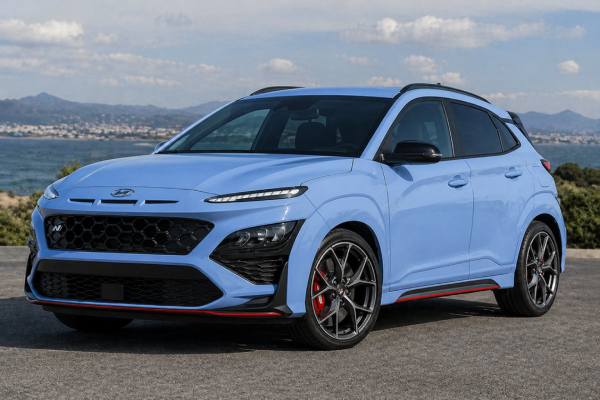

The 2021–2023 Hyundai KONA N is the version that turned the first-generation KONA from a sharp small crossover into a genuine performance model. It uses Hyundai’s 2.0-liter turbocharged direct-injection four-cylinder, front-wheel drive, an electronically controlled limited-slip differential, and an 8-speed wet dual-clutch transmission designed to handle repeated hard use. On paper, that gives it 280 hp and the sort of acceleration normally associated with hot hatchbacks rather than compact SUVs.
In real ownership, though, the KONA N is more than a spec-sheet novelty. It is fast, compact, surprisingly capable on demanding roads, and easier to live with every day than many dedicated performance cars. The trade-off is predictable: tyre wear, brake wear, fuel use, and transmission or fuel-system recall history matter much more here than on a regular KONA. Buy a well-maintained example with complete campaign records, and it remains one of the most distinctive performance crossovers of its class.
Top Highlights
- The 2.0 T-GDi engine, wet 8-speed DCT, and e-LSD give the KONA N genuine hot-hatch pace.
- N-specific suspension, brakes, and tyres make it far more than a cosmetic trim.
- It is still practical enough for daily use, with a usable rear seat and compact footprint.
- The main ownership caution is official recall history for the wet DCT and high-pressure fuel pump.
- A sensible engine-oil interval is every 8,000–10,000 km or 12 months, sooner with track use or short hard trips.
On this page
- Hyundai KONA N facelift character
- Hyundai KONA N specs and hardware
- Hyundai KONA N trim and safety kit
- Known issues, recalls and fixes
- Maintenance plan and buying checks
- Real-world driving and performance
- How the KONA N stacks up
Hyundai KONA N facelift character
The KONA N is unusual because it does not follow the normal performance-SUV formula. Many fast crossovers rely on all-wheel drive, extra mass, and simple straight-line speed. Hyundai went in another direction. The KONA N is front-wheel drive only, but it uses a proper N-engineered chassis, a wet dual-clutch transmission, an electronic limited-slip differential, bigger brakes, dedicated cooling, and sticky 19-inch performance tyres. The result is a car that feels much closer to a tall hot hatch than a typical compact SUV.
That identity matters because it defines both the appeal and the compromises. The KONA N is quick in any context, but its real strength is not just the headline acceleration figure. It is the way the car changes direction, the way the front axle digs in on corner exit, and the way the suspension manages to feel serious without becoming unlivable. Hyundai’s N division gave it adjustable drive modes, launch control, N Grin Shift, N Power Shift, and N Track Sense Shift, but the underlying achievement is simpler: the car feels engineered as a whole.
The engine is the familiar 2.0 T-GDi family unit used in other N models, tuned here to 276 hp in some North American publications and widely described as 280 hp in European-style shorthand. Torque is 392 Nm, and with overboost logic the car can feel even more urgent in short bursts. That means the KONA N never struggles with the basic problem that affects some sporty-looking small SUVs: it always feels appropriately powered.
As a daily car, it is easier to live with than its appearance suggests. The seating position is higher than an i30 N or Veloster N, visibility is decent, and the cargo area remains practical enough for real use. The rear seat is not huge, but it is usable. Cabin layout is also familiar, with physical controls where they matter and an infotainment package that does not feel overly experimental.
The compromises are predictable. Ride quality is firmer than on any regular KONA, especially on poor roads. Tyres are expensive. Fuel economy is secondary. Front-wheel drive means the car relies heavily on tyre quality and front-axle calibration, not brute-force traction from the rear. And because this is a high-output turbo car with a wet DCT, buyers need to care much more about service history and recall completion than they would on a basic small crossover.
That is the core verdict of the KONA N. It is not just an appearance package, and it is not a curiosity. It is a real performance model that happens to wear a small-SUV body, and that is exactly why it still stands out.
Hyundai KONA N specs and hardware
The facelift-era KONA N is defined by its dedicated N hardware. Although it shares the broader OS platform, this is not merely a turbo KONA with larger wheels. The tables below focus on the main North American and global-market technical constants for the 2021–2023 model.
| Item | Specification |
|---|---|
| Code | 2.0 T-GDi N |
| Engine layout and cylinders | Inline-4, DOHC, 16 valves, 4 valves per cylinder |
| Bore × stroke | 86.0 × 86.0 mm (3.39 × 3.39 in) |
| Displacement | 2.0 L (1,998 cc) |
| Induction | Turbocharged |
| Fuel system | Gasoline direct injection |
| Compression ratio | 9.5:1 |
| Max power | 280 hp class (276 hp in some Hyundai U.S. spec sheets, 206 kW) @ 5,500–6,000 rpm |
| Max torque | 392 Nm (289 lb-ft) @ 2,100–4,700 rpm |
| Timing drive | Chain |
| Transmission | N 8-speed wet dual-clutch automatic with paddle shifters |
| Drive type | FWD |
| Differential | N Corner Carving Differential, electronic limited-slip differential |
| Suspension | N-tuned MacPherson strut front / multi-link rear |
| Steering | Rack and pinion with motor-driven power assist; N-specific calibration |
| Brakes | Front ventilated discs about 360 mm (14.2 in), rear discs about 314 mm (12.4 in) |
| Most popular tyre size | 235/40 R19 |
| Wheel size | 19-inch N-specific alloy wheels |
| Item | Specification |
|---|---|
| Length / width / height | 4,215 / 1,800 / 1,565 mm (165.9 / 70.9 / 61.6 in) |
| Wheelbase | 2,600 mm (102.4 in) |
| Ground clearance | Lower than regular KONA trims in practice because of N suspension and tyre package |
| Turning circle | About 10.9 m (35.8 ft) |
| Kerb weight | About 1,510–1,535 kg (3,329–3,384 lb), depending on market and method |
| GVWR | About 1,940 kg (4,277 lb) |
| Payload | Roughly 400 kg class, depending on market and equipment |
| Fuel tank | 50 L (13.2 US gal / 11.0 UK gal) |
| Cargo volume | About 544 L (19.2 ft³) seats up / 1,296 L (45.8 ft³) seats folded, SAE method |
| Acceleration | 0–100 km/h in about 5.5 s; 0–60 mph in 5.4 s with launch control |
| Top speed | 240 km/h (149 mph) |
| Rated efficiency | EPA 20 / 27 / 23 mpg US city / highway / combined, about 11.8 / 8.7 / 10.2 L/100 km |
| Real-world highway @ 120 km/h (75 mph) | Usually around 7.8–8.8 L/100 km in calm conditions, but it climbs quickly with speed and boost use |
| Towing capacity | Not a meaningful selling point for this model |
| Item | Specification |
|---|---|
| Engine oil | Full-synthetic oil meeting Hyundai requirements, commonly 0W-30 or 0W-40 depending on market and use; about 5.0 L (5.3 US qt) |
| Coolant | Long-life coolant for aluminum components; verify by VIN and market |
| Transmission fluid | Wet DCT fluid to exact Hyundai specification; capacity varies by service method |
| Differential | E-LSD system integrated into the N driveline package; service details should be VIN-verified |
| A/C refrigerant | R-1234yf in later official documentation |
| Key torque spec | Wheel nuts: commonly 107–127 Nm (79–94 lb-ft) in Hyundai documentation |
| IIHS | 2022 KONA family crashworthiness results remain strong, though published front crash-prevention details do not map perfectly to every KONA N configuration |
| Headlight rating | KONA family headlight performance varies by lamp type; N-specific night visibility is better than lower halogen setups but should still be judged by actual trim equipment |
| ADAS suite | Forward collision assistance, lane keeping, lane following, blind-spot warning, rear cross-traffic alert, navigation-based smart cruise, and driver-attention functions were part of the N package in many markets |
The important takeaway is that the KONA N’s value is in the combination. Power alone would not make this car special. It is the engine, transmission, differential, tyres, suspension, and cooling package working together that gives it its real identity.
Hyundai KONA N trim and safety kit
One helpful thing about the KONA N is that it is much easier to understand than most KONA variants. Unlike the regular lineup, where equipment can vary sharply across SE, SEL, Limited, N Line, and regional trims, the KONA N is effectively its own full-fat model. That means buyers are not usually comparing a stripped mechanical package with an upscale cosmetic one. The chassis, engine, differential, transmission, brakes, seats, and main N controls are integral to the model.
That does not mean equipment differences disappear entirely. Market differences still matter, and there were small year-to-year adjustments in features, price, and packaging. In North America, the KONA N arrived as a single clearly defined halo trim. Hyundai largely carried the formula forward rather than rewriting it. That consistency helps used buyers because the main questions become condition, recall completion, tyre choice, and whether the car has been modified, not which obscure package box was or was not ticked.
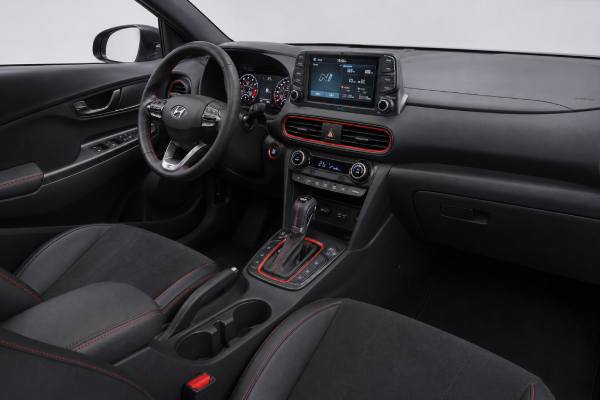
Inside, the KONA N gets the cabin treatment expected of an N model rather than a simple sport appearance pack. N-specific seats, steering wheel, drive-mode controls, pedals, cluster themes, and performance pages are part of the experience. Higher-spec infotainment with navigation, performance displays, and N-specific interior trim also help separate it from the regular KONA range.
The safety story is a little more nuanced. The broader 2018–2023 KONA family has strong crashworthiness credentials in IIHS testing, but not every published IIHS option note maps perfectly onto the KONA N itself. So it is fair to say the KONA platform is strong, but less fair to assume every safety-equipment detail from lower or differently equipped trims applies directly to the N without qualification.
In practice, though, the KONA N was not sold as a bare-bones performance special. It generally included a broad safety suite with forward collision-avoidance assist, lane keeping and lane following support, blind-spot collision warning, rear cross-traffic collision warning, driver attention warning, high beam assist, and smart cruise functions depending on market specification. The real used-market concern is calibration, not availability. Windscreen replacement, front-end repairs, wheel alignment errors, and suspension modifications can all affect how well these systems work.
That is important because many KONA Ns will have lived harder lives than ordinary Konas. A car can look straight, drive quickly, and still have an ADAS system that was never properly recalibrated after repair. Buyers should test all camera and radar-based functions and not treat a warning-light-free dashboard as full proof of health.
For most shoppers, the trim takeaway is simple: there is no “smart cheap version” of the KONA N. Condition is everything. A stock, well-maintained car with correct tyres and complete campaign history is far more desirable than a modified example with a longer equipment list or aftermarket parts.
Known issues, recalls and fixes
The KONA N has a relatively focused reliability profile. It is not defined by a huge list of random weaknesses, but the issues it does have matter because the car runs hotter, works harder, and is more likely to have been driven enthusiastically than a normal KONA. That means buyers should pay close attention to the known official recalls and the usual wear points of a high-output front-drive performance car.
The biggest official issue is the 8-speed wet DCT recall affecting certain 2022 model-year KONA N vehicles. The problem involved the transmission oil pump and related fault logic, with a fail-safe mode that could be triggered in a way that reduced drive power. The factory remedy centered on a TCU software update, and in some cases related parts inspection or replacement depending on diagnosis. For a used buyer, the lesson is straightforward: verify this recall by VIN and ask for dealer confirmation, not just the seller’s word.
The second major official campaign is the later recall covering certain 2022–2023 KONA N vehicles for the high-pressure fuel pump. Hyundai’s recall documents describe wear of the fuel-control-valve plunger inside the HPFP, which can cause an overly rich mixture and lead to hesitation, reduced power, or a loss of motive power at low speeds. Hyundai later issued an ECU update and DTC inspection process as part of the remedy rollout. This is an important point because it affects drivability and safety, and it also means buyers should be wary of cars with unexplained low-speed stumble or fuelling complaints.
Outside recalls, the predictable ownership issues are mostly wear-related:
- Front tyres wear quickly if alignment is off or the car is driven hard.
- Brake pads and front discs can be consumed much faster than regular-KONA owners expect.
- Track or repeated hard-road use can expose weak maintenance habits very quickly.
- Modified cars can suffer from boost leaks, calibration problems, or drivetrain stress.
- Suspension knocks from links, top mounts, or bushings become more likely on poor roads.
- Mixed tyre brands can upset the car’s front-axle balance and traction behavior.
The engine itself is strong when serviced properly, but this is still a turbo direct-injected 2.0-liter performance engine. Poor oil discipline, repeated short hot-cold cycles, and careless tuning are the enemies. Carbon build-up on intake valves is not unique to this car, but it is a long-term factor on any GDI performance engine. Ignition-coil issues, plug wear, and heat-related minor leaks should also be treated as possible age-and-use items rather than shocking failures.
The best way to judge a KONA N is by behavior. A good one should start cleanly, idle smoothly, shift cleanly when hot and cold, track straight, brake hard without vibration, and feel eager rather than messy. If it feels rough at low speed, uncertain under load, or obviously altered, there is usually more to investigate.
Maintenance plan and buying checks
The KONA N rewards preventive maintenance much more than delayed maintenance. That may sound obvious, but it matters more here because this car’s performance envelope is wide enough to expose neglect very quickly. A regular KONA can often hide poor upkeep for a while. A KONA N usually cannot.
A practical ownership plan starts with shorter service intervals than the longest brochure figures imply. Track use, short hot-cold trips, repeated boost, and summer heat all count as severe use. For most owners, conservative servicing is the sensible choice.
| Item | Practical interval |
|---|---|
| Engine oil and filter | Every 8,000–10,000 km or 12 months; shorten further with track use or frequent short hard trips |
| Tyre rotation and inspection | Inspect frequently; performance tyres may wear unevenly and many owners avoid simple front-to-rear rotation because of tread condition and wear pattern |
| Wheel alignment | Check at least annually and after pothole strikes or tyre replacement |
| Cabin air filter | Every 20,000–30,000 km or 12–24 months |
| Engine air filter | Inspect at every service; replace sooner on dusty or heavily driven cars |
| Spark plugs | About 40,000–60,000 km in real-world performance use |
| Brake fluid | Every 2 years; annually if the car sees track days |
| Brake pads and rotors | Inspect at every service; front wear can be rapid on enthusiastic cars |
| Wet DCT fluid and operation | Verify exact service guidance by VIN; inspect operation regularly and be conservative if the car is used hard |
| Cooling system | Inspect carefully for level, seepage, and fan operation; full coolant service per official schedule |
| Timing chain | No routine replacement interval; inspect for noise, stretch symptoms, or timing-correlation faults |
| 12 V battery | Test annually from year 4 onward |
As a used buy, inspection discipline matters. Ask for complete service records, proof of the DCT recall repair path, proof of the HPFP recall remedy, and details of any tuning, intake, exhaust, intercooler, or wheel changes. A stock car is usually the safer bet. If the car is modified, the seller should be able to explain exactly what was done and when.
On a physical inspection, focus on these areas:
- Tyre condition and age, especially the inner shoulders.
- Brake disc lip, cracks, or vibration under hard stops.
- Evidence of front-end damage or repaint.
- Any sign of overheating, coolant residue, or oily boost plumbing.
- Low-speed DCT smoothness when hot and cold.
- Steering-centre accuracy and any torque steer beyond the normal baseline.
- ADAS function after any glass or body repair.
The best KONA N to buy is the one that was enjoyed but not abused: regular oil changes, correct tyres, no bargain modifications, and fully documented campaign work. The cars to avoid are the cheaply modified ones, the ones with mixed tyres, and the ones whose sellers treat recall questions as an inconvenience.
Long-term durability looks good when the car is maintained like a serious performance vehicle. That is the key distinction. Treat it like a fast appliance and costs rise. Treat it like an N model and it usually rewards you.
Real-world driving and performance
The KONA N is fast in the simple sense, but what makes it memorable is the way it deploys that speed. In a straight line, the car feels stronger than most buyers expect from a front-drive crossover. Launch control and the wet DCT help it leave hard, the turbocharged 2.0-liter builds speed quickly, and the mid-range is especially forceful. Hyundai’s N-specific transmission functions are not gimmicks in the purest sense; they genuinely change the urgency of the drivetrain. N Grin Shift gives a short, harder-edged burst, while the transmission’s track-focused logic keeps the car more alert than a regular sporty automatic.
On a demanding road, the chassis is the real surprise. The front end bites well, the e-LSD helps the car pull itself out of tighter corners, and body control is much better than the KONA shape leads many people to expect. There is still the slightly elevated seating position of a small SUV, but the responses are close enough to a hot hatch that most enthusiasts quickly understand the appeal.
Ride quality is firm but not unreasonable. In its softer settings the KONA N can still work as a daily car, though it never truly disguises the 19-inch tyre package and stiff underpinnings. On broken urban roads you feel more of the surface than you would in a normal KONA. On a smooth B-road or motorway, the same setup gives the car a tied-down, confident feel.
Steering weight and response are well judged for a modern electric system. It is not overflowing with delicate feedback, but it is quick, precise, and trustworthy. Braking performance is also strong, with good pedal confidence and useful heat tolerance for spirited driving. Track users still need to monitor pads, fluid, and tyre condition carefully, but the base hardware is serious.
Fuel economy is secondary. Official U.S. figures put the KONA N around 20 mpg city, 27 mpg highway, and 23 mpg combined. In real use, that usually translates to roughly 10–12 L/100 km in mixed driving, better on steady highway runs, and significantly worse if the car is used the way its badges invite. Cold weather, short trips, and repeated full-throttle acceleration can push it well above that range.
Traction is good for a front-drive performance car, but it remains front drive. The tyre package is crucial. On the correct summer tyres in warm conditions, the KONA N feels impressively capable. On cold-weather tyres or mediocre all-seasons, the front axle’s job becomes much harder. That is not a flaw so much as a reminder that the car’s performance depends on its contact patches.
Under load, the KONA N remains composed, but the performance nature of the car means fuel range drops quickly when driven hard. It is not a long-distance economy hero. It is, however, a compact daily that can feel genuinely special on the right road, and that is what gives it its odd but very real charm.
How the KONA N stacks up
The KONA N does not have many direct rivals because most manufacturers approached this class differently. Some made fast small crossovers with all-wheel drive and more weight. Others never made a true performance version at all. That leaves the KONA N in a niche of its own.
Against the Volkswagen T-Roc R, the Hyundai feels more unusual and a little more playful. The Volkswagen offers AWD traction and a broader premium feel, but the KONA N counters with stronger front-axle personality, a more extroverted character, and usually lower used pricing. The Volkswagen is the more rounded fast crossover. The Hyundai is the more distinctive one.
Against the Ford Puma ST, the comparison depends on whether you value body style or chassis purity. The Ford is lower-key, lighter-feeling, and in some ways more playful at sane road speeds. The Hyundai is much faster, more powerful, and more serious in outright pace. The Puma is the scalpel. The KONA N is the heavier hammer that still turns in surprisingly well.
Against the MINI Countryman JCW, the Hyundai generally feels more direct in powertrain response and more performance-focused for the money, while the MINI trades on brand image, cabin style, and AWD traction. The MINI can feel more premium. The Hyundai feels more deliberately engineered for enthusiastic driving.
The most interesting comparison is inside Hyundai’s own N family. A Veloster N or i30 N hatchback is the purer enthusiast choice. They sit lower, feel more obviously performance-led, and are a little less compromised by SUV proportions. The KONA N gives away some purity but gains easier entry, a slightly more relaxed daily-driving stance, and the novelty of being a genuinely quick small crossover without becoming dull.
That last point matters. Many sporty SUVs feel quick but generic. The KONA N has personality. It looks distinctive, sounds purposeful, and behaves like an N car rather than an N-styled trim. It also stays practical enough to justify itself as a single-car solution for some buyers.
Its weaknesses are clear. Front-drive traction is never infinite. Ride quality is firm. Running costs can be much higher than those of a normal KONA. And some buyers will never warm to the idea of a performance crossover on principle.
But within its own logic, the KONA N succeeds. It is compact, fast, engaging, and far more serious than it first appears. For buyers who want something different from the usual hot hatch or all-wheel-drive compact SUV, it remains one of the most memorable choices of its era.
References
- 2022 Kona Specifications 2022 (Product Guide)
- Exhilarating Kona N First Drive Experienced by U.S. Media 2021 (Technical Release)
- 2022 Hyundai Kona 2022 (Fuel Economy)
- Part 573 Safety Recall Report 22V-746 2022 (Recall Database)
- Part 573 Safety Recall Report 24V-528 2024 (Recall Database)
Disclaimer
This article is for informational purposes only and is not a substitute for professional diagnosis, inspection, or repair. Specifications, torque values, service intervals, procedures, and equipment can vary by VIN, market, and model year, so always verify the correct details against the official service documentation for the exact vehicle.
If this guide was useful, please consider sharing it on Facebook, X, or another platform to support our work.