
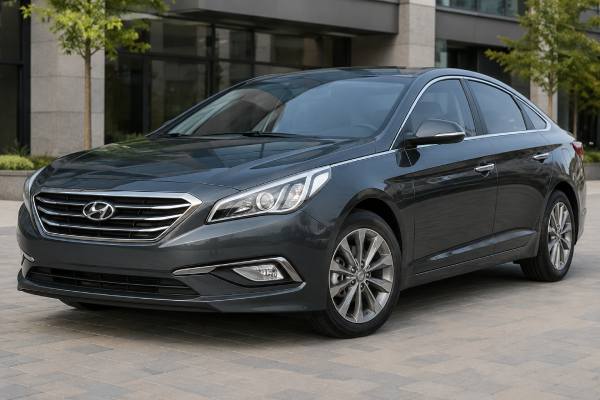
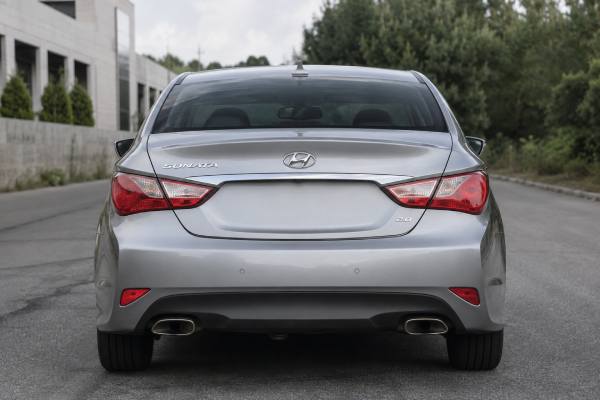
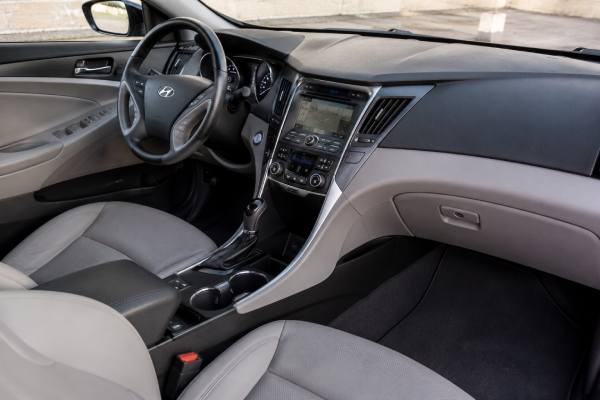
The 2014 Hyundai Sonata YF with the Theta II 2.4 GDi engine is the final-year facelift version of Hyundai’s sixth-generation midsize sedan. It combines a roomy cabin, strong standard equipment, direct-injected four-cylinder power, and good fuel economy, but it also requires careful attention to engine history because this generation is linked to important Theta II engine recall and warranty actions.
This guide focuses on the gasoline 2.4-liter GDi version rated at 190 hp, mainly as sold in North America. It covers the key specifications, trim differences, safety equipment, common reliability concerns, maintenance needs, driving feel, and what to check before buying one used.
Quick Overview
- Spacious cabin and 16.4 cu ft trunk make the Sonata YF unusually practical for a midsize sedan.
- The 2.4 GDi delivers 190 hp and EPA-rated economy of about 24 mpg city, 35 mpg highway, and 28 mpg combined.
- 2014 updates added useful features such as tire-specific TPMS, Driver Selectable Steering Mode, improved NVH measures, and wider rear-camera availability.
- Engine bearing recall history is the biggest ownership caveat; verify VIN recall completion and engine service records before purchase.
- Normal oil service is commonly listed around 7,500 miles or 12 months, but severe use or high-mileage ownership is better served by shorter 3,750–5,000 mile intervals.
Table of Contents
- Sonata YF 2014 Model Guide
- Sonata YF Technical Specs
- Sonata YF Trims and Safety
- Reliability, Issues and Recalls
- Maintenance and Buying Advice
- Driving Feel and Economy
- Rivals and Market Context
Sonata YF 2014 Model Guide
The 2014 Sonata YF is best understood as a polished final update, not a clean-sheet redesign. The YF generation arrived earlier in the decade with Hyundai’s “Fluidic Sculpture” styling, a large-car-like cabin, and a focus on high feature content for the price. For 2014, Hyundai refined the package with new grille treatments, updated wheel designs, available HID xenon headlights, LED taillights, a revised rear fascia insert, improved carpet, added foam in the A- and B-pillars, and an additional dynamic damper to reduce noise, vibration, and harshness.
The model covered here is the naturally aspirated 2.4-liter Theta II GDi four-cylinder version, rated at 190 hp and 179 lb-ft in its standard form. The sportier SE 2.4 used a dual exhaust and was rated slightly higher at 192 hp and 181 lb-ft, but the main 190 hp version is the common reference point for GLS and many Limited models.
This engine uses gasoline direct injection, dual continuously variable valve timing, an aluminum block and head, and a timing chain. It is paired with a six-speed automatic transmission with SHIFTRONIC manual shift control and front-wheel drive. There was no AWD version of this Sonata generation in the U.S. market.
The Sonata’s main strengths are clear:
- A cabin that feels bigger than many midsize rivals.
- Good highway fuel economy from the 2.4 GDi engine.
- Strong standard safety basics for its period.
- Good parts availability and broad independent-shop familiarity.
- A comfortable ride in GLS and Limited trims.
Its weaknesses are also important. The Theta II GDi family has known connecting-rod bearing recall history, so the engine cannot be judged only by mileage or how clean it looks. A well-maintained example with completed campaigns, regular oil changes, no knocking, no oil-pressure warning history, and a clean cold start can still be a useful used sedan. A neglected one can become expensive quickly.
The best buyer profile is someone who wants an affordable family sedan and is willing to verify paperwork carefully. This is not a car to buy casually from a vague seller who cannot show maintenance, recall, and repair history.
Sonata YF Technical Specs
The following figures apply to the 2014 Hyundai Sonata YF 2.4 GDi 190 hp automatic unless noted. Some values vary by trim, market, tires, equipment, and VIN plate.
| Item | Specification |
|---|---|
| Engine family / code | Theta II 2.4 GDi; commonly associated with G4KJ/GDI-family applications by market |
| Layout | Inline-4, aluminum block/head, DOHC, 16 valves, 4 valves per cylinder |
| Bore × stroke | 88.0 × 97.0 mm (3.46 × 3.82 in) |
| Displacement | 2.4 L (2,359 cc) |
| Induction | Naturally aspirated |
| Fuel system | Gasoline direct injection |
| Compression ratio | 11.3:1 |
| Max power | 190 hp (142 kW) @ 6,300 rpm |
| Max torque | 243 Nm (179 lb-ft) @ 4,250 rpm |
| Timing drive | Timing chain |
| EPA rated efficiency | 9.8 / 6.7 / 8.4 L/100 km city/highway/combined; 24 / 35 / 28 mpg US; 28.8 / 42.0 / 33.6 mpg UK |
| Real-world highway at 120 km/h | Typically about 7.4–8.3 L/100 km (28–32 mpg US / 34–38 mpg UK), depending on tires, wind, load, and terrain |
| Item | Specification |
|---|---|
| Transmission | 6-speed automatic with SHIFTRONIC; A6-family Hyundai/Kia automatic |
| Drive type | Front-wheel drive |
| Differential | Open front differential |
| Front suspension | MacPherson strut with stabilizer bar |
| Rear suspension | Multi-link independent rear suspension |
| Steering | Motor-driven electric power steering; Driver Selectable Steering Mode on 2014 models |
| Brakes | Four-wheel disc brakes; approx. 300 mm (11.8 in) front and 284 mm (11.2 in) rear rotors |
| Common tire sizes | 205/65R16, 215/55R17, and 225/45R18 depending on trim/package |
| Ground clearance | Approx. 135–140 mm (5.3–5.5 in) |
| Length / width / height | 4,820 / 1,835 / 1,470 mm (189.8 / 72.2 / 57.9 in) |
| Wheelbase | 2,794–2,795 mm (110.0 in) |
| Turning circle | 10.9 m (35.8 ft), curb-to-curb |
| Curb weight | Approx. 1,450–1,555 kg (3,200–3,430 lb), depending on trim and equipment; common published figure: 1,472 kg (3,245 lb) |
| GVWR | Approx. 1,950 kg (4,300 lb); verify on VIN certification label |
| Fuel tank | 70 L (18.5 US gal / 15.4 UK gal) |
| Cargo volume | 464 L (16.4 ft³), trunk; sedan body, no seats-down cargo rating in the hatchback sense |
| Item | Typical figure |
|---|---|
| 0–100 km/h (0–62 mph) | About 9.0–9.5 seconds, depending on trim, tires, load, and test method |
| Top speed | Approx. 205–210 km/h (127–130 mph), market dependent |
| 100–0 km/h braking | About 39–42 m (128–138 ft) with good tires and brakes |
| Towing capacity | Not generally promoted or rated for towing in U.S. passenger-car use; check local owner documentation before towing |
| Payload | Approx. 470–500 kg (1,035–1,100 lb), depending on VIN label and equipment |
| System | Specification / capacity |
|---|---|
| Engine oil | API SL or later suitable gasoline oil; common viscosities 5W-20 or 5W-30 depending on climate and manual; approx. 5.0 L (5.3 US qt) with filter for many 2014 2.4 GDi listings |
| Coolant | Ethylene-glycol based long-life coolant, typically 50/50 premix; approx. 6.6–7.0 L (7.0–7.4 US qt) |
| Automatic transmission fluid | Hyundai/Kia SP-IV type ATF; total fill approx. 7.1 L (7.5 US qt), drain/refill amount varies |
| Differential / transfer case | Not applicable; FWD transaxle has integrated differential |
| Brake fluid | DOT 3 brake fluid; DOT 4 may be acceptable when compatible and specified by service documentation |
| A/C refrigerant | R-134a; 2014 YF 2.4 service data commonly lists 650 ± 25 g (22.9 ± 0.88 oz) |
| A/C compressor oil | PAG oil; commonly around 150–160 mL (about 5.1–5.4 fl oz) total system amount, but verify by compressor label |
| Key torque values | Wheel nuts approx. 88–107 Nm (65–79 lb-ft); engine oil drain plug approx. 39 Nm (29 lb-ft); confirm by VIN service data |
Safety data is mixed but generally strong for its era. NHTSA lists the 2014 Sonata with a 5-star overall rating in the U.S. program. IIHS testing for 2011–2014 Sonata models shows Good ratings in moderate overlap front, side, roof strength, and head restraints, but the small-overlap front result was Marginal. IIHS headlight ratings were not part of the 2014 Sonata test era.
Sonata YF Trims and Safety
The 2014 Sonata 2.4 GDi was offered mainly in GLS, SE, and Limited forms in the U.S. market. Exact names and equipment vary by country, but the general pattern is easy to follow.
GLS is the value-oriented trim. It commonly includes the 190 hp 2.4 GDi engine, six-speed automatic transmission, cloth seating, alloy wheels, Bluetooth, keyless entry, stability control, ABS, side-curtain airbags, and the core safety equipment. The Popular Equipment Package is especially desirable because it brought useful everyday features such as a rearview camera and driver’s blind-spot mirror on many cars.
SE is the sportier trim. On the 2.4 version, it is the one to check if you want a firmer chassis, 18-inch wheels, sport-tuned suspension, and the dual-exhaust version rated slightly above the standard 190 hp tune. The tradeoff is ride comfort. SE cars can feel sharper on smooth roads but less settled over broken pavement, and 18-inch tires are more expensive.
Limited is the comfort trim. It commonly adds leather upholstery, automatic climate control, higher-grade audio and infotainment options, upgraded interior trim, and broader safety/convenience availability. For many used buyers, a well-kept Limited 2.4 is the best balance because it avoids the 2.0T’s extra complexity while still feeling well equipped.
Useful trim identifiers
Quick checks can help confirm what you are looking at:
- GLS: usually smaller wheels, cloth interior, simpler audio, and fewer exterior sport details.
- SE: 18-inch wheel package, sportier trim, firmer suspension tuning, and dual exhaust on 2.4 models.
- Limited: leather seating, more bright exterior trim, higher audio/navigation availability, automatic climate control, and broader blind-spot system availability.
- 2.4 GDi badge/engine bay: naturally aspirated four-cylinder layout, no turbocharger plumbing.
- VIN and build label: essential for confirming production date, market, restraint system, and campaign eligibility.
Safety systems and ADAS
Standard safety equipment is good for a 2014 midsize sedan. Expect front airbags, front seat-mounted side airbags, side-curtain airbags, active front head restraints, three-point belts for all seating positions, front pretensioners and load limiters, LATCH lower anchors for outboard rear seats, ABS, electronic brake-force distribution, brake assist, electronic stability control, traction control, and tire-pressure monitoring.
For 2014, tire-specific TPMS was a useful improvement because it identifies the low tire rather than only showing a general warning. Blind Spot Detection was newly available, standard on Limited and available through the Premium Package on some SE models. A rearview camera became much easier to find, especially on GLS Popular Equipment, SE, and Limited cars.
Modern driver-assistance features are limited. Do not expect automatic emergency braking, adaptive cruise control, lane keeping assist, traffic-sign recognition, or cyclist/pedestrian AEB on this YF-generation car. If a windshield, bumper, mirror, or camera-related component has been replaced, there is less calibration complexity than on newer ADAS-heavy vehicles, but parking camera, blind-spot sensors, and TPMS still need proper diagnosis when faults appear.
Reliability, Issues and Recalls
The 2014 Sonata 2.4 GDi can be dependable, but its reliability reputation is dominated by Theta II engine concerns. A buyer should treat recall completion and oil-change history as must-have evidence, not nice extras.
| Issue | Prevalence | Severity / cost | Typical signs | Best response |
|---|---|---|---|---|
| Connecting-rod bearing wear / engine recall history | Known high-profile issue | High | Cold or warm knock, oil-pressure light, hesitation, check-engine light, stalling | VIN recall check, dealer records, engine noise inspection, compression/oil consumption review |
| Oil consumption or low oil between services | Occasional to common with age | Medium to high | Low dipstick reading, rattling on start, catalytic converter smell, blue smoke in severe cases | Document usage, shorten oil intervals, inspect PCV system, perform leak-down/compression tests if needed |
| GDI intake-valve carbon buildup | Occasional | Medium | Rough idle, misfire codes, hesitation, reduced economy | Diagnosis first; walnut blasting or intake cleaning when confirmed |
| Six-speed automatic shift flare or harsh shifts | Occasional | Medium | Delayed engagement, flare during 2–3 or 3–4 shifts, bump on downshift | Check ATF condition, scan for codes, update/adaptation check, service fluid with correct SP-IV ATF |
| Steering clunk / coupler wear | Common on aging Hyundai/Kia EPS systems | Low to medium | Knock through wheel over small bumps, play near center | Inspect intermediate shaft, rack, and EPS coupling components |
| Suspension wear | Common with mileage | Low to medium | Clunks, uneven tire wear, wandering, harshness | Inspect struts, sway links, control-arm bushings, ball joints, and alignment |
| Brake pulsation / rear brake corrosion | Common in salt climates | Low to medium | Steering shake under braking, rear drag, uneven pad wear | Service slide pins, inspect calipers, replace pads/rotors as needed |
Engine recall and service actions
The central recall issue involves certain 2013–2014 Sonata vehicles equipped with 2.0L and 2.4L GDi engines. The concern is residual machining debris that may restrict oil flow to main bearings and lead to premature bearing wear. A worn connecting-rod bearing can create a cyclic knocking noise, illuminate warning lights, reduce power, or lead to engine stall.
For buyers, the practical checks are simple but non-negotiable:
- Run the VIN through official Hyundai and NHTSA recall tools.
- Ask for proof of Recall 162 inspection or repair.
- Confirm whether the engine was replaced, inspected only, or never presented.
- Ask whether any later engine-related service campaigns, knock-sensor updates, or warranty-extension work were performed.
- Start the engine cold and listen for lower-end knock before any test drive.
- Check the dipstick before and after the drive.
- Walk away from a car with an oil-pressure warning history unless a proper repair is documented.
A completed recall does not automatically make every engine perfect. It does, however, show that the car entered the official process. A car with no records and a vague seller is a much higher risk.
Other recalls to verify
Common recall areas for this generation include the engine campaign, front seat-belt anchor/pretensioner linkage campaigns, shift-cable attachment concerns, and fuel-pipe inspection or replacement related to some engine repair procedures. The exact applicability depends on VIN, production date, prior repairs, and market.
The safest approach is to request a dealer printout showing open and completed recalls. A clean seller should not object.
Pre-purchase inspection priorities
A good inspection should include:
- Cold-start engine noise check.
- OBD scan, including pending codes.
- Oil level and oil condition check.
- Visual leak inspection around valve cover, timing cover, oil pan, and filter housing.
- Cooling-system pressure check if coolant smell or loss is present.
- Transmission engagement test from Park to Drive and Reverse.
- Highway test for torque-converter lockup smoothness.
- Steering clunk check over small bumps.
- Undercarriage inspection for corrosion around rear suspension arms, brake lines, subframe seams, and exhaust hangers.
- Tire wear reading to detect alignment or suspension issues.
- Confirmation that all keys, infotainment functions, camera, TPMS, and blind-spot warnings operate correctly.
Maintenance and Buying Advice
Maintenance quality matters more than trim level on the 2014 Sonata 2.4 GDi. Because this engine family has bearing-history sensitivity, long oil intervals, low oil level, cheap filters, and ignored warning lights are major red flags.
| Item | Recommended interval | Notes |
|---|---|---|
| Engine oil and filter | Normal: about 7,500 miles / 12 months; severe: 3,750 miles / 6 months | For older Theta II GDi cars, many cautious owners use 3,750–5,000 mile intervals and check level every 1,000 miles |
| Engine air filter | Inspect around 15,000 miles; replace around 30,000 miles or sooner in dust | A dirty filter can affect throttle response and economy |
| Cabin air filter | Every 15,000 miles or yearly | Replace sooner in dusty or pollen-heavy areas |
| Spark plugs | About 97,500–105,000 miles depending on manual/market | Use correct iridium plugs and torque carefully |
| Coolant | Initial service around 120,000 miles / 10 years; then shorter follow-up intervals | Inspect hoses, radiator, cap, thermostat, and water pump at each major service |
| Automatic transmission fluid | Often listed as inspect/replace under severe use around 60,000 miles | A drain-and-fill with correct SP-IV fluid is wise on high-mileage cars with unknown history |
| Brake fluid | Every 2–3 years | Moisture-contaminated fluid affects ABS components and braking consistency |
| Brake pads/rotors | Inspect every 7,500–15,000 miles | Clean and lubricate slide pins, especially in winter-salt areas |
| Tire rotation | Every 7,500 miles | Shorten interval if front tires feather or wear shoulders |
| Wheel alignment | Check yearly or after impacts/tire wear | Important on SE 18-inch tire packages |
| Serpentine belt and hoses | Inspect at every service; often due around 90,000–120,000 miles | Replace early if cracking, glazing, swelling, or coolant seepage appears |
| Timing chain | No routine replacement interval | Inspect if rattling, cam/crank correlation faults, poor oil history, or guide/tensioner symptoms appear |
| 12V battery | Test yearly after 3 years; replacement often 3–5 years | Weak batteries can create misleading electrical faults |
Which examples to seek
The best used Sonata YF 2.4 is not necessarily the lowest-mileage car. A 120,000-mile car with complete oil records, completed campaigns, clean cold starts, fresh ATF service, good tires, and no rust can be better than a 75,000-mile car with missing history.
Look for:
- One- or two-owner history.
- Regular oil changes with dates and mileage.
- Dealer documentation for recall and campaign completion.
- No engine knock, no oil-pressure warning, and no unexplained engine replacement story.
- Smooth transmission engagement.
- Clean underbody in salt states.
- Matching quality tires.
- Working rear camera, TPMS, climate control, and blind-spot system if equipped.
Be cautious with:
- “Just needs a sensor” check-engine-light cars.
- Cars sold right after an oil-pressure or knocking complaint.
- Freshly cleared OBD monitors.
- Very dark oil with no service sticker.
- Cheap mismatched tires on SE 18-inch wheels.
- Strong fuel smell after engine work.
- Transmission flare or delayed reverse engagement.
- Heavy corrosion around suspension mounting points.
Long-term outlook
A sorted 2014 Sonata 2.4 GDi can still be a practical commuter and family sedan. Parts are available, independent mechanics know the platform, and the body is roomy without being difficult to park. The ownership verdict depends heavily on engine condition. Buy the maintenance history, not just the trim badge.
Driving Feel and Economy
The 2.4 GDi Sonata is not a sport sedan, but it feels more energetic than many older naturally aspirated four-cylinder midsize cars. The engine’s 190 hp rating gives it enough power for normal commuting, merging, and passing when the transmission is allowed to downshift. It prefers revs for stronger acceleration, so quick highway passes often need a firm throttle input.
At low speeds, throttle response is generally clean, though high-mileage cars with carbon buildup, old spark plugs, tired mounts, or outdated transmission adaptation can feel less smooth. The six-speed automatic is usually calm in light driving. It shifts early for economy, then kicks down decisively when asked. A healthy unit should not bang into gear, flare badly, or hesitate for several seconds when shifting from Park to Drive or Reverse.
Ride quality depends strongly on trim. GLS and Limited cars on 16- or 17-inch tires are the most comfortable. They absorb typical city pavement well and suit the car’s relaxed character. SE models with 18-inch wheels and firmer suspension feel more responsive, but rough pavement can make them busier and noisier.
Steering is electrically assisted and the 2014 Driver Selectable Steering Mode gives Comfort, Normal, and Sport settings. Comfort is light for parking. Normal is the best all-around setting. Sport adds weight but does not turn the Sonata into a highly communicative driver’s car. The system is useful, but it is more about effort than true road feel.
Highway stability is good. The long wheelbase, wide cabin, and added 2014 NVH improvements help the car feel settled. Wind and tire noise are reasonable for the class, though cheap replacement tires can make a large difference. Rear-seat comfort is a strong point, but the sloping roofline can reduce headroom for taller passengers.
Real-world fuel economy is one of the Sonata’s better traits. In city use, expect roughly 9.5–11.5 L/100 km (20–25 mpg US / 24–30 mpg UK), depending on traffic and trip length. Mixed driving often lands around 8.0–9.0 L/100 km (26–29 mpg US / 31–35 mpg UK). At steady highway speeds near 100–120 km/h, a healthy car can return about 6.7–8.3 L/100 km (28–35 mpg US / 34–42 mpg UK). Cold weather, short trips, underinflated tires, roof loads, and aggressive acceleration reduce those numbers quickly.
The brakes are adequate for daily use. Pedal feel is straightforward, but brake performance depends heavily on rotor condition, pad quality, and tire grip. If the car shudders under braking, assume it needs inspection rather than writing it off as “normal Sonata behavior.”
Rivals and Market Context
The 2014 Sonata YF competed with some of the strongest midsize sedans of the period: Toyota Camry, Honda Accord, Nissan Altima, Ford Fusion, Chevrolet Malibu, and Volkswagen Passat. Its strongest selling points were cabin space, styling, standard horsepower, warranty coverage when new, and feature value.
| Model | Typical base engine | Character | Sonata advantage | Rival advantage |
|---|---|---|---|---|
| Hyundai Sonata YF 2.4 GDi | 2.4L I4, 190 hp | Roomy, value-focused, strong equipment | Power, cabin/trunk space, features | Engine recall history hurts confidence |
| Toyota Camry 2.5 | 2.5L I4, about 178 hp | Soft, simple, durable | Sonata feels more stylish and powerful | Camry has stronger resale and reliability reputation |
| Honda Accord 2.4 | 2.4L I4, about 185 hp | More precise, efficient, roomy | Sonata may be cheaper used with more features | Accord is usually better to drive and easier to recommend long-term |
| Nissan Altima 2.5 | 2.5L I4, about 182 hp | Efficient, light, CVT-focused | Sonata avoids Nissan CVT concerns | Altima can be very fuel-efficient on highway |
| Ford Fusion 2.5 | 2.5L I4, about 175 hp | Stylish, solid chassis | Sonata has stronger standard output and larger trunk | Fusion has more European-feeling handling |
| Chevrolet Malibu 2.5 | 2.5L I4, about 196 hp | Quiet, substantial, conservative | Sonata feels roomier and often better equipped | Malibu can feel quieter and more solid |
For most used buyers, the Accord and Camry are safer default choices if budget allows. The Sonata becomes attractive when it is priced meaningfully lower, has better equipment, and comes with stronger documentation. Compared with an Altima of the same age, the Sonata’s conventional automatic can be a major advantage. Compared with Fusion and Malibu, the Sonata’s cabin space and parts availability are strong points.
The best way to view the 2014 Sonata 2.4 GDi is as a high-value used sedan with one major due-diligence requirement. It offers plenty of space, good economy, and useful equipment, but the engine history must be verified. When the records are right, it can be a sensible purchase. When the records are missing, the risk is too high unless the price leaves room for serious repairs.
References
- MAJOR UPDATE FOR 2014 HYUNDAI SONATA DELIVERS NEW LEVELS OF REFINEMENT, SAFETY AND TECHNOLOGY 2013 (Manufacturer Specifications)
- 2014 Hyundai Sonata 2014 (Safety Rating)
- Vehicle Detail Search – 2014 HYUNDAI SONATA 4 DR page_view_event 2014 (Safety Rating / Recall Database)
- Part 573 Safety Recall Report 17V-226 2017 (Recall Database)
- VIN Validation 2017 (Recall Verification)
Disclaimer
This article is for informational purposes only and is not a substitute for professional diagnosis, repair, inspection, or official service documentation. Specifications, torque values, fluid capacities, service intervals, recall applicability, and procedures can vary by VIN, market, production date, trim, and equipment. Always verify critical information against the official owner’s manual, service manual, VIN label, under-hood labels, and dealer service records before making repair or purchase decisions.
If this guide helped you, please consider sharing it on Facebook, X/Twitter, or your preferred automotive community to support our work.