
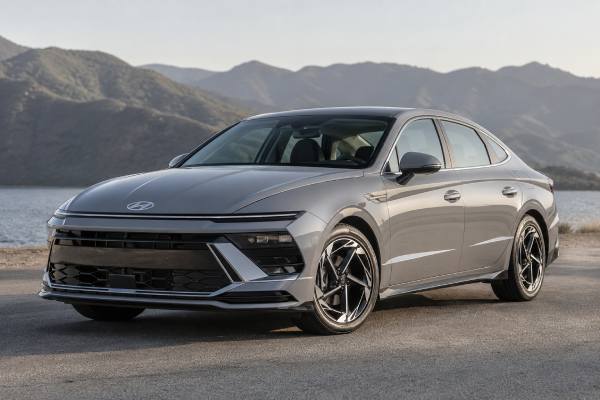
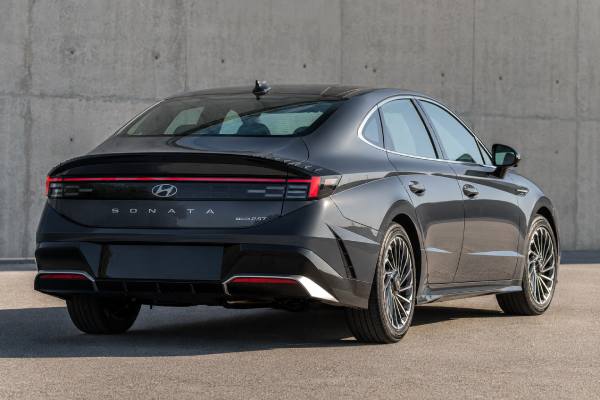
The facelifted Hyundai SONATA HTRAC AWD is the all-wheel-drive version of the DN8 Sonata introduced for the 2024 model year. It combines Hyundai’s naturally aspirated Smartstream 2.5-liter gasoline engine, an 8-speed torque-converter automatic transmission, and HTRAC all-wheel drive in a midsize sedan body that is otherwise known for space, comfort, technology, and strong safety equipment.
This version is aimed at drivers who want sedan comfort but live with snow, rain, steep driveways, or low-traction roads. It is not the fastest Sonata and it is not the most fuel-efficient one, but it fills a useful middle ground: easier winter confidence than the front-wheel-drive gas model, lower complexity than a hybrid, and better everyday refinement than many crossover alternatives.
Final Verdict
The 2024–present Hyundai SONATA HTRAC AWD with the 191 hp Smartstream 2.5 GDi is a good choice for buyers who want a comfortable, spacious midsize sedan with added all-weather traction and modest running costs. Its strongest appeal is the rare combination of conventional gasoline power, a smooth 8-speed automatic, and AWD in a segment where many rivals are FWD-only or hybrid-only. The main tradeoff is performance and economy: it feels adequate rather than quick, and AWD lowers mpg slightly. Buy one only with completed recall/software updates, clean service records, correct tires, and evidence that the AWD driveline has not been neglected.
| Pros | Cons |
|---|---|
| HTRAC AWD adds winter confidence missing from FWD Sonatas | AWD reduces fuel economy versus the FWD 2.5L model |
| 2.5L naturally aspirated engine avoids turbocharger complexity | Acceleration is adequate, not sporty, despite the large sedan body |
| 8-speed automatic is smoother than many rival CVTs | AWD adds rear coupling and driveline service considerations |
| Roomy cabin, large trunk, and strong standard safety tech | Rear-seat legroom trails some newer midsize sedan rivals |
| 2025–2026 safety updates improve crash-rating position | Early 2024 cars need recall completion verified by VIN |
Table of Contents
- DN8 Sonata AWD Overview
- SONATA HTRAC AWD Specifications
- Trims, Safety and Driver Assistance
- Reliability, Issues and Service Actions
- Maintenance and Buying Guide
- Driving, Performance and Efficiency
- How the Sonata AWD Compares
DN8 Sonata AWD Overview
The SONATA HTRAC AWD is best understood as the practical all-weather Sonata, not the performance Sonata. It uses the naturally aspirated 2.5-liter Smartstream engine and a conventional 8-speed automatic, while the HTRAC system adds rear-wheel assistance when traction or stability demands it.
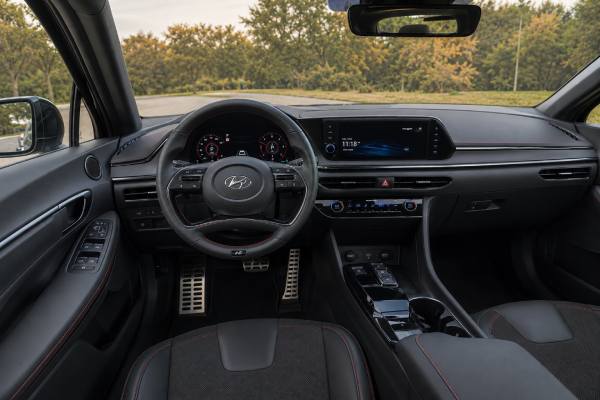
The facelifted DN8 arrived for 2024 with a much wider-looking front end, a full-width light signature, a cleaner interior layout, and a panoramic dual-screen dashboard design. The AWD option was one of the most important mechanical changes, because previous North American DN8 Sonata models were front-wheel drive only. That gives this version a specific role: a sedan for drivers who like the Sonata’s lower seating position and highway manners but do not want to move into a Tucson, Santa Fe, or other crossover just to get AWD.
The engine is not turbocharged. That matters for ownership. The Smartstream G2.5 GDi/MPI engine uses both gasoline direct injection and multi-port injection, which helps balance efficiency, emissions control, and intake-valve cleanliness better than a direct-injection-only setup. Output is 191 hp and 181 lb-ft, enough for commuting, highway merging, and family use, but the car is tuned for smoothness rather than urgency.
HTRAC AWD is also not a rally-style or off-road system. It is an on-demand road-car AWD system designed to improve traction in rain, snow, and mixed-grip conditions. Most owners will notice it most during low-speed starts, snowy intersections, wet highway ramps, and uneven winter roads. It does not turn the Sonata into an SUV, and ground clearance remains sedan-like.
The main buyer decision is whether the AWD benefit is worth the extra weight, slightly lower fuel economy, and added driveline complexity. For a warm-climate driver who mainly uses highways, the FWD 2.5L or hybrid Sonata may make more financial sense. For a driver in the Northeast, Midwest, Canada, mountain towns, or any area with frequent winter weather, the AWD version has a much clearer purpose.
SONATA HTRAC AWD Specifications
This Sonata uses Hyundai’s 2.5-liter Smartstream gasoline four-cylinder, an 8-speed automatic transmission, and HTRAC all-wheel drive. The AWD version is tied to the mainstream 2.5L engine, not the 290 hp N Line turbo engine or the hybrid powertrain. The most important technical points are the engine’s dual-injection design, the conventional automatic gearbox, the sedan’s generous cabin volume, and the model-year fuel-economy change for 2026 SEL Sport AWD.
| Item | Specification |
|---|---|
| Engine family | Smartstream G2.5 GDi + MPi gasoline inline-four |
| Displacement | 2,497 cc / 2.5L |
| Valvetrain | DOHC, 16 valves, CVVT |
| Bore × stroke | 88.5 × 101.5 mm |
| Compression ratio | 13.0:1 |
| Maximum power | 191 hp / 142 kW at 6,100 rpm |
| Maximum torque | 181 lb-ft / 245 Nm at 4,000 rpm |
| Fuel type | Regular unleaded gasoline |
| 2024–2025 AWD fuel economy | 25 city / 34 highway / 28 combined mpg US |
| 2026 SEL Sport AWD fuel economy | 24 city / 33 highway / 27 combined mpg US |
| Item | Specification |
|---|---|
| Transmission | Smartstream 8-speed automatic with torque converter |
| Drive type | HTRAC all-wheel drive |
| Driveline layout | Front transverse engine with electronically controlled rear assistance |
| Shift control | Electronic automatic with drive-mode integration |
| Towing rating | Trailer towing not recommended |
| Item | Specification |
|---|---|
| Body style | Four-door midsize sedan |
| Seating | Five passengers |
| Length | 4,910 mm / 193.3 in |
| Width | 1,859 mm / 73.2 in, mirrors excluded |
| Height | 1,445 mm / 56.9 in |
| Wheelbase | 2,840 mm / 111.8 in |
| Ground clearance | 135 mm / 5.3 in |
| Passenger volume | 104.4 cu ft / about 2,956 L |
| Trunk capacity | 15.6 cu ft / about 442 L |
| Fuel tank | 15.9 US gal / about 60 L |
| Item | Specification or note |
|---|---|
| Front suspension | MacPherson strut with stabilizer bar |
| Rear suspension | Multi-link with stabilizer bar |
| Steering | Motor-driven rack-and-pinion power steering |
| Turning circle | 35.9 ft / about 10.9 m |
| Common AWD tire size | 17-inch or 18-inch package, depending on model year and trim |
| Engine oil capacity | 5.9 US qt listed for the 2.5L in Hyundai specifications |
| Brake fluid | DOT 4 specification |
Trims, Safety and Driver Assistance
The AWD Sonata is usually positioned as a mainstream trim rather than a luxury or performance trim. In the U.S., 2024–2025 AWD availability centered on SEL AWD, while 2026 moved the AWD gas model into SEL Sport AWD with 18-inch wheels and a slightly lower EPA rating.
For 2024, the facelifted lineup simplified the gasoline range. The 2.5L SEL sat below the N Line and the hybrid trims, with AWD available on the 2.5L SEL. For 2025, Hyundai reintroduced more trim spread in the broader Sonata lineup, including SE and SEL Convenience in some markets, but AWD remained tied to the non-turbo 2.5L mainstream trim rather than the hybrid or N Line. For 2026, the SEL Sport AWD name is important because many listings will identify the AWD car that way.
Key identifiers include:
- HTRAC or AWD listing language on the window sticker, dealer listing, or build sheet.
- 2.5L non-turbo engine rather than the N Line’s 2.5T turbo.
- 8-speed automatic rather than the N Line wet dual-clutch or hybrid 6-speed automatic.
- AWD-specific VIN/build data, which matters for parts, tires, alignments, and driveline service.
- Wheel package differences, especially 17-inch versus 18-inch wheels depending on year and trim.
The facelifted cabin is a major selling point. Most versions include a wide digital display layout, large infotainment screen, wireless phone integration on newer trims, dual-zone climate control on many configurations, heated front seats on SEL-level cars, and a hands-free smart trunk. Higher trims outside this exact AWD gas scope may add ventilated seats, surround-view camera, premium audio, leather seating, or hybrid-only features, but buyers should not assume those features are present on an AWD listing.
Safety equipment is strong for the class. Standard or widely available driver-assistance systems include forward collision-avoidance assist with pedestrian and cyclist detection, lane keeping assist, lane following assist, driver attention warning, blind-spot warning, rear cross-traffic collision-avoidance assist, safe exit warning, high beam assist, stability control, traction control, ABS, and tire-pressure monitoring. Smart cruise control and Highway Driving Assist availability depend on trim and market.
The structure also changed during this facelift period. IIHS notes that 2024 models received side-impact reinforcements, and later 2025 production added rear-seat and seatbelt modifications that improved the updated moderate-overlap crash result. That makes build date relevant. A 2025 Sonata built after November 2024 may not be equivalent to an early 2025 car for every crash-test category.
For families, the Sonata includes LATCH lower anchors for two rear seating positions and top tether anchors for three rear positions. The rear door opening and sedan roofline are less convenient than a crossover for installing bulky rear-facing seats, but the rear bench is usable and the trunk is large enough for strollers, luggage, and daily cargo.
ADAS calibration is a practical ownership point. After windshield replacement, front-end collision repair, radar work, suspension work, or wheel alignment correction, camera and radar systems may need calibration. A cheap windshield or incomplete calibration can create lane-keeping, automatic braking, adaptive cruise, or warning-light problems that are not really “electrical faults” in the car itself.
Reliability, Issues and Service Actions
The 2024–present SONATA HTRAC AWD is still relatively new, so long-term high-mileage data is limited. The best reliability outlook is cautiously positive: the non-turbo 2.5L engine and conventional 8-speed automatic are less complex than the turbo N Line powertrain, but the AWD system adds parts that FWD Sonatas do not have.
| Area | Prevalence | Severity | What to watch for |
|---|---|---|---|
| Software or recall updates | Occasional | Low to medium | Open campaigns, warning lights, incomplete dealer records |
| 12V battery weakness | Occasional | Low | Slow cranking, warning messages, intermittent electronics |
| Brake wear or corrosion | Occasional | Low to medium | Pulsation, scraping after storage, uneven rotor surfaces |
| AWD coupling or rear driveline wear | Rare so far | Medium | Binding, vibration, rumble, mismatched tire wear |
| Oil consumption or leaks | Rare so far | Medium | Low oil level, burning smell, timing-cover seepage |
The most important known service action for early facelift cars is the 2024 recall related to the Emergency Stop Signal brake-light logic. Certain 2024 Sonata DN8 vehicles produced from October 18, 2023, through June 12, 2024, could have brake lights that flash incorrectly during heavy braking above 30 mph. The remedy is an ESC software update, and some vehicles may receive the update over the air while others require dealer programming. A buyer should verify completion by VIN, not by model year alone.
The engine itself has several strengths. The naturally aspirated layout avoids turbo heat, turbo oil-feed lines, wastegate hardware, and high boost pressure. The dual GDi/MPI injection strategy also helps reduce one of the classic direct-injection concerns: intake-valve carbon accumulation. That does not mean the engine is maintenance-free. It still needs correct oil, high-quality fuel, regular air-filter replacement, and attention to coolant leaks or overheating.
Potential symptoms and remedies include:
- Rough idle or misfire: check spark plugs, ignition coils, fuel quality, intake leaks, and software updates.
- Oil level dropping between services: document consumption, inspect for leaks, and shorten oil intervals if driving is mostly severe service.
- Harsh or delayed shifting: verify transmission adaptation/software status before assuming mechanical failure.
- AWD vibration or binding: inspect tire size matching, tread-depth differences, rear coupling operation, and driveline mounts.
- ADAS faults after glass or body repair: confirm proper calibration and correct replacement parts.
The HTRAC system is sensitive to tire condition. All four tires should match by size, brand/model, load rating, speed rating, and tread depth as closely as practical. Running one new tire with three worn tires can stress AWD components over time because the system sees small rolling-circumference differences. On an AWD sedan, tire discipline is a reliability item, not just a handling preference.
Corrosion risk depends heavily on climate. In salted regions, inspect rear suspension arms, subframe areas, brake lines, fasteners, wheel hubs, and the lower body seams. The Sonata is not especially known as a rust-prone new platform, but winter-driven AWD examples naturally spend more time in the conditions that accelerate corrosion.
Maintenance and Buying Guide
The best Sonata AWD to buy is one with complete records, matching tires, no open recalls, and evidence of regular oil changes. The 2.5L AWD car should be relatively straightforward to maintain, but it should not be treated like a front-wheel-drive sedan with no rear driveline hardware.
| Service item | Suggested interval | Practical note |
|---|---|---|
| Engine oil and filter | 8,000 mi / 12 months normal use | Use the correct Hyundai-approved full synthetic oil specification |
| Severe-use oil service | About 5,000 mi / 6 months | Best for short trips, cold starts, heat, dust, or heavy city use |
| Tire rotation | 8,000 mi / 12 months | More important on AWD; keep tread depths closely matched |
| Cabin air filter | 16,000 mi / 24 months | Replace sooner in dusty, humid, or high-pollen areas |
| Engine air filter | Inspect regularly; replace around 24,000–32,000 mi | Dusty roads shorten the interval significantly |
| Brake fluid | Inspect yearly; replace about every 48,000 mi / 48 months | Use DOT 4 fluid and avoid moisture contamination |
| Coolant | First major replacement around 120,000 mi / 120 months | Afterward, shorter repeat intervals are typical |
| Spark plugs | Around 96,000 mi | Use correct OEM-equivalent plugs; replace sooner for misfires |
| Drive belt and hoses | Inspect from mid-mileage onward | Look for cracks, swelling, glazing, seepage, or noise |
| AWD rear driveline fluids | Inspect/service per VIN-specific service data | Shorten interval after water exposure or severe winter use |
| 12V battery | Test yearly after year three | Modern electronics are sensitive to weak battery voltage |
The engine uses a timing chain, not a routine timing belt. That means there is no scheduled belt replacement in normal service, but chain systems still need healthy oil. Chain stretch, guide wear, tensioner problems, or timing-correlation faults are usually symptoms of wear, poor lubrication history, or defects rather than normal scheduled service items. Listen for cold-start rattle, check for cam/crank correlation codes, and avoid extending oil intervals beyond the manual.
The buyer checklist should include:
- VIN recall check through Hyundai or NHTSA.
- Proof of the 2024 ESS/ESC recall update when applicable.
- Oil-change records with correct viscosity/specification.
- Matching tires with even tread depth.
- No AWD vibration, binding, or rear driveline noise.
- No warning lights after a cold start and full test drive.
- Clean windshield-camera and radar operation.
- Smooth automatic shifts from cold and hot.
- No coolant smell, oil leaks, or underbody impact damage.
- Clear title history and no poorly repaired front-end collision.
Recommended years depend on price. A clean 2024 SEL AWD can be a strong used value if the recall is completed and the car has not been accident-repaired. A later 2025 build may be preferable for safety-rating reasons if rear-seat protection matters. A 2026 SEL Sport AWD brings the updated trim naming and equipment mix, but its 18-inch setup and EPA rating may slightly reduce efficiency compared with earlier 17-inch AWD examples.
Avoid cars with mismatched tires, missing service records, unexplained ADAS faults, flood history, or unresolved recalls. Also be cautious with very low-mileage cars that sat for long periods in harsh climates; brake corrosion, flat-spotted tires, and weak batteries can appear even when the odometer looks attractive.
Driving, Performance and Efficiency
The SONATA HTRAC AWD drives like a comfortable, composed family sedan with useful extra traction. Its performance is calm rather than exciting, but the conventional automatic and naturally aspirated engine make it easy to drive smoothly.
The 2.5L engine’s 181 lb-ft of torque arrives at 4,000 rpm, so the car does not have the low-rpm shove of the 2.5T N Line or the electric assistance of the hybrid. Around town, throttle response is predictable, and the 8-speed automatic generally keeps the engine quiet unless the driver asks for quick acceleration. Highway passing often requires a downshift, but the transmission is less droney than a CVT in many rival sedans.
Ride quality is one of the Sonata’s strengths. The long wheelbase helps it feel stable on highways, and the multi-link rear suspension gives it a more settled feel than cheaper compact sedans. AWD adds some weight, but it also gives the car a planted character in poor weather. The steering is light and easy at parking speeds, then steadier on the highway. It is not a sports sedan, but it is secure and predictable.
Noise levels are generally low for the class. Tire choice can make a noticeable difference. Cars on 18-inch wheels may look better and respond a little more sharply, but they can transmit more road texture than 17-inch cars. In winter climates, a good set of winter tires will improve braking and cornering far more than AWD alone.
Real-world fuel economy depends heavily on speed, temperature, and trip length. In mixed use, many drivers should expect figures close to the high-20s mpg US when the car is maintained and driven gently. Short winter trips, remote starts, snow tires, roof accessories, and 75-mph highway cruising can pull that down. The 2024–2025 AWD rating of 28 combined mpg US is respectable for an AWD sedan; the 2026 SEL Sport AWD rating of 27 combined mpg US is still reasonable but slightly less efficient.
In metric terms, the 2024–2025 AWD combined rating is about 8.4 L/100 km. The 2026 SEL Sport AWD combined rating is about 8.7 L/100 km. Cold weather can increase consumption noticeably because the engine runs richer during warm-up, tires have more rolling resistance, and cabin heat demand is higher.
The AWD system is most useful when starting from rest, accelerating out of wet corners, or climbing slippery grades. It cannot overcome poor tires or excessive speed. The Sonata’s sedan ground clearance also means deep snow, rutted roads, and icy driveways can still be a problem. For normal plowed roads, however, HTRAC gives this Sonata a confidence advantage over FWD midsize sedans.
How the Sonata AWD Compares
The Sonata HTRAC AWD stands out because midsize AWD sedans are now rare. Its closest direct rivals are the Toyota Camry AWD, Kia K5 AWD, Subaru Legacy, and Nissan Altima AWD, with the Honda Accord serving as a strong FWD benchmark.
| Model | AWD availability | Main advantage | Main tradeoff |
|---|---|---|---|
| Hyundai SONATA HTRAC AWD | Yes, 2.5L gas trims | Roomy cabin, strong tech, smooth automatic | Not as quick or efficient as some rivals |
| Toyota Camry AWD | Yes, depending on year/trim | Excellent resale and proven ownership reputation | Equipment value may cost more trim-for-trim |
| Kia K5 AWD | Yes, selected trims | Sporty styling and related Hyundai-Kia hardware | Rear-seat and trunk priorities differ by trim |
| Subaru Legacy | Standard AWD | Standard all-wheel drive and winter-focused image | CVT feel is less appealing to some drivers |
| Nissan Altima AWD | Yes, selected trims | Good highway comfort and efficient cruising | CVT reputation may concern some buyers |
| Honda Accord | No AWD in current mainstream versions | Excellent handling, packaging, and hybrid efficiency | No AWD option for winter-focused sedan buyers |
Against the Camry AWD, the Sonata often wins on screen layout, standard features for the money, and design flair. The Camry usually counters with stronger resale value and a deeply established reliability reputation. If you keep cars for 10 years and prioritize resale, the Camry is hard to ignore. If you want more equipment and a more distinctive cabin at a similar price, the Sonata is compelling.
Against the Subaru Legacy, the Sonata feels more modern inside and uses a conventional automatic instead of a CVT. The Subaru has the simpler message: every Legacy is AWD, and Subaru buyers often value that consistency. The Sonata is the better fit for someone who wants a more stylish sedan with a wide-screen tech interface and Hyundai’s warranty coverage.
Against the Kia K5 AWD, the comparison is close because the two cars share corporate engineering roots. The Kia leans sportier in design, while the Hyundai feels a little more mature and comfort-oriented. Used-car condition, warranty status, tire quality, and equipment should decide many Sonata-versus-K5 choices.
The Accord remains the dynamic and efficiency benchmark, especially as a hybrid, but it does not answer the AWD question. For buyers in snowy climates who are choosing between a front-wheel-drive Accord and an AWD Sonata, tires and terrain matter. A front-drive Accord on quality winter tires can be excellent, but the Sonata AWD on quality winter tires gives an extra traction margin when pulling away or climbing.
Overall, the Sonata HTRAC AWD is strongest for buyers who want sedan comfort, modern safety tech, and all-weather traction without moving to a crossover. It is weakest for buyers who want maximum fuel economy, maximum acceleration, or the strongest long-term resale value in the class.
References
- 2024 Sonata Specifications 2024 (Manufacturer Specifications) ([Hyundai News][1])
- 2026 Sonata Specs and Features 2026 (Manufacturer Specifications) ([Hyundai News][2])
- 2025 Hyundai Sonata 2025 (Safety Rating) ([IIHS Crash Testing][3])
- Vehicle Detail Search – 2025 HYUNDAI SONATA 4 DR AWD | NHTSA 2025 (Recall Database) ([NHTSA][4])
- HMA TSB 2024 (Recall TSB) ([NHTSA][5])
Disclaimer
This article is for informational purposes only and is not a substitute for professional diagnosis, inspection, repair, or official service guidance. Specifications, torque values, service intervals, software procedures, fluids, and equipment can vary by VIN, market, production date, trim, and options. Always verify maintenance and repair requirements against the official Hyundai service documentation for the exact vehicle.
If this guide helped you, please consider sharing it on Facebook, X/Twitter, or your favorite automotive community to support our work.