
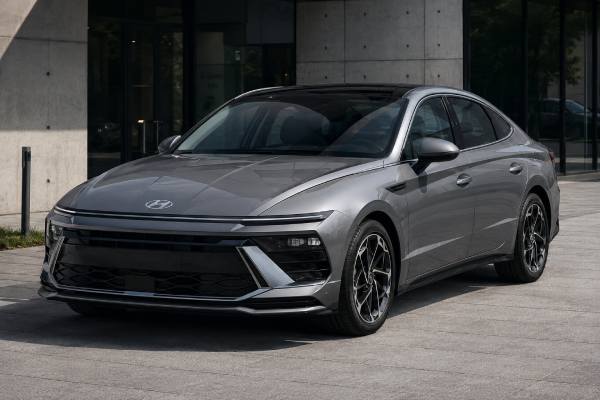
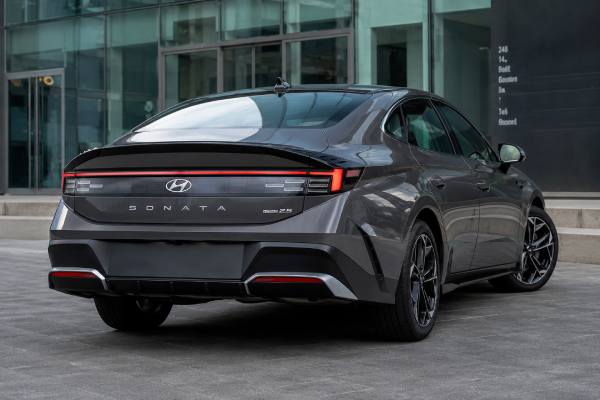
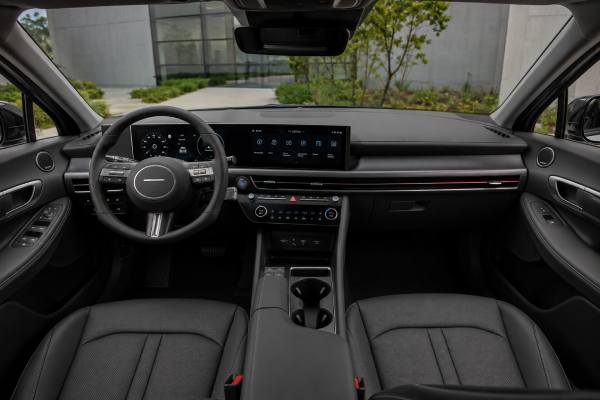
The facelifted Hyundai SONATA N Line is the sharpest and most powerful version of the DN8 Sonata sold from the 2024 model year onward. It keeps the practical four-door sedan layout, but adds a 290 hp turbocharged 2.5-liter engine, an eight-speed wet dual-clutch transmission, larger brakes, 19-inch wheels, sportier suspension tuning, and N Line-specific styling.
For buyers who want a quick family sedan without moving into a luxury badge, the SONATA N Line makes a strong case. It is fast, roomy, well equipped, and easier to live with than many compact performance cars. The main question is whether its front-wheel-drive layout, dual-clutch transmission, 19-inch tires, and higher running costs fit the way you actually drive.
Final Verdict
The 2024–present Hyundai SONATA N Line is a good choice for drivers who want strong acceleration, generous equipment, and midsize-sedan comfort without paying sport-sedan money. Its biggest appeal is the 290 hp Smartstream 2.5T engine, which gives it real passing power and makes it feel far quicker than a normal commuter sedan. It suits daily drivers who enjoy a sporty edge but still need rear seats, a usable trunk, and modern driver assistance. The main tradeoff is that the front tires and wet dual-clutch transmission work hard, so avoid neglected examples and prioritize cars with clean service records, completed software updates, good tires, and no harsh shift behavior.
| Pros | Cons |
|---|---|
| 290 hp 2.5T gives genuinely quick midsize-sedan performance | Front-wheel drive can struggle for traction under hard launches |
| Wet eight-speed DCT shifts quickly and feels sporty | DCT dislikes abuse, creeping traffic, and skipped fluid care |
| N Line gets larger brakes, 19-inch wheels, and sport tuning | Ride is firmer and tire replacement costs are higher |
| Roomy cabin, large trunk, and strong standard technology | Rear-seat space trails the best midsize rivals |
| Strong IIHS safety results and broad driver-assist coverage | 2024 brake-light recall must be verified by VIN |
Table of Contents
- SONATA N Line Overview
- Specifications and Technical Data
- Trims, Safety and Driver Assistance
- Reliability, Common Issues and Service Actions
- Maintenance and Buyer’s Guide
- Driving and Performance
- SONATA N Line vs Rivals
SONATA N Line Overview
The facelifted DN8 SONATA N Line is best understood as a fast, well-equipped midsize sedan rather than a full N performance model. It has serious power and a sportier chassis, but it remains tuned for daily use, comfort, and broad-road usability.
The 2024 facelift changed the SONATA’s character visually. The front end moved to Hyundai’s newer full-width lighting theme, the cabin gained a cleaner panoramic display layout, and the N Line kept its own body details, wheels, seats, exhaust outlets, and sportier trim. Under the skin, the important mechanical formula stayed familiar: 2.5-liter turbocharged four-cylinder, front-wheel drive, and an eight-speed wet dual-clutch transmission.
That combination gives the N Line a very different personality from the regular 2.5-liter SONATA and the hybrid models. The standard gasoline versions are calm and economical. The hybrid is the efficiency play. The N Line is the one for buyers who care about acceleration, passing power, and a more energetic feel.
It is not, however, a track-focused sedan. There is no mechanical limited-slip differential listed for the model, no all-wheel-drive option on the N Line, and no manual transmission. The front tires must manage steering, braking, and 311 lb-ft of torque, so tire quality matters. On wet pavement, cold tires, or rough surfaces, aggressive throttle inputs can bring wheelspin and torque steer.
As an ownership proposition, the SONATA N Line works best for someone who wants one car to do many things. It is comfortable enough for commuting, quick enough to feel special, and practical enough for family use. It also has a simpler ownership picture than many European sport sedans, but it still needs more care than a base naturally aspirated sedan. Turbocharged direct-injection engines, dual-clutch transmissions, large wheels, and performance tires all reward careful maintenance.
The facelifted N Line’s value depends heavily on condition. A well-maintained car with matching quality tires, smooth DCT behavior, no warning lights, and documented recall completion is attractive. A hard-used example with mismatched budget tires, delayed oil services, or harsh low-speed shifting is less appealing, even if the price looks tempting.
Specifications and Technical Data
The SONATA N Line uses Hyundai’s Smartstream 2.5-liter turbocharged GDI/MPI four-cylinder, paired with an N eight-speed wet dual-clutch transmission and front-wheel drive. The engine’s wide torque band is the key technical feature: maximum torque arrives low and stays available through the midrange, making the car feel strong in normal passing and highway driving. Hyundai’s 2024 specifications list the engine, transmission, chassis, safety equipment, dimensions, capacities, and N Line-specific brake and wheel data. ([Hyundai News][1])
| Item | Hyundai SONATA N Line 2.5T |
|---|---|
| Engine family | Smartstream 2.5L Turbo GDI + MPI |
| Layout | Inline 4-cylinder, DOHC, 16 valves |
| Displacement | 2,497 cc / 2.5 L |
| Bore × stroke | 88.5 × 101.5 mm |
| Induction | Turbocharged and intercooled |
| Fuel system | Gasoline direct injection plus multi-point injection |
| Power | 290 hp at 5,800 rpm |
| Torque | 311 lb-ft / 422 Nm from 1,650–4,000 rpm |
| Compression ratio | 10.5:1 |
| Recommended fuel | Unleaded gasoline |
| EPA fuel economy | 23 city / 32 highway / 27 combined mpg US |
FuelEconomy.gov lists the 2024 SONATA FWD with the AM-S8 automatic category at 23 mpg city, 32 mpg highway, and 27 mpg combined, which corresponds to the N Line’s eight-speed automated manual/dual-clutch layout. That equals about 10.2 L/100 km city, 7.4 L/100 km highway, and 8.7 L/100 km combined. ([Fuel Economy][2])
| Item | Specification |
|---|---|
| Transmission | N eight-speed wet dual-clutch transmission |
| Clutch type | Wet-friction twin clutch |
| Manual control | Steering-wheel paddle shifters |
| Drive type | Front-wheel drive |
| Final drive | 4.077 for gears 1, 2, 5, 6 and reverse; 2.944 for gears 3, 4, 7, 8 |
| AWD availability | Not offered on N Line |
| Item | Value |
|---|---|
| Body style | Four-door unibody sedan |
| Seating | Five passengers |
| Length | 4,910 mm / 193.3 in |
| Width | 1,859 mm / 73.2 in, excluding mirrors |
| Height | 1,445 mm / 56.9 in |
| Wheelbase | 2,840 mm / 111.8 in |
| Ground clearance | 135 mm / 5.3 in |
| Turning diameter | 10.9 m / 35.9 ft |
| Suspension | MacPherson strut front, multi-link rear |
| Fuel tank | 60.2 L / 15.9 US gal |
| Curb weight | 3,534 lb / about 1,603 kg |
| Towing | Not recommended |
| Item | Specification |
|---|---|
| Wheels | 19 × 8.0J alloy |
| Tires | 245/40R19 |
| Front brakes | 13.6-inch ventilated discs |
| Rear brakes | 12.8-inch solid discs |
| Steering assist | Rack-mounted motor-driven power steering |
| Steering ratio | 12.35:1 |
| Turns lock-to-lock | 2.44 |
| Item | Useful value |
|---|---|
| Engine oil capacity | 6.7 US qt listed in Hyundai specifications |
| Engine coolant capacity | 3.8 US qt listed in Hyundai specifications |
| Timing drive | Timing chain; inspect for noise, stretch, and timing faults |
| Spare tire provision | Tire mobility kit on U.S. N Line specification |
Trims, Safety and Driver Assistance
The N Line is the performance-oriented gasoline SONATA trim, not just an appearance package. Its defining mechanical differences are the 2.5T engine, wet dual-clutch transmission, front-wheel drive only, larger brakes, 19-inch tires, quicker steering ratio, and sportier N Line cabin and exterior details.
In the U.S. lineup, the regular gasoline SONATA trims use the naturally aspirated 2.5-liter engine, with all-wheel drive available on selected non-N Line trims. The hybrids use a separate 2.0-liter hybrid system. The N Line sits apart because it is the only facelifted SONATA with the 290 hp turbo engine.
Quick identifiers include the N Line badging, 19-inch N-design wheels, sport seats, red interior stitching, quad-style exhaust outlets, unique front and rear trim, paddle shifters, and N Line-specific steering wheel details. On a used car, the window sticker, VIN build data, and under-hood emissions label are better proof than badges alone, because cosmetic parts can be changed.
For 2024, the facelift brought the most visible update: the redesigned exterior, updated cabin display layout, and revised trim packaging. For 2025 and 2026, the N Line formula remained broadly similar, while the wider SONATA lineup changed trim names and packaging in some markets. Always compare by country, because equipment differs between the U.S., Canada, Australia, Korea, and other regions.
Crash-test ratings
The 2024 SONATA has strong IIHS results, but the details matter. IIHS lists Good ratings for driver-side and passenger-side small overlap front evaluations applying to 2020–2026 models. It also notes that 2024 models received structural reinforcements to improve side-impact protection, with the updated side test rated Good for 2024–2026 models. The updated moderate overlap front test for 2023–2024 models is rated Poor overall because of rear-passenger injury measures, even though the driver measures are strong. ([IIHS Crash Testing][3])
This is a good example of why a simple “safe” or “unsafe” label is not enough. The facelifted SONATA performs well in several major crash categories, but shoppers carrying rear-seat passengers often should pay attention to the specific IIHS updated moderate overlap result and look for the newest available test information for their model year.
Safety systems and ADAS
Hyundai’s 2024 specification sheet lists a broad safety package across the SONATA range. Standard equipment includes advanced airbags, a driver knee airbag, front side-impact airbags, side curtains, stability control, traction control, ABS with electronic brake-force distribution, brake assist, tire-pressure monitoring with individual tire display, rearview monitor, Forward Collision-Avoidance Assist with pedestrian, cyclist and junction-turning detection, Lane Keeping Assist, Lane Following Assist, Driver Attention Warning, High Beam Assist, Safe Exit Warning, Rear Occupant Alert, and LATCH lower anchors for two rear seating positions with three rear tether anchors. ([Hyundai News][1])
The N Line does not necessarily receive every camera-based feature that appears on the most expensive hybrid or Limited-type trims in every market. Features such as Surround View Monitor, Blind-Spot View Monitor, parking collision assistance, remote parking, or higher audio and convenience equipment can vary by country and model year.
ADAS condition matters when buying used. A windshield replacement, bumper repair, suspension alignment, front-end collision, or radar/camera removal can require calibration. During inspection, check that adaptive cruise, lane assistance, blind-spot monitoring, parking sensors, rear camera, and forward-collision warnings work normally and show no stored faults.
Reliability, Common Issues and Service Actions
The facelifted SONATA N Line is still a relatively young model, so long-term high-mileage data remains limited. The best reliability approach is to treat it as a powerful turbocharged front-drive sedan with a wet DCT: maintenance history, software updates, tire quality, and evidence of hard use matter more than mileage alone.
Most important known service action
The key recall to verify on 2024 U.S.-market cars is NHTSA Campaign 24V583, Hyundai Recall 267. The recall covers certain 2024 SONATA vehicles produced from October 18, 2023, to June 12, 2024, where incorrect rear brake-light software could cause the brake lights to flash during heavy braking above 30 mph instead of remaining steady as required by FMVSS 108. Hyundai’s remedy is a rear brake-light software update, offered through dealers and, for eligible connected cars, over the air. ([NHTSA Static][4])
A completed recall is not a reason to avoid the car. An open recall on a used example is a negotiation and scheduling item. Ask the seller for proof, then check the VIN through Hyundai or NHTSA.
Issue map by likelihood and severity
| System | Likelihood | Severity | What to check |
|---|---|---|---|
| DCT low-speed behavior | Occasional | Medium | Shudder, harsh engagement, delayed reverse, overheating warnings |
| Front tires | Common | Low to medium | Inside-edge wear, wheelspin damage, mismatched brands |
| Brake-light recall | VIN-dependent | Medium | Recall 267 / 24V583 completion proof |
| Turbo oil neglect | Owner-dependent | High | Long oil intervals, low oil level, smoke, noisy cold starts |
| ADAS calibration faults | Occasional | Medium | Warning lights after glass, bumper, or collision repair |
| Wheel damage | Common in rough-road areas | Low to medium | Bent 19-inch wheels, vibration, sidewall bubbles |
Symptoms, causes and remedies
Harsh low-speed takeoff usually points to DCT adaptation, clutch heat, software behavior, worn mounts, or driver use. A wet DCT can be durable, but it is not a torque-converter automatic. Avoid creeping on the throttle on steep hills and do not hold the car with the accelerator. If the car shudders badly when warm, hesitates into reverse, or shows transmission warnings, request dealer diagnosis before purchase.
Uneven front tire wear is common on powerful front-drive cars. The SONATA N Line’s 245/40R19 tires carry a lot of torque and cornering load. Feathered inner shoulders suggest alignment issues. Chopped tread can indicate worn dampers, poor rotation habits, or repeated hard launches.
Turbocharged direct-injection engines are sensitive to oil condition. The Smartstream 2.5T uses both direct and port injection, which helps compared with direct injection alone, but it still benefits from clean oil, proper warm-up, and avoiding hard boost immediately after cold starts. Blue smoke, oil smell, or low oil level between services needs investigation.
Cooling-system problems are not a widely established pattern on the facelifted N Line yet, but any turbo car should be checked carefully for coolant smell, low reservoir level, staining around hoses, radiator damage, or overheating history. A tuned or modified example deserves extra caution.
Chassis and suspension wear depends heavily on road quality. The 19-inch wheels look good and sharpen response, but they leave less sidewall to absorb potholes. Test-drive on smooth and broken pavement, listening for front-end knocks, rear suspension clunks, and wheel-bearing hum.
Software updates are part of modern ownership. Ask a Hyundai dealer to check for outstanding ECU, TCU, ADAS, infotainment, or recall updates. A reflash can be the correct remedy for drivability, warning-light, brake-light, or transmission-logic issues.
Maintenance and Buyer’s Guide
The N Line should be maintained more carefully than a base SONATA because the turbo engine, DCT, brakes, and tires carry higher loads. For long-term ownership, conservative fluid intervals and early inspection of wear items are cheaper than chasing drivability problems later.
| Interval | Recommended work |
|---|---|
| Every 5,000–7,500 miles / 8,000–12,000 km | Engine oil and filter, tire rotation, fluid check, brake inspection |
| Every 12 months | Cabin filter check, battery test, wiper and lighting inspection |
| Every 15,000–30,000 miles / 24,000–48,000 km | Engine air filter, cabin filter, brake hardware cleaning in rust climates |
| Every 2 years | Brake fluid replacement, detailed brake and corrosion inspection |
| Every 40,000–60,000 miles / 64,000–96,000 km | DCT fluid service discussion with dealer, coolant and belt inspection |
| Every 60,000–100,000 miles / 96,000–160,000 km | Spark plugs, coolant service, accessory belt, mounts, suspension inspection |
| As symptoms appear | Timing-chain noise, timing-correlation faults, oil leaks, DCT faults |
Use the official service schedule for your VIN and market as the final authority, especially for warranty coverage. The intervals above are a practical ownership approach for mixed driving, short trips, heat, cold weather, traffic, and spirited use.
The timing chain does not have a simple replacement mileage like a timing belt. Instead, listen for cold-start rattle, check for cam/crank correlation faults, inspect oil-service history, and replace chain components only when wear, stretch, guide damage, tensioner issues, or fault data justify it.
The fuel filter is typically part of the fuel-pump module strategy on many modern gasoline Hyundais rather than a routine external service item, so do not approve unnecessary “fuel filter” upsells without checking the official service information. Fuel-system cleaners and induction services should also be handled carefully; use only products and procedures compatible with Hyundai’s emissions and fuel system.
Brake fluid is worth replacing on time. The N Line is quick enough to work its brakes hard, and old fluid lowers the margin during repeated stops or mountain driving. In snowy climates, clean and lubricate brake hardware regularly because rear brakes and parking-brake mechanisms can corrode when exposed to salt.
The 12-volt battery should be tested annually after year three. Modern cars with connected services, keyless entry, large displays, and many control modules can become sensitive to weak battery voltage.
Pre-purchase inspection checklist
Start with the service history. A good N Line should show regular oil changes, tire rotations, recall completion, and no long unexplained gaps. Then inspect the car in this order:
- Confirm the VIN, engine, trim, and market specification.
- Check for open recalls, especially the 2024 brake-light software recall.
- Start the engine cold and listen for chain rattle, misfire, or exhaust leaks.
- Test low-speed DCT takeoff, reverse engagement, stop-and-go smoothness, and kickdown.
- Inspect all four tires for brand match, correct size, tread depth, and inner-edge wear.
- Check wheels for bends, cracks, curb damage, and vibration at highway speed.
- Inspect brakes for rotor lip, uneven wear, corrosion, pulsation, and caliper drag.
- Scan all modules, not just the engine ECU.
- Verify ADAS operation after any windshield, bumper, or collision repair.
- Look underneath for oil leaks, coolant staining, damaged undertrays, and corrosion.
Avoid cars with evidence of tuning unless you understand the warranty and mechanical risk. The 2.5T responds strongly to extra boost, but the front-drive DCT package already handles substantial torque in stock form. A modified car with launch-control abuse, cheap tires, or missing service records is a poor used buy.
Best version to buy
For most shoppers, the best SONATA N Line is the newest, cleanest, unmodified example with full service records and completed software campaigns. The 2024 facelift is the starting point for the updated styling and cabin. Later examples may benefit from running production updates and normal early-build improvements, but condition matters more than model-year bragging rights.
Driving and Performance
The SONATA N Line’s performance is its main reason to exist. It accelerates like a much more expensive sedan, yet it keeps the seating position, trunk, visibility, and daily comfort of a regular midsize car.
The 2.5T engine has a broad, muscular midrange. It does not need high rpm to feel fast. In everyday driving, the useful shove arrives early, and the car pulls strongly through highway passing speeds. Car and Driver recorded 0–60 mph in 5.4 seconds for a 2024 SONATA N Line and listed a 14.0-second quarter mile at 103 mph, with 75-mph highway fuel economy of 39 mpg in its test. ([Car and Driver][5])
The transmission is central to the experience. At speed, the wet DCT shifts quickly and gives the car a crisp, responsive feel. In traffic, it can feel less fluid than a conventional torque-converter automatic, especially during creeping maneuvers. Later calibration improvements make the car easier to live with, but buyers should still test low-speed behavior carefully.
Steering is quick for a family sedan, helped by the N Line’s rack-mounted assist and 12.35:1 ratio. It is not a rear-drive sport sedan, and the front axle can feel busy when accelerating hard out of tight corners. Still, the car feels stable, confident, and more alert than the standard SONATA.
Ride comfort is firm but not punishing on good roads. The 19-inch wheels and 40-series tires transmit more sharp impacts than the smaller-wheel trims, so road quality matters. On broken pavement, the N Line feels more expensive when fitted with good tires and properly aligned suspension. Cheap tires make it louder, harsher, and less composed.
Braking performance is strong for road use. The larger 13.6-inch front discs and 12.8-inch rear discs give the N Line more stopping hardware than the lower trims. Pedal feel is generally confidence-inspiring, but any vibration during braking, pulling, or uneven rotor wear should be treated as a reconditioning cost.
Real-world fuel economy varies widely. In city traffic, expect roughly 10–12 L/100 km, or about 20–24 mpg US, depending on temperature and trip length. On steady highways, the car can do much better, especially at moderate speeds, with high-30s mpg US possible in gentle conditions. Mixed driving near the EPA combined figure of 27 mpg US is realistic for owners who are not constantly using boost.
Cold weather usually reduces fuel economy because of warm-up time, denser air, winter fuel, tire rolling resistance, and heavier electrical loads. Short trips are the worst case. A turbo engine that never fully warms up accumulates more moisture and fuel dilution in the oil, which is another reason shorter oil intervals make sense for city use.
The SONATA N Line is not intended for towing. Hyundai’s 2024 specifications list towing as not recommended, so buyers needing trailer capability should look elsewhere. ([Hyundai News][1])
SONATA N Line vs Rivals
The SONATA N Line competes with two different groups: practical midsize sedans and sportier near-performance cars. It is quicker than most normal family sedans, but less balanced than rear-drive or AWD sport sedans. Its best rivals are the Kia K5 GT, Honda Accord, Toyota Camry, Nissan Altima, and lightly used entry-luxury sedans.
The Kia K5 GT is the closest mechanical rival because it uses a similar 2.5T and dual-clutch front-drive formula. The K5 GT has the same basic appeal: big power for the money, aggressive styling, and strong equipment. The Hyundai counters with its facelifted interior design, SONATA-specific styling, and trim packaging. Condition and price often matter more than brand preference between these two.
The Honda Accord is the more polished all-rounder. It does not match the SONATA N Line’s straight-line punch in mainstream trims, but it has excellent chassis balance, a spacious cabin, and strong hybrid efficiency. Choose the Accord if refinement, resale strength, and ride-handling polish matter more than turbocharged acceleration.
The Toyota Camry, especially the newest hybrid-focused lineup, is the safer long-term bet for buyers prioritizing fuel economy and predictable ownership. It lacks the SONATA N Line’s playful surge of torque, but it offers excellent efficiency and broad appeal. Choose the Camry if you want lower fuel use and less performance-car maintenance sensitivity.
The Nissan Altima is comfortable and available with all-wheel drive in some versions, but it does not feel as special or as quick as the N Line. Its main argument is price, comfort, and availability. For an enthusiast-leaning buyer, the Hyundai is more interesting.
A used BMW 330i, Audi A4, Acura TLX, Genesis G70, or Mercedes-Benz C-Class may offer more premium feel or rear-drive/AWD balance, but running costs can rise quickly. The SONATA N Line is attractive because it delivers much of the acceleration drama without luxury-brand parts pricing. It is not as refined as those cars, but it can be the smarter daily-driver choice.
| Model | Main advantage over SONATA N Line | Main drawback against SONATA N Line |
|---|---|---|
| Kia K5 GT | Very similar performance formula and sporty styling | Used choice depends heavily on price and condition |
| Honda Accord | More polished chassis and strong hybrid option | Less exciting straight-line performance in common trims |
| Toyota Camry | Excellent efficiency and ownership reputation | Not as punchy or performance-focused |
| Nissan Altima | Comfortable and available AWD in some trims | Less power and less enthusiast appeal |
| Used entry-luxury sedan | Better badge, refinement, and often RWD/AWD balance | Higher repair costs and more expensive reconditioning |
The final decision is simple. Buy the SONATA N Line if you want a fast, practical, modern sedan and accept the extra attention required by its turbo engine, DCT, brakes, and tires. Choose a hybrid Accord or Camry if efficiency and long-term simplicity matter more. Choose a used luxury sport sedan if chassis balance and premium feel are worth higher maintenance costs.
References
- 2024 Sonata Specifications 2023 (Manufacturer Specifications) ([Hyundai News][1])
- Gas Mileage of 2024 Hyundai Sonata 2024 (EPA Fuel Economy) ([Fuel Economy][2])
- 2024 Hyundai Sonata 2024 (Safety Rating) ([IIHS Crash Testing][3])
- Part 573 Safety Recall Report 24V-583 2024 (Recall Report) ([NHTSA Static][4])
- Manuals & Warranties | Hyundai Resources | MyHyundai 2026 (Owner Resources) ([MyHyundai][6])
Disclaimer
This article is for informational purposes only and is not a substitute for professional diagnosis, repair, or inspection. Specifications, torque values, service intervals, fluids, software campaigns, and procedures can vary by VIN, market, production date, equipment, and official service documentation. Always verify details against the owner’s manual, factory repair information, dealer records, and an official VIN check before buying, servicing, or modifying a vehicle.
If this guide helped you, please share it on Facebook, X/Twitter, or your favorite car community to support our work.