
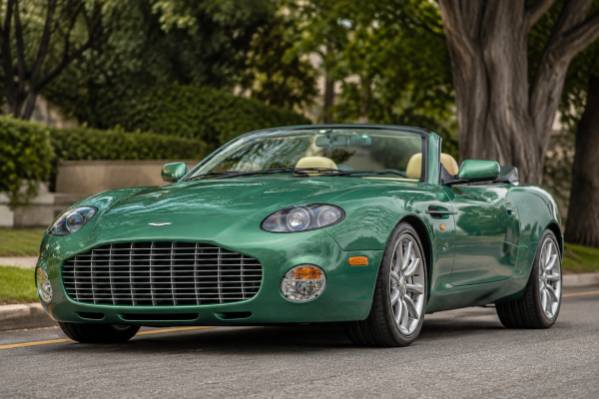
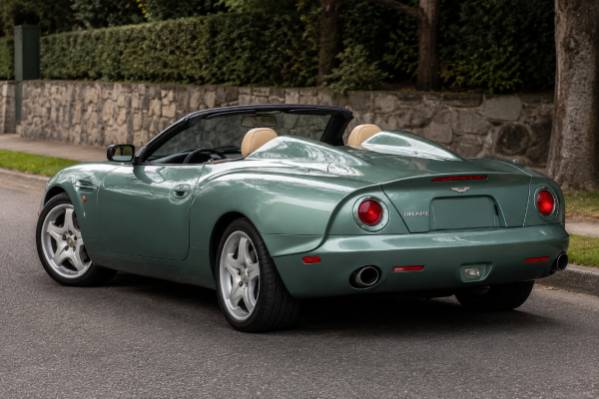
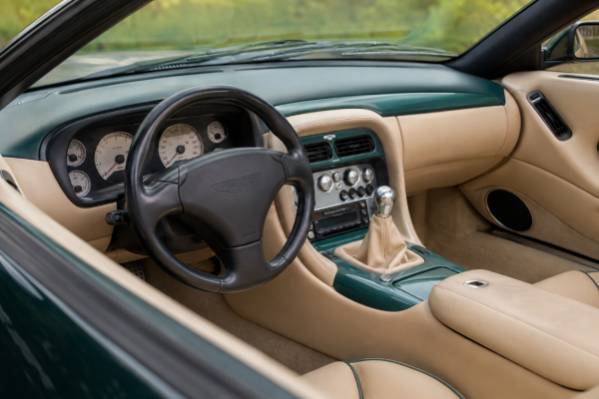
The Aston Martin DB AR1 is a roofless, two-seat V12 roadster created for the North American market at the end of DB7 production. Zagato shaped its grille, exposed cockpit, twin rear cowls, and short tail, while Aston Martin retained the full-length DB7 Vantage Volante foundation to avoid the homologation difficulty that kept the short-wheelbase DB7 Zagato coupé out of the United States.
Its specification is as serious as its appearance. The 5,935 cc AM702-derived V12 produces 435 bhp, the standard enthusiast configuration uses a six-speed manual gearbox and twin-plate clutch, and an active exhaust, special 19-inch wheels, and uprated braking hardware sharpen the experience. Only 99 customer cars were completed across 2003 and 2004.
Yet the defining fact is simpler: there is no permanent roof. The supplied cover protects a parked cabin; it does not turn the AR1 into an all-weather convertible. Ownership therefore depends on climate, storage, route planning, drainage, leather care, and rapid response to water. This guide treats the DB AR1 as the distinct numbered model it is, not as a DB7 Volante with its hood removed.
Table of Contents
- A roadster with no weather plan
- Exact DB AR1 configuration
- Zagato body, Volante foundation
- Using 435 hp in the open
- Weather, storage, and material care
- The mechanical risk map
- Due diligence for a numbered car
A roadster with no weather plan
The DB AR1 is a pure roadster in the literal sense: it has no folding hood, no removable hardtop, and no factory weather enclosure for driving. The design assumes favorable conditions and makes the exposed cockpit central to the car rather than an occasional mode.
Aston Martin developed the AR1 after the DB7 Zagato coupé generated demand in a market where that shorter car had not been homologated. The prototype was created in six months from a 1999 DB7 Vantage Volante press car. It was shown privately to prospective customers before its public appearance at the Los Angeles Auto Show in January 2003, and the response secured the limited production run.
The name means DB American Roadster 1. It is the only DB7-family derivative whose official model name omits “DB7,” even though its platform, engine architecture, electronics, and many service components belong to that family. Aston Martin did not market it as a Zagato model, but it carried Zagato “Z” badges and its coachwork was designed in the same collaboration.
The body translates the coupé’s double-bubble idea into two cowls behind the seats. Those fairings taper into the rear deck and frame a deeply open cabin. A large grille, clean flanks, circular rear lamps, special wheels, and minimal upper structure give the car a different visual balance from a Volante. The result looks shorter than its underlying chassis because the surfaces concentrate attention around the cockpit.
Aston Martin’s heritage material describes 99 examples of the DB AR1, with final assembly completed at Gaydon alongside early DB9s after work associated with the DB7 production era. Some accounts refer to a run of 100 when including a retained or development car. For valuation and numbered-car discussion, the accepted customer series is 99; the individual sill plaque and factory record should identify the exact example.
Although conceived primarily for the United States, some cars have since moved between countries, and a small number were retained or supplied elsewhere. Registration, emissions, import, and road-use status must be checked for the actual jurisdiction. A clean title, collector history, or prior registration does not automatically prove compliance with every current federal, state, or national requirement.
The AR1’s appeal comes from choosing inconvenience deliberately. It is less practical than a Vantage Volante and less structurally transformed than the short-wheelbase Zagato coupé. In return it offers unrestricted access to the V12’s induction and exhaust sound, an unusually low visual horizon, and one of the most distinctive factory bodies fitted to the NPX platform.
Exact DB AR1 configuration
The 2003–2004 DB AR1 combines a 5.9-litre naturally aspirated V12 with rear-wheel drive and, in its defining specification, a six-speed manual transmission. Period technical descriptions quote 435 bhp, 410 lb-ft, approximately 4.9 seconds to 60 mph, and a maximum speed near 185 mph.
| Item | DB AR1 value | Notes |
|---|---|---|
| Engine family | AM702-derived Aston Martin V12 | Front-mounted longitudinally |
| Configuration | Naturally aspirated 60-degree V12 | Aluminium alloy block and heads |
| Displacement | 5,935 cc (5.9 L) | 89.0 mm bore × 79.5 mm stroke |
| Valvetrain | Four overhead camshafts, 48 valves | Four valves per cylinder |
| Compression ratio | 10.3:1 | Premium unleaded petrol |
| Maximum power | 435 bhp (approximately 324 kW) | At 6,000 rpm |
| Maximum torque | 556 Nm (410 lb-ft) | At 5,000 rpm |
| Exhaust | Active sport system | Rear muffler bypass valves alter the sound path |
| Specification | Value | Interpretation |
|---|---|---|
| Primary gearbox | Six-speed manual | Quick-shift lever and twin-plate clutch |
| Automatic availability | Five-speed Touchtronic on a small number of cars | Verify the factory build record for the example |
| Drive | Rear-wheel drive | Limited-slip differential |
| 0–60 mph | Approximately 4.9 seconds | Published manual-car figure |
| Maximum speed | Approximately 185 mph (298 km/h) | Often described as exceptional for a roofless roadster |
| Fuel tank | Approximately 89 L (23.5 US gal) | Range depends heavily on pace |
| Feature | Specification | Why it matters |
|---|---|---|
| Structure | DB7 Vantage Volante-derived full-length platform | Not the Zagato coupé’s shortened wheelbase |
| Wheelbase | 2,591 mm (102.0 in) | Volante-family dimension |
| Body style | Two-door, two-seat roadster | No rear seats and no permanent roof |
| Published curb weight | Approximately 1,858 kg (4,096 lb) for a manual car | Definitions and equipment can change quoted figures |
| Roof provision | None for driving | Parked-car rain cover only |
| Production | 99 numbered customer cars | Built during 2003–2004 |
| Component | Factory description | Inspection point |
|---|---|---|
| Front suspension | Independent double wishbones, coil springs, dampers, anti-roll bar | Check bushes, joints, ride height, and alignment |
| Rear suspension | Independent wishbones with longitudinal control links | Mounting and bush condition govern stability |
| Brakes | Grooved ventilated Brembo discs, four-piston calipers, ABS | Look for corrosion, drag, cracks, and fluid neglect |
| Brake assistance | Improved booster specification | Pedal should be firm and repeatable |
| Wheels | Special offset 19-inch multi-spoke alloys | Designed to widen the track visually and dynamically |
| Original tire format | Staggered low-profile front and rear sizes | Confirm exact approved size and current availability |
| Feature | DB AR1 | DB7 Vantage Volante |
|---|---|---|
| Power | 435 bhp | 420 bhp |
| Occupants | Two | Nominal 2+2 |
| Weather equipment | No driving roof | Powered fabric hood |
| Body design | Zagato-designed roadster surfaces and rear cowls | Ian Callum-era DB7 convertible form |
| Wheels | Special 19-inch design | Normally 18-inch Vantage wheels |
| Production scale | 99 numbered customer cars | Series-production DB7 variant |
Because factory heritage summaries and later sales descriptions do not always separate manual, automatic, development, and market-specific data consistently, the individual build record and owner literature should settle any disputed specification. Do not convert an uncertainty into a confident claim merely because a number appears repeatedly online.
Zagato body, Volante foundation
The AR1’s essential engineering compromise is deliberate: it uses the standard-length Volante structure for homologation while replacing the conventional convertible body and roof mechanism with a two-seat, permanently open Zagato design. This produces a different car without the coupé’s shortened chassis.
Removing the powered hood does not mean the structure was designed casually. The Volante foundation already carried reinforcement to compensate for the absence of a fixed roof. The AR1 retains that underlying approach while changing upper-body load paths, trim, rear-deck form, and cockpit packaging. It should therefore feel like a substantial open grand tourer, not a featherweight speedster.
The twin cowls are more than styling ornaments because they define the rear deck, trim interfaces, drainage behavior, and visibility. Check them for symmetry, paint consistency, cracking around mounts, rubbing at adjacent panels, and signs that luggage or transport straps have damaged the finish. Inspect the channels around the cockpit and rear deck after water testing, then verify where the water exits.
A body repair must preserve geometry as well as appearance. The AR1 was built in tiny numbers, so replacement panels, lamps, seals, badges, and trim may require specialist sourcing or fabrication. Before authorizing paint removal or metalwork, photograph measurements, gap profiles, stampings, fastener locations, and hidden finishes. A correct original reference can be more valuable than a generic repair manual.
The cockpit is fully exposed whenever the car is used. Sunlight reaches the dashboard, leather, carpets, controls, and rear trim without a roof to moderate heat. Dust and pollen settle in switch openings and stitching. Even a light shower can put water into seams, seat mechanisms, electronics, and insulation. The cabin should be inspected as both an interior and an exterior surface.
Seat and steering position deserve a real test. The cowls, windscreen, fixed trim, seat travel, and pedal relationship may suit one driver better than another. Confirm that the seat motors work through their full range and that the driver can operate the heavy-performance clutch without twisting at the hip. A rare car is still the wrong car when its ergonomics prevent comfortable use.
Structural inspection should include the sills, jacking points, floor seams, windscreen surround, front and rear suspension pickups, radius-arm or longitudinal-link mounts, and any area where water can remain. The absence of a roof mechanism removes one maintenance system but increases the consequences of poor drainage and wet storage.
Using 435 hp in the open
The AR1 intensifies the V12 experience by removing acoustic insulation above the occupants and adding an active sport exhaust. Its performance feels immediate because the driver hears induction, combustion, exhaust-valve changes, tire noise, and airflow without a roof between them and the surroundings.
The 5,935 cc engine should be exceptionally smooth, but smoothness is not proof that every cylinder is healthy. A mild misfire can hide at idle and emerge only under load. Diagnostic scanning, fuel-trim review, plug and coil history, and catalyst monitoring are important because unburned fuel can overheat expensive catalytic converters.
Cold-start behavior reveals several systems at once. Confirm that warning lamps illuminate for their self-check, the engine catches promptly, idle stabilizes, exhaust flow is even, and no strong fuel or coolant smell develops. Listen for accessory noise and observe the charging voltage. Do not let a seller pre-warm the car before an inspection without explaining why.
Once warm, the manual gearbox should select every ratio cleanly. The quick-shift arrangement gives a shorter action, but it should not require force. The twin-plate clutch may feel purposeful; it should not slip, chatter continuously, release at the extreme end of travel, or make severe bearing noise. Test restart and gear selection after heat soak because marginal hydraulics and clutch components can behave differently hot.
The active exhaust must change behavior without rattling or sticking. Vacuum lines, valves, actuators, wiring, and mufflers should be inspected. A permanently open system may sound dramatic but can indicate a fault or modification. Replacement exhaust work must preserve heat shielding and clearance around the body and rear deck.
The wider-track wheel arrangement and low-profile tires give the AR1 strong response but little tolerance for old rubber or damaged rims. Check date codes, correct stagger, load and speed ratings, sidewall cracking, inner-edge wear, flat spotting, and repairs. Tire availability can influence whether the original format remains practical; any approved substitution should be documented rather than guessed from diameter alone.
On a road test, look for clean initial steering, stable braking, controlled body movement, and a rear axle that follows bumps without steering itself. Cowl shake and windscreen movement should be limited for a car of this type. Strong vibration, door movement, repeated secondary oscillation, or clunks over diagonal bumps can indicate worn suspension or structural trouble.
High-speed claims are historical specifications, not a testing target. A useful inspection can be completed within legal speeds by loading the engine progressively, checking several gears, holding a steady motorway pace, braking repeatedly, and observing coolant temperature in traffic afterward. The car’s rarity, open cabin, and tire age make restraint part of competent evaluation.
Weather, storage, and material care
Weather management is the first ownership system on a DB AR1. A secure dry garage, reliable forecasts, a plan for unexpected rain, and correct cleaning methods are as important as oil or coolant because water can damage unique trim and hidden electronics quickly.
The supplied cover is intended to shield a stationary cabin. It should be complete, correctly fitted, dry before storage, and inspected for abrasion points. It does not make the car safe to drive in rain, and it should not trap water beneath it after a shower. Later improvised hoods may offer limited emergency protection, but their fit, attachment, paint contact, and provenance must be evaluated separately from the factory specification.
Before a drive, consider the entire route rather than the weather at the starting point. Coastal fog, irrigation, sudden mountain rain, overnight dew, and open parking can all create exposure. Carry clean absorbent towels, a suitable temporary cover, and contact details for secure shelter or enclosed transport. Do not cover a hot exhaust area or fasten anything that can whip against paint.
If the cabin becomes wet, remove standing water immediately, isolate electrical symptoms, dry seams and carpet layers, and ventilate the car in a controlled environment. Do not apply heat aggressively to aniline leather or wood trim. A specialist should inspect seat mechanisms, connectors, control modules, insulation, and hidden cavities when water penetration is more than superficial.
Washing should minimize water volume around the cockpit. A controlled hand wash, damp detailing method, or specialist dry-care process may be preferable to free-flowing hoses. Never direct pressure at the windscreen base, rear cowls, cockpit seams, lamps, badges, or grille. Afterward, open accessible compartments, dry channels, and check that drainage paths are clear.
Storage should control humidity and battery state. Use breathable protection, a compatible maintainer, stable tire support, pest control, and ventilation. Avoid repeated short starts; they add moisture without fully heating the engine and exhaust. A periodic road exercise in suitable weather is better when it brings the drivetrain, brakes, air conditioning, and charging system through a complete operating cycle.
Document material condition with photographs. Record small leather changes, paint chips, wheel marks, lamp condensation, seal deformation, and corrosion before they become expensive. For a numbered car, continuity of care is part of provenance and gives future repairers a reference for what was original.
The mechanical risk map
AR1 mechanical risk follows the V12 DB7 family but is amplified by low mileage, heat, and scarcity. Cooling, ignition, clutch, brakes, suspension, electrical supply, air conditioning, corrosion, and dormant-car recommissioning should be evaluated together.
Cooling failures can escalate quickly. Inspect the radiator core and tanks, fan operation, thermostat behavior, expansion tank, pressure cap, every visible hose, dried residue, and coolant quality. Internal hose collapse or restricted flow may not leak externally. Test the car after a sustained drive and during idle, then recheck for pressure loss and fresh staining.
Ignition access is labor-intensive, so invoices should identify plugs, coils, cylinder locations, and diagnostic findings. Replacing one failed component can be reasonable when the rest test well, but repeated single-cylinder repairs may show an aging set. Any misfire under load, warning lamp, sulfur smell, or catalyst-efficiency fault deserves prompt action.
Oil leakage should be located with the underbody panels removed. Minor sweating differs from active loss onto an exhaust or clutch area. Check engine, gearbox, differential, power steering, and brake hydraulics separately. Clean undersides can conceal a recent wipe-down, so look at fasteners, shields, and the edges of panels after the road test.
The clutch and gearbox demand a realistic budget. A twin-plate clutch is not judged solely by mileage because heat, storage, driving style, hydraulic condition, and installation quality matter. Review flywheel and seal work completed during any clutch replacement. Gearbox oil, mounts, propeller-shaft joints, differential behavior, and driveline alignment can all contribute to vibration or harshness.
Brake components can seize on cars that remain static. Inspect caliper movement, disc corrosion and cracks, pad age, hoses, fluid moisture, ABS warnings, parking-brake operation, and wheel temperature after the test. A car that stops straight once may still have a dragging caliper or degraded fluid.
Suspension wear often appears as wandering, tire wear, knocks, or steering kickback. Test bushes and ball joints under load, inspect dampers for leakage, measure ride height, and check alignment only after worn components are corrected. Protect the model-specific wheels during any workshop visit and specify the correct lifting points.
Electrical diagnosis should begin with voltage. Test the battery under load, alternator output, grounds, cable condition, and current draw before replacing modules. Confirm windows, locks, seat motors, mirrors, lamps, instruments, alarm, remote functions, audio, exhaust control, and air conditioning. Water exposure makes connector inspection especially important.
Air conditioning is not optional comfort in a roofless car driven in hot climates; it helps make the cabin tolerable in slow traffic. Verify vent temperature, compressor operation, fan speeds, control response, condensate drainage, and refrigerant history. Evaporator replacement can require major cabin disassembly, so weak cooling should be priced accurately.
Due diligence for a numbered car
A DB AR1 should be purchased only after identity, specification, condition, weather history, and legal status are reconciled. The number plaque creates rarity, but it does not certify that the body, engine tune, gearbox, paint, or documents remain original.
Match the VIN and production number across the car, title, factory build information, service book, window sticker where available, invoices, and prior auction or sale records. Check dates, mileage, colors, options, transmission, and ownership sequence. Online catalog descriptions can help establish history but may repeat earlier errors, so compare them with primary documents.
Authenticate the body and trim. Inspect Zagato badges, grille, cowls, lamps, wheels, sill plaques, upholstery pattern, fascia material, aluminum controls, rear deck, covers, tools, books, keys, umbrella, charger, and other supplied accessories. Missing items may be replaceable, but scarcity and provenance affect cost and value.
Use paint readings as a guide rather than a verdict. Examine surface shape, metallic orientation, edge thickness, overspray, masking lines, glass and lamp markings, fasteners, sealant, hidden faces, and panel gaps. An excellent documented repair may be preferable to failing original paint; an undocumented cosmetic refinish may conceal collision or corrosion.
Inspect the underside on a lift. Concentrate on sills, jacking points, floor seams, suspension mounts, brake and fuel lines, wheel housings, front structure, rear deck supports, and drainage. Fresh undercoating should be explained with photographs of preparation. Probe suspicious areas carefully and use a borescope where access permits.
The test must begin cold and end hot. Scan the car before clearing anything, observe cold start, drive long enough to exercise every gear and brake, hold it in traffic, operate the air conditioning and exhaust valves, restart after heat soak, and scan again. Check for fresh fluids, hot wheels, coolant odor, and battery weakness afterward.
Very low mileage is not automatically superior. A delivery-mile car may retain old tires, dried seals, contaminated fluids, sticking brakes, marginal cooling components, and an untested air-conditioning system. A modest-mile car can be safer and more satisfying when each year of use is documented. Recommissioning must be completed before enthusiastic driving, not discovered during it.
Clarify intended use with the insurer and authorities. Agreed value, storage conditions, mileage limits, event use, cross-border travel, emissions obligations, and registration restrictions can differ. Written confirmation is more useful than a seller’s assurance that “another owner has done it.”
Finally, choose the example that reduces irreversible risk. Mechanical service can be expensive, but a damaged cowl, missing lamp, altered sill plaque, water-stained aniline interior, incorrect wheel, or compromised structure may be harder to remedy. The AR1 rewards an owner who plans around weather, preserves the numbered specification, and drives it often enough to know its systems. Its inconvenience is not a flaw to engineer away; it is the condition that creates the experience.
References
- Aston Martin Media — DB AR1 development and launch history
- Aston Martin — DB7 Zagato and DB AR1 heritage overview
- RM Sotheby’s — 2003 DB AR1 specification and provenance example
- Bonhams — 2003 DB AR1 technical description
- Classic & Sports Car — Aston Martin DB7 buyer’s guide
- NHTSA — Vehicle recall lookup
Disclaimer
This guide is informational and does not replace a professional diagnosis, pre-purchase inspection, legal review, or official repair instruction. Specifications, service intervals, tightening torques, fluid requirements, approved tires, emissions equipment, and procedures can vary with VIN, market, transmission, and installed options. Verify every technical or regulatory decision using factory documentation and the relevant authority for the individual car. Please share the article politely with owners or prospective buyers who may benefit from a careful DB AR1 assessment.