
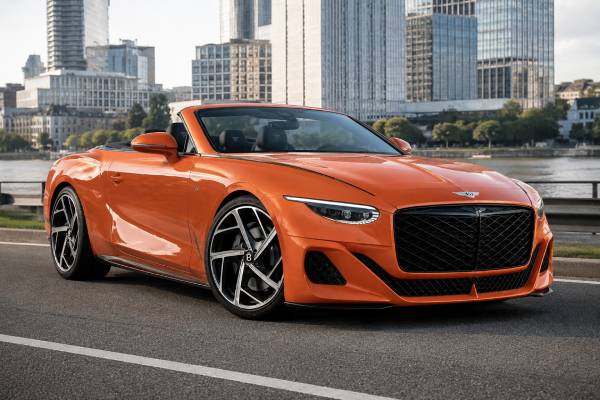
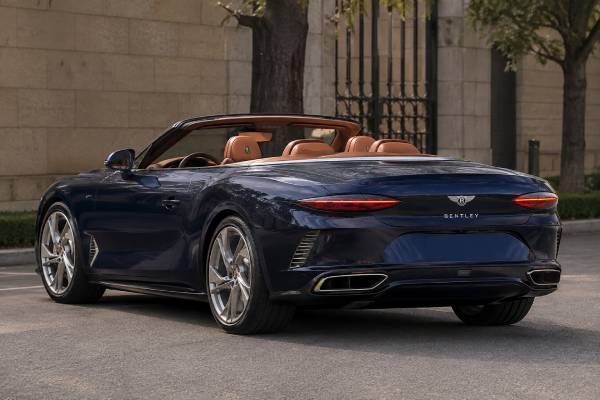
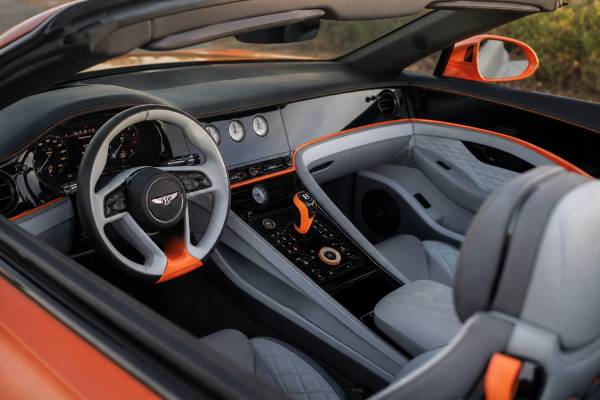
The Bentley Batur Convertible is a 16-car, two-seat Mulliner creation that combines the final 740 hp form of Bentley’s twin-turbo W12 with a powered fabric roof. It is not simply the Batur coupe with its roof removed. The rear body, airflow management, storage arrangement, and aviation-inspired “airbridge” behind the seats were developed to make the open car visually complete and usable in changing weather. The roof can be raised or lowered in 19 seconds at speeds up to 50 km/h (30 mph), giving it a practical advantage over the completely roofless Bacalar. Production began after W12 engine manufacture had ended, using the final engines reserved for the 16 commissions; the first customer car was completed in August 2025, and further individually specified examples followed in 2026. That combination of late W12 history, open-air engineering, and one-to-one personalization makes condition assessment unusually detailed. Buyers must evaluate the roof system, water management, unique bodywork, commission records, and the sophisticated chassis with the same care as the engine.
Table of Contents
- What the Convertible Changes
- Technical Data and Production Scope
- Roof System and Open-Air Packaging
- Performance, Chassis, and Refinement
- Commissioning One of Sixteen
- Care for the Roof, Body, and W12
- Buying and Preserving the Convertible
What the Convertible Changes
The Batur Convertible changes the experience more than the basic performance formula. It keeps the coupe’s powerful W12 and active chassis philosophy, but adds a weatherproof folding roof, revised rear aerodynamics, and a cockpit designed to look finished from above when the roof is stored.
This distinction separates it from the Bacalar. The earlier Mulliner barchetta has no roof at all and is best treated as a fair-weather event car. The Batur Convertible can leave home under a clear sky, continue through rain with the roof closed, and offer a quieter cabin on a long journey. Bentley described it as the first true convertible of Mulliner’s modern coachbuilding era, which makes its usability part of the concept rather than a concession.
The roof also changes how the car is seen. With a coupe, the exterior and interior are visually separate. In an open car, paint, roof fabric, tonneau area, seat colors, stitching, seatbelts, airbridge finish, and rear deck appear in one composition. Owners therefore commissioned a complete palette rather than choosing an exterior and then decorating a cabin behind glass.
At the rear, two sculpted forms behind the seats create the airbridge. Their shape recalls an aircraft cockpit and visually carries the cabin into the rear deck. The design also helps define airflow and gives the open car a strong profile without relying on conventional rollover hoops as the dominant styling feature. Luggage space is arranged behind the seats, where fitted bags can form part of the commission.
The car’s chronology is equally unusual. Bentley ended W12 production in July 2024, after reserving final engines for the Batur Convertible program. The model made public appearances in 2025, and the first customer example emerged from Mulliner in August of that year. By January 2026, Bentley was presenting later customer cars with increasingly elaborate combinations such as tri-tone paint and 3D-printed precious-metal details. As a result, “2025–present” describes an ongoing hand-build program rather than a conventional annual model cycle with regular specification changes.
For an owner, the practical consequence is clear: a Batur Convertible must be understood by its individual build file. There is a common mechanical foundation, but no single color, trim, or decorative specification that defines all 16 cars.
Technical Data and Production Scope
The Batur Convertible is a gasoline ICE grand tourer powered by Bentley’s final 6.0-liter twin-turbo W12. It uses an eight-speed dual-clutch transmission and active all-wheel drive, while its powered fabric roof and two-seat coachbuilt body distinguish it from the fixed-roof Batur.
| Specification | Value | Notes |
|---|---|---|
| Powertrain type | Gasoline ICE | No hybrid assistance |
| Engine | 6.0-liter twin-turbo W12 | Final high-output Bentley W12 specification |
| Displacement | 5,950 cc (363.1 cu in) | Factory W12 capacity |
| Maximum output | 750 PS / 740 bhp (552 kW) at 5,500 rpm | Official heritage-car specification |
| Maximum torque | 1,000 Nm (738 lb-ft) at 1,750 rpm | Official heritage-car specification |
| Transmission | 8-speed dual-clutch | Automatic with manual selection |
| Drive type | Active all-wheel drive | Rear-biased performance character |
| Measure | Value | Source condition |
|---|---|---|
| 0–60 mph | 3.3 seconds | Official published figure |
| 0–100 km/h | 3.4 seconds | Official published figure |
| Maximum speed | 337 km/h (209 mph) | Official published figure |
| Power-to-weight context | 740 bhp for a published 2,399 kg car | Development/heritage specification |
| Specification | Value | Notes |
|---|---|---|
| Body style | 2-door, 2-seat convertible | Mulliner coachbuilt body |
| Roof type | Powered folding fabric roof | All-weather open-car design |
| Roof operating time | 19 seconds | Opening or closing cycle |
| Maximum roof-operation speed | 50 km/h (30 mph) | Factory limit |
| Rear-cabin feature | Twin airbridge forms | Integrated behind driver and passenger |
| Luggage arrangement | Storage behind the seats | Can be paired with commissioned luggage |
| Measure | Value | Definition |
|---|---|---|
| Length | 4,855 mm (191.1 in) | Official heritage-car specification |
| Width across body | 1,950 mm (76.8 in) | Excludes mirror width |
| Published weight | 2,399 kg (5,289 lb) | Bentley heritage collection car VER 45 |
| Seating capacity | 2 | Driver and one passenger |
| Customer production | 16 cars | Individually commissioned |
| System | Specification | Purpose |
|---|---|---|
| Suspension | Adaptive air suspension | Touring comfort and body control |
| Roll control | 48-volt active anti-roll system | Reduces cornering roll |
| Steering | Four-wheel steering | Low-speed agility and high-speed stability |
| Rear differential | Electronic limited-slip differential | Traction and corner-exit control |
| Brake type | Carbon-silicon-carbide discs | High thermal capacity with reduced unsprung mass |
| Wheel diameter | 22 in | Bespoke Mulliner design |
| Selected body materials | Carbon fiber and flax-based composite | Used according to component and commission |
| Exhaust | Full titanium system | 3D-printed titanium finishers |
The published weight belongs to Bentley’s VER 45 heritage collection car, so it should not be used to claim that every customer commission weighs exactly the same. Paint systems, trim, precious-metal parts, audio choices, and commissioned luggage can change final mass. No generic fuel-consumption value is listed because a Continental GT figure would not be exact for this coachbuilt convertible.
Roof System and Open-Air Packaging
The powered roof is the feature that most directly changes day-to-day ownership. It converts the Batur from an open spectacle into a car that can be planned for a journey, yet the roof mechanism, seals, drains, fabric, hydraulic or electric actuation, and rear-deck clearances add inspection points that the coupe does not have.
A 19-second cycle is quick enough to respond at a traffic stop, and operation up to 50 km/h (30 mph) adds flexibility when weather changes. That limit should be treated as a maximum permitted condition, not a target. The smoothest practice is to use the roof on level ground at low speed or while stationary, with the luggage area clear and battery voltage healthy.
During operation, both sides should move at the same rate. The fabric should fold into its intended pattern without pinching, rubbing, or contacting painted surfaces. Latches should engage without repeated attempts, and windows should complete their programmed drop-and-rise sequence. A hesitant cycle may come from voltage, adjustment, sensor, or mechanism problems; forcing it can convert a calibration issue into physical damage.
Water management deserves a deliberate test. A collector car can spend years inside and still develop a leak the first time it encounters sustained rain. Inspection should include the header rail, side-glass seals, rear window, fabric seams, roof storage area, drain paths, carpets, seat-belt anchor areas, and electronic modules located low in the cabin. Damp smell, misting, tide marks, corrosion on seat hardware, or water traces beneath trim are warning signs.
The roof fabric needs a different care routine from painted body panels. It should be vacuumed or gently rinsed before washing so grit is not rubbed into the weave. Use products approved for the exact material, keep wax and oily dressings away, and clean bird residue promptly. High-pressure jets should not be directed into seams or seals. After washing, the roof should dry fully in the raised position before the car is stored.
Seals should remain clean and correctly conditioned with a product approved by Bentley. An unsuitable silicone or solvent can cause swelling, noise, staining, or loss of adhesion. If wind noise changes, first check glass indexing, seal cleanliness, and roof alignment rather than assuming the fabric itself has stretched.
With the roof lowered, the airbridge becomes a central visual feature. Its twin arches frame the two seats and help the rear deck appear intentional rather than empty. The area behind the seats also carries luggage, so hard objects, buckles, and bag fittings must not strike delicate trim under acceleration or braking. Original fitted luggage should be stored and documented even when an owner prefers another bag, because it forms part of the car’s complete commission.
Open-air comfort depends on speed, window position, seat settings, and climate-control use. At touring speeds the car is designed to manage airflow around the occupants, but it remains a 740 hp convertible: loose items, hats, scarves, and cabin papers must be secured. The most satisfying use is not necessarily maximum speed with the roof down. A clear road, moderate pace, and the W12’s exhaust sound provide the character the car was designed to deliver.
Performance, Chassis, and Refinement
The Batur Convertible is exceptionally fast, but its engineering aims to make speed stable and usable rather than raw. Active all-wheel drive, four-wheel steering, air suspension, electronic roll control, and a limited-slip rear differential compensate for the mass and structural demands of a luxury convertible.
Removing a fixed roof changes load paths through a body. The sills, floor, bulkheads, rear structure, and windscreen area must manage forces that a coupe can spread through its roof. Bentley did not publish every reinforcement detail, so it would be wrong to invent a stiffness figure. The practical test is how the car behaves over diagonal bumps, broken surfaces, and rough corners: there should be no unexplained shake, trim movement, or steering-column vibration.
The W12 delivers maximum torque from low engine speed, making small throttle movements important. In wet conditions, all-wheel drive improves traction but cannot override tire grip or physics. The rear-biased character and electronic differential can make the car feel agile, yet cold 22-inch performance tires still need respect. Owners should use the softer drive modes until temperatures and pressures stabilize.
Four-wheel steering is especially valuable in a car of this scale. At parking speeds it reduces the effective turning circle, while at higher speeds it supports lane-change stability. Any alignment work must account for the rear-steering system and use the correct ride-height and calibration procedures. A shop that treats it like a simple front-wheel alignment can leave the steering wheel centered while the chassis is not truly in specification.
The 48-volt active anti-roll system applies torque to counter body roll. On a winding road this helps the Batur Convertible feel flatter and more immediate; on a poor surface it can relax to preserve wheel movement and comfort. Because the system is networked with drive modes and other chassis controls, warning messages should be diagnosed with factory-capable equipment rather than cleared repeatedly.
Carbon-silicon-carbide brakes provide the heat capacity needed for a car capable of 337 km/h (209 mph). They should deliver consistent, straight braking with a firm pedal, but low-speed sound and feel can differ from conventional iron discs. Condition cannot be judged by a quick glance. A proper report records disc measurements, pad life, surface condition, caliper operation, and any history of track or high-speed use.
Roof-up refinement is a key measure of this particular model. The car should suppress wind roar, maintain stable cabin pressure, seal cleanly around the frameless side glass, and operate climate control without fogging. Roof-down, the exhaust becomes more prominent. The titanium system provides a clearer route for the W12’s sound, but there should be no metallic rattle, loose heat shield, or new resonance after a repair.
The gearbox should change cleanly under both light and heavy load. At crawling speed a dual-clutch transmission can feel more deliberate than a torque-converter automatic, but shudder, delayed engagement, overheating warnings, or repeated harshness are not “character.” Adaptation values, software level, clutch data, and fluid condition should be reviewed by a qualified technician.
Commissioning One of Sixteen
The commissioning file is effectively the car’s design certificate. It should explain why the exterior, roof, airbridge, cabin, luggage, hardware, and crafted details look as they do, and it is essential for future repair or authentication.
Mulliner could coordinate more than a simple paint-and-leather combination. Customer cars have demonstrated multi-color exterior schemes, hand-painted graphics, unique roof colors, custom welcome lamps, personalized embroidery, and 3D-printed metals. The first customer car used a “One Plus One” interior concept that visually divided driver and passenger areas. A later car combined three exterior tones and platinum details. Those examples show why a generic option-code printout may not capture the full commission.
Useful records include:
- signed specification sheets and final design approval;
- exterior and interior renderings;
- paint names, formulas, samples, and application notes;
- roof-fabric color and material identification;
- leather, textile, veneer, composite, and carpet samples;
- metal-finish and precious-metal certificates;
- embroidery, monogram, and welcome-lamp artwork;
- luggage specification and serial information;
- delivery photographs, invoices, and handover documents.
These materials are not merely souvenirs. A body shop may need an exact paint process, a trimmer may need the original hide and thread, and a roof specialist may need the correct fabric reference. Without the archive, an excellent repair can still become an approximation.
Open-top commissioning creates additional exposure. Light-colored leather and roof tonneau areas receive direct ultraviolet light. Dark metal controls can become hot in sunlight. Matte paint and satin brightware show incorrect polishing quickly. A car with contrasting driver and passenger treatments may require two separate cleaning approaches within one cabin.
Natural-fiber composite and lower-impact textiles also need accurate identification. They should not be assumed to behave like carbon fiber or conventional leather. The safest method is minimal intervention: dust removal, gentle approved cleaning, controlled drying, and documentation of every product used. Test any process on a hidden area only when the material-care instructions permit it.
A beautifully commissioned car can be difficult to sell if its colors suit a very narrow taste, but it can also become the example that collectors remember. The strongest long-term commissions usually have a coherent idea, excellent execution, and complete records. Originality is not measured by how bright the car is; it is measured by whether the design remains intentional and intact.
Care for the Roof, Body, and W12
Maintenance should follow the individual VIN and elapsed time, not a generic mileage schedule copied from a related Bentley. Low annual use increases the importance of battery support, fluid age, roof exercise, seal inspection, tire condition, and complete warm-up drives.
A monthly functional routine
When the car is in storage, a useful monthly routine is broader than starting the engine. With conditions suitable and the official instructions followed, check battery-maintainer status, inspect for leaks, set tire pressures cold, operate the roof through a complete cycle, test windows and latches, run climate control, verify cameras and sensors, and inspect the cabin for moisture. Then drive far enough for all major fluids to reach stable temperature.
Avoid repeated stationary warm-ups. They do not exercise the transmission, steering, differential, brakes, suspension, or wheel bearings, and they may leave moisture in the engine and exhaust. A properly planned road drive is better, provided salt, standing water, and tire temperature are considered.
W12 and cooling-system priorities
The final W12 is proven in concept but extremely dense in packaging. Inspect coolant hoses and joints, turbocharger plumbing, intercoolers, heat shielding, and the areas around the titanium exhaust. Changes in coolant level, sweet odor, uneven fan behavior, smoke, boost response, or idle quality should be investigated promptly.
Engine oil, brake fluid, coolant, transmission fluid, and driveline lubricants age by time and operating conditions. Exact intervals and specifications must come from the car’s official service documentation. Keep sealed samples or detailed invoice descriptions when practical, so a future owner can see what was used rather than only that a “service” occurred.
Storage and transport
Store the car with the roof raised and dry unless Bentley documentation instructs otherwise. This reduces long-term folding stress and allows the fabric and seals to hold their normal shape. Use a breathable tailored cover only after the body is clean; trapped dust can abrade paint, and trapped moisture can damage fabric and trim.
For long storage, manage tire loading with approved methods rather than overinflating beyond guidance. Record wheel positions if the car is moved, and inspect for flat spotting before high-speed use. Do not place jacks, dollies, or straps at guessed points: the coachbuilt body and underfloor systems require correct lifting and transport locations.
Enclosed transport should account for the car’s width, low body edges, and unusual door clearance. Photograph all sides, wheels, roof, cabin, and odometer before loading. Confirm whether the alarm, air suspension, parking brake, and transmission require a specific transport mode.
Cosmetic care that protects authenticity
Use separate tools for wheels, roof, paint, glass, and cabin. Do not apply ceramic coating, paint protection film, leather coating, fabric waterproofing, or metal polish without checking compatibility with the commission. Keep product names, batch information, installer details, and before-and-after photographs.
A small defect should not trigger a large restoration. Local correction by the right specialist can preserve more original material than a perfect-looking full refinish. On a 16-car series, originality and traceability usually matter more than making every surface look newly manufactured forever.
Buying and Preserving the Convertible
A Batur Convertible purchase should proceed only after the car, roof, commission, service record, and legal identity have been checked as one package. The roof and open cabin create condition risks that cannot be inferred from mileage or photographs.
Start with Bentley confirmation of the VIN, build sequence, original market, and commission. Compare the physical car with factory images and design records. Confirm all keys, manuals, luggage, covers, charging or maintenance equipment, presentation items, certificates, and spare trim samples that originally accompanied it.
Request a cold inspection before detailing. Heavy preparation can hide a water mark, roof rub, fluid seep, tire cracking, or exhaust residue. The inspection should include diagnostic scans, battery tests, roof-cycle counters or fault history where available, window indexing, drain checks, moisture readings, paint and composite examination, brake measurements, tire dates, suspension height, steering calibration, and a controlled road test.
Pay special attention to areas where systems meet: roof fabric against rear deck, glass against seals, airbridge trim around luggage, door edges near protective film, and underbody panels near transport points. Damage at an interface may involve several crafts and suppliers, making repair slower than the visible mark suggests.
Ask how the car was used. A dry-climate display car may have untested seals. A car regularly driven in rain may prove its roof works but show moisture or drain neglect. A car used at high-speed events may have excellent maintenance yet meaningful brake and tire heat cycles. None is automatically wrong; undocumented use is the problem.
Insurance should be arranged before purchase, with agreed-value terms and a repair pathway that recognizes Mulliner work. Confirm geographic limits, transport coverage, windscreen and roof terms, precious-metal or luggage coverage, and whether the insurer will authorize factory involvement. Ordinary replacement-cost language may not capture the time needed to remake a unique panel or finish.
The ownership plan should include annual service budgeting, climate-controlled storage, a compatible battery maintainer, roof-care products, tire replacement by age and condition, enclosed transport access, and a named Bentley contact familiar with the car. It should also include time to drive. Regular, careful operation is part of preservation because it reveals faults while they are small and keeps mechanical systems exercised.
As a collectible, the Batur Convertible has several strong historical markers: only 16 were commissioned, it uses engines from the final W12 production allocation, it is Mulliner’s first modern coachbuilt true convertible, and it develops the design language introduced by the Batur coupe. Its long-term standing will still depend on the individual car. A coherent commission, original finishes, dry roof system, complete documentation, and evidence of skilled care are more persuasive than a low odometer alone.
The best examples will remain usable artifacts rather than sealed objects. Their purpose is open-air travel with exceptional speed, sound, and craftsmanship. Preserving that purpose means protecting the fabric and details without becoming afraid to operate them.
References
- Mulliner Coachbuilt | Mulliner | Bentley Motors 2026
- History and Heritage 2026
- The Bentley Batur Convertible Is a Gorgeous W-12 Hair Dryer 2024
- 2025 Bentley Batur Convertible First Look: A Stunning Send-Off for a Stunning Engine 2024
- Bentley Batur convertible is brand’s most expensive car yet | Autocar 2024
- Service and maintenance 2026
Disclaimer
This article is for informational purposes only and is not a substitute for professional diagnosis or repair. Specifications, torque values, service intervals, and procedures can differ by VIN, market, and equipment; verify every technical decision against the car’s official Bentley service documentation. Please share this guide on Facebook, X/Twitter, or another platform if you found it useful.