
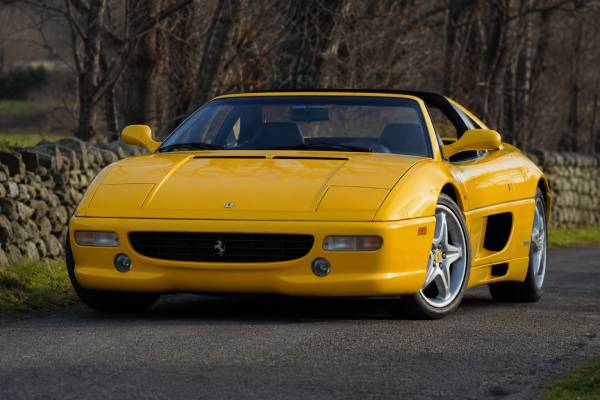
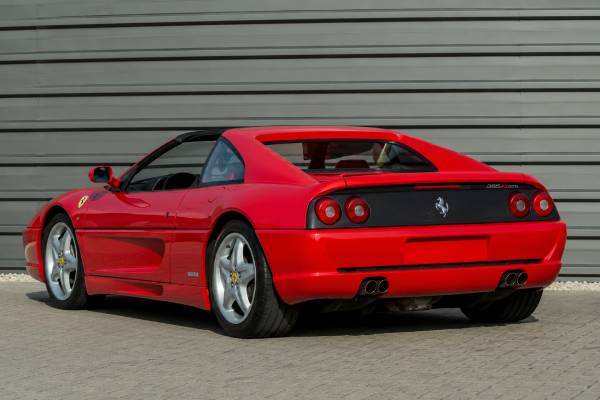
The Ferrari 355 F1 GTS is the removable-roof, paddle-shift version of Ferrari’s F129-generation mid-engine V8 sports car. Sold for 1997–1999, it combines the F355 GTS targa body with Ferrari’s early electrohydraulic F1 gearbox, a system derived from racing practice but applied to a road car for the first time in this model family. Its 3.5-liter F129 B/C V8 is the heart of the car: naturally aspirated, dry-sump, five valves per cylinder, and rated at 380 metric horsepower at a very high 8,250 rpm.
Collectors still care because the 355 F1 GTS sits at a turning point. It has the compact size, analog steering feel, and Pininfarina shape of an older Ferrari, but it also introduced the paddle-shift era that later defined Maranello’s road cars. For buyers, that mix is attractive, but it demands careful inspection, specialist servicing, and a clear view of originality.
Table of Contents
- Why the 355 F1 GTS Matters
- Engine, Chassis, and Key Specs
- Production, Variants, and Authenticity
- Pininfarina Shape and F1-Era Engineering
- Road Feel, Performance, and Character
- Maintenance Risks and Specialist Repairs
- Market Values and Buyer Checklist
Why the 355 F1 GTS Matters
The 355 F1 GTS matters because it combines one of Ferrari’s best-loved modern-classic shapes with the first-generation road-car paddle-shift system. It is not the purest F355 to everyone, but it is historically important because it marks the moment Ferrari began moving from gated manuals toward F1-style shifting.
The F355 replaced the 348 and answered many of the criticisms aimed at that earlier car. The 348 had presence and speed, but it could feel demanding, edgy, and less refined than rivals such as the Honda NSX and Porsche 911. Ferrari’s response was not a clean-sheet supercar, but the F355 was so heavily reworked that it felt like a new generation. It had a more powerful engine, revised chassis behavior, better aerodynamics, improved drivability, and a much more elegant Pininfarina body.
The GTS body style is central to the appeal. It is the targa version, with a removable roof panel that can be stored behind the seats. It gives much of the Berlinetta’s profile and structural feel, but adds open-air sound and drama without the full visual change of the Spider. For many enthusiasts, the GTS is the sweet spot: more special than the coupe, more focused than the convertible, and still unmistakably an F355.
Ferrari introduced the F1 transmission option in the late 1990s, using the same basic six-speed manual gearbox operated by electrohydraulic actuators. There is no clutch pedal. The driver shifts using paddles behind the steering wheel, while the system controls clutch operation and gear engagement. Today, the system feels old compared with a modern dual-clutch gearbox, but that is part of its historical value. It is mechanical, audible, and deliberate rather than seamless.
The 355 F1 GTS therefore sits in an interesting collector position. Manual GTS cars usually bring more money because gated Ferraris are now highly prized. The F1 GTS, however, is rarer than the manual GTS and has a stronger claim as a technology milestone. It also avoids the bulk and electronic complexity of later Ferraris while still offering a genuine early paddle-shift experience.
It is important to understand the name. Ferrari often referred to F1-equipped cars as “355 F1” rather than “F355 F1,” even though enthusiasts commonly use both terms. The car covered here is the 1997–1999 355 F1 GTS: the F129-generation, targa-roof, rear-mid-engine V8 Ferrari with the F1 electrohydraulic transmission.
Engine, Chassis, and Key Specs
The core specification is a 3.5-liter naturally aspirated V8, rear-mid-mounted, driving the rear wheels through a six-speed F1 automated manual gearbox. The important takeaway is that the F1 system changes the shifting method, not the basic engine character: this is still a high-revving, dry-sump Ferrari V8 that wants to work near the top of the tachometer.
| Category | Specification |
|---|---|
| Production years covered | 1997–1999 |
| Platform / type | F129-generation Ferrari 355 F1 GTS |
| Body style | Two-seat targa with removable roof panel |
| Engine | Rear-mid-mounted 90-degree V8 |
| Engine code family | F129 B/C |
| Displacement | 3,495.50 cc |
| Bore x stroke | 85 mm x 77 mm |
| Valvetrain | DOHC, five valves per cylinder, 40 valves total |
| Compression ratio | 11.0:1 |
| Fuel and ignition management | Bosch Motronic electronic injection and ignition |
| Maximum power | 279 kW / 380 hp at 8,250 rpm |
| Maximum torque | 363 Nm at 6,000 rpm |
| Lubrication | Dry sump |
| Transmission | Six-speed electrohydraulic F1 automated manual |
| Drivetrain | Rear-wheel drive |
The engine is the defining feature. Ferrari used five valves per cylinder, with three intake valves and two exhaust valves, to improve breathing at high rpm. That was not a marketing detail; it helped the 3.5-liter V8 produce very high specific output for its era. The result is an engine that feels modest at low revs compared with later turbocharged cars, then becomes sharp, loud, and urgent as it passes the midrange.
The dry-sump system matters because it allows the engine to sit lower in the chassis and maintain oil control during hard cornering. For buyers, it also means oil-level checks and service procedures should be done correctly. A general workshop that treats it like an ordinary wet-sump engine can make mistakes.
| Category | Specification |
|---|---|
| Length | 4,250 mm |
| Width | 1,900 mm |
| Height | 1,170 mm |
| Wheelbase | 2,450 mm |
| Front track | 1,514 mm |
| Rear track | 1,615 mm |
| Dry weight | About 1,350 kg |
| Suspension | Independent unequal-length wishbones, coil springs, telescopic dampers, anti-roll bars |
| Brakes | Vented discs with ABS |
| Front tires | 225/40 ZR18 |
| Rear tires | 265/40 ZR18 |
| 0–100 km/h | About 4.7 seconds |
| Top speed | 295 km/h |
The F355’s structure uses a compact mid-engine layout with steel and aluminum construction. The suspension is conventional in layout but carefully tuned, and many cars have electronically controlled dampers. Condition now matters more than the original brochure specification. A fresh suspension, correct tires, proper alignment, and healthy dampers can make a 355 feel precise and alive. A tired one can feel nervous, loose, and expensive.
Production, Variants, and Authenticity
The 355 F1 GTS is one of the rarer regular-production F355 variants, with commonly cited production of 529 F1-equipped GTS cars. That rarity helps its collector case, but originality and documentation matter more than the number alone.
The F355 range included three main road body styles: Berlinetta, GTS, and Spider. The Berlinetta is the fixed-roof coupe. The GTS uses the removable roof panel. The Spider is the full convertible. Mechanically, the GTS is very close to the Berlinetta, but the roof system, seals, roof storage, and body condition add extra inspection points.
Within the GTS line, the major split is manual versus F1. The manual GTS is the more traditional collector favorite because of its open-gate shifter. The 355 F1 GTS uses paddles and an electrohydraulic clutch and shift system. It was built in smaller numbers, but the market has often valued the manual more highly because modern collectors prize manual Ferraris.
| Variant | Body style | Transmission character | Collector note |
|---|---|---|---|
| F355 Berlinetta | Fixed-roof coupe | Manual or F1 depending on year | Most rigid and simplest roof structure |
| F355 GTS | Removable targa roof | Manual or F1 | Highly desirable body style; roof condition matters |
| F355 Spider | Full convertible | Manual or F1 | Most open-air drama; more roof mechanism complexity |
| F355 Challenge | Track-focused coupe | Race-prepared manual-based specification | Competition history and originality are crucial |
For authenticity, the first step is to confirm that the car is truly a factory F1 GTS, not a misdescribed GTS or a later conversion story. A real F1 car should have the correct paddle-shift hardware, interior controls, hydraulic system, transmission control components, and documentation matching the VIN and build records.
Ferrari Classiche documentation, original books, service invoices, import papers, and dealer records are valuable. A car does not become perfect because it has paperwork, but paperwork helps prove identity, mileage continuity, factory color, original market, ownership history, and major service timing.
Important identifiers and records include:
- VIN and market specification.
- Original exterior and interior colors.
- Gearbox type from build records.
- Engine and gearbox numbers where available.
- Roof panel fit, finish, and storage hardware.
- Tool kit, books, keys, alarm fobs, and manuals.
- Major belt-service invoices.
- F1 clutch wear readings and hydraulic-system service history.
- Evidence of recall or campaign completion where applicable.
Options and colors can influence desirability, but not always in a simple way. Rosso Corsa over tan is the classic poster-car combination and remains easy to sell. Dark colors can make the shape look more subtle and elegant. Yellow suits the 1990s Ferrari personality. Rare factory colors can be valuable, but only when the rest of the car is strong. A neglected rare-color car is still a neglected car.
Be cautious with modifications. Exhaust upgrades are common and often reversible. Aftermarket headers may be seen as a practical solution if original manifolds failed, but buyers should check quality, heat shielding, catalyst compatibility, and emissions legality. Manual conversions are a separate issue. Some buyers want them, but a converted F1 car is no longer an original factory F1 example. For a collector-grade 355 F1 GTS, factory configuration usually matters.
Pininfarina Shape and F1-Era Engineering
The 355 F1 GTS looks clean because its engineering is packaged tightly under a simple Pininfarina form. The car’s appeal is not just styling; the roof, underbody aerodynamics, engine placement, and high-revving V8 all shape how it looks and feels.
The F355 design softened the 348’s harder edges without losing the low, wedge-like stance of a mid-engine Ferrari. The front is cleaner, the side intakes are more elegant, and the rear buttresses give the car a dramatic profile. On the GTS, the removable roof panel adds a distinctive black-roof contrast on many cars and changes the ownership experience without turning the car into a full convertible.
Aerodynamics were a major part of the F355’s development. The car uses underbody shaping and a rear lip detail to manage airflow and stability. This matters in the real world because the F355 does not rely on a large fixed wing for drama. Its body is visually restrained, yet the car was designed to be stable at very high speed.
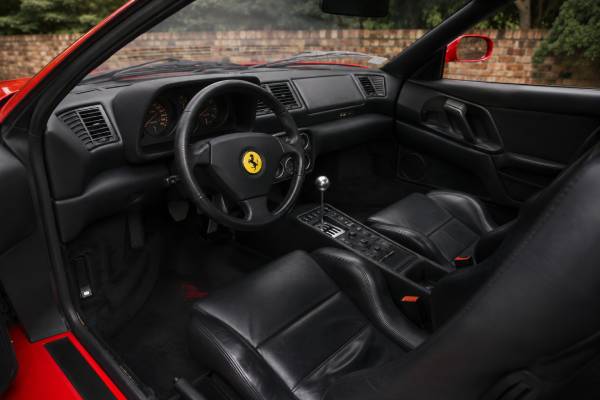
The cockpit is compact and very 1990s Ferrari. The driver sits low, the windshield is broad, and the controls are simple by modern standards. In an F1 car, the missing clutch pedal changes the feel immediately. Instead of the metal gated shifter, the driver sees paddles behind the steering wheel and a transmission control layout that feels period-correct rather than modern.
The F1 system is the special feature. It uses hydraulic pressure and electronic control to operate the clutch and shift forks. It is not a torque-converter automatic and not a dual-clutch transmission. Mechanically, it is closer to a manual gearbox operated by a robot. Smoothness depends heavily on correct adjustment, clutch condition, hydraulic health, software calibration, and driver technique.
At low speed, early F1 systems can feel clumsy if the driver expects a modern automatic. Reversing, parking, hill starts, and stop-start traffic require sympathy. On an open road, the system makes more sense. Lift slightly during shifts, let the car complete the change, and it feels mechanical and engaging. Drive it harshly in traffic and clutch wear can rise quickly.
The engine sound is another major part of the engineering identity. The flat-plane-crank V8 has a hard, metallic note, and the five-valve heads help it breathe at engine speeds where many road cars are already done. Exhaust systems can change the volume dramatically, so buyers should distinguish between a tasteful system, a poorly fitted system, and a car masking catalyst or manifold problems with noise.
The GTS roof adds its own inspection needs. A good roof panel should fit securely, seal well, and store properly behind the seats. Wind noise is normal to a degree, but water leaks, damaged seals, rattles, mismatched paint, or evidence of roof-panel repair should be taken seriously. Replacement trim and seals can be costly or difficult to source.
Road Feel, Performance, and Character
A healthy 355 F1 GTS feels compact, sharp, and rev-hungry rather than brutally powerful by modern standards. Its performance figures are still serious, but the real attraction is the way the engine, steering, chassis, roof, and early paddle-shift system interact.
The engine does not deliver modern turbo-style torque. Below the midrange it is responsive but not overwhelming. Past 5,000 rpm it becomes much more urgent, and near 8,000 rpm the car feels alive in a way few modern cars can copy. This is why condition matters: a 355 with weak compression, tired ignition components, failing catalysts, or old fuel-system parts will not deliver the crisp response people expect.
The F1 gearbox is best understood as a period performance tool. It can shift quickly for its time, and it lets the driver keep both hands on the wheel. But it does not hide the shift event. You feel the torque interruption, hear the hardware work, and learn the rhythm. A good driver can make it smoother by easing the throttle slightly during normal upshifts. At full attack, the system feels more dramatic.
Steering is one of the F355’s strengths. The car has power assistance, but it still communicates clearly compared with many later supercars. The nose feels light, the wheel is not overloaded, and the chassis gives useful feedback before the limit. Proper tires are essential. Old, hardened, or mismatched tires can make the car feel nervous and will undermine braking and wet-road safety.
Ride quality is firm but not punishing when the suspension is healthy. Many poor-driving F355s are not inherently flawed; they are simply old. Worn bushings, tired dampers, sticky suspension actuators, incorrect ride height, and bad alignment can transform the car in the wrong direction. A properly sorted example feels more refined than its reputation suggests.
Braking is strong for road use, but the system is from a different era. It does not have modern carbon-ceramic brakes or today’s huge tire contact patches. On track, heat management and pad choice matter. For road driving, pedal feel, straight stops, and ABS function are more important than quoting a single stopping-distance number.
Visibility is better than in many later mid-engine exotics. The car is low and wide, but it is not huge. The compact size makes it enjoyable on mountain roads and older European roads where modern supercars can feel too large. Cabin heat, noise, and roof-panel wind sound are part of the experience, especially in warm weather or slow traffic.
As a weekend car, the 355 F1 GTS can be highly rewarding. As a city commuter, it is less convincing. The F1 clutch dislikes creeping traffic, the turning circle is not small, and parts prices discourage casual neglect. The car wants to be warmed properly, driven with mechanical sympathy, and serviced by people who understand it.
Maintenance Risks and Specialist Repairs
The 355 F1 GTS is not a low-maintenance classic, and deferred work can quickly exceed any purchase-price saving. The smartest buyer pays more for a documented, inspected, recently serviced car than for a cheaper example with missing history and vague promises.
The timing-belt service is the best-known cost item. On the F355, belt service is generally an engine-out job, which means labor dominates the invoice. A proper major service often becomes more than belts: tensioners, cam seals, fluids, hoses, engine mounts, exhaust hardware, coolant parts, and “while you are there” repairs may be needed. Cheap belt-only work is not the same as a proper major service.
The engine has several known inspection areas. Exhaust manifolds can crack or fail internally, sometimes causing noise, heat issues, and performance problems. Valve-guide wear is a serious concern on some cars and should be checked through compression and leakdown testing, oil-consumption history, exhaust smoke, and specialist inspection. The cooling system needs attention because age affects hoses, radiators, fans, expansion tanks, and clamps.
The fuel system deserves special care. Old hoses, incorrect clamps, and recall-related fuel-line issues are not minor on a mid-engine car with hot exhaust components nearby. A buyer should confirm that relevant campaigns or corrective repairs have been completed where applicable, and should still inspect the present condition of fuel lines and fittings.
The F1 gearbox system adds its own layer. The gearbox itself is related to the manual unit, but the clutch actuation and shift hardware require specialist knowledge. Common areas include the clutch, F1 pump, accumulator, actuator, hydraulic lines, sensors, and calibration. A car that shifts harshly, drops into neutral, refuses gears when hot, or has no clear clutch-wear documentation needs investigation before purchase.
Key maintenance and inspection points include:
- Timing belts, tensioners, cam seals, and date of last engine-out service.
- Compression and leakdown results.
- Exhaust manifold condition and catalyst health.
- Valve-guide wear symptoms.
- Cooling-system hoses, radiators, fans, and expansion tank.
- Fuel hoses, clamps, divider block, and recall-related repairs.
- F1 clutch wear, pump operation, accumulator condition, and calibration.
- Engine mounts and gearbox mounts.
- Suspension bushings, ball joints, dampers, and electronic actuator function.
- Brake discs, pads, flexible lines, ABS operation, and fluid age.
- Sticky interior plastics, shrinking leather, and dashboard condition.
- Roof seals, roof-panel latches, water leaks, and wind noise.
- Accident repairs, undertray damage, corrosion on steel structures, and poor paintwork.
Parts availability is mixed. Routine service parts are available through Ferrari specialists, but trim, original exhaust parts, roof pieces, electronic modules, and some F1-specific items can be expensive. The car is old enough that diagnosis matters as much as parts replacement. Guessing at faults can become very expensive.
A pre-purchase inspection should be done by a Ferrari specialist familiar with F355s, not just a general exotic-car shop. The inspection should include diagnostic checks, underside panels removed where practical, paint-depth readings, road test from cold and hot, service-record review, and a clear estimate for immediate needs.
Restoration can be challenging because the car is modern enough to have electronics, special trim, catalysts, and F1 hydraulics, but old enough to suffer from age-related deterioration. A cosmetic refresh alone does not make a strong car. Mechanical health, correct parts, and careful documentation are what protect long-term value.
Market Values and Buyer Checklist
The 355 F1 GTS sits below the manual GTS in most collector pricing, but it has strong historical interest and a smaller production pool. As of 2026, good F1 GTS cars commonly trade or ask in the low-six-figure range, while exceptional low-mileage, highly original, freshly serviced examples can sit higher.
The market separates cars sharply. A red/tan, low-mile, documented, accident-free F1 GTS with recent major service, healthy F1 system, original books, tools, and strong paint will attract serious buyers. A higher-mile car can still be excellent if it has been maintained properly, but buyers will price in service risk. A car with missing history, sticky interior, unknown clutch wear, old belts, roof leaks, accident paint, and no specialist inspection should be treated as a project, not a bargain.
Manual GTS cars usually carry the strongest premium because the gated shifter has become a collector symbol. That does not make the F1 GTS undesirable. It means the buyer must understand why they want it. If the goal is maximum traditional Ferrari interaction, buy a manual. If the goal is a rarer targa body with the early Ferrari F1 shifting experience, the 355 F1 GTS is more interesting than market stereotypes suggest.
| Factor | Effect on value |
|---|---|
| Factory F1 GTS identity | Essential; verify against records |
| Recent engine-out service | Strong positive if complete and documented |
| F1 system health | Major value factor; clutch and actuator condition matter |
| Original paint and panels | Highly valued, especially with consistent readings |
| Low mileage | Positive, but only if condition supports it |
| Color combination | Classic and rare factory colors can both help |
| Books, tools, and records | Important for collector confidence |
| Manual conversion | May appeal to some drivers, but reduces factory F1 originality |
| Deferred maintenance | Can reduce value dramatically |
A serious buyer should approach the car in sequence:
- Confirm the exact variant and factory specification.
- Review service records before discussing final price.
- Check timing-belt service date and scope.
- Get compression and leakdown results.
- Confirm F1 clutch wear and hydraulic-system operation.
- Inspect the roof panel, seals, latches, and storage area.
- Check for sticky interior trim and leather shrinkage.
- Inspect undertrays, suspension, brakes, and accident repair signs.
- Confirm recalls, campaigns, and fuel-system condition.
- Price the car after the inspection, not before.
The best cars are not always the lowest-mile cars. A 355 F1 GTS that has been driven regularly, serviced correctly, stored well, and sorted by a known specialist can be more satisfying than a static garage queen. Long storage can create fuel, seal, clutch, brake, tire, and electrical issues.
Avoid cars with vague claims such as “just serviced” without invoices. Also be cautious with cars sold immediately before major service is due. A seller may say the next belt service is simple; the invoice may say otherwise. On these cars, a proper pre-purchase inspection is not optional. It is part of the price of admission.
Long term, the 355 F1 GTS has a credible collector story. It is rare, beautiful, mechanically special, and tied to the beginning of Ferrari’s paddle-shift road-car era. Its main challenge is the same one it has always had: ownership costs are real. Buy the right car, maintain it properly, and the reward is one of the most characterful V8 Ferraris of the 1990s.
References
- Ferrari 355 F1 GTS (1997) 1997 (Factory Specifications)
- Ferrari F355 GTS (1994) – Ferrari.com 1994 (Factory Specifications)
- REVOLUTIONARY GEARBOX: Ferrari History 1997 (Manufacturer History)
- Ferrari North America, Inc. 2009 (Recall Notice)
- Ferrari F355 GTS – F1 Market – CLASSIC.COM 2026 (Market Data)
Disclaimer
This article is for informational purposes only and is not a substitute for professional diagnosis, repair, valuation, or inspection. Specifications, torque values, service intervals, procedures, parts, and recall applicability can vary by VIN, market, equipment, production date, and prior repairs. Always verify details against the official Ferrari service documentation for the specific car and consult a qualified Ferrari specialist before buying, servicing, or restoring a 355 F1 GTS.
If you found this guide useful, please consider sharing it on Facebook, X/Twitter, or with other Ferrari enthusiasts to support our work.