
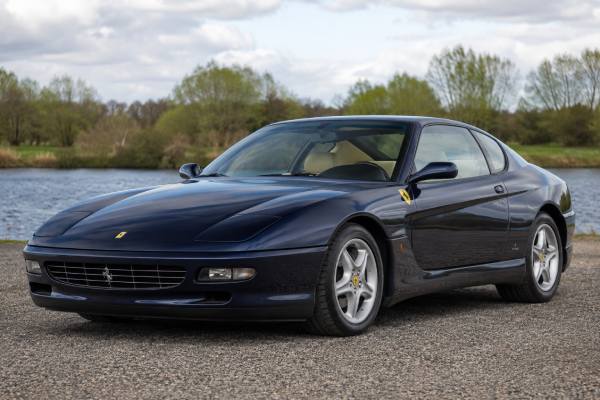
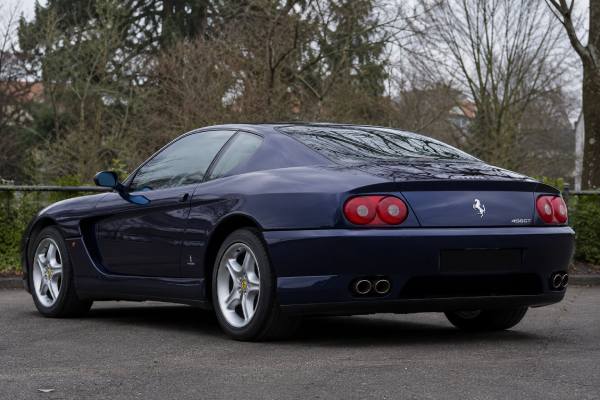
The Ferrari 456 GT (F116 CL) with the early F116B 5.5-liter V12 is one of the most important modern Ferrari grand tourers because it brought the front-engine V12 2+2 back into relevance after the long 400/412 era. Introduced in 1992 and sold through the mid-1990s in this early manual form, it combined a naturally aspirated 65-degree V12, a rear-mounted six-speed manual transaxle, restrained Pininfarina styling, and genuine four-seat intent in a car capable of more than 300 km/h.
The 456 GT matters because it sits at a useful crossroads. It is modern enough to have electronic injection, ABS, power steering, usable air conditioning, and long-distance comfort, but old enough to feel mechanical, analog, and hand-finished. For buyers today, the appeal is clear: a gated manual Ferrari V12 with elegant proportions and real touring ability. The caution is just as clear: condition, window fit, suspension health, belt-service history, body repairs, and documentation matter more than low asking price.
Quick Take
The Ferrari 456 GT F116B is an understated V12 Ferrari for people who value engineering depth, Pininfarina elegance, and usable grand touring more than visual drama. Its strongest appeal is the combination of a 5.5-liter naturally aspirated V12, six-speed manual transaxle, and a proper 2+2 cabin, while its main ownership identity is that of a complex 1990s exotic rather than a simple classic. The main caution is deferred maintenance: window regulators and seals, self-leveling rear suspension, cooling, belts, interior trim, and specialist service records can change the real cost of ownership dramatically. The best cars are original, documented, regularly exercised, and inspected by a Ferrari specialist who knows the 456 family.
Table of Contents
- Model History and Why It Matters
- F116B V12, Chassis, and Key Specs
- Production, Variants, and Original Equipment
- Design, Engineering, and Special Features
- Driving Character and Real Performance
- Reliability, Maintenance, and Restoration Risk
- Market Value and Buying Guide
Model History and Why It Matters
The 456 GT restored Ferrari’s front-engine V12 2+2 as a serious performance car, not just a luxury grand tourer with a famous badge. It replaced the aging 412 line with a cleaner shape, a far more modern chassis, a new V12, and performance that put it among the fastest four-seat production cars of its period.
Ferrari had a long history of front-engine 2+2 models, but by the late 1980s the formula needed renewal. The 400 and 412 were elegant in their own right, yet they belonged to an older world of angular styling, three-box proportions, and more relaxed performance. The 456 GT arrived as a different kind of car: lower, wider, faster, and more technically ambitious, while still keeping the front-engine V12 layout that many Ferrari traditionalists prefer.
The car was launched in the early 1990s, a difficult period for high-end sports cars. The collector boom of the late 1980s had cooled, global economies were uneven, and Ferrari was rebuilding its road-car range with more discipline. Against that background, the 456 GT was not a loud flagship. It was a refined statement that Ferrari could still build an elegant, long-legged V12 GT with serious speed and day-to-day usability.
Pininfarina handled the design, with the exterior commonly associated with Pietro Camardella under the direction of Lorenzo Ramaciotti. The shape avoided the sharp excess of many 1980s cars. It used a long hood, compact cabin, short rear deck, hidden headlamps, and a smooth waistline to create a car that looked expensive without shouting. The reference points were classic Ferrari GTs such as the Daytona and 365 GTC/4 rather than mid-engine supercars.
The factory model reference F116 CL identifies the manual 456 GT family, while the F116B engine code is tied to the early 5.5-liter V12 specification covered here. Later 456 production and the 456M update brought changes in engine management, trim, aerodynamics, equipment, and automatic availability, but the early manual F116B cars are especially interesting because they represent the original idea in its cleanest form.
The 456 GT also helped set the pattern for later front-engine Ferrari V12s. The 550 Maranello, 575M, 612 Scaglietti, FF, GTC4Lusso, and later V12 GTs all live in the broad shadow of the same idea: a front-mounted twelve-cylinder Ferrari that can cover distance at high speed with stability, comfort, and a special engine character. The 456 did that while still offering rear seats, a usable luggage area, and a manual gearbox.
Today, the car’s reputation is more nuanced than it was when values were low. For years, the 456 GT was treated as a bargain Ferrari. That was never quite right, because its service needs were always exotic-car service needs. The better view is that it is a serious collector-grade modern classic that rewards careful buying. A good one feels elegant, fast, and expensive in the best sense. A neglected one can quickly become a costly restoration project.
F116B V12, Chassis, and Key Specs
The core of the 456 GT is its front-mounted F116B V12 paired with a rear six-speed manual transaxle. The specification gives the car its identity: big torque, long gearing, balanced weight distribution, and a smoother grand-touring character than Ferrari’s mid-engine cars of the same era.
The engine is an all-alloy, naturally aspirated 65-degree V12 with four valves per cylinder and twin overhead camshafts per bank. Displacement is 5,473.91 cc, which is why the model name “456” refers to the approximate displacement of each cylinder in cubic centimeters. Its power rating is commonly listed as 325 kW, or 442 metric horsepower, at 6,250 rpm. In imperial terms, that is often expressed as about 436 bhp. Torque is the real-world headline: 550 Nm at 4,500 rpm gives the 456 GT strong flexibility for a naturally aspirated 1990s Ferrari.
Unlike a mid-engine Ferrari built around aggressive response and short, intense drives, the 456 GT’s mechanical layout was intended for speed over distance. The gearbox is mounted at the rear as a transaxle, helping weight distribution and giving the car a more settled feel at high speed. The engine sits ahead of the cabin but behind a very long hood, and the car feels like a classic front-engine GT with much more modern precision.
| Item | Specification |
|---|---|
| Engine code | F116B |
| Configuration | 65-degree naturally aspirated V12 |
| Displacement | 5,473.91 cc |
| Bore x stroke | 88 mm x 75 mm |
| Valvetrain | 48 valves, twin overhead camshafts per bank |
| Compression ratio | 10.6:1 |
| Fuel system | Bosch Motronic electronic injection on early cars |
| Maximum power | 325 kW / 442 PS at 6,250 rpm |
| Maximum torque | 550 Nm at 4,500 rpm |
| Drivetrain | Front engine, rear-wheel drive |
The chassis is a steel tubular spaceframe with mainly aluminum body panels. Ferrari used a special material called Feran to bond or weld aluminum panels to the steel structure, which helped combine light outer panels with a strong base. This matters for buyers because repairs are not like repairs on an ordinary steel-bodied car. Accident damage, poor paintwork, corrosion around joints, and incorrect panel repairs need specialist inspection.
| Category | Ferrari 456 GT F116B |
|---|---|
| Transmission | Six-speed manual rear transaxle |
| Suspension | Independent double wishbones with electronically controlled damping; rear self-leveling system |
| Brakes | Ventilated discs with ABS |
| Steering | Speed-sensitive power-assisted rack-and-pinion |
| Wheelbase | 2,600 mm |
| Length | 4,730 mm |
| Width | 1,920 mm |
| Height | 1,300 mm |
| Dry weight | About 1,690 kg |
| Fuel capacity | About 110 liters |
| 0–100 km/h | About 5.2 seconds |
| Top speed | Over 300 km/h |
The suspension layout is important because it is central to the 456’s dual character. Double wishbones and adaptive damping give the car control, while the self-leveling rear system helps maintain ride height when passengers or luggage are aboard. This is not just a luxury feature; it is part of what makes the car work as a fast 2+2 rather than a two-seat sports car with token rear seats.
The brakes and tires were strong for the period, but buyer expectations need to stay realistic. This is a heavy, powerful 1990s GT, not a modern carbon-brake supercar. Proper tires, healthy dampers, clean brake fluid, and correct alignment make a noticeable difference to how the car feels.
Production, Variants, and Original Equipment
The early F116B manual 456 GT sits within the broader 456 family, but it should not be confused with every later 456 or 456M. For buying, valuation, and authenticity, the key distinctions are manual versus automatic, early GT versus later GT updates, and original GT versus 456M Modificata.
The original public 456 range began with the six-speed manual GT. The automatic GTA followed later, using a four-speed automatic transaxle. The 456M arrived for the 1998 model update with revised styling, cooling, interior details, and equipment. Those later cars are closely related, but the article subject here is the early manual GT with the F116B V12.
Production figures are often quoted across the full early 456 GT/GTA run rather than only the exact 1992–1996 F116B subset. Commonly cited totals list 1,548 manual 456 GTs and 403 automatic GTAs before the 456M update, but buyers should treat those numbers as family context rather than a precise count of early F116B-only cars. Engine-management changes and market differences mean that build date, VIN, engine number, and documentation matter more than a simple production-year label.
How the main versions differ
| Version | Main identity | Buyer relevance |
|---|---|---|
| 456 GT | Six-speed manual 2+2 V12 grand tourer | Most desirable to many collectors because of the gated manual gearbox and original design |
| 456 GTA | Automatic version of the early 456 | More relaxed to drive, usually less valuable than a comparable manual |
| 456M GT | Updated manual Modificata model | Improved interior and detail changes, but a different collector proposition |
| 456M GTA | Updated automatic Modificata model | Often the most affordable entry into the 456 family, condition still critical |
Original equipment and specification can make a large difference to value. Many 456 GTs were ordered in restrained colors because the car was aimed at mature Ferrari clients. Dark blue, silver, gray, black, green, and subtle metallic shades suit the shape especially well, although Rosso Corsa cars exist. Interior colors often include beige, tan, black, blue, or gray leather. The best color combination is partly subjective, but originality matters. A factory color with complete records is usually more desirable than a later repaint in a fashionable shade.
Factory and period equipment to verify includes:
- Original wheels and correct tire sizes
- Tool kit, jack, books, leather pouch, and service book
- Factory luggage if supplied with the car
- Original radio or properly documented replacement
- Alarm remotes and key sets where applicable
- Correct warning labels, emissions labels, and market-specific equipment
- Matching chassis, engine, and gearbox documentation
Matching-numbers relevance depends on the market and the buyer, but on a V12 Ferrari it always matters. A replacement engine is not automatically a disaster if it is factory-supplied and documented, but it changes the conversation. A car with its original engine, gearbox, books, stamped history, invoices, and Ferrari Classiche-style documentation will be easier to value and easier to sell.
Market-specific differences also matter. U.S.-market cars may have different lighting, emissions, bumper, labeling, or safety equipment compared with European cars. Imported cars should have clear federalization or import paperwork where required. On a car of this value and complexity, vague stories about import history should be treated as a risk until proven with documents.
Design, Engineering, and Special Features
The 456 GT’s design is special because it hides serious engineering in a shape that looks calm and balanced. It is not visually aggressive like a Testarossa, F355, or F40, but its proportions, materials, and packaging show how carefully Ferrari and Pininfarina approached the modern V12 GT brief.
The exterior is built around classic front-engine Ferrari proportions: long hood, swept roofline, short rear deck, and a cabin set back from the front axle. The pop-up headlights keep the nose clean when closed, while the oval grille and simple side surfaces give the car a more mature look than many 1990s exotics. It is a car that often looks better in person than in photos because its width, low roof, and long wheelbase give it presence without obvious decoration.
The body construction is a major engineering feature. Most of the outer panels are aluminum, while the chassis uses a steel tubular structure. Feran, the special steel-and-aluminum joining material, helped Ferrari combine these materials at a time when mixed-material construction was still unusual in series production. For ownership, this makes the 456 both impressive and demanding. Panel fit, paint edges, bubbling, poor welding, and filler-heavy repairs need careful review.
Aerodynamics were also treated seriously. The original 456 GT used an active rear underbody spoiler that deployed at speed to help stability without adding a fixed rear wing. This fits the whole personality of the car: high-speed function hidden under elegant surfaces. On a pre-purchase inspection, the spoiler mechanism should be checked because failed motors, damaged linkages, or non-functioning systems are not rare on older examples.
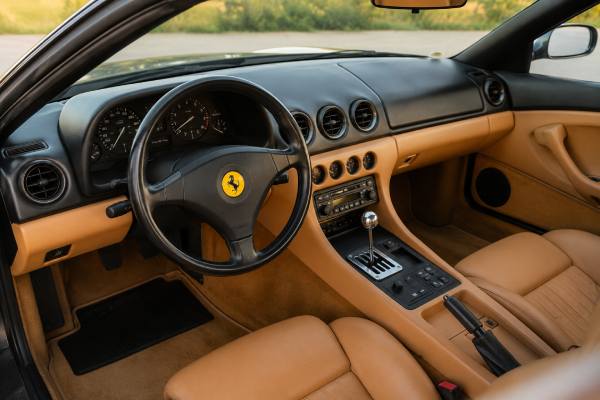
The cockpit is a blend of Ferrari tradition and 1990s luxury. The gated manual shifter is the emotional centerpiece, but the rest of the cabin is more GT than race car. There is broad leather trim, deep front seats, a low dashboard, analog instruments, and rear seats that are genuinely useful for smaller adults or children. The 456 is not a sedan, but it is far more usable than most V12 Ferraris of its era.
Why the packaging matters
The 456 GT was designed for long-distance speed with passengers and luggage. That affects almost every engineering choice:
- The V12 is tuned for torque as well as top-end power.
- The rear transaxle improves balance.
- The cabin is wide and relatively refined.
- The suspension uses adaptive damping instead of a fixed harsh setup.
- The rear self-leveling system helps the car carry weight properly.
- The styling avoids wings and vents that would make the car look like a track special.
The sound is another key part of the experience. The F116B does not scream like a small-displacement Ferrari V8, and it does not have the raw edge of an older carbureted V12. Instead, it has a smooth, layered, mechanical sound that builds with revs. At low rpm it is cultured. Above the midrange it becomes more urgent, with intake and exhaust notes blending into a rich V12 voice. A healthy exhaust system matters because tired silencers, leaks, aftermarket systems, or catalytic-converter issues can change both sound and drivability.
Compared with the later 456M, the early 456 GT feels purer in design. The M brought useful improvements, but it also changed the nose, interior, and some details. Collectors who like first-series cars usually prefer the original GT because it represents the launch design without later correction.
Driving Character and Real Performance
The 456 GT is fast, but its real strength is effortless pace rather than drama at every speed. It feels like a high-speed V12 express: stable, torquey, refined, and more involving than its understated shape suggests.
The engine defines the car from the first few miles. The F116B V12 has enough low- and midrange torque that the driver does not need to chase the redline constantly. It pulls cleanly in higher gears, which suits motorway use and long open roads. When worked harder, it becomes properly quick, with a strong surge from the midrange and a smooth climb toward peak power. The official 0–100 km/h figure of about 5.2 seconds was serious for a four-seat GT in the early 1990s, and the top speed above 300 km/h placed it in rare company.
The six-speed manual gearbox gives the car much of its collector appeal. The gated shift needs deliberate inputs, especially when cold, but it is satisfying once warm. Like many Ferraris of the period, the gearbox should not be rushed before the oil has temperature in it. A good car shifts cleanly, has a progressive clutch, and does not pop out of gear. A poor shift feel can point to worn linkage, clutch issues, mounts, or internal transaxle problems.
The steering is power-assisted and speed-sensitive, so it is not as heavy as an older Daytona or 365 GT 2+2. It is also not as hyperactive as a mid-engine sports car. The feel suits the chassis: stable on center, confident at speed, and accurate enough for fast back roads. A properly aligned 456 GT with fresh tires feels far more composed than a tired one. Old tires, worn dampers, and incorrect ride height can make the car feel vague, heavy, or nervous.
Ride quality is one of the car’s best traits. Ferrari was not trying to build a track-focused machine. The 456 GT can cover rough roads with a level of compliance that surprises people who expect every Ferrari to be stiff. The adaptive damping lets the car breathe over long-distance surfaces, while the rear self-leveling system helps keep the rear end controlled with passengers or luggage. If the rear dampers are leaking or the system is not working, the car loses much of its intended polish.
Braking performance is good for the era, but the car’s weight and speed mean the system must be in top condition. A soft pedal, vibration, old hoses, tired fluid, or uneven braking should not be dismissed. The 456 GT is capable of very high road speeds, and its brakes, tires, and suspension need to be maintained as a complete system.
In city use, the car feels large but manageable. Visibility is decent for a low GT, the engine is tractable, and the cabin is civil. The turning circle, long nose, heavy doors, and low front end require care. Heat management, battery condition, cooling-fan operation, and air-conditioning performance matter more in slow traffic than they do in a short test drive.
On a mountain road, the 456 GT rewards smooth driving. It is not a point-and-fire supercar. It prefers clean braking, measured steering, and early throttle. Use the torque, let the chassis settle, and it flows well. Driven clumsily, it feels heavy. Driven properly, it feels like a refined V12 GT with real Ferrari precision underneath.
Reliability, Maintenance, and Restoration Risk
A 456 GT can be a durable Ferrari when maintained correctly, but neglect is expensive. The car’s main risks are not one single fatal flaw; they are the combined costs of age, complex systems, V12 access, mixed-material body construction, and specialist-only service.
The F116B V12 is generally respected, but it still needs timing-belt service, fluid changes, careful cooling-system upkeep, and proper diagnosis. Belt history is one of the first things to check. A seller saying “it has not done many miles” is not a substitute for time-based maintenance. Low-mileage cars can have old belts, dry seals, sticking components, stale fuel, and electrical issues from long storage.
A serious inspection should include compression and leak-down testing if there is any doubt about engine health. Smoke on start-up, smoke after overrun, uneven idle, oil consumption, weak compression, coolant contamination, or poor service records all need specialist review. Valve-guide concerns are discussed in 456 circles, but the right response is not panic. The right response is evidence: test results, service history, exhaust behavior, and inspection by someone who knows these engines.
Common ownership and inspection areas
- Timing belts and tensioners: Verify date, mileage, parts used, and who performed the work.
- Cam and front engine seals: Look for oil leaks, especially after long storage.
- Cooling system: Check radiator condition, fans, hoses, thermostat, water pump history, and coolant quality.
- Fuel system: Inspect hoses, pumps, smell of fuel, and evidence of age-related deterioration.
- Clutch and gearbox: Check engagement, slippage, bearing noise, shift quality, and reverse operation.
- Rear self-leveling suspension: Look for leaks, sagging, warning signs, and expensive deferred repairs.
- Electronic dampers: Confirm modes work and that warning lights are not hidden or disconnected.
- Window regulators and seals: Test door glass drop, rise, alignment, wind noise, and water sealing.
- Air conditioning and climate control: Repairs can be time-consuming and costly.
- Sticky interior trim: Common on 1990s Ferraris and fixable, but poor repairs look bad.
- Leather shrinkage: Dash tops, rear trim, and seat bolsters need careful inspection.
- Electrical systems: Check battery drain, fuse panels, switches, lights, seat motors, and alarm behavior.
Window fit is one of the most famous 456 issues. The frameless door glass must seal correctly against the roof and rear quarter glass. Bad regulators, tired seals, poor adjustment, or previous door repairs can create wind noise and water leaks. This is not just an annoyance; water entering the cabin can damage leather, carpets, switches, and electrical connectors.
The suspension is another major cost center. The 456 GT’s ride quality depends on healthy dampers, correct rear leveling, and proper geometry. A car that sits oddly, bounces at the rear, displays warning lights, or clunks over bumps needs more than a casual test drive. Suspension repairs can be expensive, and some parts may require specialist sourcing.
Body and paint inspection is critical because of the mixed steel and aluminum construction. Look for:
- Uneven panel gaps around the hood, doors, and headlamp covers
- Bubbling near panel joints or edges
- Paint mismatch under different lighting
- Overspray on seals, fasteners, or underbody panels
- Poorly repaired front-end damage
- Evidence of corrosion around sills, floors, wheel arches, and mounting points
- Missing Pininfarina or factory markings where expected
Restoration can be difficult because the car is not yet supported like a 1960s Ferrari with a mature restoration ecosystem, yet it is too complex to treat as an ordinary used car. Interior leather, electronic modules, suspension components, original trim, correct wheels, and body panels can all become expensive. A “cheap” 456 GT needing paint, windows, belts, suspension, tires, and interior work may cost more than buying a well-sorted example from the start.
Originality versus upgrades is a careful balance. Sensible upgrades such as improved hoses, modern tires in correct sizes, a discreet battery maintainer, professionally refinished sticky switches, or upgraded window components can improve ownership without harming value. Poor aftermarket wheels, loud exhausts, non-factory interior changes, cheap audio installs, and undocumented engine modifications usually reduce appeal.
Market Value and Buying Guide
The Ferrari 456 GT has moved beyond its old bargain phase, but it remains condition-sensitive. Manual early cars are typically stronger in the market than automatics, and the best examples sell on history, originality, mileage credibility, color, and mechanical condition rather than model name alone.
As of 2026, public market data and specialist listings generally place good manual 456 GTs in a broad middle band, with average examples often trading below the best low-mileage, highly documented cars. Strong manual cars can bring six-figure U.S. dollar results, while cars with high mileage, incomplete records, automatic gearboxes, tired cosmetics, or known needs can sit much lower. European and U.K. values may look lower in headline currency terms, but taxes, import status, steering side, and condition can change the real comparison.
The most important value drivers are:
- Manual gearbox and correct F116 CL identity
- Early F116B originality for buyers seeking the first-series specification
- Complete service records with recent major service
- Documented belt, clutch, suspension, and cooling-system work
- Original paint or high-quality documented paintwork
- Correct wheels, books, tools, keys, and accessories
- Desirable factory color combination
- Low but believable mileage, supported by records
- Clean import, registration, and ownership history
- Specialist inspection with compression and leak-down results where appropriate
Mileage needs careful interpretation. A very low-mileage 456 GT can be valuable, but it can also be mechanically stale if it has sat unused. A higher-mileage car with continuous specialist maintenance may drive better and cost less to sort. For a V12 Ferrari, the quality and timing of work often matter more than the odometer reading alone.
Pre-purchase inspection checklist
| Area | What to check | Why it matters |
|---|---|---|
| Identity | VIN, engine number, gearbox number, market specification, build records | Confirms authenticity and helps avoid wrongly described cars |
| Service history | Belt dates, invoices, specialist stamps, major-service records | Deferred work can exceed the discount on a cheaper car |
| Engine health | Cold start, leaks, smoke, compression, leak-down, cooling behavior | V12 engine repairs are major cost events |
| Transmission | Cold and warm shift quality, clutch bite, noise, reverse engagement | Manual transaxle problems are expensive and affect value |
| Suspension | Rear leveling, damper leaks, warning lights, ride height, alignment | The car’s ride and handling depend on these systems working correctly |
| Windows and seals | Glass drop/rise, alignment, wind noise, water leaks | One of the most common and frustrating 456 GT issues |
| Bodywork | Panel gaps, Feran joints, corrosion, paint depth, accident history | Mixed-material repairs need specialist skill |
| Interior | Leather shrinkage, sticky switches, seat motors, climate control | Cosmetic work can become surprisingly expensive |
| Documents | Books, tools, keys, import papers, invoices, ownership trail | Paperwork strongly affects collector confidence |
The examples to seek are boring in the best way: long-term ownership, regular use, clean history, complete records, known Ferrari specialists, correct equipment, and no mystery modifications. The best seller can explain the car’s service history without defensiveness and provide invoices rather than vague claims.
The examples to avoid are easy to identify once you know the pattern: fresh paint with no explanation, recent auction flips with little history, warning lights dismissed as “Italian character,” window gaps explained as normal, missing records, old belts, cheap tires, weak air conditioning, and cars that have been stored for years without recommissioning.
A 456 GT is also a car where a professional inspection is not optional. The buyer should use a specialist who knows front-engine 1990s Ferraris, not just a general performance-car shop. Paying for a proper inspection can prevent a much larger mistake.
Long-term collectability looks favorable for the right cars. The recipe is strong: Pininfarina design, manual V12, limited production compared with modern Ferraris, genuine usability, and a growing appreciation for analog 1990s exotics. That does not mean every 456 GT will rise equally. Condition gaps will widen. Excellent, original, documented manual cars should remain the most desirable. Poor cars will continue to be expensive projects.
References
- Ferrari 456 GT (1992) – Ferrari.com 1992 (Manufacturer Model Page)
- Ferrari 456 GTA (1996) 1996 (Manufacturer Model Page)
- Decision That Nonconforming 1997 and 1998 Ferrari 456 GT and GTA Passenger Cars Are Eligible for Importation 2004 (Official Import Eligibility Notice)
- Ferrari 456 GT Market 2026 (Market Data)
- 1995 Ferrari 456 GT | Hagerty Valuation Tool® 2026 (Valuation Guide)
Disclaimer
This article is for informational purposes only and is not a substitute for professional diagnosis, repair, appraisal, or inspection. Specifications, torque values, service intervals, procedures, recalls, and equipment can vary by VIN, market, model year, and individual vehicle history. Always verify details against official Ferrari service documentation and have any purchase or repair decision reviewed by a qualified Ferrari specialist.
If this guide was useful, please consider sharing it on Facebook, X/Twitter, or your preferred enthusiast community to support our work.