
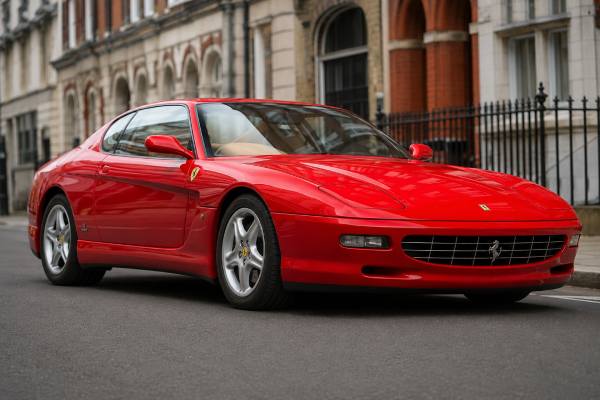
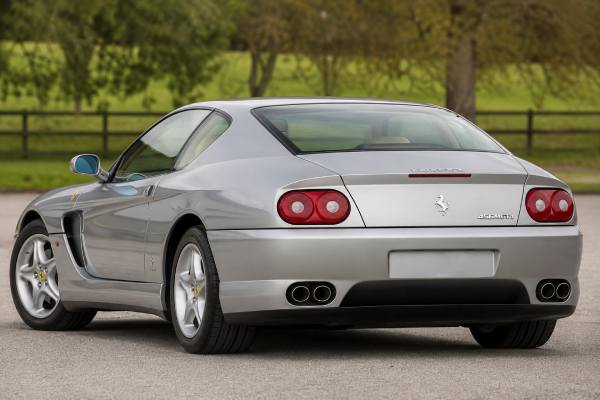
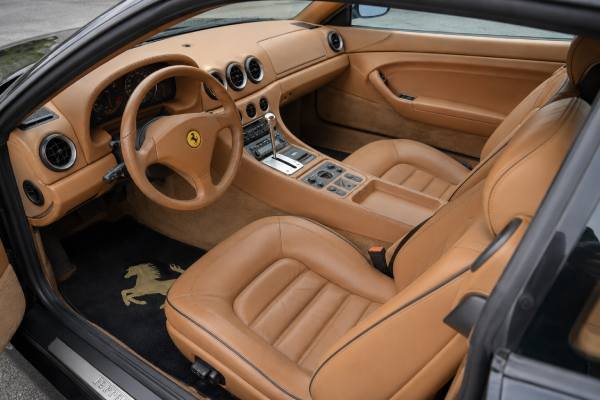
The Ferrari 456M GTA Scaglietti is the automatic, late-production expression of Ferrari’s front-engine V12 2+2 grand tourer, powered by the Tipo F116C 5.5-liter V12 and produced in 2002–2003 as part of the limited Scaglietti personalization run. It sits at an interesting point in Ferrari history: old enough to feel hand-built and analog, yet modern enough to offer fuel injection, ABS, adaptive damping, airbags in many markets, power seats, climate control, and a genuinely usable cabin.
The standard 456M GTA already blended long-distance luxury with a 442 hp V12 and rear-wheel drive. The Scaglietti version adds a rarer identity through Ferrari’s Carrozzeria Scaglietti personalization program, most famously linked with the two-tone “Bicolore” treatment shown on Michael Schumacher’s commissioned car at Geneva in 2002. For buyers today, the appeal is not just speed. It is the combination of understated Pininfarina design, a naturally aspirated Ferrari V12, four-seat packaging, limited-production character, and a market position that still looks approachable compared with many gated-manual or limited-series Ferraris.
Quick Take
The Ferrari 456M GTA Scaglietti is a rare, discreet V12 Ferrari for buyers who value grand touring refinement more than track-day theatre. Its strongest appeal is the blend of a 5.5-liter F116C V12, automatic-transmission usability, Pininfarina elegance, and Scaglietti personalization, while its biggest caution is condition sensitivity: deferred maintenance, window problems, sticky interior parts, aging suspension, cooling leaks, and incomplete documentation can turn a seemingly attractive car into an expensive project. The best examples are original, fully documented, correctly specified Scaglietti cars with consistent specialist service history, working electronics, fresh tires, healthy dampers, and clear proof of factory personalization.
Table of Contents
- History and Collector Importance
- Engine, Chassis and Key Specs
- Production, Variants and Options
- Design, Engineering and Scaglietti Details
- Driving Character and Performance
- Maintenance, Reliability and Restoration
- Market Value and Buying Guide
History and Collector Importance
The 456M GTA Scaglietti matters because it represents the last and most personalized phase of Ferrari’s F116-generation V12 2+2. It is not the most aggressive Ferrari of its era, but it is one of the most elegant and usable ways to experience a naturally aspirated front-engine Ferrari V12.
The original Ferrari 456 arrived in the early 1990s as a return to the classic front-engine V12 four-seat Ferrari formula. It followed the long-running 365 GT4 2+2, 400, and 412 family, but it was a far more modern car. The proportions were traditional Ferrari grand tourer: long hood, compact rear deck, low roofline, and a cabin set back behind the front axle. The execution, however, was much more contemporary, with aluminum body panels, a tubular steel chassis, a sophisticated V12, and a level of comfort aimed at buyers who wanted a Ferrari they could use over distance.
The 456M, with “M” standing for Modificata, arrived for the 1998 model year. Ferrari refined the design, cooling, aerodynamics, interior layout, braking, suspension behavior, and day-to-day usability. The hood lost the earlier intake vents, the front air intake was reshaped, the rear bumper and underbody treatment changed, and the interior received a more modern arrangement. The result was not a dramatic reinvention but a carefully improved version of an already mature grand tourer.
The GTA name identifies the automatic-transmission version. In Ferrari terms, that has often made it less collectible than the six-speed manual GT, especially among buyers focused on open-gate shift feel. Yet the automatic suits the car’s long-distance personality. The 456M GTA was not meant to be a stripped-out sports car. It was a fast, luxurious V12 coupe for crossing countries at high speed with luggage, two rear seats for occasional use, and enough refinement to make the journey feel special.
The Scaglietti identity adds another layer. In 2002, Ferrari used the 456M GT Scaglietti, also widely known as the Bicolore Scaglietti or Schumacher Edition, to demonstrate the possibilities of its Carrozzeria Scaglietti personalization program. Michael Schumacher’s commissioned car helped introduce the theme: two-tone exterior paint, special interior trim, unique detailing, upgraded equipment, and a more tailored feel than the standard production car.
For collectors, that makes the 456M GTA Scaglietti a niche car rather than a mass-market classic. It does not have the universal demand of a manual 550 Maranello or the drama of a mid-engine Ferrari, but it has rarity, subtlety, and a direct link to Ferrari’s early modern personalization era. The important point is documentation. A normal 456M GTA with later cosmetic changes is not the same as a factory Scaglietti-personalized car. Original build records, Ferrari documentation, invoices, books, tools, and a clear specification trail matter greatly.
The car’s reputation today is more nuanced than it was when new. For years, the 456 family sat in the shadow of more obvious collector Ferraris. That kept values relatively restrained. As buyers have become more interested in analog V12 Ferraris, elegant grand tourers, and low-production special specifications, the best 456M examples have gained more attention. The GTA still usually trades below the manual, but a true Scaglietti car can stand apart because rarity and factory personalization often carry weight with marque-focused collectors.
Engine, Chassis and Key Specs
The technical center of the 456M GTA Scaglietti is its Tipo F116C V12, a 5.5-liter naturally aspirated engine mounted at the front and driving the rear wheels through an automatic transaxle. The car combines traditional Ferrari grand touring architecture with late-1990s electronic engine management and a more refined chassis than the earlier 456.
| Category | Specification |
|---|---|
| Model years covered | 2002–2003 |
| Chassis family | F116 / F116 CLA identifier used for this variant |
| Body style | 2-door 2+2 coupe |
| Engine | Tipo F116C 65-degree naturally aspirated V12 |
| Displacement | 5,473.91 cc |
| Bore x stroke | 88 mm x 75 mm |
| Compression ratio | 10.6:1 |
| Output | 442 hp at 6,250 rpm |
| Torque | 550 Nm at 4,500 rpm |
| Fuel and ignition management | Bosch Motronic M5.2 |
| Lubrication | Dry sump |
| Transmission | 4-speed automatic |
| Drivetrain | Front engine, rear-wheel drive |
The F116C V12 is one of the main reasons the 456M remains desirable. It is not a peaky racing engine squeezed into a luxury coupe. It is a large, smooth, high-revving V12 with four valves per cylinder, dry-sump lubrication, electronic fuel injection, and a broad torque curve. The engine’s character fits the car: quiet and refined at low revs, strong through the middle, and increasingly urgent as it climbs toward the upper range.
The automatic gearbox changes the personality compared with the manual 456M GT. It softens the car’s edge and makes the GTA feel more like a fast continental GT. The automatic is not as quick or interactive as a modern dual-clutch transmission, and it should not be judged by that standard. It is a period torque-converter unit, tuned for smoothness and high-speed ease rather than aggressive shift speed.
| Area | Specification |
|---|---|
| Length | 4,763 mm |
| Width | 1,920 mm |
| Height | 1,300 mm |
| Wheelbase | 2,600 mm |
| Front track | 1,585 mm |
| Rear track | 1,606 mm |
| Dry weight | 1,690 kg |
| Front tires | 255/45 ZR 17 |
| Rear tires | 285/40 ZR 17 |
| Steering | Power-assisted rack and pinion |
| Brakes | Ventilated discs with ABS |
The chassis uses a tubular steel structure with aluminum body panels. The 456M also used a carbon-fiber hood, an advanced feature for a luxury GT of its period. Suspension is independent, with electronic damping control designed to balance comfort and control. The system is important to the car’s identity because the 456M is meant to ride with more polish than Ferrari’s two-seat sports models.
Official performance figures vary slightly by source and market, but the 456M GTA is generally quoted around 5.4 seconds from 0–100 km/h and just under or around 300 km/h at the top end. The manual GT is usually a little quicker on paper, but the real-world difference is less important than the feel. The GTA delivers its pace with a smooth, rolling surge rather than a sharp mechanical punch.
Production, Variants and Options
The Scaglietti version is best understood as a rare personalization-led derivative of the late 456M, not a mechanically separate model with a new engine or chassis. Correct identification depends on factory records, original specification, and evidence that the car was built through the Scaglietti personalization program.
The wider 456 line ran from the original 456 GT through the later 456M GT and GTA. The 456M family is commonly divided between the manual GT and automatic GTA. The Scaglietti or Bicolore Scaglietti cars appeared at the end of production and are usually described as a limited run of 30 cars, with a smaller number built as manuals and the rest as automatics. For the subject of this guide, the focus is the automatic 456M GTA Scaglietti from 2002–2003.
How the main versions differ
| Version | Years | Main identity |
|---|---|---|
| 456 GT | 1990s | Original six-speed manual V12 2+2 |
| 456 GTA | Mid-to-late 1990s | Automatic version of the original 456 |
| 456M GT | 1998–2003 | Updated Modificata model with six-speed manual |
| 456M GTA | 1998–2003 | Updated Modificata model with automatic transmission |
| 456M Scaglietti / Bicolore Scaglietti | 2002–2003 | Limited personalization-program version, including GT and GTA examples |
The 456M brought several changes over the earlier 456. The exterior was cleaned up, the cooling and aerodynamic package was revised, the interior was reorganized, and the braking and suspension feel were improved. These changes make the M cars more desirable to buyers who want the most developed version of the platform.
The Scaglietti package is more about specification and presentation than raw mechanical transformation. The most famous cars use a two-tone exterior treatment, often with the roof and pillars in a contrasting shade. Other details can include special leather treatment, unique stitching, revised instrument graphics, upgraded audio, navigation equipment, and cross-drilled brake discs. Because Ferrari personalization allowed variation, not every car should be assumed to have the same combination of features.
Factory documentation matters
For a collector, the key question is whether the car is a genuine factory Scaglietti specification. A repaint, wheel change, or later interior retrim can imitate parts of the look, but it cannot recreate factory provenance. Before paying a premium, a buyer should look for:
- Original build sheet or Ferrari documentation showing the specification
- Sales invoice or dealer paperwork identifying Scaglietti personalization
- Ferrari Classiche or official heritage records where available
- Matching chassis, engine, gearbox, and body identifiers
- Original books, pouch, tools, keys, tire inflator, and accessories
- Service records showing continuous care rather than long storage gaps
- Paint-meter readings and trim inspection consistent with the documented build
The GTA transmission also affects desirability. Manual 456M Scaglietti cars are typically more sought after by collectors who prioritize engagement and rarity. The GTA, however, may be more appealing to buyers who actually intend to drive the car in traffic or on long trips. The correct choice depends on intent. For investment-led collectors, originality and documented rarity dominate. For owner-drivers, a well-sorted automatic may be the more relaxing and usable car.
Design, Engineering and Scaglietti Details
The 456M GTA Scaglietti is distinctive because it is visually restrained for a Ferrari yet technically serious underneath. Its design does not rely on wings, scoops, or extreme stance; the appeal is in proportion, surface control, and the quiet confidence of a front-engine V12 coupe.
Pininfarina’s design gives the car a classic Ferrari grand touring shape. The long hood signals the V12 layout, while the compact tail and low greenhouse keep the car from looking like a conventional luxury coupe. The side scallop adds visual tension without turning the body into a styling exercise. The pop-up headlights, among the last used by Ferrari, give the front end a clean appearance when closed and a period-correct character when raised.
The 456M revisions made the design smoother. The earlier hood vents were removed, the front intake treatment changed, and the rear bumper and underbody were revised. These changes helped the car look more mature and less busy. On a Scaglietti example, the two-tone finish can either enhance that elegance or overwhelm it, depending on color choice. The best combinations work because they are subtle, not because they shout.
Body construction and materials
The 456M uses aluminum body panels over a steel structure, a combination chosen for strength, weight control, and repairability within Ferrari’s production methods of the time. The carbon-fiber hood is a notable engineering detail. It reduces weight high and forward in the car, while also showing how Ferrari was beginning to use composite materials beyond racing and ultra-limited supercars.
This construction also brings inspection challenges. Aluminum panels, steel structure, bonding methods, previous accident repairs, and paintwork quality all need careful assessment. A poor repair can be hidden under glossy paint but reveal itself through uneven gaps, inconsistent panel edges, corrosion around fixings, or trim that does not sit correctly.
Cabin character
The interior is more luxury GT than minimalist sports car. Connolly leather, power equipment, climate control, and a broad dashboard make the 456M feel expensive in a traditional way. The rear seats are real but limited. They suit children, shorter adults on brief trips, or extra luggage space more than regular four-adult travel.
The Scaglietti cars may feature special leather, stitching, dials, audio, and navigation equipment. These details matter because replacing or restoring them accurately can be difficult. A retrimmed cabin might look fresh, but if it loses the original stitching pattern, leather grain, plaques, or color combination, it can reduce collector appeal.
Engineering personality
Several engineering choices define how the car feels:
- The V12 sits at the front but behind a long hood, giving the car classic GT balance.
- The transaxle layout helps distribute weight more evenly than a simple front-engine/front-gearbox setup.
- Electronic damping gives the car a dual character: composed on highways, firmer when driven harder.
- The automatic gearbox prioritizes smooth power delivery over shift drama.
- Large tires and a wide body give strong high-speed stability but require correct tire choice and alignment.
The 456M GTA Scaglietti is not a lightweight special. Its engineering goal is not lap time purity. It is a fast, stable, elegant, high-speed touring car with enough Ferrari character to feel special every time the V12 comes alive.
Driving Character and Performance
The 456M GTA Scaglietti drives like a mature V12 grand tourer: fast, smooth, stable, and more relaxed than a mid-engine Ferrari. Its performance is serious, but the way it delivers speed is more important than the stopwatch number.
At low speeds, the first impression is often size and weight. The hood is long, the body is wide, and the car feels more substantial than a 360 Modena or F355. The steering is assisted but still gives more road texture than many modern GT cars. Visibility is good by exotic-car standards, although the low seating position and long nose take some adjustment.
The V12 is the centerpiece. It starts with a refined mechanical sound, settles into a cultured idle, and builds power in a smooth, expensive-feeling sweep. The engine does not need to be worked hard to feel special. There is enough torque in the middle of the rev range to make the car effortless on fast roads, yet it still rewards higher revs with a sharper intake and exhaust note.
The automatic gearbox gives the GTA its own character. It is not the choice for drivers who want the metal-gate involvement of a manual Ferrari. It is the choice for a relaxed, fast, old-school GT experience. When healthy, it should shift smoothly, respond cleanly, and avoid harsh engagement or slipping. A tired transmission, poor fluid history, or neglected cooling-line issue can turn the car from refined to worrying very quickly.
On a flowing road, the 456M GTA is best driven with rhythm. It prefers clean inputs, early throttle, and smooth braking rather than abrupt corner attacks. The front end has weight, but the chassis is stable and confidence-inspiring when the suspension, tires, and alignment are correct. Old tires can ruin the car. So can worn dampers, tired bushings, incorrect ride height, or mismatched rubber.
Braking performance is strong for the period, especially on cars with upgraded or cross-drilled discs, but expectations should remain realistic. This is a heavy, powerful GT, not a modern carbon-ceramic-braked supercar. Brake pedal feel, rotor condition, caliper health, flexible lines, and fluid age all matter.
The ride is one of the car’s underrated strengths. A well-sorted 456M can cover poor roads with surprising composure. The adaptive damping system allows the car to feel settled at highway speeds without becoming harsh in normal driving. When the system is not healthy, however, the car can feel floaty, uneven, or crashy.
The best setting for the 456M GTA Scaglietti is a long road. It feels right cruising at speed, overtaking with one smooth movement, and letting the V12 work without strain. Around town, it is usable but not small. On track, it is interesting but not ideal. On a mountain road, it can be rewarding if driven as a grand tourer rather than forced to behave like a smaller sports car.
Maintenance, Reliability and Restoration
The 456M GTA Scaglietti can be a durable Ferrari when maintained properly, but it is not cheap to run and it does not tolerate neglect. The most expensive cars are often the ones bought cheaply without a complete inspection, service history, or proof that age-related issues have already been addressed.
The F116C V12 has a good reputation compared with some more fragile exotic engines, but “good reputation” does not mean low-cost ownership. It still needs specialist care, correct fluids, careful cooling-system maintenance, and regular attention to leaks, belts, sensors, mounts, and ancillaries. A car that has sat unused for years may need more work than a higher-mileage car that has been serviced consistently.
Common inspection areas
| Area | What to inspect | Why it matters |
|---|---|---|
| Engine | Oil leaks, coolant leaks, belt history, mounts, sensors, idle quality | Deferred V12 service can become expensive quickly |
| Cooling system | Radiator condition, hoses, fans, thermostat, expansion tank | Heat control is essential for engine and gearbox health |
| Automatic gearbox | Shift quality, fluid history, cooler lines, leaks, delayed engagement | The GTA’s value depends heavily on a healthy transmission |
| Suspension | Adaptive dampers, actuators, bushings, accumulators, ride height | A tired system ruins ride, handling, and tire wear |
| Brakes | Rotor wear, calipers, hoses, ABS warning lights, fluid age | Parts and labor can be costly |
| Windows | Operation, sealing, alignment, regulator condition | 456 window issues are well known and can be frustrating |
| Interior | Sticky switches, shrinking leather, air vents, seat motors, climate controls | Correct restoration of special Scaglietti trim is difficult |
| Body | Panel gaps, aluminum repair quality, paint depth, corrosion around fixings | Accident repair can seriously affect value |
Window operation deserves special attention. Many 456s suffer from poor window sealing or alignment, which can lead to wind noise, water leaks, and repeated adjustment attempts. A car that looks beautiful but has ill-fitting glass may be hiding an expensive and time-consuming problem.
Sticky interior plastics are another common period Ferrari issue. Soft-touch coatings degrade with age, especially in warm climates. A proper refinishing job can restore the cabin, but cheap repairs often look wrong. On a Scaglietti car, preserving correct trim appearance is especially important.
Suspension condition is central to the way the car drives. The electronically controlled dampers, bushings, links, and related components all age. A pre-purchase inspection should include a road test on varied surfaces, not just a visual check on a lift. Listen for knocks, look for leaks, and confirm the suspension modes work correctly.
The automatic gearbox needs calm, careful evaluation. Shifts should not flare, slam, hesitate excessively, or produce warning lights. Cooling-line condition is important, especially because some Ferrari recall and service history concerns around transmission oil lines affected related 456M GTA cars. Buyers should verify recall and campaign completion by VIN rather than assuming anything from model year alone.
Restoration is possible but not always financially sensible. Paint, leather, electronics, window mechanisms, suspension parts, and trim can add up quickly. The best purchase is usually a complete, original, functioning car with documented maintenance. A “needs minor sorting” Ferrari GT often needs more than minor sorting.
Market Value and Buying Guide
The 456M GTA Scaglietti occupies a narrow but interesting market position: rarer and more distinctive than a standard 456M GTA, usually less universally desired than a manual 456M GT, and far more dependent on documentation than many casual buyers realize. Buy the best documented and best functioning car you can afford, not the cheapest one with attractive paint.
As of 2026, ordinary 456M GTA values remain well below many manual V12 Ferraris, while condition #3 “good” examples in major valuation tools sit around the lower-to-mid five-figure dollar range. Exceptional low-mileage, rare-color, fully documented, or Scaglietti-personalized cars can sit meaningfully above standard driver-quality examples. Asking prices can vary widely because the pool of cars is small and sellers often price rarity, mileage, and specification differently.
The key value drivers are:
- Genuine Scaglietti documentation
- Original two-tone paint and factory-correct trim
- Low but believable mileage
- Continuous Ferrari or respected specialist service history
- Completed recalls and campaigns
- Strong mechanical condition
- Correct books, tools, keys, and accessories
- Clean accident history
- Desirable color combination
- Interior originality and lack of poor retrimming
- Fully working windows, suspension, gearbox, air conditioning, and electronics
A high-mileage but regularly serviced GTA can be a better car to own than a low-mileage garage queen with old tires, dry seals, weak suspension, and incomplete records. Low mileage helps value only when the condition supports it. A car that has covered very few miles but needs recommissioning should be priced accordingly.
Buyer inspection checklist
Before buying, arrange a specialist inspection by someone who knows 456s specifically. A general exotic-car inspection is not enough.
- Confirm identity and documentation
Check chassis, engine, gearbox, registration, service book, build documents, and any Ferrari heritage paperwork. Confirm that the Scaglietti specification is factory-original. - Review service history line by line
Look for belt services, annual maintenance, fluid changes, suspension work, cooling-system renewal, brake work, gearbox service, and campaign completion. - Test every electrical item
Operate windows, mirrors, seats, locks, lights, climate control, stereo, navigation where fitted, dashboard displays, warning lights, and suspension controls. - Inspect the body carefully
Use paint readings, panel-gap inspection, underside examination, and repair-quality assessment. Aluminum repair and paint matching require skill. - Drive the car from cold
Cold start behavior, idle quality, smoke, warning lights, shift engagement, steering feel, suspension noise, brake feel, and temperature control all reveal more than a warm showroom start. - Check originality-sensitive details
On a Scaglietti car, inspect leather color, stitching, plaques, instrument graphics, audio equipment, navigation, brake specification, wheels, and paint separation lines. - Budget beyond the purchase price
Even a good car may need tires, fluids, sticky-button refinishing, suspension work, battery, alignment, hoses, or minor leather work soon after purchase.
Cars to seek and avoid
Seek cars with complete provenance, factory Scaglietti proof, long-term ownership, careful storage, and recent specialist invoices. The ideal car feels tight, starts cleanly, shifts smoothly, runs cool, tracks straight, and has no warning lights or water leaks.
Avoid cars with vague “Scaglietti-style” descriptions, missing records, non-original repaint without documentation, poor window fit, gearbox hesitation, suspension faults, overheated interiors, unexplained warning lights, or seller reluctance to allow inspection. Be especially cautious with cars that have been cosmetically refreshed for sale but lack evidence of deep mechanical care.
Long-term collectability should remain solid for the best examples. The 456M GTA Scaglietti has several ingredients collectors like: naturally aspirated V12, limited-production association, Pininfarina design, late analog-era character, and Ferrari factory personalization. The automatic gearbox may limit its ceiling compared with manual cars, but it also makes the car more usable. For the right buyer, that is not a weakness. It is the point.
References
- Ferrari 456M GTA (1998) – Ferrari.com 1998 (Manufacturer Specifications)
- Ferrari 456M GT (1998) – Ferrari.com 1998 (Manufacturer Specifications)
- 2002 Ferrari 456 M – Specs, Prices, MPG, Reviews & Photos | Cars.com 2002 (Specification Archive)
- 2002 Ferrari 456M GTA Base | Hagerty Valuation Tools 2026 (Valuation Tool)
- Vehicle Detail Search – 2001 FERRARI 456M | NHTSA 2026 (Recall Database)
Disclaimer
This article is for informational purposes only and is not a substitute for professional diagnosis, repair, appraisal, or inspection. Specifications, torque values, service intervals, recall applicability, and repair procedures can vary by VIN, market, equipment, and production date. Always verify details against official Ferrari service documentation, factory records, and a qualified Ferrari specialist before buying, servicing, or restoring any vehicle.
If you found this guide useful, please consider sharing it on Facebook, X/Twitter, or your favorite car community to support our work.