
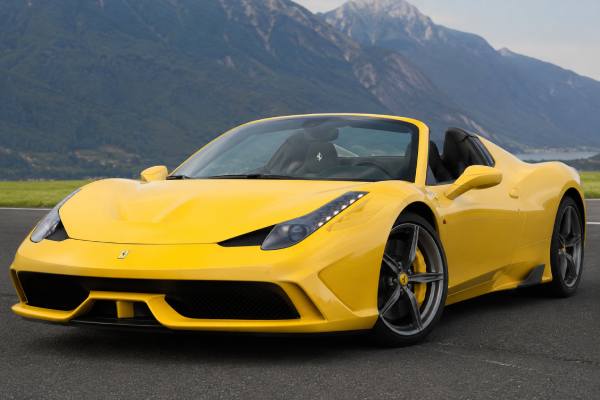
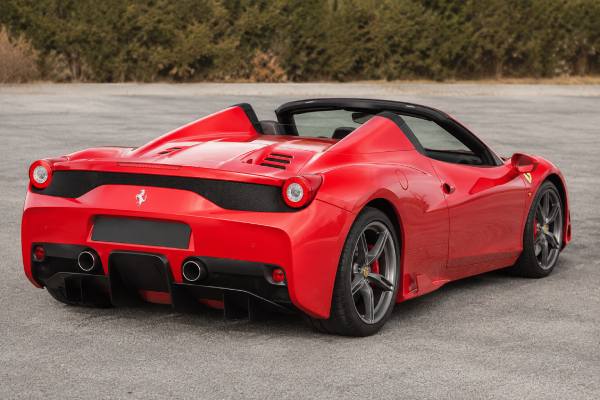
The Ferrari 458 Speciale A is the open-top version of the 458 Speciale, built on the F142 458 platform and powered by the F136 FL 4.5-liter naturally aspirated V8. Produced for the 2014–2015 period and limited to 499 cars, it combined the most focused road-going 458 chassis with Ferrari’s aluminum retractable hardtop. The result was not simply a louder 458 Spider. It was a rare, high-revving, special-series Ferrari that gave the driver the full 9,000-rpm character of the Speciale without a fixed roof.
Its importance comes from timing as much as performance. The 458 Speciale A arrived at the end of Ferrari’s naturally aspirated mid-engine V8 era, just before the 488 GTB moved the line to twin-turbocharging. That makes the car especially attractive to collectors who want the final, factory-built expression of Ferrari’s open, naturally aspirated V8 formula. It also means buyers now judge these cars on much more than mileage. Original paint, factory options, roof function, service history, carbon-ceramic brake condition, recall completion, and provenance all matter.
Quick Take
The Ferrari 458 Speciale A is most appealing because it delivers the razor-sharp 458 Speciale engine, chassis, aero, and electronics with the drama of an open roof. Its identity is tied to the 605 hp naturally aspirated V8, 499-unit production run, 9,000-rpm character, and position as the collector-grade send-off for Ferrari’s mid-engine naturally aspirated V8 Spider line. The main caution is that low mileage does not remove ownership risk: roof hardware, carbon-ceramic brakes, suspension lift, DCT service history, sticky interior wear, recalls, and originality can all affect value heavily.
Table of Contents
- Model History and Collector Significance
- Engine, Chassis, and Key Specifications
- Production, Variants, and Factory Options
- Design, Engineering, and Special Features
- Driving Experience and Real-World Performance
- Reliability, Maintenance, and Restoration Risks
- Market Value and Buying Guide
Model History and Collector Significance
The 458 Speciale A matters because it is the limited open version of one of Ferrari’s most respected modern driver’s cars. It joined the 458 family near the end of production and used the more aggressive Speciale formula rather than the softer standard Spider setup.
The 458 Italia replaced the F430 and moved Ferrari’s mid-engine V8 line into a more electronic, dual-clutch, aero-led era. The standard 458 already had a dramatic 4.5-liter V8, direct injection, a quick-shifting 7-speed dual-clutch gearbox, and styling that looked cleaner and more modern than the F430. The 458 Speciale then sharpened the idea with more power, less weight, active aerodynamics, revised software, and a more track-focused chassis.
The 458 Speciale A, with “A” standing for Aperta, took that package and added the folding hardtop from the Spider body style. Ferrari did not make it a regular-production convertible. It was a limited special series aimed at established collectors and clients who wanted the Speciale’s sharper responses without giving up open-air driving.
Its launch context is a major part of its status. Ferrari’s next regular mid-engine V8, the 488 GTB, used a smaller twin-turbocharged engine. The 488 is faster in many conditions, but the 458 Speciale A has a simpler emotional appeal: no turbochargers, a very high redline, immediate throttle response, and a naturally aspirated soundtrack that became much harder to buy new after this generation.
The car’s reputation today rests on four points:
- Rarity: only 499 examples were built.
- Powertrain character: the 4.5-liter V8 revs to 9,000 rpm and makes its power high in the range.
- Model-line position: it is the open-top version of the hardcore 458 Speciale.
- Collector timing: it marks the end of a naturally aspirated mid-engine Ferrari V8 era.
For enthusiasts, it is one of the most exciting modern Ferraris to hear and drive. For collectors, it is a mileage-sensitive, specification-sensitive, documentation-sensitive car whose values are tied closely to originality and condition.
Engine, Chassis, and Key Specifications
The 458 Speciale A uses a 4,497 cc naturally aspirated V8 mounted behind the cabin and driving the rear wheels through a 7-speed dual-clutch gearbox. Its specification is defined by high revs, low weight for an open car, carbon-ceramic brakes, and software designed to make the chassis exploitable at speed.
| Item | Ferrari 458 Speciale A |
|---|---|
| Platform / type | F142, 2-seat mid-engine retractable-hardtop Spider |
| Engine code | F136 FL |
| Engine layout | 90-degree naturally aspirated V8 |
| Displacement | 4,497 cc / 4.5 liters |
| Maximum power | 605 cv / about 597 hp at 9,000 rpm |
| Maximum torque | 540 Nm / 398 lb-ft at 6,000 rpm |
| Transmission | 7-speed dual-clutch F1 gearbox |
| Drivetrain | Rear-wheel drive |
| Official 0–100 km/h | 3.0 seconds |
| Official 0–200 km/h | 9.5 seconds |
| Top speed | 320 km/h / about 199 mph |
The engine is the heart of the car. Compared with the standard 458 Italia and 458 Spider, the Speciale engine gained power through internal, intake, combustion, and calibration changes. It is not a low-rpm torque engine in the modern turbo sense. It builds urgency as the revs rise, and it saves its most intense character for the top third of the tachometer.
| Area | Specification |
|---|---|
| Wheelbase | 2,650 mm |
| Dry weight | 1,340 kg |
| Kerb weight | 1,445 kg |
| Weight distribution | 42% front / 58% rear |
| Front tires | 245/35 ZR20 |
| Rear tires | 305/30 ZR20 |
| Front brakes | 398 mm carbon-ceramic discs |
| Rear brakes | 360 mm carbon-ceramic discs |
| Fuel tank | 86 liters |
The chassis uses aluminum construction rather than a carbon tub. That matters for repair and inspection: accident damage needs specialist measurement and factory-correct repair methods. The suspension layout uses double wishbones at the front and a multi-link rear setup, with adaptive magnetorheological dampers. The electronic systems include E-Diff, F1-Trac, ESC, high-performance ABS, and Side Slip Angle Control, commonly called SSC.
SSC is one of the Speciale family’s defining features. Instead of simply cutting power when the car begins to slide, the system reads the car’s slip angle and works with the differential and traction control to help the driver manage the car more naturally. It does not make the 458 Speciale A foolproof, but it gives skilled drivers a wider window before the electronics feel intrusive.
Production, Variants, and Factory Options
The 458 Speciale A was built as a limited-run special series, not as a normal 458 Spider trim. Its 499-unit production is central to its desirability, and buyers should treat specification and factory originality as major value factors.
Within the broader 458 family, the main road-car versions are easy to separate:
| Version | Body style | Character |
|---|---|---|
| 458 Italia | Coupe | Original 458 road car |
| 458 Spider | Retractable hardtop | Open 458 with standard road-car tuning |
| 458 Speciale | Coupe | Track-focused, lightweight, special-series 458 |
| 458 Speciale A | Retractable hardtop | Limited open-top Speciale, 499 examples |
The Speciale A was launched in a distinctive yellow presentation specification with a central blue and white stripe, but cars were built in a range of colors and Tailor Made configurations. Today, color and option choices make a large difference. Traditional Ferrari colors such as Rosso Corsa are liquid and familiar, while rarer factory colors can command a premium if they are documented and tasteful. Very unusual specifications can be valuable to the right buyer but may narrow the audience.
Important factory options and specification areas include:
- racing stripe configuration and whether it is factory-applied;
- exterior carbon-fiber pieces, including front aero elements, side sill fins, and rear diffuser trim;
- carbon-fiber engine bay options;
- forged wheels and brake caliper colors;
- racing seats, seat size, stitching, Alcantara, and interior carbon trim;
- suspension lift system;
- parking sensors and rear camera;
- navigation and audio equipment, where fitted;
- Tailor Made paint, leather, fabric, and stitching details.
Factory documentation matters because the Speciale A market punishes uncertainty. A car should ideally have its original books, tools, battery tender, service records, option list, invoices, recall records, and clear ownership history. For rare colors or one-off Tailor Made details, written factory or dealer documentation is especially useful.
Buyers should also be careful with cars that have been visually “upgraded” to look more exotic. Added carbon, aftermarket stripes, repainted panels, non-factory wheels, lowered suspension, exhaust changes, and interior retrims may make a car more dramatic, but they can reduce collector confidence. On a limited Ferrari, reversible changes are much safer than permanent ones.
Design, Engineering, and Special Features
The 458 Speciale A looks purposeful because most of its visual changes serve cooling, airflow, downforce, or weight reduction. It is more aggressive than a 458 Spider but less theatrical than many later supercars, which is part of why the design has aged well.
The basic proportions are pure mid-engine Ferrari: short nose, forward cabin, wide rear haunches, and a low rear deck shaped around the folding hardtop hardware. The Speciale bodywork adds a vented front section, deeper side features, a revised rear bumper, and aerodynamic details that separate it clearly from the standard Spider.
Its active aerodynamics are a key feature. Movable front and rear elements alter airflow depending on speed and driving conditions. At lower and medium speeds, the goal is useful downforce and stability. At higher speeds, the system reduces drag where possible. This is not decoration. It is part of why the car feels planted at speed without needing a huge fixed rear wing.
The retractable hardtop is another engineering highlight. It gives the car a more secure, coupe-like feel than a traditional soft top when closed, yet it folds quickly and preserves the open-air drama buyers expect from an Aperta. The tradeoff is weight and complexity. The Speciale A is heavier than the coupe, and the roof mechanism, seals, sensors, drains, and alignment are all important inspection points.
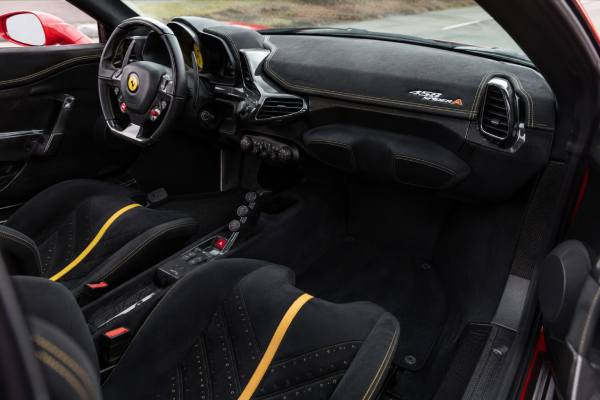
The cockpit is more focused than a regular 458 Spider. The steering wheel carries many controls, including the manettino drive-mode switch. The dashboard and door treatment can vary greatly depending on options, but many cars use Alcantara, carbon fiber, racing seats, and contrast stitching. The driving position is low and forward, with a clear view over the front arches and a strong sense that the car pivots close to the driver.
The sound is one of the car’s defining special features. The flat-plane V8 has a sharp, metallic voice, and removing the roof changes the entire experience. Intake noise, exhaust resonance, mechanical vibration, and high-rpm induction all become part of the appeal. For many buyers, this is the difference between wanting a 488 Spider and wanting a 458 Speciale A.
Driving Experience and Real-World Performance
The 458 Speciale A feels fast because the engine, gearbox, steering, and chassis all respond immediately. It is not just about the 3.0-second 0–100 km/h figure; the appeal is how naturally the car builds speed and how directly it reacts to small driver inputs.
At low speed, the car is more usable than its reputation suggests. The dual-clutch gearbox is smooth enough in normal driving, visibility is acceptable for a mid-engine supercar, and the hardtop makes the cabin more civilized when closed. A front suspension lift, if fitted, is very useful for steep driveways, ferry ramps, city entrances, and underground garages.
The engine dominates the experience. Below the midrange it is clean and responsive, but the car becomes special as the revs climb. The throttle response is crisp, and the final sweep toward 9,000 rpm feels urgent in a way turbocharged engines rarely match. The car rewards drivers who use the gearbox and keep the engine alive rather than relying on a thick wave of low-end torque.
The 7-speed dual-clutch gearbox suits the engine well. Shifts are quick and clean, and in more aggressive modes the transmission adds a sense of occasion without the interruption of an older single-clutch automated manual. It does remove the traditional manual-gate interaction that some collectors love, but the gearbox is central to how the Speciale A delivers its performance.
Steering is very quick, which can surprise drivers coming from older Ferraris. The car does not need big steering angles, and nervous hands can make it feel more alert than necessary. Once the driver relaxes, the front end is precise and eager. The rear has serious grip from the 305-section tires, but tire age and temperature have a big effect. Old tires on a low-mile collector car can make the chassis feel less secure than it should.
On a fast road, the Speciale A is more intense than a regular 458 Spider. It rides firmly, communicates surface changes clearly, and feels happier when the driver is deliberate. On track, it has the brakes, cooling, and software to be very capable, but repeated track use changes the buying equation. Brake wear, tire heat cycles, stone chips, underbody damage, and fluid history need closer review.
The open roof changes the character completely. With the top down, the car is more emotional and less filtered. With the roof up, it feels closer to a focused coupe, though not as pure as the Speciale berlinetta. That dual nature is the whole point of the car.
Reliability, Maintenance, and Restoration Risks
The 458 Speciale A is generally considered a robust modern Ferrari when maintained correctly, but it is still an exotic with expensive systems and limited-production body parts. The biggest ownership risks usually come from deferred maintenance, poor repairs, old tires, weak batteries, roof issues, brake costs, and incomplete documentation.
Routine maintenance should be annual even if the car is barely driven. Many Ferraris of this period were covered by a seven-year maintenance program when new, but those plans have now expired for Speciale A examples. A good car should show regular fluid services, brake-fluid changes, gearbox and differential attention when due, software updates, recall completion, and specialist inspections.
Key ownership areas to check include:
- DCT gearbox: look for smooth engagement, clean shifts, no warning lights, no leaks, and correct service history. The dual-clutch unit is durable when healthy but very expensive when neglected.
- Carbon-ceramic brakes: inspect disc surface condition, remaining wear, pad life, and signs of track use. Replacement costs are high.
- Suspension: check magnetorheological dampers, bushings, ball joints, alignment, and any suspension-lift leaks or faults.
- Roof mechanism: cycle the roof multiple times, check seals, hydraulic or electric operation, latch behavior, alignment, drains, and water marks.
- Cooling system: inspect hoses, radiators, fans, and signs of stone damage or corrosion in front-mounted heat exchangers.
- Electrical system: confirm battery health, tender use, module communication, warning lights, and infotainment function.
- Interior trim: inspect sticky switches, worn soft-touch surfaces, seat bolster wear, loose carbon trim, and leather or Alcantara condition.
- Aero and underbody: check active aero elements, front splitter edges, diffuser damage, undertray fasteners, and scrape marks.
Recalls are especially important. Some 2015 Ferrari models, including 458 Speciale A examples, were affected by a driver-side airbag recall. The 458 line was also included in a later brake-fluid-related recall involving the brake fluid reservoir cap and warning strategy. A buyer should not rely on verbal assurance. The VIN should be checked with an authorized Ferrari dealer, and written proof of recall completion should be kept with the file.
Restoration is a different subject from normal repair. The 458 Speciale A is not old enough to need full restoration in most cases, but accident repair can be complex. Aluminum structure, rare body panels, carbon-fiber exterior parts, special paint, and factory stripes all require expert work. A poor repaint or non-factory stripe can be obvious to a knowledgeable buyer and expensive to correct.
Low mileage can be good for value, but it is not a complete health report. A car that has sat for years may need tires, battery, fluids, seals, dampers, and careful recommissioning. A moderately driven, properly serviced example can be a better ownership car than a delivery-mile car that has not been exercised.
Market Value and Buying Guide
The 458 Speciale A sits near the top of the modern 458 collector market because it combines limited production, open-top usability, and the final naturally aspirated V8 special-series appeal. It normally trades well above standard 458 Spider values and above most 458 Speciale coupe examples.
Current market evidence is thin compared with mass-produced cars because only 499 were built and many trade privately. Public listings and auction results show a wide spread, with the best cars valued far above ordinary 458s. The strongest examples usually have very low mileage, excellent factory specifications, rare but attractive colors, complete documentation, original paint, clean history, and desirable carbon options.
Value drivers include:
| Factor | Why it matters |
|---|---|
| Mileage | Low mileage helps, but only when condition and servicing support it. |
| Original paint | Paintwork on a limited Ferrari affects collector confidence. |
| Factory specification | Carbon, racing seats, lift, stripe, and Tailor Made details can add appeal. |
| Color | Rare factory colors can command premiums, but unusual specs may narrow demand. |
| Documentation | Books, tools, invoices, option list, and recall records reduce risk. |
| Accident history | Structural or cosmetic repairs can reduce value sharply. |
| Brake and tire condition | Carbon-ceramic brakes and correct tires are major cost points. |
A serious pre-purchase inspection should be done by a Ferrari dealer or a specialist who knows the 458 platform. The inspection should include a diagnostic scan, paint-depth readings, underbody inspection, brake-disc condition check, roof operation test, suspension-lift test, service-record review, recall check, and confirmation that the option list matches the car.
Seek cars with:
- complete service history from Ferrari or recognized specialists;
- original paint or clearly documented minor cosmetic work;
- no accident stories or title issues;
- matching factory option documentation;
- healthy roof function and clean seals;
- correct wheels, tires, carbon trim, books, tools, and accessories;
- evidence of battery-tender use and regular exercise.
Be cautious with cars that have:
- missing service invoices;
- vague import history;
- aftermarket exhausts or tuning;
- non-factory stripes presented as factory;
- repaired carbon parts without documentation;
- roof warnings or slow operation;
- old tires on very low mileage;
- heavy track use without matching maintenance records.
The best buying approach is to separate “collector premium” from “ownership quality.” A delivery-mile car may be the right choice for a collection, but it may not be the best car to drive regularly. A slightly higher-mileage example with perfect maintenance, original paint, and a great specification may be more satisfying and less stressful. For long-term collectability, the safest cars are usually those with originality, factory desirability, and a paper trail that answers questions before they are asked.
References
- Ferrari 458 Speciale A (2014) 2014 (Manufacturer Model Page) ([Ferrari][1])
- Ferrari 458 Speciale (2013) – Ferrari.com 2013 (Manufacturer Model Page) ([Ferrari][2])
- IMPORTANT SAFETY RECALL INFORMATION 2015 (Recall Database)
- Part 573 Safety Recall Report 21V-833 2022 (Recall Database)
- Ferrari 458 Speciale A Market – CLASSIC.COM 2026 (Market Data) ([Classic.com][3])
Disclaimer
This article is for informational purposes only and is not a substitute for professional diagnosis, inspection, maintenance, or repair. Specifications, torque values, service intervals, fluids, procedures, recalls, and equipment can vary by VIN, market, model year, and individual vehicle configuration. Always verify details against official Ferrari service documentation and consult a qualified Ferrari technician before making repair or purchase decisions.
Please share this guide on Facebook, X/Twitter, or your preferred automotive community if it helped you research the Ferrari 458 Speciale A.