
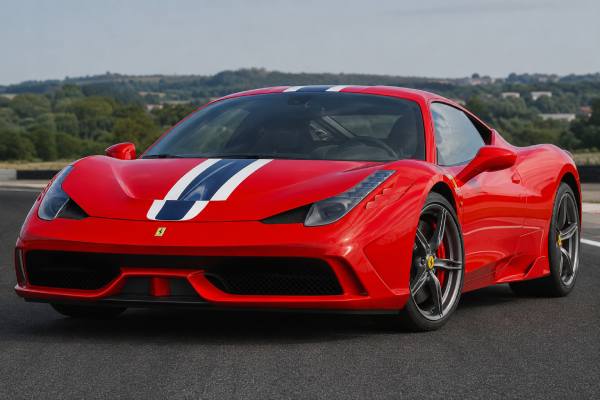
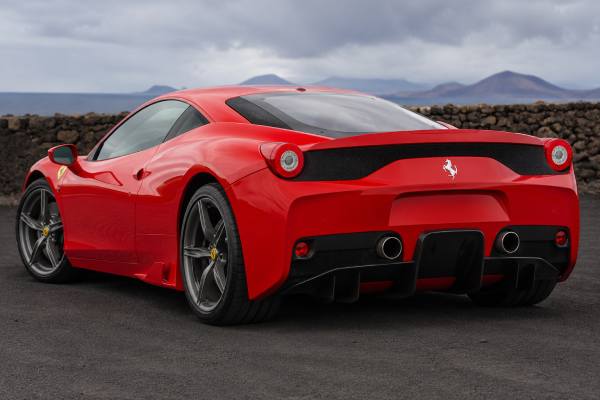
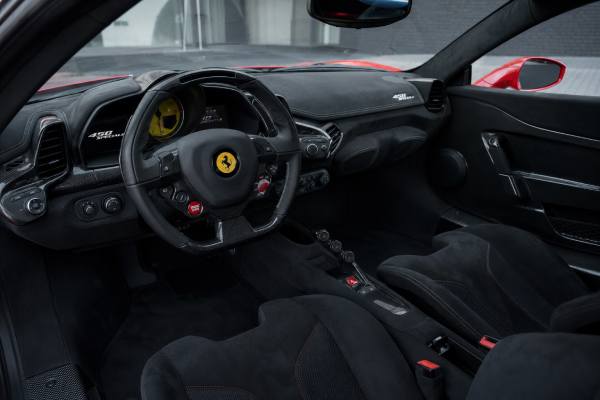
The Ferrari 458 Speciale (F142) is the stripped-back, sharper, track-focused version of the 458 Italia, built from 2013 to 2015 with the F136 FL 4.5-liter naturally aspirated V8 rated at 605 metric horsepower. It matters because it sits at a turning point in Ferrari history: the last special-series mid-engine Ferrari V8 before turbocharging arrived with the 488 GTB, and one of the clearest modern links between the 360 Challenge Stradale, 430 Scuderia, and later 488 Pista.
The Speciale was not simply a 458 Italia with more power. Ferrari changed the engine, aero, weight, software, tires, chassis tuning, and cabin specification to make the car faster, more alert, and more demanding in the right ways. Today, buyers search for it because it combines modern dual-clutch speed and electronics with a naturally aspirated engine that revs to 9,000 rpm, a lightweight aluminum structure, and a sound that the later turbocharged cars cannot copy.
Quick Take
The Ferrari 458 Speciale is most appealing because it turns the already excellent 458 Italia into a harder, lighter, more precise driver’s car without losing the usability of a modern Ferrari. Its identity is built around the 605 cv F136 FL V8, fast-shifting 7-speed dual-clutch gearbox, active aerodynamics, Side Slip Control, and limited special-series status. The main caution is that values now reward originality, specification, mileage, and documented Ferrari specialist care, so a cheaper car with accident history, incomplete recall records, worn carbon-ceramic brakes, sticky interior parts, or questionable modifications can be far more expensive than it first appears.
Table of Contents
- Model History and Significance
- Engine, Chassis and Specifications
- Production, Variants and Options
- Design, Engineering and Features
- Driving Experience and Performance
- Reliability, Maintenance and Restoration
- Market Value and Buying Guide
Model History and Significance
The 458 Speciale is Ferrari’s final naturally aspirated special-series mid-engine V8 coupe before the brand moved into turbocharged V8 supercars. It was launched in 2013 as the extreme version of the 458 Italia and became one of the most collectible modern Ferraris because it joined high-revving engine character with genuinely advanced chassis control.
The normal 458 Italia had already replaced the F430 and moved Ferrari’s mid-engine V8 line into a new era. It brought direct injection, a 7-speed dual-clutch gearbox, a steering-wheel control layout inspired by Formula 1 practice, and a much more integrated electronic chassis. The Speciale took that platform and focused it around weight reduction, sharper response, higher engine output, better aero balance, and a less filtered driver experience.
Its place in Ferrari history is easy to understand. The lineage runs from the 360 Challenge Stradale to the 430 Scuderia, then the 458 Speciale, then the 488 Pista. Each one is the harder-edged version of Ferrari’s core mid-engine V8. The Speciale is especially important because it arrived just before the 488 GTB introduced turbocharging. That made the Speciale a natural end point for the naturally aspirated V8 era in regular Ferrari production.
The Speciale was also a bridge between analog-feeling Ferrari excitement and modern electronic control. It was not an old-school car in the mechanical sense. It had a dual-clutch gearbox, magnetorheological dampers, E-Diff, F1-Trac, carbon-ceramic brakes, and Side Slip Control. But the engine’s throttle response, high rpm, intake noise, and rear-drive balance gave it a directness that many collectors now associate with the last great naturally aspirated Ferraris.
Ferrari did not publish a simple global production number for the coupe in the same way it did for the 458 Speciale A. Market sources and specialist estimates often place coupe production at roughly a few thousand cars, but buyers should treat exact figures with care unless they come from Ferrari documentation for a specific chassis. The important point is that the Speciale was built in far smaller numbers than the regular 458 Italia and has a much stronger collector profile.
Today, the 458 Speciale is valued for four reasons:
- It uses a naturally aspirated 4.5-liter V8 that revs to 9,000 rpm.
- It is the special-series version of one of Ferrari’s best-regarded modern platforms.
- It offers meaningful chassis and aero changes, not just a trim package.
- It is old enough to feel distinct from current hybrid and turbocharged supercars, but modern enough to use often.
The result is a car that sits in a useful middle ground. It is collectible, but not fragile in the way many older Ferraris are. It is highly technical, but not defined by hybrid complexity. It is fast by modern standards, but its appeal is less about headline acceleration and more about the way it gets there.
Engine, Chassis and Specifications
The heart of the 458 Speciale is the F136 FL, a 4,497 cc naturally aspirated 90-degree V8 with direct injection, a 14:1 compression ratio, and a 9,000 rpm redline. Ferrari rated it at 605 cv at 9,000 rpm and 540 Nm of torque at 6,000 rpm, making it one of the highest-output naturally aspirated V8 road-car engines of its era.
| Item | Ferrari 458 Speciale detail |
|---|---|
| Platform code | F142 |
| Engine code | F136 FL |
| Engine layout | Rear-mid-mounted 90-degree V8 |
| Displacement | 4,497 cc |
| Bore x stroke | 94 mm x 81 mm |
| Induction | Naturally aspirated |
| Fuel system | Direct injection |
| Compression ratio | 14:1 |
| Maximum output | 605 cv / 445 kW at 9,000 rpm |
| Maximum torque | 540 Nm at 6,000 rpm |
| Transmission | 7-speed F1 dual-clutch automatic |
| Drivetrain | Rear-wheel drive with electronic differential |
The engine changes over the 458 Italia were serious. Ferrari revised the intake system, pistons, cam profiles, combustion work, and internal friction targets. The 14:1 compression ratio is especially notable because it is very high for a naturally aspirated road-car engine, and it helps explain the engine’s crisp response and high specific output.
The gearbox is Ferrari’s 7-speed dual-clutch unit, commonly referred to as the F1 DCT. There is no factory manual gearbox for the 458 Speciale. Any manual-converted example should be treated as a modified car, not an original factory specification. For some drivers, that may be appealing, but for collectors it is a major originality issue.
| Category | Specification |
|---|---|
| Body structure | Aluminum spaceframe and aluminum body construction |
| Front suspension | Double wishbone with magnetorheological dampers |
| Rear suspension | Multi-link with magnetorheological dampers |
| Brakes | Carbon-ceramic discs with performance-focused calibration |
| Steering | Fast-ratio electric/hydraulic-assisted Ferrari steering system |
| Front tires | 245/35 ZR20 |
| Rear tires | 305/30 ZR20 |
| Wheelbase | 2,650 mm |
| Length | 4,571 mm |
| Width | 1,951 mm |
| Height | 1,203 mm |
| Dry weight | 1,290 kg, depending on specification |
| 0–100 km/h | 3.0 seconds |
| 0–200 km/h | 9.1 seconds |
| Top speed | Over 325 km/h |
| Fiorano lap time | 1 minute 23.5 seconds |
The numbers still look strong, but the Speciale is not defined only by them. A modern all-wheel-drive hybrid can launch harder. What makes the Ferrari different is the combination of low weight, instant throttle response, rear-drive balance, active aero, and a powertrain that gets more exciting the closer it gets to the limiter.
Production, Variants and Options
The main 458 Speciale covered here is the fixed-roof coupe, produced for the late 458 model cycle from 2013 to 2015. Related cars include the 458 Speciale A, the 458 Challenge and GT racing variants, and a small number of coachbuilt or one-off cars based on the 458 Speciale platform.
The coupe is the purist collector focus because it is lighter and more directly tied to the special-series berlinetta line. The 458 Speciale A, with “A” standing for Aperta, added the retractable hardtop body and was limited to 499 units. It is more valuable and rarer, but it is a different proposition: more open-air theater, slightly more weight, and an even stronger allocation-based collector profile.
The 458 Challenge, GT2, GT3 and related racing cars should not be confused with the road-going Speciale. They share the broader 458 family identity, but they have different usage, servicing needs, eligibility questions, and market behavior. A road-legal Speciale is normally valued through originality, street history, and factory documentation. A race car is valued through logbooks, competition history, and usable spares.
Factory identification and documentation
A serious buyer should confirm the car’s identity through the VIN, build plate, Ferrari dealer records, original books, options list, service invoices, and market-specific paperwork. The engine code and model type matter, but so do small details such as original paint, original interior trim, factory stripe configuration, wheel finish, and carbon-fiber options.
Important documentation includes:
- Original owner’s manual and book pack
- Factory options printout or dealer build sheet
- Ferrari service history from new
- Recall completion records
- Paint meter inspection and accident repair review
- Tire and brake replacement records
- Ferrari Approved or specialist inspection reports, when available
The best cars tend to have a simple story. They have a known ownership chain, no major accident history, original panels, matching factory specification, correct service stamps, and no unexplained gaps. Cars with missing documents can still be good drivers, but they should not be priced like top collector examples.
Options that influence desirability
Ferrari offered enough personalization that two Speciales can feel quite different in the market. Carbon-fiber exterior parts, racing seats, special stitching, Alcantara-heavy interiors, parking cameras, front suspension lift, telemetry equipment, and stripe choices can all affect desirability.
The most market-friendly specifications usually include:
- Factory NART-style racing stripe or desirable stripe configuration
- Carbon-fiber racing seats in the correct size
- Exterior carbon-fiber details
- Interior carbon-fiber trim
- Front suspension lift
- Parking sensors or rear camera for usability
- Forged wheels in a desirable finish
- Complete original accessories, tools, inflator kit, and books
Color matters, but it is not as simple as red always being best. Rosso Corsa remains the classic Ferrari choice, especially with a factory stripe. Giallo Modena, Bianco Avus, Nero, Grigio, Blu, and special-order colors can also be highly desirable when the specification is coherent and documented. Unusual colors help or hurt depending on taste, provenance, and how well the interior and stripe choices work with the exterior.
Originality is especially important. Aftermarket exhausts, wraps, non-factory carbon parts, lowered suspension, wheel changes, and ECU tunes may make the car more exciting to one owner, but they usually narrow the buyer pool. A reversible exhaust is less damaging than paintwork, drilled trim, changed upholstery, or missing factory parts. For a collector-grade Speciale, the safest rule is simple: keep every original part, every invoice, and every record.
Design, Engineering and Features
The 458 Speciale looks more aggressive than the 458 Italia because its design changes serve cooling, downforce, weight reduction, and aero balance. The vents, flaps, fins, diffuser, side sills, and rear treatment are not decorative add-ons; they are part of the car’s technical identity.
The front end is the clearest visual difference. The Speciale has a vented front lid, reshaped bumper openings, and active aerodynamic elements that help manage airflow. At speed, these systems balance drag reduction and downforce. The side fins and sill treatment visually lower the car and help clean up airflow along the body. At the rear, the higher spoiler line, revised bumper and diffuser area, and exhaust placement give the car a more purposeful stance than the standard Italia.
The 458 Speciale remained an aluminum car, not a carbon-monocoque hypercar. That matters because it keeps the basic repair and inspection logic closer to a modern Ferrari road car than something like a LaFerrari. However, aluminum structure repair still demands expert equipment and knowledge. Poorly repaired front or rear damage can affect alignment, panel fit, suspension geometry, and long-term value.
The cockpit is more focused than the Italia’s. Many cars use Alcantara, carbon-fiber trim, racing seats, and reduced visual softness. It still feels modern enough for road use, but the atmosphere is closer to a road-legal track car than a grand touring Ferrari. The steering wheel carries key controls, including the manettino drive-mode switch, shift lights, indicators, and other functions. Some drivers love this concentrated control layout; others need time to adjust.
The most important engineering feature beyond the engine is the integration of chassis software. Side Slip Control was one of the Speciale’s headline systems. It allowed the car to read slip angle and coordinate the electronic differential and traction systems so the driver could use controlled oversteer more naturally. That does not make the Speciale foolproof. It makes the car more transparent and more capable when the driver has the skill and space to use it.
The exhaust and intake character are central to the car’s appeal. The Speciale does not have the turbo-muted tone of the later 488. It has a hard, metallic, rising V8 sound that changes from busy and mechanical at low rpm to razor-edged near 9,000 rpm. The engine is loud enough to feel special at normal road speeds, but the full character arrives only when the car is worked hard.
Compared with the 430 Scuderia, the 458 Speciale feels more sophisticated and much quicker through transitions. Compared with the 488 Pista, it feels less torque-rich and less brutally fast in a straight line, but more immediate in throttle response and more naturally dramatic in sound. That contrast is a major reason the Speciale remains so admired.
Driving Experience and Performance
The 458 Speciale feels fast because it combines lightness, short gearing, rapid shifts, and a motor that pulls harder as revs rise. Its performance is still serious, but the real magic is the way the car asks the driver to chase the top of the tachometer rather than surf a huge turbo torque wave.
At low speed, the car is more usable than its appearance suggests. The dual-clutch gearbox is smooth when healthy, the steering is light, visibility is better than in many modern supercars, and the front lift option makes steep driveways easier. It is still wide, low, and expensive to repair, so it never feels casual in traffic. But compared with older Ferrari special-series cars, it is much easier to live with.
Once the road opens, the car changes character. The throttle response is immediate, and the engine’s best work happens high in the rev range. Below 4,000 rpm, it is flexible enough. Above that, it becomes more urgent. Near 8,000 rpm, it feels alive in a way that even very powerful turbocharged engines rarely match. The final run to 9,000 rpm is a major part of the experience.
The gearbox is one of the car’s strengths. In automatic mode, it can behave politely. In manual mode, with the manettino in a more aggressive setting, the shifts become fast and crisp. It is not as violent as an old single-clutch F1 gearbox, and that is part of its advantage. The car feels modern, but it still gives enough mechanical sensation to feel special.
Steering response is extremely quick. At first, some drivers find it almost too alert, especially if they are used to older hydraulic systems with slower racks. After a few miles, the benefit becomes clear: the front end changes direction with tiny inputs, and the car feels very eager on a mountain road or circuit. Tire condition and alignment matter enormously. A Speciale on old tires or with incorrect geometry can feel nervous; a fresh, correctly set-up car feels sharp but trustworthy.
The braking system is powerful, but carbon-ceramic brakes need proper inspection. On the road, they can last a long time if the car is driven sensibly. On track, disc wear, pad wear, and heat history become serious cost factors. Pedal feel should be firm and consistent, with no warning messages or long travel. Any brake-fluid warning or recall-related uncertainty must be handled before purchase.
The Speciale is at its best when the driver is smooth. It rewards clean steering inputs, early vision, and measured throttle application. The electronics allow more freedom than older systems, but they cannot defeat cold tires, poor road surfaces, or overconfidence. In Race mode, the car feels alive and responsive. With the systems reduced further, it becomes a serious machine that deserves space and skill.
For track use, the Speciale is highly capable but not cheap to run. Tires, brake pads, carbon-ceramic discs, fluids, wheel alignment, and underbody wear all add up. Many cars advertised as “never tracked” may still have seen spirited use, so condition matters more than the claim. A properly maintained track-used car can be better than a neglected garage queen, but it must be priced and inspected honestly.
Reliability, Maintenance and Restoration
The 458 Speciale has a strong reliability reputation for a modern exotic, but it is still a high-performance Ferrari with costly brakes, electronics, trim, tires, and specialist labor. The safest ownership approach is annual servicing, battery care, recall verification, and inspection by technicians who know the 458 platform well.
The engine itself is generally considered one of Ferrari’s more robust modern units when serviced correctly. It uses timing chains rather than the belt-service pattern associated with older Ferraris. That helps long-term ownership, but it does not make the car cheap. Oil quality, warm-up behavior, cooling system condition, intake cleanliness, exhaust condition, and correct diagnostics all matter.
Common inspection areas include:
- Carbon-ceramic brake disc condition, pad life, and heat history
- Tire age, tire brand, and correct Speciale sizing
- Front splitter, undertrays, diffuser, and belly-pan damage
- Suspension bushings, ball joints, dampers, and alignment
- Front lift operation, if fitted
- DCT shift quality, leaks, warning lights, and service records
- Radiator and condenser damage from road debris
- Battery health and low-voltage fault history
- Sticky interior switches and soft-touch trim deterioration
- Leather shrinkage, dashboard condition, and seat bolster wear
- Recall completion for brake and airbag campaigns
Low voltage is a common source of scary but misleading messages on modern Ferraris. A weak battery can trigger warnings that look more serious than they are. Even so, never assume a warning is “just the battery” until a Ferrari-capable diagnostic scan confirms it. The car should be kept on a quality battery maintainer when stored.
The dual-clutch gearbox is much more user-friendly than the old single-clutch F1 systems, and clutch wear is not usually the same worry it was on earlier Ferraris. Still, gearbox faults can be expensive. A pre-purchase inspection should check shift quality when cold and warm, signs of leaks, stored fault codes, and evidence of proper service.
The carbon-ceramic brakes deserve special attention because replacement costs can be very high. Sellers may quote pad thickness, but disc condition is just as important. Look for chip damage, surface condition, weight or wear measurements where available, and signs of heavy track heat. A car with worn carbon ceramics should be priced accordingly.
Interior condition is also a value issue. Sticky buttons and degraded soft-touch coatings are common on Ferraris of this era. They can be repaired, but poor work can make the cabin look worse. Carbon trim should be checked for cracks, scratches, lifting clear coat, and mismatched replacement parts. Racing seats should match the build spec and fit the buyer; seat size can affect comfort and resale.
The 458 family has had important recalls, including brake-fluid reservoir cap and software-related work on affected 458 models, and airbag-related campaigns on certain 2015 cars. A buyer should verify recall status by VIN through an authorized Ferrari dealer or official safety database in the car’s market. Do not rely only on a seller’s statement.
Restoration is not the right word for most 458 Speciales yet. These cars are usually in preservation, recommissioning, or correction mode. The goal is to keep the car original, properly serviced, and mechanically fresh. Major accident repair, structural aluminum work, mismatched paint, or missing factory parts can reduce value sharply. Unlike an older classic where restoration may be accepted, a modern collector Ferrari is often worth most when it has never needed restoration at all.
Market Value and Buying Guide
The 458 Speciale has moved from used exotic into modern collector Ferrari territory. Current public market data shows strong demand, with ordinary driver-quality examples priced far below exceptional low-mileage, high-specification cars, and the best examples commanding major premiums.
As of the current collector market, many usable Speciale coupes sit in a broad high-six-figure band depending on mileage, color, options, region, and history. Public auction and listing trackers have shown average results around the mid-six-figure range, while standout low-mileage cars with desirable colors, stripe, carbon options, and strong documentation can sell much higher. Asking prices can be ambitious, so completed sales matter more than listings.
The biggest value drivers are:
- Original paint and no structural accident history
- Low mileage, but not at the expense of service condition
- Complete Ferrari dealer or respected specialist service history
- Desirable color and factory stripe combination
- Carbon racing seats and sought-after carbon options
- Front lift and practical parking options
- Complete manuals, tools, covers, keys, and accessories
- Recall completion records
- No irreversible modifications
- Strong provenance and ownership history
Mileage needs context. A delivery-mile or ultra-low-mile Speciale can be a collector prize, but it may need recommissioning if it has sat too long. A 10,000- to 20,000-mile car with excellent service history may be a better driver. A high-mileage car can still be rewarding, but it should be priced as a driver, not as a collector-grade example.
Buyer inspection priorities
Before buying, arrange a Ferrari specialist pre-purchase inspection that includes paint measurement, diagnostic scan, brake assessment, suspension check, lift-system test, underbody inspection, and a review of service and recall records. The inspection should be performed by someone independent from the seller.
A strong buying checklist should include:
- Confirm VIN, model identity, market version, and options.
- Check Ferrari service records from new, not just recent invoices.
- Verify recall completion by VIN.
- Measure paint and inspect for accident repair.
- Inspect carbon-ceramic brakes and tire age.
- Scan all modules for stored and current faults.
- Test the gearbox in traffic and at operating temperature.
- Inspect suspension joints, dampers, front lift, and underbody aero parts.
- Confirm all original parts, books, keys, tools, and accessories.
- Compare the asking price with completed sales, not only advertised listings.
Avoid cars with vague histories, missing service records, undisclosed paintwork, warning lights, cheap aftermarket modifications, or sellers who resist inspection. Also be careful with cars that have been repeatedly listed across dealers without a clear reason. Sometimes the issue is simply price. Sometimes it is condition.
The best ownership strategy is to buy the right car rather than the cheapest one. A Speciale with the right specification, clean history, and recent major service may cost more up front, but it is easier to enjoy and easier to sell. A bargain car can quickly lose its advantage if it needs brakes, tires, sticky-button refinishing, lift-system repairs, paint correction, and overdue annual work.
Long term, the 458 Speciale has many ingredients collectors like: a special-series Ferrari badge, naturally aspirated V8, high-revving engine, limited production relative to standard models, strong design identity, and a clear place in the brand’s timeline. Values will still move with the broader exotic-car market, interest rates, mileage sensitivity, and collector taste. But among modern Ferraris, the Speciale has one of the clearest identities and one of the strongest emotional arguments.
References
- Ferrari 458 Speciale (2013) – Ferrari.com 2013 (Manufacturer Specifications)
- Ferrari Genuine: Ferrari 458 Speciale – Ferrari.com 2026 (Factory Equipment and Options)
- Part 573 Safety Recall Report 21V-833 2022 (Recall Database)
- Part 573 Safety Recall Report 15V-433 2015 (Recall Database)
- Ferrari 458 Speciale Market – CLASSIC.COM 2026 (Market Data)
Disclaimer
This article is for informational purposes only and is not a substitute for professional diagnosis, inspection, repair, valuation, or legal advice. Specifications, torque values, maintenance intervals, recall status, service procedures, and equipment can vary by VIN, market, model year, and factory configuration. Always verify details against official Ferrari service documentation and have any Ferrari 458 Speciale inspected by a qualified Ferrari dealer or specialist before purchase or repair. If this guide was useful, please consider sharing it on Facebook, X/Twitter, or your favorite enthusiast community to support our work.