
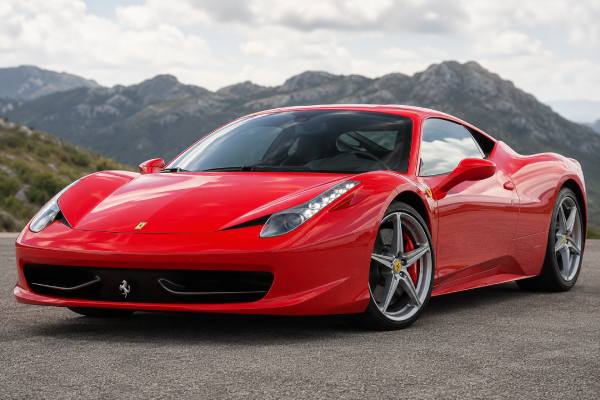
The Ferrari 458 Italia (F142) is the mid-engine V8 berlinetta that replaced the F430 and carried Ferrari’s naturally aspirated V8 line into its sharpest modern form. Built from 2009 to 2015, it used the F136 FB 4.5-liter V8, a high-revving dry-sump engine rated by Ferrari at 570 CV, often described as 570 hp, with U.S. specifications commonly listed at 562 hp.
The 458 Italia matters because it sits at a turning point. It was the first regular-production mid-engine Ferrari V8 coupe to abandon the traditional manual gearbox entirely, the last standard mid-engine Ferrari V8 coupe before turbocharging arrived with the 488 GTB, and one of the most celebrated road Ferraris of the modern era. It combined a naturally aspirated 9,000 rpm engine, a fast dual-clutch gearbox, carbon-ceramic brakes, sharp electronic controls, and a Pininfarina-shaped body that still looks clean and purposeful.
For buyers, the appeal is obvious: sound, throttle response, design, and the feeling of a modern Ferrari without hybrid complexity or turbo lag. The caution is just as real. A 458 Italia is condition-sensitive, expensive to inspect properly, and costly when neglected. The best cars are not simply the lowest-mileage examples; they are the ones with original paint where possible, clean documentation, completed recalls, healthy carbon-ceramic brakes, fresh tires, and specialist service history.
Quick Take
The Ferrari 458 Italia is most desirable as a clean, well-documented, naturally aspirated V8 Ferrari with a 9,000 rpm engine, fast dual-clutch gearbox, and a character that later turbocharged models cannot fully duplicate. Its main tradeoff is ownership risk: deferred maintenance, accident repairs, sticky interior controls, DCT issues, lift-system leaks, worn carbon-ceramic brakes, and incomplete recall work can turn a tempting car into a very expensive project. Buy on history, condition, originality, and inspection results before mileage alone.
Table of Contents
- Model History and Why It Matters
- Engine, Chassis, and Key Specifications
- Production, Variants, and Factory Options
- Design, Engineering, and Special Features
- Driving Experience and Real Performance
- Reliability, Maintenance, and Repair Risk
- Market Value and Buying Guide
Model History and Why It Matters
The 458 Italia’s importance comes from its place between two Ferrari eras: the analog-leaning F430 before it and the turbocharged 488 GTB after it. It brought Ferrari’s V8 berlinetta into the dual-clutch, high-electronics age while keeping the naturally aspirated engine feel that many collectors now prize.
Ferrari revealed the 458 Italia in 2009 as the successor to the F430. The basic layout stayed familiar: two seats, rear-mid-mounted V8, rear-wheel drive, aluminum-intensive structure, and dramatic coupe bodywork. Almost everything else felt new. The 458 used direct fuel injection, a seven-speed dual-clutch transaxle, a more advanced electronic differential, F1-Trac traction control, magnetorheological dampers, and a cabin built around steering-wheel controls rather than conventional stalks.
That shift made the car feel like a major generation change rather than a simple F430 update. The F430 still had a visible link to the 360 Modena. The 458 Italia felt wider, cleaner, faster, more precise, and more digitally integrated. It also marked the end of one buyer expectation: no manual transmission was offered on the standard road car. By the time the 458 arrived, Ferrari had decided that the dual-clutch gearbox gave the performance, emissions, and usability it wanted.
The 458 Italia also became important because of what followed. In 2015, Ferrari replaced it with the 488 GTB, which used a twin-turbocharged V8. The 488 is faster, especially in mid-range acceleration, but the 458’s appeal is different. It is about response, revs, sound, and the feel of a naturally aspirated engine working harder as the tachometer climbs.
That identity gives the 458 a durable collector position. It is modern enough to use without the constant compromises of an older Ferrari, yet old enough to avoid some of the hybrid and turbo complexity that defines newer exotic cars. For many enthusiasts, it represents a sweet spot: modern performance with a more emotional, mechanical engine character.
The car also has strong cultural and market recognition. It won praise when new, remained desirable through the 488 and F8 Tributo years, and has gained extra attention as Ferrari moved deeper into electrification and turbocharged performance. Clean 458 Italias now attract buyers who want the last standard naturally aspirated mid-engine Ferrari V8 coupe, not simply an older used supercar.
Engine, Chassis, and Key Specifications
The 458 Italia’s core specification is simple but special: a 4.5-liter naturally aspirated V8 mounted behind the cabin, driving the rear wheels through a seven-speed dual-clutch transaxle. The numbers are still serious today, but the way the engine makes them is the reason the car remains so desirable.
The F136 FB engine is a 90-degree V8 with direct injection, dry-sump lubrication, a flat-plane-crank character, and a 9,000 rpm power peak. Ferrari quoted 570 CV at 9,000 rpm and 540 Nm of torque at 6,000 rpm. In many U.S. listings, that appears as 562 hp and 398 lb-ft. The difference is mostly the rating convention, not a different engine.
| Item | Specification |
|---|---|
| Engine code | F136 FB |
| Engine type | 90-degree naturally aspirated V8 |
| Displacement | 4,497 cc |
| Induction | Naturally aspirated |
| Fuel system | Direct injection |
| Maximum output | 570 CV at 9,000 rpm |
| Maximum torque | 540 Nm at 6,000 rpm |
| Compression ratio | 12.5:1 |
| Transmission | 7-speed dual-clutch F1 transaxle |
| Drive layout | Rear-mid-engine, rear-wheel drive |
The chassis used aluminum construction rather than a carbon tub. That matters for inspection. Aluminum structure can be repaired, but poor repairs, hidden crash damage, and uneven panel gaps are major value problems. A pre-purchase inspection should include paint-depth readings, underbody inspection, suspension pickup-point checks, and a review of any accident history.
Suspension is by double wishbones at the front and a multi-link layout at the rear. Adaptive magnetorheological dampers help the car cover rough roads with more fluency than its track-ready appearance suggests. The standard braking system uses carbon-ceramic discs, which give strong performance and save weight, but replacement cost makes remaining disc life a serious buying concern.
| Item | Specification |
|---|---|
| Body style | 2-seat berlinetta coupe |
| Structure | Aluminum-intensive chassis and body construction |
| Front suspension | Double wishbones |
| Rear suspension | Multi-link |
| Dampers | Adaptive magnetorheological |
| Brakes | Carbon-ceramic discs with ABS |
| Front tires | 235/35 ZR20 |
| Rear tires | 295/35 ZR20 |
| Length | 4,527 mm |
| Width | 1,937 mm |
| Height | 1,213 mm |
| Wheelbase | 2,650 mm |
| Dry weight | 1,380 kg, depending on specification |
| Weight distribution | 42 percent front, 58 percent rear |
| 0–100 km/h | about 3.4 seconds |
| Top speed | over 325 km/h |
The electronic systems are central to how the car performs. The E-Diff helps distribute torque across the rear axle, while F1-Trac manages traction without making the car feel dull when used properly. The Manettino switch on the steering wheel changes the car’s behavior through wet, sport, race, CT off, and ESC off settings. On the road, most owners use sport or race, with race sharpening the car while still retaining a protective electronic safety net.
Production, Variants, and Factory Options
The standard 458 Italia coupe is the purest version of the F142 road-car family, but buyers need to understand the wider 458 range because options, later variants, and special versions influence pricing. A regular Italia should not be valued like a Speciale, and a modified coupe should not be confused with a factory lightweight model.
The main road-going 458 family includes the 458 Italia coupe, 458 Spider, 458 Speciale, and 458 Speciale Aperta. The Spider used a retractable hardtop and added weight, while the Speciale received a more powerful engine tune, active aerodynamic changes, weight reduction, revised software, and a far more focused personality. The Speciale Aperta was the limited open-top version of the Speciale and sits in a different market bracket.
For the 458 Italia itself, production-year differences are generally less dramatic than condition, specification, and documentation. Earlier cars can be excellent if recalls and updates are complete. Later cars may benefit from production refinements and often command stronger prices when mileage and condition are equal. The key is to inspect the individual car rather than assume a model year tells the whole story.
Factory options have a large effect on desirability. Some are mostly cosmetic, while others affect usability and resale.
Commonly valued options include:
- Carbon-fiber LED steering wheel, one of the most desirable interior options.
- Racing seats, especially in the correct size and with good bolster condition.
- Daytona-style seats for buyers who prefer a more classic Ferrari cabin look.
- Front suspension lift, useful for driveways, ramps, and urban use.
- Scuderia Ferrari shields on the front fenders.
- Forged wheels or upgraded wheel designs.
- Carbon-fiber interior trim, center bridge, dashboard inserts, and driver-zone packages.
- Parking sensors and rear camera, helpful because rear visibility is limited.
- Premium audio, navigation, and infotainment features, though these rarely drive collector value as much as carbon, seats, and color.
- Special paint, historic colors, or tasteful Tailor Made specification where documented.
Originality matters. A car with factory carbon parts, documented options, and original paint is usually more desirable than a car fitted later with aftermarket carbon pieces, non-factory wheels, loud exhaust modifications, or Speciale-style cosmetic conversions. Some buyers like tasteful upgrades, but the collector market usually pays more for a car that still matches its build specification.
Documentation should include the original books, tools, battery tender, service invoices, option list, recall completion records, and ideally Ferrari dealer or recognized specialist history. Window stickers and Ferrari build sheets are especially helpful in the U.S. market. For international cars, verify market origin, import paperwork, speedometer units, emissions compliance, and any conversion work.
Race versions such as the 458 Challenge, GT2, and GT3 are separate machines and should not be compared directly with road-car values. They share family identity but have different maintenance needs, equipment, legality, and market dynamics.
Design, Engineering, and Special Features
The 458 Italia looks clean because most of its design serves cooling, airflow, visibility, or packaging. It is dramatic without relying on oversized fixed wings, and that restraint is one reason it has aged well.
The exterior was shaped with Pininfarina involvement and Ferrari’s aerodynamic requirements at the center. The nose is low and wide, with distinctive front aeroelastic winglets in the intake area. These small flexible elements help manage airflow at speed. The body generates meaningful downforce while keeping a relatively elegant silhouette, avoiding the heavy add-on look of many later supercars.
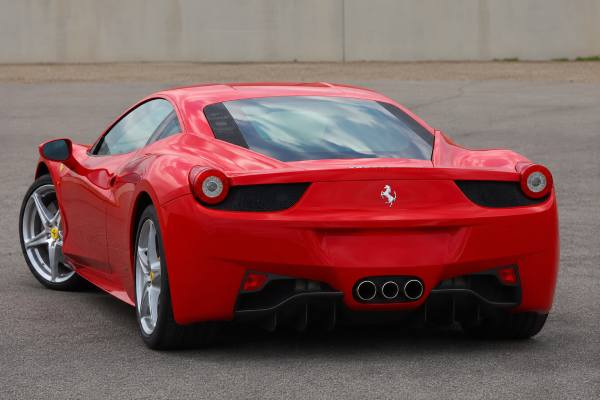
Cooling drives much of the shape. The front intakes feed radiators, the side openings manage airflow to the engine bay, and the rear design releases heat from the mid-mounted V8. The triple central exhaust pipes are one of the car’s signature details. They visually separate the 458 from the F430 before it and the 488 after it.
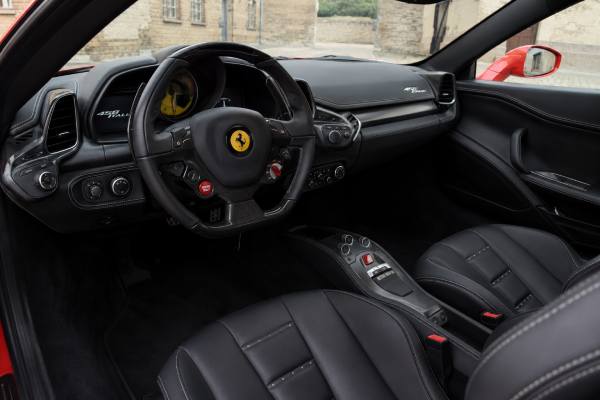
The cockpit is equally distinctive. Ferrari moved many controls to the steering wheel, including indicators, lights, wipers, damper control, engine start, and the Manettino drive-mode switch. This layout feels unusual at first, especially for drivers used to conventional stalks, but it supports the sense that the car was designed around fast driving. The large tachometer dominates the display, and the shift lights in the optional carbon LED steering wheel suit the engine’s high-revving character.
The driving position is low and focused. The windshield gives a good forward view, the front fenders help place the car, and the cabin feels snug without being as cramped as some older mid-engine exotics. The rear view is limited, and the wide body demands respect in narrow streets or tight parking areas.
Engineering details that define the 458 Italia include:
- A dry-sump oiling system that allows lower engine placement and more reliable lubrication under hard cornering.
- A seven-speed dual-clutch gearbox that shifts much faster and more smoothly than the old single-clutch F1 gearbox.
- Carbon-ceramic brakes as standard equipment.
- E-Diff and F1-Trac systems tuned to help the car put power down cleanly.
- Magnetorheological dampers that give the car a surprisingly usable ride in the softer damper setting.
- A high-revving direct-injection V8 with a sound and response profile unlike the later turbocharged 488.
The 458 is not a stripped mechanical throwback. It is a highly controlled, computer-aided supercar. Its lasting appeal comes from the way those systems support the engine and chassis rather than masking them. The electronics help the car go faster and remain approachable, but the driver still feels the engine’s rising intensity, the quick steering, and the rear-biased balance.
Driving Experience and Real Performance
The 458 Italia feels fast because it combines instant throttle response, short gearing, strong traction, and a V8 that becomes more exciting as revs rise. The performance numbers are still impressive, but the experience is more about response and sound than raw acceleration alone.
At low speeds, the 458 is easier than many older Ferraris. The dual-clutch gearbox creeps and shifts smoothly when driven gently, the steering is light enough for town use, and the adaptive dampers help the car cope with imperfect roads. The ride is firm, but it is not punishing by exotic-car standards. With the front lift option, daily usability improves substantially.
The engine dominates the experience. Below the mid-range, it is responsive and clean. Above that, it pulls harder and sharper, building toward the 9,000 rpm power peak. Turbocharged cars often feel stronger in the middle of the rev range, but the 458 rewards the driver for using revs. That rising urgency is a major reason owners and collectors still seek it out.
The gearbox changes the way the car can be driven. Compared with the F430’s single-clutch F1 transmission, the 458’s dual-clutch unit is much smoother in traffic and much faster under load. In automatic mode it is usable, though most drivers prefer manual paddle control on a good road. Shifts in race mode feel crisp without the mechanical interruption of the older automated manual.
Steering is very quick. That gives the car a sharp nose and makes it feel agile, but it also means nervous inputs can make the car feel busy on uneven roads. Good tires and correct alignment are critical. A car on old, hardened, mismatched, or incorrect tires will not feel like a proper 458.
The braking system is powerful, with carbon-ceramic discs that resist fade in hard road use. Brake feel can be different from traditional iron brakes, especially when cold. The system should feel strong, consistent, and straight. Pulsation, warning lights, uneven wear readings, or visible disc damage require expert inspection.
On track, the 458 Italia is fast and rewarding, but it is not cheap to run. Tires, brake wear, fluids, and heat management become real costs. A car with repeated track use is not necessarily bad, but it should have more frequent service records and a transparent history. For most owners, the 458’s best environment is a fast road, mountain route, or occasional track day rather than constant circuit work.
The car’s limits are high, and the electronic systems are well judged. Sport mode gives security in poor conditions. Race mode lets the car feel more alive while keeping traction and stability support. Turning systems fully off should be left to skilled drivers in safe environments because the 458 has enough power, grip, and rear weight bias to punish overconfidence.
Reliability, Maintenance, and Repair Risk
The 458 Italia has a better ownership reputation than many older Ferraris, but it is not a low-risk car. It rewards careful servicing and punishes deferred maintenance, poor storage, bad repairs, and cheap modifications.
The engine itself is generally respected when maintained correctly. It needs proper fluids, warm-up discipline, and attention to leaks, sensors, mounts, cooling components, and exhaust hardware. Because the engine is expensive to access and repair, small issues should not be ignored. A specialist inspection should check for oil seepage, coolant leaks, abnormal noises, fault codes, misfires, and evidence of poor aftermarket tuning.
The dual-clutch transmission is one of the biggest cost concerns. It is far smoother than Ferrari’s older single-clutch gearbox, but failures can be expensive. Buyers should check for smooth take-up, clean shifts when cold and hot, no warning lights, no fluid leaks, and no stored gearbox faults. Heavy launch-control use, overheating, neglected fluid service, or non-specialist repairs can shorten component life.
Known ownership and inspection areas include:
- Sticky interior buttons and switchgear, common on Ferraris of this era.
- Leather dash shrinkage or lifting, especially in hot climates.
- Worn seat bolsters on racing seats.
- Front suspension lift leaks or slow operation where fitted.
- Worn suspension joints, bushings, and dampers.
- Wheel damage from potholes or curb strikes.
- Carbon-ceramic brake disc wear, chips, cracks, and sensor readings.
- Old tires on low-mileage garage-kept cars.
- Weak battery issues causing electronic faults.
- Parking sensor, camera, infotainment, and TFT display problems.
- Exhaust valve or aftermarket exhaust issues.
- Evidence of underbody scraping or poorly repaired aerodynamic panels.
Recalls and campaigns matter. Early 458 Italias were known for a wheel-arch adhesive and heat-shield fire-risk recall. A later recall affected the front trunk latch on certain 2010 to 2014 cars. Another major campaign involved potential brake-fluid loss on Ferrari 458 and 488 models, with remedy work involving a revised brake-fluid reservoir cap and software update. A proper buyer file should show completed recall work by VIN, not just a verbal assurance.
Maintenance should be handled by a Ferrari dealer or a respected independent specialist with the right diagnostic equipment. Annual servicing, brake-fluid changes, gearbox checks, coolant condition, tires, alignment, and battery care are not optional details. Low mileage does not remove the need for time-based maintenance.
Restoration is not the right word for most 458s yet, but accident repair quality is already a major issue. These cars use aluminum structure, expensive panels, tight panel gaps, and complex electronics. A poorly repaired 458 can look acceptable in photos and still have serious value damage. Look for paint-depth variation, overspray, mismatched carbon, inconsistent panel fit, replacement glass, missing labels, bent undertrays, and suspension geometry problems.
Originality versus upgrades is a serious tradeoff. Paint protection film is usually acceptable and often desirable if professionally installed. Aftermarket exhausts, wheel changes, lowered suspension, carbon add-ons, engine software, and Speciale-style body parts reduce appeal for many collectors. Keep original parts if modifications have been made.
Market Value and Buying Guide
The 458 Italia has moved from used exotic to modern collectible, and the best cars are priced accordingly. The strongest examples are original, low-mileage, well-optioned coupes with clean history, desirable colors, complete records, and no stories.
By late May 2026, public U.S. marketplace listings for 458 Italia coupes commonly sat from around the low-$200,000 range into the mid-$300,000 range, with exceptional low-mileage or highly optioned cars advertised higher. Driver-quality cars, higher-mileage cars, cars with modifications, stories, accident history, or incomplete records can trade lower. Spiders usually sit above comparable coupes in many retail settings, while Speciale and Speciale Aperta models are separate high-value collector cars.
Value is driven by more than mileage. A 12,000-mile car with paintwork, old tires, worn carbon-ceramic brakes, missing records, and sticky interior controls may be less attractive than a 20,000-mile car with excellent records and known ownership. The market increasingly rewards quality over simple odometer reading.
| Priority | Why it matters |
|---|---|
| Clean title and accident history | Structural repair quality has a large effect on value and safety. |
| Complete service records | Shows whether the car was maintained by time and mileage, not only when problems appeared. |
| Recall completion by VIN | Confirms important safety campaigns were addressed. |
| Carbon-ceramic brake condition | Replacement costs are high and wear may not be obvious from photos. |
| Original paint and panels | Supports collector value and reduces concern about hidden damage. |
| Desirable factory options | LED steering wheel, racing seats, lift, shields, and carbon trim can help resale. |
| Interior condition | Sticky controls, leather shrinkage, and worn bolsters are common cost points. |
| Tire age and specification | Old tires make the car drive poorly and can be unsafe despite good tread depth. |
A strong pre-purchase inspection should include:
- VIN-specific recall check and service-record review.
- Paint-depth readings across all panels.
- Underbody inspection on a lift.
- Diagnostic scan of engine, gearbox, suspension, brake, and body systems.
- Carbon-ceramic brake wear measurement.
- Tire date-code and wheel inspection.
- Suspension lift test if equipped.
- Cold start, hot restart, and road test.
- DCT behavior check in traffic and under load.
- Confirmation that all keys, books, tools, charger, and accessories are present.
Examples to seek are unmodified cars in desirable colors with original panels, clean Carfax or equivalent history, documented annual maintenance, fresh tires, excellent interior condition, and a sensible option mix. Red over tan or black remains liquid, but colors such as yellow, black, silver, white, blue, and historic shades can also be attractive when paired with the right interior and documentation.
Examples to avoid include cars with vague service history, open recalls, heavy aftermarket modifications, unexplained paintwork, structural repair, warning lights, tired brakes, non-functioning lift systems, cheap tires, incomplete import paperwork, or sellers who resist a specialist inspection.
Long-term collectability looks strong because the 458 Italia has a clear identity: last standard naturally aspirated mid-engine Ferrari V8 coupe, major step forward from the F430, and more emotional than the turbocharged 488 for many drivers. That does not mean every car will appreciate equally. The market will continue to separate excellent, original, well-kept cars from average or story cars. For buyers, the safest strategy is to pay more for the right example rather than buy the cheapest 458 and hope the difference covers the problems.
References
- Ferrari 458 Italia (2009) – Ferrari.com 2009 (Technical Specifications)
- Ferrari Owner’s Manuals | Ferrari of Fort Lauderdale 2026 (Owner’s Manual Portal)
- Part 573 Safety Recall Report 21V-833 2022 (Recall Database)
- USA RECALL CAMPAIGN REF. NO. 54 FRONT TRUNK LATCH MODEL YEARS 2010 – 2014 2014 (Recall Campaign)
- Ferrari 458 Italia Market – CLASSIC.COM 2026 (Market Data)
Disclaimer
This article is for informational purposes only and is not a substitute for professional diagnosis, repair, inspection, valuation, or legal advice. Specifications, torque values, service intervals, recall status, market values, and repair procedures can vary by VIN, market, model year, equipment, and later updates. Always verify details against official Ferrari service documentation and have any Ferrari 458 Italia inspected by a qualified Ferrari dealer or specialist before purchase or repair.
If you found this article useful, please consider sharing it on Facebook, X/Twitter, or your favorite car community to support our work.