
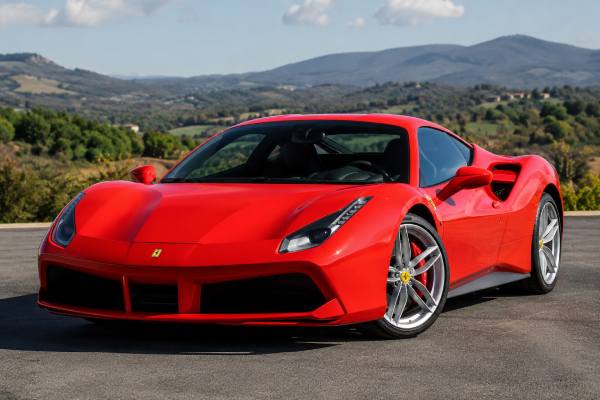
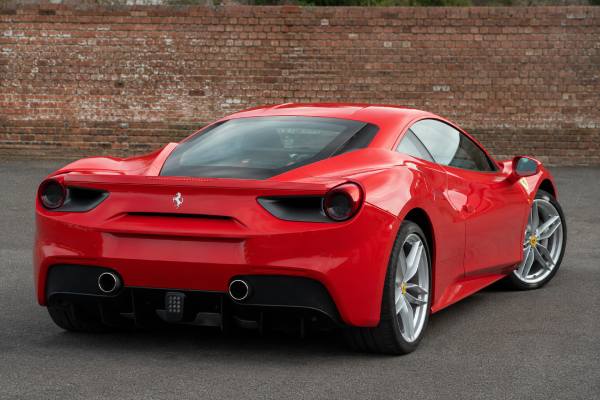
The Ferrari 488 GTB is the fixed-roof F142M berlinetta that replaced the 458 Italia and carried Ferrari’s mid-engine V8 line into the turbocharged era. Produced from 2015 through 2019, it uses the F154CB 3.9-liter twin-turbo V8, rated at 670 PS, or 661 hp, with a seven-speed F1 dual-clutch transmission and rear-wheel drive. It matters because it was not just a faster 458. It changed the character of Ferrari’s core two-seat V8 supercar from high-revving natural aspiration to huge turbo torque, software-led chassis control, and a far wider performance envelope.
The 488 GTB still attracts buyers because it sits at an interesting point in modern Ferrari history. It is newer, quicker, and easier to drive hard than a 458 Italia, but simpler and more mechanical in feel than the hybrid-era 296 GTB. It is also less rare than the 488 Pista, which makes it more usable and more attainable, while still being a 200 mph Ferrari with a major engine-family legacy. For owners and collectors, the main questions are now condition, service history, carbon-ceramic brake life, warranty status, originality, and whether the car has been modified, tracked, or repaired properly.
Quick Take
The Ferrari 488 GTB’s strongest appeal is its combination of everyday usability and very serious speed: the F154CB twin-turbo V8 delivers instant torque, the chassis electronics make the car approachable, and the coupe body gives it the purest 488 shape. Its historical identity is clear: it is the first turbocharged mid-engine V8 Ferrari berlinetta in the modern 308-to-F8 line, and it helped define Ferrari’s forced-induction era. The caution is that this is still an exotic car with expensive brakes, tires, diagnostics, electronics, cooling needs, and accident-repair risks. The best buys are original, well-documented cars with clean paintwork, complete Ferrari service records, no questionable tuning, healthy carbon-ceramic brakes, and all recall or campaign work completed.
Table of Contents
- Model History and Why It Matters
- F154CB Engine, Chassis, and Specs
- Production, Variants, and Factory Options
- Design, Engineering, and Special Features
- Driving Experience and Real Performance
- Reliability, Maintenance, and Restoration Reality
- Market Value and Buying Guide
Model History and Why It Matters
The 488 GTB is important because it marked Ferrari’s full commitment to turbocharging in its mainstream mid-engine V8 supercar. It followed the 458 Italia, arrived in 2015, and was later succeeded by the F8 Tributo as Ferrari refined the same basic turbo V8 formula.
The name also tells part of the story. “488” refers to the engine’s approximate displacement per cylinder, while “GTB” stands for Gran Turismo Berlinetta. The car continued the line that includes the 308 GTB, 328, 348, F355, 360 Modena, F430, and 458 Italia. That lineage matters because Ferrari’s mid-engine V8 berlinetta has long been the brand’s core driver-focused supercar, positioned below the limited hypercars and V12 flagships but above normal grand tourers.
The 458 Italia had become famous for its naturally aspirated 4.5-liter V8 and sharp throttle response. Replacing it with a turbocharged car was a risk. Turbo engines can bring more torque and better emissions performance, but they can also dull sound, response, and high-rpm drama. Ferrari’s answer was to make the 488 GTB not merely stronger, but also more responsive and more usable across a wider range of speeds.
The result was a major performance jump. The 488 GTB’s 3.9-liter V8 made 661 hp at 8,000 rpm and 561 lb-ft of torque, far more torque than the 458 Italia could offer. It could accelerate from 0 to 100 km/h in about 3.0 seconds and from 0 to 200 km/h in 8.3 seconds, with a top speed above 330 km/h. Those numbers placed it comfortably in serious supercar territory when new, and they still feel modern today.
Its place in Ferrari history is also linked to the F154 engine family. This V8 architecture appeared in several Ferrari and Maserati applications, but the 488 GTB version brought the engine into Ferrari’s most visible mid-engine road car. Later versions powered the 488 Spider, 488 Pista, F8 Tributo, and other high-performance models. The 488 GTB therefore represents both a model change and a powertrain turning point.
The car’s reputation today is more nuanced than it was at launch. Many enthusiasts still prefer the 458 for sound and natural aspiration. Others prefer the 488 because it is brutally fast, more flexible, more refined, and less demanding to drive quickly. For buyers, that split is helpful. It means the 488 GTB is not judged only by nostalgia. It is judged as a highly usable modern Ferrari with a distinctive place between the emotional 458 and the more developed F8.
Collectability is strongest for cars with rare colors, low mileage, carbon options, desirable seats, clean history, and untouched mechanical specification. The 488 GTB was not a numbered limited edition, so normal production examples do not carry the scarcity of a Pista. Even so, it has long-term significance as the first turbocharged modern V8 berlinetta in Ferrari’s main line, and that gives it a clear identity in the brand’s timeline.
F154CB Engine, Chassis, and Specs
The heart of the 488 GTB is its F154CB twin-turbocharged V8, a dry-sump, mid-mounted engine designed to deliver high output without the laggy character people used to associate with turbo supercars. The chassis combines aluminum construction, adaptive damping, carbon-ceramic brakes, and Ferrari’s electronic differential and traction systems.
| Item | Specification |
|---|---|
| Model | Ferrari 488 GTB |
| Platform code | F142M |
| Production period | 2015–2019 |
| Body style | Two-seat berlinetta coupe |
| Engine code | F154CB |
| Engine layout | Mid-mounted 90-degree V8, twin turbocharged |
| Displacement | 3,902 cc |
| Maximum output | 670 PS / 661 hp at 8,000 rpm |
| Maximum torque | 760 Nm / 561 lb-ft |
| Transmission | Seven-speed F1 dual-clutch automatic |
| Drivetrain | Rear-wheel drive |
The engine uses two turbochargers, air-to-air intercooling, direct fuel injection, and a dry-sump lubrication system. Dry-sump lubrication stores oil outside the crankcase and helps maintain oil supply during high cornering loads. That matters in a mid-engine Ferrari because the car is designed for sustained fast driving, not only straight-line acceleration.
Ferrari worked hard to make the engine response feel crisp. The 488 GTB does not have the same rising, naturally aspirated drama as a 458 Italia, but it has a much stronger midrange. The engine pulls hard from low rpm and keeps pulling to the top of the tachometer. For road use, that torque changes the car. You do not need to chase every downshift to get rapid acceleration.
| Item | Specification |
|---|---|
| Length | 4,568 mm |
| Width | 1,952 mm |
| Height | 1,213 mm |
| Wheelbase | 2,650 mm |
| Dry weight | 1,370 kg, depending on specification |
| Weight distribution | 46.5 percent front / 53.5 percent rear |
| Front suspension | Double wishbone with adaptive damping |
| Rear suspension | Multilink with adaptive damping |
| Front tires | 245/35 ZR20 |
| Rear tires | 305/30 ZR20 |
| Brakes | Carbon-ceramic discs |
| 0–100 km/h | 3.0 seconds |
| 0–200 km/h | 8.3 seconds |
| Top speed | Over 330 km/h |
The gearbox is a key part of the car’s character. The seven-speed dual-clutch transmission shifts far faster and more smoothly than Ferrari’s older single-clutch F1 automated manuals. In automatic mode it can behave calmly in traffic, while in manual mode the paddles give fast, firm shifts. It is not a manual transmission, and there was no manual 488 GTB, but the DCT suits the car’s power delivery.
The chassis electronics include Ferrari’s E-Diff electronic differential, F1-Trac traction control, magnetorheological dampers, and Side Slip Control. These systems are not just safety nets. They shape how the car exits corners, manages torque, and allows controlled slip. In the 488 GTB, the electronics are a major reason the car can be both approachable and very fast.
Production, Variants, and Factory Options
The 488 GTB was the coupe version of the 488 road-car family, with the Spider, Pista, and Pista Spider forming the most relevant related models. For buyers, the important point is that a GTB should be judged on its own specification, documentation, condition, and originality rather than on rarity alone.
Ferrari launched the GTB first, then followed with the 488 Spider. The Spider used a retractable hardtop and carried the same basic engine output, but added weight and a slightly different open-air character. The Pista arrived later as the lighter, sharper, more powerful track-focused version, with 720 PS and more aggressive aero, cooling, and chassis tuning. The Pista is the collectible flagship of the 488 road range, but it is also far more expensive.
The broader 488 family also included racing versions such as the 488 Challenge, 488 GT3, and 488 GTE. These are not normal road-going GTB variants, but they matter because they reinforced the model’s competition identity. The road car borrowed from Ferrari’s racing experience in aerodynamics, control systems, braking, and engine cooling, while the race cars developed the platform for customer competition.
Factory options play a large role in desirability. A lightly optioned 488 GTB can still be a superb driver’s car, but the market usually rewards cars with the right combination of color, seats, carbon fiber, wheels, and driver-focused extras.
Commonly desirable options and features include:
- Carbon-fiber racing seats in the correct size for the driver.
- Carbon-fiber driver zone with LED shift lights on the steering wheel.
- Carbon-fiber center bridge, dashboard inserts, sill covers, rear air ducts, and engine-bay trim.
- Forged wheels or diamond-finish wheels.
- Front suspension lift, especially useful in cities and steep driveways.
- Parking sensors and rear camera.
- Scuderia Ferrari shields on the front fenders.
- Premium audio, Apple CarPlay where fitted, and upgraded infotainment features.
- Special paint, historical Ferrari colors, or Tailor Made personalization.
- Contrast stitching, Alcantara, special leather, and colored seat belts.
The most valuable specifications tend to be tasteful rather than simply expensive. Rosso Corsa remains easy to sell, but colors such as Giallo Modena, Blu Tour de France, Grigio Ferro, Nero Daytona, Rosso Fuoco, and triple-layer paints can bring strong interest when paired with the right interior. Bright or unusual combinations may command a premium from the right buyer but can narrow the audience.
Documentation matters almost as much as options. A strong file should include the original books, window sticker or build sheet where available, Ferrari service history, warranty records, recall completion records, battery tender, keys, tools, tire inflator, and any invoices for tires, brakes, fluids, alignments, or paint protection film. On a modern Ferrari, a clean Ferrari dealer history and diagnostic report can make a large difference.
Originality is another major issue. Exhaust changes, ECU tuning, lowering springs, aftermarket wheels, or cosmetic carbon additions can make a car more exciting to one owner and less attractive to the next. A modified 488 GTB is not automatically bad, but buyers should price it carefully. Factory specification, reversible upgrades, and full records are much safer than undocumented tuning.
Design, Engineering, and Special Features
The 488 GTB looks close to the 458 at first glance, but its body was heavily reworked for turbo cooling, higher downforce, and better airflow management. The design is not just decoration; most of its major visual features serve the engine, brakes, underbody, or rear aero.
The most obvious change is the large side intake. It recalls the 308 GTB’s side treatment but is shaped for modern cooling needs. The intake is split so air can be directed for different purposes, including feeding the engine’s intercooling and managing flow around the body. On a turbocharged mid-engine car, cooling is central to performance and durability. The 488 GTB’s body had to move more air without becoming clumsy or drag-heavy.
The front end uses a double spoiler treatment and carefully managed airflow around the nose. Under the car, vortex generators help accelerate air beneath the body. At the rear, the diffuser and blown-spoiler concept help the car create downforce without relying on a large fixed wing. This is one reason the GTB has a clean shape compared with the later Pista.
Ferrari also changed the car’s thermal personality. Turbochargers create heat, and heat management affects everything: intake temperatures, oil life, coolant performance, exhaust routing, underbody materials, and service inspection. The 488 GTB packages its turbo hardware tightly behind the cabin, so good maintenance and careful inspection of heat-affected components are important as the car ages.
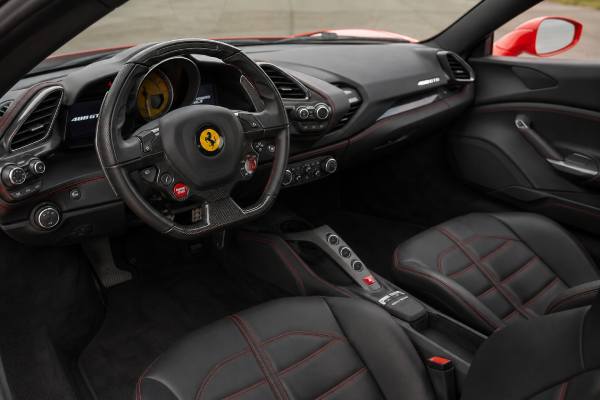
Inside, the cockpit follows Ferrari’s driver-centered approach. Many controls sit on or near the steering wheel, including the manettino drive-mode switch. The steering wheel with LED shift lights is one of the car’s signature options, and it gives the driver an easy visual cue near the engine’s upper range. The cabin is not minimalist in the modern screen-heavy sense. It is more like a focused control space built around the driver’s hands, eyes, and seating position.
The manettino changes the car’s behavior through modes such as Wet, Sport, Race, CT Off, and ESC Off. These settings alter throttle mapping, damping, traction control, stability control, differential behavior, and gearbox response. The result is a car that can be calm in poor weather, fast on a dry road, and much freer on track when the driver has the skill and space.
The sound is one of the 488 GTB’s most discussed features. It is deeper and more boosted than the 458, with less of the older car’s sharp naturally aspirated scream. Some drivers miss that. Others appreciate the 488’s harder, more muscular tone and the way the turbo V8 surges forward. The exhaust, intake path, and turbo hardware create a more complex but less operatic sound. That difference is central to the 488’s identity.
Driving Experience and Real Performance
The 488 GTB feels fast everywhere, not only when the engine is near redline. Its defining driving trait is the way it combines huge torque with quick steering, strong brakes, and electronics that help put power down without making the car feel dull.
Acceleration is immediate and forceful. In a 458 Italia, the driver often works the gearbox to keep the engine in its most exciting range. In the 488 GTB, the midrange is already strong, so a short squeeze of throttle can produce serious speed. This makes the car easier to drive quickly on normal roads, but it also means the driver must be disciplined. The car covers ground much faster than its sound or cabin comfort may suggest.
The gearbox helps. In automatic mode, the dual-clutch transmission can move through traffic with little drama. In manual mode, shifts are fast, clean, and responsive. The paddles have the expected Ferrari feel, and the transmission is well matched to the turbo V8’s torque curve. It does not provide the mechanical involvement of a gated manual, but that was not the mission of the car.
Steering is very quick. Ferrari’s modern steering can surprise drivers coming from Porsche, McLaren, or older Ferraris because it needs small inputs. Once the driver adapts, the front end feels alert and precise. The 488 GTB does not need to be wrestled into a corner. It changes direction quickly, and the rear follows with strong traction unless the driver deliberately asks for more slip.
Ride quality is better than many people expect from a 661 hp mid-engine Ferrari. The adaptive dampers allow the car to breathe over uneven roads, and the bumpy-road damper setting is genuinely useful. The car is still low, wide, and tire-sensitive, but it is not a punishing track special. That is one of the GTB’s strengths compared with more extreme variants.
Braking performance is very strong when the carbon-ceramic system is healthy and warm. Pedal feel is firm, and fade resistance is excellent for fast road use. On track, brake condition, pad material, rotor health, fluid age, and cooling all matter. Carbon-ceramic brakes are expensive, so buyers should never assume that low mileage means low brake wear. Track use can consume brakes and tires quickly.
On a mountain road, the car feels compact for its performance level, though it is still wide. Visibility is better than in many exotic cars, and the driving position is low and purposeful. On the highway, it is stable and surprisingly relaxed. In the city, the main issues are width, low ground clearance, heat, attention from others, and the need to keep the battery charged if the car is used infrequently.
On track, the 488 GTB is extremely capable, but not as focused as the Pista. It has the power, brakes, and chassis systems to run very fast laps, yet it remains a road car with road-car weight, interior trim, and tire compromises. A car that has seen regular track use is not automatically a bad buy, but it needs deeper inspection. Brake wear, tire heat cycles, alignment history, underbody damage, fluid changes, and paint protection all become more important.
Reliability, Maintenance, and Restoration Reality
The 488 GTB is generally considered a robust modern Ferrari when maintained properly, but it is not a low-cost performance car. The main ownership risks are deferred service, expensive wear items, electronic faults, accident damage, heat-related aging, carbon-ceramic brake costs, and poor-quality modifications.
Ferrari included scheduled maintenance coverage for the early years of ownership in many markets, which helped keep cars inside the dealer network. As the model ages, buyers should check whether servicing continued after the included maintenance period ended. A gap in annual servicing, even on a low-mile car, should be investigated. Exotic cars often suffer more from sitting than from careful use.
Important maintenance and inspection areas include:
- Annual service records, not just mileage-based visits.
- Engine oil, brake fluid, coolant, gearbox service, and accessory belt history.
- Battery condition and tender use.
- Tire age, brand, specification, and heat-cycle history.
- Carbon-ceramic rotor and pad condition.
- DCT behavior, leaks, shift quality, and diagnostic data.
- Turbocharger, intercooler, and intake-system condition.
- Cooling system hoses, radiators, fans, and debris buildup.
- Suspension lift operation where fitted.
- Adaptive damper condition and warning lights.
- Sticky or worn interior switches, leather shrinkage, and dashboard condition.
- Paintwork, panel gaps, underside scrapes, and evidence of accident repair.
The engine itself is strong when left stock and serviced properly. Problems are more likely to arise from heat, neglect, poor storage, or tuning than from the basic architecture. Any tuned car should be approached carefully. Higher boost, altered ECU calibration, downpipes, or non-factory exhaust changes may affect emissions compliance, warranty eligibility, turbo temperatures, and resale value.
The seven-speed DCT is much more user-friendly than Ferrari’s older single-clutch gearboxes, but it is still expensive hardware. A pre-purchase inspection should check for leaks, fault codes, clutch data where available, smooth engagement from rest, and proper operation when hot. Hesitation, harsh low-speed behavior, warning messages, or a history of ignored leaks should not be brushed aside.
Carbon-ceramic brakes deserve special attention. They can last a long time in gentle road use, but they are costly when worn or damaged. Visual inspection alone is not enough. A specialist should measure wear correctly, inspect for chips or cracks, check pad life, confirm warning-system status, and look at service records. A car advertised as “low mileage” can still have expensive brake wear if it has been driven hard on track.
Recalls and service campaigns must be checked by VIN. The 488 family was affected by brake-related recall work, including a brake fluid reservoir cap and warning-message update for some cars, and certain earlier cars had software-related brake disc wear warning campaigns. Some vehicles were also included in airbag ECU campaigns. A seller should be able to show that applicable campaigns were completed by an authorized Ferrari dealer.
Restoration in the classic-car sense is not usually the issue with a 488 GTB. The better word is repair quality. Aluminum structure, composite panels, underbody aero parts, electronic systems, and paint finishes require specialist knowledge. A poorly repaired front lift, undertray, bumper, quarter panel, or rear diffuser can create long-term problems and reduce value. Paint-meter readings, lift inspection, and a review of insurance or accident history are essential.
Market Value and Buying Guide
The 488 GTB now sits in the modern used-Ferrari market rather than the new-supercar market. It is valuable enough to require specialist due diligence, but common enough that buyers can be selective.
As a broad current-market guide, ordinary GTB examples tend to sit below 488 Pista values and usually below the strongest low-mile F8 Tributo coupes. Higher-mile or plainer cars may trade at a meaningful discount, while late-production, low-mile, highly optioned cars in desirable colors can command much stronger money. Dealer asking prices commonly vary widely because mileage, options, color, warranty, history, and condition matter more than model year alone.
The market rewards the following:
- Low but believable mileage with consistent servicing.
- Original paint or clearly documented paintwork.
- Ferrari dealer or recognized specialist maintenance.
- Clean accident history.
- Desirable factory color and interior combination.
- Carbon racing seats and carbon driver-zone options.
- Front lift, camera, shields, forged wheels, and tasteful carbon trim.
- Complete accessories, books, keys, and build documentation.
- Ferrari Approved warranty or eligibility where available.
- No ECU tune, questionable exhaust work, or irreversible modifications.
Cars to approach carefully include those with patchy records, many owners in a short period, non-factory tuning, unexplained warning lights, heavy track use without matching maintenance, old tires, weak batteries, brake wear concerns, repaint without documentation, or missing factory items. A cheap 488 GTB can become expensive quickly if it needs brakes, tires, suspension work, leak repairs, software diagnosis, or interior correction.
A proper pre-purchase inspection should be performed by a Ferrari dealer or a specialist who regularly works on modern Ferraris. The inspection should include a diagnostic scan, road test, lift inspection, paint assessment, brake measurement, tire-date check, battery test, verification of campaigns, and review of service records. A generic exotic-car inspection is not enough if the inspector does not understand Ferrari systems and 488-specific details.
A sensible buying process looks like this:
- Confirm the VIN, factory specification, ownership history, and title status.
- Review service records year by year, not only by mileage.
- Check open recalls and campaigns with a Ferrari dealer.
- Inspect tires, brakes, suspension lift, dampers, underbody panels, and cooling areas.
- Scan all control modules for stored or cleared faults.
- Verify paint quality and look for structural or cosmetic repair evidence.
- Compare the asking price with similar mileage, options, colors, and warranty status.
- Budget immediately for fluids, tires, battery, alignment, and small corrections unless recently documented.
For long-term collectability, the 488 GTB has a strong but not simple case. It is historically important as the turbocharged turning point in Ferrari’s mid-engine V8 berlinetta line, and its performance remains deeply impressive. However, it was not a limited special series, and it lives in the shadow of both the naturally aspirated 458 Italia and the harder-core 488 Pista. That does not make it less desirable as a driver’s car. It simply means the best examples will separate themselves by specification, originality, condition, documentation, and color.
The ideal 488 GTB is not necessarily the lowest-mile car in existence. It is the car that has been used enough to stay healthy, maintained consistently, kept original, stored correctly, and inspected by people who know the model. For an owner who wants a modern Ferrari that can handle weekend drives, long trips, and occasional track days while still feeling special every time it starts, the 488 GTB remains one of the most compelling choices from Ferrari’s modern V8 era.
References
- Ferrari 488 GTB (2015) – Ferrari.com 2015 (Specifications)
- FERRARI N.V. (a public limited liability company incorporated under the laws of the Netherlands) 2016 (Prospectus)
- Ferrari NV 20-F 12.31.2019 2019 (Annual Report)
- Part 573 Safety Recall Report 21V-833 2022 (Recall Database)
- Ferrari 488 GTB Market – CLASSIC.COM 2026 (Market Data)
Disclaimer
This article is for informational purposes only and is not a substitute for professional diagnosis, repair, inspection, or valuation. Specifications, torque values, service intervals, software updates, recall applicability, and procedures can vary by VIN, market, production date, and equipment. Always verify details against official Ferrari service documentation and have any specific car inspected by a qualified Ferrari specialist before purchase or repair.
Please share this article on Facebook, X/Twitter, or your preferred car community if it helped your research and you want to support our work.