
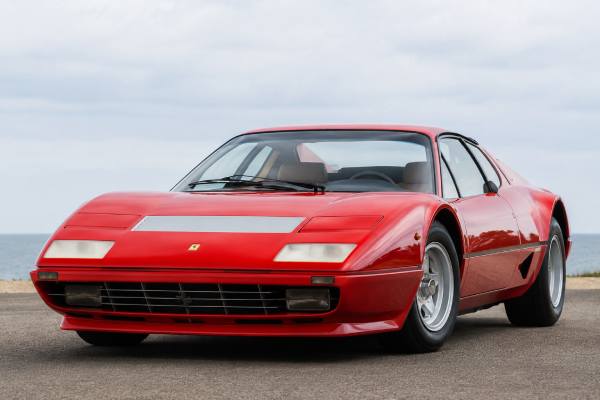
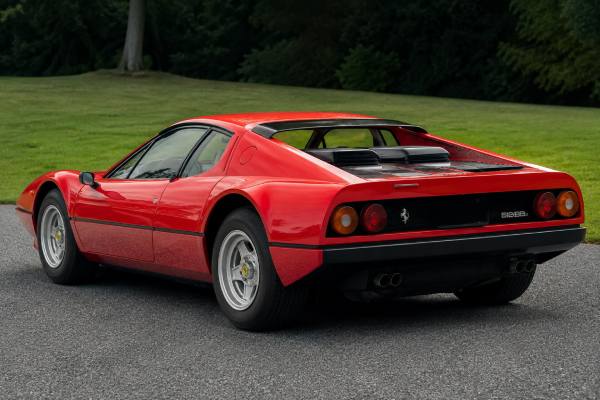
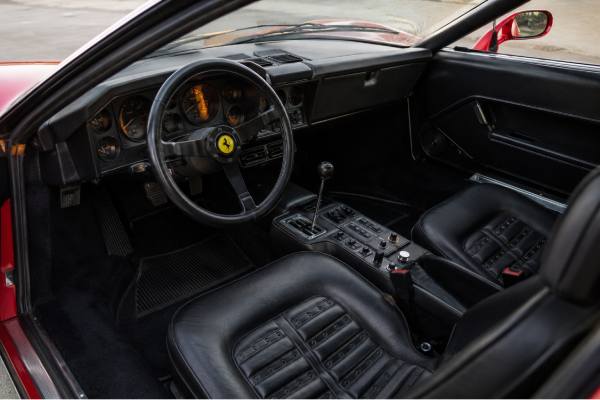
The Ferrari 512 BB is the carbureted, 4.9-liter evolution of Ferrari’s first mid-engined flat-12 road-car line. Built from 1976 to 1981, it replaced the 365 GT4 BB with more displacement, more torque, wider rear bodywork, improved cooling, and a stronger visual stance. It is not as raw and rare as the 365 GT4 BB, and it is not as easygoing as the later fuel-injected 512 BBi, but that is exactly why many collectors focus on it: the 512 BB sits in the sweet spot between early Boxer drama and more usable long-distance performance.
Quick Take
The Ferrari 512 BB’s strongest appeal is its carbureted flat-12 character wrapped in one of Pininfarina’s most recognizable wedge-era bodies. Its key identity is technical as much as historical: a rear-mid-mounted 4,943 cc F102B 000 twelve-cylinder, dry-sump lubrication, five-speed manual transaxle, and a chassis layout that moved Ferrari’s flagship road car away from the front-engined Daytona era. The main caution is ownership complexity, because belt service, carburetor setup, cooling health, corrosion repair, and body restoration can turn a tempting car into a costly project. The best examples are original, documented, matching-number cars with known history, correct components, careful maintenance, and no hidden federalization, accident, or restoration problems.
Table of Contents
- 512 BB History and Significance
- Flat-12 Specifications and Chassis Data
- Production, Variants and Identification
- Pininfarina Design and Engineering Character
- Road Feel, Performance and Usability
- Maintenance, Restoration and Ownership Risks
- Market Values and Buying Advice
512 BB History and Significance
The 512 BB matters because it was the mature carbureted version of Ferrari’s first mid-engined twelve-cylinder flagship road car. It carried Ferrari away from the front-engined 365 GTB/4 Daytona tradition and into the low, wide, mid-engined supercar format that defined the late 1970s and 1980s.
Ferrari had used mid-engined layouts in racing long before the Boxer, but the company was cautious about applying that formula to its most expensive road cars. The 365 GT4 BB, introduced before the 512 BB, was the first major step. By the time the 512 BB arrived in 1976, Ferrari had already accepted that the flagship road car would no longer be a long-hood grand tourer. It would be a lower, wider, more exotic machine with the engine behind the driver.
The “512” name follows Ferrari tradition: roughly five liters and twelve cylinders. The “BB” stands for Berlinetta Boxer, though the engine is more accurately a 180-degree V12 than a true boxer. In a true boxer engine, opposing pistons move away from and toward each other at the same time on separate crankpins. Ferrari’s flat-12 uses a different crank arrangement, but the “Boxer” name became part of the car’s identity and has remained the common collector shorthand.
The 512 BB replaced the 365 GT4 BB with several important changes:
- displacement rose from 4.4 liters to 4.9 liters
- torque improved, making the car easier to drive at lower and middle engine speeds
- the rear body became wider and more muscular
- cooling and drivability were improved
- the front spoiler and rear treatment gave the car a more planted look
- dry-sump lubrication helped the engine cope with hard driving
Pininfarina designed the shape, and Scaglietti built the bodywork. The car belongs visually to the same design period as the Lamborghini Countach, Lotus Esprit, Maserati Bora, and De Tomaso Pantera, but the Ferrari has a different character. It is less theatrical than a Countach, more refined than many low-volume Italian exotics, and more complex than a front-engined classic Ferrari.
The 512 BB was not officially federalized for the United States when new, so many American-market cars arrived through gray-market importers. That matters today. Some cars received emissions and lighting modifications, side markers, bumper changes, or other alterations for registration. A sympathetic conversion may not ruin a car, but poor federalization work can affect originality, value, drivability, and restoration cost.
Historically, the road-going 512 BB also connects to Ferrari’s endurance-racing image through the 512 BB LM. The LM was a separate competition development rather than a normal road-car option, but it reinforced the Boxer shape in the minds of enthusiasts. Even without the factory racing dominance of earlier Ferrari sports racers, the Boxer became a poster car and a landmark in Ferrari road-car engineering.
Today, the 512 BB is collectible for several reasons. It is carbureted, limited in production, visually iconic, and mechanically important. It is also old enough to require classic-car judgment rather than ordinary used-car thinking. Buyers are not just choosing a fast Ferrari. They are choosing a hand-built, twelve-cylinder, mid-engined collector car whose condition and documentation matter as much as its badge.
Flat-12 Specifications and Chassis Data
The 512 BB’s central technical story is its 4,943 cc carbureted flat-12, mounted behind the cabin and paired with a five-speed manual transaxle. It was a larger, torquier development of the earlier Boxer engine, intended to make Ferrari’s mid-engined flagship faster and more flexible without losing the drama of carburetors.
| Item | Ferrari 512 BB |
|---|---|
| Production years | 1976–1981 |
| Chassis type | F102 BB series tubular steel chassis |
| Engine code | F102B 000 |
| Engine layout | Rear-mid-mounted 180-degree twelve-cylinder |
| Displacement | 4,943.04 cc |
| Bore x stroke | 82.0 mm x 78.0 mm |
| Induction | Natural aspiration, four Weber triple-choke carburetors |
| Lubrication | Dry sump |
| Maximum output | 360 hp / 265 kW at 6,800 rpm |
| Maximum torque | about 451–452 Nm at 4,600 rpm |
| Transmission | Five-speed manual transaxle |
| Drive | Rear-wheel drive |
The flat-12 layout kept the engine’s mass low, but the complete drivetrain was not light. The engine and gearbox arrangement placed substantial weight toward the rear, and the gearbox sat below the engine. This packaging made the car compact and low, but it also influenced handling, service access, and heat management.
The carburetion is one of the main differences between the 512 BB and the later 512 BBi. The 512 BB uses Weber carburetors, which give it a sharper, more mechanical feel when properly tuned. The later BBi uses Bosch K-Jetronic fuel injection, which generally improves cold starting, emissions behavior, and day-to-day smoothness but changes the engine’s response and sound.
| Item | Figure |
|---|---|
| Wheelbase | 2,500 mm |
| Length | 4,400 mm |
| Width | 1,830 mm |
| Height | 1,120 mm |
| Front track | 1,500 mm |
| Rear track | 1,563 mm |
| Fuel capacity | about 120 liters |
| Suspension | Independent front and rear, coil springs, anti-roll bars |
| Brakes | Ventilated discs, front and rear |
| Steering | Rack and pinion, unassisted |
| Top speed | up to about 302 km/h in factory data |
| 0–100 km/h | around the mid-five-second range, depending on test conditions |
Factory and period-test figures vary, which is normal for cars of this era. A perfectly tuned 512 BB on correct tires, with the right gearing, conditions, and driver, is a very fast classic. A tired car with old fuel hoses, weak ignition, poor carburetor balance, or incorrect tires will feel completely different.
The braking system is straightforward by modern supercar standards: ventilated discs, hydraulic assistance, and no anti-lock braking. That simplicity is part of the period character, but it also means the driver must manage lock-up, pedal pressure, and tire condition. The suspension is also old-school exotic-car engineering: independent layout, low center of gravity, wide rear track, and mechanical balance rather than electronic assistance.
Production, Variants and Identification
The carbureted 512 BB was built in limited numbers, with 929 examples generally accepted for the 1976–1981 production run. For collectors, the important distinctions are not only year and color, but also carbureted versus injected, original versus federalized, and documented versus uncertain history.
The 512 BB sits between the 365 GT4 BB and the 512 BBi:
| Model | Approximate production period | Main identity |
|---|---|---|
| 365 GT4 BB | 1973–1976 | Original 4.4-liter carbureted Boxer, rarer and more delicate in feel |
| 512 BB | 1976–1981 | 4.9-liter carbureted version with more torque and wider rear bodywork |
| 512 BBi | 1981–1984 | Fuel-injected development with smoother behavior and slightly different character |
The 512 BB’s model identification is tied to Ferrari’s F102 family coding. The road car’s engine is F102B 000, and chassis identification should be checked carefully against the car, factory records, service invoices, old registrations, import papers, and any Ferrari Classiche documentation.
A strong car should have consistent evidence across several areas:
- chassis number stamping and plate details
- engine number and gearbox number
- body number where available
- color and trim history
- service records from known Ferrari specialists
- import and federalization documents, if applicable
- old photographs, ownership history, and restoration invoices
- handbooks, tool roll, jack, spare wheel, and pouch
Matching numbers are important because the engine is central to the car’s value. A replacement engine does not automatically make a 512 BB undesirable, especially if the work was factory-supported or well documented, but it changes the value conversation. A car with its original engine, gearbox, body, and colors has a cleaner collector story.
Factory colors and trim
Rosso Corsa is common in the market because red Ferraris have always attracted demand, but the 512 BB can be especially striking in darker or more subtle colors. Black, silver, blue, white, and two-tone Boxer paint schemes can change the car’s visual character dramatically.
The classic Boxer two-tone treatment, with a contrasting lower section, is part of the model’s period identity. Some cars have been repainted from two-tone to single-color or the other way around. That may be acceptable for a driver-quality car, but a serious collector should verify the original finish.
Interior condition is just as important. Daytona-style seat inserts, leather quality, dashboard condition, switchgear, carpets, and correct instruments all affect value. A retrimmed cabin can look beautiful, but originality, correct materials, stitching style, and documentation matter.
Road car versus competition image
The 512 BB LM is often mentioned alongside the road car, but buyers should not confuse the two. The LM was a race-focused development with very different bodywork, structure, and purpose. Its existence adds motorsport atmosphere to the Boxer story, but a normal 512 BB is a road car first. Its appeal is the blend of flagship Ferrari engineering, carbureted twelve-cylinder sound, and dramatic styling, not direct race-car usability.
Pininfarina Design and Engineering Character
The 512 BB looks the way it does because Ferrari and Pininfarina were solving packaging, cooling, and stability problems in a low mid-engined car. The result is not decoration for its own sake; the wedge nose, side intakes, wide rear body, rear buttresses, and clamshell access all serve the car’s mechanical layout.
Pininfarina gave the Boxer a low nose, a broad cabin, and a visually heavy rear section that clearly tells you where the engine lives. Compared with the 365 GT4 BB, the 512 BB has a more muscular look, mainly because of its wider rear bodywork and revised details. It appears planted and serious rather than flamboyant.
The front end is simple and sharp, with pop-up headlights and a low spoiler. The side profile is dominated by the black lower treatment on many cars, the air intake shapes, and the long rear deck. The rear is wide, vented, and purposeful. The car does not need large wings or exaggerated add-ons to look exotic.
The body construction reflects Ferrari practice of the period rather than modern mass production. These cars were hand-built, and small variations are normal. Panel gaps, door fit, clamshell alignment, and trim fit should be judged with an understanding of 1970s Italian coachbuilding, but that does not mean poor repairs should be excused. A properly restored or well-preserved 512 BB should still look coherent, symmetrical, and carefully assembled.
Engine placement and heat management
The rear-mid engine layout gives the 512 BB its drama, but it also creates heat. The engine bay, exhaust, fuel system, carburetors, ignition components, and rear bodywork all live in a demanding environment. Cooling airflow is critical. Missing ducting, incorrect fans, tired radiators, poor coolant hoses, and badly routed fuel lines can create expensive problems.
The dry-sump system is another important feature. In simple terms, dry-sump lubrication stores oil in a separate tank rather than relying only on a deep oil pan under the engine. This helps oil control during hard cornering and allows a lower engine installation. It is racing-derived thinking adapted to a road car.
The sound and mechanical personality
The 512 BB’s sound is one of its main attractions. A well-tuned carbureted flat-12 has a layered character: intake noise from the Webers, mechanical whir from the valvetrain, and a harder exhaust note as revs rise. It is not a modern, electronically sharpened sound. It is more physical and more dependent on tune, temperature, and throttle position.
This also means two cars can feel very different. One 512 BB may idle cleanly, pull evenly, and feel crisp. Another may cough, smell rich, hesitate, run hot, or feel flat. The difference is often setup, not design. Carburetor balance, ignition timing, valve adjustment, fuel pressure, and exhaust condition all matter.
Road Feel, Performance and Usability
A good 512 BB feels fast, mechanical, wide, and serious, but it is not a modern point-and-shoot supercar. It rewards patience when cold, confidence once warmed through, and respect for its rear weight, unassisted steering, old tire technology, and lack of electronic safety systems.
At low speed, the steering is heavy. The car is wide by classic standards, visibility to the rear is limited, and the clutch and gearbox need deliberate inputs. The gated manual shift is part of the pleasure, but it should not be rushed when the oil is cold. Like many Ferraris of its period, it feels better as the drivetrain warms and the driver settles into its rhythm.
The engine is more flexible than the earlier 365 GT4 BB’s smaller unit. That is one of the 512 BB’s biggest real-world improvements. The extra displacement gives the car stronger mid-range response, so it does not need to be worked as hard in normal driving. When the carburetors are correctly set, throttle response is immediate and satisfying.
Performance remains strong even by modern classic standards. The car’s factory top-speed claim is very high for the period, and even allowing for variation in real-world testing, the 512 BB was among the fastest road cars of its time. More important than the number is the way it gathers speed. It feels long-geared, stable, and muscular rather than frantic.
Handling character
The 512 BB has a low center of gravity, but it also has substantial mass behind the driver. On a smooth, open road, that gives the car a planted, flowing feel. In tighter corners, especially on old tires or poor surfaces, the driver must be aware of weight transfer. Abrupt throttle lifts, clumsy downshifts, or aggressive braking while turning are not wise.
The car works best with clean inputs:
- brake in a straight line
- choose the gear early
- turn in smoothly
- let the chassis settle
- feed in throttle progressively
- avoid treating old tires like modern performance rubber
A restored suspension can transform the car. Worn bushings, tired dampers, incorrect alignment, or old tires make a Boxer feel vague and nervous. A sorted example feels far more precise than many people expect.
Brakes, tires and road comfort
The brakes are capable for period road use, but the pedal feel and stopping distances depend heavily on condition. Caliper health, flexible hoses, master cylinder condition, pad material, disc condition, and tire grip all matter. There is no ABS to rescue a panic stop.
Tires are a major part of the experience. Correct high-speed-rated classic tires are available, but they are expensive and should be replaced by age, not just tread depth. Old tires can make a valuable Ferrari dangerous even if they look nearly new.
Ride quality is firm but not unbearable. The 512 BB was a flagship Ferrari road car, not a stripped track machine. It can cover distance, but cabin heat, noise, limited luggage space, heavy controls, and the stress of parking or traffic mean it is not relaxing in the way a front-engined grand tourer can be.
Maintenance, Restoration and Ownership Risks
The 512 BB is not unreliable in the simple sense, but it is highly condition-sensitive and expensive to neglect. The difference between a maintained car and a deferred-maintenance car can be six figures once engine-out service, fuel-system work, cooling repairs, suspension renewal, paint, trim, and corrosion are added together.
The most important routine ownership topic is belt service. The flat-12 uses timing belts, and access is a major job. Many specialists treat Boxer belt service as engine-out work, often combined with related “while you are there” items such as cam seals, tensioner bearings, hoses, water-pump inspection, fuel lines, clutch inspection, and engine-bay detailing. Time matters as much as mileage because many cars sit for long periods.
Carburetor maintenance is another defining issue. The Webers must be clean, correctly jetted, balanced, and supplied with proper fuel pressure. Poor setup can cause hard starting, rough idle, hesitation, fuel smell, fouled plugs, and even engine damage if the car runs too lean under load.
Common ownership concerns include:
- aging fuel hoses and fuel vapor issues
- carburetor leaks or poor synchronization
- old ignition components and weak spark
- cooling-system restrictions, tired radiators, and failing fans
- oil leaks from seals, cam covers, and hoses
- clutch wear or hydraulic problems
- gearbox synchro wear, especially if shifted aggressively when cold
- worn suspension bushings and dampers
- brake caliper corrosion from long storage
- electrical faults caused by age, heat, and previous repairs
- leather shrinkage, dashboard distortion, and fragile trim
Corrosion and body repair
Rust is a serious inspection area. The 512 BB is not a simple body-on-frame classic where panels can be cheaply replaced. It is a hand-built exotic with complex structure, clamshell panels, and model-specific trim. Corrosion repair can be difficult, and poor paintwork can hide old damage.
Inspect carefully around:
- sills and lower body sections
- door bottoms and edges
- front and rear wheel arches
- lower nose and spoiler areas
- windshield base and window surrounds
- floor sections and chassis tubes
- battery area
- suspension pickup points
- previous jack points or lift damage
- rear clamshell alignment and hinge areas
Accident damage is just as important. A 512 BB that has been poorly repaired may never fit, cool, or drive correctly. Check for uneven panel gaps, mismatched paint texture, distorted underbody sections, non-original welds, and missing factory details.
Restoration difficulty
Restoring a 512 BB properly requires Ferrari Boxer experience. General classic-car skill is not enough. The engine, transaxle, carburetion, bodywork, interior, and trim all have model-specific details. Parts are available through specialists, but not every part is easy, cheap, or original.
A full restoration can exceed the value difference between a driver and a top-tier car. That is why buying the best documented example you can afford is usually smarter than buying a cheaper car with vague needs. A “minor recommissioning” claim should be treated carefully if the car has been sitting. Fuel tanks, hoses, seals, brakes, tires, suspension, belts, and electrical systems may all need attention before the car is safe and dependable.
Originality versus upgrades is a judgment call. Sensible hidden improvements, such as better cooling fans, modern fuel hose material, or upgraded relays, may improve usability without hurting the car. Visible modifications, incorrect wheels, non-factory paint changes, federalization scars, aftermarket exhausts, and interior retrims can affect collector value unless they are reversible and well documented.
Market Values and Buying Advice
The 512 BB sits in a strong but selective collector market: desirable cars bring serious money, but buyers are cautious because restoration and maintenance risk is high. As of the mid-2020s, many public sales and listings place sound carbureted 512 BBs broadly in the low-to-mid-$200,000s through the $300,000-plus range, with exceptional cars, rare specifications, unusually low mileage, or strong documentation capable of moving higher.
The market does not value every Boxer equally. A 365 GT4 BB may attract buyers who want the earliest and rarest version. A 512 BBi may appeal to those who prefer fuel injection and smoother usability. The 512 BB attracts buyers who want carburetors, the larger 4.9-liter engine, and the more muscular later body.
Value is driven by several factors:
| Value factor | Why it matters |
|---|---|
| Original engine and gearbox | Matching major components support collector confidence |
| Documented history | Invoices, ownership records, and old photos reduce uncertainty |
| Recent major service | Engine-out belt service and recommissioning can be costly |
| Body condition | Rust and accident repair are expensive and value-sensitive |
| Original colors | Factory-correct paint and trim matter to serious collectors |
| Federalization history | Poor gray-market changes can affect originality and function |
| Tools, books and accessories | Complete cars are easier to show, sell, and certify |
| Specialist inspection | A Boxer can hide expensive problems from a casual buyer |
What to inspect before buying
A serious pre-purchase inspection should be done by a Ferrari specialist who knows Boxers. A general exotic-car inspection is better than nothing, but the 512 BB has enough specific issues that model experience is important.
A useful inspection should include:
- chassis and engine number verification
- compression and leak-down testing
- timing belt age and service history review
- carburetor condition and fuel-system inspection
- cooling-system pressure test and fan operation check
- oil leak inspection
- gearbox and clutch evaluation
- brake system inspection, including old hoses and calipers
- suspension bushing, damper, and wheel-bearing inspection
- tire age and correct specification check
- corrosion inspection on a lift
- accident-repair and paint-depth review
- electrical-system check
- verification of tools, books, jack, spare, and records
Buy the car on condition, not just mileage. Very low mileage can be attractive, but a long-stored Boxer may need more work than a regularly exercised car. A higher-mileage example with consistent specialist care can be a better driver than a garage ornament with stale systems.
Cars to seek and cars to avoid
The best 512 BB for most collectors is a complete, original or accurately restored car with matching major components, known ownership history, recent major service, correct wheels and tires, factory-correct colors, and no hidden structural problems. Ferrari Classiche certification can help, but it should not replace a physical inspection.
Be cautious with cars that have:
- missing records for long periods
- fresh paint with no restoration documentation
- unclear engine or gearbox identity
- neglected belt service
- persistent overheating
- heavy fuel smell
- non-original interior work
- poor federalization modifications
- accident history without expert repair documentation
- corrosion hidden under underseal or new paint
- incomplete tools, books, or import papers
A 512 BB is not the right Ferrari for someone seeking low-cost ownership or modern convenience. It is best for an owner who values mechanical character, understands maintenance realities, and is willing to preserve the car properly. When bought well, it offers one of the most compelling combinations in classic Ferrari ownership: carburetors, twelve cylinders, Pininfarina design, manual shifting, and a central place in Ferrari’s move to mid-engined flagship road cars.
References
- Ferrari 512 BB (1976) – Ferrari.com 1976 (Manufacturer Specifications)
- Ferrari 512 BB: Ferrari History 1976 (Manufacturer History)
- FERRARI 512 BB BERLINETTA BOXER OWNER’S MANUAL Pdf Download | ManualsLib 1981 (Owner’s Manual)
- Ferrari BB 512 Market – CLASSIC.COM 2026 (Market Data)
- 1980 Ferrari 512 BB | Gooding Christie’s 2025 (Auction Result)
Disclaimer
This article is for informational purposes only and is not a substitute for professional diagnosis, repair, appraisal, or restoration advice. Specifications, torque values, service intervals, procedures, parts, and equipment can vary by VIN, market, production date, and individual vehicle history. Always verify details against official Ferrari service documentation and consult a qualified Ferrari specialist before buying, servicing, or restoring a 512 BB.
If this guide helped you, please consider sharing it on Facebook, X/Twitter, or with a fellow Ferrari enthusiast to support our work.