
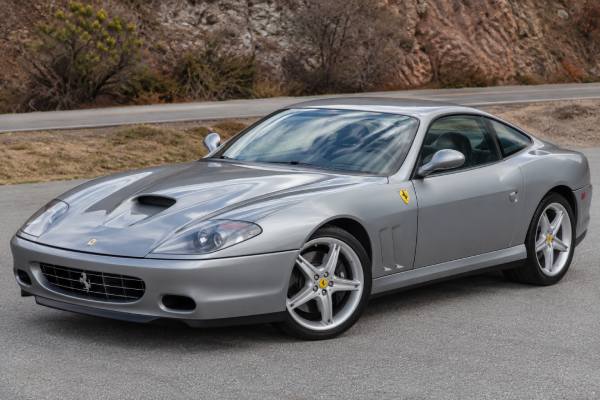
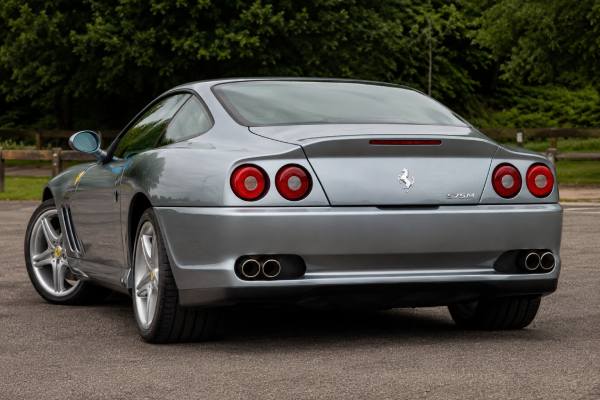
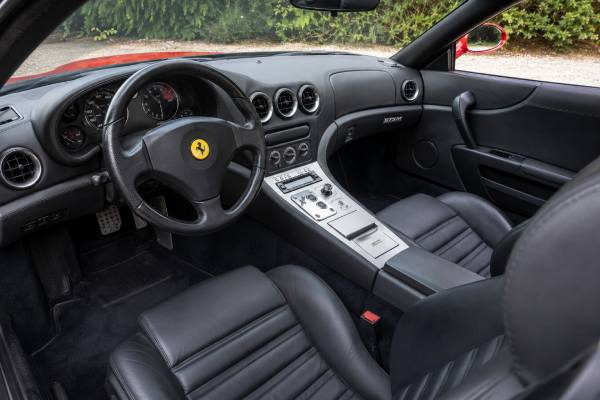
The Ferrari 575M Maranello is the revised F133 front-engine V12 grand tourer built after the 550 Maranello, using a 5.7-liter F133E naturally aspirated V12 rated at 515 hp and sold during the early-2000s return of Ferrari’s classic two-seat berlinetta formula. It kept the long hood, rear transaxle layout, and discreet Pininfarina shape of the 550, but added more power, adaptive suspension, revised aerodynamics, a redesigned interior, and the option of Ferrari’s electro-hydraulic “F1” paddle-shift gearbox.
Its importance is not just that it was fast. The 575M sits at a turning point in Ferrari history. It was one of the last front-engine V12 Ferraris available with a traditional gated manual gearbox, yet it also brought the brand’s automated-manual technology into the V12 GT line. That split personality is why buyers still study it closely: the F1 cars can be usable and relatively attainable by modern Ferrari standards, while original factory manuals have become serious collector cars.
Quick Take
The 575M Maranello’s strongest appeal is its blend of old-school Ferrari layout and early modern usability: a naturally aspirated front-mounted V12, rear-wheel drive, transaxle balance, leather-lined two-seat cabin, and enough comfort for real distance driving. The main caution is condition sensitivity. Timing-belt history, F1 system health, clutch wear, sticky interior parts, suspension electronics, documentation, and originality matter more than headline mileage alone. For buyers, the biggest market factor is transmission: factory manual cars are much rarer and far more valuable than F1 examples, while well-kept F1 cars remain the more accessible way into the model.
Table of Contents
- Why the 575M Maranello Matters
- F133E V12, Chassis and Specifications
- Production, Variants and Factory Options
- Design, Engineering and Special Features
- Driving Experience and Performance
- Reliability, Maintenance and Restoration
- Market Value and Buying Guide
Why the 575M Maranello Matters
The 575M matters because it refined the 550 Maranello formula without abandoning the traditional Ferrari grand tourer identity. It was still a front-engine, rear-drive, two-seat V12 berlinetta, but with more speed, more electronics, and a broader range of driving moods.
Ferrari launched the 550 Maranello in the 1990s as a return to the classic front-engine V12 coupe after years of mid-engine flat-12 flagships. The 575M continued that idea into the 2000s. The “575” name refers to the engine’s displacement in centiliters, while “M” stands for “modificata,” meaning modified. That was accurate rather than decorative: the car was not a clean-sheet replacement, but it was more than a trim update.
The 575M received a larger 5,748 cc V12, up from the 550’s 5,474 cc engine. Power rose to 515 hp, and torque reached 588 Nm. Ferrari also retuned the chassis, added adaptive damping, updated the interior, improved cooling and fluid dynamics, and offered the F1 transmission. These changes made the car easier to drive quickly, especially for buyers who wanted a grand tourer that could handle traffic, long trips, and fast open roads without feeling like a full-time event.
Its reputation has changed over time. When new, some purists preferred the 550 for its simpler character and standard manual gearbox. The 575M was sometimes criticized for softer responses, especially in early cars without the sharper handling packages. Today, that judgment looks incomplete. A properly sorted 575M is a fast, relaxed, sonorous V12 Ferrari with real touring ability, and the best-specified examples are highly desirable.
The car also marks an important collector boundary. Later Ferrari V12 GTs became larger, faster, more complex, and mostly automated. The 599 GTB Fiorano that followed was a major leap in performance, but it moved the front-engine V12 line into a more aggressive era. The 575M remains closer to the leather, metal, analog-instrument, long-bonnet Ferrari tradition.
For collectors, the 575M is important for four main reasons:
- It is one of the last Ferrari V12 berlinettas offered with a factory gated manual gearbox.
- It combines the elegant 550 body style with a stronger 5.7-liter engine and adaptive chassis technology.
- It introduced the F1 paddle-shift option to Ferrari’s front-engine V12 GT line.
- It has a clear hierarchy of desirability based on transmission, handling package, mileage, colors, service history, and originality.
The 575M is not a raw lightweight sports car. It is a high-speed grand tourer. That distinction helps explain why some owners love it deeply while others expect the wrong thing. It rewards smooth inputs, long corners, high-speed composure, and V12 torque more than short-gear drama. In the right condition and specification, that makes it one of the most satisfying modern-classic Ferrari road cars.
F133E V12, Chassis and Specifications
The 575M’s core specification is a 5.7-liter naturally aspirated 65-degree V12 mounted ahead of the cabin and paired with a rear transaxle. This layout gives the car its main character: big-engine response at the front, balanced weight distribution, and a long-legged GT feel.
Engine and drivetrain
The F133E V12 is an all-aluminum, four-cam, 48-valve engine with dry-sump lubrication. Dry-sump lubrication stores oil in a separate tank rather than relying only on a deep oil pan. In a high-performance car, that helps control oil supply during hard cornering and allows the engine to sit lower.
The engine is not turbocharged. Its appeal is natural aspiration: throttle response, rev build, induction sound, and a clear mechanical rise toward the upper rev range. The 575M makes strong torque for relaxed driving, but it still feels like a Ferrari V12 when extended.
| Item | Specification |
|---|---|
| Engine code | F133E |
| Configuration | Front longitudinal 65-degree V12 |
| Displacement | 5,748.36 cc |
| Bore x stroke | 89 mm x 77 mm |
| Compression ratio | 11.0:1 |
| Valve gear | Twin overhead camshafts per bank, four valves per cylinder |
| Fuel and ignition | Bosch Motronic electronic injection and ignition |
| Lubrication | Dry sump |
| Power | 515 hp at 7,250 rpm |
| Torque | 588 Nm at 5,250 rpm |
Two transmissions were offered. The traditional six-speed manual uses Ferrari’s open-gate shift pattern and a clutch pedal. The F1 version uses an electro-hydraulic system to operate a single-clutch manual gearbox by paddles behind the steering wheel. It is not a torque-converter automatic and not a modern dual-clutch transmission. It needs the same respect as a manual gearbox, especially during low-speed maneuvering.
Chassis, suspension and brakes
The 575M uses a steel tubular chassis with aluminum body panels and a rear-mounted transaxle. Suspension is by double wishbones, with adaptive damping that can vary response according to road and driving conditions. Compared with the 550, the 575M’s suspension and gearbox electronics made the car more integrated, especially in F1 form.
| Item | Specification |
|---|---|
| Layout | Front engine, rear-wheel drive |
| Transmission | Six-speed manual or six-speed F1 automated manual |
| Suspension | Double wishbones with adaptive damping |
| Steering | Power-assisted rack and pinion |
| Standard brakes | Ventilated steel discs |
| Standard tires | 255/40 ZR18 front, 295/35 ZR18 rear |
| Wheelbase | 2,500 mm |
| Length | 4,550 mm |
| Width | 1,935 mm |
| Height | about 1,277 mm |
| Kerb weight | about 1,730 kg, depending on market and equipment |
| Fuel capacity | 105 liters |
| 0–100 km/h | about 4.2 seconds |
| Top speed | about 325 km/h |
The numbers still look serious. A front-engine GT capable of more than 300 km/h was impressive in the early 2000s, and the 575M’s performance remains more than enough for modern road use. What matters more today is whether the car feels healthy, tight, and correctly maintained. A neglected example can feel heavy and vague; a good one feels composed and expensive in the best sense.
Production, Variants and Factory Options
The 575M Maranello family is simple at first glance, but collector value depends heavily on version, transmission, options, and originality. The biggest dividing line is factory manual versus F1, followed by handling packages and special-bodied derivatives.
The standard 575M Maranello was the fixed-roof berlinetta. Most cars were built with the F1 paddle-shift gearbox, while a much smaller number left the factory with the gated six-speed manual. Production totals vary slightly by source, but the commonly cited figure for the berlinetta is just over 2,000 cars, with about 246 factory manual examples. That manual number is the reason three-pedal cars command such a large premium.
Main versions
| Version | Years | Key identity |
|---|---|---|
| 575M Maranello Berlinetta | 2002–2005/early 2006 | Fixed-roof two-seat V12 GT with 515 hp |
| 575M F1 | 2002–2005/early 2006 | Paddle-shift electro-hydraulic single-clutch gearbox |
| 575M Manual | 2002–2005 | Factory gated six-speed manual; rarest regular berlinetta specification |
| Superamerica | 2005–2006 | Open-roof derivative with rotating glass roof and higher-output V12 |
| 575 GTC race car | 2003–2005 | Competition version with a 6.0-liter V12 and racing bodywork |
| 575 GTZ by Zagato | 2005–2006 | Very limited coachbuilt Zagato-bodied cars based on the 575M platform |
The Superamerica is related but not the same buying proposition. It used a rotating electrochromic glass roof and a more powerful V12 tune, commonly listed at 540 hp. It is rarer, more theatrical, and usually more expensive, especially with a manual gearbox. The article’s main focus, however, is the standard 515 hp 575M Maranello berlinetta.
The 575 GTC race car should not be confused with the road car’s GTC handling package. The race car was a competition machine developed for GT racing with much more extensive changes, including a larger racing engine, fixed aero, lightweight panels, and racing equipment. The road-car package was an option package for the street 575M.
Important factory options
Options have a strong effect on desirability. Some were cosmetic, while others changed how the car drove.
Important options and packages include:
- Fiorano Handling Package: usually desirable because it sharpens the chassis response compared with the standard setup.
- GTC Handling Package or HGTC: highly desirable late option with carbon-ceramic brakes, 19-inch wheels, revised suspension tuning, and a freer-flowing exhaust.
- Daytona-style seats: popular visual and comfort option with distinctive insert pattern.
- Scuderia Ferrari shields: fender shields are common on modern Ferraris and often help resale appeal.
- Carbon interior trim: adds a sportier cabin look, though condition and originality still matter.
- Modular or upgraded wheels: wheel style can influence buyer interest, but originality is important.
- Hi-Fi audio and leather shelf options: useful on touring-oriented cars and often seen on well-specified examples.
For collectors, a factory build sheet, window sticker, warranty booklet, stamped service book, tools, tire inflator, manuals, keys, covers, and Ferrari Classiche documentation can matter. The 575M is modern enough that buyers expect documentation, but old enough that gaps are common. A car with clean ownership records and correct specification is easier to value than one with uncertain option history.
Color also matters. Rosso Corsa remains the familiar Ferrari choice, but many 575M buyers prefer understated GT colors such as Grigio Titanio, Argento Nürburgring, Blu Tour de France, Nero, or darker metallic shades over tan, black, or Bordeaux leather. Unusual factory colors can help value if they suit the car and are documented.
Design, Engineering and Special Features
The 575M’s design is deliberately restrained, and that is a major part of its appeal. It does not rely on oversized wings or show-car drama; it uses long-hood proportions, clean surfaces, and a cabin set back toward the rear axle.
Pininfarina’s shape carried over from the 550 Maranello with subtle revisions. The headlights, front air intakes, underbody details, and interior were updated, but the basic silhouette stayed elegant and low. The result is a car that has aged better than many more aggressive early-2000s exotics. It looks expensive without shouting.
Front-engine packaging
The long bonnet is not just styling. The V12 sits ahead of the cabin, while the gearbox is mounted at the rear in transaxle layout. That spreads mass more evenly than a conventional front-engine, front-gearbox arrangement. It also gives the 575M its classic GT stance: a long nose, compact cabin, short rear deck, and stable high-speed personality.
The engine bay is visually important. The red intake plenums, broad V12 layout, and front-mid placement give the car the sense of a traditional Ferrari flagship. Access is better than on many mid-engine Ferraris, but that does not make it cheap to maintain. Packaging around the V12 still makes certain jobs labor-intensive.
Aerodynamics and cooling
The 575M was refined aerodynamically over the 550 rather than visually transformed. Ferrari improved airflow, cooling, and high-speed stability without changing the car’s basic shape. The front intakes, underbody work, and cooling routes support long high-speed running, which is central to the car’s purpose.
This is not a track aero car in the modern sense. There are no active wings, no extreme splitters, and no carbon tub. The engineering is more about stability, heat management, and road usability. That makes the 575M feel less dramatic than a later 599 or F12, but also more relaxed.
Interior character
The cabin is a mix of early-2000s Ferrari luxury and analog sports-car cues. There are round instruments, leather trim, a compact dashboard, and a low seating position. Manual cars have the famous open metal shift gate, while F1 cars have paddles and a simpler center console layout.
The driving position suits long distances better than many exotic cars of the period. Visibility is reasonable, luggage space is usable for a two-seat Ferrari, and the car can cover real miles. That is one reason higher-mileage examples should not be dismissed automatically. A 575M that has been driven and maintained can be better than a low-mileage car that has sat for years with old belts, tires, fluids, and sticky cabin parts.
The interior’s main age-related flaw is material deterioration. Many Ferraris of this era suffer from sticky plastic switches and trim coatings. Leather can shrink, dashboards can pull near vents, seat bolsters can wear, and HVAC controls can become tired. These issues are fixable, but proper restoration is more expensive than quick cosmetic repair.
Driving Experience and Performance
A good 575M feels fast, stable, refined, and muscular rather than nervous or razor-edged. It is a grand tourer first, with supercar-level speed for its era and a V12 soundtrack that becomes more special as the revs rise.
Around town, the car’s size and weight are noticeable. The bonnet is long, the controls have a serious feel, and the engine prefers being warmed properly before hard use. Once moving, the car settles into a smooth rhythm. The V12 has enough torque to avoid constant shifting, but it rewards revs when the road opens.
Engine response and sound
The F133E engine is the centerpiece. It pulls cleanly from low rpm, builds strongly through the middle, and becomes more urgent near the top end. Compared with turbocharged modern engines, it feels linear. The reward is not a sudden hit of boost, but a continuous sweep of power and sound.
The exhaust note is more cultured than savage in standard form. HGTC-equipped cars, and cars with quality exhaust upgrades, can sound sharper. Buyers should be careful with modified exhausts, though. A tasteful system can improve enjoyment, while a loud or poorly chosen setup can create drone and reduce originality.
Manual versus F1 driving feel
The manual gearbox gives the 575M a more traditional Ferrari personality. The open gate, clutch pedal, and mechanical shift action make each gear change part of the experience. The gearbox can feel stiff when cold, so patience matters until the oil is warm. Once ready, it gives the car a slower but more involving rhythm.
The F1 gearbox changes the experience. It suits quick open-road driving and adds a period-correct early-2000s Ferrari feel. It is best when driven with mechanical sympathy: lift slightly during shifts in normal driving, avoid creeping in traffic, and do not treat it like a modern automatic. In sportier use, it feels much better than it does when crawling around parking lots.
A healthy F1 system should shift consistently, select gears cleanly, and not show warning lights or pressure problems. Slow engagement, slipping, refusal to select gears, or heavy clutch wear readings should be taken seriously.
Steering, ride and handling
The 575M is not as light on its feet as a mid-engine V8 Ferrari, but it has excellent high-speed confidence. Steering effort is measured, the front end is stable, and the rear transaxle helps the car feel balanced in long corners. It prefers smooth, committed driving rather than abrupt inputs.
Early standard cars can feel a little soft if judged as sports cars. Fiorano or HGTC-equipped examples are more controlled. Tire choice also makes a major difference. Old tires can ruin the feel of the car even if tread depth looks acceptable. A 515 hp rear-drive Ferrari on aged rubber is not something to rationalize.
Braking performance is strong when the system is fresh. Standard steel brakes are easier and cheaper to service. Carbon-ceramic HGTC brakes are desirable, but condition matters because replacement costs are high. Buyers should inspect discs, pads, calipers, and service records carefully.
Reliability, Maintenance and Restoration
The 575M can be a robust Ferrari when maintained correctly, but it is not a casual used car. Its reliability depends on specialist servicing, timing-belt history, electrical health, F1 system condition, suspension electronics, and the quality of previous ownership.
The V12 itself has a strong reputation, but age is now the major issue. These cars are roughly two decades old. Rubber, seals, hoses, mounts, wiring insulation, leather, plastics, and hydraulic components age even when mileage is low. A low-mileage car with poor maintenance can be riskier than a regularly driven car with excellent records.
Core maintenance priorities
Timing belts are the major scheduled item. The 575M uses belts, not chains, and belt age matters. Many specialists work around a five-year or mileage-based interval, often combined with tensioners, accessory belts, fluids, filters, and inspection of seals and hoses. The exact requirement should always be verified by VIN, market, and official service documentation.
Important recurring maintenance items include:
- Engine oil and filter services
- Timing belts, tensioners, and related front-engine service items
- Brake fluid and clutch hydraulic fluid
- Gearbox and differential fluids
- Coolant service and inspection of hoses
- Fuel lines, vapor hoses, and rubber components
- Spark plugs and ignition components
- Battery maintenance and charging-system checks
- Tire age replacement, not just tread inspection
- Air-conditioning function and leak checks
The 575M benefits from being used. Long storage can lead to flat-spotted tires, weak batteries, stuck actuators, dry seals, old fuel, and warning lights. A car that has covered modest annual mileage with proper service is often easier to trust than a static garage queen.
Common ownership issues
| Area | What to Check | Why It Matters |
|---|---|---|
| Timing belts | Date, mileage, tensioners, invoice quality | Deferred belt service is a major negotiation point and risk |
| F1 gearbox system | Pump, actuator, accumulator, clutch wear reading, shift quality | Faults can be expensive and affect drivability |
| Manual gearbox | Cold shift quality, clutch bite, synchro behavior, originality | Factory manuals are valuable and must be verified carefully |
| Suspension | Damper function, warning lights, bushings, ball joints, ride height | Worn parts make the car feel heavy and imprecise |
| Brakes | Disc wear, pads, hoses, calipers, carbon-ceramic condition if fitted | HGTC brake replacement can be costly |
| Interior | Sticky plastics, leather shrinkage, seat wear, switch operation | Cosmetic restoration can become expensive quickly |
| Cooling system | Radiators, fans, hoses, coolant history, temperature stability | Heat management is vital for a large V12 |
| Body and paint | Panel gaps, paint meter readings, corrosion near fixings, accident repair | Original structure and paint quality affect value |
Restoration and originality
Restoration on a 575M is different from restoration on an older classic. You are not usually rebuilding a rusty body shell from the ground up. Instead, you are correcting deferred mechanical work, electronic faults, interior deterioration, worn suspension, and cosmetic aging.
Originality matters most on high-value cars. Factory manual cars, HGTC cars, unusual colors, and low-mileage examples should be kept as correct as possible. Manual conversions can be enjoyable, but they should not be valued like factory manuals. Non-original wheels, aftermarket audio changes, repainted panels, non-standard exhausts, and missing books or tools can all affect desirability.
A pre-purchase inspection should be done by a Ferrari specialist who knows the 550/575 platform. Generic exotic-car familiarity is not enough. The inspection should include a road test, diagnostic scan, clutch wear data for F1 cars, compression or leak-down testing when appropriate, suspension inspection, paint assessment, underbody check, and documentation review.
Market Value and Buying Guide
The 575M market is split into two worlds: relatively attainable F1 cars and highly valued factory manuals. Condition still matters in both, but transmission and specification create the largest price gap.
As of the mid-2020s, many F1 berlinettas trade in the low-to-mid six-figure range depending on mileage, color, options, and service history. The best F1 cars with rare options, low mileage, strong colors, and complete history can sit higher. Factory manual cars are much more expensive, often several times the value of an ordinary F1 car, with exceptional late or highly optioned manuals reaching collector-level prices.
HGTC cars deserve special attention. The package gives the 575M sharper dynamics and more desirable hardware, including carbon-ceramic brakes and 19-inch wheels. For many buyers, an HGTC F1 car is the sweet spot: more focused than a standard F1, rarer, and still usually below factory manual pricing. However, the brake system must be inspected carefully because replacement costs can be significant.
What drives value
The most important value factors are:
- Factory manual gearbox
- HGTC or Fiorano handling specification
- Original colors and desirable interior combination
- Low but believable mileage
- Continuous specialist service history
- Recent belt service
- Complete books, tools, keys, covers, and records
- Ferrari Classiche certification where appropriate
- Original panels and clean accident history
- No questionable manual conversion presented as factory
- No neglected sticky interior, warning lights, or deferred F1 work
Mileage should be judged in context. A 10,000-mile car with no recent major service may need immediate spending. A 35,000-mile car with excellent records, fresh belts, current tires, and sorted suspension may drive better and be less risky. For the 575M, “buy the best history” is often better advice than “buy the lowest mileage.”
Buyer inspection checklist
Use this checklist before committing to a car:
- Confirm the VIN, market specification, transmission type, and factory options.
- Check whether a manual car is a factory manual or a conversion.
- Review service records for timing belts, fluids, clutch, tires, suspension, and brake work.
- For F1 cars, request clutch wear data and inspect pump, actuator, accumulator, and shift behavior.
- Inspect tire date codes, not just tread depth.
- Test all interior switches, HVAC functions, windows, locks, seat controls, warning lights, and instruments.
- Look for sticky trim, leather shrinkage, dash pulling, and poor cosmetic repairs.
- Check for coolant leaks, oil leaks, fuel smells, and evidence of overheating.
- Inspect brake disc condition, especially on HGTC carbon-ceramic cars.
- Get a Ferrari-specialist pre-purchase inspection before negotiating final price.
Cars to seek and cars to avoid
The best 575M to buy depends on your goal. For collection value, a documented factory manual in a desirable color with low mileage and full history is the top choice. For driving enjoyment and value, a sorted F1 car with HGTC or Fiorano handling can be very compelling. For long-distance use, a well-maintained standard F1 car in an elegant color may be the most sensible option.
Avoid cars with missing service history, unclear transmission identity, warning lights, poor paintwork, cheap interior repairs, old tires, overdue belts, slipping clutches, or vague explanations from sellers. Be especially cautious with cars that look inexpensive compared with the market. A 575M can absorb the purchase-price savings quickly if it needs belts, clutch work, tires, suspension refurbishment, sticky trim restoration, and brake repairs at the same time.
Long-term collectability looks strong for the right cars. The 575M has the ingredients collectors like: naturally aspirated V12 power, limited production, Pininfarina styling, Ferrari front-engine heritage, and a clear rarity story around factory manuals. F1 cars may not appreciate at the same rate, but good examples are still important because they represent the model most buyers actually used and experienced.
The smartest purchase is not always the rarest one. It is the car whose condition, records, specification, and price all make sense together. A great 575M should feel tight, smooth, fast, and dignified. When it does, it delivers something increasingly rare: a modern-classic Ferrari V12 GT that can still be driven as intended.
References
- Ferrari 575M Maranello (2002) – Ferrari.com 2002 (Manufacturer Specifications)
- Ferrari 575 GTC (2003) – Ferrari.com 2003 (Manufacturer Specifications)
- Check for Recalls: Vehicle, Car Seat, Tire, Equipment | NHTSA 2026 (Recall Database)
- Ferrari 575M Market – CLASSIC.COM 2026 (Market Data)
- 2003 Ferrari 575M Maranello | Monterey 2024 | RM Sotheby’s 2024 (Auction Reference)
Disclaimer
This article is for informational purposes only and is not a substitute for professional diagnosis, repair, inspection, or valuation. Specifications, torque values, service intervals, procedures, equipment, and market details can vary by VIN, market, production date, and vehicle condition. Always verify technical work against the official Ferrari service documentation for the specific car and use a qualified Ferrari specialist before purchase or repair.
If you found this guide useful, please consider sharing it on Facebook, X/Twitter, or with other Ferrari enthusiasts to support our work.