
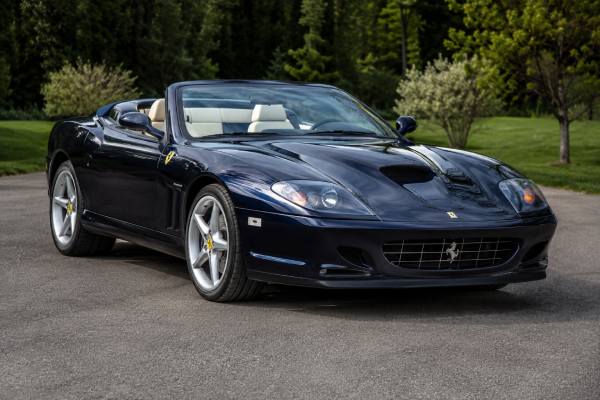
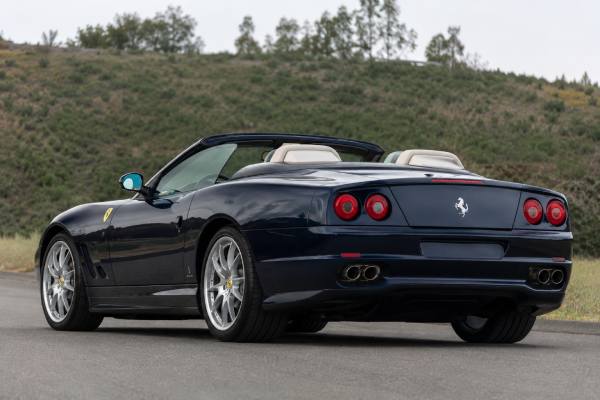
The Ferrari Superamerica is the open-top, limited-production version of the 575M Maranello, built for 2005 and 2006 with the F133G 5.7-liter naturally aspirated V12 tuned to 540 hp. It sits at a fascinating point in Ferrari history: a front-engine V12 grand tourer with old-school proportions, a rear-mounted transaxle, available gated manual gearbox, and one of the strangest factory roof systems ever fitted to a modern Ferrari.
The Superamerica matters because it was not simply a 575M with the roof removed. Ferrari gave it more power than the standard 575M, reinforced the structure, added a rotating electrochromic glass roof, and limited production to 559 cars. Today, buyers search for it because it combines modern usability with collectible rarity, especially when equipped with the factory six-speed manual or the desirable Handling GTC package.
Quick Take
The Ferrari Superamerica’s strongest appeal is its mix of front-engine V12 theater, limited production, and the dramatic Revocromico rotating glass roof. Its identity is half grand tourer and half collectible special series: fast, rare, mechanically related to the 575M, but visually and historically distinct. The main caution is ownership complexity, especially roof condition, F1 gearbox health, sticky interior parts, suspension electronics, documentation, and the cost of correcting deferred maintenance. For buyers, originality, factory gearbox, Classiche certification, complete books/tools, service history, roof function, and evidence of careful specialist care matter more than mileage alone.
Table of Contents
- History and Collector Significance
- F133G V12, Chassis and Specifications
- Production, Variants and Factory Options
- Design, Engineering and Special Features
- Driving Experience and Performance
- Reliability, Maintenance and Restoration
- Market Value and Buying Guide
History and Collector Significance
The Superamerica is important because it was Ferrari’s final open-top expression of the 550/575 front-engine V12 line and one of the last Maranello-built V12 road cars available with a factory gated manual. It was based on the 575M Maranello, but its roof, limited production, extra power, and rarity give it a separate collector identity.
Ferrari revived the Superamerica name for a very specific purpose. Earlier Superamerica models from the 1950s and 1960s were among Ferrari’s most exclusive road cars, often built for wealthy clients who wanted speed, elegance, and individuality. The 2005 Superamerica followed that idea in modern form. It was not the most radical Ferrari of its era, but it was one of the most unusual.
The base car was the 575M Maranello, itself an evolution of the 550 Maranello. The 550 had returned Ferrari to the classic front-engine V12 grand-touring layout after the mid-engine 12-cylinder Testarossa family. The 575M refined that formula with a larger 5.7-liter engine, electronic damping, updated styling, and the optional F1 electrohydraulic gearbox. The Superamerica arrived near the end of that model cycle, just before the 599 GTB Fiorano moved Ferrari’s V12 GT line into a newer, more aggressive era.
What made the Superamerica stand apart was its roof. Instead of using a normal folding fabric top or retractable metal hardtop, Ferrari used a patented rotating glass roof known as Revocromico. The roof panel pivoted backward through 180 degrees and rested over the rear deck. The glass could also vary its tint, giving the driver control over cabin light. It was technically daring, visually memorable, and very different from the simpler 550 Barchetta that came before it.
The production number also matters. Ferrari built 559 examples, a small number even by exotic-car standards. Most were fitted with the F1 automated manual gearbox. The factory six-speed manual cars are much rarer and now sit in a different value category. For collectors, that makes the Superamerica a car where specification can transform the market position.
Its reputation today is more nuanced than simple rarity. Enthusiasts admire the naturally aspirated V12, the long-hood Pininfarina shape, the open-gate manual option, and the roof’s theater. Owners also know it is a heavy, complex, hand-built Ferrari GT that demands careful maintenance. The best examples feel special because they have been preserved, serviced, and documented correctly. Neglected examples can become expensive very quickly.
F133G V12, Chassis and Specifications
The Superamerica’s core hardware is a front-mounted 5.7-liter V12, a rear transaxle, rear-wheel drive, and a reinforced 575M chassis. Its headline specification is the F133G V12, rated at 540 hp at 7,250 rpm, giving it more power than the standard 575M Maranello.
| Item | Specification |
|---|---|
| Production years | 2005–2006 |
| Body style | Two-seat retractable hardtop spider / open GT |
| Engine code | F133G |
| Engine layout | Front longitudinal 65-degree V12 |
| Displacement | 5,748 cc |
| Bore x stroke | 89 mm x 77 mm |
| Induction | Naturally aspirated |
| Valvetrain | DOHC, 48 valves |
| Maximum power | 540 hp at 7,250 rpm |
| Maximum torque | About 589 Nm / 434 lb-ft at 5,250 rpm |
| Transmission | Six-speed manual or six-speed F1 automated manual transaxle |
| Drivetrain | Rear-wheel drive |
The engine is the reason the car still feels special. It is a large-capacity Ferrari V12 with a smooth bottom end, a strong midrange, and a harder upper-register sound as it approaches the top of the tachometer. Compared with the standard 575M, the Superamerica’s extra output came from breathing and exhaust changes rather than a complete redesign. It keeps the traditional Ferrari V12 character: refined at low speed, musical under load, and more exciting the longer it is allowed to rev.
The gearbox layout is also important. The transmission sits at the rear in transaxle form, helping weight distribution and giving the car a more balanced feel than its long hood suggests. Manual cars use the classic open-gate lever that now carries major collector appeal. F1 cars use a single-clutch electrohydraulic system. It is not a dual-clutch gearbox; it needs mechanical sympathy, correct adjustment, and a healthy clutch to feel right.
| Category | Specification |
|---|---|
| Length | 4,550 mm |
| Width | 1,935 mm |
| Height | About 1,277 mm |
| Wheelbase | 2,500 mm |
| Front / rear track | 1,632 mm / 1,586 mm |
| Kerb weight | About 1,790 kg, depending on market and equipment |
| Fuel capacity | 105 liters |
| Front tires | 255/35 ZR19 |
| Rear tires | 305/30 ZR19 |
| 0–100 km/h | About 4.2 seconds |
| Top speed | About 320 km/h / 199 mph |
The suspension uses double wishbones and electronically controlled damping. This matters because the Superamerica is not a lightweight roadster; it is a powerful GT with a big V12, a reinforced body, a complex roof, and serious cruising ability. The suspension has to manage both comfort and body control. When healthy, it gives the car a polished long-distance feel with enough sharpness for fast roads.
Standard brakes are ventilated discs, while cars equipped with the Handling GTC package gained carbon-ceramic braking hardware and a sharper chassis setup. The GTC package is important for both driving feel and value, but buyers must inspect ceramic brake condition carefully. Replacement cost can be high enough to change the economics of a purchase.
Production, Variants and Factory Options
Ferrari built 559 Superamericas, and the two most important distinctions are gearbox type and factory equipment. A factory six-speed manual car is far rarer and more valuable than an F1 car, while GTC-equipped examples tend to be more desirable than otherwise similar cars without the package.
There was no long list of body variants. The Superamerica itself was the special body style: a 575M-based two-seat open GT with the rotating hardtop. However, individual cars can differ greatly because of transmission, market, colors, interior trim, wheels, brakes, and personalization.
| Feature | Why it matters |
|---|---|
| Total production | 559 cars, giving the model genuine limited-production status |
| F1 gearbox | Most common configuration; still collectible but more condition-sensitive on clutch and actuator health |
| Six-speed manual | Very rare factory specification and the strongest value driver |
| Handling GTC package | Adds desirability through sharper dynamics and carbon-ceramic brakes |
| Color and trim | Factory special-order combinations can add appeal when documented |
| Classiche certification | Useful for confirming originality and supporting collector confidence |
The factory manual cars deserve special attention. Only a small fraction of production was built with the open-gate six-speed, and those cars now attract buyers who want the most analog version of the Superamerica. A manual conversion is not the same thing. Conversions may improve driver appeal for some owners, but the market normally treats factory-built manual cars as a different category. A buyer should verify gearbox originality through factory documentation, build records, Ferrari Classiche paperwork, or a marque specialist who knows the model.
The F1 gearbox should not be dismissed. It suits the Superamerica’s period and was the modern Ferrari technology of the day. A well-set-up F1 car can shift cleanly and feel involving, especially at speed. But it does require more scrutiny. Clutch wear readings, hydraulic pump health, actuator calibration, gearbox mounts, and shift quality all matter.
The Handling GTC package is another major option. On 575M-based cars, it is associated with carbon-ceramic brakes, more focused suspension tuning, sportier wheels, and a more purposeful personality. For collectors, it adds specification strength. For drivers, it gives the heavy GT more bite. For owners, it also adds inspection responsibility, because worn carbon-ceramic components can be expensive.
Original accessories are more important than many first-time Ferrari buyers expect. A strong Superamerica should ideally have its books, tools, tire inflator or mobility kit where applicable, battery charger, keys, manuals, radio codes if relevant, covers, service invoices, and any factory documents. Missing accessories are not always deal-breakers, but on a limited-production Ferrari they affect confidence and value.
Design, Engineering and Special Features
The Superamerica’s defining feature is the Revocromico roof, but its appeal also comes from the way Ferrari blended that unusual roof with the long-hood, short-deck proportions of the 575M. It is a car where engineering, theater, and grand-touring elegance all meet in one unusual package.
The exterior design is closely related to the 575M Maranello, with Pininfarina’s clean front-engine V12 proportions. It has a long bonnet, set-back cabin, muscular rear haunches, and a low stance. Compared with later Ferraris, it looks restrained. There are no huge aero surfaces, no oversized vents, and no aggressive race-car graphics. The shape is more about proportion than visual noise.
The roof changes the character completely. The glass panel rotates backward and settles over the rear deck instead of folding into the body. This gives the Superamerica a dramatic transformation without sacrificing luggage space in the way many retractable hardtops do. The rear glass area also acts as a wind deflector when the roof is open.
The electrochromic function is part of the car’s identity. The glass can be adjusted through different tint levels, allowing more or less light into the cabin. In concept, that makes the car both a closed GT and an open-air cruiser with a high-tech roof. In ownership, it also means the roof is one of the first areas to inspect. Glass condition, tint function, seals, alignment, motor operation, and control electronics should all be checked.
Ferrari had to reinforce the structure for open-top use. Removing a fixed roof from a powerful front-engine GT is not simple. The Superamerica received strengthening in areas such as the sills, A-pillars, central structure, and rear bulkhead region. Even so, it is better understood as a fast open GT than a track-focused spider. A healthy car feels solid, but it will not have the same closed-shell rigidity as a fixed-roof berlinetta.
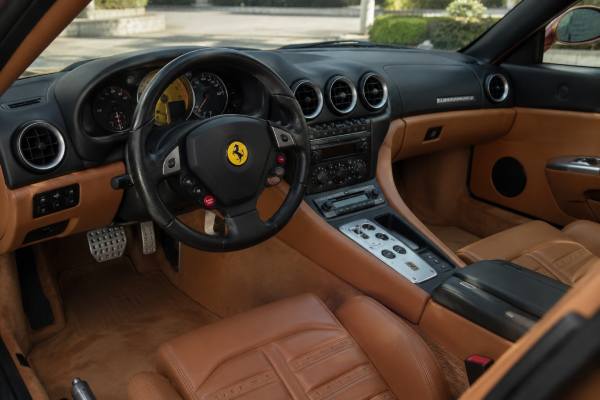
Inside, the Superamerica is very much a mid-2000s Ferrari. The cabin is low, leather-rich, and driver-focused, with a simple dashboard compared with modern screen-heavy cars. Manual cars get the iconic metal shift gate. F1 cars place more focus on the paddles and central controls. In either form, the driving position, analog instruments, and V12 soundtrack matter more than infotainment.
The sensory character is one of its best qualities. The engine sits ahead of the driver, the exhaust note builds from a cultured GT sound into a harder V12 wail, and the open roof lets more of that sound into the cabin. This is not a brutally stripped exotic. It is a fast, expensive, hand-built Ferrari grand tourer with a theatrical roof and enough power to feel serious even today.
Driving Experience and Performance
The Superamerica drives like a powerful V12 grand tourer first and an open exotic second. It is fast, stable, and dramatic, but its weight, wheelbase, and roof structure give it a more mature personality than a mid-engine Ferrari sports car.
Acceleration is strong rather than shocking by today’s supercar standards. A 0–100 km/h time of about 4.2 seconds was very quick in period, and the 320 km/h top-speed claim gave Ferrari a strong headline for an open-top car. What matters more now is how the V12 delivers its speed. It pulls smoothly from lower revs, builds with real authority in the midrange, and becomes much more emotional near the top of the rev range.
Manual and F1 cars feel different. The six-speed manual gives the driver a mechanical connection that now defines the most desirable examples. The shift gate adds rhythm and involvement, and the driver has full control over clutch engagement. The F1 gearbox is more period-correct for many cars and can be satisfying when driven assertively, but it feels slower and more deliberate than modern dual-clutch transmissions. Around town, poor technique or poor calibration can make it feel jerky. On an open road, it makes more sense.
Steering feel is one of the car’s quiet strengths. The long bonnet and front-engine layout make the car feel substantial, but the steering gives useful information once the tires are loaded. It is not nervous or hyperactive. It prefers flowing roads, smooth inputs, and confident commitment.
Ride quality depends heavily on tires, suspension health, and whether the car has the GTC package. A standard car in good condition has a genuine GT side. It can cover long distances without feeling punishing. A GTC car feels sharper and more controlled, but may ride more firmly. Old tires, tired bushings, weak dampers, or incorrect alignment can make any Superamerica feel far worse than it should.
The brakes are strong when correctly maintained. Steel-brake cars should be inspected for disc wear, pad condition, fluid age, and caliper health. GTC carbon-ceramic cars need a more specialist inspection, including disc condition and remaining life. Carbon-ceramic brakes can last a long time under road use, but replacement costs are high.
Visibility is better than many modern supercars because the car has a relatively simple shape and upright glass area. The long hood still demands care, and the car is wide enough to feel expensive on narrow roads. In city driving, heat, clutch use, low-speed F1 behavior, and parking risk are bigger concerns than raw drivability. On highways and fast open roads, the Superamerica makes much more sense. It settles into a long-legged rhythm and feels like the kind of Ferrari built to cross countries, not just chase lap times.
Reliability, Maintenance and Restoration
The Superamerica can be a dependable collector Ferrari when maintained correctly, but it is not a low-cost exotic. The biggest risks are deferred timing-belt service, F1 clutch and hydraulic issues, roof-system faults, suspension electronics, aging rubber, sticky interior trim, and expensive parts unique to the model.
The F133 V12 is generally respected when serviced on schedule. It is not a fragile engine by exotic standards, but it is still a Ferrari V12 with timing belts, many seals, cooling-system demands, expensive labor access, and a strong need for clean fluids and regular use. A car that has covered very few miles but has not received time-based service can be riskier than a car with more mileage and excellent records.
| Area | What to check |
|---|---|
| Timing belts and tensioners | Confirm current service by date, mileage, invoice detail, and specialist reputation |
| F1 gearbox system | Check clutch wear, pump operation, actuator leaks, calibration, and shift quality |
| Manual gearbox | Check synchros, clutch feel, engagement quality, mounts, and originality |
| Revocromico roof | Test full operation, glass tint, seals, alignment, motor function, and water tightness |
| Suspension | Inspect dampers, actuator function, bushings, ball joints, and alignment |
| Brakes | Check disc condition, pad life, brake-fluid age, calipers, and carbon-ceramic wear where fitted |
| Cooling system | Inspect radiators, fans, hoses, expansion tank, leaks, and temperature behavior in traffic |
| Interior trim | Look for sticky buttons, shrinking leather, worn switches, air-conditioning faults, and pixel/display issues |
The roof deserves special treatment. It is the feature that makes the Superamerica collectible, and it is also one of the features that can make ownership difficult. A pre-purchase inspection should operate the roof several times, check the latch, listen for strain, confirm smooth motion, inspect the glass, and test the electrochromic tint. Water leaks are not acceptable as “just an old Ferrari thing.” They can lead to interior damage and electrical problems.
F1 cars need a diagnostic inspection. Clutch percentage readings are useful, but they are not the whole story. Engagement behavior, selected gear learning, hydraulic pressure, pump cycle frequency, and actuator condition all matter. A car with a low displayed clutch-wear number but poor setup can still drive badly.
Manual cars avoid the F1 hydraulic system, but they are not maintenance-free. A heavy clutch, weak synchros, poor shift quality when warm, or evidence of a non-factory conversion should be taken seriously. For collector value, gearbox originality must be verified.
Aging is now a major factor. These cars are roughly two decades old. Rubber suspension parts, engine mounts, hoses, seals, tires, fuel-system components, window seals, and electrical connectors can age even on low-mileage cars. Battery condition is also important. Low voltage can trigger warning lights and strange behavior in electronic systems.
Restoration is possible but expensive. The issue is not just mechanical labor; it is finding correct parts, roof components, trim pieces, interior switches, factory-correct finishes, and specialists who know the model. Over-restoration can also hurt originality. A high-quality preserved car with careful maintenance may be more desirable than a heavily refreshed car with uncertain workmanship.
For safety and compliance, a VIN-based recall and campaign check is essential. Do not rely only on generic model-year information. Ferrari campaigns can vary by market, VIN range, equipment, and service history. A dealer or qualified Ferrari specialist should confirm whether all applicable campaigns have been completed.
Market Value and Buying Guide
The Superamerica market is divided sharply by specification, originality, mileage, and documentation. F1 cars form the main market, while factory manual cars sit in a much higher collector tier; GTC equipment, rare colors, Classiche certification, and exceptional provenance can move either car upward.
Current values should be treated as a range, not a single number. F1 examples often trade in the broad mid-six-figure zone depending on market, mileage, condition, and currency. The best low-mile, well-documented cars can bring more. Factory manuals are much rarer and often command a large premium, with top examples reaching a separate price category entirely. Asking prices can be ambitious, so recent sale results, condition, and specification matter more than advertised numbers.
The best Superamerica to buy is usually not the cheapest one. A low purchase price can disappear quickly if the roof needs work, the F1 system is tired, belts are overdue, carbon-ceramic brakes are worn, or the car lacks documentation. The most sensible purchase is the car with the clearest history, strongest inspection report, best originality, and most complete records.
Important value factors include:
- Factory six-speed manual gearbox
- Handling GTC package
- Low but usable mileage
- Complete service history from recognized Ferrari specialists
- Ferrari Classiche certification
- Original books, tools, keys, covers, and accessories
- Documented factory colors and trim
- Clean accident history and consistent paint readings
- Fully working Revocromico roof
- Strong clutch, suspension, brake, and diagnostic report
- No questionable modifications or non-factory manual conversion presented as original
A proper inspection should be performed by someone who knows 575M and Superamerica-specific issues. A general exotic-car inspection is not enough. The roof, F1 system, V12 service history, suspension electronics, carbon brakes, and originality details require model familiarity.
A practical buyer checklist should include:
- Verify VIN, build specification, gearbox type, colors, options, and market version.
- Confirm service history, especially timing belts, fluids, clutch, brakes, suspension, and roof work.
- Test the roof repeatedly and inspect the glass, seals, latch, motor, tint function, and water-tightness.
- Scan all control modules and review stored faults, not just dashboard lights.
- For F1 cars, obtain clutch wear data and assess real-world shift behavior.
- For manual cars, confirm factory originality and check shift quality hot and cold.
- Inspect paint, panel gaps, underbody, front structure, radiator area, wheels, and suspension pickup points.
- Check all original accessories, manuals, tools, keys, charger, and documentation.
- Confirm recall and campaign status by VIN.
- Price the car against its true cost to own, not just its auction headline.
Examples to seek are original, documented, dry-stored but exercised, serviced by recognized Ferrari dealers or specialists, and free from unresolved roof or gearbox issues. A higher-mile car with excellent records may be more enjoyable than a delivery-mile car needing recommissioning.
Examples to avoid include cars with vague service gaps, inconsistent mileage history, roof faults, warning lights, poor repaint quality, missing documents, unexplained clutch readings, deferred belt service, accident repairs without invoices, or sellers who cannot demonstrate roof operation. Be cautious with cars advertised around rare specifications without documentation.
Long-term collectability looks strong because the Superamerica combines several desirable traits: naturally aspirated V12, limited production, unusual engineering, Pininfarina styling, front-engine Ferrari GT heritage, and available manual transmission. It is not a simple car, and it is not cheap to maintain, but the best examples occupy a distinctive space between modern Ferrari usability and analog-era collector appeal.
References
- Ferrari Superamerica (2005) – Ferrari.com 2005 (Manufacturer Specifications)
- SUPERAMERICA MAGIC: Ferrari History 2005 (Manufacturer History)
- Ferrari Classiche: Certification – Ferrari.com 2024 (Certification)
- Check for Recalls: Vehicle, Car Seat, Tire, Equipment 2026 (Recall Database)
- 2006 Ferrari Superamerica – F1 Market – CLASSIC.COM 2026 (Market Data)
Disclaimer
This article is for informational purposes only and is not a substitute for professional diagnosis, repair, valuation, or pre-purchase inspection. Specifications, torque values, service intervals, repair procedures, recall applicability, and equipment can vary by VIN, market, model year, and individual vehicle history. Always verify details against official Ferrari service documentation, factory records, and a qualified Ferrari specialist before buying, servicing, or repairing a Superamerica.
If this guide was useful, please consider sharing it on Facebook, X/Twitter, or with other Ferrari enthusiasts to support our work.