
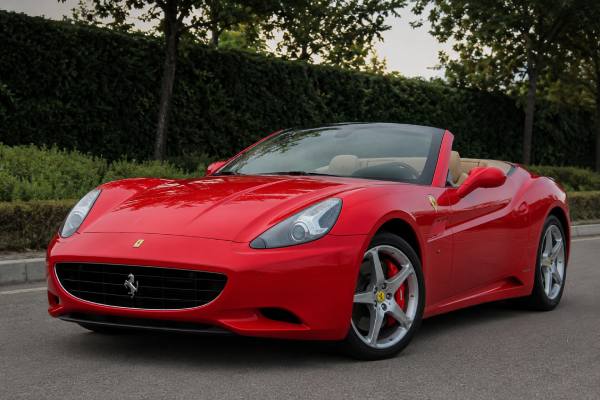
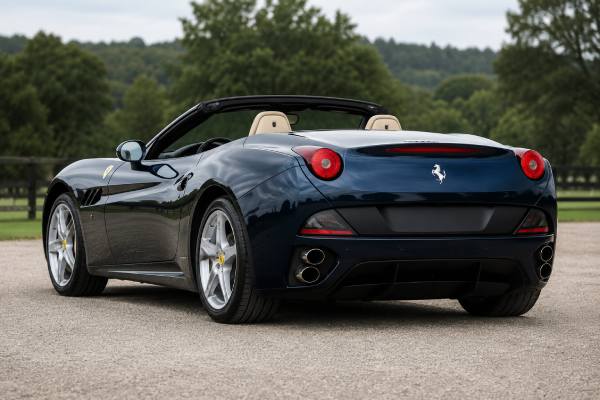
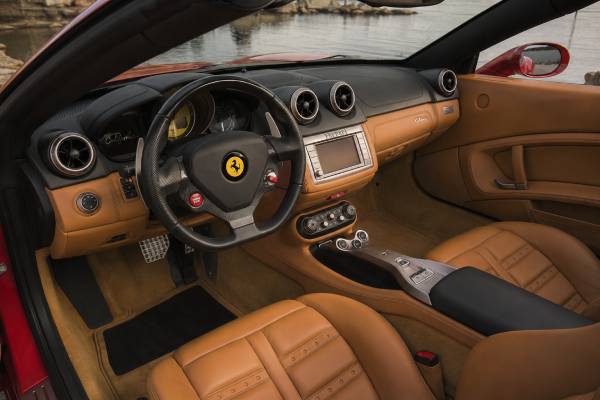
The Ferrari California F149 is the front-mid-engine V8 grand tourer that opened Ferrari ownership to a broader kind of driver without giving up the core traits that make the badge matter: a naturally aspirated engine, rear-wheel drive, sharp steering, and a cabin built around fast road use. Built around the F136IB 4.3-liter V8, the early 460 hp California sits at an interesting point in Ferrari history because it introduced several ideas that later became normal: a dual-clutch gearbox, direct fuel injection, a folding metal hardtop, and a more usable 2+2 layout.
Quick Take
The 2008–2012 Ferrari California is most appealing as a usable, open-top Ferrari with a high-revving naturally aspirated V8 and enough comfort for regular driving. Its historical identity matters because it was Ferrari’s first front-engine V8 road car, its first production dual-clutch model, and its first folding hardtop convertible. The tradeoff is that it is heavier and less raw than a mid-engine Ferrari, and ownership risk depends heavily on roof condition, DCT health, electronic stability, brake condition, and documented maintenance. The best buys are original, well-serviced cars with clean history, strong roof operation, no deferred gearbox work, and verified recall completion.
Table of Contents
- History, Purpose and Model Importance
- Engine, Chassis and Key Specifications
- Production, Variants and Factory Options
- Design, Engineering and Special Features
- Driving Experience and Real Performance
- Reliability, Maintenance and Restoration Reality
- Market Value and Buying Guide
History, Purpose and Model Importance
The California mattered because it was not simply another Ferrari convertible; it created a new grand touring entry point for buyers who wanted speed, sound, open-air use, and real-world comfort in one car. It was less extreme than an F430 or 458, but it was also easier to live with, and that was exactly the point.
Ferrari revived the California name from some of its most desirable open grand tourers, especially the 250 GT California Spyder. The modern F149 did not try to copy that car mechanically or visually. Instead, it reused the idea of a fast, elegant Ferrari that could cross distance comfortably and still feel special on a good road.
The California was revealed in 2008 and reached customers for the 2009 model year in many markets. Its position in the lineup was unusual for Ferrari at the time. The company already had mid-engine V8 sports cars, front-engine V12 grand tourers, and more focused limited models. The California added a front-mid-engine V8 2+2 with a folding metal roof, giving Ferrari a car that could serve as a coupe, convertible, weekend car, and status grand tourer.
For collectors, the early California is important for several firsts:
- First front-engine V8 Ferrari production road car.
- First Ferrari road car with a seven-speed dual-clutch gearbox.
- First Ferrari production model with a folding metal hardtop.
- First Ferrari road car with direct fuel injection.
- First Ferrari with a multi-link rear suspension layout.
Those firsts give the F149 more historical value than some casual observers give it credit for. Early depreciation made the California look like an “entry Ferrari” for many years, but that label misses the engineering shift it represented. It helped shape the path that led to later cars such as the California T, Portofino, Roma, and modern front-engine Ferrari GT models.
The California also changed Ferrari’s customer base. Many examples were bought by first-time Ferrari owners, often with comfort options, conservative colors, and higher annual mileage than limited-production cars. That means the market today contains a wide spread of condition: carefully maintained cars with complete records, lightly used garage queens, and cheaper examples with deferred roof, gearbox, brake, or cosmetic issues.
Its reputation has also become more balanced with time. When new, some enthusiasts criticized it for being too soft, too heavy, or too lifestyle-oriented. Today, the same traits make sense for buyers who want a naturally aspirated Ferrari that is usable without being ordinary. It is not the sharpest Ferrari of its era, but it is one of the most approachable, and that matters in real ownership.
Engine, Chassis and Key Specifications
The early California’s main technical identity is its F136IB 4.3-liter naturally aspirated V8 paired with a seven-speed dual-clutch transaxle. The car is built as a front-mid-engine, rear-wheel-drive grand tourer, with aluminum construction and a rear-biased weight distribution.
| Item | Specification |
|---|---|
| Engine code | F136IB |
| Engine layout | 90-degree naturally aspirated V8 |
| Displacement | 4,297 cc |
| Fuel system | Direct gasoline injection |
| Maximum power | 460 CV / 338 kW at 7,750 rpm |
| Maximum torque | 485 Nm at 5,000 rpm |
| Transmission | Seven-speed dual-clutch automatic with paddle shift |
| Drivetrain | Rear-wheel drive |
| Engine position | Front-mid-mounted |
| Weight distribution | 47 percent front / 53 percent rear |
The F136IB belongs to the broader Ferrari-Maserati F136 V8 family, but the California version is tuned for a different mission from the mid-engine Ferraris. It still revs hard and sounds unmistakably Ferrari, yet the torque delivery is smoother and more flexible than its peak-power number suggests. Direct injection helped Ferrari raise efficiency and response while meeting emissions rules, but it also makes inspection and fuel-system health more important as the cars age.
The gearbox is a major part of the car’s character. Earlier Ferrari road cars often used either a traditional manual or the single-clutch F1 automated manual. The California’s dual-clutch system shifts faster and more smoothly, especially in traffic. It also reduced the awkward low-speed behavior that made some earlier F1-gearbox Ferraris tiring in daily use. Buyers should still remember that this is not a cheap conventional automatic. Any shift-quality issue, warning light, oil leak, or DCT fault code deserves specialist diagnosis before purchase.
| Area | Specification |
|---|---|
| Body style | Two-door 2+2 retractable hardtop convertible |
| Structure | Aluminum chassis and body construction |
| Front suspension | Double wishbone |
| Rear suspension | Multi-link |
| Brakes | Carbon-ceramic disc brakes |
| Front tires | 245/40 ZR19 |
| Rear tires | 285/40 ZR19 |
| Length | 4,563 mm |
| Width | 1,902 mm |
| Height | 1,308 mm |
| Wheelbase | 2,670 mm |
| Dry weight | 1,630 kg |
| Kerb weight | 1,735 kg |
| Fuel tank | 78 liters |
Ferrari quoted 0–100 km/h in about 4.0 seconds and a top speed of 310 km/h. Those figures still feel serious, but the California’s performance is more about broad usability than one brutal launch. The car is fast enough to cover ground quickly, but it is also stable, refined, and less nervous than a mid-engine Ferrari on rough roads.
In U.S. fuel-economy terms, early automatic California models are commonly listed around 13 mpg city, 19 mpg highway, and 15 mpg combined. That figure is not a reason to buy or reject the car, but it gives useful context. This is a high-performance naturally aspirated V8 with a heavy folding roof and wide tires, not a lightweight sports car.
Production, Variants and Factory Options
The car covered here is the early 460 hp California, not the later California 30 or the turbocharged California T. This distinction matters because 2012 can overlap with the arrival of the lighter, more powerful California 30 in some markets.
The original California was sold from the 2008 launch period through the early 2010s. In 2012, Ferrari introduced the California 30, named for its approximate 30 kg weight reduction and power increase. That later model used an updated version of the 4.3-liter V8 with 490 CV and slightly sharper responses. For a buyer, the difference is important because listings can blur early California, California 30, and later California T cars.
A practical identification approach is simple: verify the VIN, build sheet, engine variant, market model year, and factory documentation. Do not rely only on advertisement wording. A genuine early 460 hp car should match its original specification, and the car’s records should support the same identity.
Body style and roof configuration
The California was offered as a 2+2 retractable hardtop convertible. With the roof up, it works as a coupe-like GT. With the roof down, it becomes an open Ferrari without the soft-top noise and weather concerns of older convertibles. The roof is a big part of the car’s appeal, but it is also one of the most important inspection points.
The rear seats are small. They are best viewed as occasional seating for children or short trips, or as extra trimmed luggage space. That said, the cabin and trunk layout make the California much more usable than many two-seat Ferraris.
Manual cars and transmission reality
Nearly every California uses the seven-speed dual-clutch gearbox. A very small number of manual-transmission examples were built, and they are treated as rare collector pieces. Buyers should be careful here: a normal early California is a DCT car, and any claim about a manual needs unusually strong proof.
For most owners, the DCT is the better everyday choice. It suits the California’s grand touring role and is smoother than Ferrari’s older single-clutch F1 systems. The downside is repair cost. A cheap California with gearbox warnings can become expensive very quickly.
Options that affect desirability
Ferrari personalization makes two California examples feel very different. Some cars are restrained and elegant; others have a sportier look with shields, carbon fiber, contrast stitching, and larger wheels. The most desirable specification depends on the buyer, but several options tend to matter in the market:
- Daytona-style seats or desirable seat trim.
- Scuderia Ferrari fender shields.
- Magneride dual-mode suspension where fitted.
- 20-inch forged or diamond-finish wheels.
- Carbon-fiber interior trim.
- Premium audio and infotainment upgrades.
- Front and rear parking sensors or reversing camera where fitted.
- Well-chosen exterior and interior color combinations.
- Complete luggage, books, tools, battery tender, and factory accessories.
Color affects value more than people expect. Rosso Corsa attracts traditional Ferrari buyers, while Nero, Grigio, Blu, Argento, and darker metallic shades suit the California’s GT shape. Rare colors can be valuable when the whole specification is tasteful, but they can also narrow the buyer pool.
Design, Engineering and Special Features
The California’s design is built around dual purpose: it had to look like a Ferrari, work as a hardtop convertible, and remain usable enough for new customers. That combination explains both its appeal and some of the compromises enthusiasts notice.
Pininfarina shaped the California with a long hood, short rear deck, muscular rear haunches, and a cabin pushed back enough to suggest classic front-engine Ferrari proportions. The car is not as delicate as a 250 California or as aggressive as a 458, but it has aged better than many early critics expected. Its best angles are roof-down three-quarter views and rear views, where the broad stance and stacked exhaust layout give it real presence.
The folding metal roof dictated much of the rear design. A hardtop mechanism needs space for panels, linkages, hydraulic or electric controls, seals, sensors, and luggage clearance. That is why the rear section is fuller than a simple soft-top spider. The benefit is real all-weather refinement. The cost is extra weight, complexity, and a higher rear deck.
Front-mid-engine packaging
The engine sits behind the front axle line, which helps balance. Ferrari paired that layout with a rear-mounted transaxle to keep more mass near the center and rear of the car. The result is a 47/53 front-to-rear weight distribution, useful for traction and high-speed stability.
This layout makes the California feel different from both a mid-engine Ferrari and a traditional front-heavy GT. It turns in with confidence, but it does not have the same nervous, rotate-around-your-hips sensation as an F430 or 458. It feels calmer, wider, and more settled.
Suspension and electronic systems
The California used double wishbones at the front and a multi-link rear suspension. The rear layout was important because it helped Ferrari tune both ride comfort and wheel control. A grand tourer needs to absorb imperfect roads without losing composure, and the California was designed for exactly that.
Ferrari’s F1-Trac traction system and stability control settings give the driver more range than a normal luxury convertible. The steering-wheel manettino switch adjusts the car’s behavior, including throttle response, gearbox strategy, stability control thresholds, and damper behavior where equipped. It makes the car feel more relaxed in wet or urban use and sharper on fast roads.
Sound and sensory character
The California’s sound is a major reason to choose the early naturally aspirated car over the later turbocharged California T. The F136IB V8 has a clean, rising note that becomes sharper as it approaches the upper rev range. It does not have the raw edge of a mid-engine Challenge Stradale-style Ferrari, but it is richer and more mechanical than many modern turbo engines.
The cabin experience is also part of the design. The driving position is more relaxed than in a track-focused Ferrari, visibility is better than expected, and the controls feel familiar once you understand the steering-wheel layout. The California was built to be used, not merely stored.
Driving Experience and Real Performance
The California feels like a fast Ferrari GT rather than a lightweight sports car. Its best qualities are throttle response, open-top sound, fast shifting, stability, and everyday confidence, while its main dynamic limitation is weight.
At low speed, the California is much easier than older single-clutch Ferraris. The DCT creeps and shifts smoothly when driven gently, and the engine has enough torque to avoid constant high-rpm driving. Parking still requires care because of the low nose, wide body, expensive wheels, and limited rear visibility, but the car is not intimidating in normal traffic.
Press harder and the car changes character. The V8 pulls cleanly from the midrange, then becomes more exciting as the revs rise. Peak power arrives high in the rev range, so the engine rewards drivers who use the paddles and let it breathe. The gearbox shifts quickly, especially in the sportier drive modes, and it makes the car feel modern even now.
The steering is quick and accurate. It does not have the delicate lightness of older analog Ferraris, but it gives enough information to place the car confidently. On a flowing road, the California works best with smooth inputs. It likes to be guided rather than forced. The front end is secure, the rear has strong traction, and the chassis feels happiest when the driver uses the engine’s response and gearbox speed to maintain rhythm.
Ride quality is one of the car’s strengths. Compared with more focused Ferraris, the California is more forgiving over poor surfaces. Cars with adaptive damping can feel especially versatile, switching from relaxed cruising to firmer body control when needed. Tire choice and tire age make a large difference. A California on old or incorrect tires can feel heavy and vague; a well-aligned car on fresh, correct high-performance tires feels much sharper.
The brakes are powerful, but carbon-ceramic systems need proper inspection. They can last a long time on road-driven cars, yet damage, edge chipping, heat cracks, or worn discs can lead to large bills. Pedal feel should be firm and consistent. Any vibration, warning light, or unusual noise needs attention.
On track, the California can be enjoyable, but it is not the best Ferrari for repeated hard laps. Its weight, roof structure, tire wear, and brake costs make it better suited to fast road driving, touring, and occasional spirited use. It can move quickly, but its personality is more Riviera road trip than pit-lane weapon.
Reliability, Maintenance and Restoration Reality
A good California can be reliable by exotic-car standards, but a neglected one can be expensive very quickly. The biggest risks are not usually the basic V8 engine; they are the roof system, dual-clutch gearbox, electronics, carbon-ceramic brakes, suspension wear, and deferred maintenance.
The F136IB engine is generally respected when serviced correctly. It is chain-driven, so it avoids the traditional timing-belt service that affected many older Ferraris. That does not mean it is maintenance-free. Oil service, coolant health, accessory belts, ignition components, fuel-system condition, and leak inspection still matter. Age is now as important as mileage because seals, hoses, mounts, and electrical connectors deteriorate even on low-mile cars.
Common inspection areas include:
- Oil leaks around cam covers, timing covers, or lower engine areas.
- Coolant leaks from hoses, radiators, tanks, or fittings.
- Engine mounts and transmission mounts.
- Rough idle, misfires, or direct-injection fuel-system faults.
- Exhaust valve operation, brackets, and exhaust leaks.
- Battery condition and charging-system health.
- Warning lights caused by low voltage or stored faults.
The DCT is one of the most important purchase checks. It should shift smoothly in automatic mode, respond cleanly to paddles, engage reverse without drama, and show no warning lights. Some Ferrari DCT issues can involve internal speed sensors, mechatronic control, clutch data, or leaks. Diagnosis requires a specialist scan tool and someone who understands the system. A general repair shop is not enough.
The retractable roof needs a full functional test. Open and close it several times, with the engine running and the car on level ground. Watch for slow movement, uneven panel gaps, warning messages, trunk-divider issues, hydraulic leaks, water leaks, tired seals, or microswitch faults. A roof problem can turn a cheap car into a poor buy.
Interior aging is another Ferrari reality. Sticky buttons and soft-touch trim deterioration are common on many Ferraris of this era. Worn seat bolsters, shrinking leather, loose trim, faded plastics, and failed infotainment parts do not always stop the car from driving well, but they affect value and restoration cost.
| Area | What to check | Why it matters |
|---|---|---|
| DCT gearbox | Shift quality, reverse engagement, fault codes, service records | Internal faults can be costly and specialist-only |
| Folding roof | Full operation, seals, sensors, alignment, hydraulic leaks | Complex roof repairs can be time-consuming and expensive |
| Carbon-ceramic brakes | Disc wear, cracks, chips, pad life, vibration | Replacement costs are high |
| Suspension | Bushings, ball joints, dampers, alignment, tire wear | Wear affects steering precision and stability |
| Electronics | Battery health, modules, warning lights, roof and parking sensors | Low voltage and module faults can create multiple errors |
| Service history | Annual care, fluids, recalls, specialist invoices | Documentation strongly affects value and risk |
Recall history should also be checked by VIN. Important campaigns for California-era cars include Takata passenger airbag recalls and a later brake-fluid reservoir cap recall affecting many Ferrari models, including California production years. Some 2011–2012 Ferrari V8 cars were also involved in crankshaft-related campaigns. A buyer should verify completion through Ferrari or an authorized dealer rather than assuming the work was done.
Restoration is not like restoring a simple classic. The California is modern enough to depend on electronics, modules, diagnostic tools, trim parts, roof calibration, and gearbox data. Originality matters, but so does proper function. Sensible maintenance upgrades, such as fresh tires, corrected sticky interior controls, updated batteries, or renewed suspension parts, can improve ownership without hurting value. Poor aftermarket wheels, exhaust hacks, ECU tuning, neglected interiors, or missing factory parts usually reduce desirability.
Market Value and Buying Guide
The early Ferrari California remains one of the more attainable modern Ferraris, but the cheapest example is rarely the best value. Market prices depend heavily on mileage, condition, options, color, service history, roof operation, DCT health, and whether the car has clean documentation.
In the 2026 market, many usable early California examples sit roughly in the $80,000 to $120,000 range in the United States, with higher prices for low-mile, highly original, well-optioned cars in desirable colors. Cars with stories, high mileage, patchy records, sticky interiors, old tires, roof problems, or gearbox concerns can appear cheaper, but the repair risk often cancels the discount. In the UK and Europe, pricing varies with steering side, tax, mileage units, import status, and local demand.
The California is not yet a blue-chip collector Ferrari in the way a limited V12 or rare manual model can be. Its long-term appeal is different. It offers a naturally aspirated Ferrari V8, open-top usability, landmark engineering firsts, and a relatively large buyer base. That gives it durable interest, especially as newer Ferraris become turbocharged, hybridized, heavier with technology, and more expensive to buy.
What drives value
The strongest cars usually share the same traits:
- Clean title and no accident history.
- Complete Ferrari or respected-specialist service records.
- Verified recall completion.
- Correct books, tools, keys, charger, and accessories.
- Good color combination with original paint where possible.
- Healthy DCT with clean diagnostic report.
- Fully working roof with no leaks or warning messages.
- Fresh, correct tires and strong alignment.
- Carbon-ceramic brakes with documented remaining life.
- Interior free from heavy wear, sticky controls, or poor retrim work.
Mileage needs context. A very low-mile California may look attractive, but long storage can create battery, seal, tire, brake, and roof issues. A higher-mile car with regular specialist maintenance can be the better driver. Collectors may prefer low mileage; owners who plan to use the car should prioritize condition and records.
Pre-purchase inspection priorities
A Ferrari specialist inspection is not optional. The inspection should include a road test, lift inspection, diagnostic scan, roof cycle test, brake measurement, tire-date check, paint-depth readings, underbody inspection, and review of service invoices.
| Priority | Inspection point | Good sign | Warning sign |
|---|---|---|---|
| 1 | Documentation | Full records, recall proof, matching specification | Missing invoices, unclear ownership, vague claims |
| 2 | DCT operation | Clean shifts, no faults, smooth reverse | Warnings, delayed engagement, harsh low-speed behavior |
| 3 | Roof system | Fast, even operation with dry seals | Slow movement, messages, leaks, misalignment |
| 4 | Brakes and tires | Measured discs, fresh premium tires | Old tires, cracked discs, pulsing pedal |
| 5 | Paint and structure | Consistent paint readings, clean underbody | Poor repairs, panel mismatch, corrosion around fasteners |
| 6 | Interior condition | Original trim, clean leather, working switches | Sticky buttons, shrinking leather, non-factory parts |
Seek a car that feels cohesive. The best California examples start easily, idle smoothly, shift cleanly, track straight, stop without vibration, and operate every comfort and roof function without drama. Avoid cars where the seller explains away warning lights, roof faults, battery issues, or gearbox behavior as “normal Ferrari things.” Some quirks are normal; unresolved faults are not.
Safety equipment is modern enough for the period, with airbags, stability control, traction systems, and strong brakes, but the California should not be judged like a current ADAS-heavy car. Many examples do not have modern driver-assist features, and crash-test data is not a major part of the buying discussion. What matters more is whether the car’s recalls, tires, brakes, suspension, and electronic systems are fully sorted.
For a buyer who wants the most involving Ferrari possible, a mid-engine model may be more satisfying. For a buyer who wants a naturally aspirated V8 Ferrari that can handle touring, weekend use, roof-down driving, and occasional daily duty, the early California makes a strong case. It is best bought with patience, records, and a specialist inspection, not emotion alone.
References
- Ferrari California (2008) – Ferrari.com 2008 (Manufacturer Specifications)
- Urgent Takata Airbag Recall 2016 (Recall Database)
- Part 573 Safety Recall Report 22V-536 2022 (Recall Database)
- Data on Cars used for Testing Fuel Economy 2026 (Official EPA Data)
- Ferrari California – Base Market 2026 (Market Data)
Disclaimer
This article is for informational purposes only and is not a substitute for professional diagnosis, repair, appraisal, or pre-purchase inspection. Specifications, torque values, service intervals, recall applicability, and repair procedures can vary by VIN, market, model year, equipment, and later updates, so owners and buyers should verify details against official Ferrari service documentation and a qualified Ferrari specialist. If this guide helped you, please consider sharing it on Facebook, X/Twitter, or your preferred car community to support our work.