
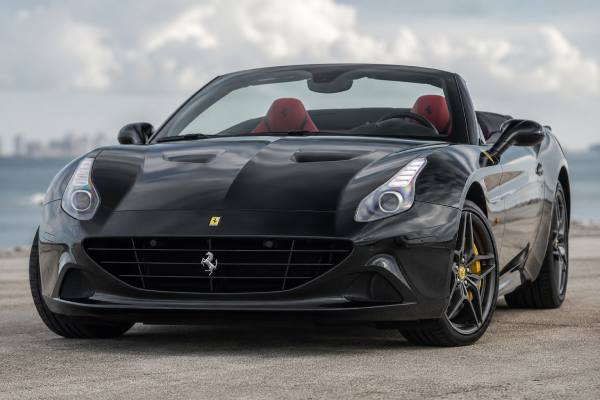
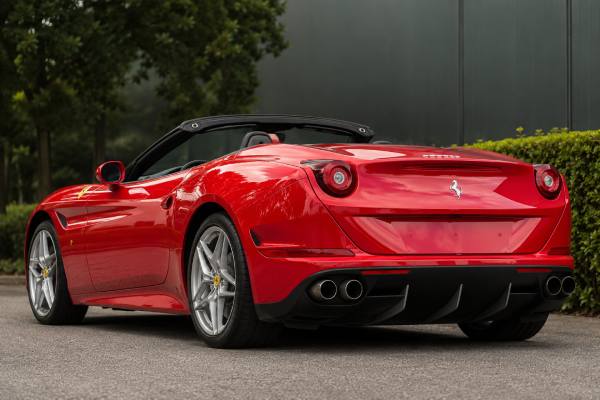
The Ferrari California T is the turbocharged evolution of Ferrari’s front-engine folding-hardtop grand tourer. It kept the original California’s 2+2 layout, retractable metal roof, and daily-use brief, but added a new 3.9-liter twin-turbo V8, sharper bodywork, a revised cabin, and a more serious performance edge. For buyers today, its appeal is simple: it is one of the more usable modern Ferraris, yet it also marks the return of turbocharging to Ferrari road cars after the F40 era.
Quick Take
The California T’s strongest appeal is its mix of open-top Ferrari character, real long-distance usability, and a huge step up in torque from the earlier naturally aspirated California. Its F154BB 3.9-liter twin-turbo V8 makes it historically important because it helped establish the modern Ferrari turbo V8 family used across later front- and mid-engine models. The main caution is that it is still an exotic GT with expensive carbon-ceramic brakes, complex roof hardware, electronics, turbo plumbing, and specialist service needs. The best cars are not simply the lowest-mileage examples; they are the ones with clean history, documented Ferrari service, correct recalls, fresh tires, healthy brakes, and a specification that will remain desirable.
Table of Contents
- History and Significance
- Engine, Chassis and Specifications
- Production, Variants and Options
- Design, Engineering and Special Features
- Driving Experience and Performance
- Reliability, Maintenance and Restoration
- Market Value and Buying Guide
History and Significance
The California T matters because it turned Ferrari’s most approachable modern GT into a much more powerful, more efficient, and more technically important car. It was not a limited-edition supercar, but it was a major turning point in Ferrari’s move back to turbocharged road engines.
The original modern California arrived for the 2009 model year as a front-mid-engine V8 convertible with a folding metal roof. It was designed to bring new customers into the brand, especially buyers who wanted a Ferrari that could handle commuting, touring, and relaxed open-air driving without feeling like a stripped-out weekend machine. It was also Ferrari’s first front-engine V8 production car and one of the company’s most practical road cars of its era.
The California T, internally known as the F149M, appeared in 2014 as a deep revision rather than a completely new platform. The “T” stood for turbo, and that one letter changed the character of the car. The earlier California used a naturally aspirated 4.3-liter V8. The California T replaced it with the F154BB, a 3,855 cc twin-turbocharged V8 with direct fuel injection and a very broad torque curve. Power rose sharply, but the bigger transformation was torque: the T had far more low- and mid-range shove than the outgoing car.
Ferrari positioned the California T as a refined grand tourer, not as a hardcore track model. It sat below the 458 and later 488 in the range, but it still carried proper Ferrari hardware: rear-wheel drive, a 7-speed dual-clutch transaxle, carbon-ceramic brakes, magnetorheological dampers on many cars, F1-Trac traction control, and a manettino drive-mode switch on the steering wheel.
Historically, the car is sometimes underestimated because it was the “entry” Ferrari of its time. That label misses the point. The California T was important because it showed how Ferrari could combine turbocharging, comfort, emissions pressure, and brand character without abandoning performance. The F154 engine family later became central to Ferrari’s V8 identity, powering models such as the 488, F8, Roma, Portofino, and others in different states of tune.
Its reputation today is more balanced than when it was new. Early critics compared it with mid-engine Ferraris and found it softer. Owners and modern buyers often judge it differently. As a fast road car, weekend convertible, and usable exotic, it makes more sense. It is not the sharpest Ferrari of the 2010s, but it is one of the easiest to live with. That usability is now part of its collector appeal, especially as many modern exotic cars become more aggressive, heavier, and more screen-led.
Engine, Chassis and Specifications
The key technical story is the F154BB engine: a compact twin-turbo V8 that gave the California T far more torque than the earlier California while keeping Ferrari’s high-revving feel. The car’s numbers are still strong today, especially for a folding-hardtop GT with a usable cabin and luggage space.
| Item | Specification |
|---|---|
| Model code | F149M |
| Engine code | F154BB |
| Engine layout | Front-mid-mounted 90-degree V8 |
| Displacement | 3,855 cc / 3.9 liters |
| Induction | Twin turbochargers |
| Fuel system | Direct fuel injection |
| Power | 560 cv / 412 kW at 7,500 rpm, often listed as about 552 SAE hp |
| Torque | 755 Nm / 557 lb-ft at 4,750 rpm in seventh gear |
| Transmission | 7-speed dual-clutch automatic transaxle |
| Drivetrain | Rear-wheel drive |
The engine is mounted behind the front axle line, which helps the car achieve a rear-biased weight distribution. The dual-clutch gearbox is mounted at the rear, giving the California T the classic Ferrari transaxle layout. This matters because the car is not just a big-power convertible; its major masses are arranged to support balance and traction.
Ferrari used variable boost management to shape torque delivery by gear. In plain language, the car does not give the same full torque in every gear at every moment. Instead, boost is managed to make the engine feel progressive, improve traction, and protect the character Ferrari wanted. Lower gears feel sharp and controlled, while the taller gears deliver the full sweep of turbocharged torque.
| Item | Figure |
|---|---|
| Length | 4,570 mm / 179.9 in |
| Width | 1,910 mm / 75.2 in |
| Height | 1,322 mm / 52.0 in |
| Wheelbase | 2,670 mm / 105.1 in |
| Dry weight | 1,625 kg / 3,582 lb, depending on equipment |
| Kerb weight | About 1,730 kg / 3,813 lb, depending on market and equipment |
| Weight distribution | 47% front / 53% rear |
| Fuel capacity | 78 liters / 20.6 US gal |
| 0–100 km/h | 3.6 seconds |
| 0–200 km/h | 11.2 seconds |
| Top speed | 316 km/h / 196 mph |
The suspension uses double wishbones at the front and a multi-link arrangement at the rear. Many cars were equipped with magnetorheological dampers, often referred to as MagneRide or dual-mode suspension. These dampers can change their behavior quickly, giving the car a broader range between comfort and control.
Carbon-ceramic brakes were standard. They are powerful and long-lasting when used correctly, but condition matters greatly on a used car. Rotors can look fine at first glance yet still require proper inspection for wear, surface condition, and heat damage. Buyers should not treat them like ordinary steel brakes.
Factory wheel and tire setups included 19-inch wheels, with 20-inch wheels common on higher-spec cars. Typical tire sizing was 245-section front and 285-section rear, with exact sidewall and load ratings depending on wheel size and market. Correct Ferrari-approved tire specification matters because the car’s traction, stability systems, ride, and steering feel were calibrated around high-performance tires.
Production, Variants and Options
The California T was built as a folding-hardtop 2+2 convertible, with the biggest factory distinction being standard cars versus examples equipped with the Handling Speciale package. For collectors and buyers, options, color, documentation, and maintenance history matter more than simple production-year differences.
Production began after the car’s 2014 debut and ran until the Portofino replaced it. In some markets it is commonly described by model years 2015 to 2018, while the covered production era here is 2014 to 2017. That distinction matters when shopping internationally because registration year, model year, build date, and market launch date may not align.
The standard California T already came with the key mechanical package: twin-turbo V8, 7-speed dual-clutch transaxle, folding hardtop, rear-wheel drive, carbon-ceramic brakes, and Ferrari’s electronic stability and traction systems. Many cars were heavily optioned, and Ferrari’s personalization programs allowed wide variation in color, leather, stitching, wheels, trim, carbon fiber, and comfort equipment.
Handling Speciale
The Handling Speciale package is the most important factory performance option. It was introduced later in the model run for buyers who wanted a sharper California T without moving to a mid-engine Ferrari.
Handling Speciale generally brought:
- firmer front and rear springs
- retuned magnetorheological dampers
- revised F1-Trac calibration
- quicker gearshift behavior in Sport mode
- a sportier exhaust note
- visual identifiers such as darker grille, diffuser, and exhaust details
It does not turn the California T into a 488 Spider. The car remains a front-engine GT with a folding hardtop and a comfort brief. What it does do is reduce some of the softness that drivers noticed in standard cars. For buyers who enjoy mountain roads or fast back-road driving, HS cars are usually more desirable. For buyers who mainly want touring comfort, a standard car may be the better fit.
Options that affect desirability
California T values are sensitive to specification. Ferrari buyers tend to care about originality, color pairing, and factory equipment, not just mileage.
Commonly desirable options include:
- carbon-fiber driver zone with LED shift lights
- Scuderia Ferrari fender shields
- 20-inch forged or diamond-finish wheels
- MagneRide dual-mode suspension
- Daytona-style or full-electric seats
- parking cameras and sensors
- premium audio
- contrasting stitching and special leather
- carbon-fiber trim
- Handling Speciale package
Color is also important. Rosso Corsa and Rosso California are easy to understand in the market, but darker blues, greys, silvers, and special-order shades can be very desirable when paired with tasteful interiors. Unusual colors can help or hurt depending on execution. A rare color with strong documentation may attract collectors; a difficult color combination may reduce the buyer pool.
For authenticity, the best paper trail includes original window sticker or option sheet, books, tools, battery tender, keys, service invoices, recall completion records, and Ferrari dealer inspection history. Ferrari-approved pre-owned certification, where available, can help, but it should not replace an independent specialist inspection.
Design, Engineering and Special Features
The California T looks more purposeful than the earlier California because Ferrari revised the bodywork around the turbocharged engine, cooling needs, and a sharper design language. It is still an elegant GT, but the surface treatment, nose, rear haunches, and cabin feel more modern and more assertive.
The exterior design was developed under Ferrari’s design direction with Pininfarina involvement in the model family’s styling heritage. Compared with the original California, the T has a cleaner front end, more sculpted flanks, and a more integrated rear. The side scallop is one of the car’s signature visual cues, helping break up the mass of a relatively practical folding-hardtop body.
The folding metal roof is central to the car’s identity. It gives coupe-like refinement with the roof up and full convertible character with the roof down. The tradeoff is complexity and weight. The roof mechanism requires careful alignment, healthy hydraulics and electronics, and clean drains. Any hesitation, uneven movement, warning message, or water leak deserves attention before purchase.
The engine placement is also important. Ferrari calls this a front-mid layout because the V8 sits behind the front axle line. That helps keep the car from feeling nose-heavy despite the long hood. The rear-mounted transaxle further improves balance, while the rear-biased weight distribution helps traction under acceleration.
The California T’s cooling and exhaust systems are more involved than the earlier naturally aspirated car’s. Turbo engines generate more heat, so heat shielding, coolant health, oil quality, and airflow are especially important. The exhaust was also tuned carefully because Ferrari wanted the car to retain a recognizable sound despite turbochargers, which naturally muffle some exhaust energy.
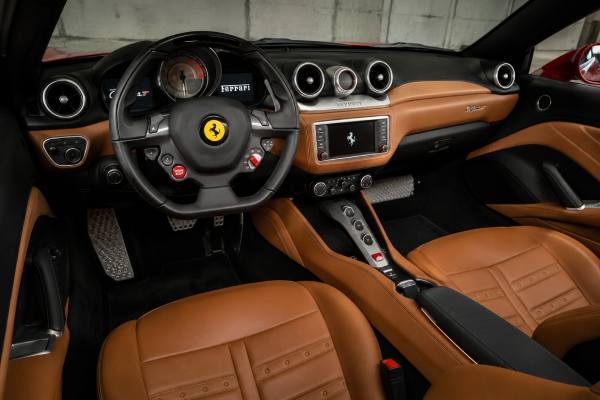
Inside, the California T combines traditional Ferrari cues with a more usable GT layout. The steering wheel carries the engine start button, manettino switch, indicators, lights, and shift LEDs on some cars. The tachometer remains central, while infotainment and comfort functions are more prominent than in Ferrari’s mid-engine sports cars of the same period.
The rear seats are best understood as occasional seats. They work for small children, short trips, or extra luggage, but they are not adult touring seats. The same is true of luggage space: practical by Ferrari convertible standards, but still shaped by the folding roof. With the roof up, the trunk is more useful; with the roof down, luggage capacity is reduced.
The car’s special character comes from this blend. It is not a purist lightweight Ferrari. It is a technical grand tourer with enough performance to feel serious, enough comfort to use regularly, and enough mechanical drama to feel different from an ordinary luxury convertible.
Driving Experience and Performance
The California T is fast in a relaxed, torque-rich way, not a peaky, knife-edge way. Its defining driving trait is how easily the turbo V8 moves the car, especially compared with the earlier naturally aspirated California.
At low speeds, the engine is smooth and flexible. The dual-clutch gearbox shifts cleanly in automatic mode, making the car easy in traffic. The steering is light by older Ferrari standards, visibility is reasonable for an exotic, and the ride can be genuinely comfortable on the right wheels and tires. This is why many owners use California T models more often than more focused Ferraris.
Press harder and the car changes character. The torque arrives strongly, and the gearbox responds quickly to the paddles. In Sport mode, shifts feel more urgent, the exhaust becomes more vocal, and the body control tightens. The California T does not need high rpm to feel quick, but it still pulls hard toward the top of the rev range. That combination makes it especially effective on real roads where space is limited.
The sound is different from a naturally aspirated Ferrari V8. It has less of the thin, soaring top-end scream that defines older mid-engine cars. Instead, it has a deeper, more forceful voice with turbocharged shove behind it. Some drivers love the added muscle; others miss the sharper edge of the older engines. Buyers should drive one before assuming either view is correct.
The handling balance is secure and confidence-building. The car is happiest as a fast road GT, where it can flow through corners and use its torque on exit. It is not as immediate as a 458 Spider or 488 Spider, and it carries more weight than those cars. On a tight road, that weight is noticeable. On a flowing road, the balance, traction, and gearbox make it very satisfying.
The brakes are powerful, but brake feel depends heavily on condition, pad material, temperature, and how the car has been used. Carbon-ceramic systems can feel firm and reassuring when healthy. They can also be expensive to correct if rotors or pads are worn, damaged, or contaminated.
For track use, the California T is capable but not ideal. It has the power, brakes, and gearbox to enjoy a track day, but the car’s weight, folding roof structure, tire wear, and brake cost make repeated heavy use expensive. Buyers looking for regular circuit work should consider a more focused Ferrari. Buyers who want a road Ferrari that can handle an occasional performance-driving event will find the California T more than quick enough.
In everyday use, the car’s main strengths are flexibility and occasion. It can cruise quietly, cover highway miles with the roof up, open the roof for a scenic drive, and still deliver supercar-level acceleration when asked. That range is exactly why the model has aged better than many critics expected.
Reliability, Maintenance and Restoration
The California T can be a dependable modern Ferrari when serviced correctly, but it is not a low-cost luxury convertible. The expensive risks are not only the engine; they include the roof system, carbon-ceramic brakes, electronics, suspension components, turbo-related heat management, and deferred maintenance.
The F154BB engine is generally respected, but it must be maintained like a high-performance turbocharged engine. Oil quality, coolant condition, proper warm-up, and regular specialist inspection all matter. Turbochargers add heat and complexity, so any oil leak, coolant smell, boost irregularity, smoke, or warning light should be investigated quickly.
The dual-clutch transmission is one of the car’s strengths. It is much more usable than older single-clutch automated Ferrari gearboxes. Even so, buyers should check for smooth take-up, clean shifts, no harsh engagement, no warning messages, and no signs of overheated or abused driveline components.
Important inspection areas include:
- complete annual service history
- brake rotor and pad condition
- tire age, brand, Ferrari specification, and tread condition
- roof operation, alignment, seals, and water leaks
- suspension damper behavior and lift system condition if equipped
- battery health and charging-system behavior
- sticky interior switches or trim deterioration
- infotainment, parking sensors, cameras, and control modules
- coolant, oil, and turbo plumbing leaks
- exhaust valves and mounts
- underbody damage from speed bumps or steep driveways
Battery condition deserves special attention. Modern Ferraris can become unreliable when the battery is weak or the car is stored poorly. A battery tender is not optional for many owners; it is part of correct ownership. Electrical faults that appear random may begin with low voltage.
The folding hardtop is another major ownership area. It should move smoothly and evenly. The trunk divider, microswitches, hydraulic components, seals, and alignment all need to be correct. A car with roof faults may still look tempting, but diagnosis can be time-consuming and expensive.
Carbon-ceramic brakes are durable in normal road use, but replacement costs can be very high. A pre-purchase inspection should include more than a casual visual check. Ask for measured wear, rotor condition, pad life, and any signs of track overheating or impact damage.
Recalls and service campaigns must be checked by VIN. Known areas include a broad brake-fluid-reservoir cap campaign affecting California and California T models, plus fuel-line and airbag-related campaigns on certain production ranges. A seller should be able to show that all applicable Ferrari recall work has been completed. If not, confirm with an authorized Ferrari dealer before purchase.
Restoration in the classic sense is not the normal issue yet, because the California T is still a modern car. The modern equivalent is returning a neglected example to proper Ferrari condition. That can mean tires, brakes, annual fluids, roof adjustment, sticky trim repair, battery replacement, alignment, paint correction, and software or module diagnosis. A cheaper car can become expensive quickly if it needs several of these at once.
Originality matters, but sensible maintenance matters more. Avoid poorly tuned cars, non-original exhaust work that causes fault codes, cheap tires, missing records, or cars that have been modified without documentation. A Ferrari with factory options and clean service history is usually a better buy than one with aftermarket changes and vague explanations.
Market Value and Buying Guide
The California T sits in a useful part of the Ferrari market: newer, faster, and more refined than the earlier California, but usually less expensive than many mid-engine V8 Ferraris. Its value is driven by specification, condition, mileage, documentation, and whether buyers see it as a usable Ferrari or a future collector GT.
As of the current market, ordinary driver-quality cars often trade in the lower six-figure range in the United States, while low-mileage, highly optioned, late-production, unusual-color, or Handling Speciale cars can bring meaningfully more. Special Tailor Made or 70th Anniversary examples can sit far above standard cars because they appeal to collectors, not just drivers.
Mileage affects value, but it should not dominate the decision. A very low-mile car with old tires, weak battery history, deferred annual services, and sticky controls may be less attractive than a moderately used car with excellent records. Ferraris do not like neglect. Regular use, correct storage, and documented maintenance are positives.
What to seek
The best California T examples usually have:
- clean title and accident-free history
- Ferrari dealer or respected specialist service records
- all applicable recalls completed
- strong option specification
- original books, tools, keys, charger, and window sticker
- fresh matching high-quality tires
- measured carbon-ceramic brake life
- smooth roof operation
- clean underbody and front-lip condition
- no warning lights or stored fault-code concerns
- paintwork consistent with the claimed history
Handling Speciale cars are especially worth considering if the price gap is reasonable. They bring a more focused feel and tend to attract enthusiast buyers. That said, a standard car in excellent condition is better than a neglected HS car.
What to avoid
Be cautious with cars that show:
- missing service history
- unresolved roof faults
- old or mismatched tires
- uncertain brake condition
- repeated battery or module issues
- heavy aftermarket tuning
- accident repairs without full documentation
- worn interior controls that suggest poor storage
- signs of track abuse without maintenance records
- sellers who discourage a specialist inspection
A pre-purchase inspection should be performed by a Ferrari dealer or a specialist familiar with modern Ferrari GTs. The inspection should include diagnostic scans, roof operation, brake measurements, suspension condition, tire dates, fluid leaks, service campaign checks, paint-depth readings, and a road test from cold.
For long-term collectability, the California T has several things in its favor. It is the turbocharged turning point for Ferrari’s modern front-engine V8 convertibles. It is more attractive and stronger than the earlier California. It remains usable in a way many exotic cars are not. It also has a clear successor, the Portofino, which makes the California T part of a defined model lineage.
Its limiting factor is production volume. This is not a rare Ferrari in normal specification, so average cars are unlikely to become blue-chip collectibles soon. The standout examples will be the best-documented, best-optioned, most original cars, especially Handling Speciale, Tailor Made, 70th Anniversary, and unusually tasteful low-mileage examples.
For the right buyer, the California T is a practical exotic with real Ferrari speed and an important engine story. Buy it as a car to use and enjoy, not as a guaranteed investment. If market appreciation comes later, it will favor the cars that were bought carefully, maintained properly, and preserved without losing their usability.
References
- Ferrari California T (2014) – Ferrari.com 2014 (Manufacturer Specifications)
- Fuel Economy of the 2018 Ferrari California T 2018 (Fuel Economy)
- Part 573 Safety Recall Report 22V-536 2022 (Recall Database)
- Part 573 Safety Recall Report 15V-811 2015 (Recall Database)
- Ferrari California T Market – CLASSIC.COM 2026 (Market Data)
Disclaimer
This article is for informational purposes only and is not a substitute for professional diagnosis, repair, valuation, or pre-purchase inspection. Specifications, torque values, service intervals, recall applicability, and repair procedures can vary by VIN, market, model year, equipment, and software level. Always verify details against official Ferrari service documentation and consult a qualified Ferrari specialist before making maintenance or purchase decisions.
If you found this guide useful, please consider sharing it on Facebook, X/Twitter, or your favorite car community to support our work.