
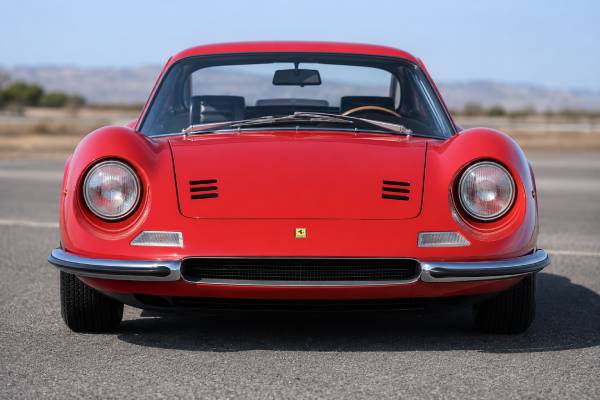
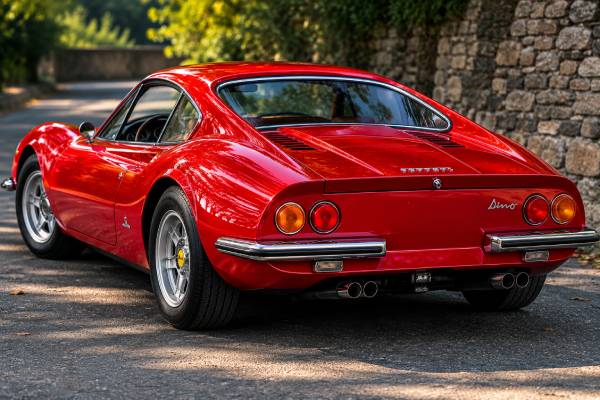
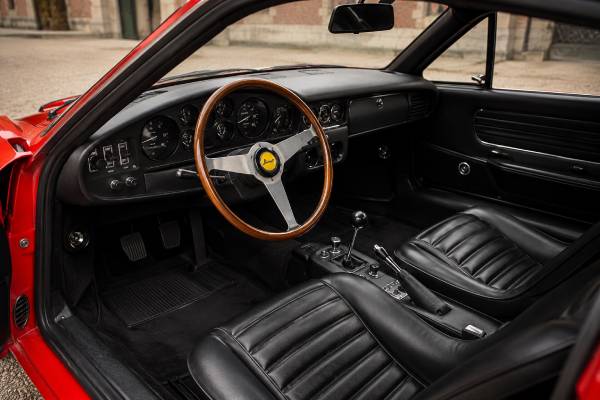
The Ferrari Dino 206 GT is one of the most important small-capacity sports cars ever connected with Maranello. It was sold under the Dino name rather than as a full Ferrari, but it carried Ferrari engineering, Ferrari racing influence, Pininfarina design, and Scaglietti-built alloy bodywork. For collectors, it is the rare, short-wheelbase, aluminum-bodied start of the road-going Dino line. For drivers, it is a light, high-revving, mid-engine V6 berlinetta with more delicacy than brute force.
Quick Take
The Dino 206 GT is the purest and rarest road-going Dino: a compact 2.0-liter V6 coupe with a transverse mid-engine layout, a lightweight aluminum body, and only about 152 production cars generally cited. It is not the fastest classic Ferrari-related car for the money, but it is one of the most historically significant and rewarding when properly restored, documented, and maintained.
Table of Contents
- Why the 206 GT Still Matters
- Tipo 135B V6 and Core Specifications
- Production Details and Authenticity Clues
- Pininfarina Shape and Mid-Engine Engineering
- Road Feel, Sound, and Performance
- Maintenance, Restoration, and Known Risks
- Market Values and Buying Priorities
Why the 206 GT Still Matters
The Dino 206 GT matters because it brought Ferrari’s mid-engine racing thinking to a road car before the layout became the company’s sports-car norm. It also proved that a Ferrari-engineered car did not need a V12 to feel special.
The name “Dino” came from Alfredo “Dino” Ferrari, Enzo Ferrari’s son, who was closely associated with Ferrari’s V6 engine direction before his death in 1956. Ferrari used the Dino badge for smaller, non-V12 cars, partly to protect the prestige of the main Ferrari name and partly to create a separate identity for lighter, more agile machines. Today that distinction feels mostly historical. Collectors generally understand the 206 GT as a Ferrari-built Dino, even if it did not originally wear normal Ferrari branding.
The 206 GT followed several important show and prototype steps. The Dino Berlinetta Speciale shown in the mid-1960s previewed the rounded, low, mid-engine form. Later prototype work refined the shape into a production two-seat berlinetta. By the time the 206 GT reached customers, Ferrari had created a car that was smaller, lighter, and more balanced than the front-engine V12 grand tourers that defined much of the company’s road-car image.
It also arrived during a period when Porsche’s 911 was becoming a benchmark for compact, usable performance. Ferrari wanted an answer that was not simply a smaller V12 car. The Dino 206 GT took a different path: a 65-degree V6, mounted transversely behind the cabin, with a five-speed manual gearbox and fully independent suspension. This gave the car a center of gravity and weight distribution that felt modern for the late 1960s.
Production was short and limited. Most accepted references cite 152 Dino 206 GT production cars between 1967 and 1969, with some auction descriptions and marque specialists using 153 depending on how certain prototypes or records are counted. Either way, it is rare. The later Dino 246 GT and GTS were built in much greater numbers and became more familiar to the public. The 206 GT is the early, light, narrow-focus version: alloy body, shorter wheelbase, smaller engine, and a more delicate feel.
Its significance rests on several points:
- It was Ferrari’s first series-production mid-engine road car.
- It introduced the road-going Dino V6 layout that led directly to the 246 GT.
- It used aluminum bodywork when the later 246 moved mostly to steel.
- It connected Ferrari racing engine thinking with a more accessible road-car format.
- It helped establish the template for later mid-engine Ferrari sports cars.
The 206 GT was not built as a luxury cruiser. It was a compact performance car with fine steering, a willing engine, and a level of balance that made it feel more advanced than many heavier grand tourers of the same era. That is why its reputation has grown. Early Dinos were once treated as junior Ferraris. Today the 206 GT is valued for exactly that character: smaller, lighter, rarer, and more precise.
Tipo 135B V6 and Core Specifications
The 206 GT’s main technical story is its all-alloy Tipo 135B 2.0-liter V6, mounted transversely behind the seats. Its numbers are modest by modern standards, but the car’s low dry weight and high-revving character make the specification more impressive than the displacement suggests.
The engine was a naturally aspirated 65-degree V6 with double overhead camshafts. It used three Weber twin-choke carburetors, a wet-sump lubrication system, and a five-speed manual gearbox. Power was quoted at 180 hp, commonly given as 180 PS or about 178 bhp depending on the unit used, at a very high 8,000 rpm.
| Item | Dino 206 GT Detail |
|---|---|
| Engine code | Tipo 135B |
| Configuration | 65-degree V6, rear mid-mounted, transverse |
| Displacement | 1,986.6 cc |
| Bore x stroke | 86.0 mm x 57.0 mm |
| Valvetrain | Double overhead camshafts, two valves per cylinder |
| Induction | Three Weber twin-choke carburetors |
| Compression ratio | 9.0:1 |
| Maximum power | 180 hp at 8,000 rpm |
| Torque | Approximately 186–187 Nm at 6,500 rpm, depending on source convention |
| Transmission | Five-speed manual |
| Driven wheels | Rear-wheel drive |
The chassis was a tubular steel frame with aluminum body panels. Some descriptions call the structure semi-monocoque in effect because the alloy panels contributed to the overall shell, but the car is best understood as a tubular chassis with coachbuilt aluminum bodywork. The wheelbase was 2,280 mm, which is 60 mm shorter than the later 246 GT. That difference is one reason the 206 feels so alert.
| Item | Dino 206 GT Detail |
|---|---|
| Factory chassis type | Tipo 607 |
| Body style | Two-seat berlinetta coupe |
| Body material | Aluminum panels by Scaglietti |
| Frame | Tubular steel |
| Front suspension | Independent wishbones, coil springs, telescopic dampers, anti-roll bar |
| Rear suspension | Independent wishbones, coil springs, telescopic dampers, anti-roll bar |
| Brakes | Four-wheel disc brakes |
| Steering | Rack and pinion |
| Wheelbase | 2,280 mm |
| Front track | 1,425 mm |
| Rear track | 1,400 mm |
| Dry weight | About 900 kg |
| Fuel capacity | About 65 liters |
| Top speed | About 235 km/h |
| Standing kilometer | About 27 seconds |
Performance figures from the period vary because testing methods, tire condition, gearing, and engine tune were not as standardized as today. The safest way to read the numbers is this: the 206 GT was fast for a 2.0-liter road car, but its greatest strength was not straight-line acceleration. Its real advantage was the combination of light weight, engine response, steering precision, and balance.
The 14-inch wheels, period tires, compact dimensions, and unassisted controls also shaped the car’s behavior. A modern reader should not compare the 206 GT with a current supercar. It belongs to a period when 180 hp in a light, mid-engine body was a serious recipe, especially with a V6 that wanted to rev.
Production Details and Authenticity Clues
The 206 GT is a low-production car, so authenticity matters as much as condition. A beautiful restoration can still lose major value if the engine, gearbox, body details, or documentation do not match the car’s history.
The production period is usually given as 1967 to 1969, with customer deliveries concentrated around 1968 and 1969. The car was left-hand drive only. It was succeeded by the Dino 246 GT, which used a larger 2.4-liter V6, a longer wheelbase, and mostly steel bodywork. That change made the 246 more powerful and more practical to produce, but it also made the 206 GT the rarer and lighter original.
Because production was hand-built and limited, buyers should expect small variations between cars. Panel fit, trim details, and restoration choices can differ. The goal is not to find a car that looks machine-perfect in the modern sense. The goal is to find one that is correct, structurally sound, properly documented, and restored with respect for original materials and construction.
Key identification points
Important 206 GT identity clues include:
- Aluminum bodywork rather than the later 246’s mostly steel construction.
- Short 2,280 mm wheelbase.
- Tipo 607 chassis identity.
- Tipo 135B 2.0-liter V6.
- Center-lock Cromodora-style wheels on many correct cars.
- Early Dino badging rather than normal Ferrari road-car branding.
- Exposed period details that differ from later 246 GT and GTS cars.
- Left-hand-drive configuration.
The engine and gearbox numbers are especially important. The Dino V6 family was also used in Fiat Dino models, and engines can be confused, swapped, or modified over decades. A car fitted with a non-original or Fiat-variant unit may still be enjoyable, but it is not the same from a collector-value standpoint.
Documentation that matters
For a serious purchase, documentation should include more than a sales description. Strong provenance may include:
- Ferrari Classiche documentation where available.
- A Massini report or another recognized Ferrari historian’s report.
- Old registration documents.
- Period service invoices.
- Restoration records with photos.
- Engine, gearbox, and body number confirmation.
- Import paperwork if the car changed countries.
- Owner history that explains long gaps, storage periods, or major work.
The best cars have a clear story. A Dino that spent decades in dry storage and then received a correct restoration may be very desirable. A shiny car with missing early history, uncertain engine identity, or undocumented body replacement needs more caution.
Colors, trim, and options
The 206 GT was not a modern option-heavy exotic. Buyers were choosing a coachbuilt Italian sports car, not configuring hundreds of carbon-fiber and infotainment choices. Exterior color, interior material, original delivery market, and early ownership history are the main specification points.
Original colors can strongly affect value when they are rare, attractive, and documented. Red cars remain easy to understand in the market, but unusual period colors can be more interesting to advanced collectors if they are factory-correct. Interior correctness also matters. Seats, instruments, steering wheel, carpets, switches, and trim hardware should be inspected for period accuracy.
A restored Dino can look wonderful while carrying small incorrect details. Some errors are minor. Others suggest a restoration shop did not fully understand the model. On a 206 GT, those details are amplified because the production pool is so small.
| Area | Dino 206 GT | Dino 246 GT |
|---|---|---|
| Engine | 2.0-liter all-alloy V6 | 2.4-liter V6, commonly with cast-iron block |
| Body | Aluminum | Mostly steel |
| Wheelbase | 2,280 mm | 2,340 mm |
| Production | Very limited | Much higher |
| Driving character | Lighter, revvier, more delicate | More torque, more mature, easier to use |
| Collector appeal | Rarity and purity | Icon status and broader usability |
Pininfarina Shape and Mid-Engine Engineering
The 206 GT looks the way it does because its engineering and design were developed together. Its low nose, curved roofline, side intakes, and short tail all serve the same goal: packaging a compact mid-engine sports car with beauty and balance.
The production design came from Pininfarina, with Aldo Brovarone and Leonardo Fioravanti commonly associated with the Dino’s styling development. Scaglietti built the bodywork, shaping aluminum panels over the compact chassis. The result is softer and more organic than the wedge-shaped supercars that followed in the 1970s. It does not shout. It flows.
The front end is low and rounded, helped by the absence of a large front engine. The cabin sits forward compared with a traditional long-hood Ferrari GT, while the rear deck rises gently over the transverse V6. The side intake treatment is not just decoration; it reflects the cooling and breathing needs of a mid-mounted engine. The fastback rear helps the small car look complete rather than stubby.
Why the transverse V6 mattered
A transverse engine is mounted sideways across the car rather than lengthwise. In the 206 GT, this helped keep the wheelbase short and the mass close to the center of the car. That layout was unusual for an exotic road car of the period and helped give the Dino its compact, responsive feel.
The V6 also gave the car a different personality from Ferrari’s V12s. It did not have the deep, effortless surge of a large grand-touring engine. Instead, it had a lighter rotating feel, a sharper top-end voice, and a need to be worked through the gearbox. That made the Dino more interactive at real road speeds.
Body construction and weight
The aluminum body is a core part of the 206 GT’s appeal. It helped keep dry weight around 900 kg and gave the car a delicacy that later steel-bodied Dinos could not quite match. Aluminum also makes restoration more specialized. It requires different repair methods from steel, and poor bodywork can be expensive to correct.
Because these cars were coachbuilt, perfect modern panel uniformity is not always realistic. However, uneven gaps, distorted reflections, thick filler, or poor shut lines can point to accident damage, corrosion repair around the underlying structure, or a rushed restoration. The best inspection is done from below and inside, not just from the paint surface.
Cockpit and controls
The cockpit is small, purposeful, and period Italian. The driver sits low, looking over rounded front wings rather than a long bonnet. The instruments and switchgear have the charm of a hand-built classic, but they also require patience. Ventilation, ergonomics, and noise isolation are not modern strengths.
The driving position suits some body types better than others. Before buying, a driver should sit in the car long enough to check pedal offset, steering-wheel position, seat support, and visibility. Comfort may sound secondary in a collector car, but an uncomfortable Dino often becomes a stored Dino, and cars that sit unused develop their own problems.
Road Feel, Sound, and Performance
A good 206 GT feels light, alert, and mechanical rather than overwhelmingly fast. Its best moments come on flowing roads where the engine can rev, the gearbox can be used, and the chassis can work at speeds that still feel human.
The Tipo 135B V6 needs revs. Below the upper part of the tachometer, it is smooth and willing, but the car’s character comes alive as the engine climbs. The sound is a bright, hard-edged V6 note, very different from a V12 Ferrari. It is more urgent than luxurious. Carburetor tuning has a major effect on this experience. A well-set-up car pulls cleanly and responds crisply. A tired or poorly synchronized car can stumble, smell rich, run hot, or feel disappointing.
The five-speed gearbox is part of the event. Like many classic Italian performance cars, it rewards a warm drivetrain and a deliberate hand. Second gear may feel reluctant when cold, and forcing it is never wise. Once warm, a healthy gearbox should shift cleanly without crunching, jumping out of gear, or feeling vague.
Steering is one of the Dino’s greatest pleasures. The rack-and-pinion setup gives direct feedback, and the front end feels light compared with front-engine Ferraris. At parking speeds it still requires effort, especially on modern tires, but once moving the car communicates clearly. This is not the filtered accuracy of a modern sports car. It is narrower, lighter, and more textured.
Ride quality depends heavily on restoration choices. Correct suspension bushings, dampers, tire sizes, and alignment can make the car supple and controlled. Overly stiff modern setups may make it feel nervous. Old tires or tired dampers can make it wander. Because the chassis is light, small changes in setup are noticeable.
Braking should be judged by period standards. Four-wheel discs give the car serious stopping ability for its era, but not the immediate bite of modern assisted brakes or carbon-ceramic systems. A properly rebuilt system should feel firm and progressive. Pulling, vibration, a long pedal, or dragging brakes suggest caliper, hose, master cylinder, or rotor issues.
The 206 GT is also more usable than its exotic reputation suggests, as long as expectations are realistic. It can cruise, it has reasonable visibility for a mid-engine classic, and its compact size suits narrow roads. But it is still a late-1960s Italian sports car. It needs warm-up time, mechanical sympathy, regular exercise, and a driver who listens to it.
Common real-world driving traits include:
- Best performance above the middle of the rev range.
- Sensitive throttle response when carburetors are correctly tuned.
- High cabin noise compared with a modern GT.
- Heat around the cabin and engine bay in slow traffic.
- Excellent front-end response on proper tires.
- More confidence on open, flowing roads than in heavy city use.
- A strong difference between a fresh car and a cosmetically restored but mechanically tired one.
For many owners, the car’s speed is secondary. The 206 GT gives a sense of precision and occasion at moderate pace. That is why it remains so compelling even when modern hot hatchbacks can match or exceed its acceleration figures.
Maintenance, Restoration, and Known Risks
The Dino 206 GT is not difficult because it is crude; it is difficult because it is rare, specialized, and valuable. Maintenance requires a Ferrari/Dino specialist who understands the V6, the chassis, the aluminum body, and the authenticity standards of the collector market.
The engine is robust when properly assembled, lubricated, cooled, and tuned. Neglect is the enemy. Old fuel, incorrect carburetor setup, weak ignition components, clogged cooling passages, tired hoses, and long storage can turn a good design into an expensive repair. The timing-chain system is not the same ownership burden as later belt-driven Ferrari engines, but chain noise, tensioner wear, oil leaks, and poor previous work still matter.
The Dinoplex-style ignition system is part of the period character and can be a source of trouble. Some cars have been updated or discreetly modified for reliability. That can make sense for a driver, but collectors will want to know whether original components are present and whether any upgrades are reversible.
Mechanical areas to inspect
A pre-purchase inspection should focus on the expensive systems first:
- Engine compression and leak-down results.
- Oil pressure hot and cold.
- Carburetor condition and synchronization.
- Ignition health and charging system output.
- Cooling system condition, including radiator, fans, hoses, and water passages.
- Timing-chain noise and valve-train condition.
- Gearbox synchros, especially second gear.
- Clutch operation and release behavior.
- Driveshaft joints and mounts.
- Brake calipers, hoses, discs, and master cylinder.
- Suspension bushings, dampers, ball joints, and wheel bearings.
- Fuel tanks, pumps, lines, and carburetor seals.
A car that has been stored for years should be treated as a recommissioning project even if it starts and drives. Fuel systems, brake hydraulics, cooling components, rubber parts, and electrical connections age while stationary.
Body and structure concerns
The aluminum outer body does not rust like steel, but the underlying structure, mounting points, fasteners, and areas where dissimilar metals meet can still deteriorate. Corrosion can hide beneath paint, trim, underseal, and old repairs. Accident damage is another major issue. Mid-engine cars can suffer from poorly repaired rear impacts, suspension pickup damage, or distorted chassis tubes.
Key body and structure checks include:
- Front and rear chassis alignment.
- Suspension pickup points.
- Evidence of front or rear accident repair.
- Door, bonnet, and engine-lid fit.
- Aluminum panel cracking or distortion.
- Corrosion where aluminum meets steel.
- Previous filler use.
- Inner sills, floors, and lower body sections.
- Engine bay heat damage.
- Correct trim attachment and period details.
Restoring a 206 GT properly is expensive because the car is rare and the standards are high. A cheap restoration can become a liability. Incorrect materials, poor panel shaping, wrong interior patterns, non-original hardware, and generic Ferrari parts used in the wrong places can all reduce value.
Originality versus sensible upgrades
Owners often face a choice between exact originality and discreet usability improvements. Electronic ignition upgrades, improved cooling fans, modern internal hose materials, better fuel-line protection, and carefully chosen tires may improve reliability and safety. The key is reversibility and documentation.
For a high-value 206 GT, every change should be recorded. Original removed parts should be kept. The best approach is to preserve the car’s identity while making it safe and dependable enough to use. Over-modification is risky. A Dino 206 GT is too rare to treat like an ordinary restomod platform.
Maintenance budgeting should be realistic. Even routine work can become expensive if parts are scarce or access is difficult. A buyer should not spend the entire budget on the purchase price. A reserve for sorting, transport, specialist inspection, registration issues, and early service is essential.
| Risk Area | Why It Matters | Buyer Response |
|---|---|---|
| Non-original engine or gearbox | Major effect on collector value | Confirm numbers before purchase |
| Poor aluminum body repair | Expensive to correct and visible to experts | Inspect with a marque body specialist |
| Weak cooling system | Can damage an expensive engine | Check operating temperature in traffic and on road |
| Gearbox synchro wear | Rebuilds are costly | Test warm shift quality carefully |
| Old restoration | May hide aged rubber, wiring, fuel, and brake parts | Review invoices, not just photos |
| Missing provenance | Creates uncertainty in a rare model | Discount heavily or keep looking |
Market Values and Buying Priorities
The Dino 206 GT sits above most 246 GT coupes in rarity and collector purity, and recent public sales show that exceptional cars can reach very strong money. The right car is bought on authenticity first, condition second, and price third.
Current public market data varies by currency, location, condition, and whether the sale was an auction or private transaction. Recent market trackers and auction results show ordinary-to-good public examples often clustering in the high six-figure range, with standout or highly original cars capable of reaching around seven figures. A project or non-matching example can be far less attractive, but it may still be expensive because the model is so rare.
The main value drivers are:
- Matching or correct-type engine and gearbox.
- Clear chassis identity.
- Original body integrity.
- Documented factory color and interior.
- Known ownership history.
- Quality of restoration.
- Mechanical freshness.
- Correct early details.
- Desirable period color.
- Expert reports and Ferrari Classiche documentation where available.
Mileage is less straightforward than on a modern collector car. Many Dinos have had restorations, speedometer work, long storage, or incomplete records. A low indicated mileage number is not enough. Condition, documentation, and mechanical evidence are more important.
Cars to seek
The strongest buying candidates usually have:
- A complete ownership file.
- Confirmed engine, gearbox, and chassis data.
- No serious unresolved accident history.
- Original or correctly restored aluminum bodywork.
- A known specialist maintaining the car.
- Recent road use rather than only static display.
- Correct wheels, trim, instruments, and interior patterns.
- A restoration file detailed enough to judge quality.
- A test drive that confirms proper temperature, oil pressure, shift quality, and braking.
A car does not need to be concours-perfect to be a good buy. In fact, a slightly used but highly correct and well-maintained Dino may be more satisfying than a freshly finished car that has not been fully sorted. Fresh restorations often need miles to reveal leaks, heat issues, suspension settling, carburetor problems, and electrical faults.
Cars to avoid
Be cautious with any Dino 206 GT that has:
- Unclear chassis or engine-number information.
- A replacement engine described vaguely.
- Missing import or title history.
- Heavy filler or suspicious body gaps.
- A restoration with no photo documentation.
- Long-term storage but no recommissioning invoices.
- Overheated engine history.
- Gearbox noise, weak synchros, or clutch drag.
- Non-standard interior work presented as original.
- A seller unwilling to allow specialist inspection.
The biggest mistake is buying the story without checking the car. The second biggest mistake is buying the paint. On a 206 GT, beautiful paint can hide the most expensive problems.
Pre-purchase checklist
A serious inspection should follow a clear order:
- Confirm identity: chassis, engine, gearbox, body, and documentation.
- Review ownership history and restoration records.
- Inspect the chassis and aluminum body before judging cosmetics.
- Test the engine hot and cold, including oil pressure and cooling behavior.
- Drive the car long enough to assess gearbox, brakes, steering, and suspension.
- Check correctness of trim, wheels, instruments, lights, and interior details.
- Estimate immediate service needs before negotiating final price.
For long-term collectability, the outlook remains strong. The 206 GT has rarity, beauty, historical importance, and a direct role in Ferrari’s shift toward mid-engine road cars. It also appeals to two groups at once: collectors who want the earliest and purest Dino, and drivers who value lightness and feedback over raw speed.
The best purchase is not necessarily the cheapest car available. It is the car with the fewest unanswered questions. A correct, documented, well-sorted 206 GT may cost more upfront, but it is usually cheaper than repairing a compromised car while trying to recover lost provenance.
References
- Ferrari Dino 206 GT (1967) – Ferrari.com 1967 (Manufacturer specifications)
- Find a car 2026 (Historic Homologation Database)
- 1969 Ferrari Dino 206 GT by Scaglietti | Monterey 2025 | RM Sotheby’s 2025 (Auction Record)
- Dino 206 GT Market 2026 (Market Data)
- 1967-1974 Ferrari Dino 206 GT and 246 GT buying guide from Magneto magazine – Magneto 2025 (Buying Guide)
Disclaimer
This article is for informational purposes only and is not a substitute for professional diagnosis, inspection, repair, valuation, or restoration advice. Specifications, torque values, service intervals, parts, and procedures can vary by VIN, market, equipment, production detail, and restoration history, so owners and buyers should verify all work against official service documentation and a qualified Ferrari/Dino specialist.
If this guide helped you, please consider sharing it on Facebook, X/Twitter, or another platform to support our work.