
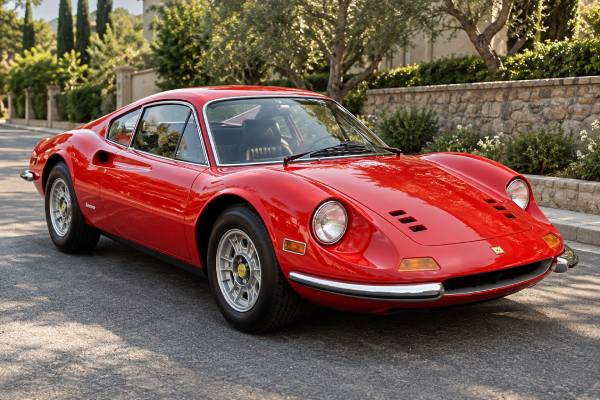
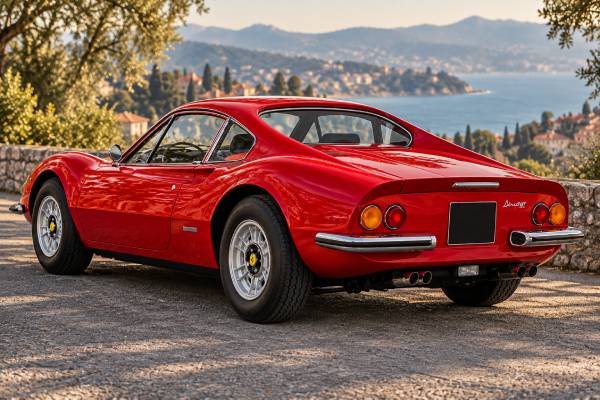
The Ferrari Dino 246 GT Series E is the most mature version of Ferrari’s landmark V6 mid-engine coupé. Built during the final years of 246 GT production, it kept the delicate Pininfarina shape and compact 2.4-liter Dino V6 while adding the later-series details that made the car easier to sell, service, and federalize in important export markets. It was not badged as a Ferrari when new, but its place in Ferrari history is now secure: the Dino 246 GT helped make the mid-engine road car layout feel natural, usable, and emotionally rich.
Quick Take
The 1971–1974 Ferrari Dino 246 GT Series E is not the rarest Dino 246, but it is often the most approachable version to buy and use. It combines the beautiful fixed-roof body, a 195 hp Tipo 135 CS V6 in standard European form, five-speed manual transaxle, sharp unassisted steering, and a more developed late-production specification. For collectors, the key is not simply finding a shiny car; it is finding one with correct numbers, clean structure, honest restoration work, strong documentation, and no hidden corrosion or accident damage.
Table of Contents
- Why the E-Series Dino 246 GT Matters
- Tipo 135 CS Engine and Core Specs
- Series E Production, Options, and Identification
- Pininfarina Shape and Mid-Engine Engineering
- Road Feel, Performance, and Dino Character
- Maintenance, Rust, and Restoration Risks
- Market Values and Buying Checklist
Why the E-Series Dino 246 GT Matters
The Dino 246 GT matters because it proved that a smaller, lighter, mid-engine Ferrari-related road car could be as desirable as the company’s front-engine V12 grand tourers. The Series E, introduced for the final phase of production, is the late-developed version most buyers encounter today.
The Dino name came from Alfredo “Dino” Ferrari, Enzo Ferrari’s son, who was closely associated with Ferrari’s V6 engine thinking before his early death. When Ferrari created a V6 road car, the company did not present it as a traditional Ferrari. The car wore Dino badges rather than Ferrari shields and script. That branding mattered at the time because Ferrari was still deeply linked with V12 engines and racing identity. Today, collectors tend to see the Dino not as a lesser Ferrari, but as one of the most important cars connected to Maranello.
The 246 GT followed the earlier Dino 206 GT. The 206 was lighter, rarer, and more delicate, with a 2.0-liter V6 and aluminum bodywork. The 246 GT enlarged the idea. It used a 2.4-liter V6, a longer wheelbase, more steel in the body structure, and a more usable road-car personality. It still felt compact and exotic, but it became easier to produce and easier to live with.
The 1971–1974 Tipo 607 E version sits in the final third of the 246 GT story. In broad terms, Dino 246 production is usually divided into L, M, and E series. The L-series cars are the earliest and have distinctive center-lock wheels. The M-series cars brought important intermediate changes. The E-series cars used the later five-bolt wheel arrangement and became the main production version, including many cars built for export markets.
For enthusiasts, the E-series 246 GT is appealing because it keeps the closed coupé body, which many consider the purest Dino shape. The later 246 GTS targa is more open and glamorous, but the GT has a cleaner roofline, better structural feel, and a more concentrated cabin. For collectors, the E-series GT also offers a useful balance: it is highly collectible, but often less aggressively priced than the rarest early L-series examples or exceptional GTS cars.
The car’s historical importance goes beyond production numbers. The Dino helped normalize Ferrari’s move toward mid-engine road cars. Later cars such as the 308, 328, 348, F355, 360, F430, 458, 488, F8, and modern V6 hybrid Ferraris all exist in a world the Dino helped create. Its value is not just nostalgia. It is a turning point in Ferrari road-car packaging, sound, and driving character.
Tipo 135 CS Engine and Core Specs
The heart of the Series E Dino 246 GT is the Tipo 135 CS 2.4-liter V6, mounted transversely behind the cabin and paired with a five-speed manual transaxle. It is not a high-torque engine by modern standards, but it is light, eager, musical, and central to the car’s appeal.
| Area | Specification |
|---|---|
| Model | Dino 246 GT Series E coupé |
| Factory type | Tipo 607 E |
| Engine | Tipo 135 CS 65-degree V6 |
| Displacement | 2,419.20 cc |
| Bore x stroke | 92.5 mm x 60.0 mm |
| Valve gear | Double overhead camshafts, two valves per cylinder |
| Induction | Three Weber twin-choke carburetors, exact type by market and build |
| Compression ratio | 9.0:1 |
| Maximum output | 195 hp at 7,600 rpm in standard European form |
| Transmission | Five-speed manual transaxle |
| Drive | Rear-wheel drive |
| Chassis | Tubular steel frame with steel body panels and aluminum front lid on many cars |
| Suspension | Independent front and rear suspension with coil springs and dampers |
| Brakes | Four-wheel hydraulic disc brakes |
| Steering | Unassisted rack-and-pinion |
| Wheelbase | 2,340 mm |
| Approximate length | About 4,235 mm |
| Approximate width | About 1,700 mm |
| Approximate height | About 1,135 mm |
| Period top speed | About 235 km/h, or 146 mph |
The engine is a compact, high-revving V6 rather than a large-capacity grand touring motor. Its 65-degree bank angle is part of the Dino V6 identity, and the short 60 mm stroke helps explain why the car feels happier when revved than when lugged. In good tune, throttle response is crisp, the engine pulls cleanly through the middle of the rev range, and the best sound arrives as the tachometer climbs.
The gearbox is part of the same assembly as the final drive, a common layout for transverse mid-engine cars of this period. The shift is mechanical and satisfying when adjusted correctly, but it should not be rushed when cold. A reluctant second gear, vague shift linkage, or baulking under load can point to wear, poor adjustment, old lubricant, or deeper transaxle issues.
The chassis is simple in concept but sophisticated for the period. The Dino uses a tubular steel frame, all-independent suspension, disc brakes at each corner, and unassisted rack-and-pinion steering. This is why the car still feels modern enough on a good road. It does not need huge power to be exciting because the weight, seating position, steering, and engine placement work together.
US-market E-series cars can differ from European examples. Emissions equipment, lighting, side-marker details, and engine tune can affect originality, performance, and value. A buyer should never assume that all 1971–1974 cars match the same specification. VIN, engine number, market delivery, carburetor type, emission equipment, and factory records all matter.
Series E Production, Options, and Identification
The Series E is the most numerous and most developed Dino 246 GT series, but individual cars still vary enough that identification work is essential. A correct E-series GT should be checked by chassis number, engine number, gearbox number, body number, market equipment, and documentary history.
The earlier L-series 246 GT is easy to spot because of its center-lock wheels and early details. The M-series moved the Dino toward the later format. The E-series, which concerns this article, generally uses five-bolt wheels, later body and mechanical refinements, and production details that supported larger-scale sales, including US-market deliveries.
Published production totals for the Dino 246 can vary because sources count GTs, GTSs, prototypes, market versions, and series breaks in different ways. For practical buying, the exact count matters less than the identity of the specific car. A Series E GT with clear factory evidence, original-number components, and consistent body details is far more valuable than a car that simply looks right from across a showroom.
| Series | General period | Common identifiers | Collector note |
|---|---|---|---|
| L-series | Early 246 GT production | Center-lock wheels, early wiper and trim details | Usually the rarest and most sought-after 246 GT series |
| M-series | Intermediate production | Five-bolt wheels and transitional details | Less common than later E-series cars |
| E-series | 1971–1974 | Later five-bolt layout, late production details, many export cars | Most developed and often the most usable GT series |
Factory and period options also influence value. The most famous late Dino option combination is often called “chairs and flares.” This refers to Daytona-style seat inserts and flared wheel arches, usually paired with wider wheels. It is most often discussed in connection with late 246s and is highly desirable when factory-original and properly documented. A car converted later to this look can still be attractive, but it should not be valued like a genuine factory car.
Other details to check include air conditioning, power windows, radio fitment, seat material, carpets, tool roll, jack, books, and original delivery paperwork. Paint and trim are especially important. A red Dino can look wonderful, but many cars were not born red. Original colors such as blue, silver, green, yellow, or period metallic shades may add interest when supported by documentation.
A serious Dino inspection should include:
- Chassis plate, stamping, and paperwork consistency
- Engine and gearbox numbers
- Body number locations and panel-number evidence
- Correct market equipment for the original delivery country
- Factory color and trim confirmation
- Old restoration photos and invoices
- Evidence of corrosion repair or accident repair
- Ferrari Classiche certification or other respected expert reports
- Tool kit, jack, books, warranty card, and ownership history
Matching numbers matter because a Dino’s value is tied closely to authenticity. A replacement engine does not make the car worthless, especially if it is a correct-type unit and the work is documented, but it changes the price conversation. The same is true for color changes, modified interiors, non-original flares, modern ignition conversions, and upgraded cooling parts. Some changes improve usability, but collectors pay the strongest money for originality that can be proven.
Pininfarina Shape and Mid-Engine Engineering
The Dino 246 GT’s design is one of the main reasons values remain strong. Its Pininfarina body is small, low, balanced, and emotional without being decorative for the sake of decoration.
The shape grew from Ferrari’s racing and concept-car thinking of the 1960s, but the road car is not a race car with plates. It is a compact berlinetta with soft fenders, a curved nose, a tight cabin, and a rear deck that makes the mid-engine layout visible without exaggerating it. Aldo Brovarone is most often associated with the Dino’s design, with Pininfarina and Scaglietti both central to how the finished car looked and was built.
The Dino’s proportions are very different from Ferrari’s front-engine V12 cars of the same era. The cabin is pushed forward, the nose is short and low, and the engine sits behind the seats. This gives the car a natural sense of tension. Even standing still, it looks like the mass is gathered near the center.
The body is mostly steel on the 246 GT, unlike the earlier 206 GT’s more extensive aluminum construction. That change helped production, cost, and durability, but it also explains why corrosion inspection is so important today. Steel-bodied Dinos can hide rust beneath paint, under trim, inside sills, and around structural areas.
The engine placement also defines the car’s engineering character. A front radiator sends coolant back to the engine through long pipes, so the cooling system must be healthy from end to end. Side intakes and rear deck vents help manage engine-bay heat. Carburetors, ignition components, fuel hoses, and wiring live in a warm, confined area, which means age-related deterioration matters as much as mileage.
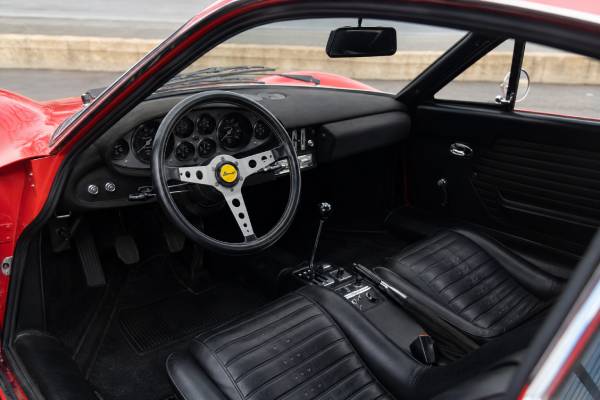
The cockpit is simple and intimate. The driver sits low, with the front arches visible and the engine close behind. The gated shifter, small steering wheel, clear instruments, and narrow cabin all make the car feel special before it moves. Visibility is better than in many later supercars because the car is compact and the pillars are slender, but rearward vision and heat management depend heavily on condition and setup.
The sound is another special feature. A Dino V6 does not have the heavy bellow of a Ferrari V12. It is sharper, more metallic, and more urgent. Induction noise from the Weber carburetors mixes with a crisp exhaust note. At low speed it can sound busy and mechanical; at high revs it becomes one of the car’s defining pleasures.
Road Feel, Performance, and Dino Character
A healthy Dino 246 GT is fast enough to feel exciting, but its real magic is balance, feedback, and sound. It rewards rhythm more than brute force.
The 195 hp figure looks modest beside modern sports cars, yet the Dino does not feel ordinary. The engine likes revs, the gearing keeps the driver involved, and the car’s compact footprint makes ordinary roads feel interesting. Period acceleration figures vary, but a good European-spec car is commonly understood as a roughly seven-second 0–100 km/h machine with a top speed around 235 km/h. More important, it reaches those numbers with drama.
Cold behavior is part of the classic-car experience. A carbureted Dino needs mechanical sympathy. It may require careful starting, a patient warm-up, and a few minutes before the gearbox feels cooperative. Owners who expect modern start-and-go manners may be disappointed. Owners who enjoy machinery will find the process part of the attraction.
The steering is one of the car’s best traits. At parking speeds, the unassisted rack takes effort, especially on modern sticky tires. Once moving, it becomes light, accurate, and full of road texture. The front end is not numb or over-assisted. It tells the driver what the tires are doing, which is why the Dino can feel so alive at speeds that do not require a racetrack.
The chassis balance is friendly but not foolproof. The mid-engine layout gives the car quick responses and strong traction, but old tires, worn dampers, poor alignment, or tired suspension bushes can make it nervous. A well-set-up Dino turns in cleanly, settles into a corner naturally, and lets the driver adjust the line with throttle and steering. A neglected one can feel vague, skittish, or oddly heavy.
Braking performance is good for the period when the system is fresh. The discs need proper pads, healthy fluid, rebuilt calipers, and sound hoses. A Dino should not pull under braking, sink at the pedal, or feel wooden after a few stops. Many complaints about classic Ferrari brakes come from cars that need restoration rather than from the original design itself.
Ride quality is better than many expect. The car is low and sporting, but it is not harsh when the suspension is correct and tires are suitable. Modern tire choice matters a great deal. Period-style Michelin XWX-type tires preserve steering feel and ride compliance better than many aggressive modern alternatives.
On a long drive, the Dino is more usable than its exotic reputation suggests, but it is still a 1970s Italian sports car. Cabin heat, fuel smell, ventilation, noise, and luggage space all depend on condition and expectations. The coupé roof gives the GT a more settled feel than the GTS, and many drivers prefer it for serious road use.
Maintenance, Rust, and Restoration Risks
The Dino 246 GT is not unreliable when properly restored and maintained, but neglect is expensive. The biggest ownership risks are hidden corrosion, poor body repairs, tired mechanical systems, incorrect parts, and restorations that look better than they function.
Rust is the first concern. The 246 GT’s steel body can corrode in places that are difficult to inspect casually. Paint thickness, shiny underseal, and fresh carpets can hide serious problems. A Dino should be inspected on a lift by someone who knows the model, not just by a general classic-car shop.
Key rust and body areas include:
- Sills, inner rockers, and jacking points
- Floor pans and under-seat areas
- Wheel arches and lower fender edges
- Door bottoms and lower skins
- Front nose, spare-wheel well, and battery area
- Rear valance and engine-bay edges
- Windshield and rear-window surrounds
- Suspension pickup areas
- Chassis tubes and prior repair sections
Accident damage is almost as important as rust. The Dino’s value makes old crash repairs worth uncovering. Look for uneven panel gaps, distorted front or rear structures, mismatched body numbers, poor welds, rippled inner panels, and evidence that the car has been clipped. Correct body restoration is specialist work and can cost more than a buyer expects.
The engine needs careful maintenance. Valve clearances, cam timing, carburetor balance, ignition health, cooling condition, and oil leaks all affect how the car drives. Many specialists pay close attention to original exhaust valves during rebuilds, as older sodium-filled valves in period engines are often viewed as a risk if they have not been addressed. A rebuild should be judged by who did it, what parts were used, and whether there are photos and invoices.
The ignition system is another common ownership topic. Original Magneti Marelli Dinoplex components are part of the car’s period character, but many cars have been converted internally or externally to modern electronic ignition for reliability. A discreet upgrade can be sensible for driving, but originality-focused buyers will want to know exactly what was changed and whether original parts remain with the car.
The fuel system must be treated as a safety item. Old fuel hoses, tired clamps, worn carburetor parts, weak pumps, and heat-soaked lines can cause poor running or worse. Any newly purchased Dino should have fuel hoses, coolant hoses, brake hoses, and age-sensitive rubber inspected immediately unless recent specialist invoices prove the work.
The gearbox and clutch are durable when used properly, but wear is common. Check for synchro weakness, noise on overrun, clutch slip, difficult engagement, and oil leaks. The shift linkage should feel precise through the gate. A car that “just needs adjustment” may indeed need adjustment, but it may also need expensive transaxle work.
| Area | What to look for | Why it matters |
|---|---|---|
| Body and chassis | Rust, accident damage, poor welds, thick filler | Structural and cosmetic repairs can dominate ownership cost |
| Engine | Compression, leaks, smoke, valve noise, rebuild records | The V6 is robust when correct, but rebuilds are specialist work |
| Cooling system | Radiator, pipes, fans, water pump, temperature stability | Long coolant runs make neglected systems troublesome |
| Fuel and carburetors | Old hoses, poor idle, flat spots, fuel smell | Running quality and fire safety both depend on condition |
| Gearbox | Cold second-gear behavior, bearing noise, shift quality | Transaxle work is expensive and requires model knowledge |
| Suspension | Bushes, dampers, bearings, alignment, tire age | A tired chassis ruins the Dino’s best driving qualities |
| Documentation | Factory data, invoices, ownership history, certification | Paperwork strongly affects value and buyer confidence |
Parts availability is generally better than for many rare classics, but that does not mean inexpensive. Trim, body panels, original carburetor parts, correct lights, wheels, instruments, tool kits, and interior details can be costly. A cheaper car missing hard-to-source parts may become more expensive than a complete, better-documented example.
Market Values and Buying Checklist
The Dino 246 GT sits in a strong collector market because it combines beauty, Ferrari history, mid-engine importance, and genuine usability. Series E GT values are usually below the very best L-series cars and some top GTS examples, but excellent E-series coupés remain serious six-figure collector cars.
As of the current 2026 market, driver-quality Dino 246 GTs can trade in the lower-to-middle six-figure range, while excellent, highly original, low-mileage, rare-color, or freshly restored cars can move much higher. Public market data also shows a wide spread between cars that need work, cars with ordinary histories, and exceptional examples with strong provenance. Asking prices can be ambitious, so recent comparable sales matter more than advertisements.
The strongest value drivers are:
- Original engine, gearbox, and body identity
- Factory color and trim, especially unusual documented colors
- Quality of restoration, with photos and invoices
- Rust-free structure or properly documented metalwork
- Known ownership chain
- Correct market specification
- Factory “chairs and flares” equipment when genuine
- Books, tools, jack, records, and original documents
- Ferrari Classiche certification or respected expert reports
- Sensible, reversible upgrades rather than heavy modifications
Cars to approach carefully include fresh restorations with no photo record, cars missing number evidence, cars with heavy underseal, cars converted to flares without proof, cars advertised as matching numbers without documentation, and cars with long storage periods but no recommissioning invoices. A Dino can look spectacular in photos while hiding corrosion, poor panel alignment, weak compression, tired suspension, or incorrect details.
A practical buying process should look like this:
- Confirm the car’s identity from chassis, engine, gearbox, and body evidence.
- Review factory records, title history, old registration documents, and restoration invoices.
- Inspect the car on a lift with a Dino specialist.
- Measure paint thickness and inspect seams, sills, floors, and suspension pickup points.
- Perform compression and leak-down testing if recent engine health is not proven.
- Drive the car long enough to check hot temperature stability, gearbox feel, braking, and carburetor behavior.
- Compare the exact car with recent sales of similar GTs, not just broad Dino averages.
- Budget for immediate sorting even if the car appears excellent.
For most buyers, the best E-series Dino 246 GT is not the cheapest one and not necessarily the most restored one. It is the most honest one. A car with older paint, excellent structure, original colors, strong mechanical records, and clear numbers may be a better long-term purchase than a glossy car with uncertain history.
Long-term collectability looks strong because the Dino has several durable advantages. It is beautiful, historically important, mechanically charismatic, and usable on modern roads. It also represents a Ferrari turning point without feeling like a museum piece. The main threat to ownership enjoyment is buying the wrong example. The right Series E GT is one of the most satisfying classic Ferraris to drive, maintain, and keep.
References
- Ferrari Dino 246 GT (1969) – Ferrari.com 1969 (Factory Specifications)
- Ferrari Dino 246 GT: Ferrari History 1969 (Factory History)
- Dino 246 GT Market – CLASSIC.COM 2026 (Market Data)
- Classic Car, Truck and Motorcycle Values | Hagerty Valuation Tool® 2026 (Valuation Tool)
- The Dino Register – Production Highlights 2026 (Production Register)
Disclaimer
This article is for informational purposes only and is not a substitute for professional diagnosis, inspection, repair, or restoration advice. Specifications, torque values, service intervals, emissions equipment, carburetor details, and procedures can vary by VIN, market, production date, and equipment, so owners and buyers should verify all details against official service documentation and a qualified Ferrari or Dino specialist.
If this guide helped you, please consider sharing it on Facebook, X/Twitter, or your favorite enthusiast community to support our work.