

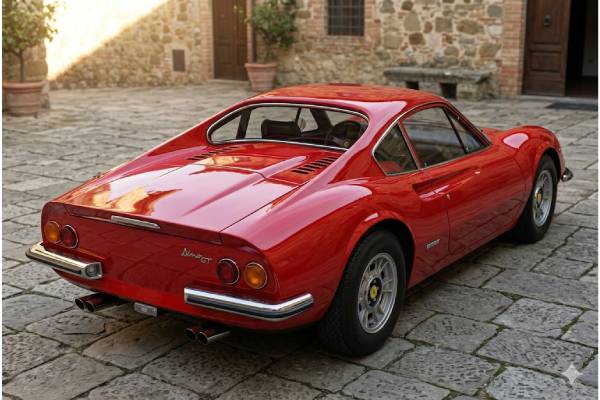
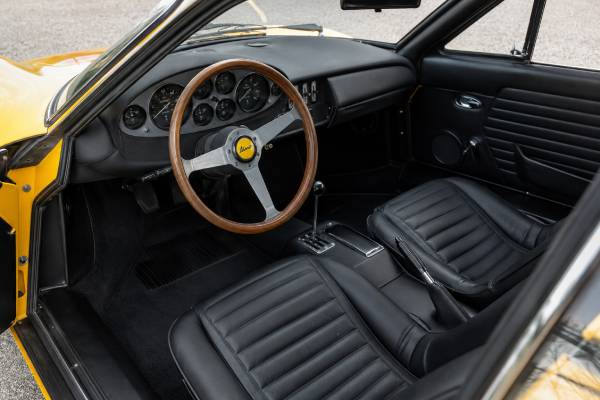
The Ferrari Dino 246 GT Tipo 607 M is one of the most important early mid-engine Italian road cars, even though it was sold under the Dino name rather than as a conventional Ferrari-badged model. Built during the 1970–1971 M-series period, it sits between the early L-series Dino and the later E-series cars, combining the beautiful Pininfarina shape with useful mechanical and detail refinements. Its 2.4-liter Tipo 135 CS V6, compact size, light steering, and balanced mid-engine chassis make it far more than a pretty collector object.
Quick Take
The 1970–1971 Dino 246 GT Tipo 607 M is a sweet spot for many collectors: rarer and more early-feeling than the later E-series cars, but more usable than the first L-series examples. It has the classic 195 hp European 2.4-liter V6, five-speed manual transaxle, Scaglietti-built bodywork, and the core Dino character: light controls, sharp balance, a high-revving soundtrack, and delicate styling. The biggest ownership risks are not speed or complexity in the modern supercar sense, but corrosion, accident repair, incorrect restoration details, missing documentation, tired mechanical systems, and inflated prices for cars that look better than they are.
Table of Contents
- Why the M-Series Dino 246 GT Matters
- Tipo 135 CS V6, Chassis, and Specs
- M-Series Production, Options, and Identification
- Pininfarina Shape and Mid-Engine Engineering
- How the 246 GT Drives on Real Roads
- Maintenance, Corrosion, and Restoration Risk
- Values, Provenance, and Buying Checks
Why the M-Series Dino 246 GT Matters
The M-series Dino 246 GT matters because it helped prove that Ferrari’s road-car future did not have to depend only on front-engine V12 grand tourers. It brought a mid-mounted engine, compact dimensions, and real production-car usability into a form that still feels elegant, delicate, and emotionally rich.
The Dino name came from Alfredo “Dino” Ferrari, Enzo Ferrari’s son, whose work and influence were tied to Ferrari’s V6 engine program. The road-going Dino models were positioned below Ferrari’s larger V12 cars and were not originally sold with Ferrari badges in the usual way. That distinction once made the Dino seem like a lesser Ferrari to some buyers. Today, it is part of the car’s charm and historical importance.
The 246 GT followed the earlier Dino 206 GT. The 206 was beautiful and advanced, with a 2.0-liter V6 and aluminum bodywork, but it was produced in small numbers. The 246 GT enlarged the idea into a more practical and more profitable production car. It used a 2.4-liter V6, a longer wheelbase, more torque, and mostly steel body construction. It kept the basic shape and spirit, but made the car easier to build and easier to live with.
The Tipo 607 M belongs to the middle phase of Dino 246 GT production. The basic sequence is usually described as L-series, M-series, and E-series. The M-series arrived after the earliest 246 GTs and before the later, more numerous E-series cars. This gives it a particular appeal. It has some early-car flavor, but it also has important updates such as five-bolt wheels, revised wipers, interior changes, and mechanical improvements.
The body design is closely associated with Pininfarina, with production bodywork by Scaglietti. The result is one of the most admired shapes of the period: low, curved, compact, and not overly aggressive. It has the visual lightness of a late-1960s sports car rather than the wedge-like look that would define many 1970s and 1980s exotics.
For collectors, the M-series Dino 246 GT is important for several reasons:
- It sits in the early mid-engine Ferrari family tree.
- It is rarer than the later E-series cars.
- It carries distinctive M-series details that matter for authenticity.
- It has the full 2.4-liter Dino driving experience without the later U.S.-market changes found on some cars.
- It remains usable on modern roads when properly maintained.
- Its value depends heavily on originality, documentation, restoration quality, and correct specification.
The Dino’s reputation has changed dramatically over time. What was once viewed as the “small” Ferrari is now one of the most desirable classic sports cars of its era. Buyers are no longer just chasing horsepower. They are chasing balance, design purity, mechanical feel, and historical importance. On those points, the Dino 246 GT remains one of the strongest collector cars Ferrari ever made, whether or not the nose originally wore a Ferrari badge.
Tipo 135 CS V6, Chassis, and Specs
The heart of the 1970–1971 Dino 246 GT is the Tipo 135 CS 2.4-liter V6, a compact 65-degree engine mounted transversely behind the cabin. Its 195 hp output is modest by modern standards, but the light weight, gearing, sound, and chassis balance make the car feel much more special than the numbers suggest.
The European specification 246 GT is generally quoted at 195 hp at 7,600 rpm from 2,419 cc. Some period and auction sources list slightly different figures, especially for later U.S.-market or emissions-equipped examples. For an M-series European-style 1970–1971 car, the 195 hp figure is the key reference point.
| Item | Ferrari Dino 246 GT Tipo 607 M |
|---|---|
| Engine code | Tipo 135 CS |
| Configuration | Rear mid-mounted transverse 65-degree V6 |
| Displacement | 2,419 cc |
| Bore x stroke | 92.5 mm x 60.0 mm |
| Compression ratio | 9.0:1 |
| Induction | Three twin-choke Weber carburetors |
| Maximum power | 195 hp at 7,600 rpm |
| Maximum torque | About 226 Nm at 5,500 rpm |
| Transmission | 5-speed manual transaxle |
| Drive | Rear-wheel drive |
The V6 uses dual overhead camshafts, two valves per cylinder, an iron block, aluminum cylinder heads, wet-sump lubrication, and carburetor fuel delivery. It is not a large engine, but it likes revs. The short 60 mm stroke helps explain the eagerness at the top end. The torque curve is not modern and flat; the driver gets the best from the car by keeping the engine awake and using the gearbox properly.
The chassis is a tubular steel structure with bodywork built by Scaglietti. The Dino 246 GT’s body is mostly steel, with aluminum used for some opening panels depending on series and production details. Compared with the 206 GT, the 246 GT gained a longer wheelbase and a heavier but more production-friendly body. That extra weight did not ruin the car. It made the 246 feel a little more mature and stable while keeping the nimble character that made the Dino famous.
| Area | Specification |
|---|---|
| Chassis | Tubular steel frame |
| Body construction | Scaglietti-built steel body with aluminum panel use depending on component and series |
| Front suspension | Independent wishbones, coil springs, telescopic dampers, anti-roll bar |
| Rear suspension | Independent wishbones, coil springs, telescopic dampers, anti-roll bar |
| Brakes | Four-wheel disc brakes |
| Steering | Rack and pinion |
| Wheelbase | 2,340 mm |
| Length | 4,235 mm |
| Width | 1,700 mm |
| Height | About 1,135 mm |
| Dry weight | About 1,080 kg |
| Typical tire size | 205/70 VR 14 |
Official top speed is usually quoted at about 235 km/h. Period acceleration testing varies, but a healthy European 246 GT is generally a roughly seven-second 0–100 km/h car. That does not sound extreme today, yet it was serious performance in the early 1970s. More important, the Dino delivers speed with precision rather than brute force.
The M-series car is not defined only by its engine. It is defined by the way the engine, short gearing, compact body, steering, and suspension work together. A modern high-performance hatchback can outrun it in a straight line, but very few cars can match the lightness and intimacy of a good Dino on a flowing road.
M-Series Production, Options, and Identification
The M-series Dino 246 GT is the short-lived middle version of the coupe, produced from late 1970 into 1971. It is valued because it combines early Dino character with practical updates that make it easier to identify and often easier to use than the first L-series cars.
Production counts vary slightly by source because Dino records, series transitions, and later documentation do not always line up perfectly. Most specialist references place M-series production at roughly 506 to 507 cars. That makes it much less common than the later E-series. Right-hand-drive production also began around this period, which adds another layer of collectability for the small number of RHD examples.
The broad 246 GT series sequence looks like this:
| Series | Approximate Period | Main Identity |
|---|---|---|
| L-series | 1969–1970 | Early 246 GT with more 206-like details, center-lock wheels, and early trim features |
| M-series | 1970–1971 | Middle 246 GT with five-bolt wheels, revised interior details, and mechanical refinements |
| E-series | 1971–1974 | Later and most numerous series, including later market changes and the GTS body style |
The M-series is especially interesting because it is a transitional model rather than a clean-sheet redesign. Ferrari and its suppliers refined the Dino as production experience grew. The changes were often small, but to collectors they matter.
Useful M-Series Identifiers
A correct M-series Dino 246 GT should be inspected by someone who knows the model well, because many cars have been restored, repaired, converted, or upgraded over the decades. Still, several details help identify the series:
- Five-bolt Cromodora alloy wheels rather than the earlier center-lock arrangement.
- Parallel-action windshield wipers instead of the earlier “clapping hands” style.
- Revised dashboard layout and ventilation controls compared with earlier cars.
- Different trim and interior detail changes from L-series production.
- Availability of features such as electric windows on some cars.
- M-series chassis-number range consistent with specialist records.
- Engine and gearbox numbers that match factory or recognized expert documentation.
The “Tipo 607 M” wording is best understood as referring to the M-series Dino 246 GT development, not as a badge a casual observer would see on the car. The engine designation, Tipo 135 CS, is the more useful mechanical identifier for the 2.4-liter V6.
Factory Options and Desirable Details
The Dino was not optioned like a modern Ferrari with huge personalization menus, but details still matter. Paint color, interior material, wheel type, market equipment, window operation, radio fitment, tools, books, and factory delivery records can all affect desirability.
The most important collector details are usually:
- Original exterior and interior color combination.
- Matching engine, gearbox, and chassis records.
- Correct carburetors, ignition components, wheels, instruments, and trim.
- Original books, pouch, jack, tool roll, and spare wheel.
- Factory build information or respected specialist documentation.
- Evidence that the car has not been assembled from mixed parts.
- Restoration photographs and invoices showing body structure, not just paint.
Some later Dino features, such as flared wheel arches and Daytona-style seats, are famous among collectors, but they are more closely associated with later cars and specific configurations. On an M-series 1970–1971 coupe, correctness is usually more important than adding later-style upgrades. A car that has been made “better” in a casual sense may be less valuable if it has lost its original identity.
Pininfarina Shape and Mid-Engine Engineering
The Dino 246 GT works so well because its design and engineering serve the same idea: a compact, balanced sports car with no excess visual or mechanical weight. It is beautiful because it is purposeful, not because it is decorated.
The shape is low and flowing, with curved front wings, a small oval grille opening, a sharply raked windshield, and a rear deck shaped around the transverse V6. The proportions are different from Ferrari’s front-engine grand tourers. The cabin sits forward, the rear haunches carry visual weight, and the short overhangs make the car look agile even when parked.
Pininfarina’s design avoids the visual aggression that later became common in supercars. There are no giant wings or oversized intakes. The air openings are there for cooling and proportion. The body looks soft, but it is not vague. The crease lines, glasshouse, roof shape, and rear buttress area all help the car feel light and tense.
Scaglietti production also means no two restored Dinos should be judged only with modern mass-production expectations. Panel fit, hand finishing, and small details can vary. That does not excuse poor restoration work, but it does mean a buyer should understand what original hand-built character looks like. Perfectly uniform modern gaps can sometimes be a sign of heavy reworking rather than untouched originality.
The mid-engine layout is the major engineering statement. By placing the V6 behind the seats and ahead of the rear axle line, the Dino gained balance and traction without needing a large engine. The transverse layout kept the package compact. The five-speed transaxle made the drivetrain short and helped preserve the proportions.
The cooling system, fuel system, ignition system, and cabin packaging are all shaped by that layout. A Dino has long coolant runs, rear engine-bay heat, tight service access in some areas, and a cabin that feels intimate rather than spacious. These are not flaws in isolation. They are part of what a small mid-engine 1970s exotic is.
The sound is one of the car’s defining features. The V6 does not have the heavy, deep voice of a Ferrari V12. It has a sharper, more metallic note that hardens as the revs rise. The carburetors add intake texture, and the exhaust gives the car an urgent character even at road speeds. The best Dinos feel alive before they are objectively fast.
Inside, the cockpit is simple and driver-focused. The driving position is low, visibility is good by exotic-car standards, and the controls have a mechanical directness that modern cars rarely offer. The dashboard and switchgear vary by series, so originality matters. A restored interior can look beautiful, but the wrong materials, incorrect stitching, modernized instruments, or misplaced controls can reduce collector appeal.
The engineering is not primitive, but it is old-world mechanical engineering. There are no electronic dampers, drive modes, stability programs, or automated gearshifts. The driver controls the car through steering, throttle, clutch, gear lever, and brake pedal. That is the Dino’s great strength. It does not filter the experience.
How the 246 GT Drives on Real Roads
A healthy Dino 246 GT feels light, balanced, and eager rather than brutally fast. The reward is not straight-line dominance; it is the way the car responds to small inputs and makes ordinary roads feel interesting.
Starting and warming a carbureted Dino is part of the experience. It needs a driver who understands old mechanical systems. Cold behavior depends on tune, weather, carburetor condition, ignition health, and how recently the car has been used. A well-sorted example should not be unpleasant, but it will not behave like a modern fuel-injected car.
Once warm, the V6 is smooth and flexible enough for normal driving, but it comes alive at higher rpm. The engine wants to rev. Below the main power band it is pleasant, not explosive. Above the midrange it becomes sharper, louder, and more urgent. The best way to drive the car is to keep momentum, choose gears carefully, and let the chassis flow.
The five-speed manual transaxle is central to the car’s personality. The shift can feel deliberate when cold, and second gear is often the one that reveals wear or poor adjustment. A good gearbox becomes more cooperative as it warms. A tired one may crunch, resist, or feel vague. Buyers should never dismiss poor shift quality as “just how they all are.” Some stiffness is normal; abuse, wear, or bad setup is not.
The steering is one of the Dino’s greatest pleasures. It is light once moving, accurate, and rich in feedback. At parking speeds it takes some effort, but on the road it gives the driver a clear sense of front grip and surface texture. This is a major reason Dinos remain so loved even in a world of much faster cars.
Ride quality is better than many people expect. The Dino is low and sporty, but it is not a harsh track special. On correct tires and fresh suspension components, it can feel supple and composed. Old tires, incorrect tire sizes, worn bushings, tired dampers, and poor alignment can ruin that impression. Many disappointing Dinos are not bad cars; they are neglected cars.
Braking performance is period-correct. Four-wheel discs give the Dino capable stopping power for its weight and speed, but pedal feel, servo condition, hoses, pad choice, and caliper health matter. A properly serviced system should feel confidence-inspiring. A long pedal, pulling under braking, vibration, or sticky calipers should be treated as repair signals.
On mountain roads and flowing country roads, the 246 GT makes the most sense. The car rewards smoothness. It does not need aggressive steering angles or dramatic throttle inputs. Its balance is natural, and its relatively narrow tires make grip levels readable. That is part of the joy. You can sense the car working without needing race-track speeds.
In traffic, the Dino is less romantic. The cabin can get warm, clutch use becomes tiring, and cooling-system health matters. Visibility is good for an exotic, but the car is low, valuable, and vulnerable in modern traffic. Owners who drive their Dinos regularly often improve reliability by keeping the cooling, fuel, ignition, and electrical systems in excellent condition rather than saving every mile for special events.
A restored Dino can drive beautifully, but restoration quality matters more than shiny paint. Cars that have sat for years may need extensive sorting even if they look perfect. A genuinely sorted, frequently exercised Dino is often better to drive than a static concours-style car with old fuel lines, sticky brakes, and dried-out seals.
Maintenance, Corrosion, and Restoration Risk
The Dino 246 GT is not unreliable when properly rebuilt and maintained, but it is a hand-built exotic from the early 1970s with expensive parts, corrosion risk, and specialist labor needs. The danger is buying a car that looks finished but still needs deep structural or mechanical work.
The engine itself is respected, but it must be treated correctly. It has carburetors, chain-driven camshafts, period ignition components, and tight packaging. A neglected fuel or ignition system can make the car seem far worse than it is. Correct tuning is not optional; it defines how the car starts, idles, pulls, and sounds.
Common mechanical and age-related concerns include:
- Worn or poorly synchronized carburetors.
- Aging fuel hoses, pumps, filters, and tanks.
- Magneti Marelli Dinoplex ignition problems or hidden modern conversions.
- Cooling-system weakness from old radiators, fans, hoses, thermostats, and poor bleeding.
- Oil leaks from aging gaskets and seals.
- Noisy timing chains or worn tensioner-related parts.
- Gearbox synchro wear, especially if the car has been shifted aggressively when cold.
- Clutch wear or poor adjustment.
- Worn suspension bushings, ball joints, dampers, and wheel bearings.
- Brake caliper sticking, old flexible hoses, tired master cylinder, or servo problems.
- Electrical faults from old wiring, fuse panels, relays, switches, and window motors.
Corrosion is the biggest body and restoration risk. A Dino can hide rust under attractive paint, especially if older repairs were cosmetic. A buyer should assume that any car without clear restoration evidence needs careful inspection underneath, inside cavities, around seams, and behind trim.
Important rust and damage areas include:
- Sills and rocker structures.
- Floor pans and footwells.
- Door bottoms and lower skins.
- Wheel arches and inner arch structures.
- Front nose, lower valance, and headlamp areas.
- Battery tray and nearby metal.
- Windshield and rear-window surrounds.
- Suspension mounting points.
- Chassis tubes and outriggers.
- Rear engine-bay structure and lower body seams.
Accident damage is also common. The Dino’s low nose, mid-engine layout, and collector history mean many cars have been repaired at least once. Poor chassis repair can affect alignment, panel fit, suspension geometry, and value. A car with beautiful paint but unclear crash history should be inspected on a lift by a Dino specialist.
Restoration is expensive because small details matter. Correct wheels, instruments, switches, seats, trim materials, lights, carburetors, airbox components, exhaust pieces, and hardware can all affect value. Missing original parts may be difficult and costly to replace. A cheap restoration that uses incorrect materials can be expensive to undo.
Originality also creates a practical dilemma. Some upgrades improve usability, such as hidden ignition reliability improvements, better cooling fans, modern fuel hose materials, or carefully chosen brake pads. These can make sense if they are reversible and documented. Permanent or visible changes are more risky. A collector-grade M-series Dino should not be casually modified to look like a later or more fashionable version.
A sensible maintenance approach includes:
- Annual fluid checks and leak inspection.
- Regular exercise to keep seals, brakes, clutch, and fuel systems healthy.
- Carburetor synchronization and ignition checks when drivability changes.
- Cooling-system inspection before hot-weather use.
- Brake-fluid replacement on schedule.
- Suspension and steering inspection for play or perished rubber.
- Careful gearbox use until fully warm.
- Documentation of every service, repair, and part replacement.
The best Dino ownership experience comes from prevention. Waiting until the car overheats, misfires, or grinds into gear is almost always more expensive than steady specialist care.
Values, Provenance, and Buying Checks
The M-series Dino 246 GT is now a serious collector car, so condition and identity matter more than ordinary used-car mileage logic. A cheaper car with corrosion, missing history, or incorrect restoration can become far more expensive than a properly documented, higher-priced example.
As of 2026, public auction and market-tracking data place good Dino 246 GT coupes broadly in the high-six-figure collector-car conversation, often around the $300,000 to $500,000 range depending on condition, history, market, and currency. Exceptional cars, rare colors, low-mileage examples, and beautifully documented restorations can exceed that. Problem cars, modified cars, cars with unclear identity, or cars needing structural restoration can appear cheaper, but the discount may disappear quickly once expert repair begins.
M-series cars attract buyers because they are less common than E-series coupes and have meaningful transitional details. However, rarity alone does not rescue a weak example. A correct, well-documented E-series car can be a better purchase than an M-series car with poor restoration work and missing records.
The strongest value drivers are:
- Matching-numbers engine and gearbox supported by credible records.
- Original chassis identity and correct M-series features.
- Factory color combination, especially if rare and attractive.
- High-quality restoration with photographs and invoices.
- Long-term ownership history.
- Specialist reports from recognized Dino authorities.
- Ferrari Classiche or other respected documentation where applicable.
- Original books, tools, jack, pouch, and delivery materials.
- Correct wheels, carburetors, trim, glass, lights, and interior details.
- Clean body structure with no hidden corrosion or poor accident repair.
The biggest value risks are:
- Fresh paint over rusty or distorted metal.
- Missing engine, gearbox, or body-number evidence.
- Poor panel fit caused by crash repair.
- Incorrect late-style parts fitted to an earlier car.
- Non-original color changes without documentation.
- Long storage with no mechanical recommissioning.
- Incomplete interior restoration using wrong materials.
- Weak gearbox synchros or noisy drivetrain.
- Overheating or poor cold-start behavior.
- Seller claims that cannot be supported by records.
Pre-Purchase Inspection Priorities
A Dino inspection should be done by a specialist, not a general classic-car shop. The inspection should include the car on a lift, a cold start, a full road test, paint-depth review, chassis-number verification, engine and gearbox number checks, and a review of records.
A practical buyer checklist:
| Area | What to Confirm |
|---|---|
| Identity | Chassis, engine, gearbox, and body details match credible factory or specialist records |
| Series correctness | M-series features are present and not mixed casually with L- or E-series parts |
| Body | No hidden rust, poor filler work, bad panel repairs, or distorted chassis structure |
| Engine | Good oil pressure, clean running, no serious smoke, correct carburetion, healthy ignition |
| Cooling | Stable temperature, working fans, sound radiator, good hoses, no signs of chronic overheating |
| Gearbox | Clean shifts when warm, no major synchro crunch, no alarming transaxle noise |
| Suspension and brakes | No excessive play, fresh rubber where needed, straight braking, no sticking calipers |
| Interior | Correct instruments, seats, trim, switches, and dashboard layout for the car |
| Documentation | Service history, ownership trail, restoration photos, manuals, tools, and expert reports |
A car to seek is one with honest history, correct M-series details, known ownership, strong mechanical behavior, and transparent restoration records. It does not need to be perfect, but it should be coherent. A car to avoid is one with a vague story, shiny paint, missing numbers, weak documentation, and a seller who discourages specialist inspection.
For long-term collectability, the Dino 246 GT remains strong because it satisfies several collector demands at once. It is beautiful, usable, historically important, mechanically engaging, and rare enough to feel special without being impossible to maintain. The M-series adds another layer of appeal because it occupies a short and interesting production window.
The smartest buyer is not necessarily the one who finds the lowest price. It is the one who buys the best identity, the best structure, and the clearest history they can afford. With a Dino, the paperwork, metalwork, and specialist inspection are part of the car.
References
- Ferrari Dino 246 GT (1969) – Ferrari.com 1969 (Manufacturer Model Data)
- Dino 246 GT: Ferrari History 1969 (Manufacturer History)
- FIA Historic Database 1971 (Homologation Database)
- Dino 246 GT Market – CLASSIC.COM 2026 (Market Data)
- 1971 Ferrari Dino 246 GT | Gooding Christie’s 2026 (Auction Reference)
Disclaimer
This article is for informational purposes only and is not a substitute for professional diagnosis, repair, appraisal, or restoration advice. Specifications, torque values, service intervals, procedures, and originality details can vary by VIN, market, production date, equipment, and later repairs. Always verify critical information against official service documentation, factory records, and a qualified Ferrari Dino specialist before buying, servicing, restoring, or valuing a car.
If this guide helped you, please consider sharing it on Facebook, X/Twitter, or your favorite car community to support our work.