
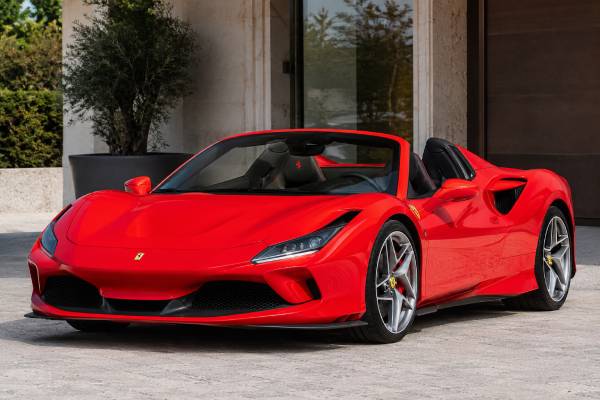

The Ferrari F8 Spider is the open-roof version of Ferrari’s final-series non-hybrid mid-engine V8 supercar before the 296 GTB and 296 GTS moved the line into V6 plug-in hybrid territory. Sold for the 2020 through 2023 model years, it pairs the F142MFL platform with the F154 CG 3.9-liter twin-turbocharged V8, rated at 720 metric horsepower, or 710 hp, and 568 lb-ft of torque. It is not a numbered limited edition, but its place in Ferrari history is already clear: it carries the 488 Pista-derived V8 character into a more usable retractable-hardtop Spider. For buyers, owners, and collectors, the F8 Spider matters because it blends modern Ferrari speed, open-air drama, analog engine appeal, and strong residual value in one of the most desirable modern V8 Ferrari packages.
Table of Contents
- Why the F8 Spider Still Matters
- F154 CG V8, Chassis, and Key Specs
- Model Years, Variants, and Factory Options
- Aero, Roof, Cabin, and Ferrari Details
- How the F8 Spider Drives
- Maintenance, Recalls, and Ownership Risk
- Values, Inspection Priorities, and Smart Buying
Why the F8 Spider Still Matters
The F8 Spider is important because it represents the last pure gasoline, mid-engine, open-top Ferrari V8 in the 458, 488, and F8 family line before Ferrari’s central sports-car range shifted toward hybrid power. It is newer, faster, and more technically mature than the 488 Spider, but less extreme and less rare than the 488 Pista Spider.
Ferrari revealed the F8 Spider after the F8 Tributo coupe, using the same basic aluminum mid-engine architecture and the same F154 CG V8 family. In simple terms, it is a successor to the 488 Spider, but it borrows much of its powertrain character from the 488 Pista. That combination is why the car occupies an interesting space. It has the usability of a series-production Ferrari, the roof theater of a retractable-hardtop Spider, and an engine lineage closely tied to one of Ferrari’s great modern track-biased V8 models.
The F8 Spider also arrived at a turning point. The 458 Italia and 458 Spider were naturally aspirated cars. The 488 GTB and 488 Spider brought turbocharging to the modern mid-engine V8 line. The F8 refined that turbocharged formula with more power, sharper aero, and improved control systems. Then the 296 series changed the formula again with a twin-turbo V6 and plug-in hybrid assistance. That makes the F8 Spider attractive to buyers who want modern pace without hybrid complexity.
It is not an old-school Ferrari in the classic sense. It has a dual-clutch gearbox, electronic differential, magnetorheological dampers, stability software, drive modes, and extensive aerodynamic work. Yet compared with newer hybrid supercars, it feels mechanically direct. The engine is always the main event. There is no electric-only driving mode, no charging routine, and no high-voltage battery ownership concern.
The Spider body style gives it another layer of desirability. Ferrari’s retractable hardtop allows the car to feel secure and refined when closed, then theatrical when open. With the roof down, turbo whistle, exhaust note, and intake sound become a bigger part of the experience. That matters because the F8 is not only bought for acceleration numbers. It is bought for the sensation of a Ferrari V8 working hard behind the driver.
Collectors also pay attention because the F8 Spider sits between two eras. It is modern enough to use regularly, but old-fashioned enough in concept to appeal to people who do not want a hybrid drivetrain. Condition, mileage, color, options, and Ferrari service history already make a large difference in value. Cars with special paint, extensive carbon fiber, Daytona or racing seats, forged wheels, suspension lift, passenger display, and complete documentation usually receive more attention than plain, high-mileage examples.
The F8 Spider’s reputation today is strong. It is fast enough to remain serious by current supercar standards, usable enough for road trips, and special enough to feel like more than a regular exotic convertible. Its long-term collector status will depend on supply, specification, and future Ferrari product direction, but the core ingredients are already there.
F154 CG V8, Chassis, and Key Specs
The heart of the F8 Spider is the F154 CG, a 3,902 cc twin-turbocharged V8 rated at 710 hp and 568 lb-ft of torque. It sends power only to the rear wheels through a seven-speed dual-clutch transmission, which keeps the car lighter and more focused than an all-wheel-drive supercar.
| Item | Ferrari F8 Spider |
|---|---|
| Model code | F142MFL |
| Model years covered | 2020–2023 |
| Engine code | F154 CG |
| Engine layout | Rear-mid-mounted 90-degree twin-turbo V8 |
| Displacement | 3,902 cc / 3.9 liters |
| Power | 720 cv / 710 hp / 530 kW at 8,000 rpm |
| Torque | 770 Nm / 568 lb-ft at 3,250 rpm |
| Transmission | 7-speed dual-clutch automatic |
| Drivetrain | Rear-wheel drive |
| 0–100 km/h | 2.9 seconds |
| 0–200 km/h | 8.2 seconds |
| Top speed | 340 km/h / 211 mph |
The V8 uses a flat-plane crankshaft, twin turbochargers, direct injection, and Ferrari’s highly developed engine control strategy. A flat-plane crank helps the engine rev quickly and gives the V8 a sharper sound than a conventional cross-plane V8. The turbochargers provide the huge mid-range torque that defines the car’s real-world performance.
The F8 Spider’s output is often described in different ways depending on market and measurement. Ferrari’s European figure is 720 cv, which converts to 710 mechanical horsepower. That is why the same car is commonly described as a 720 PS Ferrari or a 710 hp Ferrari. The torque figure, 770 Nm or 568 lb-ft, is just as important because it gives the F8 its instant passing power.
| Area | Specification |
|---|---|
| Body structure | Aluminum-intensive mid-engine structure with retractable hardtop |
| Suspension | Independent suspension with electronically controlled magnetorheological dampers |
| Steering | Electric power-assisted steering |
| Brakes | Carbon-ceramic discs with multi-piston calipers |
| Front tires | 245/35 ZR20 |
| Rear tires | 305/30 ZR20 |
| Wheelbase | 2,650 mm / 104.3 in |
| Length | 4,611 mm / 181.5 in |
| Width | 1,979 mm / 77.9 in |
| Height | 1,206 mm / 47.5 in |
| Dry weight | About 1,400 kg / 3,086 lb with lightweight equipment |
Ferrari’s control systems are central to the car. The F8 Spider uses E-Diff3, F1-Trac, Side Slip Control, Ferrari Dynamic Enhancer Plus, and adaptive damping to manage power delivery and cornering behavior. These systems do not make the car slow or numb. Their purpose is to let the driver use more of the engine more often, especially when grip changes.
The transmission is a major part of the car’s personality. Around town it behaves smoothly for an exotic, but in sportier modes it shifts with the speed and firmness buyers expect from a modern Ferrari. It is not a manual-transmission experience. It is a rapid, software-driven dual-clutch experience designed to keep the engine in boost and the chassis settled.
The F8 Spider’s braking system uses carbon-ceramic hardware as standard. These brakes resist fade very well when used properly, but their condition matters greatly when buying. Replacement costs are high, and visual inspection alone is not enough. A specialist should check rotor wear, surface condition, pad life, and heat damage.
Model Years, Variants, and Factory Options
The F8 Spider was sold as the open-roof companion to the F8 Tributo coupe, not as a separate limited-edition model. Ferrari did not publish a simple global production number for the F8 Spider, so buyers should focus more on individual specification, originality, service records, and market history than on claimed rarity.
The main factory body styles in the F8 range were:
- F8 Tributo: fixed-roof berlinetta coupe.
- F8 Spider: retractable-hardtop Spider with the same basic powertrain.
- One-off Special Projects cars: F8-based creations exist, but they are not normal production variants and should not be treated as comparable market cars.
For most buyers, the key question is not which F8 variant exists, but how a specific F8 Spider was ordered. Ferrari options can change the look, usability, and resale appeal dramatically. Two cars from the same model year can feel very different because of their paint, interior trim, seat choice, wheels, carbon fiber package, lift system, and technology options.
Factory options that affect desirability
Common high-interest options include:
- Front suspension lift, especially valuable in cities with steep driveways or speed humps.
- Carbon-fiber exterior trim, including front, side, rear, and underbody details.
- Carbon-fiber driver zone and LED steering wheel.
- Racing seats or Daytona-style seats, depending on buyer preference.
- Forged wheels or special wheel finishes.
- Carbon-fiber engine bay trim.
- Passenger display.
- Apple CarPlay where fitted.
- Premium audio, though some buyers care less because the engine dominates the experience.
- Parking cameras and front/rear sensors.
- Special stitching, colored seat belts, colored leather, Alcantara, and contrast piping.
- Special paint, historic Ferrari colors, Atelier specifications, and Tailor Made details.
A heavily optioned car is not automatically better. A tasteful, coherent specification usually wins over a car with expensive but mismatched choices. For example, a traditional Rosso Corsa car with carbon driver zone, lift, shields, forged wheels, and strong service records may be easier to resell than a more expensive but unusual build with a polarizing interior.
Identification and documentation
Modern Ferrari buying depends heavily on paperwork. Buyers should verify the VIN, original window sticker or build sheet, service history, warranty status, recall completion, and option list. A Ferrari dealer or qualified specialist can usually confirm configuration and campaign status.
Important documents include:
- Original sales invoice or window sticker.
- Ferrari service records.
- Warranty and maintenance plan records.
- Recall and campaign completion records.
- Owner’s manuals and tool/accessory items.
- Battery conditioner and related charging accessories.
- Paint protection film records, especially if the car has full-body coverage.
- Records for tires, brake pads, brake fluid, alignments, and software updates.
For a collector-grade F8 Spider, originality matters. Factory paint is preferred. Factory interior is preferred. Factory wheels, factory carbon trim, and documented options are more desirable than later aftermarket changes. Tasteful reversible upgrades may not ruin a car, but extreme tuning, aftermarket exhaust modifications, lowered suspension, and modified bodywork can narrow the buyer pool.
Aero, Roof, Cabin, and Ferrari Details
The F8 Spider’s design is not only styling; much of its shape is there to manage airflow, cooling, and high-speed stability. Compared with the 488 Spider, it looks sharper, uses more visible aero features, and carries a stronger connection to Ferrari’s recent track-focused V8 work.
The front of the car is defined by its S-Duct, a feature associated with Ferrari’s racing and special-series thinking. Air enters low at the nose, is directed through the bodywork, and exits over the front section to increase front-end downforce. This helps the car feel more planted without relying only on large wings.
Cooling is also a major design theme. Turbocharged mid-engine cars produce serious heat, especially when driven hard. The F8 Spider’s body channels air around the radiators, brakes, intercoolers, and engine bay. The side intakes are not decoration. They are part of the car’s thermal management and pressure balance.
At the rear, the F8 returns to a more classic Ferrari twin-round-taillight look, a detail many buyers prefer over the 488’s design. The rear deck, vents, and spoiler treatment help manage air as it leaves the body. The result is a Spider that still looks elegant enough for road use but much more aggressive than earlier open V8 Ferraris.
Retractable hardtop
The roof is one of the F8 Spider’s defining features. It is a folding hardtop rather than a fabric soft top, so the car feels more secure and coupe-like when closed. The mechanism operates quickly, and the roof can be used at low speeds, which makes it practical in real weather.
The hardtop also affects the car’s side profile. Ferrari moved and shaped the roof separation lines so the folded roof could be packaged neatly behind the cockpit. The F8 Spider does not look like a coupe with the roof simply cut off. It has its own rear deck and flying-buttress style structure that frames the cabin.
For ownership, the roof adds both pleasure and inspection points. Buyers should check the roof operation, seals, drains, latching behavior, trim alignment, and any signs of water entry. A perfect-looking car can still have roof squeaks or seal problems if it has been poorly stored or repaired.
Cockpit and controls
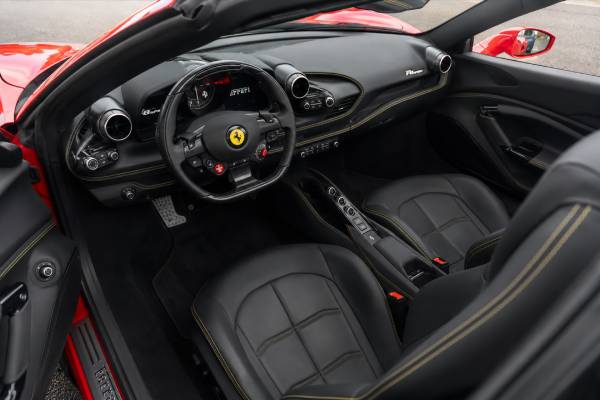
The interior is driver-focused in the modern Ferrari style. Many major controls sit on or near the steering wheel, including the manettino drive-mode switch. The cabin is not minimalist in the modern EV sense. It is a layered supercar cockpit with leather, carbon fiber, vents, screens, and switchgear arranged around the driver.
The driving position is low, but visibility is better than many people expect for a mid-engine exotic. The front corners are still expensive and low, so parking cameras and lift equipment are useful. The cabin can be comfortable enough for longer drives, although tire noise, road texture, and engine heat remind you that this is not a grand tourer.
The optional passenger display is a useful resale feature because it adds theater. It lets the passenger see speed, rpm, gear, and other performance data. It is not essential, but many buyers like it because it makes the passenger part of the experience.
How the F8 Spider Drives
The F8 Spider feels brutally quick, but its real talent is how easily it delivers huge speed without making every drive feel like a track session. It has the performance of a serious supercar and the polish of a modern Ferrari road car.
The engine response is the first thing most drivers notice. Older turbocharged cars could feel soft before boost arrived, but the F8’s V8 responds with urgency. The torque comes in early, and the car gathers speed with very little waiting. On a public road, short bursts are enough to make the point.
The sound is different from the naturally aspirated 458 Spider. The F8 does not have the same high-pitched, free-breathing crescendo. Instead, it has a forceful turbocharged sound with intake rush, exhaust punch, and a harder mechanical edge at high rpm. With the roof open, the experience becomes much more dramatic. Drivers who judge the F8 only from outside noise miss part of its appeal; from the cabin with the roof down, it feels alive.
The gearbox is fast and generally well judged. In automatic mode it can creep through traffic with reasonable manners. In manual paddle mode it becomes sharper, especially when the manettino is set to more aggressive modes. Downshifts are quick, and the car keeps the engine in the useful part of the powerband with little effort.
Steering is quick, which is typical of modern Ferrari mid-engine cars. Some drivers coming from older hydraulic systems may find it light, but it is accurate and immediate. The front axle reacts quickly to small inputs, so smooth hands matter. The car is not nervous when aligned correctly and on healthy tires, but it does not like careless inputs at high speed.
Ride quality is better than the performance suggests. The adaptive dampers give the F8 Spider enough compliance for real roads, and the bumpy-road damper function is genuinely useful. That does not mean it is soft. It is still low, wide, and tire-sensitive. Poor roads can make it feel busy, and worn or old tires can damage both ride and confidence.
Braking performance is strong, but carbon-ceramic brakes feel best when warm and in good condition. Around town they can feel different from iron brakes, especially at very low speeds. On fast roads they give strong stopping power and good resistance to fade. On track, brake temperature, pad choice, fluid condition, and tire condition become far more important.
The chassis balance is friendly for the level of power. The electronic differential and traction systems help the driver put power down, but they do not repeal physics. Cold tires, wet roads, old rubber, and sudden throttle inputs can still overwhelm the rear axle. A good F8 Spider rewards smooth, confident driving. A poorly maintained one can feel loose, harsh, or inconsistent.
For daily or weekend use, the F8 Spider is surprisingly workable. The front trunk is modest, the cabin has enough comfort for two, and the roof gives useful flexibility. It is still wide and attention-grabbing, but compared with more extreme supercars it is easy to enjoy without needing a racetrack.
Maintenance, Recalls, and Ownership Risk
The F8 Spider is not fragile when cared for properly, but it is an exotic Ferrari with expensive consumables, complex electronics, and very little tolerance for neglected maintenance. The best cars have annual Ferrari specialist records, healthy batteries, fresh tires, documented brake condition, and completed recalls or campaigns.
Ferrari’s 7-Year Genuine Maintenance program is one reason modern Ferrari ownership can be more predictable during the early years. Scheduled servicing is typically tied to time or mileage, and records are important for resale. Even when a car has low miles, annual service still matters because fluids age, batteries weaken, tires harden, and software updates or inspections may be needed.
Common ownership inspection areas
The most important checks are specific to the F8’s type of car:
- Battery condition: Modern Ferraris dislike weak batteries. A car that was not kept on a conditioner can show warning lights, module faults, and strange behavior.
- Tire age and brand: Old tires can make a low-mile car dangerous. Check date codes, wear pattern, and correct specification.
- Carbon-ceramic brakes: Confirm rotor condition, pad life, surface damage, and wear data. Replacement can be very expensive.
- Dual-clutch transmission: Check for smooth engagement, leaks, overheating history, and diagnostic data.
- Clutch wear data: Even dual-clutch cars have clutch wear values that a specialist can read.
- Turbo and cooling system health: Look for leaks, heat damage, coolant issues, and signs of poor repair work.
- Roof operation: Test opening and closing, alignment, seals, drain paths, and wind noise.
- Front lift system: If fitted, confirm proper operation and check for hydraulic leaks or slow response.
- Suspension dampers: Inspect for leaks, worn bushings, uneven ride height, and abnormal noises.
- Paint and carbon fiber: Look for stone chips, cracked carbon trim, poor paint protection film installation, and previous repair evidence.
- Interior wear: Bolsters, sticky trim, loose switches, leather shrinkage, and damaged carbon pieces can all affect value.
A pre-purchase inspection should include a diagnostic scan, service record review, underside inspection, paint-depth check, roof-system test, brake measurement, tire inspection, and road test. The inspection should be done by a Ferrari dealer or a specialist who knows 458, 488, and F8 cars. A normal luxury-car inspection is not enough.
Recalls and campaigns
U.S.-market F8 buyers should verify recall status by VIN. A major Ferrari brake-fluid reservoir cap recall affected certain 2020–2022 F8 vehicles, including F8 Spider and F8 Tributo examples. The concern involved brake reservoir cap venting, possible brake fluid leakage, and reduced braking capability. The remedy should be confirmed in the car’s records.
Recalls and service campaigns vary by country, VIN, and build date. Do not assume a car is clear because it is low mileage, dealer-sold, or recently serviced. Ask for written confirmation.
Running costs and wear items
The F8 Spider’s biggest costs are often not routine oil services. They are wear items and age-related items:
- Tires, especially if the car is driven hard.
- Brake pads and carbon-ceramic brake components.
- Battery replacement and electrical troubleshooting.
- Alignment and suspension wear.
- Paint protection film replacement or correction.
- Roof seals or trim repairs.
- Cosmetic carbon-fiber repairs.
- Out-of-warranty electronic module or sensor diagnosis.
Track use changes the equation. A tracked F8 Spider may still be a good car, but it needs stronger evidence: brake fluid history, tire history, alignment records, heat checks, and honest disclosure. A car with heavy track use but no supporting maintenance records should be priced accordingly.
Values, Inspection Priorities, and Smart Buying
The best F8 Spider to buy is not simply the cheapest or the lowest-mile car. It is the car with the right specification, clean history, complete service records, healthy wear items, documented options, and no story around paintwork, electronics, roof function, or ownership gaps.
The F8 Spider has generally held strong market appeal because it combines the last non-hybrid mid-engine V8 formula with open-top usability. Values vary widely by mileage, color, options, region, and seller type. Public auction and listing data show a broad spread, with ordinary examples below the most collectible specifications and exceptional low-mile, heavily optioned, or special-color cars commanding a premium.
What drives value
Key value factors include:
- Mileage, but only when supported by condition.
- Ferrari dealer or recognized specialist service history.
- Completed recalls and campaigns.
- Original paint and clean body history.
- Desirable factory colors.
- Coherent interior specification.
- Carbon-fiber driver zone and LED steering wheel.
- Front lift.
- Forged wheels.
- Racing seats or high-demand comfort seat configuration.
- Passenger display.
- Paint protection film quality.
- Number of owners.
- Warranty or extended-warranty eligibility.
- Complete manuals, keys, accessories, and battery conditioner.
A very low-mile car can be less appealing if it has old tires, weak battery history, missing records, or unclear storage conditions. A slightly higher-mile car with excellent records and fresh consumables may be the better driver’s purchase.
Cars to seek
Look for an F8 Spider that has:
- Clean title and clean accident history.
- Consistent annual service records.
- Fresh or recent tires from a correct high-performance specification.
- Brake condition verified by measurement or diagnostic data.
- Fully working roof.
- No unresolved warning lights.
- No aftermarket ECU tune unless you knowingly want a modified car.
- Original exhaust or reversible, documented changes.
- High-quality paint protection film with no trapped dirt or cut marks.
- A specification that will appeal to the next buyer, not only the current one.
Cars to avoid
Be cautious with cars that show:
- Gaps in service history.
- Repeated battery-related warning lights.
- Cheap or mismatched tires.
- Heavy front-end repaint without documentation.
- Unexplained carbon-ceramic brake wear.
- Roof noises, leaks, or slow operation.
- Modified suspension or tuning with no records.
- Track use without matching maintenance.
- Missing factory accessories.
- Sellers unwilling to allow a proper Ferrari inspection.
The smartest buying strategy is to choose condition and documentation first, then color and options, then mileage. Mileage matters, but it should not blind you to the bigger risks. An F8 Spider is expensive to buy and expensive to correct. A bargain car can become the costly car very quickly if it needs brakes, tires, battery work, roof repairs, paint correction, and deferred service at the same time.
Long term, the F8 Spider’s collectability looks promising because of what it represents: a modern, open-top, mid-engine Ferrari V8 without hybrid hardware. It is not rare in the way a numbered special series is rare, but it has the right story, the right engine, and the right emotional appeal. For buyers who want to drive rather than store, it may be one of the most complete modern Ferrari Spiders of its era.
References
- Ferrari F8 Spider, the evolution of the species 2019 (Manufacturer Specifications)
- Warranties And Official Ferrari Maintenance 2026 (Manufacturer Maintenance Information)
- Part 573 Safety Recall Report 22V-536 2022 (Recall Database)
- Gas Mileage of 2023 Ferrari F8 Spider 2023 (EPA Fuel Economy)
- Ferrari F8 Spider Market 2026 (Market Data)
Disclaimer
This article is for informational purposes only and is not a substitute for professional diagnosis, repair, valuation, or inspection. Specifications, torque values, service intervals, repair procedures, recall status, and equipment can vary by VIN, market, production date, and option package. Always verify details against official Ferrari service documentation and have any purchase inspected by a qualified Ferrari specialist.
If you found this guide useful, please consider sharing it on Facebook, X/Twitter, or your preferred automotive community to support our work.