
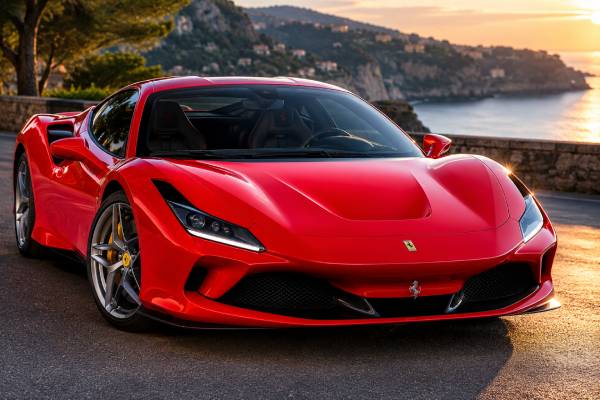


The Ferrari F8 Tributo is the fixed-roof, mid-rear-engined V8 berlinetta that replaced the 488 GTB and carried Ferrari’s non-hybrid V8 supercar line into its final phase before the 296 GTB arrived. Built around the F154 CG 3.9-liter twin-turbo V8, it delivers 710 hp, or 720 cv, and takes much of its engine character from the harder-edged 488 Pista. The result is a car that feels more focused than a 488 GTB but less rarefied and track-specific than a limited special series model.
The F8 Tributo matters because it sits at a turning point. It is one of the last mid-engined Ferrari V8 road cars without hybrid assistance, yet it has modern aero, electronics, dual-clutch speed, and everyday usability. Buyers care about mileage, options, history, recall completion, and originality; enthusiasts care because it is fast, beautiful, and deeply tied to Ferrari’s long V8 lineage.
Table of Contents
- Why the F8 Tributo Still Matters
- F154 CG V8, Chassis, and Key Specs
- F8 Tributo Production, Spider Links, and Options
- Aerodynamics, Cabin Details, and Ferrari V8 Character
- How the F8 Tributo Drives
- Maintenance Risks, Recalls, and Ownership Reality
- Market Values and Smart Buying Checks
Why the F8 Tributo Still Matters
The F8 Tributo is important because it represents the mature peak of Ferrari’s non-hybrid, mid-engined V8 berlinetta formula. It followed the 488 GTB, borrowed heavily from the 488 Pista’s engine development, and arrived just before Ferrari moved this model line into plug-in hybrid territory with the 296 GTB.
Ferrari introduced the F8 Tributo in 2019 as a celebration of its V8 history. The name was not subtle: “Tributo” pointed directly to the company’s long run of mid-engined V8 road cars, from the 308 and 328 through the 348, F355, 360 Modena, F430, 458 Italia, and 488 GTB. The F8 did not reinvent the layout. It refined it.
That matters for collectors. The F8 Tributo is not a numbered limited edition, and Ferrari did not present it as a hardcore special-series successor to the 488 Pista. Instead, it is a regular-production Ferrari supercar with unusually strong historical timing. It is the last fixed-roof, series-production, mid-engined Ferrari V8 coupe before the hybrid V6 296 GTB took over the core model slot.
The F8’s position is also unusual because it blends two personalities. Compared with a 488 GTB, it is sharper, faster, and more aerodynamically advanced. Compared with a 488 Pista, it is more usable, more luxurious, and easier to live with. That middle ground makes it appealing to owners who want a serious Ferrari driving experience without the scarcity premium and uncompromising feel of a special series car.
Its reputation today rests on a few key points:
- It has the 3.9-liter twin-turbo F154 family V8 in one of its most powerful road-car forms.
- It keeps rear-wheel drive, not hybrid AWD or electric torque fill.
- It uses advanced Ferrari chassis software but still feels like a traditional mid-engined supercar.
- It has strong modern usability, including a dual-clutch gearbox, drive modes, lift-system availability, and a relatively comfortable cabin.
- It has clear collector interest because it marks the end of an era, not because it was artificially limited.
For buyers, the main question is not whether the F8 Tributo is desirable. It is whether a specific car has the right mileage, specification, service record, recall status, and condition to justify its premium over a 488 GTB and its relationship to the 488 Pista and 296 GTB.
F154 CG V8, Chassis, and Key Specs
The F8 Tributo’s core appeal is its 3,902 cc twin-turbo V8: 710 hp, 568 lb-ft of torque, and a power delivery that feels far more urgent than the 488 GTB it replaced. The headline figures are only part of the story, because the F8 combines that engine with a fast seven-speed dual-clutch gearbox, rear-wheel drive, active chassis electronics, and serious aero work.
| Item | Specification |
|---|---|
| Model code | F142MFL |
| Engine code | F154 CG family |
| Engine layout | 90-degree twin-turbocharged V8, mid-rear mounted |
| Displacement | 3,902 cc / 3.9 liters |
| Output | 710 hp / 720 cv / 530 kW |
| Torque | 568 lb-ft / 770 Nm |
| Transmission | 7-speed F1 dual-clutch automatic |
| Drivetrain | Rear-wheel drive |
| Top speed | 211 mph / 340 km/h |
| 0–100 km/h | 2.9 seconds |
| 0–200 km/h | 7.8 seconds |
The engine is the star. It uses direct fuel injection, two turbochargers, a flat-plane-crank character, and high-flow exhaust and intake work related to Ferrari’s track-focused V8 development. Peak torque arrives low enough to make the car explosive in normal road use, while the engine still revs high enough to avoid feeling like a lazy turbocharged unit.
The seven-speed dual-clutch gearbox is central to the car’s character. Around town, it can behave smoothly enough for a modern exotic. In aggressive modes, shifts are extremely quick and add to the sense of acceleration. There is no manual version, and there is no all-wheel-drive version. Every F8 Tributo sends power to the rear wheels.
| Item | Specification |
|---|---|
| Length | 4,611 mm |
| Width | 1,979 mm |
| Height | 1,206 mm |
| Wheelbase | 2,650 mm |
| Dry weight | About 1,330 kg, depending on specification |
| Kerb weight | About 1,435 kg, depending on market and equipment |
| Weight distribution | Rear-biased mid-engine layout |
| Fuel capacity | 78 liters |
| Luggage capacity | About 200 liters |
The suspension uses Ferrari’s familiar performance-car approach: double wishbones at the front, a multi-link layout at the rear, magnetorheological dampers, and electronic control through the steering-wheel manettino. Carbon-ceramic brakes are standard, and the car runs staggered 20-inch wheels with very wide rear tires.
The electronics are just as important as the hardware. The F8 Tributo uses Ferrari’s Side Slip Control system, F1-Trac traction control, E-Diff, adaptive damping, and Ferrari Dynamic Enhancer logic to help the driver manage the huge torque output without making the car feel numb. This is why the car can be both approachable and very fast.
F8 Tributo Production, Spider Links, and Options
The F8 Tributo coupe was sold as part of the regular Ferrari range, not as a numbered limited edition. That means condition, specification, mileage, documentation, and color matter more than a serial-number plaque or official build quota.
The main production story is simple. The F8 Tributo coupe launched first, followed by the F8 Spider with a retractable hardtop. Both use the same basic engine family and model concept, but the coupe is the purer berlinetta and the one most closely tied to the “Tributo” idea. The Spider adds open-air appeal and usually carries different buyer demand, especially in warm-weather markets.
Ferrari has not made full global F8 Tributo production totals a central public selling point. Buyers should therefore avoid claims such as “one of only X made” unless supported by a Ferrari document, dealer data, or credible market-specific records. A rare color or unusual Tailor Made configuration can be meaningful, but it is not the same as a factory-numbered limited edition.
Versions and related cars
The F8 family includes the coupe and Spider. The coupe is the subject of this guide, but related cars influence values and buyer decisions:
- F8 Tributo: fixed-roof berlinetta, lighter and more structurally direct than the Spider.
- F8 Spider: retractable-hardtop version, similar power, more open-air usability, usually heavier.
- 488 Pista: earlier special-series model using a more track-focused version of the same engine lineage.
- 296 GTB: hybrid V6 successor in the core mid-engined Ferrari model line.
- Special Projects cars based on F8 architecture: rare one-off Ferrari commissions can be based on F8 hardware, but these are separate collector objects.
Factory options that affect desirability
F8 Tributo values can move noticeably based on specification. The most desirable cars usually combine a strong exterior color, tasteful interior, useful carbon fiber options, complete service history, and low but credible mileage.
Commonly desirable options include:
- carbon-fiber steering wheel with shift LEDs
- carbon-fiber driver zone
- carbon-fiber exterior details
- racing seats or Daytona-style seats, depending on buyer taste
- suspension lifter
- forged wheels
- front and rear parking sensors
- rear camera
- passenger display
- premium audio
- Apple CarPlay where fitted
- special stitching, colored seat belts, and personalized interior trim
- Tailor Made or Atelier specification with proper documentation
Not every expensive option adds equal resale value. Heavy personalization can help if it is tasteful and documented, but unusual color combinations can narrow the buyer pool. A car with a famous Ferrari color, clean carbon package, lift, camera, and good seat choice is often easier to sell than a heavily customized example that reflects one owner’s very specific taste.
Documentation matters. A complete file should include the original books, service records, recall documentation, option list, battery tender, tools where applicable, and Ferrari dealer or specialist inspection history. For a modern Ferrari, provenance is not only about celebrity ownership or delivery photographs. It is also about proving the car has been maintained properly and has not been damaged, tuned poorly, or neglected.
Aerodynamics, Cabin Details, and Ferrari V8 Character
The F8 Tributo looks dramatic because its bodywork is doing real aerodynamic and cooling work. The design is not just a facelift of the 488 GTB; it uses a reshaped front, S-Duct, revised rear treatment, engine-cover louvers, and underbody work to manage air more effectively.
The front S-Duct is one of the clearest engineering features. Air enters low at the nose, is guided through the front structure, and exits over the hood. This helps generate front downforce and gives the F8 a visual link to Ferrari’s track-developed thinking. The front lights are slimmer than the 488’s, which frees space for larger brake-cooling intakes.
At the rear, the car returns to twin round taillights on each side, a strong Ferrari design cue that many enthusiasts missed on the 488. The rear screen uses louvers over the engine bay, echoing the F40 without becoming a retro copy. The engine remains visible, but the cover also manages heat and airflow.
The F8’s body is shaped around cooling needs. Turbocharged engines generate serious heat, and a mid-engined Ferrari has little spare packaging space. The side intakes, rear vents, and diffuser all serve a purpose. A buyer inspecting a used car should pay close attention to the lower front edge, undertray, diffuser, and side intake areas, because damage there can be expensive and may point to hard use.
Inside, the F8 Tributo is driver-focused rather than minimalist. The steering wheel carries major controls, including the manettino drive-mode switch, start button, indicators, wipers, and shift lights if optioned. This can feel busy at first, but it keeps the driver’s hands close to the wheel during fast driving.
The cabin is more modern than the 488’s but still recognizably Ferrari. There is a central bridge, large shift paddles fixed to the steering column, supportive seats, and a low driving position. Visibility is good forward and to the sides for a supercar, but rear visibility through the louvered engine cover is limited. Parking aids are therefore useful, not just luxury extras.
The sound is different from the naturally aspirated 458 Italia. The F8 does not have the same high-pitched, unfiltered scream. It has more boost-driven force, deeper intake and exhaust texture, and a hard-edged rush near the top of the rev range. Some buyers prefer the 458’s sound, but the F8’s performance advantage is massive. The best way to understand the car is to view it as the polished end point of Ferrari’s turbo V8 era, not as a replacement for the emotional character of the older naturally aspirated cars.
How the F8 Tributo Drives
The F8 Tributo feels brutally quick, but its real achievement is how calmly it delivers that speed. It has enough torque to make ordinary roads feel short, yet the chassis electronics and steering response make it feel more usable than the numbers suggest.
Throttle response is very sharp for a turbocharged engine. Ferrari worked hard to reduce the laggy, elastic feel that can affect high-output turbo cars. The F8 still has the huge mid-range punch expected from a twin-turbo V8, but it does not feel sleepy at low revs or reluctant to rev out. The power builds with urgency and keeps pulling hard into the upper range.
The gearbox is one of the car’s strongest daily-use features. In automatic mode, it can handle traffic without drama. In manual mode, the large paddles and fast shift response make the car feel alive. Downshifts are crisp, and the gearing lets the driver enjoy several ratios without needing a racetrack every time.
Steering is quick and light, as modern Ferraris tend to be. Drivers coming from older hydraulic-steering Ferraris may find it less textured, but the front end responds immediately. The car changes direction with very little delay, and the mid-engine balance gives it a sense of rotation that front-engined performance cars cannot match.
The ride is firm but not punishing when the dampers are set appropriately. The bumpy-road damper setting is useful on real pavement and should not be dismissed as a comfort gimmick. It allows the car to breathe over rougher surfaces without giving up its sharp basic character.
On track, the F8 Tributo is extremely fast but not as single-minded as a 488 Pista. Heat, tires, brake condition, and driver skill all matter. Carbon-ceramic brakes can handle high-speed work, but they still need inspection, proper warm-up, and careful monitoring. Tire temperature also has a big influence on how the car feels. Cold or old tires can make the rear axle feel nervous; fresh, correct tires transform the car.
For normal use, the F8 is easier than its power figure suggests. The front lift helps with steep driveways. The dual-clutch transmission removes the low-speed clutch concerns of older single-clutch Ferraris. The cabin is livable, and the front luggage area makes weekend use realistic. Still, it is a low, wide, mid-engined supercar. Poor roads, tight parking garages, curbs, potholes, and heat-soak traffic are part of the ownership reality.
Maintenance Risks, Recalls, and Ownership Reality
The F8 Tributo is not fragile in the old exotic-car sense, but it is still a high-value Ferrari with expensive systems and very little tolerance for neglected maintenance. The safest ownership path is a complete official or specialist service history, verified recall completion, correct tires, healthy brakes, clean diagnostic scans, and careful inspection of low bodywork and cooling areas.
Ferrari’s seven-year genuine maintenance program is a major advantage for cars still within the eligible period, depending on market and ownership details. It helps keep annual service work inside the official network and supports resale value. But “covered maintenance” does not mean “no ownership cost.” Tires, damage, wear items, cosmetic repairs, battery issues, brake wear, and optional warranty coverage can still be expensive.
Key areas to inspect
Before purchase, a Ferrari-experienced technician should inspect the car on a lift and with proper diagnostic equipment. The inspection should focus on:
- brake recall completion and brake-fluid reservoir cap remedy
- diagnostic fault history and module communication
- gearbox behavior, adaptation values, and signs of harsh engagement
- carbon-ceramic brake disc condition and pad life
- tire age, tire type, wear pattern, and alignment
- suspension lift operation and leaks
- coolant, oil, and gearbox-fluid seepage
- undertray, splitter, diffuser, and lower body damage
- evidence of track use, repeated launch use, or poor repair work
- battery health and tender use
- condition of interior switches, displays, leather, stitching, and carbon trim
The F8 was included in a Ferrari brake-related recall affecting certain model years. The issue involved the brake fluid reservoir cap not venting correctly, which could contribute to brake-fluid leakage and reduced braking performance. On any candidate car, do not rely on the seller’s word. Confirm recall completion by VIN through a Ferrari dealer or the relevant safety database.
Carbon-ceramic brakes are another major cost driver. They can last a long time in gentle road use, but track use, chips, cracks, overheating, or incorrect handling can make replacement very costly. A visual look is not enough. A specialist should assess disc condition, pad life, and any warning signs.
Tires are more important than many buyers realize. A low-mileage F8 on old original tires may look attractive but drive poorly and present safety risk. Correct, fresh, high-performance tires are essential because the car’s stability systems, braking, and traction depend on them.
Low voltage can create misleading warnings. Modern Ferraris should live on a proper battery conditioner when parked. If a car shows odd electrical faults, infotainment glitches, or random warnings, the first check should include battery condition and charging history. That does not mean every warning is harmless, but weak batteries are common troublemakers in lightly used exotics.
Avoid poorly modified cars. Exhaust changes, ECU tuning, lowering kits, non-factory wheels, or cosmetic carbon parts may appeal to one owner, but they can reduce buyer confidence. A Ferrari Power warranty or extended coverage may also depend on condition, inspection, and originality. For long-term value, an original car with clean records is usually the better bet.
Market Values and Smart Buying Checks
The F8 Tributo currently trades like a desirable late-era Ferrari V8, not like an ordinary used exotic. Values depend heavily on mileage, color, options, condition, accident history, warranty status, and whether the car has a complete Ferrari service record.
In the current market, many U.S. F8 Tributo asking prices sit roughly in the low-$300,000s to low-$400,000s, with very low-mileage, high-option, unusual-color, or highly desirable cars asking more. Auction results can be lower than retail asking prices, while certified Ferrari dealer cars often command a premium because of inspection, presentation, and warranty confidence.
The strongest cars usually have:
- low but believable mileage
- no accident history
- original paint or clearly documented paintwork
- complete service records
- verified recall completion
- desirable exterior color
- tasteful interior specification
- carbon-fiber steering wheel with LEDs
- suspension lift
- camera and parking assistance
- original books, tools, battery tender, and accessories
- Ferrari dealer inspection or eligibility for official warranty products
The cars to avoid are not always the cheapest ones. A higher-mileage F8 with perfect maintenance may be better than a low-mileage car that sat unused, missed annual services, has old tires, and shows battery-related fault history. Likewise, a car with extensive paint protection film and careful use may be preferable to a garage queen with dry tires, stone chips, and no service continuity.
| Area | What to verify | Why it matters |
|---|---|---|
| Identity | VIN, model year, market, option list | Confirms the exact car and factory specification |
| Service history | Annual maintenance, dealer records, specialist invoices | Supports reliability and resale value |
| Recall status | Brake recall and software work completed by VIN | Safety-critical and value-relevant |
| Brakes | Carbon-ceramic discs, pads, warning history | Replacement can be very expensive |
| Tires | Correct size, date code, wear, matching set | Transforms grip, ride, braking, and stability |
| Body | Splitter, undertray, diffuser, paint depth, panel gaps | Low exotic bodywork is easy to damage |
| Electronics | Diagnostic scan, battery health, infotainment, sensors | Modern Ferrari modules are costly to troubleshoot |
| Originality | Factory exhaust, wheels, suspension, software | Original cars are easier to value and resell |
For collectors, the best F8 Tributo is a low-mileage, original, documented car in a strong color with a balanced option list. For drivers, the best car may be a slightly higher-mileage example with fresh tires, full service, warranty eligibility, paint protection, and no stories. Those are different priorities, and buyers should be honest about which one they are.
Long-term collectability looks strong because of the F8’s place in Ferrari history. It is not the rarest modern Ferrari, and it is not as raw as a Pista. But it has the right ingredients: final-era non-hybrid V8 character, beautiful styling, huge performance, and a direct link to the 488 and 458 bloodline. The safest purchases will be the cars that preserve those ingredients without questionable modifications or missing history.
References
- Ferrari F8 Tributo – A Celebration of Excellence 2019 (Manufacturer specifications) ([Ferrari][1])
- Annual Report 2019 2020 (Manufacturer annual report)
- Part 573 Safety Recall Report 22V-536 2022 (Recall Database)
- Gas Mileage of 2023 Ferrari F8 Spider 2023 (Fuel Economy) ([Fuel Economy][2])
- Ferrari F8 Tributo Market 2026 (Market Data) ([Classic.com][3])
Disclaimer
This article is for informational purposes only and is not a substitute for professional diagnosis, service, repair, valuation, or pre-purchase inspection. Specifications, torque values, service intervals, recall applicability, and repair procedures can vary by VIN, market, equipment, software version, and production date. Always verify details against the official Ferrari service documentation and have any car inspected by a qualified Ferrari dealer or specialist.
If you found this guide useful, please share it on Facebook, X/Twitter, or your preferred car community to help support our work.