
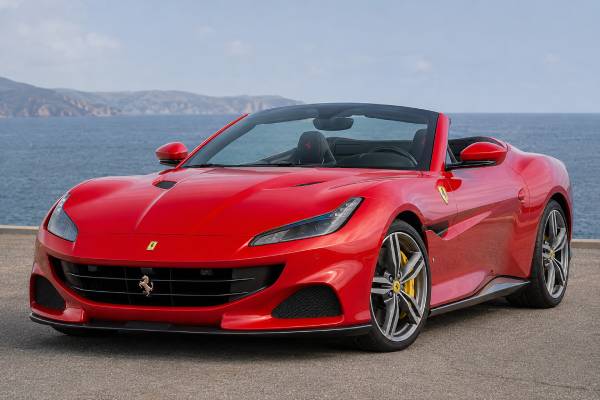

The Ferrari Portofino M is the final and most developed version of Ferrari’s front-mid-engine V8 retractable-hardtop GT convertible before the Roma Spider took over the open-top grand-touring role. Built for the 2021–2023 model years, it updated the original Portofino with more power, an 8-speed dual-clutch gearbox, sharper chassis software, a Race setting on the Manettino, and revised styling. Its F154-family 3.9-liter twin-turbo V8 produces 620 cv, commonly listed as 612 hp in U.S. ratings, while keeping the relaxed 2+2 layout, folding metal roof, usable luggage space, and everyday Ferrari character. Buyers still care because the Portofino M sits in a rare space: fast enough to feel like a modern Ferrari, comfortable enough for real trips, and likely to remain desirable as one of the last folding-hardtop V8 Ferrari GTs.
Table of Contents
- Why the Portofino M Matters
- F154 V8 Specs and Chassis Data
- Production Years, Options, and Identification
- Design, Engineering, and GT Details
- How the Portofino M Drives
- Maintenance, Reliability, and Ownership Risks
- Market Values and Buying Advice
Why the Portofino M Matters
The Portofino M matters because it turns Ferrari’s most usable modern convertible into a sharper, more complete GT without losing the everyday comfort that made the Portofino line different from Ferrari’s mid-engine sports cars. It is not the rarest modern Ferrari, but it is important because it marks the end of the California-to-Portofino folding-hardtop V8 grand-touring line.
The original Portofino arrived as the successor to the California T. That was an important job. The California family brought many first-time buyers into Ferrari ownership, but it also carried a softer reputation among purists. The Portofino improved the formula with a cleaner shape, more performance, a lighter-feeling chassis, and a stronger sense of occasion.
The Portofino M, introduced for the 2021 model year, moved the car another step closer to Ferrari’s sportier models. The “M” stands for “Modificata,” Ferrari’s word for a meaningfully modified version. In this case, the name was justified. The power increase from 600 cv to 620 cv was only part of the change. The Portofino M also gained an 8-speed F1 dual-clutch gearbox related in concept to Ferrari’s newer transmission family, a five-position Manettino with Race mode, updated Side Slip Control software, revised exhaust tuning, and small but noticeable changes to the front and rear design.
Its position in the Ferrari range was clear. It was the front-engine, open-roof, 2+2 Ferrari for drivers who wanted speed, sound, luxury, and usability in one car. The F8 Spider was more exotic and more focused. The 812 GTS had V12 theater and much higher running costs. The Roma coupe was sleeker and more design-led, but it did not initially offer open-air driving. The Portofino M sat between those worlds.
For collectors, it is too new and too available to be treated like a blue-chip limited-edition Ferrari. For buyers, that is part of the appeal. It can be bought, driven, serviced through the dealer network, and enjoyed without the storage-only mindset that surrounds some special-series cars. Its long-term collectability will likely depend on specification, mileage, condition, color, and documentation rather than pure production rarity.
The Portofino M also has a special place because of its roof. Ferrari later moved to a fabric-roof Roma Spider, so the Portofino M stands as one of the final modern Ferrari models with a retractable hardtop. That gives it a different character. Roof up, it feels more coupe-like than many soft-top convertibles. Roof down, it becomes a genuine open Ferrari with better weather security than a fabric-roof car.
Today, the model appeals to three groups. First are Ferrari buyers who want one car to do weekend trips, city use, and fast road driving. Second are enthusiasts who appreciate the F154 twin-turbo V8 and the more aggressive M update. Third are value-focused collectors watching the last folding-hardtop Ferrari GTs as the brand moves deeper into hybrid, soft-top, and electrified performance cars.
F154 V8 Specs and Chassis Data
The key technical story is simple: the Portofino M combines a 620 cv 3.9-liter twin-turbo V8 with rear-wheel drive, an 8-speed dual-clutch transaxle, magnetorheological damping, carbon-ceramic brakes, and a folding hardtop body. It is a modern Ferrari GT, but the hardware is serious enough to deliver genuine supercar acceleration.
| Category | Specification |
|---|---|
| Model code | F164 |
| Model years | 2021–2023 |
| Body style | 2-door 2+2 retractable-hardtop convertible |
| Layout | Front-mid-engine, rear-wheel drive |
| Engine family | F154-family twin-turbocharged V8 |
| Displacement | 3,855 cc |
| Bore x stroke | 86.5 mm x 82 mm |
| Compression ratio | 9.45:1 |
| Maximum output | 456 kW / 620 cv at 5,750–7,500 rpm |
| U.S. output rating | 612 hp |
| Maximum torque | 760 Nm / 561 lb-ft at 3,000–5,750 rpm |
| Maximum engine speed | 7,500 rpm |
| Transmission | 8-speed F1 dual-clutch gearbox |
The engine is a 90-degree V8 with twin turbochargers, direct injection, and a broad torque plateau. The F154 engine family is used across several modern Ferrari models, but each application has its own tuning, exhaust, packaging, calibration, and response. In the Portofino M, the engine is tuned for fast road use rather than track dominance. It has huge mid-range pull, quick throttle response for a turbo engine, and enough top-end energy to feel properly Ferrari-like.
The gearbox is one of the most important upgrades over the original Portofino. The older car used a 7-speed dual-clutch unit. The M’s 8-speed gearbox gives a shorter, more energetic lower-gear feel and a calmer cruising gear at higher speeds. It also shifts very quickly and helps the car feel newer from the driver’s seat.
| Item | Figure |
|---|---|
| Length | 4,594 mm |
| Width | 1,938 mm |
| Height | 1,318 mm |
| Wheelbase | 2,670 mm |
| Front track | 1,633 mm |
| Rear track | 1,635 mm |
| Dry weight with optional content | 1,545 kg |
| Kerb weight with optional content | 1,664 kg |
| Fuel tank | 80 liters |
| Boot capacity | 292 liters |
| Front tires | 245/35 ZR20 |
| Rear tires | 285/35 ZR20 |
| Front brakes | 390 mm x 34 mm carbon-ceramic discs |
| Rear brakes | 360 mm x 32 mm carbon-ceramic discs |
| 0–100 km/h | 3.45 seconds |
| 0–200 km/h | 9.8 seconds |
| Top speed | Over 320 km/h |
The chassis systems are a major part of the car’s character. The Portofino M uses electric power steering, E-Diff3 electronic differential control, F1-Trac traction management, SCM-E magnetorheological dampers, ABS with electronic brake-force distribution, and Ferrari Dynamic Enhancer software within Side Slip Control 6.0. In plain language, those systems help the car put power down cleanly, read driver inputs quickly, and feel secure even when the road is rough or traction is changing.
It is easy to focus only on the headline power, but the Portofino M’s numbers work because the whole package is integrated. The V8 has torque everywhere, the gearbox keeps it on boost, the differential manages rear traction, and the dampers stop the folding-hardtop body from feeling loose or heavy. It is not as light or raw as a mid-engine Ferrari, but it is far more capable than the “entry Ferrari” label suggests.
Production Years, Options, and Identification
The Portofino M was sold for the 2021, 2022, and 2023 model years, with no separate coupe, lightweight, or track-focused factory version. Differences between cars are mainly about model year, market equipment, color, interior trim, carbon-fiber options, driver-assistance features, and Ferrari personalization choices.
The easiest way to identify the M is by its revised exterior details and its mechanical specification. Compared with the earlier Portofino, the M has more aggressive front bumper surfacing, reshaped air intakes, a revised rear diffuser area, the 8-speed gearbox, the higher-output 620 cv engine tune, and the five-position Manettino with Race mode. The original Portofino does not have the same gearbox or drive-mode layout.
Production numbers have not been broken out by Ferrari in the same way as limited-series cars. That means buyers should avoid listings that imply artificial rarity without documentation. A special color, Atelier build, unusual interior, or low mileage can make one car more desirable than another, but the Portofino M itself was a regular-production Ferrari GT.
Factory and personalization choices
Most Portofino M desirability comes from specification. Ferrari buyers often ordered these cars with highly personalized interiors, contrast stitching, special leather, passenger displays, carbon trim, upgraded wheels, and premium audio. Some options make the car more usable, while others mainly improve presentation.
Common value-relevant equipment includes:
- Carbon-fiber driver zone with LED shift lights
- Carbon-fiber central bridge and exterior carbon details
- Forged wheels or special wheel finishes
- Magneride dual-mode suspension, where market equipment varied
- Front suspension lift, when fitted
- Daytona-style or full-electric seats
- Ventilated seats in warm markets
- Passenger display
- Apple CarPlay
- JBL premium audio
- Adaptive front lighting
- Surround-view or parking camera systems
- Advanced driver-assistance features, where specified
- Special paint, historical colors, or Tailor Made details
Not every option adds equal resale value. Carbon-fiber driver zone, attractive wheels, special paint, and desirable interior combinations tend to be easier to explain to the next buyer. Expensive but subtle trim choices may matter only if the whole specification is tasteful and well documented.
Documents that matter
Because the Portofino M is modern, authenticity is less about matching engine stampings and more about provenance. Buyers should ask for:
- Original window sticker or build sheet
- Ferrari dealer service history
- Warranty and maintenance-plan records
- Recall completion records
- Battery replacement or tender-use history
- Tire date codes and replacement invoices
- Paint-protection-film documentation, if fitted
- Accident, paintwork, or wheel-repair disclosures
- Books, tools, keys, charger, and factory accessories
Ferrari Approved cars from official dealers often bring confidence because they are inspected and can be sold with warranty coverage depending on age, market, and condition. A private-sale car can still be excellent, but the price should reflect any missing documentation or uncertainty.
Design, Engineering, and GT Details
The Portofino M is designed to hide serious performance inside a graceful GT shape, not to look like a track special. Its engineering is built around a difficult brief: open roof, folding metal top, front-mounted V8, rear transaxle feel, 2+2 seating, usable luggage room, and Ferrari-level response.
The exterior was developed by Ferrari’s in-house design team. It keeps the long hood, set-back cabin, short rear deck, and muscular rear haunches expected of a front-engine Ferrari. The M revisions make the car look sharper without turning it into a different model. The front bumper openings appear more assertive, the grille area looks more technical, and the rear diffuser treatment gives the car a lower, wider stance.
The folding hardtop is central to the car’s identity. A metal roof adds weight and complexity compared with a fabric top, but it gives the Portofino M a quieter, more secure feel with the roof closed. That matters for owners who actually travel in the car. It also changes the ownership experience in colder, wetter, or high-security urban environments. A Portofino M can feel like a coupe during a highway drive, then become an open Ferrari once the road and weather suit it.
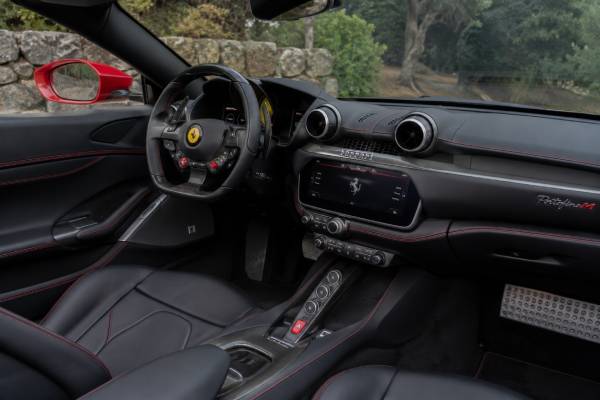
The cabin is more GT than stripped sports car. The driving position is low enough to feel special, but the car is easier to enter, see out of, and park than many mid-engine Ferraris. The rear seats are small and best used for children, bags, or short hops, but their presence matters. They make the car more flexible for weekend use. The boot is also genuinely useful for a Ferrari convertible, though roof position affects available space.
Engineering details serve the GT mission. The engine sits behind the front axle line, improving balance. The transmission layout and electronic differential help the rear of the car feel planted under power. The adaptive dampers make it possible to drive quickly on uneven roads without the stiff, brittle feel that can make some high-performance convertibles tiring.
Sound is more complex. Turbocharging naturally softens and filters some of the raw edge that older naturally aspirated Ferrari V8s delivered. The Portofino M answers with exhaust tuning, fast throttle response, and a more purposeful tone than many luxury GT rivals. It is not as wild as a 458 Italia or as dramatic as an 812 GTS, but it has enough Ferrari voice to feel special when the roof is down and the revs climb.
The Portofino M’s most distinctive feature is the way it blends roles. It can be a comfortable open cruiser, a fast mountain-road car, a long-distance GT, or a city Ferrari with relatively friendly manners. That spread of ability is the point. A buyer who wants maximum track focus should look elsewhere. A buyer who wants one modern Ferrari to use often will understand the Portofino M quickly.
How the Portofino M Drives
The Portofino M drives with much more urgency than its relaxed shape suggests. It is quick in a straight line, easy to place on the road, and more playful than the original Portofino, especially because the M adds Race mode and sharper gearbox behavior.
The engine dominates the first impression. There is very little waiting for power in normal driving. The twin-turbo V8 pulls hard from low rpm, surges through the mid-range, and keeps pulling near the top of the rev band. In automatic mode, the gearbox makes the car feel calm and expensive. In manual mode, using the paddles, it becomes much more alert. The shifts are fast, clean, and satisfying, especially under throttle.
Acceleration is strong enough that the Portofino M rarely feels like a compromise. The official 0–100 km/h time of 3.45 seconds puts it in serious performance territory. More important in daily use is the 0–200 km/h time of 9.8 seconds, because it shows how hard the car keeps pulling after the first launch. On the road, that translates into effortless overtaking and a sense that the engine always has another layer waiting.
The steering is fast and light by traditional sports-car standards. Drivers used to older hydraulic Ferrari steering may find it less talkative, but it is accurate and makes the car easy to guide on tight roads. The front end responds quickly, while the rear remains stable unless the driver deliberately asks for more rotation.
The ride is one of the car’s strengths. With the dampers in their softer setting, the Portofino M can cover poor pavement better than many expect from a 620 cv Ferrari on 20-inch wheels. It still has low-profile tires and a stiff structure, so it is not a luxury sedan, but it is comfortable enough for real distance. That is one reason owners put actual miles on these cars.
Braking performance is strong, but buyers should understand carbon-ceramic behavior. The brakes can feel slightly different when cold compared with conventional steel systems, and replacement cost is high if discs are damaged or worn beyond limits. A proper inspection should measure disc condition and check for chips, cracks, uneven wear, and pad life.
The Manettino changes the mood. Wet mode calms the car for poor conditions. Comfort and Sport suit most normal road use. Race mode allows a more energetic chassis attitude while keeping safety systems active enough for road driving. It does not turn the Portofino M into a Challenge car, but it gives the driver a sharper throttle, quicker responses, and a more exciting rear-drive feel.
The main driving limitation is weight. At more than 1,600 kg in running order, the Portofino M cannot feel as light-footed as a smaller mid-engine Ferrari. On a tight road, you sense the mass, the folding-roof structure, and the GT mission. The benefit is confidence, comfort, and stability. The car feels substantial rather than nervous.
In city use, visibility is decent for an exotic, the gearbox is smooth, and the engine is flexible. The nose still needs care over ramps and steep driveways, especially on cars without a front lift. The rear seats and roof mechanism also create blind spots with the roof up. Parking cameras and sensors are not cosmetic options on this car; they make ownership easier.
Maintenance, Reliability, and Ownership Risks
The Portofino M is a modern Ferrari, so reliability depends less on folklore and more on maintenance history, battery care, software status, recall completion, tire age, brake condition, and how the car has been stored. A well-kept example can be very usable, but neglected cars become expensive quickly.
Ferrari’s 7-Year Genuine Maintenance program is a major ownership advantage on cars still within the covered period. It generally supports scheduled routine maintenance during the first seven years, with service timing commonly treated as annual or mileage-based depending on use and market rules. Buyers should still verify the exact coverage for the specific VIN, country, ownership status, and dealer network.
Known ownership attention points
The Portofino M does not have a reputation as a fragile car when maintained correctly, but several areas deserve careful inspection:
- Battery condition: Modern Ferraris are sensitive to low voltage. Cars that sit without a tender may develop warning lights, module faults, or weak-start issues.
- Dual-clutch gearbox behavior: Shifts should be smooth at low speed and crisp under load. Any harsh engagement, slipping feel, warning message, or fluid leak needs specialist diagnosis.
- Carbon-ceramic brakes: Inspect discs and pads carefully. Replacement can be very expensive, and visual condition matters.
- Tires: Check brand, specification, tread, and date codes. Old tires can make the car feel nervous and reduce braking performance.
- Suspension and lift system: Listen for knocks, check damper leaks, and test the front lift if fitted.
- Cooling system: Look for coolant residue, damaged radiators, blocked intake areas, and evidence of overheating.
- Turbocharger oil and coolant lines: Inspect for seepage and heat-related deterioration.
- Roof mechanism: Operate the roof fully several times. It should move smoothly, latch properly, and seal well.
- Electronics and infotainment: Test screens, cameras, sensors, Apple CarPlay, passenger display, seat controls, and warning lights.
- Exhaust valves and mounts: Rattles, buzzing, or warning behavior can point to wear or actuator issues.
Recalls are especially important. A broad U.S. brake-fluid-reservoir-cap recall affected certain Ferrari models, including 2021–2022 Portofino M cars. The risk involved brake fluid loss and reduced braking capability, with the remedy involving a revised cap and software-related warning updates. Some 2023 Portofino M vehicles were also listed in a very small U.S. driveshaft-screw recall. The correct approach is simple: check the VIN with Ferrari and NHTSA or the relevant authority in the car’s market, then confirm completion in writing.
Service records and inspection priorities
A pre-purchase inspection should be done by an official Ferrari dealer or a specialist who works on late-model Ferraris regularly. A general luxury-car inspection is not enough. The technician should scan all modules, check for stored faults, inspect underbody panels, measure brake wear, test the roof, look for accident repair, and confirm software and recall status.
Ask for invoices, not just stamps. A clean service book is helpful, but invoices show what was actually done. They also reveal patterns: repeated battery replacements, recurring warning lights, tire damage, alignment issues, or roof adjustments.
Paint and bodywork matter. Many Portofino M cars have paint protection film. That is not a problem, but poor film installation can hide paint defects, edges, or old stone chips. Look closely around bumper edges, the hood, mirror caps, rocker panels, and rear haunches. Convertible cars also deserve extra attention around seals, roof drains, and trim alignment.
Ownership costs are not limited to scheduled servicing. Tires, brakes, batteries, insurance, annual registration, detailing, paint protection, and warranty extension can all be meaningful expenses. The smartest buyer budgets for the car as an exotic even though it is one of the more usable modern Ferraris.
Market Values and Buying Advice
The Portofino M market is still mileage-, condition-, and specification-driven rather than collector-rarity-driven. In current U.S. listings and auction results, strong cars often sit in the mid-$200,000 to low-$300,000 range, with low-mile 2023 examples and dealer-certified cars usually asking more.
Market data in 2026 shows the Portofino M trading well above earlier Portofino values. That makes sense. The M has the stronger engine tune, newer gearbox, Race mode, later production dates, and fewer years of aging. It also benefits from being the last version of the folding-hardtop Ferrari GT formula.
A realistic buyer should think in tiers:
| Factor | Why it matters |
|---|---|
| Model year | Later 2023 cars often bring stronger money, especially with low miles and warranty options. |
| Mileage | Very low mileage helps resale, but cars that have sat unused need careful battery, tire, and seal checks. |
| Specification | Carbon driver zone, desirable wheels, lift, cameras, and tasteful colors improve buyer appeal. |
| Color combination | Classic Ferrari colors sell easily, but elegant or rare GT colors can be highly desirable when well matched. |
| Service history | Official Ferrari records and recall completion reduce risk and support value. |
| Condition | Brake condition, tire age, paintwork, roof operation, and interior wear can move the price significantly. |
| Warranty status | Ferrari Approved coverage or eligible extended warranty can justify paying more. |
Cars to seek
The best Portofino M to buy is not always the cheapest or the lowest-mile car. Look for a car with a coherent specification, full Ferrari service history, fresh tires, clean paint, completed recalls, no warning lights, and evidence of correct storage. A car used lightly but regularly can be better than a delivery-mile example that has sat for years.
Strong examples often have:
- Attractive exterior and interior color pairing
- Carbon driver zone with LEDs
- Useful parking and camera options
- Front lift, especially in steep-driveway areas
- Clean dealer service records
- Remaining maintenance-plan benefit
- No accident history
- Matching tire set with recent date codes
- Clean roof operation and dry seals
- Complete accessories and documentation
Cars to avoid
Avoid cars with vague service history, repeated electrical complaints, cheap replacement tires, unverified paintwork, missing keys or books, unresolved recalls, or signs of hard launch abuse. Be cautious with unusually low advertised prices. They often reflect stories: title issues, accident history, export/import complications, missing documentation, deferred maintenance, or undesirable specification.
A tuned Portofino M should be approached carefully. The F154 V8 can produce more power, and aftermarket exhausts or ECU tunes are common in some markets. For a driver who wants modifications, that may be appealing. For resale, warranty eligibility, emissions compliance, and long-term Ferrari value, an original car is usually safer.
Long-term collectability is promising but not guaranteed. The Portofino M has several things in its favor: final folding-hardtop Ferrari GT status, a strong V8, limited production window, real-world usability, and Ferrari branding. Against it are regular-production volume, turbocharged character, and the fact that many buyers still chase mid-engine and V12 models first.
The best buying strategy is to pay for quality. A slightly more expensive car with the right records, options, tires, brakes, and warranty status will usually be cheaper to own than a discounted car that needs sorting. The Portofino M rewards buyers who treat it as a Ferrari first and a used convertible second.
References
- Ferrari Portofino M – Ferrari.com 2020
- Ferrari Portofino M Technical Specifications 2021
- Part 573 Safety Recall Report 22V-536 2022 (Recall Database)
- Warranties And Official Ferrari Maintenance 2026
- Ferrari Portofino M Market 2026
Disclaimer
This article is for informational purposes only and is not a substitute for professional diagnosis, inspection, maintenance, or repair. Specifications, torque values, service intervals, recall status, software updates, and repair procedures can vary by VIN, market, equipment, and production date. Always verify details against official Ferrari service documentation and have any vehicle inspected by a qualified Ferrari dealer or specialist before purchase.
If you found this guide useful, please consider sharing it on Facebook, X/Twitter, or your favorite car community to support our work.