
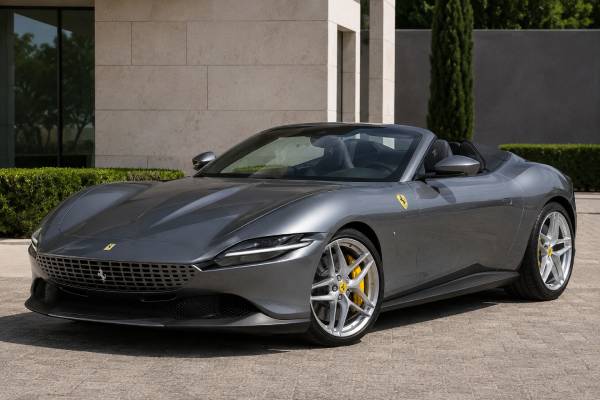
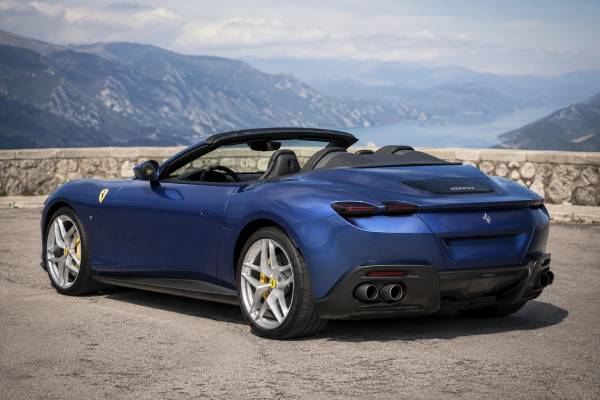
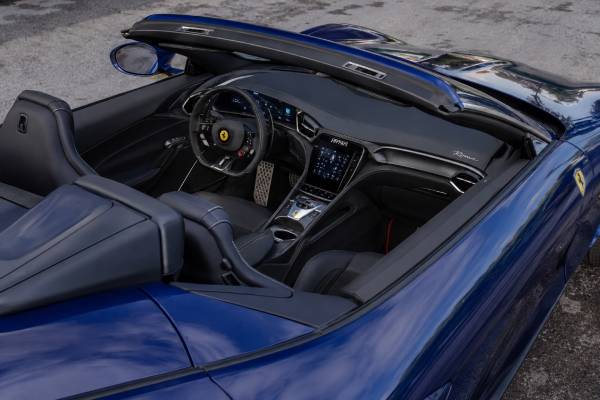
The Ferrari Roma Spider is the open-top version of Ferrari’s front-mid-engine Roma grand tourer, introduced in 2023 as a 2+ spider with a fabric roof and the F154BH twin-turbo V8. It keeps the Roma coupe’s clean “La Nuova Dolce Vita” design language but adds a compact soft top, a patented rear-seat wind deflector, and a stronger emphasis on relaxed high-speed touring. Its 3.9-liter V8 produces 620 cv, commonly quoted as 612 hp, and drives the rear wheels through Ferrari’s eight-speed dual-clutch transmission. For buyers and enthusiasts, the Roma Spider matters because it blends modern Ferrari performance with a more understated GT character than mid-engine models such as the F8 or 296. It is also significant because it brought a fabric roof back to Ferrari’s front-engine spider tradition, linking a very modern car to the elegance of classic open Ferraris.
Table of Contents
- Why the Roma Spider Matters
- F154BH V8 Specs and Chassis Data
- Production, Options, and Identification Details
- Soft-Top Design and Ferrari Engineering
- Road Character, Speed, and Usability
- Maintenance, Reliability, and Ownership Risks
- Market Values and Buyer Checklist
Why the Roma Spider Matters
The Ferrari Roma Spider matters because it turns the Roma coupe’s clean front-engine GT formula into a more emotional open car without making it feel like a track special. It is not the loudest, rarest, or most extreme Ferrari of its era, but that is exactly why many buyers pay attention to it.
Ferrari placed the Roma Spider in the softer side of its modern range: a fast, luxurious, front-mid-engine V8 grand tourer with rear-wheel drive, 2+ seating, and a design that avoids the more aggressive visual language of Ferrari’s mid-engine supercars. It follows the broad path set by the California, California T, Portofino, and Portofino M, but it feels more elegant and more serious than those cars. The Roma Spider is less about resort-town glamour and more about a refined, minimalist Ferrari shape with real pace underneath.
The car was unveiled in 2023 and uses the F169 platform family associated with the Roma. Its closest mechanical relation is the Roma coupe, but the Spider has its own rear body structure, roof system, rear-seat wind deflector, and body reinforcement. Ferrari did not simply cut the roof off the coupe. The soft-top packaging required changes around the rear deck, rear screen area, tonneau cover, roof compartment, sills, and windscreen surround.
One of the car’s historical talking points is the return of a fabric roof to a front-engine Ferrari spider after a long gap. Ferrari had used retractable hardtops on recent front-engine convertibles, but the Roma Spider returned to a traditional soft top in a modern, tightly packaged form. That choice is more than nostalgia. It helps the car keep a graceful roofline, reduces visual bulk, and gives the Spider a more classic grand-touring feel.
For enthusiasts, the Roma Spider is important because it represents one of Ferrari’s final pure internal-combustion V8 GT experiences before the brand’s range moved deeper into hybrid and next-generation electronic systems. It uses no hybrid motor and no all-wheel-drive system. The appeal is simple: a twin-turbo flat-plane-crank Ferrari V8, rear-wheel drive, sharp electronics, and the option to hear more of the engine with the roof down.
For buyers and collectors, its long-term importance will depend on several factors:
- Whether future Ferrari GTs become more electrified, heavier, or more complex
- How the Roma Spider is viewed beside the later Amalfi and Amalfi Spider
- Whether low-mile, well-specified cars remain desirable as modern analog-feeling Ferraris
- How well early electronic interfaces, roof systems, and trim materials age
- Whether Ferrari’s Tailor Made and special-order cars become more collectible than regular configurations
The Roma Spider is not a numbered limited edition, so rarity alone is not the story. Its value case is more about specification, elegance, condition, maintenance history, and the fact that it offers a distinctive open Ferrari GT experience without the visual drama or harsher focus of the mid-engine cars.
F154BH V8 Specs and Chassis Data
The Roma Spider’s core specification is simple but serious: a 3,855 cc twin-turbo V8, an eight-speed dual-clutch gearbox, rear-wheel drive, and an aluminum structure. Its official performance figures place it firmly in supercar territory, even though its design and cabin atmosphere lean toward grand touring.
| Item | Specification |
|---|---|
| Engine code | F154BH |
| Engine layout | 90-degree V8, front-mid-mounted |
| Induction | Twin turbochargers |
| Displacement | 3,855 cc |
| Bore x stroke | 86.5 mm x 82 mm |
| Maximum power | 456 kW / 620 cv / 612 hp |
| Maximum torque | 760 Nm / 561 lb-ft |
| Maximum engine speed | 7,500 rpm |
| Compression ratio | 9.45:1 |
| Transmission | Eight-speed F1 dual-clutch automatic |
| Drive layout | Rear-wheel drive |
The F154 engine family is one of Ferrari’s most important modern V8 lines. In the Roma Spider, the engine uses a flat-plane crankshaft, compact turbochargers, direct injection, equal-length exhaust work, and Ferrari’s Variable Boost Management. Variable Boost Management changes torque delivery by gear, so the car can feel progressive and controllable in lower gears while still delivering its full torque in the higher gears.
The eight-speed dual-clutch gearbox is closely linked to Ferrari’s newer transmission strategy. Compared with older seven-speed dual-clutch Ferraris, it is designed for quicker shifts, better efficiency, and smoother low-speed behavior. In normal driving it can behave like a refined automatic, but in sportier modes it gives the quick, clean shift feel expected from a modern Ferrari.
| Item | Specification |
|---|---|
| Length | 4,656 mm |
| Width | 1,974 mm |
| Height | 1,306 mm |
| Wheelbase | 2,670 mm |
| Dry weight | 1,556 kg with optional lightweight content |
| Weight distribution | 48% front / 52% rear |
| Fuel tank | 80 liters |
| Boot capacity | 255 liters with roof up |
| Front tires | 245/35 ZR20 |
| Rear tires | 285/35 ZR20 |
| Front brakes | 390 x 34 mm carbon-ceramic discs |
| Rear brakes | 360 x 32 mm carbon-ceramic discs |
The official performance figures are strong for an open GT. Ferrari quotes a top speed above 320 km/h, 0–100 km/h in 3.4 seconds, and 0–200 km/h in 9.7 seconds. Those figures are not just marketing numbers. They show how much performance is available from the engine and transmission even though the car is tuned for road use, comfort, and elegance rather than maximum circuit focus.
The electronic chassis systems are central to the Roma Spider’s character. The car uses systems such as E-Diff3, F1-Trac, SSC 6.0, Ferrari Dynamic Enhancer, magnetorheological damping, electronic stability control, and electric power steering. The goal is not to make the car drive itself. It is to make a 612 hp rear-drive convertible feel approachable and predictable across a wide range of roads.
Production, Options, and Identification Details
The Roma Spider is a regular-production Ferrari rather than a numbered limited edition, so the best cars are identified by condition, specification, documentation, and factory originality. Buyers should focus less on production rarity and more on whether the car’s build, service record, and options match its asking price.
Ferrari introduced the Roma Spider for the 2023 model era, with customer cars appearing in different markets from 2024 onward. It sits beside the Roma coupe in the model story, though the wider Roma line has since moved into a transition period with newer successor models arriving. That makes the Roma Spider especially interesting as a late pure-V8 Ferrari GT with the original Roma design language.
The model is usually identified as a Ferrari Roma Spider, with F169 used as the platform or type reference. The engine is the F154BH version of Ferrari’s twin-turbo V8 family. VIN decoding, market equipment, emissions equipment, and option content vary by country, so buyers should verify the exact build through Ferrari dealer records rather than relying only on advertisement text.
Body style and roof identity
The Spider is visually close to the coupe from the front and side, but the roof and rear deck are the main identifiers. It uses a five-layer fabric soft top, a redesigned rear-screen arrangement, a tonneau cover, and a body-color band around the roof base. When the roof is down, the rear deck and headrest area give the car a different character from the fastback coupe.
Important identification points include:
- Fabric soft top rather than retractable hardtop
- Body-color rear band separating roof and active rear spoiler area
- Rear-seat integrated wind deflector
- 2+ cabin layout with small rear seats
- Eight-speed DCT and manettino with Race mode
- Roma-style digital cockpit and center display layout
The Roma Spider was available through Ferrari’s normal personalization channels, so two cars can feel very different. A conservative exterior color with a dark roof and classic interior will appeal to traditional GT buyers. A bold Tailor Made car with unusual fabrics, contrast stitching, special leather, or carbon trim may appeal to a different collector base.
Factory and personalization options
Options matter greatly on modern Ferraris because they affect both desirability and resale. Many cars carry large option totals, and the market often rewards tasteful, coherent specifications more than the most expensive build.
Commonly desirable equipment includes:
- Scuderia Ferrari side shields
- Forged or upgraded wheel designs
- Carbon-fiber exterior trim
- Carbon-fiber interior trim
- Daytona-style or highly optioned seats
- Ventilated or heated seats where available
- Neck warmer for colder open-top driving
- Passenger display
- Upgraded audio
- Advanced driver assistance features
- Suspension lifter, where fitted
- Apple CarPlay and Android Auto capability
- Tailor Made paint, leather, stitching, or roof fabric choices
The soft-top color is especially important because it changes the whole look of the car. A dark roof can make the car look formal and discreet. A contrast roof can emphasize the Spider identity. A special fabric roof may be a selling point, but only if it suits the body color and interior.
For authenticity, buyers should request the original window sticker or build sheet, dealer option printout, service invoices, warranty record, recall status, and any Ferrari Approved inspection documents. On a modern Ferrari, “originality” is not about matching carburetors or hand-stamped body panels. It is about whether the car still matches its factory configuration and has not been poorly modified, wrapped, tuned, damaged, or repaired outside the correct network.
Soft-Top Design and Ferrari Engineering
The Roma Spider’s special feature is not only that it has a soft top, but that Ferrari made the roof work without spoiling the Roma’s clean shape. The engineering goal was to keep the coupe’s elegance, retain strong GT usability, and avoid the bulky look that can affect folding-roof convertibles.
The fabric roof opens or closes in about 13.5 seconds and can operate at speeds up to 60 km/h. That is useful in real life because the driver does not need to stop completely when the weather changes or when entering slow traffic. When folded, the roof uses a compact Z-shaped motion and sits low enough to help preserve luggage space.
The five-layer roof is designed to reduce wind and road noise. This matters because the Roma Spider is not meant to be a raw weekend toy only. It is a grand tourer that should cover long distances, work with the roof up in bad weather, and feel quiet enough for conversation and music.
The patented wind deflector is one of the car’s cleverest details. Instead of using a loose removable mesh screen, Ferrari integrated the deflector into the rear-seat backrest. It deploys from the rear bench area and reduces cabin turbulence when the roof is down. This improves top-down comfort without taking up storage space, although it also confirms that the rear seats are best treated as occasional seats or luggage space.
The exterior design comes from the Ferrari Styling Centre under Flavio Manzoni. The car follows the Roma coupe’s minimalist approach: long hood, compact cabin, smooth flanks, narrow lights, and a front treatment that avoids a traditional open grille look. The result is a Ferrari that looks less like a winged track weapon and more like a modern interpretation of a 1950s or 1960s GT.
The active rear spoiler is another important engineering feature. It is integrated into the rear bodywork and deploys according to speed and driving conditions. On the Spider it is calibrated around the roofless body shape, helping maintain aerodynamic balance while keeping the exterior clean when not in use.
The cabin is built around Ferrari’s dual-cockpit idea. The driver and passenger sit in separate visual zones, with a digital instrument cluster, a vertical central screen, and Ferrari’s modern steering-wheel controls. Some drivers like the clean digital layout; others prefer older Ferrari cabins with more physical buttons. Anyone buying the car should spend time using the controls before purchase, because the interface is part of the ownership experience.
The most distinctive engineering choices are:
- Front-mid-engine layout for better weight distribution
- Rear-wheel drive rather than all-wheel drive
- Compact fabric roof instead of a retractable hardtop
- Integrated wind deflector instead of a removable screen
- Active rear spoiler hidden in the clean tail
- Eight-speed DCT for both comfort and fast shifts
- Advanced chassis electronics tuned for road confidence
The Roma Spider is not engineered to feel old-fashioned. It is a modern, software-supported Ferrari. But it uses that technology to support a traditional GT idea: a long-nose, open-roof, rear-drive Ferrari with a powerful V8 and enough comfort for real journeys.
Road Character, Speed, and Usability
The Roma Spider feels fast, polished, and more relaxed than Ferrari’s mid-engine cars, but it is still a serious performance machine. The key to understanding it is that it delivers supercar speed through a grand-touring filter.
The engine is flexible at low and medium speeds, partly because the turbocharged V8 produces strong torque early in the rev range. It does not need to be driven hard to feel quick. Around town, the gearbox can shift smoothly and the engine can stay quiet enough for normal use. On an open road, the car changes personality quickly. The throttle sharpens, the transmission becomes more alert, and the V8 pulls hard toward its 7,500 rpm limit.
The sound is an important part of the Spider’s appeal. Turbocharging reduces some of the raw edge found in older naturally aspirated Ferraris, but the flat-plane V8 still has a crisp, mechanical character. With the roof down, intake, exhaust, and turbo sounds are easier to hear. It is not as wild as a 458 Italia or as futuristic as a 296 hybrid, but it has a mature, expensive, unmistakably Ferrari tone.
The steering is quick, as modern Ferraris tend to be. Drivers coming from older GT cars may need time to adjust to the fast rack and light response. The car does not need big steering inputs. It rewards smooth hands, careful throttle use, and trust in the front axle.
Ride quality is one of the reasons to choose the Roma Spider over more aggressive Ferrari models. With the dampers in their more compliant setting, it can handle imperfect roads without feeling fragile or punishing. It is still wide, low, and expensive to repair, so it is not carefree in the way a normal luxury convertible might be. But by Ferrari standards, it is usable.
On a mountain road, the car feels balanced rather than nervous. The rear-drive layout and 48/52 weight distribution help it rotate naturally, while the electronic systems give the driver a safety net. Race mode does not turn the Roma Spider into a track car. It gives more freedom and sharper responses while keeping the car manageable.
On track, the Roma Spider is capable but not the natural first choice in the Ferrari range. It is heavier than the coupe, has a roof mechanism, and is tuned for mixed use. Repeated hard laps will put more demand on tires, brakes, and cooling than normal road driving. A buyer who wants frequent track use should look more closely at a 296, F8, or track-focused Ferrari. A Roma Spider can enjoy a track day, but its best environment is a fast road, a coastal route, or a long weekend trip.
Daily usability is better than the performance figures suggest. The 80-liter fuel tank gives it useful touring range. The boot is decent for a Ferrari spider when the roof is up. The rear seats are small, but they add luggage space and occasional flexibility. Visibility is acceptable for a low GT, though the driver must always remember the car’s width, low nose, and expensive wheels.
The main usability compromises are:
- Low front clearance, especially near ramps and steep driveways
- Wide body in narrow city streets or old parking garages
- Small rear seats
- Expensive tire and brake wear
- Digital controls that may not suit every driver
- Roof, trim, and painted surfaces that need careful handling
The best way to drive the Roma Spider is not to chase lap times. It is to use its torque, enjoy the clean shift speed, let the chassis breathe, and treat it as a very fast open GT rather than a race car with leather.
Maintenance, Reliability, and Ownership Risks
The Roma Spider is too new to judge like an older collector car, so ownership risk is mostly about proper servicing, electronic systems, roof condition, battery health, tires, brakes, and accident history. The F154 V8 family has a strong reputation, but a modern Ferrari still needs specialist care.
Ferrari’s seven-year Genuine Maintenance program is a major ownership advantage. It covers scheduled maintenance for the first seven years of the car’s life and is tied to regular service intervals of 20,000 km or once per year, depending on market and usage. That does not mean ownership is cheap. It means routine scheduled service is more predictable while the car is within the program.
The most important rule is simple: do not buy a Roma Spider without a complete Ferrari dealer or recognized specialist history. Missed annual services, long storage without proper battery care, cheap tires, paintwork with no explanation, or incomplete warranty records should all reduce confidence.
Mechanical and electronic areas to inspect
The engine and gearbox are advanced, expensive assemblies. They should start cleanly, idle smoothly, shift without hesitation, and show no warning lights. Any drivetrain warning, misfire, boost issue, oil leak, or transmission fault should be investigated before purchase, not after negotiation.
Key inspection areas include:
- Engine oil leaks or coolant leaks
- Turbocharger behavior and boost consistency
- DCT shift quality in low-speed traffic and hard acceleration
- Service records showing correct annual maintenance
- Software updates and dealer campaign completion
- Battery condition and use of the correct maintainer
- Exhaust valve operation
- Radiator and cooling duct debris
- Underbody damage from ramps or road strikes
Modern Ferraris can become troublesome when the battery is weak. A low or unstable battery can trigger warning messages, module errors, roof issues, or infotainment problems. A car stored for weeks without a maintainer deserves extra electronic checks.
Roof, body, brakes, and tires
The soft top is a major inspection item because it is central to the Spider’s value. It should open and close smoothly, latch correctly, sit evenly, and show no warning messages. The fabric should be clean, tight, and free from rub marks, staining, cuts, or poor repairs. Check the rear glass, seals, tonneau area, drains, and wind deflector operation.
Carbon-ceramic brakes usually last a long time in road use, but damage can be costly. Inspect the discs for chips, cracks, abnormal wear, and impact marks. Pads, calipers, and brake fluid history also matter. A car used for repeated track days needs closer inspection than a low-mile touring car.
Tires should be the correct size, brand specification, load rating, and age. Low mileage does not mean good tires. A five-year-old tire on a 612 hp Ferrari is a liability even if the tread looks deep. Uneven wear can indicate alignment issues, aggressive driving, or suspension damage.
Body and chassis inspection should focus on the nose, side skirts, undertrays, wheels, suspension mounting areas, and paint thickness. Many modern Ferraris have paint protection film, which is useful, but poor film installation can hide stone chips, edges, or prior repairs. A pre-purchase inspection should include paint-depth readings and underbody photographs.
Known ownership risk areas include:
- Roof fabric damage or misalignment
- Weak battery and electronic warning messages
- Wheel damage from curbs or potholes
- Carbon-ceramic brake damage
- Aged or incorrect tires
- Sticky or worn interior touch surfaces over time
- Front bumper and undertray scrapes
- Incomplete recall or service campaign history
- Poor-quality paint protection film or cosmetic repair work
- Cars tuned or modified outside Ferrari’s normal support path
The Roma Spider is not a restoration-type car yet. Its biggest risks are modern exotic risks: complex electronics, expensive trim, expensive carbon-ceramic brakes, costly body repairs, and poor ownership habits. A carefully kept car with dealer history should be far less risky than a cheaper car with gaps, stories, or cosmetic shortcuts.
Market Values and Buyer Checklist
The Roma Spider’s market position is strongest when the car has low mileage, a tasteful specification, full Ferrari history, and remaining factory-backed coverage. It is not scarce enough for every example to become collectible, so buyers should be selective.
In the U.S. market, the Roma Spider started around the high-$270,000 range before options, while many real cars were ordered with substantial extra equipment. On the used market, advertised prices commonly vary from the high $200,000s to the mid $300,000s depending on mileage, model year, options, color, condition, and dealer certification. Very highly optioned, delivery-mile, Tailor Made, or unusual-color cars can sit above ordinary examples. Higher-mile or less desirable specifications can fall faster.
The car is still modern enough that depreciation matters more than classic collectability. That may change over time, especially if buyers later decide that the Roma Spider represents a clean, elegant, non-hybrid Ferrari V8 moment. But no buyer should assume automatic appreciation. Buy the right car because you want to own and drive it, not because every example is guaranteed to become a blue-chip collector asset.
| Value factor | Why it matters |
|---|---|
| Mileage | Very low mileage helps resale, but long storage without care can create problems. |
| Specification | Color, roof fabric, wheels, carbon trim, seats, shields, and ADAS can change desirability. |
| Service history | Annual Ferrari maintenance and campaign records are essential. |
| Warranty status | Remaining factory, extended, or Ferrari Approved coverage reduces risk. |
| Paint and accident history | High-quality original paint usually beats unexplained repair work. |
| Roof condition | The soft top is a major identity feature and an expensive system to neglect. |
| Interior condition | Leather, screens, touch controls, switches, and trim must match the mileage claim. |
| Certification | Ferrari Approved cars often bring more confidence, especially for first-time buyers. |
Cars to seek
The best Roma Spiders are usually clean, original, well-documented cars with coherent specifications. A traditional color combination may be easier to resell than a very personal build, but a truly tasteful Tailor Made car can be special.
Strong candidates usually have:
- Full Ferrari dealer service history
- Remaining seven-year maintenance coverage
- Clear warranty and recall records
- Original paint or fully documented minor cosmetic work
- No tuning or unsupported modifications
- Fresh, correct tires
- Clean roof operation
- No warning lights or stored fault patterns
- Complete books, keys, charger, tools, and option documents
- A specification that fits the car’s elegant GT character
Cars to avoid
Avoid any car where the story is more complicated than the savings justify. A discounted Ferrari can become expensive quickly if the roof, electronics, brakes, or body repairs are wrong.
Be cautious with:
- Missing service invoices
- Repeated battery or electrical faults
- Non-Ferrari tuning
- Unexplained paintwork
- Track-heavy use without matching maintenance
- Old tires on a low-mile car
- Roof stains, slow operation, or seal issues
- Imported cars with unclear market equipment
- Cars advertised with options they do not actually have
- Sellers unwilling to allow a Ferrari specialist inspection
A proper pre-purchase inspection should include a diagnostic scan, service history review, paint-depth readings, underbody inspection, tire age check, brake inspection, roof-cycle test, road test from cold, and verification of recalls or service campaigns. The inspection should be done by a Ferrari dealer or an independent specialist with current diagnostic access.
For long-term collectability, the Roma Spider’s strongest case is emotional rather than numerical. It is a beautiful open Ferrari GT with a pure V8 powertrain, strong performance, and a more timeless shape than many modern supercars. The cars most likely to age well will be original, carefully kept, tastefully specified, and properly documented. A neglected example may still look glamorous in photos, but the real value is in the records, the condition, and the way every system works when inspected closely.
References
- Ferrari Roma Spider | Ferrari.com 2026 (Manufacturer Page)
- FERRARI ROMA SPIDER: LA NUOVA DOLCE VITA 2023 (Manufacturer Press Kit)
- Vehicle Detail Search – 2024 Ferrari Roma | NHTSA 2026 (Recall Database)
- Part 573 Safety Recall Report 24V-810 2024 (Recall Database)
- Ferrari Amalfi 2025 (Manufacturer News)
Disclaimer
This article is for informational purposes only and is not a substitute for professional diagnosis, inspection, repair, valuation, or legal advice. Ferrari specifications, torque values, service intervals, software procedures, recall applicability, and maintenance requirements can vary by VIN, market, model year, equipment, and later factory updates. Always verify details against the official service documentation for the specific car and consult a qualified Ferrari dealer or specialist before purchase, repair, or modification.
Please share this article on Facebook, X/Twitter, or your preferred car community if it helped with your research.