

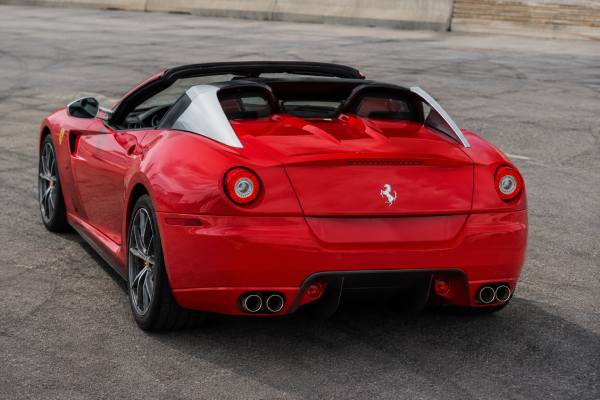

The Ferrari SA Aperta is the open-roof, limited-production version of the 599 line, powered by the F140 CE 6.0-liter naturally aspirated V12 and built around the end of the 599 era from 2010 to 2012. It uses the 599 GTO’s 670 CV engine tune, equivalent to about 661 hp, but wraps that performance in a dramatic two-seat roadster body created to honor Sergio and Andrea Pininfarina. The result is not a normal convertible 599 GTB. It is a rare front-engine V12 Ferrari with open-air character, GTO-derived performance hardware, and a collector identity tied closely to Pininfarina’s 80th anniversary.
The SA Aperta matters because it sits at a special point in Ferrari history. It arrived when the 599 was already mature, after Ferrari had proved the platform’s performance with the 599 GTO and 599XX. It also came before the F12berlinetta moved Ferrari’s V12 GT line into a sharper, more modern generation. Buyers and collectors still search for the SA Aperta because it combines old-school Ferrari ingredients—front-mounted naturally aspirated V12, rear-wheel drive, low production, Pininfarina design, and a roof-off soundtrack—with the complex ownership demands of a modern exotic.
Quick Take
The Ferrari SA Aperta’s strongest appeal is its mix of open-air V12 drama, 599 GTO-derived power, and extreme rarity, but its value depends heavily on originality, documentation, condition, and correct factory specification. It is more of a collectible open grand tourer than a casual convertible, with serious maintenance expectations around the F1 gearbox, carbon-ceramic brakes, roof hardware, suspension systems, electronics, tires, and low-mileage storage history. The best cars are complete, Classiche-certified or well documented, carefully serviced, and still wearing their original colors, interior trim, books, tools, roof equipment, and factory details.
Table of Contents
- History and Significance
- Engine, Chassis and Specifications
- Production, Variants and Options
- Design, Engineering and Features
- Driving Experience and Performance
- Reliability, Maintenance and Restoration
- Market Value and Buying Guide
History and Significance
The SA Aperta is significant because it turned the 599 platform into a rare open-top celebration of Pininfarina rather than a regular series-production Spider. Its name honors Sergio and Andrea Pininfarina, and its limited-production status gave it a different role from the 599 GTB Fiorano and 599 GTO.
Ferrari introduced the SA Aperta in 2010, during the final phase of the 599 family. The standard 599 GTB Fiorano had already established Ferrari’s new-generation front-engine V12 grand tourer formula after the 575M Maranello. The 599 GTO had pushed that platform toward track-influenced performance. The SA Aperta borrowed much of the GTO’s emotional and technical edge, then added an open body and special-edition presentation.
The car’s place in the range is important. It was not simply a 599 GTB with the roof cut off. Ferrari used the stronger 670 CV V12 specification associated with the GTO, gave the car its own windshield treatment, buttress-style rear forms, special rollover structure, and model-specific identity. It was intended as a high-end collector car from the beginning, not as an everyday catalog model.
The SA Aperta also belongs to the last generation of naturally aspirated, front-engine Ferrari V12 cars before electronic integration and active systems became even more central to the brand’s grand tourers. It does not have hybrid assistance, turbocharging, all-wheel drive, or rear-wheel steering. Its character comes from a large-displacement V12, a rear transaxle, an automated single-clutch F1 gearbox, and a chassis developed from the 599 architecture.
For collectors, the Pininfarina connection is a major part of the appeal. Ferrari and Pininfarina had one of the most famous design relationships in automotive history, and the SA Aperta’s name makes that link explicit. The car arrived as a tribute rather than just another variant. That helps explain why buyers pay attention to provenance, original paint, special-order colors, factory documents, and the presence of the complete roof and accessory set.
The production story is also part of the car’s mystique. Ferrari publicly associated the model with 80 examples, reflecting Pininfarina’s 80th anniversary. In the collector world, the exact number of cars has been discussed often because some chassis tracking suggests the number may be higher than the originally announced figure. For practical buying, the official 80-car story remains central to how the car is marketed, but serious buyers should verify any individual chassis through Ferrari Classiche records, factory documents, and specialist inspection rather than relying only on listing language.
Today, the SA Aperta is best understood as a collector-grade open V12 Ferrari. It is rarer and more occasion-focused than a 599 GTB, less track-obsessed than a 599 GTO, and more theatrical than either because the engine sound and cabin exposure dominate the experience. Its reputation depends on condition and completeness. A low-mileage car without its full roof equipment, books, tools, service history, or original specification is not the same asset as a fully documented example.
Engine, Chassis and Specifications
The SA Aperta uses Ferrari’s F140 CE naturally aspirated V12, a 5,999 cc engine rated at 670 CV, or about 661 hp, at 8,250 rpm. It sends power to the rear wheels through a six-speed F1 automated manual transaxle, giving the car the basic performance identity of an open 599 GTO-derived grand tourer.
| Item | Specification |
|---|---|
| Model code | F141 family |
| Engine code | F140 CE |
| Engine layout | Front-mid-mounted 65-degree V12 |
| Displacement | 5,999 cc |
| Induction | Naturally aspirated |
| Maximum power | 670 CV / about 661 hp at 8,250 rpm |
| Maximum torque | 620 Nm / about 457 lb-ft at 6,500 rpm |
| Transmission | Six-speed F1 automated manual transaxle |
| Drivetrain | Rear-wheel drive |
| Top speed | 325 km/h / about 202 mph |
| 0–100 km/h | About 3.6 seconds |
The engine is the star of the car. Ferrari’s F140 V12 family appeared in several important models, but the SA Aperta uses a high-output version related to the 599 GTO rather than the lower-output 599 GTB tune. It has a broad, naturally aspirated power curve, a high redline, and the sharp response expected from a large Ferrari V12 without forced induction. The power delivery is not turbocharged or softened by electric assist. It builds with revs and gives the car much of its personality.
The gearbox is Ferrari’s F1-style automated manual, not a modern dual-clutch transmission. Mechanically, it is closer to a manual gearbox operated by electrohydraulic actuators. This matters for both driving feel and maintenance. Shifts can feel dramatic and mechanical, especially under hard acceleration, but the system is not as seamless at low speed as later Ferrari dual-clutch units. Clutch wear, calibration, hydraulic health, and correct service history are important inspection points.
The chassis follows the 599’s front-mid-engine layout, with the V12 set behind the front axle line and the transaxle helping weight distribution. The SA Aperta’s open structure required additional reinforcement, and Ferrari worked to preserve handling precision despite removing the fixed roof. The result is a car that feels more solid and serious than a casual soft-top, though it still has a more open, less coupe-like sensation than a 599 GTO.
| Item | Specification |
|---|---|
| Overall length | 4,700 mm |
| Overall width | 1,962 mm |
| Overall height | 1,300 mm |
| Wheelbase | 2,750 mm |
| Dry weight | About 1,595 kg |
| Kerb weight | About 1,705 kg |
| Fuel tank | About 105 liters |
| Seating | Two seats |
Suspension is independent front and rear, with magnetorheological dampers used to adjust ride and body control. The system was advanced for its time and helps the SA Aperta feel more usable than its output suggests. It can be compliant enough for grand touring while still controlling the mass and speed of a large V12 Ferrari on fast roads.
Braking is handled by carbon-ceramic discs, which give strong stopping power and help resist fade. For a buyer, the condition of the discs and pads is more important than a simple visual impression. Carbon-ceramic brake replacement can be expensive, and cars that have seen track use, heavy mountain driving, or careless washing and storage need careful measurement and inspection.
The SA Aperta’s specification is not just about numbers. The combination of a high-revving V12, open cockpit, rear transaxle, carbon-ceramic brakes, magnetic dampers, and F1 gearbox gives it a distinct position among Ferrari’s modern front-engine cars. It is fast enough to feel contemporary, but old enough to feel mechanical and raw compared with later dual-clutch V12 Ferraris.
Production, Variants and Options
The SA Aperta was built as a limited special series rather than a family of many sub-variants. The most important differences between cars are not mechanical trims but factory specification, market delivery, color, interior configuration, documentation, and completeness.
Officially, the SA Aperta is tied to an 80-car production story, matching Pininfarina’s 80th anniversary. That number appears throughout Ferrari and auction-market descriptions and is the basis for the car’s collector image. However, because very rare Ferraris can involve special builds, market-specific records, and later-discovered chassis data, buyers should confirm a particular car through Ferrari Classiche, original order paperwork, and expert chassis-number research.
There was no regular coupe version called SA Aperta. The coupe counterpart in spirit is the 599 GTO, which used the same broad performance philosophy but had a fixed roof and a more aggressive mission. The SA Aperta is softer in image, more elegant in presentation, and more open-air focused, even though its engine output is closely aligned with the GTO.
Factory identity and authentication
For a car like this, authentication is not a formality. It directly affects value. A serious inspection should confirm:
- correct VIN and chassis records
- Ferrari Classiche certification or eligibility
- original engine and gearbox identity where documentation is available
- original exterior color and interior trim
- correct SA Aperta-specific body and trim details
- complete factory books and service book
- tool kit, battery charger, manuals, roof bag, roof assembly, and accessories
- original options and special-order details
- delivery market and import history
- accident, paintwork, or structural repair history
The roof equipment deserves special attention. The SA Aperta’s roof is not like a modern power-folding hardtop. It is a limited-use soft roof arrangement intended mainly to protect the cabin from poor weather rather than to turn the car into a daily all-season convertible. Missing roof pieces, damaged seals, improper storage, or signs of water ingress can hurt both usability and collectability.
Colors, interiors, and special orders
Many SA Apertas were ordered by high-profile clients with special colors, two-tone treatments, unique stitching, carbon-fiber trim, Daytona-style seats, contrast accents, and Tailor Made-type personalization. This makes specification a major part of the buying decision.
A rare or tasteful factory color can add appeal, but only when documentation supports it. A repaint in a dramatic color may look attractive, yet it will not carry the same collector weight as an original Ferrari-approved specification. For this model, factory originality often matters more than cosmetic drama.
Interior condition is especially important because the open cabin exposes leather, stitching, carbon trim, switches, and plastics to more sun and heat than a closed coupe. Low mileage does not guarantee a perfect interior. Shrinking leather, sticky switches, faded stitching, dried seat bolsters, and warped trim can appear on stored cars if they have lived in hot climates or were not maintained properly.
Market-specific details
Cars may differ by market in lighting, emissions equipment, instrumentation, compliance labels, and paperwork. A car delivered new in Europe, China, the Middle East, or North America may have different documentation trails and import requirements. Buyers should be careful with cars that have crossed several jurisdictions, especially where registration, taxes, title records, or compliance modifications are unclear.
Because the SA Aperta is so rare, many cars have public histories through auction catalogs, dealer listings, concours appearances, or online registries. That can help verify claims, but it can also reveal inconsistencies. Mileage changes, color descriptions, missing accessories, repeated auction appearances, or long gaps in service history should be investigated.
Design, Engineering and Features
The SA Aperta’s design is defined by the challenge of turning a front-engine V12 coupe platform into an elegant, low-volume open car without making it look like a simple roof removal. The windshield rake, rear buttresses, roll-over forms, and special trim give it a distinct identity within the 599 family.
The basic proportions are pure front-engine Ferrari GT: long hood, compact rear cabin, wide stance, and a muscular rear section. The SA Aperta takes that shape and lowers the visual mass around the cockpit. With the roof removed, the car’s length and shoulder line become more obvious. It looks less like a closed high-speed GT and more like a speedster-style V12 road car.
The rear buttress treatment is one of the most recognizable features. Instead of a conventional convertible rear deck, the SA Aperta uses sculpted forms behind the seats that visually connect it to the 599’s flying-buttress theme. These elements also help the car look finished with the roof off, which is important because that is how the car is meant to be seen.
The windscreen surround and rear details often use contrasting finishes, and many cars were specified with special paint or trim combinations. This gives the model a more coachbuilt feel than a normal 599 GTB. The effect is not subtle, but it suits the car’s role as a celebration model.
Open structure and body stiffness
Removing a fixed roof from a powerful front-engine car creates structural challenges. The chassis must resist flex while handling high torque, wide tires, and carbon-ceramic braking loads. Ferrari added reinforcement to help the SA Aperta maintain the precision expected from the 599 platform.
Even so, the SA Aperta should not be judged exactly like the GTO coupe. A fixed-roof car will always have advantages in torsional stiffness, noise isolation, and pure track focus. The Aperta’s goal is different. It is meant to deliver serious performance with open-air emotion, not to be the sharpest circuit tool in the 599 family.
Roof concept and weather protection
The roof is one of the most misunderstood parts of the car. The SA Aperta does not have a modern retractable hardtop or a quick power soft top. Its roof is a temporary soft cover intended for limited use. That makes sense for the car’s character, but it creates real ownership considerations.
A buyer should check the roof’s condition, fit, fasteners, seals, storage bag, and evidence of previous use. Water stains, musty odors, electrical glitches, wet carpets, or corrosion around hidden areas can indicate that the roof was used improperly or stored poorly. The car is best treated as an open fair-weather Ferrari, not a daily convertible.
Cabin layout and materials
Inside, the SA Aperta follows the 599’s driver-focused layout, with Ferrari’s manettino steering-wheel control, paddle shifters, deeply bolstered seats, and a mix of leather, aluminum, and carbon-fiber trim depending on specification. The driving position is more grand-touring than race-car cramped. There is space for taller drivers compared with many mid-engine supercars, and the long hood gives the car a traditional V12 Ferrari feel.
The cabin’s special value lies in its specification. Stitching color, seat style, leather choice, carbon options, dashboard treatment, and contrast details all matter. On a high-value SA Aperta, a retrimmed interior should be treated cautiously unless it was done by Ferrari or documented to a very high standard.
Sound and sensory character
The V12 sound is one of the car’s defining features. With the roof open, the intake and exhaust note become central to the experience. The engine has a harder edge than a luxury GT V12, especially near the upper rev range, but it is not as stripped-out or abrasive as a track-only car.
This sound is also part of why exhaust originality matters. Aftermarket exhausts may be exciting, but they can reduce collector appeal if the original parts are missing. A buyer should confirm whether the exhaust is factory-correct and whether any changes are reversible.
Driving Experience and Performance
The SA Aperta feels fast, loud, and more dramatic than its size suggests, but it is still a front-engine Ferrari GT rather than a small mid-engine sports car. Its appeal comes from the way the V12 dominates the drive, the open cabin amplifies the speed, and the chassis remains composed enough for long, fast roads.
Acceleration is immediate once the engine is in its power band. The 6.0-liter V12 has enough torque to move the car easily at normal speeds, but the real character appears as the revs rise. Above mid-range, the engine becomes sharper and more urgent. It rewards revs in a way that later turbocharged performance cars often do not.
The F1 gearbox gives the car a period-correct Ferrari feel. At low speed, it can be clunky if treated like a torque-converter automatic. Smooth driving requires understanding how the system engages the clutch, especially in parking situations, inclines, and slow traffic. Under load, the shifts become quicker and more satisfying. This is one reason the car feels more mechanical than later dual-clutch Ferraris.
Steering feel is direct for a large GT, and the car’s front-engine layout gives the driver a clear sense of the front axle. It is wide, though, and that width matters on narrow roads. The SA Aperta is most enjoyable on flowing routes where the driver can use the engine, read the chassis, and avoid constant stop-start traffic.
Ride quality depends heavily on damper health, tires, alignment, and wheel choice. When the magnetic dampers are working properly, the car can feel surprisingly usable. It is firm, but not punishing in the way some track-focused supercars can be. Worn dampers, old tires, or poor alignment can make the car feel nervous, harsh, or less settled than it should.
Braking performance is very strong, but carbon-ceramic brakes need heat and proper condition to feel their best. Around town, they may not have the same initial feel as conventional iron brakes. On fast roads, they offer serious stopping power and resistance to fade. Any vibration, warning lights, uneven wear, or measured disc wear outside tolerance should be taken seriously.
The open body changes the emotional balance. A 599 GTO coupe feels more focused and enclosed. The SA Aperta feels more theatrical. Wind, engine noise, heat, and exhaust note become part of the drive. That is the point of the car, but it also means it is not as quiet or relaxed as a normal convertible luxury GT.
Road use versus track use
The SA Aperta can handle very high speeds, but it is not the most sensible 599 for repeated track work. The car is rare, valuable, open, and expensive to consume. Hard circuit use will increase wear on tires, brakes, clutch, suspension, and cooling systems. It may also affect market value if documented.
For most owners, the better use case is spirited road driving, touring events, concours appearances, and careful occasional exercise. Cars that sit unused for years can develop their own problems, so the ideal pattern is not total storage. It is regular, careful use with proper servicing.
Usability and comfort
The SA Aperta is more usable than many limited-run exotics because it has a front-engine GT layout, reasonable cabin space, and a large-displacement engine that does not need constant revs. However, it is still low, wide, expensive, and visibility is not ordinary-car simple.
City use exposes the gearbox and clutch to unnecessary wear. Rough roads can threaten the front bumper, underbody panels, wheels, and carbon-ceramic brake components. Hot climates can stress the cooling system, leather, roof seals, and electronics. Owners who treat it as a sunny-day special will usually have a better experience than those who expect normal convertible convenience.
Reliability, Maintenance and Restoration
The SA Aperta can be durable when maintained by specialists, but it is a complex, low-volume exotic with expensive systems and age-sensitive components. The biggest risks are not only engine failure; they are deferred maintenance, incorrect repairs, low-mileage deterioration, missing parts, and poor documentation.
The F140 V12 has a strong reputation when serviced properly, but it still needs correct fluids, careful warm-up, healthy cooling, and attention to leaks, sensors, ignition parts, belts, hoses, and fuel-system components. A car that has covered very few miles may still need major age-related service. Rubber, gaskets, seals, tires, batteries, and fluids deteriorate whether the odometer moves or not.
The gearbox and clutch system are major inspection points. The F1 transmission depends on hydraulic actuation, clutch condition, software calibration, and correct setup. A pre-purchase inspection should check clutch wear data, engagement quality, hydraulic leaks, pump operation, actuator behavior, and service records. Slow-speed clutch abuse can shorten clutch life, even on a car with low mileage.
Carbon-ceramic brakes require specialist evaluation. A visual check is not enough. The discs should be measured and inspected for wear, chips, cracks, impact damage, and surface condition. Brake pads, calipers, lines, and fluid history also matter. Replacement costs can be high enough to change the economics of a purchase.
Magnetic dampers and suspension components should be checked for leaks, electronic faults, worn bushings, cracked rubber, tired ball joints, and alignment history. A car that feels loose, noisy, or unstable may need more than a simple alignment. Because the SA Aperta is rare, model-specific parts and trim pieces may not be easy or cheap to source.
Common ownership inspection areas
A thorough SA Aperta inspection should include:
- engine oil leaks, coolant leaks, and signs of overheating
- complete annual service history, even for low-mileage cars
- F1 clutch wear percentage and gearbox calibration records
- brake disc condition, pad life, and brake-fluid service
- suspension damper operation and warning lights
- tire age, tire type, and matching correct sizes
- battery condition and evidence of tender use
- sticky interior switches and degraded soft-touch trim
- leather shrinkage around dash, airbag panels, and seat bolsters
- roof fit, seals, fasteners, storage bag, and water ingress
- underbody scraping, front bumper damage, and lift-point damage
- accident repair, paint depth, and panel alignment
- full tool kit, manuals, service book, and factory accessories
The interior deserves more care than many buyers expect. Ferraris from this era can suffer from sticky buttons and soft-touch coating degradation. Leather can shrink or pull around the dashboard and vents, especially in hot climates. Open cars are more exposed to sunlight, so a perfect-looking odometer reading does not guarantee a fresh cabin.
Electrical issues may come from battery neglect. Modern Ferraris dislike weak batteries, and rare cars often sit for long periods. Fault codes, warning lights, window issues, roof-related alarms, suspension faults, and gearbox warnings can sometimes trace back to voltage problems, but they should never be dismissed without proper diagnosis.
Service records and specialist care
A stamped service book is helpful, but invoices are better. The best records show dates, mileage, fluids, parts, campaigns, clutch readings, brake measurements, tire replacements, battery replacements, and the names of qualified Ferrari dealers or respected specialists.
Because the SA Aperta is a high-value collector Ferrari, service history should also make sense chronologically. Long gaps, repeated auction listings without fresh service, or vague “just serviced” claims need verification. Ask what was done, by whom, with which parts, and whether the work is supported by invoices.
Restoration is not usually the goal with this model. Preservation is better. Repainting, retrimming, changing colors, fitting aftermarket wheels, modifying the exhaust, or replacing original details can reduce collector appeal unless the original parts are retained and the work is fully documented. On an SA Aperta, originality is often more valuable than personalization after the fact.
Market Value and Buying Guide
The SA Aperta sits in the upper collector tier of the 599 family, above normal 599 GTB values and often in the same conversation as other limited modern Ferrari V12 cars. Its market value is driven less by ordinary mileage guides and more by rarity, provenance, originality, specification, and completeness.
Recent public-market data has placed good SA Apertas roughly in the high six-figure to multi-million-dollar range, with stronger cars often trading well above standard 599 GTO money depending on currency, venue, specification, mileage, and buyer demand. Auction results can vary sharply. A special-color, low-mileage, fully documented car may attract a different buyer pool from a higher-mileage car with gaps, repainting, missing accessories, or uncertain import history.
The most important value drivers are:
- factory-original specification
- Ferrari Classiche certification or strong eligibility
- original paint or well-documented paint history
- complete service records
- low but credible mileage
- correct roof equipment and accessories
- desirable color and interior combination
- clean title and clear import history
- known ownership chain
- no accident or structural repair concerns
- complete books, tools, charger, manuals, and factory items
- recent specialist service with clutch and brake data
Mileage needs careful interpretation. Ultra-low mileage can add value, but only if the car has been maintained properly. A car that has barely moved for ten years may need tires, fluids, battery, seals, hoses, brake work, and recommissioning. A slightly higher-mileage car with consistent use and excellent service may be safer to drive, even if a delivery-mile example brings more attention at auction.
Cars to seek
The strongest buying candidates are original, complete, documented cars with no stories. A good SA Aperta should have a clear factory specification, strong service file, correct roof equipment, clean paint readings, healthy clutch data, measured brake life, fresh tires, and no signs of water ingress or poor storage.
A particularly desirable car may have a special factory color, elegant interior contrast, Classiche certification, one or two careful owners, and a public history that supports rather than complicates its story. Limited-run Ferraris reward clarity. The fewer unanswered questions, the better.
Cars to avoid
Be cautious with cars that show any of the following:
- missing roof, roof bag, tools, books, or accessories
- unclear production or identity claims
- inconsistent mileage across listings
- unexplained repainting or color changes
- accident history or structural repair
- sticky interior and leather shrinkage presented as “normal”
- old tires on a supposedly ready-to-drive car
- no clutch-wear report
- no carbon-ceramic brake measurements
- long service gaps
- warning lights or incomplete readiness monitors
- import paperwork issues
- aftermarket modifications without original parts
A discount rarely fixes a bad story on a rare Ferrari. The cost of sourcing missing parts, correcting poor repairs, restoring originality, or explaining a questionable history at resale can be greater than the apparent savings.
Pre-purchase inspection priorities
A proper inspection should be done by a Ferrari dealer or specialist familiar with 599-generation cars and limited-series models. The inspection should not be a generic used-car check. It should include diagnostic scans, paint-depth readings, underbody inspection, clutch and gearbox data, brake measurements, suspension evaluation, roof and seal inspection, documentation review, and verification of factory options.
Use the inspection to answer three questions. Is the car authentic? Is it mechanically healthy? Is it complete enough to hold collector value? A car can pass one of those questions and fail another. For example, a beautiful low-mileage car may be authentic but need expensive recommissioning. A mechanically strong car may be enjoyable but less collectible if it has paintwork, missing equipment, or incomplete records.
Long-term collectability
The SA Aperta has several traits collectors tend to favor: naturally aspirated V12 power, Pininfarina connection, limited-production identity, open body style, high performance, and a place near the end of the 599 era. These qualities support long-term interest, especially as later performance cars become more electrified and more software-driven.
That does not mean every car will appreciate equally. The market is selective. Original, well-documented, low-mileage, carefully specified examples are likely to remain the most liquid. Cars with stories may still be exciting to own, but they will usually need to be priced with their issues in mind.
The best ownership mindset is to treat the SA Aperta as a collectible machine that still needs exercise. Keep it serviced, keep every removed part, avoid irreversible modifications, store the roof correctly, use a proper battery tender, protect the interior from sun, document every maintenance event, and drive it enough to keep the systems alive. That is how this Ferrari stays both valuable and enjoyable.
References
- Ferrari SA APERTA (2010) – Ferrari.com 2010 (Manufacturer Specifications) ([Ferrari][1])
- Ferrari SA APERTA: Ferrari History 2010 (Manufacturer History) ([Ferrari][2])
- Check for Recalls: Vehicle, Car Seat, Tire, Equipment 2026 (Recall Database) ([NHTSA][3])
- 2011 Ferrari SA Aperta | Munich 2025 | RM Sotheby’s 2025 (Auction Result) ([RM Sotheby’s][4])
- Ferrari 599 SA Aperta Market – CLASSIC.COM 2026 (Market Data) ([classic.com][5])
Disclaimer
This article is for informational purposes only and is not a substitute for professional diagnosis, repair, appraisal, or pre-purchase inspection. Specifications, torque values, service intervals, software procedures, parts, recalls, and maintenance requirements can vary by VIN, market, equipment, and service history. Always verify details against official Ferrari service documentation and consult a qualified Ferrari dealer or specialist before buying, servicing, or repairing the vehicle.
If this guide helped you, please consider sharing it on Facebook, X/Twitter, or your favorite car community to support our work.