
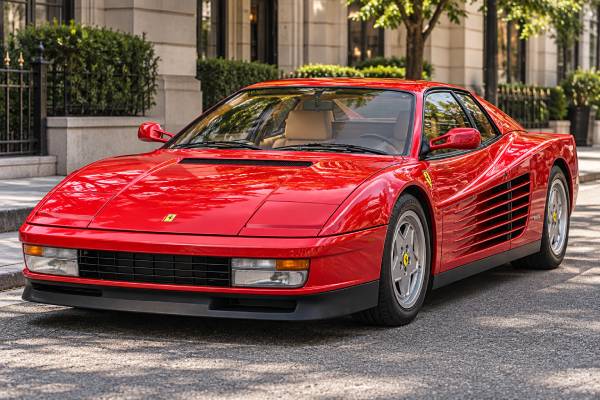
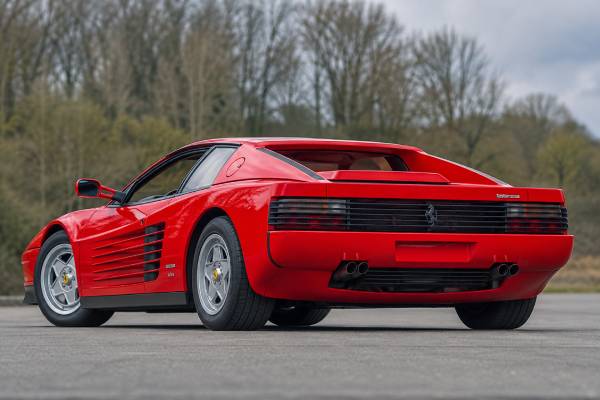
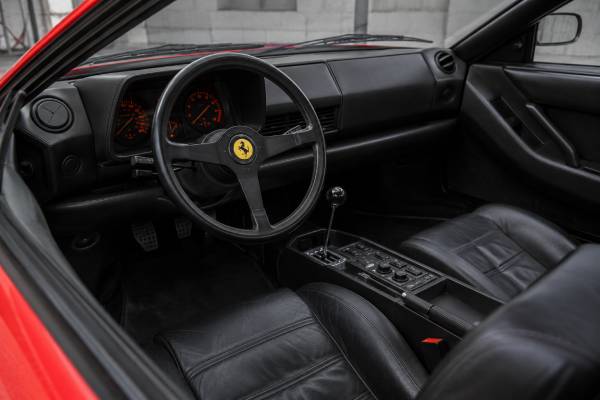
The Ferrari Testarossa F110 AB is the original 1984–1991 version of Ferrari’s wide-bodied flat-12 supercar, powered here by the F113 4.9-liter naturally aspirated engine rated at 390 hp in its key European specification. It replaced the Berlinetta Boxer and became one of the defining Ferrari road cars of the 1980s, not because it was subtle, but because it solved real packaging and cooling problems with a shape nobody forgot. Its side strakes, rear width, five-speed gated manual, mid-mounted 12-cylinder layout, and Pininfarina body made it both a bedroom-wall icon and a serious grand touring machine. Today, collectors care about early single-mirror cars, condition, originality, documentation, service history, and color. Owners care about the same things for a simpler reason: a correct Testarossa is magnificent, while a neglected one can be financially brutal.
Table of Contents
- Why the F110 Testarossa Still Matters
- F113 Flat-12 Specs and Chassis Data
- Production Changes and Authenticity Details
- Pininfarina Design, Cooling, and Packaging
- Road Character, Sound, and Real Performance
- Ownership Risks, Service, and Restoration
- Values, Inspection, and Buying Priorities
Why the F110 Testarossa Still Matters
The original Ferrari Testarossa matters because it was both a technical response to the Berlinetta Boxer and a cultural reset for Ferrari. It kept the mid-engine flat-12 formula, but made it more usable, more stable at speed, better cooled, and far more recognizable.
Launched at the 1984 Paris Motor Show, the Testarossa arrived when Ferrari needed a flagship road car that could carry the drama of the Boxer into a new decade. The 512 BBi had been exotic and beautiful, but it was cramped, hot, and demanding. The Testarossa did not abandon that layout; it refined it. Ferrari kept the longitudinal 12-cylinder engine behind the cabin, paired it with a rear transaxle, and wrapped it in a much broader body with large side-mounted radiators.
That cooling change defined the whole car. Instead of feeding front radiators and pushing long hot coolant pipes through the body, Ferrari moved major cooling airflow to the sides. The famous side strakes were not just styling theater. They helped manage airflow into the side intakes while satisfying safety and bodywork needs. The result was a shape that looked futuristic in 1984 and still reads instantly as a Testarossa today.
The name also carried heritage. “Testarossa” means “red head,” a reference to red-painted cam covers and a name associated with Ferrari’s great 1950s sports-racing cars. The 1980s Testarossa was not a race car, but the name gave Ferrari’s new flagship an emotional link to Maranello’s competition past.
In model-line terms, the F110 Testarossa sits between the carbureted and injected Berlinetta Boxer cars and the later 512 TR and F512 M. The 512 TR was heavily updated, sharper, and quicker. The F512 M was rarer and more modernized. Yet many collectors prefer the original Testarossa because it is the pure 1980s design: wide tail, pop-up headlights, cheese-grater strakes, gated shifter, and the early cabin architecture.
Its reputation has changed several times. In period, it was a poster car and status symbol. Later, it became unfashionable to some buyers as tastes moved toward smaller, sharper, more minimalist Ferraris. More recently, the market has reassessed the Testarossa as a significant analog supercar with a manual gearbox, 12 cylinders, dramatic Pininfarina design, and enough production volume to be usable rather than unobtainable.
For collectors, the appeal is not just nostalgia. A good Testarossa offers a rare mix:
- a naturally aspirated Ferrari 12-cylinder engine
- a manual open-gate gearbox
- a mid-engine chassis
- major Pininfarina-era visual identity
- real long-distance usability for an older exotic
- strong parts and specialist support compared with many rarer Ferraris
- clear variant desirability, especially for early single-mirror and single-lug cars
The F110 AB covered here is the original 1984–1991 Testarossa, not the later 512 TR or F512 M. That distinction matters when comparing values, mechanical details, performance figures, wheels, interior updates, and collectability.
F113 Flat-12 Specs and Chassis Data
The Testarossa’s core specification is simple in concept but expensive in execution: a mid-mounted 4.9-liter, 48-valve Ferrari flat-12 driving the rear wheels through a five-speed manual transaxle. The European 390 hp version is the headline model, while emissions-equipped market versions may differ slightly in output and hardware.
The engine is commonly described as a flat-12 because its cylinder banks sit at 180 degrees. Technically, it is part of Ferrari’s horizontally opposed 12-cylinder road-car family rather than a simple racing-style boxer in the strict mechanical sense. For buyers, the more important points are its dry-sump lubrication, four valves per cylinder, Bosch mechanical fuel injection, timing belts, and the high labor involved in major service.
| Item | Specification |
|---|---|
| Model | Ferrari Testarossa F110 AB |
| Production period | 1984–1991 |
| Engine code | F113 family |
| Engine layout | Rear-mid, longitudinal 180-degree 12-cylinder |
| Displacement | 4,943 cc |
| Valvetrain | DOHC, four valves per cylinder, 48 valves total |
| Fuel system | Bosch K-Jetronic mechanical fuel injection |
| Lubrication | Dry sump |
| Maximum power | 390 hp at 6,300 rpm in key European specification |
| Maximum torque | About 490 Nm at 4,500 rpm |
| Transmission | Five-speed gated manual transaxle |
| Drivetrain | Rear-wheel drive |
| Top speed | About 290 km/h |
| 0–100 km/h | About 5.7–5.8 seconds, depending on test and market version |
The chassis follows the classic Ferrari exotic layout of the period: a tubular steel frame with independent suspension, unequal-length wishbones, coil springs, anti-roll bars, and ventilated disc brakes. It is not a lightweight modern carbon-tub car. It is a large, wide, hand-built grand touring supercar designed for high-speed stability as much as corner-entry aggression.
| Area | Typical F110 Testarossa detail |
|---|---|
| Body and frame | Pininfarina-designed body over tubular steel structure |
| Suspension | Independent wishbones, coil springs, telescopic dampers, anti-roll bars |
| Rear suspension note | Twin rear dampers per side on many original Testarossa applications |
| Brakes | Ventilated discs front and rear |
| Steering | Unassisted rack-and-pinion |
| Wheelbase | 2,550 mm |
| Length | About 4,485 mm |
| Width | About 1,976 mm |
| Height | About 1,130 mm |
| Fuel capacity | About 115 liters |
Early cars used metric center-lock wheels, commonly associated with Michelin TRX tires. Later production moved through wheel and hub changes, including more conventional five-bolt wheels. These changes matter because tires, originality, and wheel hardware affect both usability and value.
The Testarossa was never a small car. Its width is central to its character. It gives the car huge visual presence and helps house the rear track, side cooling arrangement, and large rear tires. It also means parking, tight streets, and narrow mountain roads demand more care than in a 308, 328, or many later V8 Ferraris.
Production Changes and Authenticity Details
The most desirable Testarossas are usually the most original, best documented, and easiest to authenticate, not simply the shiniest. Early single-mirror and single-lug cars attract special attention, but late five-lug cars can be better drivers and often easier to live with.
Ferrari built the original Testarossa from 1984 into 1991 before the 512 TR took over. Total production is widely cited at 7,177 cars for the original Testarossa, making it rare by normal car standards but not rare by Ferrari flagship standards. That production volume is part of the appeal: there are enough cars, parts sources, and specialists for the model to be usable, but not so many that excellent examples feel ordinary.
The best-known early identifier is the “monospecchio” single high-mounted driver-side mirror. These early cars also often have single-lug center-lock wheels. The high mirror looks strange to some people and iconic to others. In the collector market, it is a strong visual marker of the earliest production phase.
Later cars gained dual mirrors, different wheel arrangements, and detail updates. The move from center-lock to five-bolt wheels is especially important for inspection. A car’s wheels, hubs, suspension details, build date, and market specification should make sense together. A mismatched car is not automatically bad, but it needs explanation and documentation.
| Identifier | Why it matters |
|---|---|
| Single high mirror | Early “monospecchio” cars are visually distinctive and often more collectible. |
| Dual mirrors | Later configuration with improved rear visibility and broader availability. |
| Single-lug wheels | Important early feature; hardware condition and correct tools matter. |
| Five-lug wheels | Later arrangement; easier tire and service practicality in many cases. |
| Metric TRX tires | Original on many early cars but can limit tire choice and raise replacement cost. |
| Market-specific emissions equipment | Affects power rating, service parts, exhaust layout, and authenticity. |
| Original books and tools | Strong value factor, especially on low-mileage collector-grade cars. |
Authenticity should be checked through more than a glance at the paint and dashboard. A serious buyer should confirm the chassis number, engine number where documented, gearbox details, market delivery specification, service invoices, import papers if applicable, and Ferrari heritage documentation where available. The car should also have a coherent story. A U.S.-market car, a gray-market European car, and a later federalized import can all be good purchases, but they should not be priced as if they are identical.
Factory colors matter, but the Testarossa is not limited to red. Rosso Corsa is the classic image and often the easiest to sell. Black, white, silver, blue, and other period shades can be highly attractive when original and well documented. Interior color also matters. A red car with tan leather is the default mental image for many buyers, but unusual original combinations may appeal strongly to collectors who want something less predictable.
Originality is valuable, but it must be balanced against usability. Sensible preservation is usually better than cosmetic over-restoration. A car with original paint, correct wheels, books, tools, and continuous maintenance records can be more compelling than a freshly painted car with missing history and unclear mechanical work.
Pininfarina Design, Cooling, and Packaging
The Testarossa’s design is dramatic because its engineering forced it to be dramatic. The huge side intakes, wide rear body, and horizontal strakes were all tied to cooling, packaging, safety, and high-speed stability rather than decoration alone.
Pininfarina’s shape was a clean break from the softer, wedge-like Berlinetta Boxer. The Boxer had a more compact, low-slung look, while the Testarossa made the rear of the car the main event. From the front, it is low and relatively restrained. From the side, the long strakes dominate. From the rear, the car is extremely wide, with a broad black grille and tail-lamp treatment that makes it look planted and mechanical.
The side radiators were the central packaging move. By placing major cooling hardware along the sides, Ferrari improved thermal management and helped reduce the cabin heat issues associated with earlier mid-engine 12-cylinder layouts. The tradeoff was width. The Testarossa had to be broad enough to feed air, house the radiators, cover the rear track, and maintain stability around a large engine and transaxle.
The strakes also helped Ferrari manage rules around side openings. Large exposed side intakes could create safety and homologation problems, so the horizontal elements made the openings more controlled. Over time, they became the car’s signature feature. Many later cars copied the idea visually, but few made it look as natural as the original Testarossa.
The cabin is pure analog Ferrari grand tourer. The seating position is low, the view forward is framed by a shallow nose, and the rear view is limited by the wide tail. The gated shifter is not just a nostalgic detail. It shapes the whole driving rhythm. A clean shift through the metal gate is one of the reasons people still want these cars despite their maintenance demands.
The engine bay is another part of the theater. The flat-12 sits low and wide, with red cam covers, long intake runners, and a layout that looks expensive because it is. Unlike modern supercars hidden under plastic covers, the Testarossa exposes much of its mechanical identity. It rewards owners who enjoy seeing, hearing, and understanding the machine.
The lighting and exterior details also define the era. Pop-up headlights give the front a clean parked profile. The high-mounted early mirror looks almost concept-car strange today. The rear deck, engine cover, and broad tail emphasize the car’s width. Even the luggage area matters: the Testarossa was intended as a fast road car, not a stripped track special. It could cover long distances if maintained properly.
Compared with the later 512 TR, the original Testarossa feels more visually theatrical and less modernized. The 512 TR improved chassis balance, ergonomics, power delivery, and performance. Yet the first Testarossa has the stronger design purity. It looks like the idea before the revision.
Road Character, Sound, and Real Performance
A well-sorted Testarossa feels fast, stable, mechanical, and surprisingly usable once moving, but it does not drive like a modern supercar. Its size, heavy low-speed controls, gated gearbox, and wide rear track give it an old-school sense of occasion.
The F113 engine is the center of the experience. It does not deliver modern turbocharged punch from idle. Instead, it builds with a smooth, layered 12-cylinder pull. The torque is strong enough for road use, but the car feels best when the engine is warm, the fluids are up to temperature, and the driver lets it rev. The sound is not as shrill as some later Ferraris. It is broader, more mechanical, and more expensive-sounding, with intake and valvetrain character layered into the exhaust note.
The five-speed gearbox rewards patience. Cold shifts, especially into second gear, should not be rushed. This is normal for many classic Ferraris, and forcing the lever is poor practice. Once warm, a good gearbox should feel deliberate, precise, and satisfying. A baulky, grinding, or vague shift can point to clutch adjustment issues, worn linkage, tired synchros, or deeper transaxle trouble.
Steering is heavy at parking speeds because there is no power assistance. Once the car is rolling, the steering becomes one of its pleasures. It has real feedback and a calm, measured response. The Testarossa is not a nervous car. Its wide stance and long wheelbase make it feel settled at speed, especially on open roads.
Braking performance is period-correct rather than modern. The ventilated discs are capable when healthy, but the pedal feel, tire technology, and heat management should be judged against 1980s supercars, not current carbon-ceramic systems. Old brake hoses, aged fluid, tired calipers, or glazed pads can make a Testarossa feel far worse than it should.
The handling balance is more grand touring than razor-edged track tool. There is real grip, especially from the rear, but the car’s mass and width are always present. It prefers smooth inputs. A good driver works with the chassis rather than throwing it around. On fast roads, the Testarossa makes sense. In narrow city streets, it can feel like too much car.
Visibility is mixed. The forward view is good for such an exotic shape, but rear-quarter visibility and judging the tail require practice. Early single-mirror cars add another layer of compromise. Cabin heat, air-conditioning performance, and noise vary heavily by condition. A restored or well-maintained car can be pleasant for long trips. A neglected one can feel hot, smelly, loose, and tiring.
Period performance remains strong. A top speed around 290 km/h placed the Testarossa among the fastest production cars of its day. Acceleration to 100 km/h in the high-five-second range is no longer shocking, but the way the car gathers speed is still special. The engine, gearbox, width, smell, view, and sound make the numbers feel more memorable than many quicker modern cars.
Ownership Risks, Service, and Restoration
The Testarossa is not fragile when properly maintained, but deferred maintenance can turn it into one of the most expensive “cheap” Ferraris to own. The main risk is not one single flaw; it is the combined cost of engine-out service, aging fuel and cooling systems, old electrics, tired suspension, and poor previous work.
The timing-belt major service is the headline maintenance item. On the Testarossa, proper belt service is normally treated as an engine-out job because the drivetrain and rear suspension assembly were designed to be removed as a unit. While the engine is out, a specialist will usually inspect or renew tensioners, cam seals, valve-cover gaskets, water pump condition, hoses, fuel lines, engine mounts, clutch components, and many “while you are there” items.
That phrase can be dangerous but necessary. Skipping sensible work during an engine-out service can save money now and multiply labor later. At the same time, a shop can turn a major service into an uncontrolled restoration if the owner does not agree on scope. Clear estimates, photographs, parts lists, and specialist experience matter.
Common ownership concerns include:
- old fuel hoses and fuel distributors
- cooling hoses, radiator condition, fans, and thermostat issues
- oil leaks from cam covers, seals, and gaskets
- clutch wear and hydraulic leaks
- second-gear synchro wear or poor shift adjustment
- tired engine mounts and suspension bushings
- electrical faults from aging connectors, fuse boxes, relays, and grounds
- weak air conditioning, especially in hot climates
- old metric tires or aged performance tires
- corrosion or poor repairs around lower body, chassis tubes, and accident-damaged areas
The fuse box and electrical system deserve specific attention. Heat, age, and load can cause connection problems. Symptoms may include intermittent fans, lighting faults, starting issues, or strange accessory behavior. A neat-looking car can still have poor electrical health if previous owners added alarms, stereos, battery tenders, or non-original wiring without care.
Cooling system health is critical. The Testarossa was designed to manage heat better than the Boxer, but that does not mean a 35- to 40-year-old cooling system can be ignored. Radiators, fans, hoses, caps, and bleed procedures all matter. Any car that overheats in traffic, smells of coolant, or shows inconsistent temperature behavior needs specialist diagnosis before purchase.
Restoration is expensive because the car is large, complex, and partly hand-built. Body repairs require knowledge of the structure, panel fit, and original materials. The broad rear quarters, side strakes, engine lid, and lower panels are costly to repair correctly. Accident damage is a major value issue. A badly repaired Testarossa may look impressive in photos but drive poorly, wear tires oddly, leak water, or show inconsistent panel gaps.
Interior restoration also adds up. Leather shrinkage, sticky switches, worn seat bolsters, warped trim, cracked plastics, and damaged carpets are common. Correct materials and workmanship matter for value. A cheap retrim can hurt a collector-grade car even if it looks fresh at first glance.
For owners who drive their cars, mechanical condition should come before cosmetic perfection. A car with recent belts, sorted cooling, fresh tires, rebuilt suspension, working air conditioning, and clean electrical behavior will usually be more enjoyable than a lower-mileage car that has been sitting for years.
Values, Inspection, and Buying Priorities
The safest Testarossa purchase is usually the best-documented car you can afford, not the cheapest one with the lowest advertised mileage. Current market data shows a wide spread, with driver-quality cars, late low-mileage cars, and early single-mirror examples often occupying very different price bands.
As of 2026, public market benchmarks and recent auction results commonly place many usable Testarossas in the mid-six-figure range in U.S. dollars, while exceptional low-mileage, early, rare-color, or highly original cars can sell for substantially more. Rough cars, federalization-question cars, missing-history cars, or overdue-service cars should trade at a meaningful discount, but the discount must be large enough to cover real correction costs.
Value is driven by several overlapping factors:
- originality of paint, interior, wheels, and major components
- early single-mirror and single-lug specification
- documented service history, especially recent belt service
- mileage that is believable and supported by records
- market specification and import history
- books, tools, jack, spare, manuals, and pouch
- color combination and factory-correct trim
- accident-free body and chassis condition
- quality of any restoration or repaint
- reputation of the servicing specialist
A pre-purchase inspection is essential. It should be done by a Ferrari specialist who knows Testarossas specifically, not just a general exotic-car shop. The inspection should include a lift review, leak inspection, compression or leak-down testing when appropriate, cooling-system check, electrical test, gearbox evaluation, clutch assessment, suspension inspection, tire-date check, brake inspection, and documentation review.
| Area | What to check | Why it matters |
|---|---|---|
| Service history | Recent engine-out belt service with invoices and parts detail | Overdue major service can change the real purchase price dramatically. |
| Engine | Leaks, smoke, compression, fuel injection behavior, idle quality | Flat-12 repairs are expensive and specialist-dependent. |
| Gearbox | Warm shift quality, synchros, clutch operation, linkage feel | Transaxle work can be costly and affects driving pleasure. |
| Cooling | Fans, radiators, hoses, temperature stability, coolant leaks | Heat problems can damage confidence and mechanical health. |
| Body | Panel gaps, strakes, lower structure, repair evidence, corrosion | Poor body repairs hurt value and are difficult to correct. |
| Wheels and tires | Correct wheel type, hub hardware, tire age, tire availability | Originality and safe driving both depend on the right setup. |
| Electrical | Fuse box, fans, lights, windows, charging, added wiring | Electrical faults are common on aging exotics and can be time-consuming. |
| Documentation | Books, tools, ownership chain, import papers, specialist records | Paperwork strongly affects collectability and resale confidence. |
Cars to seek are those with coherent history, known specialists, regular use, recent major service, correct details, and no mystery gaps. Low mileage is attractive only when it is believable and the car has not suffered from long-term storage. A 10,000-mile car on old belts, old tires, stale fuel, and dry seals can require more spending than a 35,000-mile car maintained by an expert.
Cars to avoid include fresh cosmetic flips with no mechanical depth, cars advertised as “just serviced” without itemized invoices, examples with accident stories but no repair documentation, cars with missing emissions equipment in strict markets, and vehicles with incorrect wheels or interior changes presented as original.
The long-term collectability case is strong. The Testarossa has the right ingredients: a manual gearbox, naturally aspirated Ferrari 12-cylinder engine, Pininfarina design, analog controls, cultural recognition, and enough production history to support a mature market. It is unlikely to become obscure. The real question is not whether people will remember the Testarossa; they will. The question is whether a specific car has the originality, condition, and records to deserve serious money.
For an enthusiast-owner, the best Testarossa is often not the lowest-mileage museum piece. It is a properly maintained, correct, confidently usable car that can be driven without fear. For an investor-collector, early configuration, originality, color, low mileage, and documentation move higher on the list. In both cases, the rule is the same: buy the car with the fewest unanswered questions.
References
- Ferrari Testarossa (1984) – Ferrari.com 1984 (Manufacturer Specifications)
- Vehicle Detail Search – 1988 FERRARI TESTAROSSA | NHTSA 2026 (Recall Database)
- Ferrari Testarossa Market – CLASSIC.COM 2026 (Market Data)
- Ferrari Testarossa Owner’s Manual 1987 (Owner’s Manual)
Disclaimer
This article is for informational purposes only and is not a substitute for professional diagnosis, repair, valuation, or inspection. Ferrari Testarossa specifications, torque values, maintenance intervals, procedures, emissions equipment, and parts can vary by VIN, market, production date, and individual vehicle history. Always verify details against official Ferrari service documentation and consult a qualified Ferrari specialist before buying, servicing, or restoring a car.
If you found this guide useful, please consider sharing it on Facebook, X/Twitter, or with other Ferrari enthusiasts to support our work.