
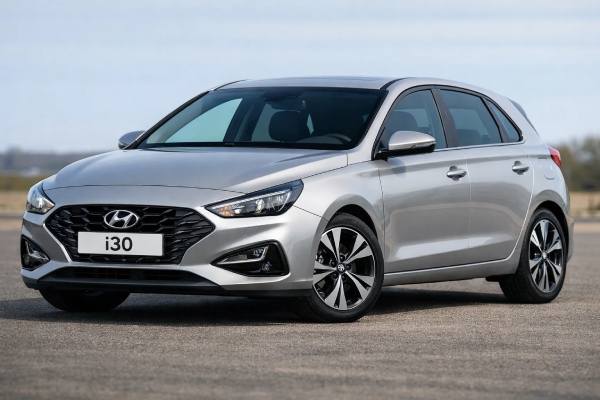
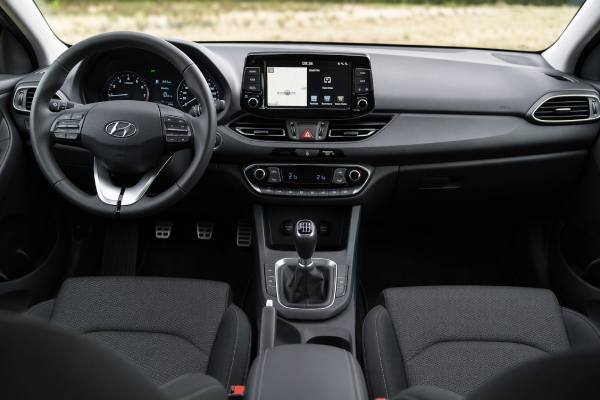
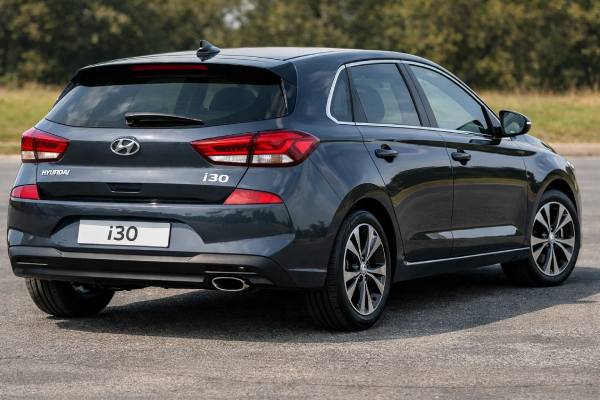
The facelift Hyundai i30 (PD) with the 1.6 CRDi 115 hp diesel sits in a useful middle ground. It is not the fastest version in the range, and it is not as mechanically simple as the basic petrol models, but it combines strong everyday torque, low highway fuel use, and proven compact-hatch packaging in a way that still makes sense for long-distance drivers. This facelift generation also benefited from cleaner styling, better infotainment, and a broader active-safety package. For buyers looking at the used market, the 115 hp diesel is attractive because it avoids the added 48-volt mild-hybrid hardware of the stronger 136 hp diesel in many markets, while still delivering the kind of mid-range pull that suits motorway use and loaded family driving. The trade-off is that diesel ownership demands the right driving pattern, proper AdBlue and emissions-system care, and closer attention to recall history and service records than the simpler petrol versions.
Essential Insights
- Strong 280 Nm torque makes the 115 hp diesel more relaxed than the 1.5 DPi on hills and motorways.
- Low fuel use on longer runs is a real strength, especially at steady cruising speeds.
- The facelift i30 adds modern driver assistance and improved cabin tech without changing the car’s practical layout.
- Short-trip use can accelerate DPF, EGR, and AdBlue-related headaches, so this is not the ideal diesel for low-mile urban driving.
- Hyundai’s published diesel oil-change interval is typically 30,000 km or 24 months, though many careful owners service earlier.
What’s inside
- Hyundai i30 facelift diesel profile
- Hyundai i30 CRDi technical facts
- Hyundai i30 grades and protection
- Durability patterns and service actions
- Upkeep plan and used-buy tips
- Road manners and diesel economy
- Where it stands among rivals
Hyundai i30 facelift diesel profile
The facelift i30 kept the same core job description as the earlier PD-generation car: a sensible front-wheel-drive family hatchback designed to be easy to live with every day. What changed from 2020 onward was the polish. Hyundai sharpened the nose and lighting, refreshed the cabin technology, and made the car feel more modern without overcomplicating the basic layout. For used buyers, that matters because the facelift car still feels current in areas that age quickly, especially the infotainment and driver-assistance package.
In 1.6 CRDi 115 hp form, the i30 leans toward efficiency and range rather than outright pace. This engine is a Euro 6d four-cylinder turbo diesel with common-rail direct injection, SCR aftertreatment, a diesel particulate filter, and AdBlue. That means it has the strong low-speed torque people expect from a modern diesel, but it also brings the normal diesel ownership realities: the emissions hardware needs regular longer drives, clean maintenance history matters, and ignored warning lights can quickly become expensive. Buyers who mainly do city trips should think carefully before choosing this version.
Where the diesel shines is on the open road. Compared with the naturally aspirated 1.5 petrol, it needs fewer downshifts, carries speed more easily with passengers on board, and feels much more relaxed at motorway pace. The 115 hp rating is modest on paper, but 280 Nm delivered from low rpm gives the car a stronger real-world character than the number alone suggests. It is the kind of engine that suits commuters, sales reps, and families who spend time on faster roads.
This version also sits in an interesting place within the diesel range. In many facelift-era markets, the stronger 136 hp 1.6 CRDi used a 48-volt mild-hybrid setup, while the 115 hp version kept a more conventional layout. That makes the 115 hp car appealing to buyers who want diesel economy without extra hybrid-related components. It is still not a simple old-school diesel, but it is the more conservative choice in the lineup.
The final ownership verdict depends heavily on use case. If you cover regular motorway distance, the 1.6 CRDi 115 is one of the most convincing non-performance i30 powertrains. If your life is mostly cold starts, school runs, and short urban hops, the petrol versions are easier to justify. This i30 diesel is best when driven the way a diesel was designed to be driven.
Hyundai i30 CRDi technical facts
The figures below focus on the facelift Hyundai i30 hatchback with the 1.6 CRDi 85 kW, or 115 hp, diesel engine. Trim, gearbox, tyre size, and market can affect some values, so VIN-specific confirmation is still essential.
| Powertrain and efficiency | Data |
|---|---|
| Code | Public consumer documents do not consistently publish the engine code; verify by VIN |
| Engine layout and cylinders | Inline-4 diesel, 4 cylinders, DOHC, 4 valves per cylinder |
| Bore × stroke | 77.0 × 85.8 mm (3.03 × 3.38 in) |
| Displacement | 1.6 L (1,598 cc) |
| Induction | Turbocharged, variable-geometry turbo |
| Fuel system | Common-rail direct injection with piezo injectors |
| Compression ratio | 15.9:1 |
| Max power | 115 hp (85 kW) @ 4,000 rpm |
| Max torque | 280 Nm (206 lb-ft) @ 1,500–2,750 rpm |
| Timing drive | Toothed belt |
| Emissions equipment | SCR with AdBlue, oxidation catalyst, EGR, diesel particulate filter |
| Rated efficiency | 4.5 L/100 km combined (52.3 mpg US / 62.8 mpg UK) |
| Real-world highway @ 120 km/h | About 5.0–5.7 L/100 km (47.0–41.3 mpg US / 56.5–49.6 mpg UK) |
| Transmission and driveline | Data |
|---|---|
| Transmission | 6-speed manual standard; 7-speed DCT optional in some markets |
| Drive type | Front-wheel drive |
| Differential | Open differential |
| Chassis and dimensions | Data |
|---|---|
| Front suspension | MacPherson strut |
| Rear suspension | Torsion-beam rear axle on this diesel trim in some markets is replaced by multilink on higher-output versions; verify by trim and market |
| Steering | Electric rack-and-pinion |
| Steering ratio | 13.4:1 |
| Brakes | Front ventilated discs 280 mm, 288 mm, or 305 mm depending on trim; rear discs 272 mm or 284 mm depending on trim |
| Most common tyre sizes | 195/65 R15, 205/55 R16, 225/45 R17, 225/40 R18 |
| Most popular tyre size | 205/55 R16 |
| Ground clearance | 140 mm (5.51 in) |
| Length / Width / Height | 4,340 / 1,795 / 1,455 mm (170.9 / 70.7 / 57.3 in) |
| Wheelbase | 2,650 mm (104.3 in) |
| Turning circle | 10.6 m (34.8 ft) |
| Kerb weight | 1,388–1,537 kg (3,060–3,389 lb), depending on trim |
| GVWR | 1,890 kg (4,167 lb) |
| Fuel tank | 50 L (13.2 US gal / 11.0 UK gal) |
| Cargo volume | 395–1,301 L (14.0–45.9 ft³), VDA |
| Performance and capability | Data |
|---|---|
| 0–100 km/h | 10.9 s |
| Top speed | 192 km/h (119 mph) |
| Braking distance | Public consumer data not consistently published for this exact variant |
| Towing capacity | 1,500 kg (3,307 lb) braked / 650 kg (1,433 lb) unbraked |
| Payload | 353–502 kg (778–1,107 lb) |
| Roof load | 80 kg (176 lb) |
| Fluids and service capacities | Data |
|---|---|
| Engine oil | 4.4 L (4.65 US qt) including filter; verify exact oil approval and viscosity by VIN, market, and climate |
| Coolant | 7.3 L (7.72 US qt); verify official Hyundai coolant specification and mix |
| Manual transmission oil | 1.6 L (1.69 US qt) |
| 7-DCT fluid | 2.0 L (2.11 US qt), where fitted |
| AdBlue / urea | 12 L (3.17 US gal) |
| A/C refrigerant | Verify from the under-bonnet label and VIN-specific service data |
| A/C compressor oil | Verify from official service documentation |
| Key torque specs | Public consumer documents do not publish critical torque values; verify by VIN in workshop literature |
| Safety and driver assistance | Data |
|---|---|
| Euro NCAP | 5 stars |
| Adult Occupant | 88% |
| Child Occupant | 84% |
| Vulnerable Road Users | 64% |
| Safety Assist | 68% |
| IIHS | Not applicable for this Europe-focused model |
| ADAS suite | AEB, lane support, driver-attention warning, high beam assist, blind-spot and rear cross-traffic functions, and cruise-based assistance depending on trim and market |
The most important technical takeaway is simple: this 115 hp diesel delivers stronger usable torque than the basic petrol i30, but it does so through a more complex emissions system. That is the core ownership trade-off.
Hyundai i30 grades and protection
Trim naming varied by country, but the facelift i30 diesel usually sat in the sensible middle of the range. In the German technical data, the 115 hp 1.6 CRDi was tied to Select and Trend-grade positioning rather than the more premium N Line or high-output diesel trims. That tells you something important about the kind of car this was meant to be: not a sporty flagship, but a practical, well-equipped long-distance hatchback.
For buyers, trim level changes the ownership experience more than the power figure does. Lower and mid-grade cars typically have smaller wheel packages, lower running costs, and the most comfortable ride. Better-equipped versions add stronger lighting, nicer upholstery, larger infotainment screens, more parking support, and a wider SmartSense package. Wheel choice matters because it affects not only appearance but tyre price, ride quality, and sometimes brake sizing.
Useful trim identifiers include:
- wheel diameter and tyre size
- halogen versus LED front lighting
- manual versus dual-zone climate control
- size of the central infotainment display
- digital cluster presence
- steering-wheel buttons for driver assistance
- trim-specific upholstery and seat stitching
The facelift also improved the i30’s active-safety story. Depending on trim and market, the car could offer Forward Collision-Avoidance Assist, lane-keeping and lane-follow support, Driver Attention Warning, Intelligent Speed Limit Assist, blind-spot monitoring, rear cross-traffic collision warning, and on better-equipped cars, more advanced cruise-related support. In later brochures, some of the more advanced functions were tied to higher trims or DCT-equipped cars, so used buyers should not assume every facelift diesel has the full set.
Crash protection remains a real strength. The i30 achieved a 5-star Euro NCAP result with strong adult and child occupant scores. For families, the basics are solid: a stiff safety structure, multiple airbags, ISOFIX outer rear seat mounting points, electronic stability control, and an active-safety package that was competitive for the class. However, a star rating is not the same thing as current condition. On a used car, you need to ask whether the windscreen has been replaced correctly, whether a front-end repair has disturbed radar or camera alignment, and whether any warning lights or ADAS messages appear during a test drive.
If you want the best balance in the used market, the sweet spot is usually a mid-grade diesel on 16-inch wheels with documented servicing and confirmed recall completion. That combination gives you the diesel’s long-distance character without piling on unnecessary tyre and trim cost.
Durability patterns and service actions
The facelift i30 1.6 CRDi is generally a sound used-car proposition when it has been driven properly and serviced on time. The catch is that the diesel system rewards the right use and punishes neglect more clearly than the basic petrol models do. The problems to watch are therefore less about catastrophic design weakness and more about emissions hardware, operating pattern, and whether official service actions were completed.
A practical durability map looks like this.
Common, low to medium cost
- Rear brake corrosion and sticky operation: especially on lightly used cars. Symptoms include scraping, uneven rear pad wear, or a dragging feel after wet weather. Remedy is cleaning, freeing hardware, or replacing pads and discs.
- 12 V battery weakness: low voltage can trigger strange warnings, infotainment glitches, or start-stop problems. Remedy is battery testing and replacement when reserve capacity has fallen.
- Uneven tyre wear and alignment drift: often caused by potholes, kerb strikes, or worn suspension links.
Occasional, medium cost
- DPF loading and incomplete regeneration: most common on short-trip cars. Symptoms include rising fuel use, cooling fans running after shutdown, rougher idle during regeneration, or dashboard warnings. Root cause is repeated interrupted regeneration cycles. Remedy is a proper regeneration drive, diagnosis of soot loading, and repair of the underlying trigger if present.
- EGR and intake soot build-up: usually tied to stop-start urban use. Symptoms include flat response, hesitation, or emissions warnings. Remedy depends on diagnosis and can range from cleaning to replacement.
- NOx sensor, AdBlue, or SCR faults: these are normal watchpoints on Euro 6 diesels. Warning lights, countdown messages, or poor emissions readiness should not be ignored.
Less common but more expensive
- Clutch and dual-mass flywheel wear: manual cars that lived in traffic can develop vibration, rattle at idle, or shudder on take-off. A clean, quiet clutch action matters on inspection.
- Turbo hose or boost leak issues: look for whistling, limp mode, or oily residue around charge-air plumbing.
- Poor accident repair on ADAS-equipped cars: not a design failure, but a real ownership risk.
Official service actions matter. Two recall-related concerns stand out in public sources for the facelift era. One involved potentially defective front seat belt tensioners on some 2020-built i30s. Another involved a tandem-pump pre-filter issue that could increase brake pedal effort on certain i30s built up to mid-2020. These do not mean every facelift diesel is affected, but they are exactly why a used buyer should verify recall completion by VIN through Hyundai and ask for dealer printouts, not just a verbal assurance.
Software is part of reliability too. Dealers can check for powertrain, infotainment, and driver-assistance updates, and Hyundai servicing information notes that recommended updates are carried out during routine dealer visits. On a used diesel, an update history is a quiet but valuable sign of proper dealer-level care.
Upkeep plan and used-buy tips
Hyundai’s published diesel schedule is generous: oil changes at 30,000 km or 24 months, with broader maintenance also at 30,000 km or 24 months. That is acceptable for ideal use, but many careful owners and specialists shorten the oil interval for urban driving, repeated cold starts, or heavy stop-start duty. With modern diesels, conservative maintenance usually pays back.
A practical long-term plan looks like this:
| Maintenance item | Practical interval |
|---|---|
| Engine oil and filter | Every 15,000–20,000 km or 12 months for mixed or short-trip use; 30,000 km or 24 months is the published maximum in many markets |
| Engine air filter | Inspect at each service, replace around 30,000 km sooner in dusty use |
| Cabin air filter | Every 15,000–30,000 km or 12 months |
| Fuel filter | Replace by official schedule or sooner if poor fuel quality is suspected |
| Coolant | Follow VIN-specific Hyundai schedule |
| Brake fluid | Every 2–4 years depending on inspection results and official guidance |
| Manual gearbox oil | Inspect for leaks; preventive change around 90,000–120,000 km is sensible |
| DCT fluid | Follow transmission-specific service guidance where fitted |
| Auxiliary belt and hoses | Inspect at each major service |
| Timing belt system | Follow official replacement guidance and inspect for age, noise, contamination, or service history gaps |
| Brake pads and rotors | Inspect at every service |
| Tyre rotation and alignment | Every 10,000–15,000 km or when wear suggests it |
| 12 V battery | Test yearly after year 3 |
| AdBlue level and SCR function | Monitor continuously; do not ignore warning countdowns |
| DPF health | Watch for interrupted regenerations and frequent fan run-on after shutdown |
Inspection on a used 1.6 CRDi should focus on the items that separate a healthy motorway car from a problem short-trip diesel:
- cold start quality with no excessive smoke
- smooth idle and no strong diesel knock once warm
- clean pull from low rpm without hesitation
- no active check-engine, AdBlue, or emissions warnings
- no clutch slip, shudder, or flywheel rattle
- full recall completion by VIN
- service invoices, not just a stamped book
- even tyre wear and stable braking feel
- no signs of crash repair around the nose, lights, or windscreen
- evidence that the car has done enough longer journeys to keep the DPF healthy
The best buys are usually lightly to moderately optioned cars with 16-inch wheels, complete service history, and motorway-biased use. Cars that have spent their lives on short urban cycles are less attractive, even if the mileage looks low. Long-term durability is good when the car gets the kind of driving and maintenance a Euro 6 diesel needs.
Road manners and diesel economy
The i30 1.6 CRDi 115 is defined by its mid-range. It does not feel rapid in the first few yards, and there is a little normal diesel softness below the heart of the torque band, but once moving it is noticeably more effortless than the base petrol. That suits the i30’s calm, everyday chassis well.
In town, the diesel is easy enough to drive, but the car makes more sense once speeds rise. On suburban roads and highways, the engine settles into the sort of relaxed, low-effort rhythm that people buy diesel hatchbacks for. You need fewer downshifts for overtakes, and the car feels less strained with passengers or luggage on board. The 6-speed manual is a good fit because it lets the driver use that torque without fuss. The optional DCT can make commuting easier, but the manual keeps the mechanical package simpler.
Ride and handling are consistent with the i30’s mainstream family-car mission. Straight-line stability is good, the steering is accurate if not talkative, and the car feels secure rather than playful in corners. Smaller wheels are the better choice for real roads because they preserve the comfortable, mature ride this model does well. Larger wheels add appearance but reduce some of that softness over broken surfaces.
Cabin noise is respectable. At motorway pace, this diesel is not silent, but it is composed. Most of the time you hear a subdued diesel background rather than a harsh clatter. Wind and tyre noise depend heavily on trim and wheel choice.
Real-world fuel use is one of the car’s better arguments:
- City: about 5.8–6.8 L/100 km depending on congestion and regeneration frequency
- Highway at 100–120 km/h: about 5.0–5.7 L/100 km
- Mixed driving: about 5.2–6.0 L/100 km
Cold weather, repeated short trips, and active DPF regenerations can push those numbers higher. That is why owners who mainly drive short urban distances often fail to see the diesel benefit they expected.
Performance is adequate rather than sporty. A published 0–100 km/h time of 10.9 seconds is enough for the class, but the more relevant number is how calmly the car builds speed in the mid-range. Towing performance is also decent for a compact hatchback, with up to 1,500 kg braked, though regular towing still raises thermal and clutch demands. Overall, this is a car that feels strongest when used steadily and intelligently, not aggressively.
Where it stands among rivals
The facelift i30 1.6 CRDi 115 competes best when judged as a practical ownership tool, not a class leader in any single headline test.
Against the Volkswagen Golf 2.0 TDI:
The Golf usually feels a little more polished and can have a broader spread of trims and options. The Hyundai counters with strong value, a simpler used-market decision tree, and, in many cases, lower buy-in cost.
Against the Kia Ceed 1.6 CRDi:
This is the closest match in spirit. The Ceed shares much of the same group logic, but the Hyundai often feels slightly more conservative in cabin design and used-market positioning. Choice comes down to condition, price, and exact equipment.
Against the Ford Focus 1.5 EcoBlue:
The Focus is usually more engaging to steer. The i30 replies with a more straightforward cabin, strong safety value, and a calm long-distance character. Buyers prioritizing handling may lean Ford; buyers prioritizing ownership logic may prefer Hyundai.
Against the Skoda Scala or Octavia diesel:
The Skoda options often offer more boot space and a slightly more utilitarian feel. The Hyundai feels tighter and more conventional as a compact hatchback, with a competitive safety and tech package.
Against the Toyota Corolla hybrid:
This is the key non-diesel alternative. The Corolla is far better suited to short urban use and usually cheaper to keep happy in that environment. The i30 diesel makes sense only for buyers who still do enough higher-speed mileage to exploit diesel economy and torque.
That is the real verdict. The Hyundai i30 1.6 CRDi 115 is not the universal answer it might have been a decade earlier, because driving patterns and emissions systems have changed the diesel equation. But for drivers who still cover real distance, want a compact hatch rather than a crossover, and value steady torque and fuel efficiency on longer runs, it remains a strong and sensible used buy.
References
- Hyundai i30 | Technische Daten | Stand: 4.2019 2021 (Technical Data)
- The new i30 | Downloads | Hyundai Motor UK 2026 (Brochure and Equipment)
- EuroNCAP | Hyundai i30 2017 (Safety Rating)
- Home | Hyundai Recalls & Service Campaigns 2026 (Recall Database)
- Safety Gate Alerts 2022 (Recall Notice)
Disclaimer
This article is for informational purposes only and is not a substitute for professional diagnosis, repair, or vehicle-specific service information. Specifications, torque values, service intervals, procedures, recalls, and equipment can vary by VIN, market, body style, transmission, and trim. Always verify critical details against official Hyundai service documentation and dealer records before servicing, repairing, or buying a vehicle.
If this guide was useful, please consider sharing it on Facebook, X, or other social platforms to support our work.