

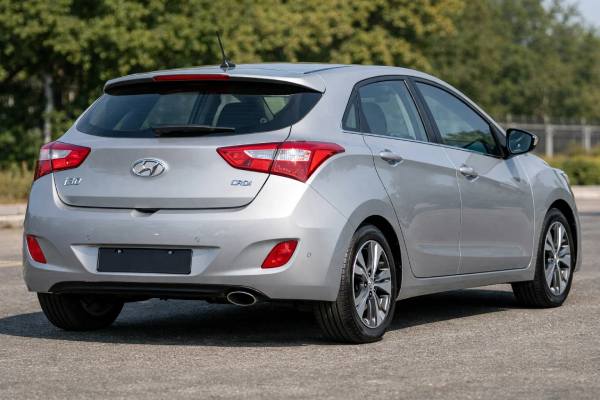
The facelifted Hyundai i30 GD 1.6 GDI is one of the more balanced compact hatchbacks from the mid-2010s. It combines tidy dimensions, a mature chassis, and a direct-injection petrol engine that sits between the simpler MPI cars and the more demanding turbocharged options. For many used buyers, that balance is the real attraction. You get a car that feels modern enough in daily use, offers solid cabin space, and avoids some of the heavier diesel-related risks that now affect many older family hatchbacks. The 1.6-liter GDI engine is smooth, reasonably efficient, and more eager than the basic petrol versions, but it also brings the usual direct-injection caveats around intake deposits and maintenance quality. The facelifted 2015–2017 cars also benefit from refreshed styling, Euro 6-era updates, and an updated safety case in some markets. Buy a well-kept example and the i30 remains an easy car to recommend. Buy a neglected one and it can feel flat, noisy, and more expensive than expected.
Quick Overview
- The 1.6 GDI offers a useful middle ground between basic petrol simplicity and stronger but costlier turbo options.
- Facelift cars keep the i30’s roomy cabin, good 378 L boot, and stable long-distance road manners.
- Safety remained a strong point, with a 5-star ANCAP rating for updated Series II variants in applicable markets.
- Carbon buildup, stretched oil intervals, and weak ignition parts are the most important ownership cautions.
- A sensible oil-and-filter interval is every 10,000 to 15,000 km or 12 months.
On this page
- Hyundai i30 GD Facelift Profile
- Hyundai i30 GD Facelift Data Guide
- Hyundai i30 GD Facelift Features and Safety
- Recurring Faults and Dealer Fixes
- Care Schedule and Used Checks
- Ride, Pace and Consumption
- Where It Sits Among Rivals
Hyundai i30 GD Facelift Profile
The facelifted GD-generation i30 arrived at a point when Hyundai had already proved it could build a credible compact hatch for European roads. The update did not reinvent the car, but it refined a formula that already worked. Styling became cleaner and slightly sharper, cabin trim was improved in some markets, and the overall package felt more settled. In 1.6 GDI form, the facelift hatch occupies a very sensible place in the range. It is stronger and more responsive than the lower-powered petrol versions, but it avoids the heavier complexity and cost exposure that can come with old turbocharged performance models.
The G4FD 1.6 GDI engine is the key to understanding this version. It is a naturally aspirated, direct-injection petrol four-cylinder with 135 hp and 164 Nm. On paper, those numbers look healthy enough for a compact hatch. In daily driving, the engine feels clean and willing, but it is not a torque-heavy unit. Peak torque arrives fairly high in the rev range, so the car rewards drivers who are happy to use the gearbox rather than rely on lazy low-rpm pull. That makes the i30 feel more refined than dramatic. It is well suited to drivers who want predictable throttle response and a smooth power build rather than a sudden turbo surge.
The facelift helps the ownership case in other ways too. The GD platform already offered a roomy front cabin, decent rear-seat space, and a genuinely useful hatchback boot. Those strengths remain. The car is compact enough to park easily in town but large enough to work as a family daily. This is exactly where the i30 has always been strongest. It does not win by being flashy. It wins by feeling easy to live with.
The chassis also deserves credit. Hyundai tuned the GD with more confidence than many buyers expected at the time. The car feels planted on motorways, calm over broken surfaces, and predictable through corners. It is not as playful as the best Ford Focus of the era, but it is far from dull. For long-distance commuting or mixed family use, that calmness matters more than sharp steering feedback.
In 2026, the real buying question is not whether the facelift i30 1.6 GDI was a good car when new. It was. The real question is whether a used example has been maintained like a direct-injection petrol hatch should be. A healthy one still feels tidy, efficient enough, and quietly competent. A neglected one can feel rough, hesitant, and unimpressive in a way that hides the model’s real strengths. That is why service history, smooth cold running, and general condition matter more here than trim level alone.
Hyundai i30 GD Facelift Data Guide
The figures below focus on the 2015–2017 Hyundai i30 GD facelift 1.6 GDI five-door hatch in its common 6-speed manual form. Exact tyre sizes, kerb weights, trailer limits, and equipment vary by market and trim. In some regions, automatic or DCT-related variants existed under slightly different emissions or blue-badged configurations, so verify key numbers by VIN if you are buying parts or checking workshop data.
Powertrain and efficiency
| Item | Value | Notes |
|---|---|---|
| Code | G4FD | Hyundai Gamma direct-injection petrol |
| Engine layout and cylinders | Inline-4, DOHC, 16-valve | 4 cylinders, 4 valves per cylinder |
| Bore × stroke | 77.0 × 85.4 mm | 3.03 × 3.36 in |
| Displacement | 1.6 L (1,591 cc) | Naturally aspirated petrol |
| Induction | Naturally aspirated | No turbocharger |
| Fuel system | Direct injection | GDI petrol |
| Compression ratio | 10.5:1 | Common published figure |
| Max power | 135 hp (99 kW) @ 6,300 rpm | 133 bhp in some market listings |
| Max torque | 164 Nm (121 lb-ft) @ 4,850 rpm | High-rpm torque peak |
| Timing drive | Chain | No fixed belt-replacement interval |
| Rated efficiency | 5.7 L/100 km (41.3 mpg US / 49.6 mpg UK) | Combined, manual |
| Real-world highway @ 120 km/h | about 6.2–6.8 L/100 km | Depends on tyres, load, weather |
Transmission and driveline
| Item | Value | Notes |
|---|---|---|
| Transmission | 6-speed manual | Some related variants used automatic or DCT |
| Drive type | FWD | Front-wheel drive |
| Differential | Open | Standard road-car arrangement |
Chassis and dimensions
| Item | Value | Notes |
|---|---|---|
| Suspension (front/rear) | MacPherson strut / independent multi-link | One of the GD’s better engineering traits |
| Steering | Rack and pinion, electric assist | Light, accurate, comfort-focused |
| Brakes | Front ventilated discs / rear discs | ABS standard |
| Wheels/Tyres | 195/65 R15 to 225/45 R17 | Most common sizes vary by trim |
| Ground clearance | 140 mm (5.51 in) | Published baseline figure |
| Length / Width / Height | 4,300 / 1,780 / 1,470 mm | 169.3 / 70.1 / 57.9 in |
| Wheelbase | 2,650 mm | 104.3 in |
| Turning circle (kerb-to-kerb) | 10.6 m | 34.8 ft |
| Kerb (Curb) weight | about 1,271–1,417 kg | 2,802–3,124 lb depending on trim and market |
| GVWR | 1,820 kg | 4,012 lb |
| Fuel tank | 53 L | 14.0 US gal / 11.7 UK gal |
| Cargo volume | 378–1,316 L | 13.4–46.5 ft³ |
Performance and capability
| Item | Value | Notes |
|---|---|---|
| Acceleration | 0–100 km/h in 9.9 s | Manual |
| Top speed | 195 km/h | 121 mph |
| Braking distance | highly tyre- and test-dependent | no single official figure for this exact variant |
| Towing capacity | 1,400 kg braked / 600 kg unbraked | market dependent |
| Payload | about 403–549 kg | varies by trim and market |
Fluids and service capacities
| Item | Value | Notes |
|---|---|---|
| Engine oil | 5W-30 or 5W-40 meeting the correct Hyundai petrol spec | market and climate dependent |
| Engine oil capacity | 3.6 L | 3.8 US qt |
| Coolant | Hyundai-approved long-life coolant | verify exact standard by market |
| Coolant capacity | 6.4 L | 6.8 US qt |
| Transmission fluid | correct Hyundai manual or automatic fluid | verify by gearbox code |
| Manual transmission capacity | about 1.9–2.0 L | approximate service fill |
| A/C refrigerant | R134a | charge varies by system |
| A/C compressor oil | PAG type | verify exact charge from system label |
| Key torque specs | wheel nuts commonly around 90–110 Nm | verify by VIN and market manual |
Safety and driver assistance
| Item | Value | Notes |
|---|---|---|
| Crash ratings | ANCAP 5 stars for updated Series II variants in applicable markets | build dates from January 2015 on that rating page |
| Assessment score | 35.69 out of 37 | ANCAP published score |
| Whiplash / pedestrian / ESC | Good / Adequate / Standard | from ANCAP published assessment |
| ADAS suite | very limited by modern standards | no AEB on any variant in the referenced ANCAP rating |
The numbers reveal the facelift i30’s real personality. It is not a hot hatch and not an economy special. Instead, it balances useful performance, respectable fuel use, and strong family-hatch packaging. The GDI engine’s higher torque figure over earlier listings also makes the facelift car feel slightly more substantial on paper, though it still needs revs to deliver its best.
Hyundai i30 GD Facelift Features and Safety
Trim naming differed by country, but the facelifted i30 generally followed Hyundai’s familiar pattern: lower trims offered the core essentials, mid-level versions added the equipment most owners actually valued, and higher trims focused on convenience and appearance rather than major mechanical differences. That structure is useful in the used market because it means the best buy is often a sound mid-spec car with a strong service history, not necessarily the highest trim with the most gadgets.
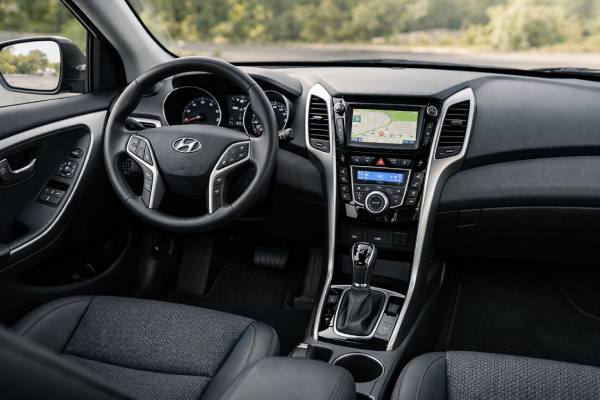
Entry and mid-range examples typically included air conditioning, power windows, remote locking, adjustable front seats, steering-wheel audio controls, and solid baseline safety equipment. Move further up the ladder and buyers often gained alloy wheels, dual-zone climate control, parking sensors, Bluetooth, upgraded infotainment, reversing cameras in some markets, heated seats, and more polished seat fabrics or trim finishes. The facelift also helped the dashboard and cabin feel a touch more contemporary, even though the overall layout stayed rational rather than dramatic.
Mechanical variation across trims remained modest. The 1.6 GDI kept the same basic character throughout the range. The main differences owners feel on the road usually come from wheel and tyre packages. Fifteen-inch cars generally ride better, cost less to maintain, and suit the car’s comfort-focused nature well. Seventeen-inch cars look smarter and sharpen response slightly, but they can ride more firmly and generate more tyre noise. On an older compact hatch where suspension wear is already possible, wheel size affects the verdict more than many buyers expect.
Quick visual identifiers help when viewing used cars. Lower trims usually have smaller wheels, simpler cloth upholstery, and more basic climate controls. Better-equipped cars have more steering-wheel buttons, nicer center-stack integration, and additional parking or comfort features. None of that changes the engine’s layout, but it can change how modern and complete the car feels after purchase.
Safety is one of the facelift GD’s strongest arguments. ANCAP’s published rating for the updated i30 Series II applies to all updated variants in the relevant market, including wagons, built from January 2015. The car received a 5-star rating with an overall score of 35.69 out of 37. Published assessment details included strong frontal, side-impact, and pole-test scores, advanced seat-belt reminders, and standard ESC, EBD, and emergency brake assist. Dual frontal, side chest, and curtain airbags, plus a driver knee airbag, were listed as standard in that rating description.
That said, the facelift still belongs to a transitional period in vehicle safety. Passive safety and core stability systems were strong, but advanced driver-assistance technology was limited. The same ANCAP page notes that AEB city, interurban, VRU, junction, and backover functions were not available on any variant in that safety assessment, and lane support systems were also not available. That matters when comparing this car with newer rivals, but it does not erase the fact that the facelifted i30 was a well-engineered safe family hatch for its time.
Recurring Faults and Dealer Fixes
The facelifted 1.6 GDI i30 is generally a dependable car, but like many direct-injection petrol engines, it has a very recognizable pattern of long-term issues. Most of them are manageable if caught early. Most of them become irritating and expensive if ignored. That is the right way to think about this model: not fragile, but sensitive to servicing quality and usage habits.
Common, low to medium cost: intake-valve carbon buildup. This remains the most important GDI-specific topic. Because fuel is injected directly into the combustion chamber, the intake valves do not benefit from the same fuel-wash cleaning effect seen on MPI engines. Over time, especially with short trips and repeated cold starts, deposits can accumulate. Symptoms usually include rough idle, weak throttle response, cold-start hesitation, flat mid-range feel, and worsening fuel economy. The right remedy is inspection and cleaning when deposits are affecting performance, often by walnut blasting or a similar intake-cleaning method.
Occasional, medium cost: timing-chain stretch or tensioner wear. The chain is an advantage over a scheduled belt, but it is not lifetime-proof. Delayed oil changes and poor oil quality can accelerate wear. Listen for a metallic rattle on start-up, check for timing-correlation faults, and take persistent top-end timing noise seriously. The proper remedy is measured diagnosis and replacement of the worn chain set if the engine is out of spec.
Common, low to medium cost: ignition faults. Worn spark plugs, weak coils, and sensor-related issues can all trigger misfires or uneven idle. On this engine, those symptoms can sometimes be confused with carbon buildup, so diagnosis matters. A good workshop will distinguish between a basic ignition issue and a more involved intake-cleaning problem rather than replacing parts blindly.
Occasional, low to medium cost: oil seepage and crankcase-ventilation issues. Older examples may show rocker-cover leakage, damp timing-cover areas, or increased oil misting if the PCV system is not healthy. None of these are usually catastrophic at first, but they can worsen deposit formation and general engine grime if ignored. Cooling-system age issues, such as thermostat housing seepage or tired hoses, also appear as the cars get older.
Transmission and driveline: the 6-speed manual is the easier long-term choice for many buyers. Clutch wear, release-bearing noise, and occasional notchy shifts can show up with mileage, but the layout is straightforward. Automatic or DCT-related versions need more caution, especially if fluid-service history is unclear or shift quality already feels inconsistent. Harsh shifts or hesitation on a used test drive should not be dismissed as normal.
Chassis and body wear: drop links, lower-arm bushes, top mounts, wheel bearings, tired dampers, and rear brake calipers are normal age-related concerns. The GD resists serious corrosion better than some older rivals, but that is not the same as being immune. Brake lines, underbody seams, subframe areas, wheel arches, and tailgate edges still deserve a careful inspection.
For recalls and service actions, the sensible process is simple. Run an official recall check, ask for dealer documentation where possible, and look for evidence that software or campaign work was actually completed. A seller saying “there are no issues” is not proof. A folder with proper maintenance records is.
Care Schedule and Used Checks
The facelift i30 1.6 GDI rewards conservative servicing. Even if some original schedules allowed longer intervals, owners who want reliability should think in shorter, cleaner service cycles. Direct-injection petrol engines stay happier when oil is fresh, plugs are not overdue, and minor drivability symptoms are dealt with before they become patterns.
A practical maintenance schedule looks like this:
- Engine oil and filter: every 10,000 to 15,000 km or 12 months.
- Engine air filter: inspect every service, replace every 20,000 to 30,000 km.
- Cabin filter: every 15,000 to 20,000 km or yearly.
- Spark plugs: roughly every 45,000 to 60,000 km, depending on plug type and operating conditions.
- Coolant: every 5 years or around 90,000 to 100,000 km.
- Brake fluid: every 2 years.
- Manual gearbox oil: every 60,000 to 90,000 km if long-term ownership matters.
- Automatic or DCT fluid: periodic servicing is wise even if old sales language implied long-life fill.
- Timing chain: no routine replacement interval, but inspect immediately if there is start-up rattle or timing-related fault activity.
- Accessory belt and hoses: inspect every service and replace on condition.
- Brake pads, discs, rear-caliper movement, and handbrake operation: inspect every service.
- Tyres and alignment: inspect regularly and align after suspension repairs or irregular wear.
- 12 V battery: test annually once it is about four years old.
Fluid choices should stay conservative. A quality 5W-30 is the default answer for many climates, with 5W-40 also seen in some markets depending on approved specification and ambient conditions. Oil capacity is about 3.6 L, coolant capacity about 6.4 L, and manual-transmission fluid roughly 1.9 to 2.0 L. Those figures are enough for planning, but exact approved grades should still be checked by VIN and market documentation before major service work.
For buyers, the used-car checklist starts with paperwork. Look for consistent annual oil changes, spark-plug replacement history, and invoices showing that the car has not been serviced only when something failed. Then start the car fully cold. It should settle quickly, idle evenly, and avoid prolonged chain noise. On the road, watch for hesitation from low rpm, misfire under load, rough idle at traffic lights, or a general lack of response that feels out of line with a 135 hp hatch.
After the test drive, inspect underneath and in the boot. Look at rear brakes, suspension bushes, tyre wear, dampness in the spare-wheel well, and any signs of underbody corrosion or poor repair work. Inside, test all windows, locks, infotainment functions, climate controls, and steering-wheel switches. Small electrical faults are rarely catastrophic, but several together can indicate generally poor care.
The best buys are usually manual cars with complete history, sensible wheel sizes, and evidence of routine preventative maintenance. Mid-level trims often offer the strongest value. Cars to avoid are the ones with vague service records, rough cold idle, obvious chain noise, or sellers who insist the engine’s hesitation is “just how GDI cars are.” A good one should feel smooth, tidy, and coherent.
Ride, Pace and Consumption
On the road, the facelifted i30 1.6 GDI feels mature rather than exciting. That is not faint praise. It is exactly the sort of calm, predictable character that makes a compact hatch easy to own. Steering is light and accurate, the body stays composed over broken surfaces, and motorway stability is one of the car’s quiet strengths. Hyundai’s tuning focus here was clearly everyday competence rather than sharp-edged enthusiasm.
The engine shapes the experience more than anything else. Around town, the 1.6 GDI is smooth, refined, and easy to modulate. It does not feel especially strong below the mid-range, but it responds cleanly and predictably. Once the road opens up, the car benefits from being driven with intent. Because peak torque arrives high, this engine likes to rev. The manual transmission makes that easy to manage and is the best fit for drivers who want the car to feel alert. Automatic versions are more relaxed in traffic, but they tend to make the i30 feel a little flatter and a little heavier in character.
Ride quality is well judged, especially on smaller wheels. Fifteen- and sixteen-inch setups suit the chassis better than many owners realize. They give the car a more settled ride and often reduce tyre noise. Seventeen-inch wheels look better on some trims, but they add firmness and can make worn suspension components more obvious. Straight-line stability remains good regardless, and the independent rear suspension helps the car avoid the busy, unsettled feel some rivals show on poor roads.
Noise, vibration, and harshness are respectable for the class. At idle, the petrol engine is quiet and smooth. Under acceleration, it becomes more noticeable because it needs revs to work properly, but the sound stays cleaner and less intrusive than an old diesel equivalent. At a steady cruise, road and tyre noise matter more than the engine itself. This is a hatch that feels comfortable over distance if the tyres and suspension are in good order.
Real-world fuel economy is decent, though not miraculous. Expect roughly 7.8–8.8 L/100 km in short-trip urban use, 6.2–6.8 L/100 km on steady highway runs at 100–120 km/h, and 6.8–7.5 L/100 km in mixed use for a healthy manual car. Automatic or DCT versions can run slightly higher depending on route and style. Carbon buildup, tired plugs, bad alignment, cheap tyres, or repeated cold starts can all push the figures upward.
This is also a car where condition changes the verdict quickly. A healthy 1.6 GDI feels smooth, willing, and tidy. A neglected one feels flat, hesitant, and rough. Because the model is not powerful enough to hide problems with brute force, a bad example stands out clearly. The upside is that a good example still feels like a very well-judged family hatch, even several years on.
Where It Sits Among Rivals
The facelifted i30 1.6 GDI competes in one of the busiest used-car segments, so its value becomes clearer through comparison. It is rarely the absolute best car in any single category, but it remains one of the stronger all-rounders when condition is equal.
Against the Kia cee’d 1.6 GDI: this is the closest rival in both engineering and philosophy. The Kia often presents a slightly different cabin style or trim mix, but the ownership story is very similar. Buy whichever car has the better service history, stronger cold-start behavior, and cleaner underside.
Against the Ford Focus 1.6 petrol: the Ford is still the more engaging driver’s car. Steering feel, front-end precision, and overall chassis involvement are better. But the Hyundai counters with a strong practicality package, a sensible cabin, and a very easy ownership personality. If driving enjoyment matters most, the Focus has the edge. If balance, ease, and value matter more, the i30 is very persuasive.
Against the Volkswagen Golf 1.4 or 1.6 petrol: the Golf usually feels more premium inside and carries stronger badge appeal. It can also command more money in comparable condition. The Hyundai does not have the same image, but it often matches the Golf more closely in real-world usefulness than buyers expect. For someone who cares more about a sound used hatch than brand status, that matters.
Against the Opel Astra and Peugeot 308 petrols: those cars can be attractive for design, features, or cabin atmosphere, but long-term ownership often depends heavily on exact engine and transmission choice. The Hyundai’s appeal is its clarity. You know what it is: a direct-injection naturally aspirated petrol hatch with decent performance, good space, and straightforward chassis engineering.
Against small turbo-petrol rivals: this is where the i30’s naturally aspirated layout divides opinion. It does not deliver the easy low-end shove of a small turbo engine, but some buyers still prefer its more linear power delivery and simpler mechanical layout. The trade-off is obvious: you give up some effortless pace for predictability and, in some cases, lower long-term stress.
That leaves the facelift i30 in a strong position. It is not the enthusiast’s pick, not the prestige pick, and not the cheapest thing in the market. It is the rational pick for buyers who want a modern-feeling compact hatch with useful space, good safety for its era, and manageable ownership demands. The real competition is not another badge. It is the difference between a well-kept example and a neglected one. In good condition, the i30 still compares very well. In poor condition, no specification sheet will save it.
References
- Hyundai Owners manuals | Hyundai Motor UK 2026 (Owner’s Manual)
- Owner manuals | Hyundai Australia 2025 (Owner’s Manual)
- Check if a vehicle, part or accessory has been recalled – GOV.UK 2026 (Recall Database)
- Car Recalls | Owning | Hyundai Australia 2026 (Recall Checker)
- Hyundai i30 | Safety Rating & Report | ANCAP 2026 (Safety Rating)
Disclaimer
This article is for informational purposes only and is not a substitute for professional diagnosis or repair. Specifications, torque values, intervals, procedures, and equipment can vary by VIN, market, transmission, trim, and model year. Always verify critical details against the correct official service documentation, owner’s manual, parts catalog, and recall records for the exact vehicle.
If this guide was helpful, please consider sharing it on Facebook, X, or another social platform to support our work.