
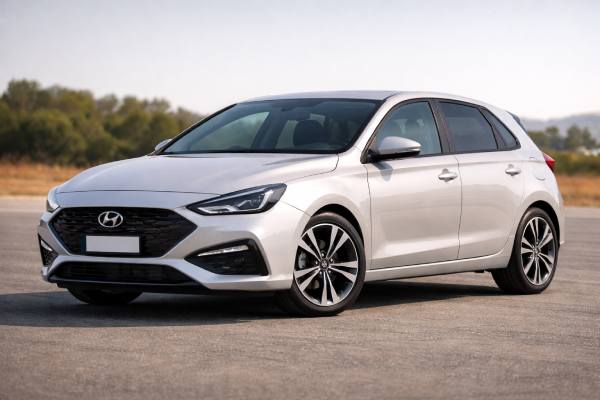
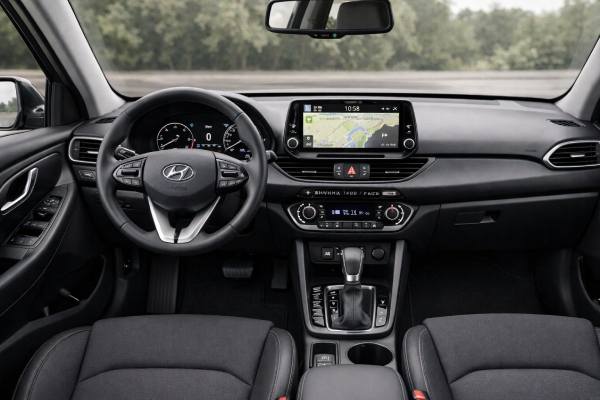
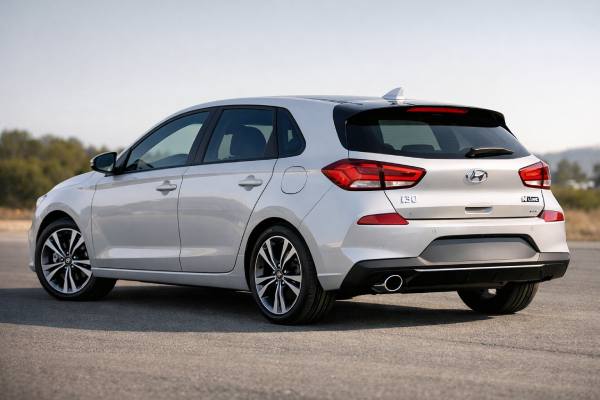
The current Hyundai i30 PD facelift with the 1.0 T-GDi 100 hp engine is a quietly important car. It sits at the sensible end of the compact hatchback class, but it still gives buyers modern driver assistance, a useful five-door body, a strong infotainment package, and a small turbo petrol engine that feels more flexible than its power output first suggests. This version also needs one important note up front: current i30 engine line-ups now vary more by market than many buyers expect. In some countries the post-2024 car is listed with a 100 hp 1.0 T-GDi, while other markets currently advertise a 115 PS version. This guide focuses on the 100 hp current-market specification. That matters because the ownership logic changes slightly. You are not buying this i30 for outright pace. You are buying it for low running costs, tidy packaging, straightforward drivability, and a better-than-average balance between comfort and technology.
What to Know
- The 1.0 T-GDi keeps the i30 light on its feet in town and easy to run on a daily budget.
- Boot space and rear-seat usability remain strong for a compact hatchback.
- Current cars bring better standard safety and cleaner infotainment than earlier facelift versions.
- Exact powertrain availability now varies by country, so confirm the VIN-spec engine and gearbox before buying.
- A practical oil-and-filter routine is every 10,000 to 15,000 km or 12 months.
On this page
- Hyundai i30 latest 100 hp portrait
- Hyundai i30 100 hp data tables
- Hyundai i30 100 hp grades and assistance
- Fault patterns and recall checks
- Service rhythm and smart buying
- Road feel and fuel use
- Rival match-up and verdict
Hyundai i30 latest 100 hp portrait
The 2024-onward i30 1.0 T-GDi 100 hp is best understood as the practical core of the current i30 range. Hyundai did not turn this latest update into a completely new car. Instead, it refined a familiar compact hatchback with cleaner lighting, better-connected cabin tech, more standard safety functions, and a tidier model structure in several European markets. That matters because the i30’s value has always come from balance rather than novelty. It offers enough space for family use, enough refinement for commuting, and enough equipment to avoid feeling like a stripped entry model.
The engine is the key to how this version should be judged. The 1.0 T-GDi is a three-cylinder turbo petrol that, in this current 100 hp form, focuses more on useful everyday torque than on outright speed. Official current market pages list 172 Nm with the 6-speed manual, and 200 Nm when paired with the 7-speed dual-clutch transmission. Those numbers explain why the i30 feels stronger in real traffic than its modest power figure suggests. It will not thrill a keen driver, but it pulls cleanly from low revs, handles urban use well, and feels appropriately matched to the car’s size.
The current update also sharpened the i30’s ownership case in less obvious ways. Standard LED lighting is more widely fitted. USB-C charging has become more common. Over-the-air map updates and broader Bluelink functionality make the cabin feel less dated. Hyundai also pushed more active-safety content deeper into the range, which is important because buyers in this part of the market often keep their cars for years and benefit more from dependable daily features than from one-off showroom tricks.
There is one point buyers should keep in mind. This generation now has more regional engine variation than earlier i30 ranges. Some official European Hyundai sites list the 1.0 T-GDi at 100 hp, while others currently show 115 PS. That does not mean the article target is wrong. It means you should treat the 100 hp car as a current market-specific version rather than assume every new i30 hatch in Europe is mechanically identical. That also affects resale comparisons, insurance quotes, and how used listings are described.
As a package, the current 100 hp i30 is not trying to be special. It is trying to be easy to own. That remains one of its strongest qualities.
Hyundai i30 100 hp data tables
Because current i30 specifications now vary by market, the most accurate way to present the 2024-present 1.0 T-GDi 100 hp car is to combine current official model-page data for the engine and equipment with unchanged body measurements carried over from Hyundai’s official i30 technical documents for the facelift body shell. Where a single Europe-wide current number is not openly published for this exact 100 hp hatch, the table notes that clearly.
| Powertrain and efficiency | Hyundai i30 1.0 T-GDi 100 hp |
|---|---|
| Code family | 1.0 T-GDi petrol |
| Engine layout and cylinders | Inline-3, 3 cylinders, DOHC, 4 valves per cylinder |
| Bore × stroke | 71.0 × 84.0 mm (2.80 × 3.31 in) |
| Displacement | 1.0 L (998 cc) |
| Induction | Turbocharged |
| Fuel system | Direct injection |
| Compression ratio | 10.5:1 |
| Max power | 100 hp class output, about 73.6 kW, market-listed as 100 ch or 100 CV |
| Max torque | 172 Nm (127 lb-ft) with 6MT; 200 Nm (148 lb-ft) with 7DCT |
| Timing drive | Chain |
| Rated efficiency | Market and wheel dependent; expect roughly mid-5s to low-6s L/100 km combined |
| Real-world highway at 120 km/h | Usually about 6.0 to 6.8 L/100 km in normal conditions |
| Transmission and driveline | Data |
|---|---|
| Transmission | 6-speed manual or 7-speed dual-clutch automatic |
| Drive type | Front-wheel drive |
| Differential | Open |
| Chassis and dimensions | Data |
|---|---|
| Front suspension | MacPherson strut |
| Rear suspension | Market-specific torsion beam or multi-link layout within the wider i30 family; most mainstream 1.0 hatch versions are not sold as sport chassis cars |
| Steering | Electric rack-and-pinion |
| Brakes | Front discs, rear discs or drums depending on market specification and wheel package |
| Popular tyre sizes | 195/65 R15, 205/55 R16, 225/45 R17 |
| Ground clearance | 140 mm (5.5 in) |
| Length | 4,340 mm (170.9 in) |
| Width | 1,795 mm (70.7 in) |
| Height | 1,455 mm (57.3 in) |
| Wheelbase | 2,650 mm (104.3 in) |
| Turning circle | About 10.6 m kerb-to-kerb (34.8 ft) |
| Kerb weight | Usually around 1,200 to 1,380 kg (2,646 to 3,042 lb), depending on gearbox and trim |
| GVWR | Typically around 1,780 to 1,830 kg (3,924 to 4,035 lb), depending on gearbox and market |
| Fuel tank | 50 L (13.2 US gal / 11.0 UK gal) |
| Cargo volume | 395 L seats up / 1,301 L seats folded, VDA (14.0 / 45.9 ft³) |
| Performance and capability | Data |
|---|---|
| 0–100 km/h | Current open market pages do not publish one universal Europe-wide figure for the 100 hp hatch; expect low-12s manual and slower DCT market sheets depending on trim and homologation |
| Top speed | Market dependent; generally below the 115 PS version and broadly in the upper-170s to low-180s km/h range |
| Braking distance | Not publicly published as one factory number for this exact current-market variant |
| Towing capacity | Varies by market, gearbox, and homologation sheet; verify by VIN before buying for towing use |
| Payload | Trim and gearbox dependent |
| Fluids and service capacities | Practical note |
|---|---|
| Engine oil | Use VIN-correct Hyundai-approved full-synthetic oil; 0W-30 or 5W-30 are common European grades |
| Coolant | Hyundai-approved coolant only; verify exact fill by VIN |
| Transmission fluid | Manual and DCT use different fluids; do not mix specifications |
| Differential / transfer case | Not applicable |
| A/C refrigerant | Verify by VIN and build date before service |
| Key torque specs | Wheel, brake, and suspension torque values should always be confirmed in workshop documentation |
| Safety and driver assistance | Data |
|---|---|
| Euro NCAP | 5 stars for the i30 model family |
| Adult occupant | 88% |
| Child occupant | 84% |
| Vulnerable road users | 64% |
| Safety assist | 68% |
| IIHS | Not applicable for this European-market model line |
| ADAS suite | AEB, lane keeping, lane following, speed-limit support, parking assistance, rear occupant alert, and other SmartSense items depending on market and trim |
The main thing these figures show is that the 100 hp i30 is a measured, efficiency-led hatchback. It is not under-engineered. It is simply calibrated toward low-cost daily use instead of performance.
Hyundai i30 100 hp grades and assistance
For the current 100 hp i30, the clearest baseline region is France, where Hyundai’s official current pages show the 1.0 T-GDi 100 hp hatch with a simple trim structure built around Creative and N Line. That is useful because it gives buyers a clean picture of how Hyundai currently positions this engine: not as the cheapest possible bare-bones i30, but as a mainstream, properly equipped compact hatch.
Creative is the sensible starting point. It already includes the equipment most real owners want. Official current feature lists show front and rear parking assistance with reversing camera, automatic climate control, a wireless charging pad, cruise control with speed limiter, power-folding mirrors, and a 10-inch Bluelink-connected multimedia system with over-the-air update capability. That means even the lower trim feels modern enough in 2026. You are not dealing with a car that forces buyers straight into the options list just to get daily essentials.
N Line is the sportier-looking step up, but on the 100 hp car it should be seen mainly as an appearance and comfort package rather than a fundamentally different mechanical version. In current French trim descriptions, N Line adds a 10-inch digital cluster, 18-inch alloy wheels, adaptive cruise control, heated front seats with power adjustment, leather and Alcantara trim, a panoramic roof, and the expected N Line interior and exterior styling. Visually, it is the more interesting car. Financially, it is also the one that can become expensive to re-tyre and slightly firmer to ride.
Safety is one of the current i30’s stronger selling points. The i30 family still carries a five-star Euro NCAP result, and Hyundai has continued to add safety content over the recent updates. Current official model pages emphasize seven additional SmartSense-related functions across the refreshed line, and current feature pages specifically reference systems such as rear occupant alert, multi-collision braking, intelligent speed support, and Highway Driving Assist 1.5 in markets and trims where fitted. Exact standard and optional status varies by country, which is now more important than before because Hyundai no longer presents one perfectly unified Europe-wide trim logic.
There are a few practical ownership implications here. First, calibration matters. A windshield replacement or front-end repair on a current i30 can affect camera-based systems, so used buyers should ask whether any ADAS recalibration was completed. Second, base and mid trims now carry more equipment than many earlier i30s, so there is less pressure to chase the highest trim unless you specifically want the N Line look, larger wheels, or extra cabin comfort. Third, if you are cross-shopping between countries, do not assume the same trim name means the same standard equipment.
In short, the current 100 hp i30 is strongest when bought as a well-equipped mainstream hatch, not when judged only by its modest engine output.
Fault patterns and recall checks
The current 1.0 T-GDi i30 does not yet have the kind of long-run ownership history that lets anyone call it fully proven in 2026. But because the car is an update of an established i30 platform and a familiar Hyundai small-turbo petrol architecture, the likely reliability picture is fairly predictable. The key is to separate normal modern-car annoyances from real mechanical risk.
The most common low-cost faults are likely to be electrical or sensor-related rather than major engine failures. Weak 12V batteries, low system voltage, or intermittent connection issues can trigger stop-start complaints, warning messages, parking-sensor faults, or infotainment resets. These problems often feel dramatic to owners because they show up as dashboard alerts, but many are still routine modern-car issues rather than deep design failures.
The next area to watch is transmission behavior on DCT cars. Hyundai’s 7-speed dual-clutch units can work well, but buyers should still road test them carefully in parking-speed traffic, repeated creeping starts, and incline maneuvers. Symptoms such as hesitation, abrupt take-up, or shudder under light throttle usually point first to calibration, clutch adaptation, or wear rather than catastrophic gearbox damage. The manual remains the safer long-term choice for buyers who prioritize simplicity over convenience.
Engine-side concerns are typical small-turbo petrol items. Watch for:
- Rough cold starts or misfire under load, often tied to spark plugs, coils, or intake leaks.
- Poor short-trip use, which increases fuel dilution risk and carbon deposit buildup over time.
- Boost-control or sensor issues if the car feels flat or inconsistent in the mid-range.
- Chain noise at cold start, which should not be ignored even though the 1.0 T-GDi is not defined by a widely recognized chain crisis.
There is also the issue of market variation. Because the current i30 now differs more by country, software levels, trim equipment, and even published engine outputs can differ more than many buyers expect. That makes paper history more important. Dealer or specialist invoices matter. A generic stamp book matters less.
As for recalls and service campaigns, the correct approach is always VIN-specific. Hyundai’s official recall and campaign checker is the right first step. Do not rely on general forum posts or country-specific rumor lists. A current i30 can have completed campaigns, software updates, or service actions that never appear in the sales ad. For a used example, ask for proof of completed recall work and dealer records.
The overall reliability outlook looks reasonable, but the best cars will still be the ones serviced on time, kept standard, and not run permanently on the cheapest tyres and longest oil intervals.
Service rhythm and smart buying
The current 1.0 T-GDi i30 is the kind of engine that benefits from sensible maintenance more than heroic repair work. Small turbo petrol units are usually happiest on clean oil, healthy ignition parts, and a strong battery. That makes the right service rhythm more important than waiting for problems to announce themselves.
A practical owner schedule looks like this:
| Item | Practical interval |
|---|---|
| Engine oil and filter | Every 10,000 to 15,000 km or 12 months |
| Engine air filter | Inspect yearly, replace around 30,000 km sooner in dusty use |
| Cabin filter | Every 12 months or 15,000 to 20,000 km |
| Spark plugs | Around 60,000 km is a sensible target |
| Brake fluid | Every 2 years |
| Coolant | Inspect annually and replace to VIN-specific schedule |
| Manual gearbox | Check operation and leaks at every service |
| DCT health check | At every service and during every used-car test drive |
| Brake pads and discs | Inspect every service |
| Tyre rotation and wear check | About every 10,000 km |
| Wheel alignment | Yearly or after pothole impacts |
| 12V battery test | Annually after year 3 or 4 |
| Timing chain | No routine replacement interval, but inspect if noisy or if timing-correlation faults appear |
For fluids, the safe rule is easy: use Hyundai-approved products and the exact VIN-correct specification. This matters more on newer cars than many owners assume. Wrong engine oil, poor-quality coolant, or “close enough” DCT fluid can create drivability problems that are later misdiagnosed as bigger failures.
The used-buyer checklist should stay disciplined:
- Confirm the exact engine output and gearbox by VIN, especially in cross-border listings.
- Ask for invoices, not just service stamps.
- Cold-start the engine and listen for rough idle, chain rattle, or misfire.
- On DCT cars, test crawl-speed manners, reverse, and hill starts.
- Check tyre brand and tread wear pattern. Cheap mismatched tyres are a warning sign.
- Verify all parking aids, camera functions, and SmartSense warnings are clear.
- Ask whether the windshield has ever been replaced and whether ADAS calibration followed.
- Inspect for accident-repair clues around the nose, grille, and camera area.
- Check boot and rear-seat trim for rattles or poor refit if interior work was done.
For most buyers, the best version is a mid-trim manual with a full history and sensible wheel size. N Line looks sharper, but a Creative-type car is often the smarter long-term buy. Durability should be good if maintenance is kept simple, regular, and slightly more conservative than the longest possible official interval.
Road feel and fuel use
From the driver’s seat, the current i30 1.0 T-GDi 100 hp feels exactly like a modern compact hatch should feel: easy to place, light enough in town, stable enough on the motorway, and mature enough that nothing stands out as awkward. It is not a car that seduces you with one brilliant dynamic trick. Its strength is that it rarely gets tiring.
The engine’s character suits that mission. At low revs, it behaves like most small turbo three-cylinders and needs a moment to gather itself. Once the turbo is in its useful band, the i30 feels more willing than the 100 hp label suggests. In traffic, the manual version is simple and intuitive. The DCT version gives easier commuting but can feel slightly less fluid at walking pace, which is common for this transmission type. Neither version is exciting. Both are usable.
Ride quality remains one of the i30’s better traits. On smaller wheels, the chassis absorbs urban roughness well and stays settled at speed. Larger N Line wheel packages sharpen the look but bring more road noise and a slightly firmer edge over broken surfaces. Steering is light rather than chatty, but that suits the car. Straight-line stability is good, and braking feel is predictable even if the standard setup is clearly tuned for normal driving rather than enthusiastic use.
Real-world fuel use is one of the reasons to choose this engine. In mixed conditions, expect roughly 5.8 to 6.8 L/100 km depending on the route, weather, and transmission. Steady highway running at 100 to 120 km/h usually lands around 6.0 to 6.8 L/100 km. Cold starts, short urban trips, and heavy stop-go use can push that into the 7.0s. That is not class-leading magic, but it is respectable and easy to live with.
The performance story is honest. This is not a fast hatchback. Overtakes require a gear change and some planning, especially with passengers aboard. Yet the i30 rarely feels painfully slow because the mid-range torque is usable and the gearing is sensible. For buyers moving out of an older naturally aspirated compact car, the current 1.0 T-GDi often feels more responsive than expected.
In everyday driving, that matters more than raw acceleration numbers. The i30 100 hp wins by being cooperative, predictable, and efficient enough to keep daily costs under control.
Rival match-up and verdict
The current i30 1.0 T-GDi 100 hp sits in one of the market’s hardest jobs: the mainstream compact hatchback that has to be competent at everything while remaining affordable. Its rivals include the Kia Ceed 1.0 T-GDi, Volkswagen Golf 1.0 TSI or equivalent lower-output petrol versions, Opel Astra petrol models, Peugeot 308 entry petrols, Renault Megane petrols in remaining markets, and the Toyota Corolla if buyers are willing to shift toward hybrid logic instead.
Against the Kia Ceed, the i30 feels very closely matched in purpose. The difference often comes down to trim, pricing, and how each car was specified rather than any dramatic mechanical gap. The Hyundai tends to feel slightly more conservative in presentation. The Kia can look a little fresher depending on trim. In used form, service history matters more than brand preference.
Against the Volkswagen Golf, the Hyundai usually loses some perceived-cabin polish and badge strength, but wins on equipment value. That matters a lot in this part of the market. A current i30 often gives buyers more standard technology and a clearer trim strategy without demanding a premium brand-tax price. For many real owners, that is the better deal.
The Peugeot 308 and Opel Astra can feel more visually modern in some trims, but the Hyundai often answers with easier ergonomics and a calmer ownership experience. The Toyota Corolla is the smarter urban economy pick if full-hybrid operation is the priority. The i30 is the better fit for buyers who still want a conventional petrol hatch with a manual option, familiar mechanical feel, and simpler everyday behavior.
That is really the point of this current 100 hp i30. It is not an emotional purchase. It is a rational, better-than-average one. It has enough space, enough safety, enough technology, and enough performance for buyers who want one car to do everything reasonably well.
If you drive mostly normal distances, want low ownership stress, and prefer sensible engineering over trend-driven marketing, the current Hyundai i30 1.0 T-GDi 100 hp remains an easy car to recommend. Just make sure you verify the exact market specification, because with today’s i30, the details matter more than the badge on the tailgate.
References
- Hyundai i30 | La berline compacte 2026 (Model Overview)
- Hyundai i30 | Equipements 2026 (Technical Features)
- Hyundai i30 Technical Specifications 2020 (Technical Data)
- EuroNCAP | Hyundai i30 2020 (Safety Rating)
- Home | Hyundai Recalls & Service Campaigns 2026 (Recall Database)
Disclaimer
This article is for informational purposes only and is not a substitute for professional diagnosis, repair, or VIN-specific workshop guidance. Specifications, torque values, intervals, procedures, and equipment can vary by VIN, market, trim, gearbox, and production date, so always verify the exact details against official Hyundai service documentation for the vehicle you are buying or servicing.
If this guide was useful, please consider sharing it on Facebook, X, or another social platform to support our work.