
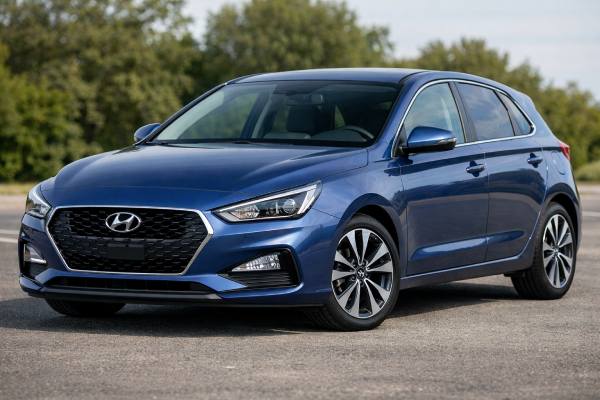
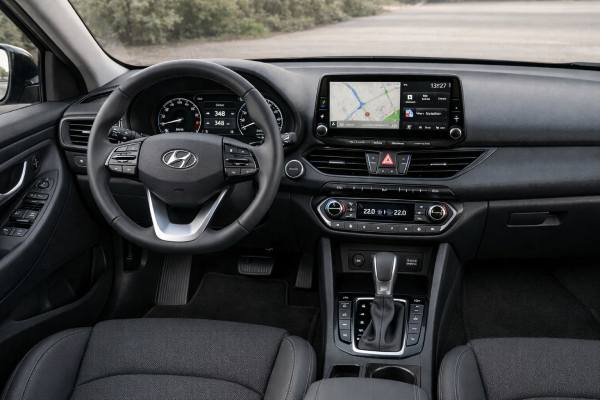
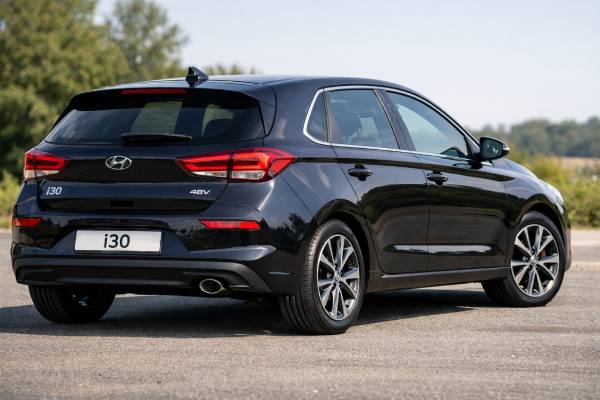
The facelifted Hyundai i30 PD 1.5 DPi 96 hp is the definition of a rational modern hatchback. It keeps the i30’s familiar strengths—good packaging, easy controls, mature ride comfort, and a strong safety baseline—but pairs them with a simple naturally aspirated 1.5-litre petrol engine instead of the more complex turbo or diesel options higher up the range. For many buyers, that is the real appeal. This version is not quick, but it is straightforward, quieter in town than a small turbo under load, and less mechanically busy than the electrified alternatives. The late 2024-onward update also brought sharper styling, more standard driver-assistance tech, and broader equipment depending on market. This guide uses the current Austrian-market hatchback as its baseline because Hyundai still openly publishes the 96 PS 1.5 DPi there. That matters, since the i30’s engine range now varies more by region than many buyers expect.
Top Highlights
- The 1.5 DPi is the simplest current petrol i30 option, with no turbocharger and no mild-hybrid hardware to complicate ownership.
- Facelift cars gained stronger standard safety equipment, improved connectivity, and a cleaner cabin layout.
- The i30 still offers a useful 395 L boot and compact exterior dimensions that suit daily family use.
- The main trade-off is performance: this engine is smooth and honest, but it needs revs and planning when the car is fully loaded.
- A sensible used-ownership oil interval is 10,000–15,000 km or 12 months, even if broader service schedules differ by market.
On this page
- Hyundai i30 1.5 DPi Snapshot
- Hyundai i30 1.5 DPi Numbers
- Hyundai i30 Features and Safety
- Known Issues and Dealer Fixes
- Ownership Schedule and Purchase Checks
- Daily Use and Efficiency
- Versus Golf, Ceed and Corolla
Hyundai i30 1.5 DPi Snapshot
The current 1.5 DPi i30 exists for buyers who still want a normal petrol hatchback without extra powertrain layers. That sounds simple, but in today’s market it is increasingly unusual. Many rivals now push buyers toward small turbo engines, mild-hybrid systems, or full hybrids even at the lower end of the range. Hyundai’s naturally aspirated 1.5 DPi takes a different path. It gives you four cylinders, multipoint-style petrol fueling rather than turbo direct-injection as the only option, a six-speed manual gearbox, and front-wheel drive in a package that is easier to understand long term.
That mechanical simplicity is the car’s main advantage. This is not the i30 to buy if you want effortless acceleration or sporty character. It is the i30 to buy if you value smoother low-speed response, predictable maintenance, and a lower chance of expensive turbo-related repairs later in life. Hyundai’s published figures show 96 PS and 139.3 Nm, which means the car is clearly an entry engine in this class. On paper, that looks modest. In practice, it is good enough for commuting, urban use, regional roads, and family duties if you are happy to shift gears properly and avoid expecting turbo-style mid-range shove.
The late-update i30 also benefits from Hyundai’s continued improvement of the PD platform. The structure remains solid, the controls are straightforward, and the car feels like a mature European-tuned hatchback rather than an entry-level compromise. The 2024 update added more standard Hyundai Smart Sense safety features, extra interior and boot lighting, standard front and rear parking sensors in some market specifications, and upgraded connectivity and charging points. Those details sound small, but together they help the car feel newer than the aging platform alone might suggest.
This version also keeps the i30’s core packaging strengths intact. The hatchback body gives you a 395-litre boot, a 60:40 folding rear bench, useful second-row space for the class, and dimensions that remain easy to manage in town. At 4,340 mm long and 1,795 mm wide, it still fits daily European driving better than many crossovers that cost more and offer less control from behind the wheel. Ground clearance is modest, but that helps the car feel settled and car-like rather than SUV-ish.
The main ownership compromise is easy to define. The 1.5 DPi suits calm, sensible driving. It is not badly matched to the i30, but it does ask more of the driver than the turbo engines do when the car is heavily loaded or used on fast roads. That is why this model works best for buyers who prioritize simplicity, not speed. If that sounds like your brief, it may actually be one of the most sensible late-PD i30s you can buy.
Hyundai i30 1.5 DPi Numbers
For this guide, the reference car is the current late-facelift European hatchback with the 1.5 DPi 96 PS engine and six-speed manual gearbox. Hyundai’s open Austrian technical sheet is the clearest current source for this exact version. Some workshop-level data still varies by VIN, market, and equipment level, so those items should always be confirmed against the official service data for the exact car.
| Powertrain and efficiency | Value |
|---|---|
| Code | 1.5 DPi Smartstream/Kappa family |
| Engine layout and cylinders | Inline-4, DOHC, 4 cylinders, 4 valves per cylinder |
| Displacement | 1.5 L (1,498 cc) |
| Bore × stroke | 72.0 × 92.0 mm (2.83 × 3.62 in) |
| Induction | Naturally aspirated |
| Fuel system | Dual-port / multipoint petrol injection |
| Compression ratio | 11.0:1 |
| Max power | 96 hp (70.6 kW) @ 6,000 rpm |
| Max torque | 139.3 Nm (102.7 lb-ft) @ 3,500 rpm |
| Timing drive | Chain |
| Rated efficiency | 6.2–7.1 L/100 km (37.9–32.8 mpg US / 45.6–39.8 mpg UK), trim dependent |
| Real-world highway @ 120 km/h | about 6.5–7.5 L/100 km |
| Transmission and driveline | Value |
|---|---|
| Transmission | 6-speed manual |
| Drive type | FWD |
| Differential | Open |
| Chassis and dimensions | Value |
|---|---|
| Suspension front/rear | MacPherson strut / torsion beam on 1.5 DPi applications |
| Steering | Electric rack-and-pinion; steering ratio about 13.4:1 from published PD-family data |
| Brakes | Front discs and rear discs |
| Brake diameters | About 280 mm front, 272 mm rear in earlier published 1.5 DPi data; verify exact trim |
| Wheels and tyres | 195/65 R15 or 205/55 R16 are the common 1.5 DPi sizes |
| Ground clearance | 140 mm (5.5 in) |
| Length / width / height | 4,340 / 1,795 / 1,453–1,455 mm (170.9 / 70.7 / 57.2–57.3 in) |
| Wheelbase | 2,650 mm (104.3 in) |
| Turning circle | 10.6 m (34.8 ft) |
| Kerb weight | 1,176–1,225 kg (2,593–2,701 lb), trim dependent |
| GVWR | 1,750 kg (3,858 lb) |
| Fuel tank | 50 L (13.2 US gal / 11.0 UK gal) |
| Cargo volume | 395 L / 1,301 L (13.9 / 45.9 ft³), VDA |
| Performance and capability | Value |
|---|---|
| 0–100 km/h (0–62 mph) | 13.4 s |
| Top speed | 197 km/h (122 mph) |
| Braked towing | 1,010 kg (2,227 lb) |
| Unbraked towing | 610 kg (1,345 lb) |
| Payload | roughly 525–574 kg depending on trim |
| Fluids and service capacities | Value |
|---|---|
| Engine oil | Hyundai-approved full-synthetic oil, typically 5W-30 or market-specific equivalent |
| Engine oil capacity | about 3.4 L (3.6 US qt) with filter |
| Coolant | Hyundai-approved long-life coolant at the correct mix ratio |
| Coolant capacity | about 5.8 L (6.1 US qt) |
| Transmission fluid | Hyundai manual-transmission fluid for the exact gearbox code |
| Transmission fluid capacity | about 1.6 L (1.7 US qt) |
| Differential / transfer case | not applicable as separate service units |
| A/C refrigerant | verify by under-bonnet label and VIN |
| A/C compressor oil | verify by refrigerant type and VIN |
| Key torque specs | always verify wheel, brake, spark plug, and drain-plug figures in official service data |
| Safety and driver assistance | Value |
|---|---|
| Euro NCAP family baseline | 5 stars |
| Adult occupant protection | 88% |
| Child occupant protection | 84% |
| Vulnerable road users | 64% |
| Safety assist | 68% |
| ADAS suite | FCA/AEB, lane keep assist, lane following assist, intelligent speed assist, rear occupant alert, parking sensors, and market-specific options |
The numbers show why this car appeals to a certain kind of buyer. It is not powerful, but it is mechanically simple. It is not especially light, yet it remains compact. Most of all, it delivers enough practicality and enough efficiency without turning the ownership experience into a science project.
Hyundai i30 Features and Safety
For the current 1.5 DPi i30, trim structure is heavily market-specific. In Austria, where Hyundai still openly lists this engine in current price and technical documents, the hatchback is offered in Smart Line, GO!, and GO! Plus forms. That is a useful baseline because it shows how Hyundai positions the 96 PS version today: as the simple, value-focused part of the range rather than the sporty or premium one.
Smart Line is better equipped than many entry trims used to be. In the current Austrian-market sheet, even the base car includes LED low and high beam lights, LED tail lamps, a reversing camera, front and rear parking sensors, navigation with a 10.25-inch display, Apple CarPlay and Android Auto, Bluelink connectivity, cruise control with speed limiter, manual climate control, leather steering wheel, and a meaningful bundle of safety systems. That is a strong starting point, especially for an entry engine. In older market logic, many of those features would have been locked into a higher trim.
GO! adds the comfort items most private buyers usually want, including 17-inch wheels, privacy glass, wireless phone charging, two-zone climate control, heated front seats, heated steering wheel, shift paddles on DCT cars where relevant, electric parking brake with auto hold, and a larger digital instrument display. GO! Plus builds further with more cabin polish and convenience details. In everyday terms, GO! is the likely sweet spot if you want the 1.5 DPi but do not want the car to feel basic.
Safety is one of the i30’s quiet strengths. The PD family earned a five-star Euro NCAP result, and while that official test dates back to the earlier phase of the generation, the late-update car benefits from additional active-safety hardware and software. Hyundai’s 2024 update states that the new i30 comes standard with more Hyundai Smart Sense features, including Forward Collision-Avoidance Assist, Lane Following Assist, and Intelligent Speed Limit Assist. The update also brought Rear Occupant Alert logic and optional Highway Driving Assist 1.5 in some versions, along with optional expanded FCA support including Junction Turning in certain markets.
The current Austrian equipment sheet also shows that even current lower trims carry a serious safety baseline. That includes driver and passenger airbags, front side airbags, curtain airbags, ABS, ESP, hill-start assist, Intelligent Speed Limit Assist, Rear Seat Alert, multi-collision braking, Forward Collision-Avoidance Assist, Lane Following Assist, Lane Keep Assist, TPMS, ISOFIX on the outer rear seats, and electronic power steering. That is a long list for a modest-power family hatchback.
For used or nearly new buyers, the biggest practical lesson is not to assume all current i30s are identically equipped just because they share the same face. Safety and convenience content still changes by country, pack, and dealer stock. So when you inspect a car, verify the actual hardware. Check the screen size, look for the driver-assistance menus, test the parking sensors and camera, and confirm whether the car has the exact lighting and wheel package you expect.
This also matters after repair work. Any current i30 with windscreen replacement or front-end repair should be checked for proper camera and assistance-system calibration. That is true of most late-model cars, but it is especially relevant on a model where the standard safety package has become such a big part of the value proposition.
Known Issues and Dealer Fixes
The 1.5 DPi is probably the least risky current i30 petrol powertrain from a complexity point of view, but that does not mean it is completely issue-free. The good news is that most likely faults are the ordinary modern-car kind rather than deep design failures. The better news is that this engine avoids several of the bigger long-term variables that come with turbocharging and mild-hybrid hardware.
A realistic issue map looks like this:
- Common and lower-cost: weak 12V batteries, infotainment glitches, parking sensor faults, tyre-pressure warnings, and occasional trim rattles.
- Occasional and medium-cost: ignition-coil or spark-plug wear causing rough running, coolant seepage from hoses or thermostat-area components, and front suspension consumables such as drop links and bushes.
- Less common but worth checking: timing-chain noise on poorly maintained cars, intake contamination over high mileage, and wear-related clutch or gearshift feel problems on hard-used examples.
- Rare compared with turbo models: there is no turbocharger or 48V mild-hybrid system to add extra failure points, which is one of this engine’s strongest ownership arguments.
The engine’s naturally aspirated layout simplifies the picture. There is less heat stress than on the turbo engines, and there is no boost system to leak or fail. That said, the 1.5 DPi still depends on correct oil, clean ignition components, and proper servicing. Rough running under load, uneven idle, or hesitant throttle response should still prompt inspection of coils, plugs, intake cleanliness, and service history. A simple engine is usually forgiving, but it is not invincible.
The timing chain is another area where simplicity does not mean neglect-proof. Hyundai’s published earlier technical data for the 1.5 DPi shows a chain-driven valvetrain, which avoids a scheduled timing-belt cost but does not remove the need for proper oil changes. If you hear chain noise at cold start, or if the car shows timing-correlation faults, investigate it early. On naturally aspirated family cars, long oil intervals often hide the first signs of chain wear until owners stop listening.
Chassis wear tends to follow normal family-hatch patterns. Front tyres, drop links, lower-arm bushes, and brake wear matter more on rough urban roads than on gentle motorway use. The 1.5 DPi usually sits on smaller wheels than sportier i30 versions, which helps both comfort and long-term suspension life. That is a real benefit if you plan to keep the car for years.
Software and dealer updates still matter, even on a simpler model like this. Hyundai’s current servicing information says retailers check and perform recommended updates free of charge during service visits. That can help with infotainment behavior, vehicle systems, and safety-feature refinements. On a late-model car with more standard ADAS, a full service history is valuable not only because it proves oil changes, but because it suggests the car stayed connected to the manufacturer’s update cycle.
For recalls and service actions, the correct process remains VIN-first verification. Do not rely on model-year assumptions or general internet advice. Ask a Hyundai dealer to check campaign status and completion history for the exact car. On current-generation cars with more electronics and safety systems, that is part of responsible buying, not just paperwork tidying.
Ownership Schedule and Purchase Checks
The i30 1.5 DPi is a car that rewards sensible, low-drama maintenance. That is one of its strongest selling points. Hyundai’s broader market schedules can allow relatively long inspection intervals, but a used or long-term private owner is usually better served by more frequent basic care. The engine is simple enough that routine attention goes a long way.
A practical ownership schedule looks like this:
| Item | Practical interval | Notes |
|---|---|---|
| Engine oil and filter | 10,000–15,000 km or 12 months | Even if some market schedules are longer, this is the safer long-term rhythm |
| Main service inspection | 12 months | Check brakes, tyres, battery, cooling system, and electronics yearly |
| Engine air filter | Inspect yearly, replace around 20,000–30,000 km | Sooner in dusty use |
| Cabin filter | 12 months or 15,000–20,000 km | Cheap and worth keeping fresh |
| Spark plugs | Around 45,000–60,000 km | Earlier replacement helps smoothness and starting |
| Coolant | Check every service, replace by official schedule | Use only the correct Hyundai coolant |
| Brake fluid | Every 2 years | Important for corrosion control and pedal feel |
| Brake inspection | Every service | Pads, discs, hoses, and slider condition matter |
| Manual gearbox oil | Inspect for leaks; refresh by condition and mileage | Use the exact Hyundai fluid |
| Timing chain | No routine replacement interval, but inspect on symptoms | Noise, poor oil history, or timing faults matter |
| Auxiliary belt and hoses | Inspect every service | Replace on cracking, squeal, or age |
| Tyres and alignment | Pressure monthly; alignment when wear pattern changes | Uneven wear is a clue, not bad luck |
| 12V battery | Test yearly from around year 4 onward | Weak batteries cause many nuisance faults |
In service-planning terms, the 1.5 DPi keeps things simple. Public PD-family technical data lists about 3.4 litres of engine oil, around 5.8 litres of coolant, and about 1.6 litres of manual gearbox oil. Those are useful planning figures, but the exact fill and fluid specification should still be confirmed by VIN and market because Hyundai’s regional manuals and parts systems can differ.
For buyers, the checklist is refreshingly straightforward:
- Cold start quality and idle smoothness.
- Clean gearshift action and clutch take-up.
- No misfire, hesitation, or stumble under load.
- Coolant level and no staining around hoses or thermostat housing.
- Matching tyres and even wear across the axle.
- Working parking sensors, reversing camera, touchscreen, and smartphone connection.
- No warning lights for engine, TPMS, safety systems, or battery.
- Full service invoices, not just a stamped booklet.
- Proof of campaign or software-update completion where available.
- Clean underside and suspension condition, especially on rough-road cars.
The best used buys are likely to be simple, unmodified cars in Smart Line or GO! specification with complete service records and sensible tyres. GO! is particularly attractive because it adds meaningful comfort without turning the car into a more complex drivetrain package. The examples to approach more carefully are neglected low-mileage city cars with weak batteries, poor service proof, or repeated electronic complaints.
Long term, the durability outlook is good. This is one of the few current compact cars where the basic version may genuinely be the safest ownership bet.
Daily Use and Efficiency
The i30 1.5 DPi drives exactly the way its numbers suggest: cleanly, predictably, and without drama. That can sound faint praise, but for many buyers it is ideal. The engine is not quick, and it does not produce the effortless mid-range shove of Hyundai’s 1.5 T-GDi. What it offers instead is progressive response, smoother low-speed manners than many small turbos, and a simpler character that feels well suited to commuting and town work.
Around town, the naturally aspirated setup is easy to manage. Throttle response is linear, clutch take-up is usually light, and the car feels calm rather than busy. Because peak torque arrives at 3,500 rpm, you do need to use the gearbox more actively than in a turbo model. That is especially true with passengers or on steep inclines. But for drivers who do not mind shifting properly, the engine feels honest rather than strained.
On the open road, the i30 remains a mature compact hatchback. Straight-line stability is good, the steering is light but accurate enough, and the suspension tuning favours comfort over excitement. Smaller-wheel 1.5 DPi cars often ride better than higher-trim turbo or N Line versions, which is a real ownership advantage on patched urban roads and rough secondary routes. The rear torsion-beam setup on this engine is simpler than the more expensive versions, but in normal driving it rarely feels crude.
Cabin noise is acceptable for the class. At steady motorway speeds, wind and road noise are well contained, and the engine settles into the background once cruising. The main limitation appears when you need a fast overtake or climb a long grade with load onboard. Then the lack of low-end torque becomes obvious. This is where buyers must be honest about use case. If your daily life includes frequent full-load motorway work, the turbo engines are more relaxed. If most of your driving is urban or mixed and you value simplicity, the DPi still makes sense.
Real-world fuel use is fair rather than exceptional. The current WLTP span of 6.2–7.1 L/100 km reflects trim and wheel differences, and real owners should expect something close to that. In mixed use, around 6.6–7.6 L/100 km is realistic. At a steady 100–120 km/h, around 6.5–7.5 L/100 km is a good expectation. Cold weather, full loads, aggressive motorway driving, and repeated short trips can push the number higher. Because this is a naturally aspirated petrol engine in a C-segment hatch, you should not expect hybrid-like economy.
Performance is best understood as sufficient, not brisk. A 13.4-second 0–100 km/h time tells the truth. The i30 1.5 DPi is usable rather than fast. But that does not make it unpleasant. In calm driving, it feels refined enough, balanced enough, and predictable enough to be easy company. For some buyers, that matters more than shaving a few seconds off a sprint figure they rarely use.
Versus Golf, Ceed and Corolla
The i30 1.5 DPi occupies a slightly unusual position because many of its natural rivals have moved either toward downsized turbos or hybrid systems.
Against the Volkswagen Golf with an entry petrol engine, the Hyundai usually gives away some interior polish and a little brand prestige. The Golf often feels more expensive for a reason. But the i30 counters with value, strong standard equipment in the right markets, and a refreshingly straightforward ownership pitch. If you can buy a newer, better-equipped i30 for the same money as an older base Golf, the Hyundai’s logic becomes very strong.
Against the Kia Ceed, the comparison is especially close. The two brands share broad philosophy and often similar ownership logic. The Kia may look slightly fresher inside depending on year and trim, while the Hyundai often feels a touch more conservative and mature. On the used market, this is usually a battle of condition, equipment, and service history rather than one of major engineering difference. If both cars are equal, the Hyundai’s current 96 hp naturally aspirated simplicity is a genuine selling point.
Against the Toyota Corolla, the i30 loses the hybrid advantage. The Corolla will usually beat it in urban fuel economy and can feel more advanced in stop-start driving. But the Hyundai answers with a lower complexity threshold in this specific version, a manual gearbox for drivers who still want one, and a more traditional non-hybrid ownership experience. Some buyers still prefer that. They want a normal petrol hatchback with current safety tech, not a car whose main selling point is electrification.
You could also compare it with the Ford Focus, but the Ford’s future in this class has become more complicated and its strengths lean more toward driving feel than toward current simplicity. The Hyundai’s advantage is clarity. It is easy to understand what it is for: a practical, safe, well-equipped family hatch with manageable size and straightforward running.
That is the heart of the verdict. The 2024-onward Hyundai i30 1.5 DPi 96 hp is not the exciting choice, the fastest choice, or the most efficient choice in every situation. It is the sensible choice for buyers who still want a current compact hatchback with a simple petrol engine, solid safety, a useful boot, and a clear ownership story. In a market full of small turbos, mild hybrids, and more complex alternatives, that may be exactly its strongest advantage.
References
- Bolder and more high-tech: i30 gets update 2024 (Press Release)
- TECHNISCHE DATEN i30 HATCHBACK / KOMBI / FASTBACK 2025 (Technical Data)
- Der neue Hyundai i30 2025 (Brochure)
- EuroNCAP | Hyundai i30 2017 (Safety Rating)
- Routine Servicing 2026 (Servicing)
Disclaimer
This article is for informational purposes only and is not a substitute for professional diagnosis or repair. Specifications, torque values, service intervals, procedures, fluid grades, capacities, and equipment vary by VIN, market, trim, and production date, so always verify details against the official Hyundai service documentation for the exact vehicle.
If this guide was useful, please consider sharing it on Facebook, X, or another platform to support our work.