
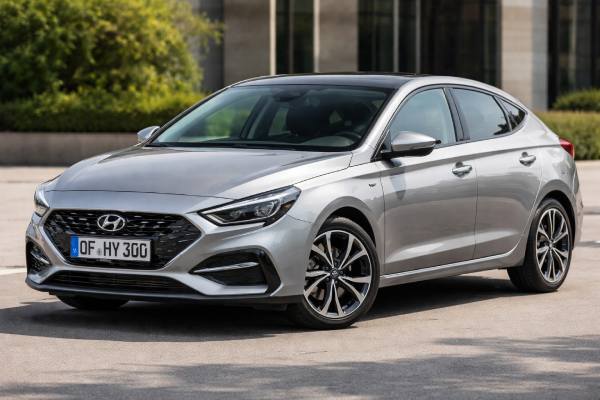
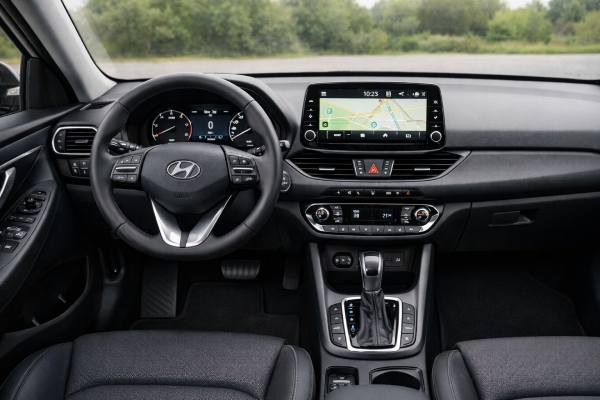

The facelift Hyundai i30 Fastback PD 1.6 CRDi 48V is an interesting car because it mixes three things that do not often come together cleanly: a sleek five-door fastback body, strong diesel long-distance efficiency, and a mild-hybrid system that adds polish without turning the car into something complicated to use. In 136 hp form, it is not a performance model, but it is a very capable real-world cruiser. The engine brings strong mid-range torque, the chassis remains composed at motorway speed, and the Fastback body gives the i30 line a more distinctive shape than the standard hatchback. The trade-off is that this is still a modern emissions-controlled diesel with SCR, DPF, AdBlue, and extra 48-volt hardware under the cargo floor. That means buying the right example matters. For drivers who cover steady mixed or highway mileage and want something more stylish than a normal family hatchback, the facelift i30 Fastback diesel can be a genuinely smart used choice.
Quick Specs and Notes
- Strong mid-range torque and relaxed motorway behavior are the main strengths of this powertrain.
- The Fastback body looks more distinctive than the hatchback while staying useful for daily family use.
- The 48-volt system adds a little refinement and efficiency without changing the car’s basic diesel character.
- Short-trip use can bring DPF, EGR, NOx-sensor, or AdBlue complaints if maintenance has been delayed.
- A 12-month or 15,000 km engine-oil service rhythm is the safest real-world habit for long-term ownership.
Section overview
- Hyundai i30 Fastback 48V profile
- Hyundai i30 Fastback 48V numbers
- Hyundai i30 Fastback trims and protection
- Failure patterns and service actions
- Maintenance route and buyer checks
- Road feel and real efficiency
- Rival picture and verdict
Hyundai i30 Fastback 48V profile
The facelift i30 Fastback 1.6 CRDi 48V occupies a narrow but useful place in the Hyundai range. It is the version for drivers who want the more elegant Fastback body and who still value diesel torque and range more than hybrid-town efficiency or petrol-engine smoothness. In Europe, the 2020 facelift sharpened the i30 family with revised styling, updated connectivity, and a broader SmartSense package. In this trim, it also paired the 1.6-litre diesel with a 48-volt mild-hybrid system and either a 6-speed intelligent manual transmission or a 7-speed dual-clutch gearbox.
That makes the car feel more modern than the older 1.6 CRDi models without changing its basic mission. It is still a front-wheel-drive compact five-door built for long-distance usability. The mild-hybrid system does not turn it into an electric car or a full hybrid. Instead, it uses a 48-volt belt-driven starter-generator, a 0.44 kWh lithium-polymer battery under the cargo floor, and an inverter to assist efficiency and smooth certain stop-start and load transitions. In normal driving, the effect is subtle. The car still behaves like a diesel Fastback, but one with slightly cleaner responses and better economy in the right conditions.
The body style is part of the appeal. At 4,455 mm long and only 1,425 mm tall, the Fastback looks lower and sleeker than the standard i30 hatchback. It feels a little more mature on the motorway and visually more special, which matters for buyers who want a practical car without the ordinary look of a fleet hatch. Yet it is still a genuine five-door. Front-seat space is good, rear seats remain usable, and the luggage compartment is generous enough for daily life, even if the 48-volt hardware reduces total cargo volume compared with the non-hybrid layout.
The engine itself is defined by torque more than revs. Hyundai rates it at 136 hp and either 280 Nm with the iMT or 320 Nm with the 7-DCT. That means the car never needs to feel strained in ordinary driving. It is not fast in a dramatic sense, but it is easy, calm, and effective between city-edge traffic and motorway cruising speeds.
The main ownership question is not whether the car is good to drive. It is whether your usage suits a modern diesel. This engine likes distance, regular warm-up cycles, and on-time servicing. If that matches your routine, the Fastback can be a very attractive choice. If your life is mostly cold starts and short urban trips, the same diesel hardware that makes it efficient on the open road can become the reason to choose something else.
Hyundai i30 Fastback 48V numbers
The facelift technical data explains the Fastback diesel very clearly. This is a front-wheel-drive compact car with a 1,598 cc common-rail diesel engine, a 48-volt mild-hybrid system, and a choice of iMT or 7-DCT transmissions. The important thing is not just the headline output, but how the entire package fits together.
| Powertrain and efficiency | 1.6 CRDi 48V iMT | 1.6 CRDi 48V 7-DCT |
|---|---|---|
| Code / family | Smartstream 1.6 CRDi 48V | Smartstream 1.6 CRDi 48V |
| Engine layout | Inline-4, front-transverse | Inline-4, front-transverse |
| Cylinders and valvetrain | 4 cylinders, DOHC, 4 valves per cylinder | 4 cylinders, DOHC, 4 valves per cylinder |
| Bore × stroke | 77.0 × 85.8 mm (3.03 × 3.38 in) | 77.0 × 85.8 mm (3.03 × 3.38 in) |
| Displacement | 1.6 L (1,598 cc) | 1.6 L (1,598 cc) |
| Induction | Turbo diesel, intercooler | Turbo diesel, intercooler |
| Fuel system | Common-rail direct injection | Common-rail direct injection |
| Compression ratio | 15.9:1 | 15.9:1 |
| Max power | 136 hp (100 kW) @ 4,000 rpm | 136 hp (100 kW) @ 4,000 rpm |
| Max torque | 280 Nm (207 lb-ft) @ 1,500–3,000 rpm | 320 Nm (236 lb-ft) @ 2,000–2,250 rpm |
| Timing drive | Belt | Belt |
| Rated efficiency | 4.4 L/100 km | 4.4 L/100 km |
| Official economy | 53.5 mpg US / 64.2 mpg UK | 53.5 mpg US / 64.2 mpg UK |
| Real-world highway at 120 km/h | about 5.0–5.8 L/100 km | about 4.9–5.6 L/100 km |
| Mild-hybrid system | 1.6 CRDi 48V |
|---|---|
| System type | 48-volt mild hybrid |
| Starter-generator | Belt-driven |
| System voltage | 48 V |
| Starter-generator output | 12 kW |
| Battery chemistry | Lithium-polymer |
| Battery capacity | 0.44 kWh |
| Battery location | Under luggage-compartment floor |
| Transmission and driveline | iMT | 7-DCT |
|---|---|---|
| Transmission type | 6-speed intelligent manual with electronic clutch | 7-speed dual-clutch |
| Drive type | FWD | FWD |
| Differential | Open | Open |
| Chassis and dimensions | Hyundai i30 Fastback 1.6 CRDi 48V |
|---|---|
| Front suspension | MacPherson strut |
| Rear suspension | Multi-link |
| Steering | Electric rack and pinion |
| Steering ratio | 13.4:1 |
| Turns lock-to-lock | 2.57 |
| Front brakes | Ventilated discs, 305 mm (12.0 in) |
| Rear brakes | Discs, 284 mm (11.2 in) |
| Most common tyre sizes | 225/45 R17, 225/40 R18 |
| Ground clearance | 135 mm (5.3 in) |
| Length | 4,455 mm (175.4 in) |
| Width | 1,795 mm (70.7 in) |
| Height | 1,425 mm (56.1 in) |
| Wheelbase | 2,650 mm (104.3 in) |
| Turning circle | 10.6 m (34.8 ft) |
| Fuel tank | 50 L (13.2 US gal / 11.0 UK gal) |
| Cargo volume | 405 / 1,306 L (14.3 / 46.1 ft³), VDA |
| Performance and capability | iMT | 7-DCT |
|---|---|---|
| 0–100 km/h | 10.4 s | 10.1 s |
| Top speed | 200 km/h (124 mph) | 200 km/h (124 mph) |
| Kerb weight | 1,440–1,566 kg (3,175–3,452 lb) | 1,470–1,596 kg (3,241–3,519 lb) |
| GVWR | 1,920 kg (4,233 lb) | 1,950 kg (4,299 lb) |
| Towing, unbraked | 650 kg (1,433 lb) | 650 kg (1,433 lb) |
| Towing, braked | 1,500 kg (3,307 lb) | 1,500 kg (3,307 lb) |
| Payload | about 338–500 kg (745–1,102 lb), trim dependent | about 348–500 kg (767–1,102 lb), trim dependent |
| Fluids and service capacities | Hyundai i30 Fastback 1.6 CRDi 48V |
|---|---|
| Engine oil | 4.4 L (4.65 US qt) incl. filter |
| Recommended oil approach | VIN-specific low-SAPS diesel oil meeting Hyundai approval |
| Coolant | 7.3 L (7.7 US qt) |
| Manual transmission oil | 1.6 L (1.7 US qt) |
| 7-DCT fluid | 2.0 L (2.1 US qt) |
| Urea / AdBlue | 12 L (3.17 US gal) |
| A/C refrigerant | Verify by under-bonnet label and VIN-specific service data |
| A/C compressor oil | Verify by under-bonnet label and VIN-specific service data |
| Key torque spec | Wheel nuts 107–127 Nm (79–94 lb-ft) |
| Safety and driver assistance | Hyundai i30 Fastback facelift |
|---|---|
| Euro NCAP | 5 stars |
| Adult occupant protection | 88% |
| Child occupant protection | 84% |
| Vulnerable road user | 64% |
| Safety assist | 68% |
| IIHS | not applicable |
| ADAS suite | AEB/FCA, lane support, driver-attention systems, speed-sign recognition, and market-dependent blind-spot, rear-cross-traffic, and adaptive-cruise functions |
Hyundai i30 Fastback trims and protection
The facelift Fastback diesel usually sat in the better-equipped part of the i30 range rather than at the entry level. In many European markets, the 1.6 CRDi 48V appeared in N Line and Prime-style specifications, which means most used examples carry stronger equipment than a basic hatchback. That matters because this car is not just an engine and a body style. Wheel size, seat trim, ADAS package, and transmission choice all influence how well it works as a used buy.
The main functional trim differences are worth understanding:
- N Line versions usually bring the more aggressive styling package, sport seats, darker trim details, and the 17-inch or 18-inch wheel setups that most people associate with the Fastback.
- Prime or similarly upper-spec cars often add the richest comfort and convenience equipment, including larger infotainment, upgraded lighting, electric parking brake, and a stronger ADAS feature set.
- DCT-equipped cars often cluster higher up the trim ladder, which means their prices and complexity both step up.
- The 18-inch cars look best in photos, but 17-inch cars often ride better and are cheaper to keep on tyres.
Mechanically, there are not large gear-ratio or suspension-package splits within this diesel Fastback range the way you might see in performance models. The important differences are more about transmission, brake hardware, and tyre package. The official technical data shows 305 mm front and 284 mm rear discs for the facelift Fastback diesel in upper trim form, plus multi-link rear suspension across the stronger Fastback line. That gives the car a more settled, capable feel than the simpler lower-output torsion-beam versions elsewhere in the i30 family.
Safety is one of the easier positives to recommend. The i30 family’s Euro NCAP five-star result remained valid through the facelift review period, including mild-hybrid variants. For family buyers, that matters because the Fastback may look style-led, but its underlying safety case is still solid. The structure, restraint systems, braking aids, and driver-assistance package were already respectable when the facelift arrived.
The more interesting part is how the equipment evolved. The 2020 facelift widened the SmartSense offering, and the 2024 update further sharpened the i30 family’s connectivity and safety presentation. Depending on market and trim, buyers may see features such as Forward Collision-Avoidance Assist, Lane Keeping Assist, Lane Following Assist, Driver Attention Warning, Leading Vehicle Departure Alert, Blind-Spot Collision-Avoidance Assist, Rear Cross-Traffic Collision-Avoidance Assist, Intelligent Speed Limit Assist, and smart cruise functions. The exact mix varies a lot, so listings should never be trusted on description alone.
This is also the section where calibration matters. If the Fastback has had a windscreen replacement, front bumper repair, or minor crash repair, camera- and radar-based systems may need recalibration. A car can drive acceptably and still have a compromised ADAS setup. On a used facelift Hyundai, that is one of the easiest things for casual buyers to miss.
For most owners, the sweet spot is a well-kept 17-inch car with a clean service history, full safety-system function, and a trim level that gives you the useful comfort equipment without chasing looks alone. The Fastback’s appeal is balance. The best trim is the one that keeps that balance intact.
Failure patterns and service actions
The 1.6 CRDi 48V Fastback is not an especially fragile car, but it is also not a diesel you can neglect and expect to forgive everything. Its reliability story is mostly shaped by emissions hardware, service discipline, and transmission choice. The 48-volt system adds some complexity, yet the more common problems still come from familiar diesel areas rather than from the mild-hybrid hardware itself.
A practical reliability map looks like this:
- Common and low to medium cost: interrupted DPF regeneration, EGR contamination, AdBlue warnings, tired 12 V batteries, brake wear, and tyre wear.
- Occasional and medium cost: NOx sensor faults, SCR dosing complaints, glow-plug issues, belt-driven starter-generator or 48V system warnings, and software-related DCT behavior.
- Rare but high cost: turbo damage after long oil neglect, injector trouble, chronic emissions faults ignored too long, major dual-clutch repair, or accident-related ADAS faults that were never correctly recalibrated.
The most typical complaint chain is familiar to anyone who knows modern diesels. Short-trip use prevents the DPF from completing regeneration properly, which then increases soot loading, raises fuel use, and can eventually trigger fault lights or limp-home behavior if the owner keeps ignoring it. That same kind of usage also tends to worsen EGR contamination and makes the car feel less smooth than it should.
Typical symptoms and likely paths are:
- Cooling fan running after shutdown, rising fuel use, or warning lights: incomplete DPF regens.
- Hesitation, reduced power, or emissions warnings: EGR fouling, NOx sensor failure, or SCR/AdBlue issues.
- Repeated AdBlue messages with no obvious leak: level sensor, dosing module, or software adaptation problem.
- Jerky creeping on DCT cars: clutch wear, adaptation need, or control-software behavior.
- Mild-hybrid or charging warnings: check 48V battery state, starter-generator belt drive, inverter communication, and DC-DC support logic.
The mild-hybrid system itself is usually not the first thing to fail, but it changes ownership in two ways. First, the battery under the boot floor reduces luggage volume compared with the non-48V layout. Second, diagnostic work becomes more dependent on proper dealer-level or specialist scan access. That does not mean the system is inherently troublesome. It just means faults are less suited to guesswork.
Software and calibration work matter more here than on a simpler petrol i30. Official reflash work can improve DCT behavior, emissions-system responses, infotainment stability, and ADAS operation. Cars with consistent dealer history or specialist Hyundai servicing are genuinely safer buys for that reason.
As for recalls and campaigns, the exact picture varies by VIN and market. There is no single universal campaign that defines every facelift Fastback diesel, so buyers should not rely on generic internet lists. The correct process is to run the VIN through Hyundai’s official recall checker and then compare that with dealer records and invoices. That confirms whether any market-specific field actions or campaign repairs were completed.
Pre-purchase, ask for proof of:
- Correct oil changes.
- AdBlue and emissions faults being repaired, not merely cleared.
- Clean cold start and warning-free running.
- Smooth DCT or clean iMT clutch engagement.
- Full ADAS function after any body or windscreen repair.
A healthy long-distance example can be an excellent diesel Fastback. A city-used car with warning-light history is far harder to recommend.
Maintenance route and buyer checks
This is the section that decides whether the i30 Fastback 1.6 CRDi 48V stays a sensible diesel or turns into an avoidable expense. Hyundai’s public technical data shows a 30,000 km or two-year service interval for the diesel, but that does not mean every owner should blindly stretch the car that far between checks. For real used-car ownership, a more cautious maintenance approach is smarter.
A practical schedule looks like this:
| Item | Sensible real-world interval |
|---|---|
| Engine oil and filter | every 12 months or 15,000 km |
| Engine air filter | inspect yearly, replace around 30,000 km |
| Cabin filter | every 12 months or 15,000–20,000 km |
| Fuel filter | around 30,000–60,000 km depending on market schedule and fuel quality |
| Brake fluid | every 2 years |
| Coolant | inspect yearly; replace by VIN-specific schedule or if history is unclear |
| Manual transmission oil | inspect for leaks; refresh around 100,000–120,000 km is prudent |
| 7-DCT fluid and operation check | inspect at every service; follow exact transmission guidance |
| AdBlue / SCR system | keep topped up and investigate repeated warnings immediately |
| DPF and emissions health | monitor regeneration behavior, fault history, and soot-loading complaints |
| Auxiliary belt and hose check | inspect every service |
| Brakes and discs | inspect every service |
| Tyre rotation and alignment check | around every 10,000–15,000 km |
| 12 V battery test | yearly after year four |
| 48V system check | scan for stored faults during major services |
| Timing belt | replace strictly at the VIN-specific official interval |
A few specific service points matter more than owners expect. The engine oil is not just another annual fluid on this car. Low-SAPS, diesel-approved oil of the correct Hyundai specification is essential because it supports the turbocharger and the emissions system at the same time. Cheap or incorrect oil is one of the easiest ways to make a modern diesel age badly.
The same logic applies to timing service. The facelift technical data identifies a belt-driven valvetrain on this 1.6 CRDi, not a chain. That means buyers should verify the correct timing-belt interval for the exact VIN, market, and production year rather than assuming all i30 diesels use the same timing strategy. This is not a detail to guess.
For buyers, the inspection checklist should focus on the expensive failure paths:
- Cold start with no warning lights.
- Smooth pull from low revs without hesitation.
- Evidence of regular oil servicing.
- AdBlue system working normally.
- DPF history consistent with the owner’s mileage pattern.
- No DCT shudder or harshness in low-speed crawling.
- Even tyre wear and no crash-repair signs around sensors.
- Clean underbody, exhaust, and rear suspension condition.
The best versions to seek are usually 17-inch cars with full service history and usage that makes sense for a diesel. The iMT can appeal to buyers who want slightly less transmission complexity, while the 7-DCT suits drivers who prioritize convenience and can verify smooth operation. The versions to be more cautious about are low-mileage city cars, especially those with repeated emissions warnings or vague service records.
Long-term durability is good when the car is maintained early, used on proper journeys, and not allowed to accumulate unresolved warning lights. It becomes only average when owners chase headline economy and ignore the maintenance reality behind it.
Road feel and real efficiency
On the road, the facelift Fastback diesel feels exactly like the kind of car it is supposed to be: composed, mature, and stronger in the mid-range than its headline power figure suggests. It is not a sports model, but it is one of the more satisfying non-performance i30 variants for fast-road and motorway use.
The chassis remains a strong point. Straight-line stability is good, the steering is light but accurate enough, and the Fastback body helps the car feel planted at speed. It is quieter in character than many people expect from a compact diesel, particularly once it settles into a steady cruise. On 17-inch wheels, the balance between ride comfort and body control is arguably the best in the range. Eighteens look sharper but can make the car feel busier over broken surfaces.
The powertrain’s character is centered on torque. The 136 hp output is only part of the story. What matters more is how easily the car gathers speed in real traffic, especially from 80 to 120 km/h. That is where the diesel feels natural. There is some mild turbo lag at very low rpm, but once it reaches the core of its torque band it pulls with very little drama. The iMT version feels straightforward and predictable, while the 7-DCT is the easier long-distance partner if you want automatic convenience and smooth high-speed cruising.
The 48-volt system does not radically transform the car, but it refines the edges. Stop-start can feel less clumsy, some load transitions feel cleaner, and efficiency benefits slightly when the car is used the way Hyundai intended. It is not a miracle system. It is a small polish layer on top of an already competent diesel.
Real-world fuel use is one of the car’s strongest arguments:
- City and short-trip use: about 6.1–7.2 L/100 km, and sometimes worse if DPF regenerations are interrupted.
- Highway at 100–120 km/h: about 5.0–5.8 L/100 km.
- Mixed driving: about 5.2–6.0 L/100 km for a healthy car with correct servicing.
- Moderate towing or full-load touring: usually 15–30 percent more fuel use depending on speed, terrain, and wind.
That means the Fastback still makes strong sense for drivers who cover steady mileage. Compared with a small petrol turbo, it often feels more relaxed under load. Compared with a full hybrid, it is less efficient in urban crawling but often better suited to long motorway runs with luggage.
The missing piece is outright excitement. The i30 Fastback diesel is effective rather than thrilling. Braking feel is stable and confidence-inspiring, but it is not especially sporty. The steering is accurate rather than communicative. And while 10.1–10.4 seconds to 100 km/h is respectable, the car’s real talent is not launching hard from a standstill. It is moving calmly and efficiently across distance.
In that sense, the Fastback 1.6 CRDi 48V is a refined tool. It works best when driven smoothly, loaded sensibly, and used for the kind of mileage modern diesels were built to handle.
Rival picture and verdict
The i30 Fastback 1.6 CRDi 48V has no huge pool of direct rivals because its body style is unusual. It sits somewhere between a conventional hatchback, a small liftback, and a style-led family five-door. That makes comparisons a little less obvious, but the main alternatives still fall into place.
The closest internal rival is the regular i30 hatch diesel. The hatch is easier to find, often cheaper to buy, and a little more upright inside. The Fastback counters with better style, a more distinctive road presence, and a slightly more special feel on the motorway. If you want the smartest-looking non-N i30, the Fastback wins that argument easily.
The Kia Ceed range remains a natural comparison because of shared Hyundai-Kia engineering philosophy. Yet Kia never gave buyers an exact Ceed equivalent with the same Fastback silhouette. In practical terms, the Kia can match the Hyundai on value and often on equipment, but the Hyundai offers a more individual body style for buyers who are bored by ordinary hatchbacks.
Against the Ford Focus diesel, the Hyundai loses a little on steering feel and outright chassis playfulness. The Focus is the more enthusiastic driver’s car. The Fastback is the calmer long-distance companion and arguably the more design-conscious choice if you want something slightly different without stepping into premium-brand pricing.
The Skoda Octavia diesel is the practical benchmark. It offers more outright cabin and cargo usefulness, especially in liftback or estate form. If maximum space per euro is the goal, the Octavia remains hard to beat. The Hyundai answers with a more distinctive shape and a less taxi-like image.
The Mazda3 Fastback is the styling alternative. It arguably has the richer interior atmosphere, but the Hyundai diesel often wins on easy torque and long-distance economy, especially for buyers who genuinely do motorway mileage. The Toyota Corolla Hybrid is the smart alternative for drivers who mostly stay in town, because it avoids diesel aftertreatment concerns entirely. But for heavy motorway use, the Hyundai diesel still makes more sense.
So the verdict is straightforward. Choose the i30 Fastback 1.6 CRDi 48V if you want:
- strong motorway efficiency,
- usable diesel torque,
- a more distinctive body than the ordinary hatch,
- and respectable long-term value when maintained properly.
Look elsewhere if you want:
- mainly urban short-trip use,
- the biggest luggage space for the footprint,
- or a car with fewer emissions-system dependencies.
In the right use case, this facelift Fastback is one of Hyundai’s more quietly compelling PD-generation variants. It is not the flashiest, the fastest, or the simplest car in the range. But it is stylish, efficient, and well judged, which is often a better combination in the real world.
References
- Hyundai i30 Fastback | Technische Daten | Stand: 4.2019 2021 (Technical Data)
- New Hyundai i30: sleeker, safer, and more efficient 2020 (Press Kit)
- Bolder and more high-tech: i30 gets update 2024 (Press Release)
- Euro NCAP | Hyundai i30 2017 (Safety Rating)
- Home | Hyundai Recalls & Service Campaigns 2025 (Recall Database)
Disclaimer
This article is for informational purposes only and is not a substitute for professional diagnosis, repair, or workshop guidance. Specifications, torque values, fluids, service intervals, procedures, safety equipment, and recommended repairs can vary by VIN, market, trim, transmission, and production date. Always verify critical details against the correct official service documentation for the exact vehicle before maintenance or purchase decisions.
If this guide was helpful, please consider sharing it on Facebook, X, or another social platform to support our work.