
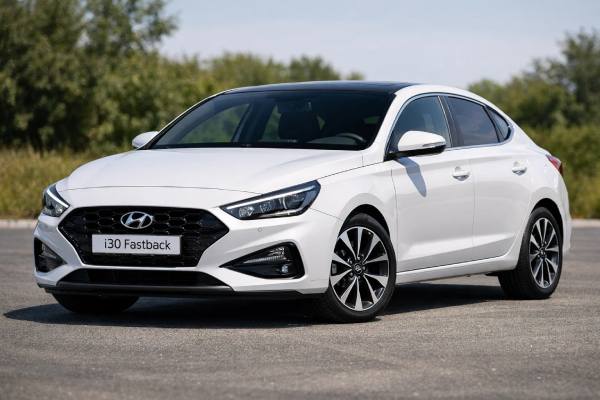
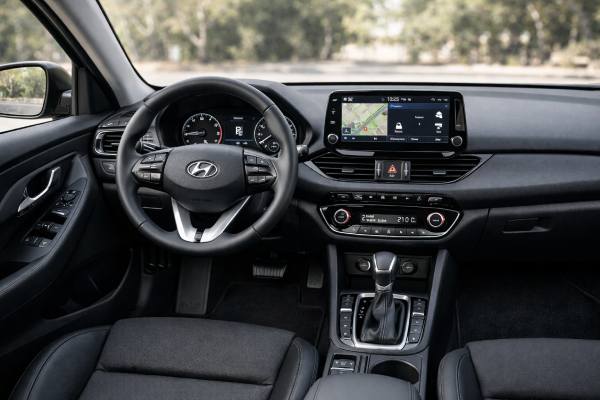
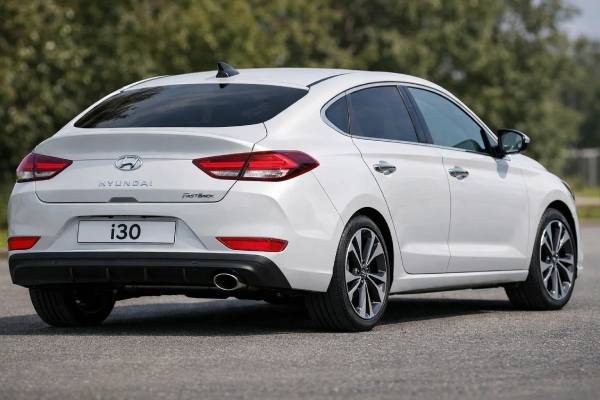
The facelifted 2020–2024 Hyundai i30 Fastback 1.0 T-GDi is one of the more unusual compact cars of its period because it blends everyday hatchback practicality with a sleeker, lower fastback shape. In this version, the engineering brief is clear: keep the car efficient, light, and affordable to run, while giving it sharper styling and enough turbocharged torque to feel more flexible than the old naturally aspirated petrol options. The 1.0-liter three-cylinder engine is the key. It is not a performance unit, but it brings useful low-rpm response, compact weight, and respectable economy. The facelift also matters. Hyundai improved the cabin tech, expanded the SmartSense safety package, and gave the Fastback a more modern feel without changing its core strengths. For owners, that makes this one of the more appealing style-led used buys in the i30 family, provided the service history is solid and the turbo petrol has not been neglected.
Quick Specs and Notes
- The Fastback body gives the i30 a more premium look without giving up a useful 450 L boot.
- The 1.0 T-GDi engine offers better mid-range flexibility than older non-turbo small petrols.
- Facelift cars gained better connectivity and a stronger driver-assistance package.
- The main ownership caution is service discipline, because this is a small direct-injection turbo engine.
- A prudent baseline is engine oil and filter every 15,000 km or 12 months.
On this page
- Hyundai i30 Fastback Facelift Character
- Hyundai i30 Fastback Facelift Data
- Hyundai i30 Fastback Facelift Trims
- Reliability Risks and VIN Checks
- Care Schedule and Used Checkpoints
- On-Road Feel and Real Economy
- Against ProCeed, Scala and Mazda3
Hyundai i30 Fastback Facelift Character
The facelifted Hyundai i30 Fastback 1.0 T-GDi sits in an interesting part of the market. It is not a full coupe, not a traditional saloon, and not simply a hatchback with a different rear panel. Hyundai gave it its own identity by lowering the roofline, stretching the rear profile, and making the whole car look slimmer and more expensive than the regular i30 hatch. That visual difference matters more than many buyers expect. In the used market, the Fastback tends to appeal to people who want a compact car with a little more style than the class norm, but who still need practical rear doors and a meaningful luggage area.
The facelift sharpened that appeal. The front end became cleaner and more modern, the lighting signature improved, and the cabin tech moved the car closer to newer rivals. The result is that a 2020–2024 Fastback feels more contemporary than a simple mid-cycle refresh might suggest. Inside, the i30 Fastback gained a more digital feel, stronger smartphone integration, and a broader range of driver-assistance features, all of which matter in real ownership. A used car that still feels current in the cabin tends to stay satisfying for longer.
Mechanically, the 1.0 T-GDi is the engine that makes the most sense if your priorities are fuel cost, lower tax exposure in some markets, and enough torque to keep the car from feeling weak. This is a turbocharged direct-injection three-cylinder petrol, not an old-fashioned economy engine. In facelift-era European trim, Hyundai offered the 1.0 with standard manual and optional dual-clutch transmission, and in some markets with 48-volt mild-hybrid assistance as well. That means buyers need to check the exact car rather than assume every 1.0 Fastback is mechanically identical.
The important ownership point is that this version is better at everyday flexibility than at outright pace. The 1.0 T-GDi’s 172 Nm torque figure arrives low enough in the rev range to make city driving and ordinary overtaking easier than the engine size suggests. It is more relaxed than a small naturally aspirated petrol, but it is not a strong long-distance load-hauler in the way a larger turbo petrol or diesel can be. If you regularly drive with four adults, luggage, and steep motorway gradients, you will notice the limits.
That still leaves a very clear use case. The Fastback 1.0 works well for buyers who want one car to do commuting, family errands, and occasional longer trips without feeling visually bland. It also suits drivers who value tidy exterior size but dislike the boxier look of most hatchbacks. In that sense, the facelifted Fastback is not just the pretty i30. It is the i30 for buyers who want everyday logic with a little more elegance.
Hyundai i30 Fastback Facelift Data
For this version, the technical picture is straightforward: a compact front-wheel-drive fastback body, a 1.0-liter turbocharged petrol engine, and a choice of manual or dual-clutch transmission depending on market. Some European markets also offered a 48-volt mild-hybrid version of the same 1.0 T-GDi engine, so a careful buyer should always check the VIN and build sheet before ordering parts or quoting figures as universal.
Powertrain and efficiency
| Item | Hyundai i30 Fastback 1.0 T-GDi facelift |
|---|---|
| Code | 1.0 T-GDi |
| Engine layout and cylinders | Inline-3, DOHC, 4 valves per cylinder |
| Bore × stroke | 71.0 × 84.0 mm (2.80 × 3.31 in) |
| Displacement | 1.0 L (998 cc) |
| Induction | Turbocharged |
| Fuel system | Direct injection |
| Compression ratio | 10.5:1 |
| Max power | 120 PS (88.3 kW) @ 6,000 rpm, roughly 118 hp |
| Max torque | 172 Nm (127 lb-ft) @ 1,500–4,000 rpm |
| Timing drive | Chain-type timing layout is listed in period technical material |
| Rated efficiency | About 5.3–6.2 L/100 km WLTP depending on wheel size, transmission, and 48V fitment |
| Real-world highway @ 120 km/h | Around 6.2–7.0 L/100 km in steady use |
Transmission and driveline
| Item | Hyundai i30 Fastback 1.0 T-GDi facelift |
|---|---|
| Transmission | 6-speed manual or 7-speed DCT |
| 48V version | Available in some markets with 6-speed iMT and in some cases DCT pairing |
| Drive type | FWD |
| Differential | Open |
Chassis and dimensions
| Item | Hyundai i30 Fastback 1.0 T-GDi facelift |
|---|---|
| Suspension front | MacPherson strut |
| Suspension rear | Multi-link rear axle in period technical data |
| Steering | Electric power steering |
| Brakes | Ventilated front discs / solid rear discs |
| Most popular tyre size | 205/55 R16 |
| Other common tyre sizes | 195/65 R15, 225/45 R17 |
| Ground clearance | 135 mm (5.31 in) |
| Length | 4,455 mm (175.39 in) |
| Width | 1,795 mm (70.67 in) |
| Height | 1,425 mm (56.10 in) |
| Wheelbase | 2,650 mm (104.33 in) |
| Turning circle | About 10.6 m (34.8 ft) kerb-to-kerb |
Weights and capacities
| Item | Hyundai i30 Fastback 1.0 T-GDi facelift |
|---|---|
| Kerb weight / running order | Typically about 1,357–1,498 kg (2,992–3,302 lb) depending on trim and transmission |
| GVWR | About 1,820–1,860 kg (4,012–4,101 lb) depending on version |
| Fuel tank | 50 L (13.21 US gal / 11.0 UK gal) |
| Cargo volume | 450 L (15.89 ft³) seats up / 1,351 L (47.71 ft³) seats folded, VDA |
| Towing capacity, braked | Commonly 1,000 kg (2,205 lb) for manual versions, lower on some DCT versions |
| Towing capacity, unbraked | Commonly 500 kg (1,102 lb), lower on some DCT versions |
| Payload | Verify by VIN plate, trim, and transmission |
Performance and service data
| Item | Hyundai i30 Fastback 1.0 T-GDi facelift |
|---|---|
| 0–100 km/h | About 11.4 s |
| Top speed | About 196 km/h (122 mph) |
| Engine oil | Use VIN-correct Hyundai-approved petrol turbo oil |
| Typical oil viscosity | 5W-30 is common, but verify by market and service literature |
| Coolant | Ethylene-glycol coolant for aluminum systems |
| Brake fluid | DOT 4 class fluid is the sensible baseline |
| A/C refrigerant | Verify by under-hood label and VIN-specific data |
| Key torque specs | Use official workshop documentation for wheel, brake, and suspension work |
Safety and driver assistance
| Item | Hyundai i30 facelift range basis |
|---|---|
| Euro NCAP rating basis | 5 stars for the i30 family, with facelift review logged in 2020 |
| Adult Occupant | 88% |
| Child Occupant | 84% |
| Vulnerable Road Users | 64% |
| Safety Assist | 68% |
| ADAS availability | FCA, LFA, LKA, ISLA, BCA, RCCA, HDA, and related features depending on trim and market |
The most important numbers here are not the headline power output. They are the 172 Nm torque figure, the 450 L boot, and the relatively modest WLTP consumption range. Those are the numbers that define the Fastback’s real-life appeal.
Hyundai i30 Fastback Facelift Trims
With the facelift, Hyundai made the Fastback easier to justify because it no longer relied on styling alone. The cabin and safety technology improved enough that even a modestly equipped example can feel fresh beside similarly priced used rivals. That said, trim logic still varies from one European market to another, so buyers should judge actual equipment rather than assume that a familiar trim name means the same thing everywhere.
Most facelift Fastbacks start from a solid baseline. Even lower trims usually include touchscreen infotainment, smartphone connectivity, a digital supervision display of some kind, cruise control, multiple airbags, tyre-pressure monitoring, stability systems, and at least some Hyundai SmartSense driver-assistance technology. That is already enough to make the car feel well-rounded in day-to-day use. Mid-range versions tend to be the sweet spot because they add the features owners appreciate most without pushing tyre cost or repair complexity too far upward.
The most useful upgrades on a used Fastback are usually practical rather than cosmetic:
- Rear parking sensors and a rear-view camera.
- Automatic climate control.
- Larger infotainment screen.
- Better seat trim and steering-wheel materials.
- LED lighting.
- The wider SmartSense package.
For the 1.0 T-GDi, the most meaningful mechanical difference is transmission rather than trim badge. A manual car is simpler and often the safer long-term buy for owners who want lower risk and more direct control. A 7-speed DCT car is easier in traffic and suits the engine reasonably well, but it adds another system that needs careful inspection on a used example. In some markets, the 1.0 also came with optional 48-volt mild-hybrid assistance, so it is worth checking whether the car has conventional 12V-only hardware or the mild-hybrid layer.
The facelift safety story is one of the car’s stronger points. Hyundai’s SmartSense suite expanded for the updated i30 Fastback, and the official feature pages highlight items such as Forward Collision-Avoidance Assist, Lane Following Assist, Highway Driving Assist, Intelligent Speed Limit Assist, Junction Turning support on applicable versions, Multi-Collision Braking, Rear Occupant Alert, and navigation-based cruise functions. Not every one of those systems appears on every trim, but the breadth of availability is good for the class.
Euro NCAP’s official i30 record still helps the Fastback in the used market. The i30 family’s 5-star result remains a strong sign of a solid passive-safety base, and Euro NCAP later logged a facelift review in 2020 before the rating expired under time-based rules in January 2024. That expiration matters only in the sense that the old rating is no longer current against the newest test protocols. It does not mean the car’s structure suddenly became weak. In used-car terms, the facelift Fastback still has a very respectable safety foundation.
The best trim strategy is usually simple: buy the car with the equipment you will actually value every day, but avoid paying a premium just for bigger wheels and sportier styling details. A mid-spec Fastback with a camera, sensible tyres, climate control, and the broader driver-assistance set is usually a better ownership bet than a flashier one on expensive rubber with patchier history.
Reliability Risks and VIN Checks
The facelift i30 Fastback 1.0 T-GDi is generally a sensible used buy, but it is also a modern small turbo petrol with direct injection. That means reliability is shaped heavily by how the car was maintained. A well-kept example can be very straightforward to own. A neglected example can develop the typical issues associated with missed oil changes, weak batteries, tired ignition components, and delayed diagnosis of small faults.
| Area | Prevalence | Severity and cost tier | What to watch for |
|---|---|---|---|
| 12V battery ageing | Common | Low to medium | Slow starts, odd warning messages, stop-start or electrical quirks |
| Ignition coil or spark plug issues | Occasional | Low to medium | Misfire under load, rough idle, hesitation |
| Turbo hose or boost-leak issues | Occasional | Medium | Flat response, underboost feel, fault codes |
| Carbon-sensitive running issues on DI engines | Occasional | Medium | Uneven idle, softer throttle response over time |
| DCT low-speed awkwardness on neglected cars | Occasional | Medium | Jerky creep, shudder, hesitant take-up |
| Infotainment and camera calibration faults | Occasional | Low to medium | Screen glitches, warning messages, missing ADAS functions |
| Clutch wear on hard-used manuals | Occasional | Medium | Slip in higher gears, weak bite, judder |
| Recall-related campaign items | Limited but important | High | VIN check required before purchase |
The most common used-car problems are ordinary ones, not dramatic engine failures. Batteries, plugs, tyres, and brake condition tell you a lot about how carefully the car has been treated. On a small turbo petrol, regular oil changes matter more than a shiny paint finish. A seller who can show exact service dates and invoices is usually offering a safer car than someone who only points to low mileage.
The 1.0 T-GDi’s biggest long-term weakness is not that it is small. It is that some owners treat small turbo engines like maintenance-free appliances. They are not. This engine relies on clean oil, proper warm-up habits, and prompt attention when it starts to misfire or lose smoothness. Ignition-related problems are usually manageable early. They become more expensive when ignored.
Transmission choice changes the risk profile a little. Manual cars tend to be easier to read on a test drive: the clutch either feels healthy or it does not. DCT cars need more patience. Low-speed behavior should be smooth and consistent, not clumsy or hesitant to an unusual degree. A poor urban test drive on a DCT car is worth investigating properly.
The recall picture is also important because facelift-era production overlaps with known i30 PDE family campaigns. One official recall covered defective front seat-belt tensioners on certain 2020-production vehicles. Another brake-related campaign affected some early-2020 PDE-family cars, so buyers should never assume a facelift Fastback is automatically unaffected just because it looks newer. The correct approach is simple: run the VIN through Hyundai’s official recall tool and ask for printed proof of completion.
A strong pre-purchase check should include:
- Cold start from fully cold.
- Fault-code scan, even if no warning lamps are showing.
- Proper road test in town and on an open road.
- Confirmation of recall completion.
- Inspection of tyres, brakes, and wheel condition.
- Clear evidence of regular oil servicing.
The safest used Fastback is rarely the cheapest one. It is the one with the most believable history and the fewest unanswered questions.
Care Schedule and Used Checkpoints
A practical maintenance plan for the facelift Fastback 1.0 T-GDi is mostly about keeping the engine healthy and avoiding the slow build-up of neglected small problems. The car does not need exotic care, but it does benefit from more discipline than older naturally aspirated petrol hatchbacks. That is especially true if the car has the optional DCT or mild-hybrid hardware.
Practical maintenance schedule
| Item | Sensible interval |
|---|---|
| Engine oil and filter | Every 15,000 km or 12 months |
| Engine air filter | Inspect regularly, replace around 30,000–45,000 km sooner in dusty use |
| Cabin air filter | Check yearly and often replace annually |
| Spark plugs | Inspect early on used cars and usually replace in the 60,000–90,000 km region depending on plug type and service schedule |
| Coolant | Verify the first-change interval by VIN and market handbook, then monitor condition closely with age |
| Brake fluid | Every 2 years is a sensible baseline |
| Brake pads and discs | Inspect at every service |
| Manual transmission fluid | Inspect for leaks and shift quality; proactive replacement around 90,000–120,000 km is sensible |
| DCT fluid and operation | Follow Hyundai guidance and pay attention to shift quality and clutch behavior |
| Auxiliary belt and hoses | Inspect at every service |
| Timing chain system | Listen for abnormal start-up noise and investigate correlation faults promptly |
| 12V battery | Test annually from about year 4 onward |
| 48V system, if fitted | Check battery condition and stored faults during routine service |
Useful fluid and workshop guidance
- Engine oil: use VIN-correct Hyundai-approved oil for turbo petrol applications.
- Common oil grade: 5W-30 in many markets, though exact specification varies.
- Brake fluid: DOT 4 class fluid.
- Coolant: ethylene-glycol coolant compatible with aluminum systems.
- Fuel tank: 50 L.
- Fuel: use the octane rating specified for the market and avoid poor-quality fuel on a stressed small turbo engine.
For used buyers, the inspection checklist should focus on the parts of the car that show real care. Check whether the tyres match as a proper set. Inspect wheel rims for curb damage. Watch for uneven panel gaps or signs of bumper repair around the front sensors and camera systems. Check the rear hatch opening, luggage floor, and side trim panels, because fastback cars often live hard daily lives and cargo-area repairs can be badly hidden.
A good test drive should confirm three things. First, the engine should pull cleanly from low rpm without stutter. Second, the steering and brakes should feel consistent and predictable. Third, the infotainment and safety systems should behave normally, with no hidden warnings or disabled functions.
The years to target are usually 2021–2024 cars with complete service history and obvious recall compliance. Early 2020 cars can still be excellent, but they deserve the closest VIN and campaign check. In trim terms, the best buy is often the moderate-spec Fastback on 16-inch wheels with the useful safety and convenience features, not the one with the most visual extras. Long-term durability is good when the car is maintained on schedule and driven sensibly. Neglect is the real risk, not the basic concept of the car.
On-Road Feel and Real Economy
From behind the wheel, the facelift Fastback 1.0 T-GDi feels exactly like what it is supposed to be: a stylish compact car with enough turbo torque to feel alert, but not enough outright power to pretend it is sporty. That actually suits the car. The Fastback is at its best when driven smoothly, using the low-end torque and tidy size rather than chasing big performance numbers.
The three-cylinder engine gives the car a light, eager character around town. Step-off is clean, the turbo helps the engine feel more flexible than the displacement suggests, and the car does not need constant revving just to keep pace with traffic. In a city or suburban environment, that makes the 1.0 T-GDi a much more agreeable companion than an old-school small petrol engine. On faster roads, the limits are clearer. The car is perfectly usable, but overtakes need planning, especially with passengers or luggage aboard.
Ride and handling are among the Fastback’s quiet strengths. The lowered silhouette gives the car a more planted look, and Hyundai tuned the chassis so it feels settled rather than flimsy. On 16-inch wheels, the balance is especially good. The steering is light but accurate enough, the body control is tidy, and the car tracks neatly on open roads. It is not the sharpest car in the class, but it does not feel lazy either.
Noise levels are acceptable for a turbo triple of this type. You hear the three-cylinder note most under acceleration and on cold starts. Once cruising, the Fastback feels calmer than many buyers expect, helped by the sleeker roofline and the generally mature PD-platform tuning. Larger wheels and rough road surfaces can add more tyre noise, which is another reason the moderate wheel package often makes the most sense.
Real-world economy is one of the strongest arguments for the 1.0 Fastback, provided expectations are realistic.
| Use case | Real-world expectation |
|---|---|
| Dense city driving | Around 6.8–7.8 L/100 km |
| Mixed commuting | Around 5.8–6.8 L/100 km |
| Highway at 100–110 km/h | Around 5.5–6.2 L/100 km |
| Highway at 120 km/h | Around 6.2–7.0 L/100 km |
Those figures depend on tyre size, traffic, temperature, and transmission. Cars with the mild-hybrid system can do a little better in mixed driving, but the difference is not dramatic. The biggest economy gains still come from driving style, route type, and keeping the car healthy.
Load carrying is another pleasant surprise. With 450 L of boot space, the Fastback is more useful than its roofline suggests. It can handle family luggage, airport runs, and ordinary household tasks without feeling compromised. Towing is possible on the right versions, but the 1.0 is not the ideal choice for frequent trailer work. For everyday life, though, the car manages to feel more stylish than a hatch without becoming less usable.
As a driver’s car, it is tidy rather than thrilling. As a daily car, it is easy to like.
Against ProCeed, Scala and Mazda3
The facelift Hyundai i30 Fastback 1.0 T-GDi competes in a slightly unusual niche because its real rivals are not always the most obvious ones. Some buyers cross-shop it with conventional hatchbacks, while others want a sleeker shape and compare it to cars with more style-led bodywork. That makes the Kia ProCeed, Skoda Scala, and Mazda3 Fastback useful reference points.
Against the Kia ProCeed, the Hyundai feels like the more understated choice. The ProCeed often leans harder into its shooting-brake style and can feel a little more distinctive in design terms. The Hyundai answers with a tidier footprint, a calmer cabin atmosphere, and a simpler used-buying proposition in some markets. Much depends on the individual car, but the i30 Fastback usually comes across as the more conservative, lower-risk choice.
Against the Skoda Scala, the Hyundai gives up some of the Skoda’s straight practicality and value-for-money cleverness. The Scala often feels like the rational benchmark, especially for rear space and storage thinking. The Hyundai fights back with stronger styling identity and a more premium-looking silhouette. If the Skoda is the head choice, the Fastback is the head-and-heart compromise.
Against the Mazda3 Fastback, the Hyundai takes the opposite approach. The Mazda often feels richer in materials and more design-focused inside, but its rear space and everyday practicality are not always as friendly as the Hyundai’s. The i30 Fastback is the easier family car and often the cheaper used proposition. The Mazda is the more polished object; the Hyundai is the easier all-round ownership decision.
Where the Hyundai scores best is balance. It offers:
- A distinctive body style without losing rear doors or boot usefulness.
- Sensible running costs.
- A broad and modern safety package on facelift cars.
- A small turbo petrol engine that feels flexible enough for daily life.
- A used-market image that is usually less risky than more fashion-led alternatives.
Its weaknesses are just as clear. The 1.0 engine is adequate rather than strong. The car is not the roomiest in the class. And the sleek body style is more about design than dynamic advantage. But that may be exactly why the Fastback still works. It gives buyers a car that feels a little more special without dragging them into the compromises of a true niche coupe or premium-badge alternative.
If you want maximum space, a wagon or boxier hatchback still makes more sense. If you want maximum luxury feel, some rivals push further. But if you want a compact car that looks smarter than most, drives neatly, remains practical, and avoids the cost and complexity jump of larger premium fastbacks, the facelift Hyundai i30 Fastback 1.0 T-GDi is one of the better used choices available.
References
- The new i30 Fastback | Features | Hyundai Motor Europe 2026 (Features and Specifications)
- Nový Hyundai i30 Fastback – Dokumenty ke stažení 2026 (Technical Data)
- EuroNCAP | Hyundai i30 2017 (Safety Rating)
- Hyundai Owners manuals | Hyundai Motor UK 2026 (Owner’s Manual)
- Home | Hyundai Recalls & Service Campaigns 2026 (Recall Database)
Disclaimer
This article is for informational purposes only and is not a substitute for professional diagnosis or repair. Specifications, torque values, service intervals, procedures, recall applicability, and equipment can vary by VIN, market, transmission, trim, and production date, so always verify critical details against official Hyundai service documentation and dealer records before servicing, repairing, towing, or buying a vehicle.
If this guide was useful, please consider sharing it on Facebook, X, or another social platform to support our work.