
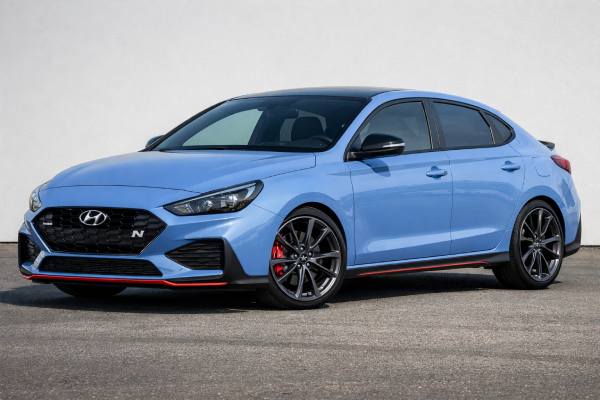
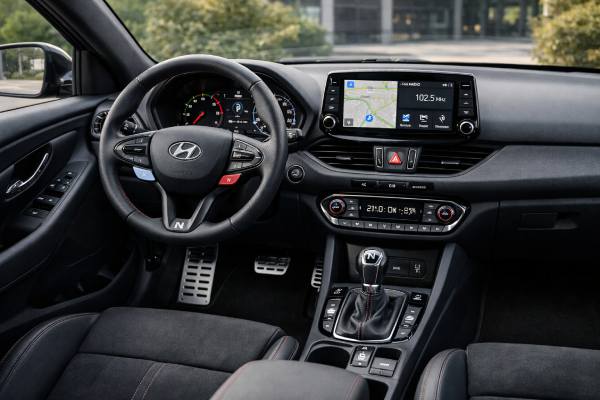
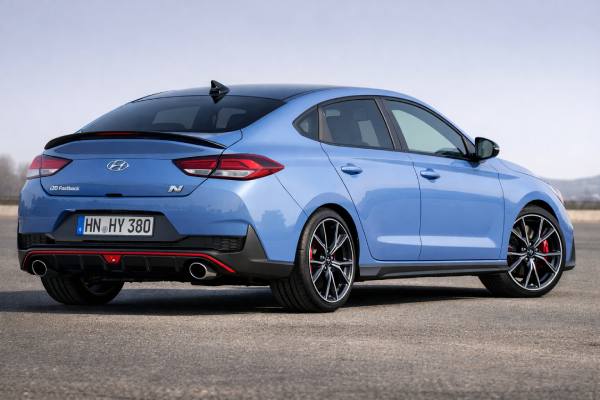
The facelift Hyundai i30 Fastback N 2.0 T-GDi 250 occupies an unusual corner of the performance-car market. It is shaped like a compact coupe-sedan, drives like a serious front-wheel-drive hot hatch, and still keeps enough rear-seat and cargo space to work as a daily car. In facelift form, it gained sharper front-end styling, improved lighting, updated infotainment, and a broader driver-assistance package, but the real appeal stayed the same: a strong turbocharged 2.0-liter engine, manual transmission, adaptive damping, and a chassis tuned to feel alive without becoming exhausting. For buyers who want the Hyundai N experience without stepping up to the harder-edged 280 PS Performance version, the 250 model can be the more balanced choice. It is still quick, still mechanically focused, and still practical enough to justify every day. The trade-off is that running costs, tyres, brakes, and careful maintenance all matter more here than on any regular i30.
What to Know
- The 250 hp Fastback N blends strong real-world pace with a more usable ride than many track-focused rivals.
- The fastback body adds a larger, more practical load area than the hatchback N while keeping the same N character.
- Adaptive dampers, Rev Matching, and the manual gearbox make it engaging without feeling one-dimensional.
- Tyres, brakes, ignition parts, and suspension wear can add up quickly on hard-driven or modified cars.
- A sensible oil-change routine is every 10,000 km or 12 months, even if broader service visits are less frequent.
On this page
- Hyundai i30 Fastback N profile
- Hyundai i30 Fastback N numbers
- Hyundai i30 Fastback N equipment map
- Weak points and service campaigns
- Maintenance roadmap and buyer checks
- Track-bred road manners
- Fastback N against rivals
Hyundai i30 Fastback N profile
The facelift i30 Fastback N is not just an i30 hatchback with a different roofline. It feels like Hyundai’s attempt to give the N formula a more mature, more distinctive shape without softening the core engineering. The longer rear body gives the car a sleeker silhouette and a more useful boot opening, while the mechanical package remains rooted in the same N philosophy: a turbocharged 2.0-liter four-cylinder, front-wheel drive, a six-speed manual, adaptive suspension, large brakes, and a body structure stiff enough to tolerate enthusiastic road use and occasional track work.
In 250 hp trim, the Fastback N sits in an interesting spot. It is clearly more serious than any N Line model, but it is not as extreme as the 280 PS Performance package. That matters because many buyers do not actually need the bigger brakes, electronic limited-slip differential, and extra power of the Performance version to enjoy the car. The 250 model still delivers strong pace, meaningful driver involvement, and a genuine sense of mechanical connection, but it does so with slightly lower tyre and brake costs and a calmer overall character.
The facelift also improved the car in areas that matter if you use it often. Lighting, infotainment, graphics, and SmartSense assistance features all moved forward. The interior remained driver-focused, with physical controls where they still make sense, clear N menus, and a cabin that feels more durable than flashy. The seating position is low and serious without being awkward, and the visibility is better than the sloping shape suggests.
One of the Fastback N’s best tricks is that it still behaves like a proper daily driver when you ask it to. The rear seat is usable, the boot is helpful, and the adaptive dampers keep the ride from becoming punishing on normal roads. That is why this car appeals to people who want one car rather than a weekend toy and a commuter. It can do both jobs.
There is one market complication worth knowing. Some facelift-era European technical documents list a standard-trim 250 PS Fastback N, while some country-specific brochures focused heavily on the 280 PS Fastback N Performance. In used-car terms, that means buyers should verify exact equipment by VIN and original market, not assume every Fastback N has the same brakes, differential, or wheel package.
Hyundai i30 Fastback N numbers
The data below focuses on the facelift Hyundai i30 Fastback N in standard 250 hp-class trim with the 2.0 T-GDi engine and 6-speed manual transmission. Equipment, wheel package, original market, and optional body-stiffness hardware can affect some figures, so VIN-specific checking remains important.
| Powertrain and efficiency | Data |
|---|---|
| Code | Public consumer documents do not consistently list the internal engine code; verify by VIN |
| Engine layout and cylinders | Inline-4, DOHC, 4 valves per cylinder |
| Bore × stroke | 86.0 × 86.0 mm (3.39 × 3.39 in) |
| Displacement | 2.0 L (1,998 cc) |
| Induction | Turbocharged |
| Fuel system | Direct injection |
| Compression ratio | 9.5:1 |
| Max power | 250 PS class, about 247 hp (184 kW) @ 5,500–6,000 rpm |
| Max torque | 353 Nm (260 lb-ft) @ 2,100–4,700 rpm |
| Timing drive | Chain |
| Rated efficiency | 7.7 L/100 km (30.5 mpg US / 36.7 mpg UK) WLTP combined |
| Real-world highway @ 120 km/h | About 7.6–8.8 L/100 km (30.9–26.7 mpg US / 37.2–32.1 mpg UK) |
| Transmission and driveline | Data |
|---|---|
| Transmission | 6-speed manual |
| Drive type | Front-wheel drive |
| Differential | Open differential in standard trim |
| Chassis and dimensions | Data |
|---|---|
| Front suspension | MacPherson strut, N-specific geometry |
| Rear suspension | Multi-link |
| Steering | Rack-and-pinion with rack-mounted electric assist |
| Steering ratio | 12.23:1 |
| Steering lock-to-lock | 2.14 turns |
| Brakes front | Ventilated discs, 330 mm (12.99 in) |
| Brakes rear | Ventilated discs, 300 mm (11.81 in) |
| Wheels and tyres | 7.5J × 18 in alloys with 225/40 R18 tyres |
| Most popular tyre size | 225/40 R18 |
| Ground clearance | 134 mm (5.28 in) |
| Length / Width / Height | 4,455 / 1,795 / 1,417 mm (175.4 / 70.7 / 55.8 in) |
| Wheelbase | 2,650 mm (104.3 in) |
| Turning circle | 11.6 m (38.1 ft) |
| Kerb weight | 1,419–1,504 kg (3,129–3,316 lb) |
| GVWR | 1,930 kg (4,255 lb) |
| Fuel tank | 50 L (13.2 US gal / 11.0 UK gal) |
| Cargo volume | 436 L (15.4 ft³) with rear brace / 450 L (15.9 ft³) without; 1,337–1,351 L (47.2–47.7 ft³) seats folded, VDA |
| Performance and capability | Data |
|---|---|
| 0–100 km/h | 6.4 s |
| Top speed | 250 km/h (155 mph) |
| Braking distance | Official public consumer sheets do not consistently publish a 100–0 km/h figure for this exact trim |
| Towing capacity | 1,600 kg (3,527 lb) braked / 700 kg (1,543 lb) unbraked |
| Payload | About 426–511 kg (939–1,127 lb), depending on exact equipment |
| Roof load | 80 kg (176 lb) |
| Fluids and service capacities | Data |
|---|---|
| Engine oil | 4.8 L (5.1 US qt) including filter; use VIN- and market-approved full-synthetic oil |
| Coolant | 8.5 L (9.0 US qt); verify exact Hyundai coolant specification by VIN |
| Manual transmission oil | 1.9 L (2.0 US qt) |
| Differential / transfer case | Not applicable for the standard open differential |
| A/C refrigerant | Verify from under-bonnet label and workshop literature |
| A/C compressor oil | Verify by VIN |
| Key torque specs | Public press data do not publish workshop torque figures; verify wheel, brake, and suspension fasteners in official service literature |
| Safety and driver assistance | Data |
|---|---|
| Euro NCAP | 5 stars for the i30 family |
| Adult Occupant | 88% |
| Child Occupant | 84% |
| Vulnerable Road Users | 64% |
| Safety Assist | 68% |
| IIHS | Not applicable for this Europe-focused model |
| ADAS suite | FCA/AEB, lane keep assist, lane follow assist, driver-attention warning, high beam assist, and further features depending on trim, market, and option packages |
The most important spec takeaway is not the headline power figure. It is the way the package comes together: enough power to feel genuinely quick, a manual gearbox, lighter 18-inch running gear than the Performance version, and a useful fastback body that makes the car easier to live with every day.
Hyundai i30 Fastback N equipment map
Equipment on the facelift Fastback N is more complicated than the badge suggests. The core N hardware is consistent: strong sports seats, adaptive dampers, an N-specific steering and braking setup, Rev Matching, launch control on the manual, N drive modes, and a cabin built around performance menus rather than just sporty trim. But the exact trim structure changed by market, and that matters a great deal when buying used.
In some official European material, a standard-trim 250 PS Fastback N is listed alongside the 280 PS Performance package. In Germany, however, facelift Fastback brochures focused on the Fastback N Performance rather than a separate 250 PS Fastback offering. This means a buyer cannot safely assume that a car advertised simply as “Fastback N” has the same wheel size, brake specification, differential, or assistance package as another car from a different country.
For a true 250 trim, the usual mechanical picture is:
- 18-inch wheels with 225/40 R18 tyres
- 330 mm front brakes and 300 mm rear brakes
- open front differential rather than electronically controlled limited-slip hardware
- six-speed manual transmission
- adaptive suspension
- N drive modes and variable exhaust character, depending on market spec
That makes the 250 car the more purist choice in one sense. It is slightly simpler, slightly cheaper to run on tyres and brake parts, and a little less aggressive in its hardware mix. The downside is that it gives away some traction and corner-exit bite compared with the Performance version.
Safety and driver assistance also need careful decoding. The i30 family’s 5-star Euro NCAP rating is a meaningful base strength, but this specific N model uses the wider i30 crash structure rather than having a separate N-only safety program. Standard safety equipment typically includes multiple airbags, ESC, ABS, hill-start assist, TPMS, ISOFIX on the outer rear seats, lane keep assist, lane follow assist, driver-attention warning, and forward collision warning with autonomous braking. Depending on market and transmission, blind-spot monitoring, rear cross-traffic alert, navigation-linked sign recognition, and upgraded rear cross-traffic braking may be optional rather than standard.
Quick identifiers are useful on the used market. An 18-inch wheel package, smaller front brakes, and the lack of eLSD-specific marketing clues often point to the 250 car. A 19-inch forged wheel set, larger 360 mm front brakes, and stronger Performance branding usually indicate the 280 package. Inside, look for seat type, infotainment size, steering-wheel N buttons, driver-assistance menu depth, and any evidence of dealer retrofits or non-original modifications.
The lesson is simple: buy the actual car, not the listing headline. On a Fastback N, original market and VIN-based equipment confirmation are essential.
Weak points and service campaigns
The facelift Fastback N is generally a strong car when maintained properly, but it is not a cheap-performance car that can be neglected. Most problems come from one of three places: hard use, modifications, or owners who treat it like a regular i30 rather than a stressed turbo performance model.
A practical issue map looks like this.
Common, low to medium cost
- Front tyres and alignment: The car loads the front axle heavily, and enthusiastic driving can wear the outer shoulders quickly. Symptoms include tramlining, steering nibble, and uneven shoulder wear. Remedy is alignment, tyre replacement, and checking for bent wheels.
- Brake wear and corrosion: Even cars that are not tracked can eat front pads and discs faster than normal i30 models. Symptoms include vibration, lip wear, or noisy light braking. Remedy is standard brake service, but quality parts matter.
- 12 V battery weakness: Low voltage can trigger nuisance warnings, stop-start issues, or infotainment glitches.
Occasional, medium cost
- Ignition-related misfire under load: Hard use, old plugs, or incorrect heat range after tuning can cause hesitation or misfire at boost. Remedy is proper diagnosis, correct plug choice, and coil replacement if required.
- Engine mount and driveline movement: Wheel hop and aggressive launches can stress mounts. Symptoms include clunking, harsh take-up, or sloppy shift feel.
- Exhaust-valve rattle or flap issues: The variable exhaust hardware can develop noise or inconsistent operation with age.
Occasional to high cost
- Clutch wear on abused manuals: Repeated hard launches or track use can shorten clutch life. Look for slip, smell, or a high bite point.
- Adaptive damper expense: The electronically controlled dampers are a big part of the car’s breadth, but they are costlier to replace than ordinary units.
- Modified or tuned cars: Extra boost, poor calibration, cheap intakes, or deleted emissions parts can turn a good car into a difficult one.
On the engine itself, the 2.0 T-GDi is robust when oil quality, warm-up habits, and service timing are respected. The danger is not that the engine is fundamentally weak. It is that performance owners sometimes stretch oil intervals, ignore plugs, track the car without cooling discipline, or install poor software.
Recall and campaign history still matters. Hyundai issued campaign work affecting some i30-family cars built in 2020 because front seat belt tensioners could be defective. Whether that affects a given Fastback N depends on VIN and build date, so buyers should verify completion through Hyundai records. More broadly, dealer history is valuable because Hyundai dealer servicing also checks for recommended updates and calibration work that can improve driveability and system behavior.
For pre-purchase checks, ask for full service invoices, proof of recall completion, evidence of recent brake and tyre work, and a diagnostic scan. Avoid cars with heavy aftermarket tuning unless the documentation is unusually complete and the inspection is unusually thorough.
Maintenance roadmap and buyer checks
A practical maintenance plan for the Fastback N should be more conservative than the generic family-car schedule. Hyundai’s earlier Fastback N data listed engine-oil service every 10,000 km or annually and broader service visits at 30,000 km or two years. For a hard-driven turbo car, that still feels sensible today. Even if a car is used gently, this is not a model to run on stretched oil changes.
A realistic schedule looks like this:
| Maintenance item | Practical interval |
|---|---|
| Engine oil and filter | Every 10,000 km or 12 months |
| General inspection service | Every 30,000 km or 24 months |
| Engine air filter | Inspect every service; replace around 20,000–30,000 km sooner in dusty use |
| Cabin filter | Every 15,000–20,000 km or 12 months |
| Spark plugs | Around 30,000–40,000 km on enthusiast-driven cars, sooner if tuned or tracked |
| Coolant | Follow VIN-specific Hyundai schedule; inspect condition yearly |
| Manual gearbox oil | Inspect for leaks; preventive replacement around 60,000–90,000 km is wise on performance use |
| Brake fluid | Every 2 years, sooner if the car sees track days |
| Brake pads and rotors | Inspect at every service |
| Tyre rotation and alignment | Check every 10,000 km or after any harsh kerb strike |
| Timing chain | Inspect for noise or timing-correlation faults; replace only when symptomatic or out of spec |
| Auxiliary belt and hoses | Inspect at each major service |
| 12 V battery | Test yearly after year 3 |
Key capacities are straightforward:
- engine oil: 4.8 L including filter
- manual gearbox oil: 1.9 L
- coolant: 8.5 L
- fuel tank: 50 L
Exact oil approvals, coolant type, refrigerant fill, and torque values should always be checked against VIN-specific Hyundai documentation. Public press data are helpful for capacities, but not a substitute for workshop literature.
The buyer’s guide for this car is mostly about separating clean enthusiast ownership from disguised abuse. A good inspection includes:
- cold start with no smoke, stumble, or harsh timing noise
- stable idle and clean boost under full load
- clutch take-up with no slip or shudder
- straight braking with no vibration
- even tyre wear across the front axle
- no damper leaks or repeated suspension clunks
- no warning lights or stored powertrain faults
- evidence of regular oil changes, not just long-interval servicing
- confirmation of recall and software updates
- careful body inspection for crash repair around the nose, roofline, and rear quarters
The best used examples are usually lightly modified or unmodified, on quality tyres, with stock-size wheels and complete service paperwork. The cars to be careful with are heavily tuned examples, cars with cheap tyres, and cars that have clearly spent time doing repeated hard launches. Long-term durability is good when the car is maintained like a performance car rather than a commuting appliance.
Track-bred road manners
The Fastback N 250 makes its case not with one dramatic number, but with how it feels from the driver’s seat. It is quick enough to feel special, but its bigger strength is adjustability. The steering is fast and direct, the front axle bites harder than you expect from an open-differential front-driver, and the adaptive suspension gives the car a much wider bandwidth than many rivals.
Around town, the ride is firm but manageable. The suspension never fully disappears, yet it does not beat you up in the way some compact performance cars do. On poor roads, the Fastback body seems to help the car feel a little more mature in character than a short-wheelbase hot hatch, even though the mechanicals are closely related. At highway pace, stability is excellent. The car tracks cleanly, the steering stays calm, and the longer tail makes it feel like a very fast compact GT rather than just a hot hatch in fancy clothes.
The engine has enough low-end shove to feel useful, but its real strength is the broad mid-range. The 353 Nm torque spread makes overtakes easy, and the six-speed manual suits the engine well. The shift is not the slickest in the class, but it is positive and mechanical enough to fit the car’s personality. Rev Matching remains one of the model’s best features because it makes everyday downshifts feel polished and track-style shifts easier to execute cleanly.
Real-world fuel use depends heavily on how much of the N personality you use:
- City: about 10.0–11.8 L/100 km
- Highway at 100–120 km/h: about 7.6–8.8 L/100 km
- Mixed driving: about 8.7–10.0 L/100 km
Those figures are completely acceptable for a 250 hp-class manual performance car, but no one should buy one expecting economy-car running costs.
Where the 250 trim differs from the Performance version is in traction and ultimate aggression. On a dry, smooth road, it is still fast and engaging. On tighter exits or poorer surfaces, the lack of eLSD means it can be a little more dependent on tyre quality and driver restraint. Some buyers will actually prefer that because it feels a touch lighter, cheaper to feed, and less intense all the time.
The result is a car with genuine depth. It is sharp enough for a back road, stable enough for a long trip, and practical enough for normal life. That balance is why the Fastback N remains so appealing.
Fastback N against rivals
The Fastback N 250 is best compared with cars that combine performance with daily usefulness, not just with raw-power hot hatches.
Against the Volkswagen Golf GTI:
The GTI is more polished and often easier to live with in stop-start traffic. The Hyundai counters with a more intense steering and chassis feel, a more distinctive body shape, and a stronger sense of driver involvement.
Against the Honda Civic Type R:
The Civic is sharper, faster, and more focused. But it is also more visually aggressive and often more expensive. The Fastback N is the calmer, subtler choice for drivers who still want serious pace.
Against the Ford Focus ST:
The Focus ST has a superb engine and playful chassis, but the Hyundai often feels more buttoned down at high speed and more special inside its N-specific menus and controls.
Against the Cupra Leon 245 or 300:
The Cupra offers strong pace and a more premium design mood, but the Hyundai feels more transparent and more old-school in the way it communicates through the wheel, gearbox, and suspension.
Against the 280 PS i30 N Performance:
This is the real in-house rival. The Performance model is faster, more aggressive, and more capable on track. The 250 trim is the smarter buy for some owners because it is still quick, still interesting, and a little cheaper to own.
The final verdict is that the facelift i30 Fastback N 250 is one of the most complete performance cars Hyundai built in the combustion era. It offers speed without becoming tiresome, style without sacrificing space, and genuine chassis sophistication without asking you to tolerate race-car compromises every day. It is not the cheapest i30 to run and not the ultimate N variant, but for many buyers it may be the most usable and most balanced of them all.
References
- Hyundai i30 N | Technical specifications 2021 (Technical Data)
- Hyundai starts production of the new i30 N in Europe 2021 (Press Release)
- Hyundai i30 N und i30 N Fastback Ausstattungsvarianten 2021 (Pricing and Equipment)
- Hyundai i30 Fastback N | Technische Daten | Stand: 1.2019 2019 (Technical Data)
- Hyundai i30 – EuroNCAP 2017 (Safety Rating)
Disclaimer
This article is for informational purposes only and is not a substitute for professional diagnosis, repair, or VIN-specific service information. Specifications, torque values, intervals, procedures, equipment, and campaign applicability can vary by VIN, market, model year, and trim. Always verify critical details against official Hyundai service documentation and dealer records before servicing, repairing, or purchasing a vehicle.
If this guide helped you, please consider sharing it on Facebook, X, or another platform to support our work.