
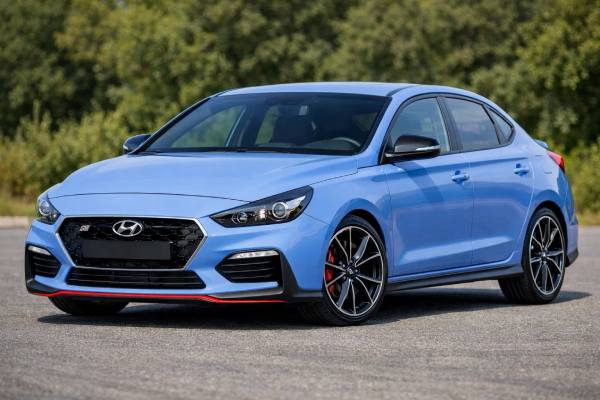
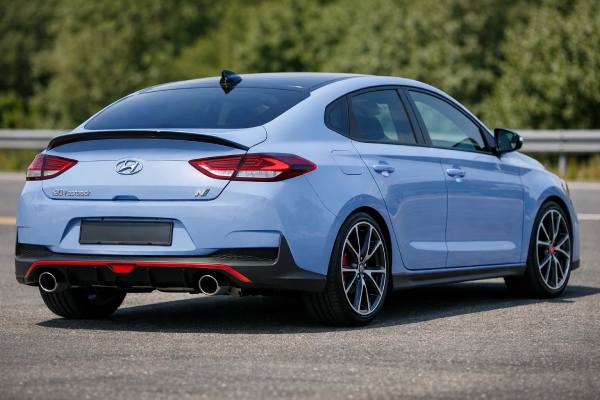
The Hyundai i30 Fastback N is one of the more unusual performance cars of its era because it mixes real hot-hatch engineering with a sleeker fastback body and a genuinely usable boot. In 250 hp form, it is the entry point to the Fastback N idea: a front-wheel-drive performance car with a 2.0-litre turbocharged engine, six-speed manual gearbox, adaptive chassis hardware, and everyday comfort that still matters on a long drive. That gives it a broader appeal than many rivals that feel great only when pushed hard.
This article focuses on the 250 PS standard-trim car, commonly rounded to 250 hp in classifieds. That detail matters because official Hyundai material confirms a 250 PS Fastback N at launch and in facelift-era N documentation, while some late-2020 market price lists listed only the higher-output Fastback N Performance. As a used buy, the 250 car remains appealing because it keeps the same basic N character with slightly lower purchase and tyre costs.
Essential Insights
- The 250 PS Fastback N combines genuine performance hardware with a larger 450 L boot and a more mature body style than the hatch.
- Standard-trim cars on 18-inch wheels are usually the better real-road setup for comfort, tyre cost, and wet-weather usability.
- The 2.0 T-GDi is strong when maintained correctly and warmed properly before hard use.
- Brake wear, tyre cost, and heat-related wear from track use are the main ownership cautions.
- A careful oil and filter service every 10,000–15,000 km or 12 months is the sensible baseline for long-term ownership.
What’s inside
- Hyundai i30 Fastback N profile
- Hyundai i30 Fastback N technicals
- Hyundai i30 Fastback N equipment and safety
- Weak points and service actions
- Maintenance map and buyer advice
- Road feel and real pace
- Rivals and alternatives
Hyundai i30 Fastback N profile
The i30 Fastback N arrived as Hyundai’s second N model in Europe and took the already respected i30 N hatch formula in a slightly different direction. The hatchback was the more obvious choice for buyers who wanted the rawest look and the shortest body. The Fastback N was aimed at drivers who liked the same engineering but wanted a more elegant shape, a subtler rear spoiler treatment, and a little more long-distance polish. That is why the car still feels distinctive today. It is not simply a different roofline. It is the same N idea repackaged for buyers who wanted pace without shouting about it.
At launch, Hyundai presented the Fastback N with two outputs of the same 2.0-litre turbocharged engine. The standard package delivered 250 PS, while the Performance Package made 275 PS. Both versions used front-wheel drive and a six-speed manual gearbox, and both could briefly rise to 378 Nm through overboost. That means the 250 car is not the “soft” version in the way some base performance trims are. It still gets the fundamental N recipe: a strong Theta 2.0 T-GDi engine, Rev Matching, Launch Control, dedicated drive modes, and the ability to feel special on an ordinary road.
The body shape changes the character more than the basic numbers suggest. Hyundai quoted 450 litres of boot space with the rear seats up and 1,351 litres with them folded. Cars fitted with the optional rear stiffness bar lose a little of that space, dropping to 436 and 1,337 litres. Even so, the Fastback N remains far more practical than many people expect from a compact performance car. That matters in ownership. A car like this often has to do more than a Sunday blast. It may also cover commuting, motorway trips, or airport runs, and the Fastback body makes that easier to justify.
The 250 hp version also makes sense on real roads. Hyundai’s own launch figures gave it a 0–100 km/h time of 6.4 seconds and a 250 km/h top speed. Those are strong numbers without forcing the owner into the higher-cost wheel, tyre, and brake setup tied more closely to the top package. In many markets, the standard car also ran 18-inch Michelin tyres rather than 19-inch Pirellis, which tends to help comfort and replacement cost.
One important caveat for 2018–2020 buyers is market variation. Hyundai’s official launch material clearly presented a 250 PS Fastback N. Facelift-era N press information also described a standard-trim 250 PS new i30 N range in both hatchback and fastback body styles. But some late-2020 price lists in individual markets show only the higher-output Fastback N Performance. In practical terms, that means buyers should identify the car by VIN, wheel size, brake package, and original order specification, not just by registration year or seller description. That is especially important because many used ads round PS to hp and many sellers confuse standard and Performance cars.
Hyundai i30 Fastback N technicals
The technical case for the 250 hp i30 Fastback N is stronger than the headline output suggests. This is not a simple warm hatch with a larger engine. It is a purpose-built N model using a dedicated performance chassis, a turbo four with strong mid-range torque, and hardware that was designed to survive hard driving. Official Hyundai data also confirms that the 250 PS figure is measured in metric horsepower. In common English-language listings it is often rounded to 250 hp, but the official output is 184 kW or 250 PS.
| Powertrain and efficiency | Specification |
|---|---|
| Engine family / code | Theta 2.0 T-GDi |
| Engine layout and cylinders | Inline-4, DOHC, 16 valves |
| Bore × stroke | 86.0 × 86.0 mm (3.39 × 3.39 in) |
| Displacement | 2.0 L (1,998 cc) |
| Induction | Turbocharged |
| Fuel system | Direct injection |
| Compression ratio | 9.5:1 |
| Max power | 250 PS (184 kW) @ 6,000 rpm |
| Max torque | 353 Nm (260 lb-ft) @ 1,450–4,000 rpm |
| Overboost | 378 Nm (279 lb-ft) @ 1,750–3,500 rpm |
| Timing drive | Chain |
| Official combined economy | 7.7 L/100 km (30.5 mpg US / 36.7 mpg UK) on 2019 public data |
| Launch-cycle combined economy | 7.0 L/100 km (33.6 mpg US / 40.4 mpg UK) on initial launch figures |
| Real-world highway at 120 km/h | Usually around 7.8–8.8 L/100 km depending on tyre, temperature, and traffic |
| Transmission and driveline | Specification |
|---|---|
| Transmission | 6-speed manual |
| Drive type | FWD |
| Differential | Open differential on standard trim; eLSD tied to higher-output Performance specification in many markets |
| Rev Matching | Yes |
| Launch Control | Yes |
| Chassis and dimensions | Specification |
|---|---|
| Front suspension | MacPherson strut |
| Rear suspension | Multi-link |
| Steering | Rack-and-pinion R-MDPS |
| Steering ratio | 12.31:1 |
| Lock-to-lock turns | 2.14 |
| Turning circle | 11.6 m (38.1 ft) |
| Brakes | Front 345 mm ventilated discs; rear 300 mm solid discs on 2019 published Fastback N data |
| Most common tyre size | 225/40 R18 on standard trim |
| Ground clearance | 132 mm (5.2 in) |
| Length | 4,455 mm (175.4 in) |
| Width | 1,795 mm (70.7 in) |
| Height | 1,417 mm (55.8 in) on standard trim |
| Wheelbase | 2,650 mm (104.3 in) |
| Kerb weight | About 1,494 kg (3,294 lb) in early public Fastback N data |
| GVWR | 1,950 kg (4,299 lb) |
| Fuel tank | 50 L (13.2 US gal / 11.0 UK gal) |
| Cargo volume | 450–1,351 L VDA; 436–1,337 L with rear stiffness bar |
| Performance and carrying ability | Specification |
|---|---|
| 0–100 km/h | 6.4 s |
| 80–120 km/h | 5.7 s |
| Top speed | 250 km/h (155 mph) |
| Braking distance | Public Hyundai technical sheets do not consistently publish a single official 100–0 km/h figure |
| Towing capacity | Up to 1,600 kg braked / 700 kg unbraked in later official UK N data |
| Payload | Roughly mid-400 kg range depending on spec |
| Fluids and service capacities | Specification |
|---|---|
| Engine oil | Use the exact Hyundai-approved petrol turbo grade for your VIN and climate |
| Engine oil capacity | Verify by VIN and market manual before service |
| Coolant | Hyundai-approved long-life coolant to official specification |
| Manual gearbox oil | Verify exact Hyundai manual transmission fluid by VIN |
| Differential / transfer case | Not applicable on the standard FWD manual car |
| A/C refrigerant | Verify by VIN and year before service |
| Key torque specs | Use workshop-manual data by VIN for wheel, brake, plug, and suspension fasteners |
The biggest technical difference between the 250 and the stronger versions is not just power. It is the way the whole car is finished. The higher package added items such as larger 19-inch wheels, a more aggressive differential setup in many markets, and later even larger front brake discs. That is why the standard 250 car deserves to be judged on its own terms. It is the lighter-touch Fastback N, not merely the cheaper one.
Hyundai i30 Fastback N equipment and safety
The Fastback N range is easier to understand than many mainstream i30s because Hyundai kept the N formula focused. Even so, there are still important trim and year differences to understand. In broad terms, the 2018–2019 250 PS Fastback N standard trim gave buyers the core performance hardware without every high-cost extra. That usually meant 18-inch wheels, a six-speed manual, the N drive-mode system, performance instrument displays, heated front seats in some markets, and a healthy amount of standard safety equipment. The Performance Package then layered on more aggressive hardware and, depending on market, a more advanced differential, larger wheel-and-tyre package, and more dramatic exhaust and brake setup.
That distinction matters in daily use. The standard 250 car is often the sweeter real-world ownership proposition. The 18-inch Michelin setup is less expensive to replace, less harsh over broken roads, and more forgiving in poor weather than the larger 19-inch package. It also reduces the risk of cracking or buckling a wheel on rough urban roads. The faster Performance car is the better circuit tool. The 250 car is arguably the broader all-rounder.
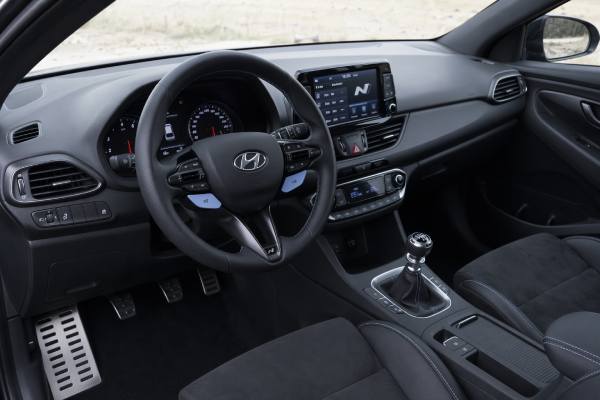
Cabin equipment was strong for the class. Hyundai’s launch material described an eight-inch central touchscreen with rear-view camera, Bluetooth, Apple CarPlay, and Android Auto, plus N-specific performance menus for engine, rev-matching, exhaust, and custom settings. The driver also gets the features that make an N model feel special from the seat rather than just from outside the car: the N steering wheel, dedicated drive mode buttons, a variable LED shift light, and a cluster designed around performance use. The Fastback’s interior is not exotic, but it is functional, clear, and built around actual driving.
For 2020, Hyundai updated the broader i30 N family with design revisions, new seats, digital enhancements, and the option of the wet eight-speed N DCT. Official facelift press material also described the new i30 N as available in both hatchback and fastback body types, with a 250 PS standard trim and a stronger Performance Package. At the same time, some market-specific price lists restricted the Fastback to Performance specification. That means a late registered car needs careful decoding. Do not assume that every 2020 Fastback N is the same.
Safety is a quieter strength. The i30 family holds a five-star Euro NCAP result, with 88% adult occupant protection, 84% child occupant protection, 64% vulnerable road user protection, and 68% safety assist. The Fastback N also benefited from Hyundai SmartSense active-safety features. Launch material lists Forward Collision-Avoidance Assist, Driver Attention Warning, Lane Keeping Assist, High Beam Assist, and Intelligent Speed Limit Warning. Later facelift-era N material added broader SmartSense functions, including lane following support and further assistance updates depending on body type, transmission, and market.
A practical buying point sits here too. Safety hardware on a used Fastback N should be checked like any other major system. Windscreen replacements, front bumper repairs, and sensor alignment all matter on a car that may have been driven hard. If a seller mentions accident repair, confirm that the camera and any radar-based systems were recalibrated correctly. That matters as much as paint quality on a modern performance car.
Weak points and service actions
The 2.0 T-GDi Fastback N is fundamentally a strong car, but it is not a cheap hot hatch to neglect. Reliability usually depends less on a single fatal flaw and more on how the car has been used. A well-serviced road car can be very solid. A poorly warmed-up, heavily modified, or frequently tracked example can become expensive quickly. That is the right frame for buyers.
The most common low-to-medium-cost issues are wear-related. Front brakes, tyres, and alignment are the obvious ones. These cars can eat their front tyres if they spend their lives on enthusiastic road drives or poor alignment settings. Inner shoulder wear is worth checking carefully. Brake discs can lip or heat-spot, and pads can disappear much faster than on an ordinary i30. None of that means the car is troublesome. It means the consumables need to match the car’s ability.
The next layer is ignition and fueling behavior. Misfires under load, a shaky idle, or hesitant boost response usually point first toward spark plugs, coils, or air-path issues rather than a broken engine. Because the car uses direct injection and a turbocharger, it is also more sensitive to neglected oil changes and poor-quality fuel than a basic naturally aspirated family hatch. Carbon build-up can become part of the long-term story on a direct-injection performance engine, especially if the car does lots of short journeys and never really gets hot.
Heat management matters more here than on the non-N i30 range. Cars that have done repeated track days or hard mountain-road use deserve extra checks for coolant condition, oil seepage, tired engine mounts, and brake-fluid age. The engine itself can take spirited driving, but repeated heat cycles expose weak maintenance habits. A seller who cannot explain when the brake fluid was changed, what oil has been used, or whether the car has seen track use is giving you useful information, even if they do not realise it.
Transmission durability is generally good on the six-speed manual, but clutch life varies hugely with driver habit. A strong engine and front-wheel-drive traction can punish the clutch and mounts if the car has seen repeated launch-control starts or aggressive standing starts on sticky tyres. A high bite point, slip in higher gears, or drivetrain thump on lift-off deserves inspection. Modified cars deserve even more caution. Simple ECU tunes can lift torque well beyond the standard calibration, which increases risk for the clutch, tyres, and front axle.
Chassis-wise, expect the usual performance-car wear. Suspension bushings, drop links, top mounts, and wheel bearings are all normal long-term attention points. Cars from wet or salted regions should be checked underneath for corrosion on subframes, brake lines, and exhaust fasteners. Electronics are usually manageable, but weak 12 V batteries can still trigger nuisance warnings on modern Hyundais.
For recalls and service actions, use the official Hyundai VIN-based check and dealer records instead of forum lists. Also ask whether software updates were carried out during routine dealer servicing. Hyundai specifically notes that recommended updates are checked during service visits, and that matters because modern performance cars often receive drivability, infotainment, and assistance-system improvements quietly over time.
Maintenance map and buyer advice
A performance Hyundai still responds best to disciplined, unglamorous maintenance. For the Fastback N, that means working from a conservative real-world plan rather than stretching every fluid because the car “seems fine.” The article brief asks for a practical schedule, and that is exactly the right way to think about this model.
| Maintenance item | Practical schedule |
|---|---|
| Engine oil and filter | Every 10,000–15,000 km or 12 months; shorter interval is smarter for hard use |
| Engine air filter | Inspect every service; replace around 20,000–30,000 km in mixed use |
| Cabin filter | Every 15,000–20,000 km or 12–24 months |
| Spark plugs | Inspect early on tuned or tracked cars; replace on schedule from the official manual |
| Coolant | Check yearly; replace strictly by official interval or sooner if history is uncertain |
| Brake fluid | Every 2 years minimum; yearly is sensible for frequent hard driving |
| Manual gearbox oil | Inspect for leaks; refresh around 60,000–100,000 km on enthusiast-driven cars |
| Brake pads and discs | Inspect at every service |
| Tyres and alignment | Inspect often; align whenever wear pattern changes or after suspension work |
| Timing chain | No routine fixed replacement in public owner material; inspect if noisy or if timing faults appear |
| Auxiliary belts and hoses | Inspect every service |
| 12 V battery | Test yearly after year 4 |
That schedule is intentionally more cautious than the bare minimum because of how the car is used. A 250 Fastback N driven gently on long commutes may tolerate wider intervals. A car used for short trips, back-road driving, or occasional track days will not thank you for stretched fluids. Clean oil matters. Fresh brake fluid matters. Correct tyres matter. Those three decisions shape ownership more than any badge or forum trick.
Fluid planning should also stay exact. Use the Hyundai-approved oil grade for the precise VIN and climate, not what a random parts website suggests. The same applies to coolant and transmission oil. Public owner portals are useful for identifying the right manual, but the exact service fill should still be verified against the official documentation for the car in front of you. That is especially important with a performance model that may have crossed markets or been updated during its life.
As a used buy, the best cars are usually unmodified or very lightly modified examples with a complete service record, sensible warm-up habits, and evidence of careful tyre and brake maintenance. A thick file of invoices from one Hyundai dealer or one respected specialist is a very good sign. The cars to be wary of are the predictable ones: cheap remapped examples, cars on mismatched tyres, cars with heavy inner-edge tyre wear, obvious launch abuse, or sellers who cannot explain their oil history.
Inspection should focus on the things that show how the car lived. Look for even panel fit, clean cold start, stable idle, strong but smooth boost, tidy clutch take-up, no drivetrain slam, no steering pull under power, no brake judder, and no suspension knocks over small sharp bumps. Then look underneath. If the underside, brakes, tyres, and service file all tell the same careful story, the Fastback N can be a durable and very satisfying long-term performance car.
Road feel and real pace
The i30 Fastback N 250 is fast enough to feel serious without becoming exhausting. That balance is the key to its appeal. The engine has a broad, strong mid-range, and even the lower-output version feels properly quick once it is on boost. Below that, it is civil. It does not constantly try to turn every journey into a performance event. Then, when you select a sharper drive mode and start using the upper rev range, it wakes up convincingly.
Ride and handling are where the Fastback body earns its place. The car feels planted and confident at speed, with strong straight-line stability and a more mature motorway manner than some shorter, more nervous hot hatches. Steering is direct and quick enough to feel alert, but it is not endlessly chatty. Brake feel is firm and reassuring on a healthy car. In mixed driving, the standard 18-inch setup often feels like the right compromise. It gives enough grip and keeps the chassis breathing over imperfect roads.
The standard 250 PS version also suits real public roads better than its numbers suggest. Officially, it reaches 100 km/h in 6.4 seconds and 80–120 km/h in 5.7 seconds. In practice, it feels flexible rather than explosive. You can make brisk progress without constantly chasing the last few tenths. That suits the six-speed manual well. The gearbox is part of the experience rather than just a device for hitting test figures. Rev Matching also helps the car feel polished when driven hard.
There is still front-wheel-drive reality to manage. Hard launches on cold or worn tyres can produce wheelspin and some tug through the steering. That is normal for the layout. The standard trim also lacks some of the corner-exit aggression of the more heavily equipped Performance variants seen in some markets. But that does not make it flat or dull. It still changes direction well, resists roll effectively, and rewards clean, tidy inputs.
Fuel economy is acceptable for the pace on offer. On the older published cycle, the 250 car sat at 7.7 L/100 km combined. In real use, most owners should expect more. Around town, high-8s or worse are easy to reach. A relaxed motorway run can sit in the high-7s or low-8s. A spirited back-road drive will push the number well higher. That is the honest trade-off. This is not the hot hatch you buy to save fuel. It is the one you buy because its performance is usable often enough to justify the fuel it consumes.
Noise, vibration, and harshness are also well judged. In calmer modes, the car is civil enough for commuting. In sharper modes, the exhaust and throttle response bring the car to life without making it unusable every day. That dual nature is why the Fastback N still stands out. It is fast and engaging, but it remembers that owners have to live with it.
Rivals and alternatives
The Fastback N 250 sits in an interesting gap between traditional hot hatches and more expensive coupe-shaped performance cars. Against the Volkswagen Golf GTI, it usually wins on theatre, boot utility, and chassis attitude per euro or pound spent. The Golf often feels more polished inside and a little more refined in its controls. The Hyundai feels more special if you value the driving side more than the badge or the dashboard finish.
Against the Honda Civic Type R of the same period, the Hyundai is less extreme. The Honda is the sharper tool and the faster benchmark in outright terms. But it is also visually louder and often less subtle to own. The Fastback N is the calmer answer for a driver who wants genuine pace without looking as though they brought a track car to a hotel car park.
The Renault Mégane R.S. is another natural rival. It can feel more exotic in chassis tuning and, in some versions, even more focused in the way it turns in. But ownership confidence, warranty-era reputation, and day-to-day ease often tilt buyers toward the Hyundai. The Fastback N does not always beat the Renault in one isolated dynamic category. It often wins by being easier to trust as a whole car.
The Ford Focus ST is perhaps the closest match in spirit. It offers strong real-road pace, daily usability, and a broad talent spread. The Hyundai still has two advantages. First, the Fastback body gives it a more distinctive shape and a useful luggage area. Second, the N model identity feels more purpose-built than some rivals that share more obviously with ordinary trims.
That is really the final verdict on the i30 Fastback N 250. It is not the cheapest hot hatch to run, and it is not the absolute fastest version of Hyundai’s own N formula. But it is one of the most coherent. It combines a strong manual performance car experience, real luggage space, usable comfort, and enough visual restraint to work every day. For buyers who want a slightly more mature alternative to the usual hatchback shape, it remains one of the most interesting performance Hyundais of the period.
References
- From Rome to Paris in 8:18 minutes: Hyundai unveils the All-New i30 Fastback N 2018 (Press Information)
- Hyundai i30 Fastback N | Technische Daten | Stand: 1.2019 2019 (Technical Data)
- The new Hyundai i30 N: enhanced for maximum driving fun 2020 (Press Information)
- EuroNCAP | Hyundai i30 2017 (Safety Rating)
- Hyundai Owners manuals | Hyundai Motor UK 2026 (Owner’s Manual)
Disclaimer
This article is for informational purposes only and is not a substitute for professional diagnosis, repair, or factory service information. Specifications, torque values, intervals, procedures, and equipment can vary by VIN, market, model year, transmission, and trim, so always verify the exact vehicle against official Hyundai service documentation before servicing, repairing, or purchasing a car.
If this guide helped you, please consider sharing it on Facebook, X, or another platform to support our work.