
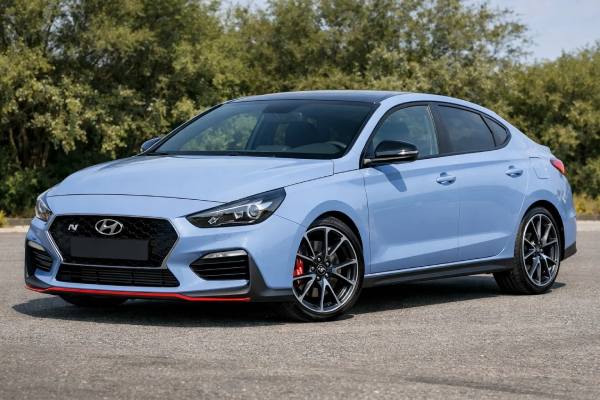
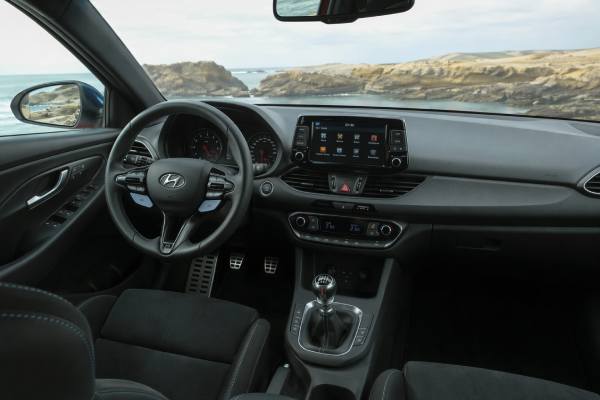
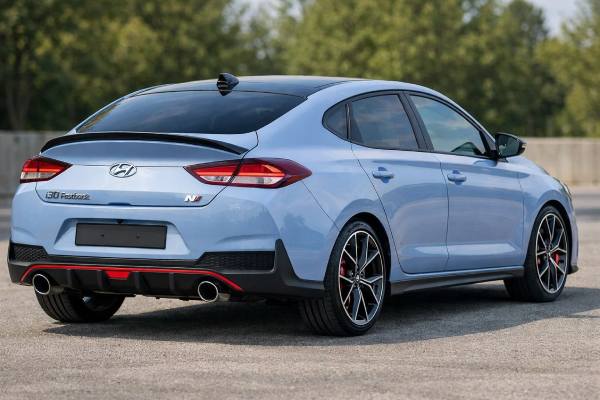
The 2018–2020 Hyundai i30 Fastback N 275 is the more polished side of Hyundai’s first serious hot-hatch formula. Underneath, it shares the same core N hardware as the hatchback Performance model: a 2.0-liter turbocharged four-cylinder, a six-speed manual gearbox, electronically controlled suspension, an electronically controlled mechanical limited-slip differential, and real track-minded brake and cooling capacity. What changes is the shape and, to a degree, the character. The Fastback N is longer, sleeker, and quieter in the way it presents itself, yet it still delivers the sharp front-end response and serious body control that made the i30 N name credible. For owners, that combination is a real strength. You get authentic driver appeal, useful cargo space, and everyday comfort that many rivals only manage halfway. The catch is simple: this is a high-performance direct-injection turbo car, so tyre quality, oil-service discipline, recall status, and evidence of hard use matter just as much as mileage.
Essential Insights
- The 275 hp Fastback N combines real performance hardware with a more practical 5-door fastback body.
- Standard N features include E-LSD, adaptive suspension, rev matching, launch control, and an active exhaust.
- Cargo space is better than many hot hatches, even if the rear brace cuts a little usable boot room.
- Cheap examples are risky because aggressive driving, tuning, and skipped oil changes can turn a good car into an expensive one.
- A strong maintenance baseline is engine oil and filter every 10,000 km or 12 months, whichever comes first.
Explore the sections
- Hyundai i30 Fastback N Defined
- Hyundai i30 Fastback N Figures
- Hyundai i30 Fastback N Gear and Safety
- Weak Spots and Factory Actions
- Service Rhythm and Buying Advice
- Chassis Feel and Straight-Line Pace
- Versus GTI, Civic Type R and Cupra
Hyundai i30 Fastback N Defined
The Hyundai i30 Fastback N 275 is best understood as the mature expression of the early N formula. Mechanically, it is not a soft alternative to the hatchback. It keeps the serious parts that matter: the Theta 2.0 T-GDi engine, a six-speed manual transmission, front-wheel drive, an electronically controlled mechanical limited-slip differential, large brakes, adaptive dampers, launch control, rev matching, and the configurable N drive modes that let the driver change throttle, damper, steering, exhaust, and differential behavior. In other words, this is a real N car first and a prettier i30 second.
That is important because the body style can mislead buyers. The Fastback shape looks more restrained and more premium than the upright hatch, but on the road it remains a focused performance car. The 275 hp version is the one most enthusiasts want because it combines the stronger calibration, the 19-inch wheel package, and the best-known N hardware mix from the pre-facelift period. Hyundai positioned it as a car that could cover daily duties without giving up the sharpness expected from a hot hatch, and that balance is still the reason it makes sense today.
The body itself changes the ownership experience in a few useful ways. The longer rear profile gives the car a more elegant stance, and the luggage area is genuinely practical for this class. Hyundai’s own numbers show that the Fastback carries more cargo than the hatchback. Depending on whether you count the standard rear stiffness bar in the space calculation, the Fastback N offers either 450 to 1,351 liters or about 436 to 1,337 liters in VDA form. That is not estate-car space, but it is enough to make the car realistic for weekend trips, airport runs, or daily family use.
There is also a subtle dynamic shift. The Fastback N still feels serious, but it is slightly less shouty in character. Some owners prefer that. It looks less obvious, blends into traffic more easily, and feels like the car you buy when you want real performance without the boy-racer image that some hot hatchbacks can attract. That does not mean it is softer. It simply hides its intent better.
The used-market appeal comes from that dual nature. A good Fastback N can be a rare thing: a car that entertains on a back road, carries luggage properly, feels special in the cabin, and still looks distinctive years later. But it also means buyers need to evaluate two separate histories. One is the normal ownership record: servicing, tyres, brakes, recall work. The other is the performance history: track use, launch-control abuse, engine tuning, and how carefully the previous owner treated a hot turbo engine. The car is strong when looked after, but it does not reward laziness.
Hyundai i30 Fastback N Figures
The 2018–2020 Fastback N 275 is the Performance Package version, and the core technical story is clear: a front-drive fastback body with serious chassis hardware and a 2.0-liter turbo engine making 275 PS. Some figures vary slightly by market or test cycle, so the tables below focus on the most consistent factory-published numbers and note where regional differences exist.
Powertrain and efficiency
| Item | Hyundai i30 Fastback N 275 |
|---|---|
| Code | Theta 2.0 T-GDi with Performance Package |
| Engine layout and cylinders | Inline-4, DOHC, 16 valves |
| Bore × stroke | 86.0 × 86.0 mm (3.39 × 3.39 in) |
| Displacement | 2.0 L (1,998 cc) |
| Induction | Twin-scroll turbocharger |
| Fuel system | Direct injection |
| Compression ratio | 9.5:1 |
| Max power | 275 hp (202 kW) @ 6,000 rpm |
| Max torque | 353 Nm (260 lb-ft) @ 1,450–4,700 rpm |
| Overboost | 378 Nm (279 lb-ft) in overboost operation |
| Timing drive | Verify by VIN-specific Hyundai service documentation before parts ordering |
| Official efficiency | 8.2 L/100 km WLTP combined in European technical data |
| Real-world highway @ 120 km/h | Around 7.5–8.5 L/100 km in steady use, higher with hills or aggressive driving |
Transmission and driveline
| Item | Hyundai i30 Fastback N 275 |
|---|---|
| Transmission | 6-speed manual |
| Gear ratios | 3.083 / 1.931 / 1.696 / 1.276 / 1.027 / 0.854 |
| Final drive | 4.333 for 1st/2nd/reverse and 3.250 for 3rd–6th |
| Drive type | FWD |
| Differential | Electronically controlled mechanical limited-slip differential |
Chassis and dimensions
| Item | Hyundai i30 Fastback N 275 |
|---|---|
| Suspension front | MacPherson strut |
| Suspension rear | Multi-link |
| Steering | Rack-mounted motor-driven power steering, rack and pinion |
| Steering ratio | 12.31 on the Performance Package reference sheet |
| Lock-to-lock | 2.14 turns |
| Turning circle | 11.6 m (38.1 ft) kerb-to-kerb equivalent |
| Front brakes | Ventilated discs, 345 × 30 mm (13.58 × 1.18 in) |
| Rear brakes | Ventilated discs, 314 × 20 mm (12.36 × 0.79 in) |
| Wheels and tyres | 19 × 8.0J alloys with 235/35 R19 tyres |
| Ground clearance | 132 mm (5.20 in) |
| Length | 4,455 mm (175.39 in) |
| Width | 1,795 mm (70.67 in) |
| Height | 1,419 mm (55.87 in) |
| Wheelbase | 2,650 mm (104.33 in) |
Weights and capacities
| Item | Hyundai i30 Fastback N 275 |
|---|---|
| Kerb weight | About 1,441–1,520 kg (3,177–3,351 lb) depending on market definition and equipment |
| EU technical-sheet reference | 1,516 kg in Performance Package form |
| GVWR | 1,950 kg (4,299 lb) |
| Fuel tank | 50 L (13.21 US gal / 11.00 UK gal) |
| Cargo volume | 450 / 1,351 L or 436 / 1,337 L with rear stiffness bar, VDA |
| Towing capacity | Market-specific; verify homologation by VIN before towing |
| Payload | Roughly 430–520 kg depending on market method and equipment |
Performance and service data
| Item | Hyundai i30 Fastback N 275 |
|---|---|
| 0–100 km/h | 6.1 s |
| Top speed | 250 km/h (155 mph) |
| Fuel type | Minimum 95 RON unleaded in Hyundai market material |
| Engine oil | Use Hyundai-approved full-synthetic oil for the exact VIN and market |
| Coolant | Ethylene-glycol based coolant for aluminum systems |
| Brake fluid | High-quality DOT 4 is the sensible baseline for road use |
| A/C refrigerant | Verify from under-hood label and VIN-specific service data |
| Key torque specs | Verify from workshop documentation before brake, suspension, or drivetrain work |
One number deserves special attention: the cargo area. Unlike many performance hatchbacks, the Fastback N keeps real luggage usefulness. The second is the brake package. These are not small commuter-car discs with sporty branding. They are part of what makes the car feel genuine when used properly.
Hyundai i30 Fastback N Gear and Safety
On the 2018–2020 Fastback N 275, equipment is less about trim hierarchy and more about how Hyundai bundled the N hardware and local-market options. In many markets, the 275 hp version effectively arrived as the fully serious one. That meant the important chassis pieces were already included, and buyers were choosing between option packs, comfort extras, and market-specific convenience features rather than between “mild” and “proper” N specifications.
The core N package is what matters most. Standard Fastback N hardware includes the electronically controlled mechanical limited-slip differential, electronically controlled suspension, the N Drive Mode System, rev matching, launch control, an active variable exhaust, the N race computer display, large 19-inch wheels, and the rear chassis brace in the luggage area. Those parts explain why the car feels more complete than some rivals that separate their best differential, brakes, or damper package into expensive extras. The 275 car is the one that carries the full engineering intent.
Cabin equipment is a mix of performance purpose and daily usability. Factory material for the Fastback N shows sports front seats with extended bolsters, dual-zone climate control, an 8-inch touchscreen with navigation, Apple CarPlay and Android Auto, a rear camera, rear parking sensors, cruise control, and tyre-pressure monitoring. Some markets added options such as heated seats, a heated steering wheel, power seat adjustment, privacy glass, keyless entry, or a panoramic roof. That is why two Fastback Ns can feel quite different in the used market even when the headline power figure is the same.
Quick identifiers that matter on a used car
- 19-inch wheels with 235/35 R19 tyres are a strong clue you are looking at the 275 Performance form.
- The rear stiffness bar in the boot area is a visible N-specific detail.
- N mode buttons on the steering wheel and the N drive display are part of the real N experience, not just cosmetic trim.
- The front seats, exhaust note, and brake hardware should match a genuine N rather than an N Line look-alike.
Safety is a little more nuanced. The i30 family earned a 5-star Euro NCAP result, but the open Euro NCAP publication is based on i30 family testing rather than a separate Fastback N-only crash listing. That means it is safest to treat the rating as a strong platform reference, not as a dedicated Fastback N crash test entry. In practical terms, that is still reassuring. The Fastback N benefits from the PD i30 body structure, a solid passive-safety baseline, and a useful set of driver aids for the period.
Factory Fastback N specification sheets also list a respectable set of safety systems. These include front, side, curtain, and driver knee airbags, stability control, brake assist, hill-start assist, emergency stop signal, lane keeping assist, forward collision-avoidance assist in city use, driver attention warning, rear parking sensors, a rear camera, and ISOFIX child-seat anchors. Again, exact fitment can vary by region, so used buyers should confirm the actual car rather than assume every market car received the same camera or assistance package.
Calibration matters, too. Windscreen replacement, front-end repair, or bumper work can affect camera-based assistance systems. On a hot hatch that may already have seen track days or previous body repairs, that deserves closer checking than usual. A clean scan and a proper inspection are worth more than a long equipment list.
Weak Spots and Factory Actions
The i30 Fastback N 275 does not have a reputation for a single unavoidable design disaster, which is good news. But that should not be confused with cheap ownership. This is a performance car, and the failure pattern is often shaped more by how the car was used than by what it was built from. A carefully maintained standard car can be strong. A tuned, tracked, poorly serviced one can be expensive very quickly.
| Area | Prevalence | Severity and cost tier | What to watch for |
|---|---|---|---|
| Front tyres and wheel damage | Common | Medium | Inner-edge wear, tramlining, buckled rims, mixed tyre brands |
| Front brakes and pads | Common | Medium to high | Steering vibration, lip on discs, blueing, uneven pedal feel |
| Clutch wear on abused cars | Occasional | Medium to high | Slip in higher gears, shudder, weak bite point |
| Plugs, coils, and misfire issues | Occasional | Medium | Rough running under load, flashing engine light, poor hot restart |
| Intake carbon and oily intake tract | Occasional | Medium | Lumpy idle, lost crispness, uneven throttle response |
| Hatch and cargo-area rattles | Occasional | Low | Trim buzzes from rear brace area or tailgate trim |
| Diff, damper, or suspension fatigue on hard-used cars | Rare but costly | High | Knocks, leaks, inconsistent turn-in, strange front-end behavior |
| Safety recalls | Limited but important | High | Open campaigns should be treated as non-negotiable |
The first reality is consumables. Many used examples have been driven exactly as Hyundai hoped: hard. That means the first expensive items are often tyres and brakes rather than engine internals. The 19-inch wheel and tyre package works brilliantly when the car is healthy, but it is not forgiving of potholes, poor alignment, or cheap replacement tyres. A car wearing unknown budget rubber is a warning sign on an N. It tells you either the owner cut corners or the car was prepared for a sale rather than looked after.
The second reality is modifications. A remap is not automatically a reason to walk away, but it changes the burden of proof. The same applies to aftermarket intakes, exhaust changes, or evidence of repeated track work. The Theta 2.0 T-GDi responds well to tuning, but the margin for lazy servicing becomes smaller as boost and heat rise. On a road car, oil quality and change frequency are basic. On a tuned or tracked car, they are critical.
Direct injection brings another long-term ownership point: intake-valve deposits are possible over time, especially on cars that do short trips or spend long periods idling. That is not unique to Hyundai, and it is not a guaranteed problem at any fixed mileage, but it is worth remembering if a car feels less clean off-boost than it should. Spark plugs and coils are also worth watching on any hard-driven turbo car. Misfire symptoms are often cheaper to fix when caught early.
The official factory actions matter most because they are clear and verifiable. Hyundai’s campaign systems and EU Safety Gate records show two headline items relevant to the wider i30 PDE family from this period. One concerns defective front seat-belt tensioners on certain 2020-production vehicles. The other concerns tandem pump pre-filter blockage by fibres from the tandem pump belt, which can harden the brake pedal and impair normal braking. Any Fastback N buyer should run the VIN through Hyundai’s official recall tool and ask for proof of completion.
The best reliability advice is not dramatic. Buy the car with the most believable history, the least evidence of tuning shortcuts, and the best tyres and brakes. That usually beats buying the cheapest example and hoping the big bills never arrive.
Service Rhythm and Buying Advice
A good maintenance plan for the Fastback N 275 should match the car, not the badge. This is not a soft commuter i30, so “manufacturer minimum” thinking is rarely the best ownership strategy. Hyundai’s official service material in some markets sets petrol-turbo service intervals at 10,000 km or 12 months, and that is a sensible base rule for the N even before you consider enthusiastic use. For road-driven stock cars, that is reasonable. For tuned cars, short-trip cars, or track-driven cars, being even more conservative is wise.
Practical maintenance schedule
| Item | Realistic interval |
|---|---|
| Engine oil and filter | Every 10,000 km or 12 months |
| Engine air filter | Inspect every service; replace sooner in dusty use or after repeated track days |
| Cabin air filter | Check yearly and usually replace annually |
| Spark plugs | Inspect earlier than a normal family hatch; many owners treat 30,000–40,000 km as a sensible checkpoint on hard-used cars |
| Coolant | Check condition yearly; earlier refresh is sensible on track-driven cars even if the factory interval is longer |
| Manual transmission fluid | Inspect for leaks and shift quality; proactive fluid renewal around 60,000–80,000 km is sensible on hard-used cars |
| Brake fluid | Every 2 years for normal road use, sooner if the car sees track work |
| Brake pads and discs | Inspect every service and before any track event |
| Tyres | Inspect frequently; rotate if wear pattern and tyre type allow, and check alignment regularly |
| Accessory belt and hoses | Inspect at each service |
| Timing components | No routine public replacement interval; investigate any start-up noise or timing-correlation faults immediately |
| 12 V battery | Test yearly after about 4 years of age |
Fluids and consumables guidance
- Fuel: minimum 95 RON unleaded in Hyundai market material.
- Engine oil: use Hyundai-approved full-synthetic oil for the exact VIN and market.
- Coolant: ethylene-glycol base coolant for aluminum systems.
- Brake fluid: DOT 4 is the practical minimum for road use.
- Tyres: quality matters more than bargain price on this chassis.
There are two useful ownership rules here. First, the N should be maintained like a performance car even when it is used as a daily driver. Second, a seller’s receipt stack matters more than their enthusiasm. A well-kept Fastback N usually comes with evidence: branded tyres, recent brake work, proper oil invoices, and recall documentation.
Used-buyer checklist
- Cold-start the engine and listen for abnormal timing or top-end noise.
- Confirm smooth idle, clean boost delivery, and no misfire under load.
- Check tyre brand, age, and shoulder wear across all four corners.
- Inspect the 19-inch wheels carefully for cracks, bends, or repairs.
- Check front brake condition and look for vibration on a hard stop.
- Test the clutch in a high gear at low rpm to see if it slips.
- Scan the car for stored powertrain and ADAS faults.
- Confirm recall completion through Hyundai records.
- Inspect the cargo area brace, trim, and rear body panels for signs of hard use or repairs.
The best years to buy are not about a magical build cutoff as much as condition. A clean 2019 or 2020 car with standard hardware, complete servicing, good tyres, and no tuning surprises is usually the safest play. The cars to avoid are the ones with mixed cheap rubber, loud modifications but no paperwork, or obvious track wear combined with vague maintenance history. Long-term durability is good when the owner respects the car. When they do not, the bills arrive in clusters.
Chassis Feel and Straight-Line Pace
The Fastback N’s real achievement is not its 0–100 km/h time. It is the way the car combines a serious front axle with a body style that feels calmer and more grown-up than many hot hatchbacks. On a good road, the front end bites cleanly, the E-LSD helps the car pull itself out of tighter corners, and the steering reacts quickly enough to make the car feel alert without becoming nervous. The chassis is what gives the Fastback N its identity.
The damper tuning is a major part of that. In softer settings, the car is firm but usable. In the more aggressive N modes, it becomes much more tied down and much less forgiving on broken surfaces. That is the trade-off. Hyundai did not try to disguise the car as a soft grand tourer. Instead, it gave the driver a genuine spread between everyday road use and full-performance mode. Buyers moving from softer rivals will notice how much the Fastback N changes when the drive-mode system is set aggressively.
The powertrain has more character than polish. The 2.0 turbo engine delivers strong low and mid-range shove, and the overboost function adds a little extra punch when conditions allow. It is responsive rather than lazy, and the six-speed manual suits the car well. The shift is not the last word in mechanical sweetness, but it is positive and feels appropriate for the car’s personality. Rev matching is a real benefit on the road, and it helps the car feel more polished when driving briskly.
In a straight line, the performance is strong enough to feel special without becoming theatrical. An official 6.1-second 0–100 km/h time and a 250 km/h top speed put it comfortably in serious hot-hatch territory. More importantly, the car feels flexible in ordinary overtakes because the torque band is wide. You do not have to thrash it all the time to make progress.
Fuel use depends heavily on how much of the car you decide to use. Officially, European WLTP data puts combined consumption at 8.2 L/100 km. In real life, that can be bettered on calm motorway runs and beaten badly in urban traffic or on fast roads.
| Use case | Real-world expectation |
|---|---|
| Steady highway run | Around 7.5–8.5 L/100 km |
| Mixed everyday driving | Around 8.5–10.0 L/100 km |
| City use | Around 10.5–12.5 L/100 km |
| Hard road driving or track use | Significantly higher |
Noise, vibration, and harshness are typical for a focused car of this kind. The active exhaust adds character, the tyre roar is noticeable on coarse surfaces, and the 19-inch wheel package does not hide bad roads. Still, for a genuine performance front-driver, the Fastback N remains surprisingly livable. That is its edge. It is entertaining enough for an enthusiast and usable enough for someone who only wants one car.
Versus GTI, Civic Type R and Cupra
The Hyundai i30 Fastback N 275 sits in an interesting place among its rivals because it does not copy just one of them. Against a Volkswagen Golf GTI, it feels more mechanical, more adjustable, and less polished in refinement. The GTI is often the smoother daily car, but the Hyundai offers more theatre, more driver-configurable character, and a chassis that feels less filtered. For buyers who want involvement over brand familiarity, that is a real advantage.
Against the Honda Civic Type R of the same era, the Hyundai takes the opposite role. The Honda is sharper, more extreme, and arguably the higher dynamic benchmark. But the Fastback N is easier to live with visually, quieter in how it presents itself, and less likely to divide opinion. Many buyers prefer that balance. The Hyundai feels like the car for someone who wants genuine performance without turning every school run into a public statement.
Against Cupra and similar Volkswagen Group alternatives, the Fastback N often wins on distinctiveness and equipment honesty. The E-LSD, adaptive suspension, active exhaust, launch control, and configurable N drive modes give the Hyundai real substance. It also brings a body style that is more elegant than the usual hatchback shape. Where some rivals can feel fast but generic, the Hyundai feels intentionally engineered.
Its weak spots in this comparison are clear enough. Cabin materials are good rather than class-leading. Fuel use is not especially light when driven hard. The ride on 19-inch tyres can be firm on poor roads. And the used market needs careful filtering because N cars attract modifiers and enthusiastic drivers in a way ordinary i30s do not. That is not unique to Hyundai, but it matters.
Where the Fastback N scores best is in the blend. It is fast enough to satisfy, practical enough to use daily, distinctive enough to feel special, and honest enough to make sense years later. It also carries a bit of underdog appeal. Some rivals win more immediate recognition, but the Hyundai often leaves a stronger impression once you understand how much proper engineering is underneath.
For the right buyer, that is the verdict. If you want the last word in front-drive lap-time aggression, the Civic Type R still sets the tone. If you want the softest premium everyday feel, the GTI remains strong. But if you want a hot front-driver with real hardware, useful luggage space, manual-gearbox involvement, and a shape that has aged remarkably well, the Hyundai i30 Fastback N 275 deserves serious attention.
References
- Hyundai i30 Fastback N. 2020 (Technical Specifications)
- The All-New Hyundai i30 Fastback N 2019 (Technical Specifications)
- EuroNCAP | Hyundai i30 2017 (Safety Rating)
- Service warranty passport. 2017 (Service Schedule)
- Home | Hyundai Recalls & Service Campaigns 2026 (Recall Database)
Disclaimer
This article is for informational purposes only and is not a substitute for professional diagnosis, repair, or VIN-specific workshop guidance. Specifications, torque values, service intervals, procedures, recall applicability, and equipment can vary by VIN, market, transmission, trim, and production date, so always verify details against official Hyundai service documentation and dealer records before servicing, repairing, or buying a vehicle.
If this guide was useful, please consider sharing it on Facebook, X, or another social platform to support our work.