
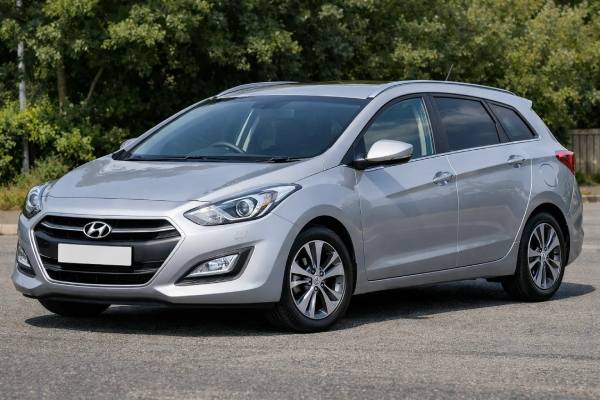


The facelifted Hyundai i30 Tourer GD 1.6 CRDi 110 sits in a very sensible corner of the used-estate market. It combines a compact footprint with a properly useful cargo area, a strong low-speed torque curve, and running costs that can still look attractive if the car has been maintained correctly. The facelift years also matter, because they brought a cleaner design, updated equipment, Euro 6 diesel calibration, and in many markets a more polished overall feel than the earlier GD Tourer.
That gives this car a clear role today. It is not a premium estate and it does not have modern driver-assistance systems, but it offers honest family-wagon practicality with a mature chassis and a diesel engine that suits long-distance use well. The real ownership question is condition. A good 1.6 CRDi Tourer feels efficient, steady, and capable. A neglected one can quickly need brakes, suspension work, fuel-system attention, and emissions-related repairs. That is why service history matters more than trim badge or mileage alone.
Quick Specs and Notes
- The Tourer body is genuinely useful, with a wide boot opening and 528 L of luggage space before folding the rear seats.
- The 1.6 CRDi 110 offers strong mid-range torque and noticeably easier motorway work than the small petrol engines.
- Ride comfort, straight-line stability, and load-carrying manners are better than many budget-badged estates from the same period.
- Poor oil service history can lead to timing-chain wear, turbo trouble, injector issues, or DPF-related costs.
- A sensible engine-oil interval is every 10,000–15,000 km or every 12 months.
On this page
- Hyundai i30 Tourer GD Diesel Purpose
- Hyundai i30 Tourer GD Specs and Capacities
- Hyundai i30 Tourer GD Trims and Safety
- Known Faults and Service Campaigns
- Maintenance Plan and Buyer Checklist
- Driving Feel and Real Economy
- How the Tourer Compares to Rivals
Hyundai i30 Tourer GD Diesel Purpose
The facelifted i30 Tourer was built for buyers who needed estate-car usefulness without moving into a larger, heavier, more expensive class. That is exactly where it still makes sense. The body is longer than the hatchback, but it is not so large that it becomes awkward in town. You can still place it easily in traffic, park it without drama, and use it as a daily commuter. At the same time, it gives you a cargo area that is wide, low enough to load comfortably, and genuinely practical for family life, airport runs, bicycles, dog crates, or bulky shopping.
The 1.6 CRDi 110 is a strong match for that body style. It is not the fastest engine in the range, but it is probably the most balanced for owners who cover real distance. The key figure is not peak power but torque. The diesel pulls from low rpm, feels more relaxed than the petrol engines on inclines or with passengers aboard, and makes the car feel more substantial than its modest output number suggests. That matters most on the motorway and on country roads, where the Tourer settles into an easy rhythm instead of needing frequent downshifts.
The facelift brought worthwhile refinement. Exterior changes sharpened the nose and lighting treatment, interior materials improved in many markets, and the overall car felt a little more grown up. In several regions, the facelift range also added better infotainment choices, updated wheels, and more polished trim combinations. None of this changed the Tourer’s core personality, but it made the car easier to justify next to more established rivals.
The chassis is another quiet strength. Hyundai’s multi-link rear suspension gives the Tourer a more composed feel than many buyers expect from a compact estate. The car stays settled over rough roads, tracks cleanly at speed, and does not feel loose or cheap when fully loaded. Steering feel is only average, but the balance of comfort and control is strong.
Today, this version appeals to practical buyers. It makes sense for long commutes, family use, and people who value luggage space without wanting an SUV. It makes less sense for short urban hops, because an older Euro 6 diesel is happiest when driven long enough to reach and hold operating temperature. In the right use case, though, the facelift i30 Tourer 1.6 CRDi 110 remains an impressively rational wagon.
Hyundai i30 Tourer GD Specs and Capacities
The figures below reflect the facelifted Hyundai i30 Tourer GD with the 1.6 CRDi 110 hp diesel engine sold in the 2015–2017 period. Small changes by market, trim, wheel size, and gearbox are normal, especially where DCT and Blue Drive equipment were offered.
Powertrain and efficiency
| Item | Data |
|---|---|
| Code | U-II 1.6 CRDi / D4FB family |
| Engine layout and cylinders | Inline-4 diesel, 4 cylinders |
| Valvetrain | DOHC, 16 valves, 4 valves per cylinder |
| Bore × stroke | 77.2 × 84.5 mm (3.04 × 3.33 in) |
| Displacement | 1.6 L (1,582 cc) |
| Induction | Turbocharged with variable-geometry turbo and intercooler |
| Fuel system | Common-rail direct injection |
| Compression ratio | 16.0:1 |
| Max power | 110 hp (81 kW) @ 4,000 rpm |
| Max torque | 280 Nm (207 lb-ft) @ 1,500–3,000 rpm; about 300 Nm with DCT in some calibrations |
| Timing drive | Chain |
| Rated combined efficiency | about 3.9 L/100 km manual or 4.2 L/100 km DCT |
| Rated efficiency in mpg | about 60.3 mpg US / 72.4 mpg UK manual; 56.0 mpg US / 67.3 mpg UK DCT |
| Real-world highway @ 120 km/h | usually about 5.0–6.0 L/100 km (39.2–47.0 mpg US / 47.1–56.5 mpg UK) |
Transmission and driveline
| Item | Data |
|---|---|
| Transmission | 6-speed manual or optional 7-speed dual-clutch transmission |
| Drive type | FWD |
| Differential | Open |
Chassis and dimensions
| Item | Data |
|---|---|
| Suspension front | MacPherson strut, coil springs, anti-roll bar |
| Suspension rear | Multi-link independent rear suspension |
| Steering | Rack and pinion, electric assist with Flex Steer |
| Steering ratio | 15.3:1 |
| Steering wheel turns lock-to-lock | 2.85 |
| Brakes | Front ventilated discs, rear discs |
| Brake diameter | 300 mm front on most trims, 280 mm on some entry versions; 284 mm rear |
| Most popular tyre size | 205/55 R16 |
| Ground clearance | 135 mm (5.3 in) |
| Length | 4,485 mm (176.6 in) |
| Width | 1,780 mm (70.1 in) |
| Height | 1,495 mm (58.9 in) |
| Wheelbase | 2,650 mm (104.3 in) |
| Turning circle | 10.6 m (34.8 ft) |
| Kerb weight | about 1,388–1,544 kg (3,060–3,404 lb), trim dependent |
| GVWR | 1,920 kg (4,233 lb) manual / 1,940 kg (4,277 lb) DCT |
| Fuel tank | 53 L (14.0 US gal / 11.7 UK gal) |
| Cargo volume | 528 L (18.6 ft³) seats up / 1,642 L (58.0 ft³) seats folded, VDA |
Performance and capability
| Item | Data |
|---|---|
| 0–100 km/h | about 11.5 s manual / 12.2 s DCT |
| Top speed | 188 km/h (117 mph) manual / 185 km/h (115 mph) DCT |
| Braking distance | exact factory 100–0 km/h figure not consistently published for this variant |
| Towing capacity | 1,500 kg (3,307 lb) braked / 650 kg (1,433 lb) unbraked |
| Payload | about 376–532 kg (829–1,173 lb), trim dependent |
Fluids and service capacities
| Item | Data |
|---|---|
| Engine oil | low-ash diesel oil meeting correct Hyundai approval, commonly 5W-30 |
| Engine oil capacity | 5.3 L (5.6 US qt) |
| Coolant | long-life ethylene-glycol coolant |
| Coolant capacity | about 7.3 L (7.7 US qt) |
| Manual transmission fluid | about 1.7 L (1.8 US qt), verify by gearbox code |
| DCT fluid | about 1.9 L (2.0 US qt), verify by transmission code |
| Brake and clutch fluid | DOT 3 or DOT 4 |
| Tank capacity | 53 L |
| Key torque spec | wheel nuts 88–107 Nm (65–79 lb-ft) |
Safety and driver assistance
| Item | Data |
|---|---|
| Crash ratings | 5-star ANCAP for updated i30 variants including wagon |
| Assessment score | 35.69 out of 37 |
| Airbags | dual front, front side, curtain, and driver knee airbag in the ANCAP-assessed updated range |
| ADAS suite | no AEB, no adaptive cruise, no lane support, no blind-spot monitoring |
Hyundai i30 Tourer GD Trims and Safety
Trim structure depended on region, but the facelift Tourer usually followed the same broad pattern as the hatchback. Entry versions covered the basics well, mid-level cars represented the strongest used-car value, and upper trims added comfort, technology, and visual upgrades rather than major mechanical changes. That makes condition, service history, and wheel size more important than the exact badge on the tailgate.
Lower trims often still had a healthy specification. Many cars included air conditioning, Bluetooth, cruise control, LED daytime running lights, front fog lamps, electric windows, roof rails, multiple airbags, stability control, and ISOFIX. Mid-spec cars usually add the features most owners actually appreciate in daily use: 16-inch alloys, rear parking sensors, heated front seats, better seat adjustment, better steering-wheel trim, and improved audio or infotainment. Higher trims may bring dual-zone climate control, navigation, panoramic roof, part-leather trim, privacy glass, automatic lights and wipers, heated steering wheel, and in some markets the optional DCT.
Mechanical differences between trims are modest, but they still affect ownership. Smaller-wheel cars ride better and cost less to tyre. DCT models are more relaxed in traffic, but the manual makes the most of the 110 hp diesel and is simpler in the long term. Roof rails, luggage-management equipment, and seat-fold mechanisms also matter more on the Tourer than they do on the hatch, because buyers often use the wagon for real carrying work.
Safety remained a strong point for the updated i30 range. ANCAP’s rating for the January 2015 to March 2017 update explicitly applied to all updated i30 variants, including the wagon. That is important because it confirms that the Tourer shares the same solid crash structure and restraint package as the facelift hatch. The assessed score of 35.69 out of 37 was strong for the class and era.
The standard safety foundation was broad. The updated range included dual frontal airbags, front side airbags, curtain airbags, a driver knee airbag in the ANCAP-applied specification, ABS, electronic brakeforce distribution, emergency brake assist, electronic stability control, and advanced seatbelt reminders across all seats. Those are meaningful real-world safety features for a family estate.
What this car does not offer is modern driver assistance. There is no autonomous emergency braking, no adaptive cruise control, no lane-keep assist, no blind-spot monitoring, and no rear cross-traffic alert. That means buyers should think in terms of strong passive safety and competent basic stability systems, not a modern sensor-led safety suite. After repair, the main concern is correct restoration of structure, airbags, belts, brakes, and alignment rather than calibrating cameras or radar modules.
Known Faults and Service Campaigns
The facelift i30 Tourer 1.6 CRDi 110 is usually a durable estate when it is maintained like a diesel should be. Its problems are rarely mysterious, but several can become expensive if the car has lived a short-trip, poorly serviced life.
Common, usually manageable issues
- EGR and intake contamination: rough idle, flat response, hesitation, and smoke under load can often be traced to soot build-up in the EGR path or intake tract. This is more likely on cars that spend most of their lives in city use.
- DPF stress on short-trip cars: repeated interrupted regenerations can lead to warning lights, limp mode, higher fuel use, and sometimes rising oil level. These cars need regular longer runs.
- Glow plug or glow-system faults: hard cold starts or uneven first-minute running often point here.
- Suspension wear: drop links, bushes, and top mounts are ordinary wear items on a compact estate, especially on rough roads or heavy-load cars.
- Rear brake drag: sticky rear calipers and uneven handbrake effort are common age-related problems.
Occasional but more expensive trouble spots
- Timing-chain wear: this engine uses a chain, not a belt. It does not require routine belt-style replacement, but long oil intervals and incorrect oil can lead to chain noise, guide wear, or timing errors.
- Turbo and boost leaks: split charge pipes, actuator problems, or turbo wear can produce loss of power, whistle, smoke, or overboost and underboost fault codes.
- Injector and high-pressure fuel-system issues: not a certainty on every car, but hard starting, rough idle, or uneven running deserve proper diesel diagnosis before purchase.
- Clutch or DCT wear: manuals can develop tired clutches and dual-mass flywheel issues with towing or urban stop-start use. DCT cars need careful road testing for hesitation, jerky take-up, or unusual shift behaviour.
Chassis and corrosion watchpoints
The Tourer generally resists rust better than older FD i30s, but it is not immune. Check rear arches, the tailgate seam, underbody seams, rear suspension mounting points, brake lines, subframes, and jacking points. Wagons often lead more work-focused lives than hatchbacks, so tired load-bay trim, dented rear bumper tops, and abused seat-fold mechanisms are not unusual.
In public recall coverage, the facelift diesel Tourer appears less exposed than some earlier i30 generations, but that does not remove the need for a VIN-based recall check. Hyundai’s recall exposure varies by market, year, and component supplier, so buyers should always verify open campaigns through official channels and dealer records. On a used Euro 6 diesel estate, confirmed campaign completion is part of the value proposition, not a minor extra.
Maintenance Plan and Buyer Checklist
A good maintenance plan for the facelift i30 Tourer 1.6 CRDi focuses on oil quality, fuel-system cleanliness, and keeping the emissions hardware happy. This is not a car that benefits from stretching intervals just because a brochure once suggested a long service window.
Practical maintenance schedule
- Engine oil and filter: every 10,000–15,000 km or 12 months. Short trips, cold weather, towing, or repeated city use justify the shorter end of that range.
- Engine air filter: inspect every service and replace roughly every 20,000–30,000 km, earlier in dusty conditions.
- Cabin air filter: every 12 months or around 15,000–20,000 km.
- Fuel filter: replace on schedule and do not postpone it on a common-rail diesel.
- Coolant: renew to the correct specification and interval. If history is unclear on a newly bought car, replace it.
- Brake fluid: every 2 years.
- Manual gearbox oil: even if called long-life, a change around 80,000–100,000 km is sensible.
- DCT fluid: follow the exact transmission guidance for the market and gearbox, and do not ignore early shift-quality changes.
- Timing chain: inspect by symptoms, cold-start noise, and timing-related fault history rather than mileage alone.
- Auxiliary belt and hoses: inspect annually.
- Rear brake service: inspect calipers, slider pins, and parking-brake operation at every service.
- Battery: test from year four onward, especially on stop-start equipped cars.
Useful fluid and decision data
| Item | Practical guidance |
|---|---|
| Engine oil | approved low-ash 5W-30 diesel oil |
| Engine oil quantity | 5.3 L |
| Coolant quantity | about 7.3 L |
| Manual gearbox oil | about 1.7 L |
| DCT fluid | about 1.9 L |
| Brake fluid | DOT 3 or DOT 4 |
| Wheel nut torque | 88–107 Nm |
Used-buyer inspection checklist
- Start the engine from cold and listen for chain noise, extended cranking, or rough diesel knock beyond normal.
- Drive it long enough to test boost delivery and to see whether it pulls smoothly through the mid-range.
- Ask exactly when the fuel filter was last changed and which oil grade has been used.
- Check for smoke under acceleration and inspect charge-air hoses for oil mist or splits.
- Test clutch take-up in a manual car and listen for flywheel rattle at idle.
- On a DCT car, check for smooth take-off, clean low-speed shifts, and no delayed engagement.
- Inspect rear brakes and handbrake balance carefully.
- Check the underbody for rust around subframes, brake lines, and suspension mounts.
- Look for uneven tyre wear, which often points to bush wear or alignment issues.
- Confirm official recall completion and dealer campaign history.
The long-term durability outlook is good when this Tourer is used for the kind of mileage a diesel estate likes. The wrong car will feel tired, sooty, and expensive. The right one still feels like a very useful long-distance family wagon.
Driving Feel and Real Economy
The facelift i30 Tourer 1.6 CRDi 110 makes its strongest case once you use it like an estate car. It is not especially exciting in a short test drive, but it becomes more convincing on longer journeys, with luggage aboard, or on mixed fast roads where torque and stability matter more than sharp steering feel.
The engine’s character is defined by its mid-range. Step-off is orderly rather than punchy, but once the turbo is in its working zone the car feels stronger than its 110 hp figure suggests. That matters in a Tourer body. With passengers and luggage on board, it still feels willing enough for hills, overtakes, and motorway joining. The manual gearbox suits the engine very well, because it lets the driver use the diesel’s low-rpm pull cleanly and keeps the car feeling alert. The 7-speed DCT is smoother in traffic but blunts some of that mechanical connection.
Ride quality is one of the best parts of the package. The GD platform already had a mature feel, and the Tourer body does not upset that balance. Over patchy roads, the car stays composed and does not feel brittle. On the motorway, it tracks cleanly and settles into an easy cruise. The longer body also helps the wagon feel planted when loaded, which is exactly what you want from an estate.
Steering is light and only moderately informative, but that is not a deal breaker in a car like this. The i30 Tourer is easy to place, easy to park, and undemanding on long trips. Braking feel is straightforward and reassuring when the system is healthy, though sticky rear calipers or poor tyres can quickly undo that sense of security.
Noise levels are acceptable for the class. At idle, the diesel makes itself known. At a steady cruise, it calms down well, though road noise and wind noise are still present on rougher surfaces. Wheel and tyre choice make a noticeable difference here.
Real-world fuel economy expectations
- City: about 5.8–7.0 L/100 km manual, often slightly higher with the DCT
- Highway at 100–120 km/h: about 5.0–6.0 L/100 km
- Mixed driving: about 5.2–6.2 L/100 km
Cold weather, repeated regeneration cycles, short-run use, heavy loads, and poor tyres can push those figures higher. Even so, a healthy Tourer remains usefully efficient for a compact diesel estate.
The key selective numbers also fit the car’s role well: about 11.5 seconds to 100 km/h in manual form, 188 km/h top speed, and steady high-speed composure. This is not a sports wagon. It is a practical long-distance estate that feels strongest when carrying people and cargo without stress. That is a very good match for its intended purpose.
How the Tourer Compares to Rivals
The facelift i30 Tourer 1.6 CRDi 110 lived in one of the toughest estate-car classes in Europe. Its closest rivals included the Kia cee’d Sportswagon 1.6 CRDi, Ford Focus Estate diesel, Volkswagen Golf Variant 1.6 TDI, Opel or Vauxhall Astra Sports Tourer diesel, Skoda Octavia Estate, and Renault Mégane Sport Tourer dCi. Against that group, the Hyundai rarely led on badge cachet, but it often made a convincing ownership case.
Against the Ford Focus Estate, the Hyundai gives away steering feel and some driver involvement, but it answers with calmer ride comfort and often lower used prices. Against the Volkswagen Golf Variant, the i30 Tourer feels less premium inside, yet it can be the safer financial choice if the alternative is a diesel with a more complex transmission history or a more expensive brand premium. Against the Skoda Octavia Estate, the Hyundai is not quite as cavernous in the rear or boot, but it feels more compact and often costs less to buy. Against the Kia cee’d Sportswagon, the comparison is extremely tight because the engineering overlap is so strong. In real life, history and condition matter far more than the badge.
The i30 Tourer’s strongest arguments are simple:
- a useful 528-liter boot and genuinely versatile estate body
- good diesel torque for real-world load carrying
- mature ride and stable motorway behaviour
- strong period crash protection
- predictable, conventional maintenance when serviced properly
Its weaknesses are just as clear. This 110 hp version is not especially quick, and it does not have modern driver-assistance technology. It is also not the ideal choice for drivers who only do short urban trips, because diesel hardware is not at its best in that pattern of use.
Where the Hyundai wins is in balance. It is big enough to replace larger cars for many households, efficient enough to justify its diesel engine, and simple enough to remain viable as a used car if bought carefully. That is not glamorous, but it is useful. For families, commuters, and anyone who needs estate-car practicality without SUV bulk, the facelift i30 Tourer 1.6 CRDi 110 remains one of the more rational used options in the segment.
References
- Hyundai i30 Kombi | Technische Daten Diesel | Stand: April 2016 2016 (Technical Data)
- Hyundai i30 | Safety Rating & Report | ANCAP 2015 (Safety Rating)
- Hyundai Owners manuals | Hyundai Motor UK 2026 (Owner’s Manual)
- Hyundai i30 (wagon) 2016 (Price List)
- Find out if your vehicle or component has been recalled because of a safety risk. 2026 (Recall Database)
Disclaimer
This article is for informational purposes only and is not a substitute for professional diagnosis, repair, or model-specific workshop guidance. Specifications, torque values, intervals, procedures, and equipment vary by VIN, market, transmission, and trim, so always verify critical details against the correct official service documentation for the exact vehicle.
If this guide helped you, please consider sharing it on Facebook, X, or another social platform to support our work.