

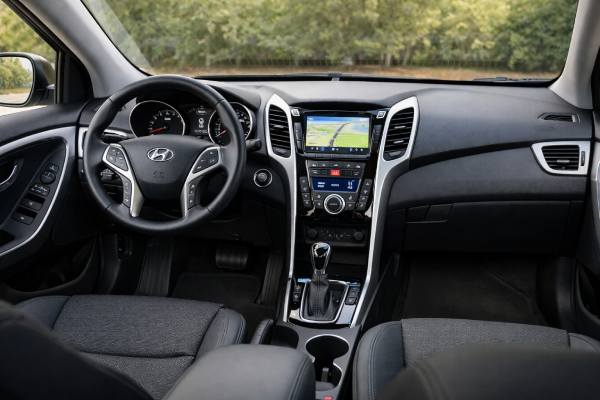
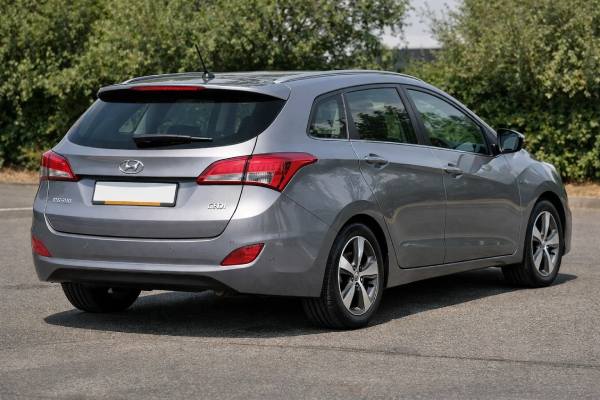
The facelifted 2015–2017 Hyundai i30 Tourer 1.6 MPI is one of those cars that makes a strong case through balance rather than flash. It takes the already practical GD-generation i30 wagon, updates the styling and safety package, and pairs it with Hyundai’s naturally aspirated 1.6-liter petrol engine. That matters because this version avoids many of the ownership worries tied to small diesels and downsized turbo petrols. There is no turbocharger, no diesel particulate filter, and no direct-injection carbon build-up to dominate the maintenance story. Instead, you get a chain-driven four-cylinder, a 6-speed manual in the common configuration, useful cargo space, and a chassis with independent rear suspension that still feels more sophisticated than many compact estates from the same era. The trade-off is simple and honest: the 1.6 MPI is smooth and dependable when maintained well, but it is only moderately quick, especially with a full load.
Top Highlights
- The 1.6 MPI engine is simpler to own than the diesel and turbo alternatives, especially for low-mileage or mixed urban use.
- The Tourer body offers a genuinely useful 528 L boot and a flat, family-friendly cargo area.
- Independent rear suspension helps the car ride and handle with more composure than many value-focused wagons.
- Performance is adequate rather than strong, so motorway overtakes with passengers and luggage need planning.
- A sensible service routine is engine oil and filter every 15,000 km or 12 months.
Jump to sections
- Hyundai i30 Tourer Series II
- Hyundai i30 Tourer Numbers
- Hyundai i30 Tourer Grades and Safety
- Reliability Patterns and Recalls
- Service Plan and Buyer Checks
- Driving Feel and Efficiency
- Rival Comparison and Verdict
Hyundai i30 Tourer Series II
The facelifted Hyundai i30 Tourer GD is a compact estate designed around practical daily use rather than image. That becomes even clearer in 1.6 MPI form. This is the straightforward petrol version for owners who want a wagon with real luggage space, predictable servicing, and fewer high-cost systems than many rival diesels or small turbo petrols. It is not the fastest i30 Tourer, and it is not the flashiest. But it is often one of the easiest to live with over time.
At the center of the car is Hyundai’s 1.6-liter naturally aspirated petrol four-cylinder. In this version it produces 120 hp and 156 Nm. On paper, those are modest numbers for a family wagon. In practice, the engine is smooth, mechanically simple, and well suited to drivers who do shorter trips or mixed use where a diesel would be harder to justify. It uses multi-point injection rather than direct injection, and it runs a timing chain rather than a belt. Those details matter because they reduce some of the long-term maintenance risks that newer, more highly stressed engines can bring.
The facelift model years also improved the i30 Tourer’s overall appeal. Hyundai did not completely reinvent the GD wagon in 2015, but the update sharpened the front-end look, freshened trim details, and aligned the car with the later safety specification that ANCAP applied to all updated i30 variants, including the wagon, built from January 2015. That gives the facelift car a slightly more modern feel without changing its core identity as a practical compact estate.
Body design is one of the Tourer’s main strengths. At about 4,485 mm long with a 2,650 mm wheelbase, it is long enough to offer real luggage capacity without feeling oversized in town. The official-style cargo figures are 528 liters with the rear seats in place and up to 1,642 liters with them folded. Those are useful, well-shaped liters too. The load bay is wide enough for strollers, flat-pack furniture, sports gear, and family travel without needing SUV height or SUV running costs.
The chassis deserves more credit than the badge usually gets. Like other GD i30 variants, the Tourer uses MacPherson strut front suspension and an independent multi-link rear setup. That gives it a mature, settled feel over broken roads and when carrying weight in the back. It does not drive like a sports estate, but it usually feels better tied down than compact wagons built around a cheaper rear axle.
The trade-off is performance. Unlike the 1.6 CRDi diesels or the more powerful petrols, the 1.6 MPI relies on revs rather than torque. Around town, that is fine. On a fast road with passengers and luggage, it can feel like it needs more effort than the shape suggests. That does not make it a poor engine. It just means the car works best for drivers who value smoothness, simplicity, and long-term predictability over effortless punch. In used form, that still makes it a very sensible choice.
Hyundai i30 Tourer Numbers
The facelifted i30 Tourer 1.6 MPI is a good example of a car whose specification sheet matches the real driving experience quite closely. The numbers show a compact estate with a simple petrol engine, honest performance, strong packaging, and mainstream running costs.
| Powertrain and efficiency | Specification |
|---|---|
| Code | G4FC |
| Engine layout and cylinders | Inline-4, DOHC, 4 valves per cylinder |
| Bore × stroke | 77.0 × 85.4 mm (3.03 × 3.36 in) |
| Displacement | 1.6 L (1,591 cc) |
| Induction | Naturally aspirated |
| Fuel system | Multi-point injection |
| Compression ratio | 10.5:1 |
| Max power | 120 hp (88 kW) @ 6,300 rpm |
| Max torque | 156 Nm (115 lb-ft) @ 4,850 rpm |
| Timing drive | Chain |
| Rated efficiency | About 8.5 / 5.0 / 6.4 L/100 km urban / extra-urban / combined |
| Rated efficiency in mpg | About 27.7 / 47.0 / 36.8 mpg US and 33.2 / 56.5 / 44.1 mpg UK |
| Real-world highway @ 120 km/h | Usually around 7.0–7.8 L/100 km in a healthy manual car |
| Emissions standard | Euro 5 |
That set of figures explains the car clearly. The 1.6 MPI has enough power to be comfortable in daily use, but not enough torque to feel effortless when loaded. The engine needs revs more than the diesel versions do, which is why its real motorway character depends heavily on the driver using the gearbox properly.
| Transmission, driveline, and chassis | Specification |
|---|---|
| Transmission | 6-speed manual |
| Optional transmission | 6-speed automatic in some markets |
| Drive type | FWD |
| Differential | Open front differential |
| Suspension front / rear | MacPherson strut / independent multi-link |
| Steering | Rack-and-pinion electric power steering |
| Steering ratio | Commonly published around 15.3:1 in related GD data |
| Brakes | Ventilated front discs / rear discs |
| Wheels and tyres | Common sizes include 195/65 R15, 205/55 R16, and 225/45 R17 depending on trim |
| Length / width / height | 4,485 / 1,780 / 1,500 mm (176.6 / 70.1 / 59.1 in) |
| Wheelbase | 2,650 mm (104.3 in) |
| Turning circle | 10.6 m (34.8 ft) |
| Kerb weight | About 1,187 kg (2,617 lb) in commonly published base manual data |
| GVWR | 1,820 kg (4,012 lb) |
| Fuel tank | 53 L (14.0 US gal / 11.7 UK gal) |
| Cargo volume | 528 L (18.7 ft³) seats up / 1,642 L (58.0 ft³) seats folded |
| Payload | About 633–635 kg (1,396–1,400 lb), depending on trim and market |
| Performance and service capacities | Specification |
|---|---|
| 0–100 km/h | About 10.9 s |
| Top speed | 192 km/h (119 mph) |
| Braking distance | Not consistently published for the exact facelift Tourer 1.6 MPI |
| Towing capacity | Market-dependent; verify from VIN plate and owner documentation before towing |
| Engine oil | About 3.3 L (3.5 US qt) service fill |
| Coolant | About 5.8 L (6.1 US qt) |
| Transmission oil | Verify by gearbox code and service method before filling |
| Differential / transfer case | Not applicable |
| A/C refrigerant | R-134a; exact charge varies by VIN and under-bonnet label |
| A/C compressor oil | PAG-type oil; verify exact grade by compressor label |
| Key torque specs | Wheel nuts commonly 100 Nm (73.8 lb-ft) |
| Crash ratings | ANCAP 2014 datestamp Series II rating applies to all updated i30 variants, including the wagon, built from January 2015 |
| Euro NCAP | Public facelift Tourer-specific Euro NCAP percentages are not separately listed in the sources used here |
| Headlight rating | IIHS not applicable |
| ADAS suite | No AEB, ACC, lane support, BSD, or traffic-sign assist on the relevant wagon variants |
The spec sheet confirms the i30 Tourer’s role. It is not a fast estate, and it was never meant to be. Its strengths are packaging, simplicity, safety for its era, and a petrol powertrain that stays easy to understand as the car ages.
Hyundai i30 Tourer Grades and Safety
Trim structure on the facelift i30 Tourer varies by market, but the broad pattern is familiar. The 1.6 MPI usually sat in the middle of the range: more substantial than the basic 1.4 MPI, but not as torque-rich as the diesels or as costly as the higher-powered direct-injection petrol options. That often means used examples are found in practical mid-grade trims rather than stripped-out entry versions.
In many markets, the common trim differences are exactly the ones family buyers notice most. Lower or mid-level cars may have 15-inch or 16-inch wheels, cloth upholstery, manual or simple climate control, a basic infotainment setup, and fewer cosmetic upgrades. Better-specified versions add alloy wheels, upgraded media functions, cruise control, parking sensors, and slightly richer cabin trim. These differences matter in day-to-day use, but they do not fundamentally change the car’s ownership logic. The 1.6 MPI remains the same sort of car across the trim ladder: a practical petrol wagon with decent comfort and honest performance.
That makes condition more important than badge. A cleaner lower-spec car is often the smarter buy than a better-equipped example with vague servicing and worn interior trim. The good news is that Hyundai did not bury huge mechanical changes in most trim upgrades. You are not usually choosing between radically different suspension hardware or complicated option-pack drivetrains. Most of what changes is convenience and presentation.
Safety is one of the facelift Tourer’s stronger points. ANCAP’s updated i30 Series II rating states that the model introduced in Australia and New Zealand in May 2015 applies to all updated i30 variants, including the wagon, built from January 2015. That is important for this exact car because it ties the facelift Tourer directly to the relevant safety assessment rather than forcing buyers to infer results from a different body style.
The listed standard safety package for the updated car includes dual front airbags, side chest airbags, side head curtain airbags, and a driver knee airbag. Electronic Brakeforce Distribution and Emergency Brake Assist are standard, and advanced seat-belt reminders are fitted to all seats. Those are strong basics for a family estate from this era. The overall ANCAP score was 35.69 out of 37, with 15.35 out of 16 in frontal offset, 15.33 out of 16 in side impact, and full points in the pole test. That remains reassuringly solid in passive protection terms.
Where the car shows its age is active safety. The ANCAP Series II page makes it clear that city AEB, interurban AEB, vulnerable-road-user AEB, backover AEB, and lane-support systems were not available on any variant covered by the rating. So the facelift Tourer offers a strong old-school safety package, but not modern crash-avoidance technology.
For used buyers, that leads to a simple checklist:
- confirm the warning lights cycle correctly,
- check ESC and ABS function,
- inspect seat belts and rear-seat hardware,
- verify airbag history through VIN-based recall checking,
- and do not assume that cosmetic trim alone tells you how well the car was specified or maintained.
The i30 Tourer’s trim structure is simple enough that the best car is usually the best-kept one, not the one with the flashiest wheel design or the longest options list.
Reliability Patterns and Recalls
The facelift i30 Tourer 1.6 MPI is generally one of the lower-risk versions in the GD range. That does not mean every car is automatically dependable. It means the problem pattern is usually more manageable than on the diesel or turbo petrol variants. Most of the common faults are age-related, maintenance-related, or wear-related, rather than being tied to one catastrophic design flaw.
The engine itself is usually strong when it receives regular oil changes and good-quality ignition parts. The most important internal watch point is timing-chain wear or tensioner noise on cars that have lived on stretched oil intervals. The first sign is often a cold-start rattle that lasts longer than a brief moment. In worse cases, the engine can develop timing-related fault codes or a rougher running character. The usual root cause is wear in the chain, guides, or tensioner system, not a sudden terminal failure. Catching the issue early matters because chain repair is far less painful than ignoring it.
Running-quality faults are common old-car territory rather than model-specific disaster. Worn coils, aged spark plugs, throttle-body deposits, and vacuum leaks can all cause uneven idle, hesitation, or a mild misfire under load. On this engine, those repairs are usually more straightforward than on a direct-injection turbo engine, which is one reason the 1.6 MPI remains attractive as a used buy.
The GD generation also has a known steering weak point. Electric power steering coupler wear can create a click, clunk, or knock through the steering column at low speed or during parking maneuvers. It is often more irritating than dangerous, but it is common enough that buyers should check for it deliberately. A car that feels quiet and tight at parking speed has a clear advantage over one with obvious column noise.
Other common age-related issues are familiar:
- front drop links and suspension bushes wearing and causing light knocks,
- rear brake drag on lightly used cars,
- wheel-bearing hum,
- tired batteries triggering strange electrical behavior,
- and air-conditioning output falling away with age or refrigerant loss.
Body and underbody condition also matter on wagons. Check the tailgate opening, lower door edges, rear arches, underbody fasteners, and luggage-floor area for corrosion or signs of previous poor repair. Tourers often live family-duty lives, and that means the boot trim, loading lip, and rear quarter areas reveal a lot about how the car has been used.
Factory actions and recall checks should be handled by VIN, not assumption. Hyundai’s official recall pages remain the best way to confirm whether safety campaigns have been completed. That matters because the broader GD-era Hyundai family includes market-specific campaign activity for airbag systems, safety software, and other recall items. The right question is never “Do these have recalls?” It is “Has this exact VIN had everything completed?”
A good used example normally shows a simple pattern: smooth cold start, quiet steering, even idle, clean gearshift, and paperwork for regular servicing. A risky one often shows the opposite: seller-warmed engine, vague explanations for steering noises, uneven running, or no clear proof of recall or service history. The 1.6 MPI Tourer is usually robust when cared for, but it still needs the basics done properly.
Service Plan and Buyer Checks
The facelift i30 Tourer 1.6 MPI rewards ordinary, consistent maintenance. That is one of its best qualities. You do not need a complicated ownership strategy to keep it healthy. You do need to avoid the trap of assuming that a simple naturally aspirated petrol engine can be ignored indefinitely.
A practical maintenance schedule looks like this:
| Item | Practical interval |
|---|---|
| Engine oil and filter | Every 15,000 km or 12 months |
| Engine air filter | Inspect every service, replace around 30,000–45,000 km |
| Cabin air filter | Usually yearly |
| Spark plugs | About every 45,000–60,000 km depending on plug type |
| Coolant | About every 90,000 km or 5 years |
| Fuel filter | Not a routine external diesel-style service item; inspect by market guidance and system design |
| Manual transmission oil | Sensible preventive change around 90,000–120,000 km |
| Automatic transmission fluid | If fitted, use a conservative fluid-service strategy rather than treating it as lifetime fill |
| Brake fluid | Every 2 years |
| Auxiliary belt | Inspect every service and replace if cracked, noisy, or contaminated |
| Timing chain | No fixed replacement interval; inspect for rattle, stretch symptoms, and timing-correlation faults |
| Brake inspection | At every service |
| Tyre rotation | About every 10,000–15,000 km |
| Alignment check | When tyre wear becomes uneven or after suspension repairs |
| Battery test | Yearly after about 4 years |
The timing-chain line deserves emphasis. Chain-driven does not mean maintenance-free forever. If the car develops more than a very brief cold-start rattle or shows timing-related fault behavior, inspection comes before hope. Regular oil changes are the cheapest form of chain protection on this engine.
Useful service figures are straightforward. Engine oil service fill is about 3.3 liters, coolant capacity is about 5.8 liters, and wheel nuts are commonly tightened to 100 Nm. Transmission-fluid quantity depends on gearbox type and service method, so that is one area where VIN-specific workshop information is worth checking before ordering parts. Air-conditioning charge and compressor-oil data should be taken from the under-bonnet label or official workshop material, not guessed from another i30 variant.
For buyers, the most useful inspection list is practical:
- insist on a fully cold start,
- listen for timing-chain noise,
- check for steering-column clunks at low speed,
- confirm smooth idle and clean throttle response,
- inspect all four brakes for drag or uneven wear,
- scan the car for engine, ABS, steering, and airbag codes,
- and verify safety-campaign completion by VIN.
Because it is a Tourer, also inspect the rear of the car carefully. Wagons often carry tools, pets, strollers, and luggage, so the boot tells the truth quickly. Look for wet carpets, damaged trim, scratched loading edges, and signs of poor rear-end repair. Outside, check the door bottoms, wheel arches, tailgate seams, and underbody.
The best examples are usually the least dramatic ones: regular service history, matching tyres, no warning lights, quiet steering, and no seller excuses. The weaker ones are the cheap cars that already need catch-up work everywhere you look. Long-term durability on the 1.6 MPI Tourer is good when maintenance stays boring and regular. That is exactly how this version should be owned.
Driving Feel and Efficiency
The i30 Tourer 1.6 MPI feels much like a well-sorted family wagon should. It is calm, predictable, and easy to place on the road. It does not try to imitate a hot hatch, but it also avoids the underdeveloped feel that some budget estates of the same era had. The chassis is one of the main reasons why.
Ride quality is a strength. The independent rear suspension helps the Tourer stay composed over broken surfaces and gives it a more settled feel when the boot is full. Small bumps are absorbed well, body motions are controlled, and motorway stability is reassuring. In many real-world conditions, it feels more mature than buyers expect from a value-brand compact estate. Steering is light and user-friendly rather than especially communicative, which suits the car’s purpose.
The 1.6 MPI engine is smooth and easygoing, but it is not especially muscular. With 156 Nm arriving relatively high in the rev range, the car depends on downshifts more than a diesel would. Around town, that is rarely a problem. The engine is pleasant enough, the clutch is manageable, and the 6-speed manual feels normal rather than heavy. On fast roads, the story changes. If the car is loaded with passengers and luggage, overtakes need planning and the engine needs to be worked.
That is the core personality difference between this car and the diesel Tourers. The petrol is quieter at idle, simpler in ownership, and better suited to short trips. The diesel is easier when heavily loaded or doing long high-speed work. Buyers who understand that distinction usually end up happier with the car they choose.
Noise levels are acceptable rather than class-leading. At moderate speed, the engine stays fairly subdued. At motorway pace, wind and tyre noise matter more, especially on bigger wheels. Cars on 15-inch or 16-inch wheels often feel like the sweet spot for everyday use because they preserve ride quality without making the cabin noisier than necessary.
Real-world economy is decent for a naturally aspirated petrol estate, but not exceptional by modern hybrid standards. A healthy manual car usually lands somewhere like this:
- City: around 8.2–9.0 L/100 km
- Highway at 100–120 km/h: around 7.0–7.8 L/100 km
- Mixed driving: around 7.4–8.2 L/100 km
Those numbers are not bad, and they are often more predictable than a small diesel used in the wrong conditions. That is a big part of the Tourer 1.6 MPI’s appeal. Owners who do modest mileage, lots of short trips, or mixed urban use can accept the extra fuel cost in return for simpler long-term maintenance.
Performance itself is perfectly usable. Around 10.9 seconds to 100 km/h and a top speed of 192 km/h are enough for normal family-car duty. The car feels best when driven smoothly, using the gearbox when needed rather than expecting strong low-rpm shove.
Overall, the i30 Tourer 1.6 MPI drives like a rational, well-engineered estate. It is comfortable enough for distance, easy enough for daily commuting, and honest enough about its limits that there are no surprises once you understand what the engine is trying to do.
Rival Comparison and Verdict
The facelift Hyundai i30 Tourer 1.6 MPI competed in one of the busiest parts of the market, and its natural rivals still shape the used-car decision today. The most relevant comparisons are the Kia Cee’d Sportswagon 1.6 petrol, Ford Focus Estate 1.6 petrol, Opel Astra Sports Tourer 1.4 or 1.6 petrol, Volkswagen Golf Variant 1.2 TSI or 1.4 TSI, and in some markets the Peugeot 308 SW petrol. Each of those cars can make a strong case, so the Hyundai needs to win on balance rather than on a single standout headline.
Against the Kia Cee’d Sportswagon, the story is straightforward. The two cars share much of their engineering, so condition and service history matter more than brand preference. Against the Ford Focus Estate, the Hyundai often gives away a little steering sharpness, but it answers with a practical, easy-to-understand petrol engine and a chassis that still rides very well. Against the Golf Variant, the Hyundai usually loses on interior richness and badge cachet, yet it can be the more reassuring choice for buyers who want to avoid some of the long-term risk that came with small turbo petrol engines.
That is really where the i30 Tourer 1.6 MPI makes its best case. It offers:
- a simple petrol engine with fewer expensive systems,
- real estate-car cargo space,
- strong safety for the era,
- a comfortable, composed chassis,
- and predictable ownership when maintained properly.
Its weaknesses are easy to define too:
- the engine is only moderately quick,
- full-load motorway performance is just adequate,
- some rivals feel more premium inside,
- and buying the cheapest example can erase the model’s reputation for low-stress ownership very quickly.
Compared with crossovers in the same budget range today, the i30 Tourer often still looks surprisingly sensible. It usually offers better luggage shape, lower loading height, more predictable road manners, and lower tire and suspension costs than many older SUVs. That makes it especially appealing to buyers who still want a wagon rather than a fashion-led raised hatchback.
The final verdict is simple. The facelift Hyundai i30 Tourer 1.6 MPI is not the most exciting compact estate of its era, and it is not the quickest. But it is one of the more balanced and one of the easier ones to recommend to practical buyers. If you want a family wagon with a strong safety story, useful space, and a petrol engine that avoids many common modern complications, it still makes a lot of sense. The best examples are the clean, quiet, well-documented cars owned by people who serviced them on time. Those are worth seeking out. The rough, cheap ones with steering knocks and vague service claims are not.
References
- Hyundai Owners manuals | Hyundai Motor UK 2026 (Owner’s Manual)
- Hyundai i30 | Safety Rating & Report | ANCAP 2014 (Safety Rating)
- Car Recalls | Owning | Hyundai Australia 2025 (Recall Database)
- Service & Safety Campaigns | Hyundai New Zealand 2026 (Recall Database)
Disclaimer
This article is for informational purposes only and is not a substitute for professional diagnosis or repair. Specifications, torque values, service intervals, procedures, and equipment can vary by VIN, market, build date, and trim, so always verify critical details against the official service documentation for the exact vehicle.
If this guide was useful, please consider sharing it on Facebook, X, or another social platform to support our work.