

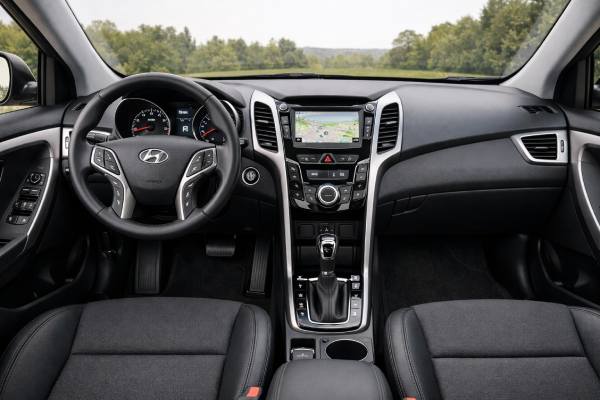

The facelifted Hyundai i30 Tourer GD 1.6 GDI is one of the more interesting compact estates of its era because it blends useful wagon practicality with a stronger naturally aspirated petrol engine than the ordinary entry-level models. In 135 hp form, the 1.6 GDI gives the Tourer enough extra mid-range and top-end performance to feel more relaxed with passengers and luggage than the 1.4 MPI, while the GD platform still delivers a roomy cabin, stable handling, and sensible family-car ergonomics. The facelift also sharpened the design, refreshed the trim structure, and kept the i30 competitive against better-known European rivals. What makes this version worth careful attention in the used market is balance. It is practical, comfortable, and usually cheaper to own than many small turbo estates. The main caveat is the engine itself: direct injection improves efficiency and response, but it also makes service history, oil quality, and intake cleanliness more important than on the simpler MPI petrol models.
Core Points
- The Tourer body offers a genuinely useful 528 L boot and estate-car flexibility without SUV bulk or weight.
- The 1.6 GDI engine gives this wagon noticeably stronger performance than the smaller 1.4 petrol versions.
- Ride comfort, motorway stability, and rear-seat space are real strengths of the GD Tourer platform.
- Because this is a direct-injection petrol, intake carbon build-up and service quality matter more than on MPI models.
- Engine oil and filter are best changed every 12 months or 12,000–15,000 km for long-term durability.
Section overview
- Hyundai i30 Tourer GD GDI profile
- Hyundai i30 Tourer GD GDI data
- Hyundai i30 Tourer GD trims and safety
- Problem patterns and official actions
- Maintenance routine and used-buying advice
- Real-world driving and running costs
- Compact estate rivals compared
Hyundai i30 Tourer GD GDI profile
The facelifted Hyundai i30 Tourer GD sits in a sweet spot that many used buyers overlook. It gives you most of what people want from a family estate car without moving into a larger, heavier, and more expensive class. The body is long enough to make the luggage area genuinely useful, but not so large that the car feels awkward in town. It still drives like a compact hatchback, which is one of its biggest strengths.
In 1.6 GDI form, the Tourer also gets a better-matched petrol engine than the smaller 1.4 MPI. The extra power is only part of the story. More important is the way the engine changes the car’s character. With 135 hp, the Tourer feels less strained on the motorway, less breathless with a family load, and more flexible when merging or overtaking. It is still not a performance estate, but it is a more convincing all-rounder than the lowest-output petrol versions.
The platform helps a lot. The GD-generation i30 was Hyundai’s serious attempt to compete with the best cars in the European C-segment, and that shows in the basics. The Tourer uses a multi-link rear suspension rather than a simpler torsion-beam arrangement, which helps it ride more smoothly and stay composed over uneven surfaces. It also gives the car a planted, mature feel on fast roads. Cabin packaging is strong, rear-seat room is useful, and the luggage area is not just large on paper but easy to use in practice.
The 1.6 GDI engine is where the ownership decision becomes more nuanced. Unlike the simpler 1.6 MPI, this engine uses direct injection. That improves efficiency and gives slightly crisper response, but it also introduces a more modern set of long-term maintenance concerns. Intake-valve carbon build-up becomes more relevant, fuel quality matters more, and oil-change discipline becomes more important. This does not make the engine bad. It simply means it rewards careful ownership more than the plain MPI motor does.
That trade-off is why this version suits a specific kind of buyer. It is a good choice for drivers who want a practical petrol estate with more power than the 1.4, who do mixed city and motorway use, and who are prepared to maintain the engine properly. It is less attractive for buyers who want the absolute lowest-maintenance petrol option or who do very short trips with little mechanical sympathy.
The facelift itself added value without changing the core formula. The design became cleaner, equipment was reorganized, and some markets added features like lane-departure warning or better infotainment on higher trims. The result is a compact estate that still feels modern enough today. In short, the i30 Tourer 1.6 GDI is not special because it is rare or prestigious. It is special because it combines practicality, sensible road manners, and just enough extra engine to make the wagon feel complete.
Hyundai i30 Tourer GD GDI data
The tables below focus on the 2015–2017 facelift Hyundai i30 Tourer GD with the 1.6 GDI petrol engine in 135 hp form. As with most Hyundai models of this period, exact figures can vary slightly by market, trim, wheel package, and gearbox.
| Powertrain and efficiency | Specification |
|---|---|
| Code | G4FD |
| Engine layout and cylinders | Front-transverse inline-4, DOHC, 4 cylinders, 4 valves per cylinder |
| Bore × stroke | 77.0 × 85.4 mm (3.03 × 3.36 in) |
| Displacement | 1.6 L (1,591 cc) |
| Induction | Naturally aspirated |
| Fuel system | Gasoline direct injection |
| Compression ratio | About 11.0:1 |
| Max power | 135 hp (99 kW) @ about 6,300 rpm |
| Max torque | 164 Nm (121 lb-ft) @ about 4,850 rpm |
| Timing drive | Chain |
| Rated efficiency | About 5.9–6.3 L/100 km, depending on gearbox and market |
| Real-world highway @ 120 km/h (75 mph) | Usually about 6.7–7.8 L/100 km in good condition |
| Transmission and driveline | Specification |
|---|---|
| Transmission | 6-speed manual; 7-speed dual-clutch automatic on some markets |
| Drive type | FWD |
| Differential | Open |
| Chassis and dimensions | Specification |
|---|---|
| Suspension front / rear | MacPherson strut / multi-link independent rear |
| Steering | Electric-assist rack and pinion |
| Steering ratio | About 2.85 turns lock-to-lock |
| Brakes | Front and rear discs on many 1.6 GDI Tourer variants |
| Most popular tyre size | 205/55 R16 |
| Ground clearance | About 140–150 mm (5.5–5.9 in), market-dependent |
| Length / width / height | 4,485 / 1,780 / 1,500 mm (176.6 / 70.1 / 59.1 in) |
| Wheelbase | 2,650 mm (104.3 in) |
| Turning circle | About 10.6 m (34.8 ft) |
| Kerb weight | About 1,300–1,360 kg (2,866–2,998 lb), trim- and gearbox-dependent |
| GVWR | About 1,900–1,920 kg (4,189–4,233 lb) |
| Fuel tank | 53 L (14.0 US gal / 11.7 UK gal) |
| Cargo volume | 528 L (18.6 ft³) seats up / 1,642 L (58.0 ft³) seats folded, VDA |
| Performance and capability | Specification |
|---|---|
| 0–100 km/h | About 11.1 s manual |
| Top speed | About 189 km/h (117 mph) |
| Braking distance | Exact body- and tyre-specific public figure varies by test source |
| Towing capacity | Often about 1,500 kg (3,307 lb) braked / 650 kg (1,433 lb) unbraked; verify by VIN plate |
| Payload | Roughly 500–560 kg (1,102–1,235 lb) |
| Fluids and service capacities | Specification |
|---|---|
| Engine oil | Usually 5W-30 or 5W-40 meeting the correct Hyundai and ACEA petrol spec |
| Engine oil capacity | About 3.6–3.8 L (3.8–4.0 US qt) with filter |
| Coolant | Long-life ethylene-glycol coolant, typically 50:50 mix |
| Coolant capacity | About 5.7–6.0 L (6.0–6.3 US qt), verify by VIN |
| Manual transmission oil | API GL-4 manual gear oil |
| Manual transmission capacity | About 1.9–2.0 L (2.0–2.1 US qt) |
| DCT fluid | Hyundai-approved specification only, verify by transmission code |
| A/C refrigerant | R-134a; exact charge varies by label |
| A/C compressor oil | PAG type; verify by under-bonnet label |
| Key torque specs | Wheel nuts commonly 88–107 Nm (65–79 lb-ft); confirm other critical fasteners by VIN data |
| Safety and driver assistance | Specification |
|---|---|
| Crash ratings | Euro NCAP 2012 generation result: 5 stars, 90% adult, 90% child, 67% pedestrian, 86% safety assist |
| IIHS | Not applicable to this exact market variant |
| Headlight rating | No IIHS headlight rating for this model |
| ADAS suite | ABS, ESC, VSM, and related stability functions standard in many markets; LDWS on some higher facelift trims; no widespread factory AEB or ACC on most 1.6 GDI Tourers |
The specification sheet shows why this version works well as an all-round family estate. It offers useful luggage capacity, sensible dimensions, and stronger petrol performance than the basic engines without moving into a more extreme or expensive part of the range.
Hyundai i30 Tourer GD trims and safety
Trim names differ widely across markets, so the most useful way to assess a facelifted i30 Tourer 1.6 GDI is to focus on actual equipment rather than the brochure name. Depending on country, buyers saw versions such as Entry, Comfort, Style, Premium, Deluxe, or local special editions. The key is that the 1.6 GDI usually sat above the basic petrol in both price and equipment, and that often makes it a more pleasant used buy when the condition is right.
Lower-grade Tourers generally came with steel wheels or smaller alloys, cloth trim, manual air conditioning, and simple infotainment. Mid-range cars often added cruise control, parking sensors, steering-wheel controls, Bluetooth, better seat trim, and 16-inch alloys. Higher-spec versions could include a navigation system, rear camera, dual-zone climate control, keyless entry, folding mirrors, rain sensors, and even panoramic roof or semi-leather upholstery on some markets.
For the 1.6 GDI, the mechanical differences by trim are more interesting than on the weaker petrol models. The GDI engine was paired with a 6-speed manual as standard in many regions, and some markets also offered the 7-speed dual-clutch transmission. That is worth checking because it changes the driving feel and the long-term maintenance picture. The DCT can make the car feel more modern and efficient, but it also adds complexity and deserves careful road-testing.
Wheel and tyre choice also matter. Sixteen-inch cars with 205/55 tyres usually offer the best compromise between comfort, grip, and running cost. Seventeen-inch packages look sharper, but they can harden the ride and raise tyre expense without adding much benefit for the way most owners use this estate.
Quick identifiers help when sellers are vague. Roof rails, rear cargo cover, 60:40 split rear seats, and luggage-area fittings are typical Tourer features, but higher grades may add under-floor cargo solutions, luggage nets, and more refined trim. GDI versions often bring more upmarket wheel designs, additional chrome details, and stronger equipment bundles than the entry 1.4 or 1.6 MPI cars. VIN-based equipment decoding is still the safest method because feature bundles differ by country.
Safety is one of the GD Tourer’s strongest selling points. The GD-generation i30 scored a five-star Euro NCAP result under the 2012 protocol, which was a meaningful improvement over the earlier FD model and kept it fully competitive in its class at the time. In practical terms, buyers got a solid shell, multiple airbags, ESC, ABS, brake assist, hill-start functions on many cars, and strong child-seat compatibility. Curtain airbags and ISOFIX were important family-car credentials and remain relevant now.
Modern driver assistance is less consistent. Many 1.6 GDI Tourers do not have autonomous emergency braking or adaptive cruise, but some higher facelift trims in certain markets added lane-departure warning. That is useful, but it should not distract from the fundamentals. On a used compact estate, good tyres, healthy brakes, a straight body shell, and working stability systems matter more than optional electronics. A well-kept mid-spec Tourer with full safety systems working properly is usually a better buy than a heavily optioned car with electrical faults or unclear history.
Problem patterns and official actions
The facelifted i30 Tourer 1.6 GDI is generally a sound estate, but it is not as simple as the MPI models. Most of the extra complexity comes from the direct-injection system and, where fitted, the DCT gearbox. That does not make it fragile, but it does mean service history matters more.
The main reliability themes are easy to group.
- Common, low to medium cost: intake-valve carbon build-up.
- Symptoms: rough idle, uneven cold-start behavior, reduced throttle crispness, occasional misfire codes.
- Likely cause: direct injection means fuel no longer washes the intake valves.
- Recommended remedy: inspect and clean the intake valves when symptoms and mileage suggest it, especially on short-trip cars.
- Common, low cost: ignition coils and spark plugs.
- Symptoms: misfire, hesitation under load, engine light.
- Likely cause: normal aging of coils or overdue plugs.
- Recommended remedy: proper scan and targeted replacement, with plug condition checked at the same time.
- Common, low to medium cost: steering-coupling wear in the electric steering system.
- Symptoms: knocking or clicking through the wheel during parking manoeuvres.
- Likely cause: wear in the flexible coupling of the motor-driven steering system.
- Recommended remedy: replace the coupling rather than over-diagnosing the full steering assembly.
- Occasional, medium cost: cooling-system leaks and thermostat issues.
- Symptoms: low coolant, poor heater performance, unstable temperature.
- Likely cause: hoses, clamps, housing seals, or overdue coolant service.
- Recommended remedy: pressure-test the system and fix leaks early. Overheating history should always worry a buyer.
- Occasional, medium cost: timing-chain wear on neglected engines.
- Symptoms: start-up rattle, timing-correlation faults, rough idle.
- Likely cause: stretched oil intervals or low oil level.
- Recommended remedy: inspect chain, guides, and tensioner together if symptoms appear.
- Occasional, medium to high cost: DCT hesitation or poor shift quality on dual-clutch cars.
- Symptoms: shudder, hesitation in traffic, poor low-speed smoothness.
- Likely cause: software calibration, clutch wear, or service neglect.
- Recommended remedy: road-test carefully, scan transmission data, and confirm software and service history.
The engine’s biggest long-term difference from the MPI petrols is the direct injection system. Many GDI engines stay healthy for a long time, but short trips and long oil intervals tend to accelerate intake deposits. That does not mean every car needs expensive preventative work. It means buyers should be alert to idle quality, throttle response, and whether the car feels clean and smooth from cold to hot.
Chassis aging is usually straightforward. Front drop links, bushes, top mounts, and rear brake hardware can all wear with age, especially on estates that carried regular family loads. Rust is not usually severe on a good GD, but check sill edges, jacking points, tailgate seams, rear arches, and subframe areas carefully.
Campaign and recall history also matters. Public recall resources show that i30 safety and campaign status should always be checked by VIN, not guessed from model year. Steering- and ESC-related actions have existed in the wider GD-era family depending on market and build. The right buying approach is simple: confirm open and closed campaign status with an official recall database or dealer record before purchase.
Maintenance routine and used-buying advice
The i30 Tourer 1.6 GDI rewards regular, preventive maintenance. That is especially true compared with the MPI petrol models, because the GDI engine responds more strongly to oil quality, service timing, and intake cleanliness. A good one can age very well. A neglected one tends to become rougher and more expensive in stages rather than through one dramatic failure.
A practical maintenance schedule looks like this:
| Item | Practical interval | Notes |
|---|---|---|
| Engine oil and filter | Every 12,000–15,000 km or 12 months | More conservative intervals help chain life and general engine cleanliness |
| Engine air filter | Inspect every service, replace around 30,000 km | Earlier in dusty use |
| Cabin air filter | Every 12 months or 15,000 km | Helps HVAC performance and demisting |
| Spark plugs | About 45,000–60,000 km depending on plug type | GDI engines are sensitive to weak ignition quality |
| Intake-valve inspection | Check condition at higher mileage or when idle quality worsens | Clean when symptoms justify it |
| Coolant | Inspect yearly; renew every 4–5 years if history is unclear | Check thermostat housing and hoses at the same time |
| Brake fluid | Every 24 months | Important for ABS and pedal feel |
| Manual gearbox oil | Preventive change around 90,000–120,000 km | Helps long-term shift feel |
| DCT service | Follow the exact transmission specification and service guidance | Verify by gearbox code and dealer data |
| Auxiliary belt and tensioners | Inspect yearly | Replace on cracks, noise, or wobble |
| Timing chain | No routine replacement interval; inspect for rattle or timing faults | Clean oil is the best protection |
| Brake inspection | Every service | Rear brake hardware can seize with age |
| Tyre rotation and alignment | Every 10,000–12,000 km and after suspension work | Especially valuable on wagons carrying load |
| 12 V battery test | Yearly after year four | Weak batteries cause many nuisance faults |
Useful planning figures include about 3.6–3.8 L of engine oil with filter, about 5.7–6.0 L of coolant, and about 1.9–2.0 L of manual gearbox oil depending on version. Wheel-nut torque is commonly in the 88–107 Nm range, but more critical values should always be checked against the exact workshop data for the VIN.
A smart used-buyer inspection should include:
- Confirm whether the car is manual or DCT.
- Demand invoices, not just stamps.
- Start the engine cold and judge idle quality carefully.
- Test for hesitation, misfire, or uneven response under load.
- Listen for steering clicks at low speed.
- Check the luggage area, tailgate struts, and rear trim for estate-car wear.
- Inspect the underside for rust, fluid leaks, and damaged jacking points.
- Scan for stored engine, ESC, and transmission codes.
- Check tyre brand and wear pattern for clues about maintenance habits.
The best versions are usually mid- or higher-spec Tourers on 16-inch wheels with clear service history and no rough-running symptoms. Cars to avoid are those with vague history, poor idle quality, dashboard lights, or obvious DCT hesitation. Long term, the 1.6 GDI Tourer can be a very capable estate, but it asks for a little more care than the simpler MPI petrol variants.
Real-world driving and running costs
On the road, the i30 Tourer 1.6 GDI feels like the petrol estate many buyers actually want. It is not fast in a dramatic way, but it has enough extra power over the 1.4 MPI to make the wagon feel more natural and less strained. That difference is most obvious with passengers, luggage, or longer motorway climbs, where the GDI engine feels better matched to the Tourer body.
Around town, the engine is smooth and fairly eager once warm. Throttle response is cleaner than many small turbo engines from the same period, even if it lacks their low-rpm punch. You still need to use the gearbox properly, but the car no longer feels as underpowered as the smaller entry engines can. The manual transmission suits the engine well. It keeps the car light on its feet and lets the driver make the most of the naturally aspirated power delivery.
If fitted with the 7-speed dual-clutch, the car can feel more modern in traffic and on longer trips, but low-speed smoothness varies with condition and calibration. A good DCT car shifts neatly and helps economy. A neglected one can feel hesitant or jerky during parking manoeuvres or stop-start use, which is why test-driving one carefully matters so much.
The chassis remains one of the strongest parts of the package. Straight-line stability is very good, the multi-link rear suspension gives the wagon a composed feel over broken roads, and the longer body does not make the car clumsy. On 16-inch wheels, ride comfort is especially well judged. The Tourer feels settled, which is exactly what many family-estate buyers want. Steering is accurate enough without being especially talkative, and braking feel is solid when the system is in good order.
Cabin refinement is respectable for the class and period. At urban speeds the car feels smooth and solid, and on faster roads it remains calm enough for long trips. Wind and tyre noise are present but not excessive. Compared with the diesel Tourer, the GDI petrol gives a quieter, more refined character at lower speeds, though it does not match the diesel’s relaxed low-rpm torque.
Real-world fuel economy is decent rather than outstanding:
- City: about 7.8–9.0 L/100 km
- Highway at 100–120 km/h: about 6.1–7.4 L/100 km
- Mixed use: about 6.8–7.9 L/100 km
Expect those figures to rise with short trips, roof loads, DCT use in traffic, or poor wheel alignment. This is not a low-cost diesel substitute, but it is a more refined and simpler day-to-day petrol estate than many turbo alternatives. The verdict on the road is clear: the 1.6 GDI makes the Tourer feel complete, comfortable, and properly usable for family travel.
Compact estate rivals compared
The i30 Tourer 1.6 GDI sits in a useful part of the used-estate market. It is not the obvious premium choice, but it often lands in the sweet spot between price, practicality, and manageable long-term ownership. That is why it deserves to be compared as a whole package rather than just on badge image.
The Kia cee’d Sportswagon is the closest relative and the most obvious rival. In many cases, the decision comes down to condition, trim, and local service history rather than meaningful engineering differences. Both cars appeal because they provide useful estate packaging without over-complicating the ownership experience. The Hyundai often feels slightly more conservative in design, while the Kia may sometimes look better equipped at the same price.
Compared with a Ford Focus estate, the Hyundai loses on steering feel and outright driver involvement. The Focus remains the better driver’s car. The i30 Tourer answers with a calmer ownership case, strong packaging, and a generally mature road feel. For buyers who care more about stability, space, and comfort than about chassis sharpness, the Hyundai is easy to justify.
Against the Volkswagen Golf Variant, the Hyundai typically gives away some cabin richness and badge prestige. But many Golfs of the same era used smaller turbo engines that can complicate the long-term reliability picture. The Hyundai’s naturally aspirated GDI is not maintenance-free, yet many buyers still prefer that risk profile to a downsized turbo car once mileage rises.
The Toyota Auris Touring Sports is another strong comparison. Toyota usually carries the better reliability reputation overall, but the Hyundai often feels more spacious and can represent stronger value for money in the used market. The Opel or Vauxhall Astra Sports Tourer is also worth a look, though again the engine choice there often determines whether the car becomes a value buy or a maintenance gamble.
The Hyundai is strongest for buyers who want:
- a proper compact estate with real luggage space,
- more petrol performance than the basic entry engines,
- good ride comfort and motorway manners,
- and sensible used-market value.
It is less attractive for buyers who want the absolute simplest petrol ownership experience, because the GDI engine does ask for a little more care than an MPI engine. It is also less ideal for drivers who want especially low-rpm shove, where a diesel still has the edge.
Overall, the facelifted i30 Tourer 1.6 GDI is one of the more balanced used compact estates available. It gives you a practical wagon body, mature road manners, and enough extra performance to feel worth choosing over the base petrol. For the right owner, that makes it a very smart alternative to more expensive or more complex rivals.
References
- Hyundai Owners Manuals 2026 (Owner’s Manual)
- EuroNCAP | Hyundai i30 2026 (Safety Rating)
- Hyundai i30 (wagon) 2016 (Technical Guide)
- Check if a vehicle, part or accessory has been recalled – GOV.UK 2026 (Recall Database)
- Hyundai i30 2015 (Model Brochure)
Disclaimer
This article is for informational purposes only and is not a substitute for professional diagnosis, repair, or official workshop guidance. Specifications, torque values, service intervals, procedures, and equipment can vary by VIN, market, gearbox, and trim, so always verify details against the correct official service documentation for the exact vehicle.
If this guide helped you, please consider sharing it on Facebook, X, or another social platform to support our work.