

The facelifted Hyundai i30 Wagon PD with the 1.6 CRDi 115 hp diesel is one of the most practical versions of the i30 family for drivers who still cover real mileage. It combines the long-roof wagon body, a useful six-speed manual or seven-speed dual-clutch option, and the kind of torque that suits motorway work, family travel, and light towing far better than the smaller petrol engines. It is not the most exciting i30 on paper, but it often makes the strongest everyday case.
This facelift generation also matters because Hyundai improved the i30’s design, connectivity, and safety features while keeping the wagon’s strong cargo space and sensible dimensions. The 115 hp diesel remained the simpler diesel choice, sitting below the stronger electrified 136 hp version. That gives it a clear identity in the used market. Its biggest strength is efficiency with real-world usability. Its biggest caveat is equally clear: like any modern Euro 6 diesel, it rewards longer trips and proper servicing more than repeated short-distance neglect.
Quick Specs and Notes
- The 1.6 CRDi suits motorway driving, full-family loads, and regular long trips better than the smaller petrol options.
- The wagon body offers 602 L of boot space and useful towing capacity for a compact estate.
- Manual cars are usually the simplest long-term ownership choice, while the DCT adds convenience if it has been maintained properly.
- Short-trip use can accelerate DPF, EGR, and AdBlue-related headaches on neglected cars.
- Official market data lists diesel oil service intervals as long as 30,000 km or 2 years, but a shorter real-world interval is wiser.
Contents and shortcuts
- Hyundai i30 Wagon diesel portrait
- Hyundai i30 Wagon data tables
- Hyundai i30 Wagon trims and ADAS
- Known issues and campaigns
- Service plan and buyer checks
- Diesel manners and road use
- Versus estate car rivals
Hyundai i30 Wagon diesel portrait
The facelifted i30 Wagon is easy to understand once you know where the 1.6 CRDi 115 hp version sits in the range. It is the sensible diesel, not the flashy one. Hyundai’s 2020 facelift press material made that split clear: the 115 PS 1.6-litre diesel stayed in the range with a six-speed manual or optional seven-speed dual-clutch transmission, while the stronger 136 PS diesel took the 48-volt mild-hybrid system as standard. That matters because buyers often confuse the two in used-car listings. The 115 hp car is the simpler diesel choice, and for many buyers that is exactly the point.
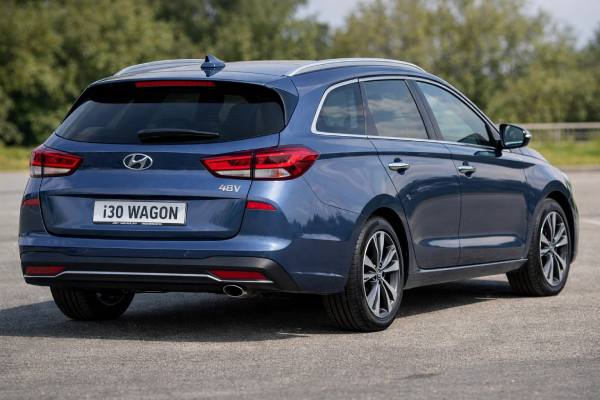
The wagon body is a big part of the appeal. Hyundai gave the estate a full 602 litres of luggage space with the rear seats up and 1,650 litres with the seats folded. That makes the i30 Wagon more than a hatchback with a longer tail. It is a genuine family estate with enough boot depth for pushchairs, dogs, airport luggage, flat-pack items, or weekend travel without immediately forcing owners into SUV size or SUV fuel consumption. The footprint is still compact enough to work easily in city parking spaces, which is part of the charm.
This diesel also suits the wagon better than many buyers expect. On paper, 115 hp does not sound like much for an estate. In reality, the 1.6 CRDi’s torque is what matters. Hyundai’s technical data shows 280 Nm in manual form and 300 Nm with the seven-speed DCT. That is enough to make the car feel relaxed in the mid-range, especially when compared with small petrol engines that need more revs and more planning once the car is full. The diesel is not quick, but it is appropriately strong in the real conditions wagons often face.
The facelift itself improved the ownership case. Hyundai updated the exterior, sharpened the front-end styling, expanded the available digital displays, and widened the SmartSense driver-assistance package. By the later phase of the facelift run, the i30 family also received another design and technology update for 2024. That means a late-run wagon can feel newer inside than the basic 2020 launch-year facelift cars, even when the core platform is unchanged. Diesel availability, however, depended more heavily on market as the years went on. Some countries kept the 1.6 CRDi longer than others, so buyers should always identify the exact car by VIN, original order sheet, and engine code rather than by year alone.
The ownership logic is very clear. This is the i30 Wagon for drivers who still do distance. It is not the right engine for constant five-kilometre city hops and long idle periods. It is the version for motorway commuters, mixed intercity family use, or buyers who want better real-world fuel economy under load. That distinction shapes the whole article, because a well-used diesel wagon and a badly used diesel wagon often feel like two different cars.
Hyundai i30 Wagon data tables
For the facelift 2020–2024 Hyundai i30 Wagon 1.6 CRDi 115 hp, the core technical story is simple: a Euro 6 diesel estate with useful torque, front-wheel drive, and practical wagon packaging. Hyundai’s official 2020 facelift technical sheets provide the clearest model-specific data for this powertrain. Later facelift years continued the design and equipment evolution, but exact trim and market availability varied.
| Powertrain and efficiency | Specification |
|---|---|
| Engine family | 1.6 CRDi diesel |
| Engine layout and cylinders | Inline-4 diesel, DOHC, 4 valves per cylinder |
| Displacement | 1.6 L (1,598 cc) |
| Bore × stroke | 77.0 × 85.8 mm (3.03 × 3.38 in) |
| Induction | Turbocharged |
| Fuel system | Common-rail direct injection with piezo injectors |
| Compression ratio | 15.9:1 |
| Max power | 115 hp (85 kW) @ 4,000 rpm |
| Max torque | 280 Nm (206 lb-ft) @ 1,500–2,750 rpm manual |
| Max torque with DCT | 300 Nm (221 lb-ft) @ 1,500–2,500 rpm |
| Timing drive | Belt |
| Emissions hardware | SCR with AdBlue, oxidation catalyst, NOx storage catalyst, EGR, diesel particulate filter |
| Fuel type | Diesel |
| Transmission and driveline | Specification |
|---|---|
| Transmission | 6-speed manual or optional 7-speed DCT |
| Drive type | FWD |
| Differential | Open |
| Clutch | Single dry clutch on manual; dual-clutch automatic on DCT |
| Performance and economy | Specification |
|---|---|
| 0–100 km/h | 11.1 s |
| Top speed | 192 km/h (119 mph) |
| Official combined consumption, early converted figures | 4.3 L/100 km manual, 4.1 L/100 km DCT |
| Official WLTP combined range in later Hyundai EU material | about 4.5–5.1 L/100 km depending on trim and transmission |
| Real-world highway at 120 km/h | typically about 5.3–6.2 L/100 km in healthy condition |
| Chassis and dimensions | Specification |
|---|---|
| Front suspension | MacPherson strut |
| Rear suspension | Multi-link or CTBA depending on exact trim and market package |
| Steering | Electric power steering |
| Brakes front | Ventilated disc, 280 mm; 288 mm in some trims |
| Brakes rear | Disc, 272 mm; 284 mm in some trims |
| Wheels and tyres | Common sizes include 205/55 R16 and 225/45 R17 |
| Ground clearance | 140 mm (5.5 in) |
| Length | 4,585 mm (180.5 in) |
| Width | 1,795 mm (70.7 in) |
| Height | 1,465 mm without rails / 1,475 mm with roof rails |
| Wheelbase | 2,650 mm (104.3 in) |
| Turning circle | 10.6 m (34.8 ft) |
| Kerb weight | about 1,415–1,573 kg manual, 1,445–1,603 kg DCT depending on trim |
| GVWR | 1,920 kg manual / 1,950 kg DCT |
| Fuel tank | 50 L (13.2 US gal / 11.0 UK gal) |
| AdBlue tank | 12 L |
| Cargo volume | 602–1,650 L, VDA |
| Capability | Specification |
|---|---|
| Braked towing | 1,500 kg |
| Unbraked towing | 650 kg |
| Roof load | 80 kg |
| Payload | about 347–505 kg depending on trim |
| Fluids and service capacities | Specification |
|---|---|
| Engine oil capacity | 4.4 L including filter |
| Gearbox oil | 1.6 L manual / about 2.0 L DCT |
| Coolant capacity | 7.3 L |
| Fuel tank | 50 L |
| AdBlue | 12 L |
| Recommended official oil-change interval in public market data | 30,000 km or 2 years |
| Official general service interval in public market data | 30,000 km or 2 years |
A few numbers shape the ownership verdict immediately. The 1,500 kg braked towing figure is useful for a compact diesel wagon. The 602-litre boot makes the estate body worthwhile. The 280 to 300 Nm torque band explains why the car feels stronger in ordinary use than the headline 115 hp suggests. And the 12-litre AdBlue tank and full Euro 6 after-treatment layout explain why this is a modern diesel that needs proper usage patterns and proper servicing, not old-school neglect.
Hyundai i30 Wagon trims and ADAS
The facelift i30 Wagon was sold with different trim names depending on country, but the structure is familiar. Lower and middle trims focused on value and comfort, while upper trims added more technology, bigger wheels, and a fuller SmartSense package. In Germany, Hyundai’s published facelift wagon technical material lists trims such as Pure, Select, Trend, Prime, and N Line. In the UK and some other markets, names differed, but the basic logic was similar: the 1.6 CRDi 115 hp usually sat in the practical part of the range rather than the showiest one.
That matters because the 115 hp diesel is mostly a usability-focused choice. Buyers who selected it were usually interested in fuel range, torque, and motorway pace rather than appearance alone. As a result, many good used examples are found in middle trims where the specification is genuinely helpful: sensible alloy wheels, parking sensors, navigation or smartphone integration, climate control, and useful safety technology without the higher tyre costs of the most appearance-focused versions.
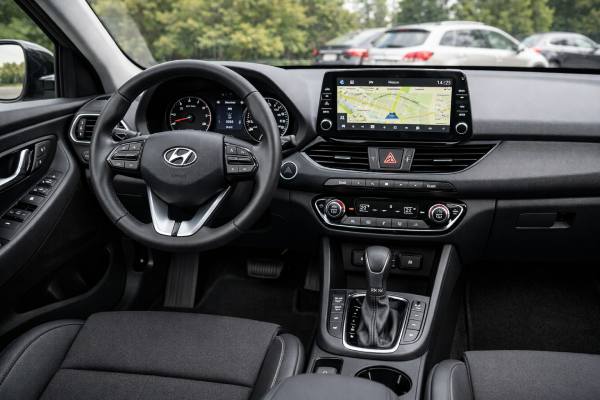
The facelift significantly improved cabin technology. Hyundai introduced a 10.25-inch navigation touchscreen in higher grades and a seven-inch digital instrument cluster in the wider facelift family. It also brought Bluelink connectivity to the i30 for the first time in navigation-equipped versions. Wireless phone charging and expanded smartphone integration made later facelift cars feel more modern than earlier PD-generation models, even though the underlying structure stayed familiar. This matters in the used market because a 2023 or 2024 car can feel much newer inside than a 2020 one with a smaller display and fewer connected features.
Safety is a strong point. Euro NCAP’s published i30 scores remain solid: 88% adult occupant protection, 84% child occupant protection, 64% vulnerable road user protection, and 68% safety assist. Euro NCAP also records that the facelift and mild-hybrid variants were added into the rating history and that the rating validity expired on January 1, 2024 as part of the organization’s time-based review process. That does not mean the car became unsafe. It means the old rating is no longer current under the latest testing regime.
The facelift also widened the SmartSense package. Hyundai’s 2020 facelift press material lists new Lane Following Assist, Rear Collision-avoidance Assist, Leading Vehicle Departure Alert, and Blind-Spot Collision-Avoidance Assist, alongside existing systems such as Forward Collision-Avoidance Assist with pedestrian detection, Driver Attention Warning, High Beam Assist, Intelligent Speed Limit Warning, and Lane Keeping Assist. eCall also became part of the updated safety story. In real buying terms, this means later and better-equipped facelift wagons can be meaningfully richer in active-safety hardware than earlier or lower-spec examples.
Quick identifiers matter when shopping. A lower trim often rides on 16-inch wheels and gives the most forgiving ride. Better-equipped cars may add 17-inch wheels, upgraded lighting, navigation, and more assistance features. N Line versions change the look and sometimes the wheel-and-tyre package, but the 115 hp diesel should still be judged mainly by service quality rather than styling. For buyers who care most about value, a mid-grade car with full service history is often the sweet spot.
Known issues and campaigns
The 1.6 CRDi 115 hp facelift wagon is usually dependable when used as intended, but it is not an old mechanical diesel that tolerates endless abuse. It is a Euro 6 car with SCR, AdBlue, EGR, and a diesel particulate filter. That means reliability depends heavily on usage pattern and maintenance quality. In simple terms, the car likes miles, temperature, and clean servicing. It dislikes constant short trips, ignored warning lights, and delayed fluid changes.
The most common issues are diesel-aftertreatment related. The typical pattern is familiar: frequent short journeys lead to incomplete DPF regeneration, which then creates higher soot loading, warning lights, or limp-home behaviour. Symptoms usually begin with more frequent regeneration attempts, stronger cooling-fan activity after shutdown, rising fuel consumption, or a dash warning. The likely root cause is not a failed engine but a car that has not been driven long enough to complete proper regeneration cycles. The right remedy is early diagnosis, not wishful thinking. A forced regeneration, sensor check, or cleaning procedure is far cheaper than a neglected DPF replacement.
AdBlue and SCR issues are another real-world theme. Crystallisation around filler areas, sensor faults, or dosing-system complaints can appear as the cars age. Symptoms include warnings about emissions systems, restricted restart countdowns, or check-engine lights. Sometimes the issue is a sensor, sometimes the dosing path, and sometimes poor maintenance around the system. Buyers should not panic at the word AdBlue, but they should absolutely confirm that the system behaves correctly and that no warning history exists.
EGR contamination and intake soot are occasional-to-common depending on use. A diesel estate used mainly on short urban trips can accumulate deposits faster than one used for intercity work. Symptoms include hesitant throttle response, rough idle for a diesel, smoke, or fault codes. The likely root cause is soot build-up in the EGR path or related intake areas. Remedy can range from cleaning and software updates to replacement parts on more worn cars.
Manual cars are usually the safer long-term bet, but they are not flawless. Expect normal clutch wear on urban cars, and listen for release-bearing noise or drivetrain shunt. The optional 7-speed DCT deserves extra caution if the car has spent years in slow traffic or has inconsistent service history. Hesitation, low-speed jerking, or warning lights should be treated as diagnostic starting points, not as normal behavior.
Other occasional issues are more ordinary. Wheel bearings, suspension links, rear brake corrosion, and 12V battery weakness are all plausible as mileage rises. Weak batteries can also trigger misleading modern-car warnings, so battery testing remains important even on a diesel. Corrosion is not a defining flaw, but wagons from salted climates still deserve close inspection around the rear underside, brake lines, and subframe areas.
For campaigns and software actions, the safest rule is simple: verify by VIN through Hyundai’s official recall and service-campaign portal and check dealer records. Hyundai’s own servicing material states that retailers check for recommended updates and perform them free of charge during routine service. That matters because on a modern diesel, software can affect regeneration behavior, warning logic, and general drivability.
Service plan and buyer checks
Public Hyundai market data for the facelift wagon lists very long diesel service intervals: oil change at 30,000 km or 2 years and general servicing at 30,000 km or 2 years. That may be acceptable under ideal conditions, but it is not the best real-world strategy for a used diesel wagon. A more conservative service plan is smarter, especially if the car does mixed use, towing, cold starts, or urban traffic.
| Maintenance item | Practical interval |
|---|---|
| Engine oil and filter | Every 15,000 km or 12 months |
| Engine air filter | Inspect every service, replace around 30,000 km |
| Cabin filter | Every 15,000–30,000 km or 12–24 months |
| Fuel filter | Around 30,000–60,000 km depending on use and fuel quality |
| Coolant | Check yearly, replace to official schedule or sooner if history is unclear |
| Brake fluid | Every 24 months |
| Manual gearbox oil | Inspect for leaks, refresh around 100,000 km if history is unknown |
| DCT fluid strategy | Follow exact VIN-based service guidance and inspect for smooth operation |
| Timing belt | Replace strictly at the official interval for the market and VIN |
| Auxiliary belts and hoses | Inspect every service |
| DPF and AdBlue system | Check for stored faults and proper regeneration behavior at every major service |
| Brakes | Inspect every service, especially rear brakes on lightly used cars |
| Tyres and alignment | Inspect often; align when wear pattern changes |
| 12V battery | Test yearly after year 4 |
Fluid planning is straightforward but important. The engine takes 4.4 L of oil with filter, the manual gearbox takes 1.6 L, the DCT about 2.0 L in the published technical data, the cooling system holds 7.3 L, and the AdBlue tank is 12 L. Those are useful numbers for buyers because they tell you the car is not unusually expensive to service in raw materials, but it still needs proper consumables and the right specifications.
The buyer’s checklist should focus on evidence, not promises. Ask for:
- a complete service history,
- proof of oil changes earlier than the longest official interval where possible,
- evidence of timing-belt planning or replacement when relevant,
- recent AdBlue and emissions-system diagnosis if applicable,
- tyre brand consistency,
- recent brake work,
- and proof that recall or service campaigns were checked.
Then drive the car properly. Start it cold. Watch for excessive smoke, rough idle, chain-like noise that should not be there on a belt-driven engine, warning lights, and rough pull under load. Once warm, check that boost delivery is smooth, the gearbox behaves cleanly, and the car tracks straight. After the drive, listen for cooling fans and smell for overactive regenerations or exhaust issues.
The best used examples are usually cars that have done regular longer journeys and received annual servicing. A lower-mileage diesel is not automatically the best diesel. In many cases, a well-maintained motorway car is healthier than a lightly used urban one. That principle matters more here than trim badge or paint colour. Long term, the outlook is good if the car is used properly. If it is treated like a short-hop city runabout, the emissions hardware will eventually complain.
Diesel manners and road use
On the road, the facelift i30 Wagon 1.6 CRDi 115 feels exactly like a good compact diesel estate should. It is calm, stable, and easy to live with. The steering is light enough for town, the chassis settles well on the motorway, and the longer wagon body never feels cumbersome. Hyundai tuned the i30 family for broad real-world usability rather than for dramatic steering tricks, and that suits this engine very well.
The diesel’s character is defined by torque, not revs. The engine pulls best in the low-to-mid range, where the 280 Nm manual output gives the car a relaxed feel. The DCT version, with 300 Nm, can feel slightly stronger in everyday rolling acceleration. That makes the wagon a more natural long-distance companion than the smaller petrol models, especially once there are passengers and luggage on board. It still is not fast. The official 11.1-second 0–100 km/h time makes that clear. But it is strong enough in the conditions wagons often face.
Refinement is decent for the class. At cold start, you hear the diesel clearly, especially in winter. Once warm, it settles into the background well enough for family use. At motorway speed, wind and road noise matter more than the engine itself. Smaller wheel packages usually improve the ride and keep the car feeling mature over poor surfaces. That is one reason 16-inch or 17-inch wheels often make more sense than larger style-led options on a working diesel estate.
Real-world fuel economy is one of the main reasons to buy this version. The early official converted figure of 4.3 L/100 km manual and 4.1 L/100 km DCT looks impressive, and later WLTP-era Hyundai figures still keep the wagon in roughly the 4.5 to 5.1 L/100 km range depending on exact configuration. In normal use, owners should expect somewhat more. A healthy manual car can still return mid-5s L/100 km at a true 120 km/h motorway cruise, and mixed commuting can stay close to that if the trips are long enough. Short urban driving, winter operation, and repeated DPF regeneration will raise that number.
This is also a reassuring load-carrying car. The chassis remains stable with a full boot, and the 1,500 kg braked towing figure is genuinely useful. A light trailer, small caravan, or hobby load is within the car’s comfort zone if the cooling system and brakes are in good order. The performance penalty is real, but the car remains composed. That is a very different experience from a small petrol estate that feels breathless when loaded.
So the road verdict is easy to summarize. The 1.6 CRDi 115 wagon is not the i30 for buyers who want the lightest front end or the most city-friendly powertrain. It is the i30 for distance drivers who want steady pace, good luggage space, and fuel economy that still makes sense on the open road.
Versus estate car rivals
The facelift i30 Wagon 1.6 CRDi 115 sits in a shrinking but still very useful niche: the compact diesel estate for people who drive enough to justify one. Against the Kia Ceed Sportswagon diesel, the Hyundai is a close relative in purpose. The two cars are often decided by trim, service history, and price rather than by a huge mechanical difference. The Hyundai generally feels slightly more conservative in the way it drives, which many wagon buyers actually prefer.
Against the Ford Focus Estate diesel, the Hyundai usually gives up some steering sparkle and chassis playfulness. The Ford still tends to feel more engaging on a twisting road. But the i30 Wagon answers with a calmer ownership character, a straightforward cabin layout, and a very coherent family-car personality. Buyers who value daily comfort and predictability more than cornering flair often end up leaning Hyundai.
The Skoda Octavia Combi is the practical benchmark many used buyers cross-shop. It often offers an even stronger sense of space and a very broad engine range. But it also tends to be more expensive and brings a wider spread of specs and complexity in the used market. The i30 Wagon makes a simpler case. It is easier to understand, often easier to buy well, and usually cheaper to enter.
The Opel or Vauxhall Astra Sports Tourer is another direct rival. It can look tempting on price, but the i30 often feels like the safer all-round used bet because Hyundai’s facelift-era safety package, stable chassis, and clear model structure make it easier to shop rationally. That does not mean every Astra is worse. It means the Hyundai often feels like the cleaner, lower-drama decision.
The final rival is the small SUV. Many buyers who once bought diesel estates now drift toward crossovers. The i30 Wagon quietly makes the counterargument. It offers better luggage efficiency than many compact SUVs, lower centre-of-gravity road manners, and fuel economy that usually beats a taller body style with the same power. If you do not need the seating height or image of an SUV, the wagon remains the smarter engineering answer.
That is really where this diesel i30 lands overall. It is not the flashiest compact estate, and it is not the best choice for city-only use. But for real distance work, family travel, and buyers who still understand why a diesel estate exists, it remains one of the most coherent options in the segment. It does many things well, wastes very little, and makes even more sense when bought in the right condition.
References
- Hyundai i30 Kombi | Technische Daten | Stand: 4.2019 2020 (Technical Data)
- New Hyundai i30: sleeker, safer, and more efficient 2020 (Press Information)
- Bolder and more high-tech: i30 gets update 2024 (Press Information)
- EuroNCAP | Hyundai i30 2017 (Safety Rating)
- Käyttöohjekirjat – Hyundai 2026 (Owner’s Manual Portal)
Disclaimer
This article is for informational purposes only and is not a substitute for professional diagnosis, repair, or factory service information. Specifications, torque values, intervals, procedures, software content, and equipment can vary by VIN, market, model year, transmission, and trim, so always verify the exact vehicle against official Hyundai service documentation before servicing, repairing, or purchasing a car.
If this guide helped you, please consider sharing it on Facebook, X, or another platform to support our work.