
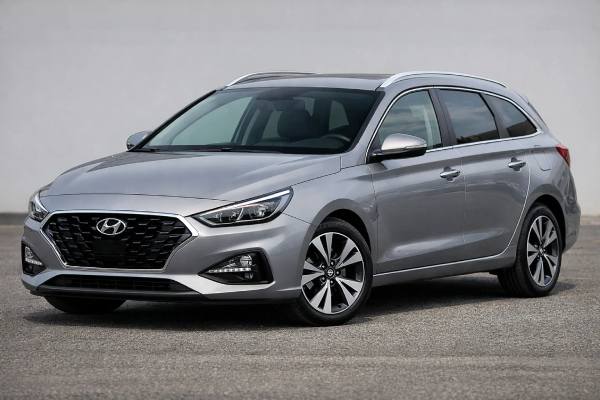
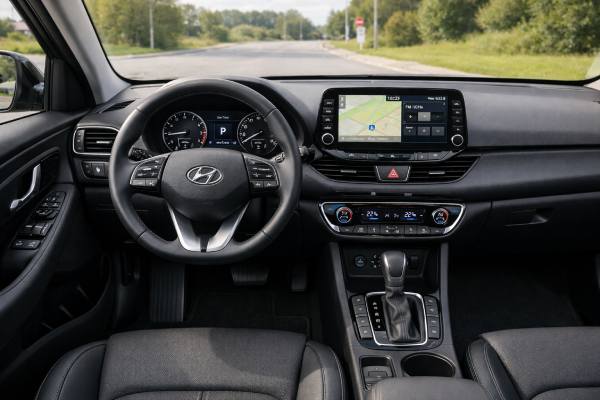
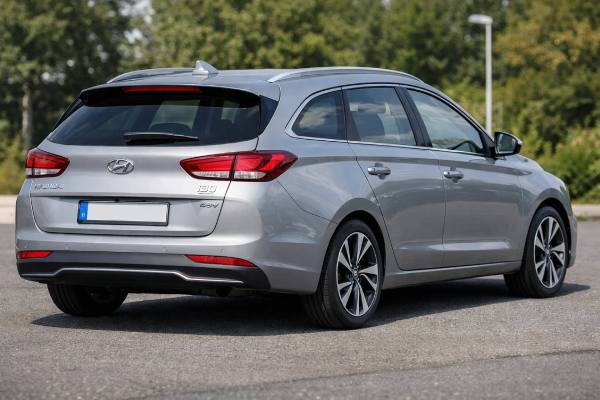
The facelift Hyundai i30 Wagon (PD) 1.5 T-GDi 48V is one of the more interesting versions of the i30 range because it blends three things that do not always come together in one compact estate: strong everyday performance, a genuinely useful cargo area, and mainstream running costs. This is not the simplest i30 to own over the long term, because the 48-volt mild-hybrid system, direct injection, turbocharging, and optional 7-speed dual-clutch transmission add complexity compared with the basic 1.5 DPi. But it is also a much more effortless car to drive, especially when loaded or used on longer trips. The facelift brought cleaner styling, updated infotainment, and a stronger safety-and-assistance package, while the wagon body remained the practical choice for families, company-car users, and drivers who wanted hatchback manners with better luggage space. For the right buyer, this version is one of the most complete non-N i30s in the whole facelift lineup.
Quick Specs and Notes
- Strong turbo torque and the longer wagon body make it an easy motorway and family car.
- The 48-volt system and 1.5 T-GDi engine give this i30 Wagon a useful step up over the basic petrol models.
- Multi-link rear suspension and bigger brake hardware help it feel more composed than lower-power versions.
- The trade-off is higher long-term complexity than the simple 1.5 DPi, especially with the 48V system and optional 7-DCT.
- Hyundai’s published oil-change interval for the 1.5 T-GDi is typically 30,000 km or 24 months.
Section overview
- Hyundai i30 Wagon facelift character
- Hyundai i30 Wagon 1.5 T-GDi data
- Hyundai i30 Wagon trims and safety tech
- Known faults and recall checks
- Service timing and buying checks
- Driving feel and fuel use
- Estate-car rivals and verdict
Hyundai i30 Wagon facelift character
The facelift i30 Wagon is best understood as the grown-up version of the regular i30 hatch. It keeps the same basic front-wheel-drive compact-car platform, but stretches the body for more luggage room and slightly more long-distance usefulness. That alone makes it easier to justify for families, dog owners, business users, and anyone who regularly carries bulky gear. In the facelift years, Hyundai also sharpened the exterior design, refreshed the cabin tech, and improved the way the car presented itself against rivals that were starting to feel more premium or more digital.
The 1.5 T-GDi 48V version is where the wagon becomes genuinely appealing rather than merely practical. Hyundai paired the 1.5-liter turbocharged direct-injection petrol engine with a 48-volt mild-hybrid system, belt-driven starter-generator, and either a 6-speed intelligent manual or an optional 7-speed DCT. The result is a drivetrain that feels far stronger than the base petrol options without needing a full hybrid setup. In public Hyundai data, this version is rated at 117 kW and 159 PS, which is commonly rounded to 160 hp. Torque is 253 Nm, and that matters more than the headline power figure in daily use.
This is also one of the more rounded chassis setups in the non-performance range. Official wagon technical data shows MacPherson strut front suspension and a multi-link rear axle for the 1.5 T-GDi, not the simpler beam arrangement found on some lower-power configurations. That gives the car a more settled feel when it is loaded, driven quickly on poor roads, or used for frequent motorway travel. It is still a mainstream family estate, not a sports wagon, but it feels more planted than the slowest i30 variants.
There is one practical catch buyers often miss. Because this exact version uses the 48-volt battery system, the wagon loses some boot space versus the non-hybrid estate. Hyundai’s own data lists the standard wagon at 602 to 1,650 L VDA, but the 48V-hybrid figure in brackets drops to 493 to 1,541 L. That is still useful, but it is a meaningful difference.
So the verdict on character is straightforward. This facelift i30 Wagon is a practical estate first, but the 1.5 T-GDi 48V gives it enough performance and enough chassis polish to feel like more than a sensible appliance. That makes it one of the strongest all-round i30 wagons for drivers who want pace without stepping into the full i30 N world.
Hyundai i30 Wagon 1.5 T-GDi data
The tables below focus on the facelift Hyundai i30 Wagon (PD) with the 1.5 T-GDi 48V mild-hybrid powertrain. Values can vary by trim, tyre package, market, and gearbox, so VIN-level confirmation still matters for parts, fluids, and exact running gear.
| Powertrain and efficiency | Data |
|---|---|
| Code | Public consumer-facing Hyundai documents do not consistently publish the engine code; verify by VIN |
| Engine layout and cylinders | Inline-4, DOHC, 4 valves per cylinder |
| Bore × stroke | 71.6 × 92.0 mm (2.82 × 3.62 in) |
| Displacement | 1.5 L (1,482 cc) |
| Induction | Single-scroll turbocharger |
| Fuel system | Direct injection |
| Compression ratio | 10.5:1 |
| Max power | 160 hp class / 117 kW / 159 PS @ 5,500 rpm |
| Max torque | 253 Nm (186.6 lb-ft) @ 1,500-3,500 rpm |
| Timing drive | Chain |
| Mild-hybrid motor | Belt-driven starter-generator, max 12 kW |
| Motor count and axle | Single belt starter-generator, front-engine layout |
| System voltage | 48 V |
| Battery chemistry | Lithium-polymer |
| Battery capacity | 0.44 kWh |
| Rated efficiency | 5.4 L/100 km published combined figure in Hyundai’s 2021 wagon technical sheet |
| Real-world highway @ 120 km/h | About 6.3-7.2 L/100 km (37.3-32.7 mpg US / 44.8-39.2 mpg UK), depending on tyres, load, and weather |
| Transmission and driveline | Data |
|---|---|
| Transmission | 6-speed intelligent manual (iMT) or 7-speed DCT |
| Drive type | Front-wheel drive |
| Differential | Open differential |
| Chassis and dimensions | Data |
|---|---|
| Front suspension | MacPherson strut |
| Rear suspension | Multi-link |
| Steering | Electric rack-and-pinion |
| Steering ratio | 13.4:1 |
| Lock-to-lock turns | 2.57 |
| Turning circle | 10.6 m (34.8 ft) |
| Brakes front | Ventilated discs, 280 mm; Trend 288 mm; Prime and N Line 305 mm |
| Brakes rear | Disc, 272 mm; Prime and N Line 284 mm |
| Wheels and tyres | 195/65 R15, 205/55 R16, 225/45 R17 depending on trim |
| Most popular tyre size | 225/45 R17 on upper trims |
| Ground clearance | 140 mm (5.51 in) |
| Length / Width / Height | 4,585 / 1,795 / 1,465 mm without rails; 1,475 mm with roof rails (180.5 / 70.7 / 57.7 / 58.1 in) |
| Wheelbase | 2,650 mm (104.3 in) |
| Kerb weight | 1,352-1,510 kg manual; 1,382-1,540 kg DCT (2,981-3,329 lb / 3,047-3,395 lb) |
| GVWR | 1,860 kg manual; 1,890 kg DCT (4,101 lb / 4,167 lb) |
| Fuel tank | 50 L (13.2 US gal / 11.0 UK gal) |
| Cargo volume | 493-1,541 L (17.4-54.4 ft3), VDA, for 48V-hybrid wagon |
| Performance and capability | Data |
|---|---|
| 0-100 km/h | 8.6 s manual / 8.8 s DCT |
| Top speed | 210 km/h (130 mph) |
| Braking distance | Public Hyundai consumer sheets do not consistently publish an exact 100-0 km/h figure for this variant |
| Towing capacity | 1,410 kg (3,109 lb) braked / 600 kg (1,323 lb) unbraked |
| Payload | About 350-508 kg (772-1,120 lb), depending on trim and gearbox |
| Roof load | 80 kg (176 lb) |
| Fluids and service capacities | Data |
|---|---|
| Engine oil | 4.2 L (4.44 US qt) including filter; exact Hyundai approval and viscosity must be verified by VIN and climate |
| Coolant | 6.3 L manual / 6.1 L DCT (6.66 / 6.45 US qt) |
| Transmission fluid | 1.6 L manual / 2.0 L DCT |
| Differential / transfer case | Not applicable |
| A/C refrigerant | Verify from the under-bonnet label and VIN-specific service literature |
| A/C compressor oil | Verify by VIN |
| Key torque specs | Public press sheets do not publish workshop torque values; use official service literature only |
| Safety and driver assistance | Data |
|---|---|
| Euro NCAP | 5 stars |
| Adult Occupant | 88% |
| Child Occupant | 84% |
| Vulnerable Road Users | 64% |
| Safety Assist | 68% |
| IIHS | Not applicable for this Europe-focused i30 range |
| ADAS suite | AEB/FCA, lane keep assist, driver-attention warning, cruise functions, blind-spot and rear cross-traffic functions depending on trim and package |
Two details matter more than they first appear. First, this exact wagon uses the mild-hybrid system and pays for it with lower boot volume than the non-hybrid estate. Second, the 1.5 T-GDi wagon gets the stronger chassis hardware, especially at the rear, which is a big part of why it feels more complete than the weaker engines in the lineup.
Hyundai i30 Wagon trims and safety tech
For this version, trim matters a lot because Hyundai did not spread the 1.5 T-GDi 48V powertrain evenly across the whole wagon range. In the German facelift equipment and pricing material, the i30 Kombi 1.5 T-GDi 48V 159 PS appears in Trend, N Line, and Prime forms, with both 6-speed iMT and 7-speed DCT options. That means most used examples are not poverty-spec cars. They usually start from the better-equipped middle of the lineup and then move upward into sportier or more comfort-oriented versions.
Trend is the value center in the range. It generally brings the features most buyers actually want, including climate upgrades, parking support, touchscreen infotainment, and a broader connected and convenience package. N Line adds the visual and dynamic flavor: unique bumpers, twin exhaust styling, black exterior detailing, sportier trim, and usually the more aggressive wheel and seat presentation. Prime is the comfort-led top trim, aimed less at visual sportiness and more at equipment depth. In practice, that can mean a better light package, richer seating materials, stronger comfort features, and more safety tech included as standard rather than optional.
The safety story is strong, but it is worth reading beyond the headline. Euro NCAP awarded the i30 5 stars, with 88% adult-occupant protection and 84% child-occupant protection. That published score comes from the i30 hatchback program rather than a separately tested wagon, so the right way to describe it is as the family rating for the i30 line rather than a wagon-only crash test. In practical terms, though, the wagon shares the same platform, basic safety structure, and much of the same restraint and assistance hardware.
On standard equipment, the German brochure is especially useful. Lane Keep Assist and Driver Attention Warning are shown as standard across the range, while the broader SmartSense package develops as you climb the ladder. Front collision warning and AEB with pedestrian detection are standard on many trims, while cyclist detection, blind-spot warning, rear cross-traffic alert, adaptive cruise with stop function, lane-follow assist, and upgraded rear cross-traffic braking move into option packs or become standard in Prime, depending on trim and transmission. That is an important used-car detail: two cars with the same engine and body may have very different active-safety capability.
The easiest identifiers on the used market are wheel size, headlamp type, seat trim, exhaust finish, digital cluster size, and whether the car has the steering-wheel controls and menu screens for the bigger SmartSense suite. If you care about maximum safety equipment, buy by VIN build sheet, not by badge alone.
Known faults and recall checks
The i30 Wagon 1.5 T-GDi 48V is not a car with a public reputation for one giant, model-defining failure. Its risk profile is more nuanced than that. The main ownership question is how well the car has been maintained, how often it has been updated and inspected by Hyundai, and whether the added complexity of the 48V system, turbocharged direct injection, and DCT on some cars has been treated properly.
A sensible issue map looks like this.
Common, low to medium cost watchpoints
- 12 V battery and voltage-related glitches: mild-hybrid cars still rely on a healthy conventional battery, and weak voltage can show up as infotainment bugs, warning-light noise, or poor stop-start behavior.
- Brake corrosion, especially on lightly used cars: even quicker wagons still suffer from rear-brake rust and sticky hardware if they are driven mostly on short trips.
- Tyre wear and alignment issues: bigger wheels and low-profile tyres make this version more sensitive to kerbs and potholes than the basic cars.
Occasional, medium-cost concerns
- 7-DCT low-speed hesitation or jerkiness: not every car does it, but it is an inspection point. A test drive should include parking-speed creeping, repeated stop-start use, and hot restarts.
- Turbo and boost plumbing leaks: listen for hiss, flat response, or inconsistent pull under load.
- Direct-injection intake deposits over longer mileage: not a guaranteed failure point, but a normal long-term consideration for DI turbo petrol engines used for short trips.
Occasional electrified-system watchpoints
- 48V system faults or charging-management errors: the belt starter-generator, inverter, and compact battery are usually quiet in normal use, but diagnostic scanning matters if warning messages or charging faults appear.
- Software calibration complaints: with modern Hyundai drivetrains, updates can affect shift behavior, stop-start operation, and driver-assistance consistency. A dealer-maintained history is a positive sign.
The clearest public service-action item for this generation is recall work. The official EU Safety Gate system lists a Hyundai i30 recall, code 11DC45, affecting PDE-type cars built between 25 May 2020 and 6 October 2020 because the front seat belt tensioners may be defective. That is exactly the kind of recall a used buyer must verify by VIN and dealer history, not by assumption. Ask for proof. If the seller cannot provide it, budget dealer time to check the car before purchase.
In practical pre-purchase terms, the best inspection requests are simple: full service history, proof of recall completion, diagnostic scan with no powertrain or hybrid-system faults, clean cold start, and a complete road test with both low-speed and motorway use. On this model, the scary cars are usually the neglected ones, not the high-mileage ones.
Service timing and buying checks
Hyundai’s published wagon technical data gives this engine a long service interval, with oil changes at 30,000 km or 24 months and broader maintenance also at 30,000 km or 24 months. That is the official framework. For real-world ownership, especially if the car lives on short trips, sees cold starts, or spends time in traffic, many careful owners shorten the oil interval. On a turbocharged direct-injection petrol with a mild-hybrid system, earlier fluid care is cheap insurance.
A practical maintenance schedule looks like this:
| Maintenance item | Practical interval |
|---|---|
| Engine oil and filter | Every 15,000-20,000 km or 12 months for mixed use; official published maximum is 30,000 km or 24 months |
| Engine air filter | Inspect at each service, replace around 30,000 km sooner in dusty use |
| Cabin filter | Every 15,000-30,000 km or 12 months |
| Spark plugs | Usually around 60,000-90,000 km depending on market schedule |
| Coolant | Follow VIN-specific Hyundai schedule; capacity 6.3 L manual / 6.1 L DCT |
| Manual gearbox oil | Inspect for leaks, consider preventive replacement by about 90,000-120,000 km |
| 7-DCT fluid | Follow transmission-specific Hyundai guidance; confirm by VIN |
| Brake fluid | Every 2 years is a sensible preventive interval |
| Brake inspection | At every service |
| Tyre rotation and alignment check | Every 10,000-15,000 km or whenever wear indicates |
| Auxiliary belt and hoses | Inspect at each major service |
| Timing chain | Inspect for noise or correlation faults; replace only when out of spec or symptomatic |
| 12 V battery test | Yearly after year 3 |
| 48V system health check | At routine service if any mild-hybrid warning or stop-start abnormality appears |
Key capacities and decision-useful data are straightforward:
- Engine oil: 4.2 L including filter
- Gear oil: 1.6 L manual / 2.0 L DCT
- Coolant: 6.3 L manual / 6.1 L DCT
- Fuel tank: 50 L
- Public press material does not publish workshop torque figures, so wheel, suspension, and engine fastener values should always come from VIN-specific workshop documentation.
A buyer’s checklist for this model should focus on condition more than marketing. Look for smooth power delivery, no hybrid or engine warnings, no DCT shunt when hot, even tyre wear, full operation of parking and camera systems, and strong brake feel without rust lip or shudder. Inspect the load floor carefully because the 48V hardware changes the luggage area. Also check for evidence of crash repair around the nose, lamps, windscreen, and tailgate shut lines, since ADAS calibration and wagon-body sealing matter.
The best used examples are usually serviced cars in Trend, N Line, or Prime trim with complete invoices and original wheel sizes. The ones to be careful with are heavily modified cars, cars on cheap mismatched tyres, and cars with missing software or recall history. Long-term durability should be good when maintenance is proactive rather than purely interval-driven.
Driving feel and fuel use
This version of the i30 Wagon feels like the point in the range where practicality stops being a compromise and starts feeling genuinely polished. The engine has enough torque to make the extra wagon body feel light on its feet, and the mild-hybrid system helps smooth start-stop behavior and some of the transition at low load. It is not a full hybrid and it does not drive like one, but it does make the drivetrain feel a little more modern and slightly less old-fashioned than a plain turbo petrol manual.
The biggest dynamic advantage over the weaker i30 engines is flexibility. You do not need to chase the redline to make normal progress. The 253 Nm torque band comes in early, which means easier overtakes, less gear hunting on hills, and much less strain when the car is full of passengers or luggage. The 6-speed iMT suits the engine well and keeps driver involvement high. The 7-DCT makes urban commuting easier and can be the better choice for some buyers, but it also adds another system to assess carefully when buying used. Official performance figures of 8.6 seconds to 100 km/h for the manual and 8.8 for the DCT are enough to make this wagon feel genuinely brisk by family-estate standards.
Chassis feel is mature rather than playful. The multi-link rear setup helps the car stay composed over broken roads and under load, and it gives the wagon a more settled rear axle than lower-power versions with simpler hardware. Steering is accurate without being especially talkative. Straight-line stability is very good, and the long roof helps the car feel like a proper touring tool. In the best trim-and-wheel combinations, it is one of those cars that becomes more impressive on a 300 km day than on a 10-minute test drive.
Real-world fuel use depends heavily on wheel size, transmission, and route type. A careful driver can usually expect something like this:
- City: about 7.2-8.4 L/100 km
- Highway at 100-120 km/h: about 6.3-7.2 L/100 km
- Mixed driving: about 6.6-7.5 L/100 km
That is not hybrid-level efficiency, but it is fair for a 160 hp-class turbo petrol estate with strong performance. The wagon is also a credible light tow car. Hyundai’s official braked towing figure of 1,410 kg is useful, though regular towing will naturally raise heat, clutch, and fuel demands. Overall, the 1.5 T-GDi 48V wagon feels like the all-rounder’s choice: quick enough, refined enough, and practical enough to justify its extra complexity.
Estate-car rivals and verdict
This i30 Wagon makes the most sense when judged against the shrinking pool of mainstream compact estates, not just against hatchbacks.
Against the Kia Ceed Sportswagon 1.5 T-GDi:
This is the closest mechanical rival in spirit. The Hyundai usually feels slightly more conservative in cabin layout, while the Kia can look a little sharper. In reality, condition, service history, and trim matter more than the badge.
Against the Ford Focus Estate 1.0 EcoBoost or 1.5 EcoBoost:
The Ford often feels more playful to steer. The Hyundai fights back with a stronger sense of solidity, a very usable wagon body, and a calmer long-distance personality.
Against the Skoda Octavia Combi 1.5 TSI:
The Octavia is roomier and often feels more grown-up inside, but it can cost more to buy and spec similarly. The Hyundai counters with strong equipment value and a tidier compact footprint.
Against the Volkswagen Golf Variant 1.5 eTSI:
The Golf usually has the premium image and the cleaner cabin presentation. The i30 Wagon answers with value, straightforward ergonomics, and a more under-the-radar ownership proposition.
Against hatchback alternatives:
If you do not need the space, the hatch is easier to park and slightly lighter. But this 48V wagon loses less than many estates do. The boot remains genuinely useful, and the car still drives like a compact rather than a bulky family hauler.
The final verdict is simple. The Hyundai i30 Wagon 1.5 T-GDi 48V is one of the best balanced facelift i30s for people who actually use their cars hard. It is not the cheapest i30 to maintain, and it is not the simplest. But it gives you the performance that the base petrol lacks, the luggage room that the hatch cannot match, and the kind of daily drivability that makes a family estate worth owning in the first place. For the right buyer, that is a very convincing package.
References
- Hyundai i30 Kombi | Technische Daten | Stand: 4.2019 2021 (Technical Data)
- Hyundai i30 | Technical, Specifications and Pricing | Model year 2023 | April 2024 2024 (Technical Data)
- i30 5-Türer und i30 Kombi Ausstattungsvarianten 2021 (Pricing and Equipment)
- EuroNCAP | Hyundai i30 2017 (Safety Rating)
- Safety Gate Alerts 2022 (Recall Notice)
Disclaimer
This article is for informational purposes only and is not a substitute for professional diagnosis, repair, or VIN-specific service information. Specifications, torque values, intervals, procedures, recalls, and equipment can vary by VIN, market, transmission, model year, and trim. Always verify critical details against official Hyundai service documentation and dealer records before servicing, repairing, or buying a vehicle.
If this guide was useful, please consider sharing it on Facebook, X, or another social platform to support our work.