
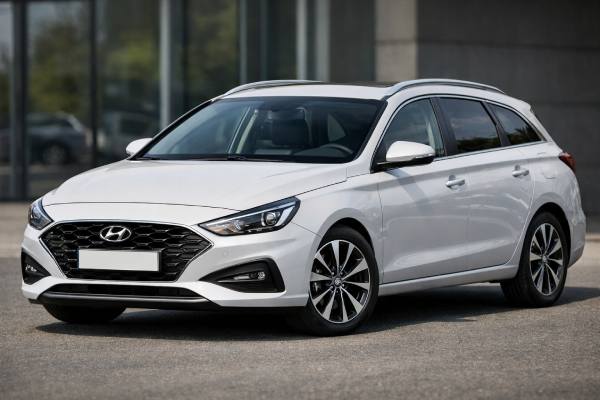
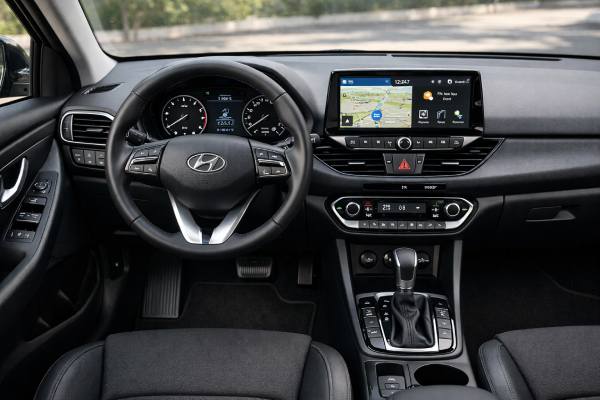

The facelifted Hyundai i30 Wagon PD with the 1.5 DPi 96 hp engine is one of the clearest examples of a car built around practical ownership rather than headline numbers. It takes the already useful i30 estate formula and pairs it with a simple naturally aspirated petrol engine, a six-speed manual gearbox, and a large, square luggage area that still matters to families and high-mileage private owners. In current markets, this version is best understood as a late-run, value-focused choice rather than the flagship of the range. That actually suits its strengths. The 1.5 DPi is not quick, but it is mechanically simpler than the turbo petrol and diesel alternatives, and the facelift wagon gained better safety technology, improved infotainment, and a more polished cabin than earlier PD models. The key buying point is straightforward: if you want useful space, low drama, and honest running costs, this is one of the more sensible compact estates left on sale or in dealer stock.
Top Highlights
- The Wagon body offers a genuinely useful 602 L boot and up to 1,650 L with the rear seats folded.
- The 1.5 DPi engine avoids turbocharger complexity and suits low-stress, long-term ownership.
- Facelift cars gained stronger SmartSense safety features and a more modern cabin layout.
- Current availability varies by market, and some 1.5 DPi wagons are now sold mainly from remaining stock.
- A sensible maintenance baseline is engine oil and filter every 15,000 km or 12 months.
Contents and shortcuts
- Hyundai i30 Wagon Market Role
- Hyundai i30 Wagon Hard Facts
- Hyundai i30 Wagon Versions and SmartSense
- Early Ownership Risks and VIN Checks
- Service Routine and Buying Advice
- Road Behavior and Fuel Use
- Rivals and Value Position
Hyundai i30 Wagon Market Role
The facelift Hyundai i30 Wagon 1.5 DPi fills a role that many manufacturers have started to abandon. It is a compact estate designed around usable space, tidy running costs, and straightforward mechanicals rather than crossover styling or electrified complexity. That gives it a clear identity in the current market. Buyers who still want a low-roof estate instead of an SUV usually care about rear load space, easy access, predictable road manners, and value over time. The i30 Wagon answers those needs directly.
The 1.5 DPi version is especially interesting because it sits at the simple end of the range. In markets where it has been offered during the 2024-on facelift period, it is the car for buyers who do not need turbocharged punch or diesel torque and who would rather keep mechanical complexity modest. That matters more than it once did. A naturally aspirated 1.5-liter petrol with port-type injection and a manual gearbox is not exciting on paper, but it is a reassuring setup for owners who keep cars for a long time and want fewer expensive systems to age.
This version also benefits from the facelift itself. Hyundai updated the i30 range with sharper exterior details, broader digital features, and a more substantial SmartSense safety package. That means even the entry-level engine can sit inside a cabin that feels modern enough for current use. On the road, the facelift wagon still feels like a compact estate rather than a small van or a lifted hatchback. The seating position is low enough to feel natural, the body is easy to place, and the rear cargo area remains one of the car’s strongest selling points.
There is an important market caveat, though. By 2025 and 2026, the i30 range has already narrowed in some European countries, and the 1.5 DPi Wagon is not equally available everywhere. In Poland, for example, official material shows 2024-built model-year 2025 cars still being sold from stock, with the 1.5 DPi 96 KM version listed as a runout-type offer. That tells you something useful about how to approach the car today. This is less a mainstream freshly configurable model and more a smart late-run choice in selected markets.
That does not reduce its usefulness. In fact, it may strengthen the case for the right buyer. The i30 Wagon 1.5 DPi is the kind of car people buy because they need it to make sense every day. It has enough cargo room for family life, a simple petrol engine, and a modern-enough safety and tech package to avoid feeling dated. The lack of outright performance is obvious, but that is not why anyone buys this engine. They buy it because they want a practical estate that stays easy to understand, easy to maintain, and easy to live with.
Hyundai i30 Wagon Hard Facts
For the 2024-on facelift wagon, the technical picture is built around practicality and simplicity. The body is the familiar long-roof i30 estate, while the 1.5 DPi engine serves as the straightforward petrol option in markets where it has remained available. Because current supply is market-dependent and some official pages now emphasize other engines, it is best to treat a few figures as stock-market or VIN-dependent details rather than universal pan-European values.
Powertrain and efficiency
| Item | Hyundai i30 Wagon 1.5 DPi |
|---|---|
| Code | 1.5 DPi petrol |
| Engine layout and cylinders | Inline-4, DOHC, 16 valves |
| Bore × stroke | 75.6 × 82.0 mm (2.98 × 3.23 in), market data dependent |
| Displacement | 1.5 L (1,498 cc) |
| Induction | Naturally aspirated |
| Fuel system | Multi-point / dual-port type petrol injection |
| Compression ratio | Market-dependent; verify by VIN-specific data |
| Max power | 96 hp (about 71 kW) @ 6,000 rpm |
| Max torque | About 139–140 Nm (103 lb-ft) |
| Timing drive | Chain-type timing layout is generally associated with this engine family |
| Rated efficiency | About 6.0–6.8 L/100 km combined WLTP, depending on tyres and trim |
| Real-world highway @ 120 km/h | Around 5.8–6.5 L/100 km in steady use |
Transmission and driveline
| Item | Hyundai i30 Wagon 1.5 DPi |
|---|---|
| Transmission | 6-speed manual |
| Drive type | FWD |
| Differential | Open |
Chassis and dimensions
| Item | Hyundai i30 Wagon |
|---|---|
| Suspension front | MacPherson strut |
| Suspension rear | Rear axle layout varies across sources and markets; verify exact parts by VIN |
| Steering | Electric power steering |
| Brakes | Front discs and rear discs or drums depending on exact market spec; verify by trim |
| Most popular tyre size | 195/65 R15 |
| Other common tyre sizes | 205/55 R16, 225/45 R17 |
| Ground clearance | About 140 mm (5.51 in) |
| Length | 4,585 mm (180.51 in) |
| Width | 1,795 mm (70.67 in) |
| Height | 1,475 mm (58.07 in) with roof rails in many wagon specs |
| Wheelbase | 2,650 mm (104.33 in) |
| Turning circle | About 10.6 m (34.8 ft) kerb-to-kerb |
Weights and capacities
| Item | Hyundai i30 Wagon 1.5 DPi |
|---|---|
| Kerb weight | About 1,206–1,364 kg (2,659–3,007 lb), trim-dependent |
| GVWR | About 1,800–1,870 kg (3,968–4,123 lb), market-dependent |
| Fuel tank | 50 L (13.21 US gal / 11.0 UK gal) |
| Cargo volume | 602 L (21.26 ft³) seats up / 1,650 L (58.27 ft³) seats folded, VDA |
| Towing capacity, braked | Around 1,000–1,010 kg (2,205–2,227 lb), verify by VIN plate |
| Towing capacity, unbraked | Around 500–510 kg (1,102–1,124 lb), verify by VIN plate |
| Roof load | About 80 kg (176 lb), market-dependent |
Performance and service data
| Item | Hyundai i30 Wagon 1.5 DPi |
|---|---|
| 0–100 km/h | About 12.6 s |
| Top speed | About 178 km/h (111 mph) |
| Engine oil | Use Hyundai-approved petrol-engine oil for the exact VIN and market |
| Typical viscosity | 5W-30 is common, but always verify by service literature |
| Coolant | Ethylene-glycol coolant for aluminum systems |
| Brake fluid | DOT 4 class fluid is the sensible baseline |
| A/C refrigerant | Verify by under-hood label and VIN-specific workshop data |
| Key torque specs | Use official workshop documentation for wheel, brake, and suspension work |
Safety and driver assistance
| Item | Hyundai i30 family basis |
|---|---|
| Euro NCAP basis | 5-star i30 family rating, with facelift review recorded in 2020 |
| Adult Occupant | 88% |
| Child Occupant | 84% |
| Vulnerable Road Users | 64% |
| Safety Assist | 68% |
| ADAS availability | LFA, FCA, FCA-JT, ISLA, HDA 1.5, MCB, camera and parking systems depending on trim |
The crucial point is that this wagon’s value comes from the whole package rather than any single figure. The big numbers are the 602 L boot, the 50 L fuel tank, and the modest combined consumption range. The small ones are the power and acceleration figures, which tell you exactly what kind of car this is: useful first, quick second.
Hyundai i30 Wagon Versions and SmartSense
Trim structure is especially important on the 1.5 DPi wagon because this engine is usually the value-led entry point rather than the aspirational version. In current official material from some markets, the 1.5 DPi appears mainly in the lower trim structure, which actually makes sense for the type of buyer it attracts. People shopping this engine usually want simplicity, price control, and useful core equipment rather than large wheels and visual extras.
Polish official equipment material is a good example of how the facelift wagon is structured. The entry-level PURE version already includes LED headlamps with bending-light function, a 10.25-inch multimedia touchscreen, front and rear parking sensors, a rear-view camera, Lane Following Assist, and manual air conditioning. That is a strong baseline for a value-oriented estate. It means the cheapest engine is not paired with a stripped cabin or an outdated infotainment system. For many buyers, that is enough.
Mid-level versions such as MODERN and SMART add the equipment that tends to matter most in daily life. Depending on market, those upgrades can include heated front seats and steering wheel, rear USB charging, two-level luggage floor, aluminum wheels, electric-folding mirrors, 10.25-inch digital instruments, dual-zone climate control, wireless phone charging, and privacy glass. SMART PLUS adds keyless entry and a few extra comfort details. N Line mostly changes the look and wheel package rather than the fundamental value proposition of the 1.5 DPi.
The safety side of the facelift is one of the car’s stronger selling points. Hyundai’s official feature material for the wagon highlights the enhanced SmartSense package and lists features such as Rear Occupant Alert, Multi-Collision Braking, Highway Driving Assist 1.5, Forward Collision-Avoidance Assist, Forward Collision-Avoidance Assist with Junction Turning, and Intelligent Speed Limit Assist. Higher trims or N Line versions can also add blind-spot and rear cross-traffic systems in some markets.
That is important because the 1.5 DPi’s mechanical simplicity might lead some buyers to assume it is a “basic car.” In reality, the facelift wagon can be quite well equipped. Even lower trims can include more active-safety and convenience technology than many older C-segment estates that cost similar money on the used market.
The Euro NCAP picture is also worth setting out clearly. The i30 family holds a 5-star rating basis, and Euro NCAP records a facelift review on April 1, 2020, before the rating expired under the organization’s time-based system on January 1, 2024. That expiration does not mean the car became unsafe. It simply means the old star result is no longer current against today’s newest testing rules. For ownership and comparison purposes, the i30 still has a strong passive-safety foundation for its class.
The best trim strategy depends on what you want from the 1.5 DPi. PURE makes sense if price and simplicity matter most. MODERN and SMART are often the sweet spots because they add warmth, convenience, and cabin polish without pulling the car too far away from its value-first identity. The best buy is usually not the flashiest wagon. It is the one with the safety and comfort features you will use every day, combined with the most sensible wheel and tyre package.
Early Ownership Risks and VIN Checks
Because the facelifted 1.5 DPi wagon is still relatively new and, in some markets, now mostly a stock-availability model, it does not yet have the kind of long public reliability record that older PD i30s do. That is actually an important point in itself. There is no well-established epidemic failure pattern attached specifically to the 2024-on 1.5 DPi estate in the sources used here. That is good news, but it also means buyers should focus on likely ownership risks rather than waiting for a dramatic “known issue” narrative.
| Area | Prevalence | Severity and cost tier | What to watch for |
|---|---|---|---|
| 12V battery ageing over time | Common on modern cars generally | Low to medium | Slow starts, random warnings, electrical oddities |
| Ignition wear or fuel-quality sensitivity | Occasional | Low to medium | Misfire, rough idle, hesitation under load |
| Minor infotainment or camera faults | Occasional | Low to medium | Frozen screen, parking-camera glitches, warning messages |
| Brake corrosion on lightly used cars | Occasional | Low to medium | Lipped discs, pulsing, rough feel after standing |
| Clutch wear from poor use | Occasional | Medium | Slip in higher gears, weak bite point, vibration |
| Recall or service campaign status | Unknown by model-specific public pattern | Medium to high | Missing campaign records, no dealer printout |
The best reliability argument for this version is its engine concept. Compared with the turbocharged petrol and diesel options in the wider i30 family, the 1.5 DPi is mechanically simpler. There is no turbocharger to age, no intercooler plumbing to leak, and no diesel after-treatment hardware to worry about. That does not make it maintenance-free, but it does mean the likely long-term ownership risks are more ordinary: ignition parts, battery condition, clutch wear, brakes, tyres, and routine electrical issues.
The main caution is that “simple” does not mean “ignore it.” Modern Hyundais still rely on healthy voltage, clean sensors, and software that is up to date. Infotainment glitches, rear-camera faults, or SmartSense warnings are usually less dramatic than engine damage, but they still affect ownership quality and resale value. That is why even a relatively new car deserves a proper diagnostic scan and not just a quick visual inspection.
Public recall information specific to this exact 2024-on engine and body combination is still limited in the sources reviewed. That means the safe recommendation is not to assume there are no campaigns. It is to check the car by VIN through Hyundai’s official recall and service-campaign system and to ask the dealer for printouts confirming completion. That is especially important because some current wagons are effectively late-run or stock-market cars, and build dates, market codes, and equipment mixes may vary more than buyers expect.
For a pre-purchase or pre-delivery check, ask for five things:
- Full service history or dealer preparation record.
- Confirmation of any recall or campaign work by VIN.
- A cold start and road test.
- A diagnostic scan, even on a young car.
- Proof of correct tyre brand, size, and load rating.
The most honest reliability verdict is this: the 1.5 DPi wagon looks like one of the lower-risk i30 variants, but it is still too new for sweeping long-term claims. Right now, the safest approach is to buy condition, records, and dealer transparency rather than relying on assumptions.
Service Routine and Buying Advice
A sensible maintenance plan for the i30 Wagon 1.5 DPi is refreshingly straightforward. That is one of the reasons this version is attractive. The car does not need special hybrid procedures, turbo-cooling habits, or diesel-emissions management. It mainly needs regular fluid and filter changes, careful inspections, and the kind of routine discipline that keeps any naturally aspirated family car healthy over time.
Practical maintenance schedule
| Item | Sensible interval |
|---|---|
| Engine oil and filter | Every 15,000 km or 12 months |
| Engine air filter | Inspect regularly, usually replace around 30,000–45,000 km |
| Cabin air filter | Check yearly and often replace annually |
| Spark plugs | Inspect by around 60,000 km and replace per official schedule or condition |
| Coolant | Follow VIN-specific Hyundai schedule and monitor age and level |
| Brake fluid | Every 2 years is a sensible baseline |
| Brake pads and discs | Inspect every service |
| Tyres | Rotate and inspect roughly every 10,000–12,000 km |
| Manual transmission fluid | Inspect for leaks and shift quality; proactive renewal around 90,000–120,000 km is sensible |
| Auxiliary belt and hoses | Inspect at every service |
| Timing components | No routine public replacement interval; investigate noise or correlation faults promptly |
| 12V battery | Test annually from about year 4 onward |
Useful fluid and workshop guidance
- Engine oil: use Hyundai-approved petrol-engine oil for the exact VIN and market.
- Common oil grade: 5W-30 in many markets, but always verify.
- Coolant: ethylene-glycol coolant for aluminum systems.
- Brake fluid: DOT 4 class fluid.
- Fuel tank: 50 L.
- Fuel: use the grade specified for the market and avoid poor-quality petrol on a car that may sit unused in dealer stock.
Because the wagon is so new, the buyer’s guide is less about major reconditioning and more about choosing the right car from the outset. Check build date, tyre age, and battery condition on any car that has spent time in dealer stock. Cars that sit can pick up flat-spotted tyres, tired batteries, and brake corrosion even before they have a meaningful ownership history. On a nearly new wagon, that matters more than rust or previous repair work, which are less likely this early in life.
The best inspection checklist includes:
- Battery test and charging-voltage check.
- Tyre DOT age and even tread wear.
- Brake-disc surface condition after a road test.
- Smooth clutch action and clean manual-shift feel.
- Proper operation of the camera, sensors, and SmartSense features.
- A dry engine bay with no suspicious dealer valeting residue hiding leaks.
If you are choosing between trims, the safest long-term bet is usually a modestly optioned car with the features you will genuinely use, not the one with the biggest wheels. PURE works if budget matters. MODERN or SMART is often the better all-round choice because you gain comfort and safety-value items without meaningfully increasing mechanical risk. The durability outlook is encouraging precisely because this is the simpler engine in the range. Provided the car is maintained annually and not left sitting for long periods without care, it should be one of the easier current i30s to own.
Road Behavior and Fuel Use
From the driver’s seat, the i30 Wagon 1.5 DPi behaves exactly as its specification suggests: steady, predictable, and easy to live with. It is not fast, and Hyundai never pretended otherwise. What it offers instead is a calm, low-stress driving experience that suits commuting, family work, and ordinary road trips better than many buyers may expect from a 96 hp estate.
The first thing you notice is that the wagon does not feel awkwardly large. Despite the extended rear body, it still behaves like a compact car in town. Visibility is manageable, the steering is light enough for parking, and the manual gearbox keeps the car feeling direct and simple. The engine needs revs more than the turbocharged alternatives, but the responses are clean and predictable. That is one of the benefits of a naturally aspirated setup. There is no boost surge, no turbo lag, and no sudden change in character.
The trade-off is obvious on faster roads. With around 12.6 seconds to 100 km/h and a top speed around 178 km/h, this is not a car for impatient overtakes with a full load. If the wagon is carrying passengers, luggage, or climbing long gradients, you will use the gearbox and plan ahead. Buyers stepping out of a diesel or a small turbo petrol will notice the difference immediately. The engine is honest rather than muscular.
Ride quality is one of the car’s better points, especially on 15-inch or 16-inch wheels. The long-roof body does not make the i30 feel loose or ungainly. Instead, it adds a little extra maturity to the way the car settles on the road. Straight-line stability is good, the steering is neutral rather than lively, and the wagon remains easy to place on narrow roads or in poor weather. It is not a sporty estate, but it is a composed one.
Noise, vibration, and harshness are acceptable for the class. Under harder acceleration, the 1.5 DPi sounds like what it is: a straightforward petrol four-cylinder working to move a practical wagon. At steady speeds, however, the car settles well, and the absence of turbo strain or diesel clatter helps it feel relaxed. It is the kind of car that disappears into daily use, which is often a compliment.
Real-world economy also makes sense if expectations stay grounded.
| Use case | Real-world expectation |
|---|---|
| Dense city driving | Around 7.0–8.0 L/100 km |
| Mixed commuting | Around 6.2–7.0 L/100 km |
| Highway at 100–110 km/h | Around 5.5–6.0 L/100 km |
| Highway at 120 km/h | Around 5.8–6.5 L/100 km |
Those figures will vary by load, wheel size, weather, and terrain, but they fit the broader WLTP story well. The car is not exceptionally efficient for its size, yet it avoids the fuel-use penalties that often come with more powerful turbo engines when driven briskly. Towing and full-load work will raise consumption noticeably, and the modest engine means hills can demand frequent downshifts. Still, for normal family and commuting use, the i30 Wagon 1.5 DPi delivers exactly what it promises: calm road manners, usable cargo space, and sensible petrol economy.
Rivals and Value Position
The Hyundai i30 Wagon 1.5 DPi sits in a smaller market niche than it would have a few years ago because compact estates with simple petrol engines are becoming rare. That actually helps define its rivals more clearly. The natural comparison points are cars such as the Kia Ceed Sportswagon, Toyota Corolla Touring Sports in lower-power trim, Skoda Octavia Combi entry petrols, and value-focused estate alternatives from brands that still offer conventional wagons.
Against the Kia Ceed Sportswagon, the Hyundai feels like a close relative in philosophy. Both prioritize usable cargo space, straightforward ergonomics, and good value over badge prestige. The Kia often feels a little more assertive in styling, while the Hyundai usually comes across as slightly calmer and more neutral. In practice, the better buy is often the one with the better trim balance and clearer paperwork.
Against the Toyota Corolla Touring Sports, the Hyundai gives up hybrid sophistication and urban fuel savings. The Toyota is the better city economy car and usually the smoother automatic daily companion. The Hyundai answers with a simpler conventional drivetrain, lower mechanical complexity in this specific 1.5 DPi form, and often a more accessible purchase price. Buyers who dislike hybrid systems or simply want a straightforward manual estate may prefer the Hyundai’s honesty.
Against a Skoda Octavia Combi, the i30 Wagon usually loses on ultimate rear space and sheer family-car scale. The Octavia is the roomier and more versatile shape. But the Hyundai often feels easier to place, less bulky in town, and, in the right spec, less expensive to buy and tyre. That makes it attractive to buyers who want estate practicality without drifting toward a larger car than they actually need.
The i30 Wagon’s strongest value argument is not performance, luxury, or image. It is balance. It offers:
- A genuinely useful 602 L boot.
- A simple naturally aspirated petrol engine.
- A modern safety and infotainment package on facelift cars.
- A tidy exterior footprint.
- Lower long-term mechanical drama than the more complex engines in the same family.
Its weaknesses are just as easy to understand. The 96 hp engine is slow by modern standards. Some markets now treat it as a stock-runout version rather than a core orderable model. And buyers who regularly carry heavy loads or drive fast on long motorways may prefer the turbocharged or diesel alternatives. But for the right owner, those are acceptable compromises.
If your priority is a practical compact estate that still feels current, avoids unnecessary drivetrain complexity, and does not demand SUV money, the Hyundai i30 Wagon 1.5 DPi deserves serious attention. It is not exciting, but it is clear-headed, useful, and likely to age well in the hands of an owner who values sensible engineering over fashion.
References
- The i30 Wagon | Features | Hyundai Motor Europe 2026 (Features and Safety)
- Petrol and Diesel Powertrains | Hyundai Motor Europe 2026 (Powertrain Guide)
- i30 Wagon | Wyposażenie 2026 (Equipment and ADAS)
- Nowy Hyundai i30 Wagon 2025 (Official Price List)
- EuroNCAP | Hyundai i30 2017 (Safety Rating)
Disclaimer
This article is for informational purposes only and is not a substitute for professional diagnosis or repair. Specifications, torque values, service intervals, procedures, recall applicability, and equipment can vary by VIN, market, trim, and production date, so always verify critical details against official Hyundai service documentation, the VIN plate, and dealer records before servicing, repairing, towing, or buying a vehicle.
If this guide helped you, please consider sharing it on Facebook, X, or another social platform to support our work.