


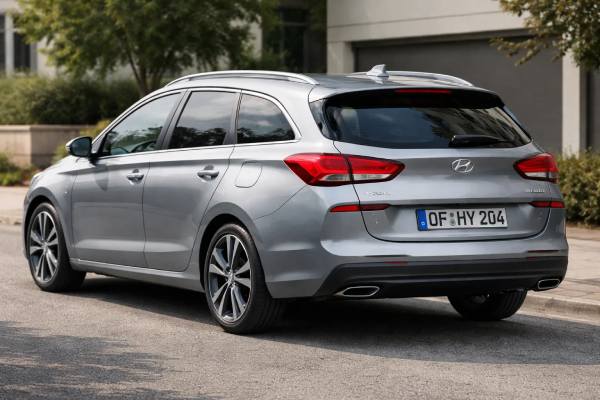
The Hyundai i30 Wagon PD with the 1.4 MPI 100 hp petrol engine is one of those cars that makes more sense the longer you keep it. It does not chase headline performance. Instead, it gives buyers a straightforward naturally aspirated four-cylinder engine, a six-speed manual gearbox, a generous wagon body, and running costs that are usually easier to manage than the turbocharged alternatives. That makes it attractive to owners who value predictability, luggage space, and simpler long-term upkeep.
This version also sits in an interesting place within the 2017–2020 PD range. Early cars represent the cleanest form of the formula, while later 2019 and early 2020 examples benefit from trim and equipment updates before many markets moved toward newer petrol engines. The result is a practical estate that is easy to understand as a used buy. Its main weakness is equally clear: with 100 hp and modest torque, it feels calm rather than quick, especially when fully loaded.
Fast Facts
- The 1.4 MPI is one of the simpler i30 Wagon petrol engines to own long term.
- The 602 L boot makes it meaningfully more useful than the hatchback for family duty.
- Ride comfort, motorway stability, and a six-speed manual are strong everyday advantages.
- Performance is only adequate when the car is full of passengers or luggage.
- Standard scheduled maintenance is due every 15,000 km or 12 months.
Quick navigation
- Hyundai i30 Wagon PD essentials
- Hyundai i30 Wagon figures and specs
- Hyundai i30 Wagon trims, safety, and equipment
- Trouble spots and service actions
- Upkeep plan and purchase tips
- On-road character and economy
- Rival wagons and alternatives
Hyundai i30 Wagon PD essentials
The PD-generation Hyundai i30 Wagon was designed to give European family-car buyers something more useful than a hatchback without pushing them into SUV size, weight, or cost. In 1.4 MPI form, it becomes the most conservative petrol choice in the range. That matters. While the turbocharged i30s are quicker, the 1.4 MPI keeps the formula simple: a 1,368 cc naturally aspirated four-cylinder petrol engine, multi-point injection, a timing chain, front-wheel drive, and a six-speed manual gearbox. For the right owner, that combination is part of the appeal rather than a compromise.
The wagon body is the real reason this version deserves attention. Hyundai quoted 602 L of luggage capacity with the rear seats up and 1,650 L with them folded. That is a major jump over the hatchback and turns the car into a genuinely flexible estate for pushchairs, bicycles with wheels removed, airport runs, or family holiday luggage. Rear-seat space is still class-typical rather than limo-like, but the load area gives the car its real personality. Buyers who value space more than speed usually understand this version very quickly.
There are two ownership themes that define the 1.4 MPI Wagon. The first is simplicity. Compared with the 1.0 T-GDi and 1.4 T-GDi, this engine avoids turbocharger heat, direct-injection carbon concerns, and the extra complexity that comes with chasing torque from small displacement. The second is patience. With 100 hp and 134 Nm, the car is not especially fast for its size. Official 0–100 km/h performance sits around 12.9 seconds in the wagon, and that tells you what daily use feels like. It is smooth, steady, and fully usable, but not eager when fully loaded or climbing long grades.
Across the 2017–2020 range, the 1.4 MPI is most closely associated with the pre-facelift years and early carryover cars. By the time the broader 2020 facelift range rolled through many markets, Hyundai was already shifting toward newer petrol options such as the 1.5 and mild-hybrid turbo engines. That means the true 1.4 MPI 2020 wagons are a narrower niche than the 2017–2019 cars. As a used purchase, though, that does not reduce the appeal. In fact, it can increase it, because buyers looking for the simplest PD wagon often prefer the earlier naturally aspirated setup on purpose.
Hyundai i30 Wagon figures and specs
The i30 Wagon 1.4 MPI is mechanically straightforward, but the official numbers still tell an important story. This is a naturally aspirated family estate, so its technical case rests on usable packaging, predictable service needs, and stable chassis tuning rather than standout power. Figures below reflect official Hyundai technical data for the PD wagon in this engine configuration. Minor variation can appear by trim, tyre size, and market.
| Powertrain and efficiency | Specification |
|---|---|
| Engine family / code | Hyundai 1.4 MPI petrol, 1,368 cc |
| Engine layout and cylinders | Inline-4, DOHC, 4 valves per cylinder |
| Bore × stroke | 71.6 × 84.0 mm (2.82 × 3.31 in) |
| Displacement | 1.4 L (1,368 cc) |
| Induction | Naturally aspirated |
| Fuel system | Electronically controlled MPI |
| Compression ratio | 10.5:1 |
| Max power | 100 hp (73 kW) @ 6,000 rpm |
| Max torque | 134 Nm (99 lb-ft) @ 4,000 rpm |
| Timing drive | Chain |
| Official combined economy | 5.6–6.2 L/100 km (42.0–37.9 mpg US / 50.4–45.6 mpg UK) depending on test cycle, year, and wheel size |
| Real-world highway at 120 km/h | Typically about 6.5–7.2 L/100 km in normal use |
| Transmission and driveline | Specification |
|---|---|
| Transmission | 6-speed manual |
| Drive type | FWD |
| Differential | Open |
| Chassis and dimensions | Specification |
|---|---|
| Front suspension | MacPherson strut |
| Rear suspension | Multi-link |
| Steering | Electric rack-and-pinion; 13.4 ratio |
| Brakes | Ventilated front discs 280 mm; rear discs 272 mm on core versions |
| Most common tyre size | 195/65 R15 |
| Ground clearance | 140 mm (5.5 in) |
| Length | 4,585 mm (180.5 in) |
| Width | 1,795 mm (70.7 in) |
| Height | 1,465 mm without rails / 1,475 mm with rails |
| Wheelbase | 2,650 mm (104.3 in) |
| Turning circle | 10.6 m (34.8 ft) |
| Kerb weight | About 1,285–1,447 kg (2,833–3,190 lb), depending on trim |
| GVWR | 1,800 kg (3,968 lb) |
| Fuel tank | 50 L (13.2 US gal / 11.0 UK gal) |
| Cargo volume | 602–1,650 L (21.3–58.3 ft³), VDA |
| Performance and carrying ability | Specification |
|---|---|
| 0–100 km/h | 12.9 s |
| 80–120 km/h | 16.4 s |
| Top speed | 181 km/h (112 mph) |
| Towing capacity | 1,200 kg braked / 600 kg unbraked |
| Payload | About 353–515 kg depending on trim |
| Fluids and service capacities | Specification |
|---|---|
| Engine oil | Typically SAE 5W-30 petrol-engine grade; verify by market manual |
| Engine oil capacity | 3.6 L (3.8 US qt) with filter |
| Coolant capacity | 5.8 L (6.1 US qt) |
| Manual gearbox oil | Low-viscosity manual transmission fluid; verify exact Hyundai spec by VIN |
| Manual gearbox capacity | About 1.6–1.7 L (1.7–1.8 US qt) |
| Brake fluid | DOT 4 class fluid |
| Differential / transfer case | Not applicable |
| Safety and driver assistance | Specification |
|---|---|
| Euro NCAP | 5 stars |
| Euro NCAP scores | 88% adult / 84% child / 64% vulnerable road user / 68% safety assist |
| IIHS | Not applicable for this European wagon variant |
| Standard core safety systems | ESC, VSM, hill-start assist, AEB with pedestrian detection, lane keeping support on many markets |
| Optional or trim-dependent items | Blind-spot monitoring, rear cross-traffic alert, smart cruise, upgraded lighting, and later SmartSense functions depending on year and market |
A few of these numbers shape the ownership verdict. First, the wagon’s 602 L boot is one of its strongest selling points. Second, the engine’s 134 Nm torque figure explains why the car feels composed rather than lively. Third, the six-speed manual and chain-driven valvetrain keep the long-term service conversation more predictable than on some smaller turbo rivals. That is the essence of this model: ordinary-looking specs that add up to a very usable family estate.
Hyundai i30 Wagon trims, safety, and equipment
The i30 Wagon PD was sold across Europe with market-specific trim names, so a buyer may see badges such as Pure, Select, Trend, Style, Premium, SE, or local equivalents. For the 1.4 MPI wagon, the most common pattern is that it sits in the lower-to-middle trim walk rather than the fully loaded end of the range. That makes sense because buyers choosing this engine were usually prioritising value, simplicity, and space over performance or luxury extras.
In broad terms, the best-equipped 1.4 MPI wagons differ more in convenience and wheel package than in core mechanical design. The main hardware remains the same: six-speed manual, front-wheel drive, naturally aspirated MPI engine, and the wagon body. Changes across trim usually involve wheel size, brake diameter in some cases, parking sensors, climate control, infotainment screen size, lighting upgrades, interior finish, and whether the car uses a mechanical or electric parking brake. On the official German technical data, the 1.4 MPI appears in trims such as Pure, Select, and Trend, with larger wheel and brake packages as you climb the range.
That means trim choice matters more than some buyers expect. A base car on 15-inch wheels often gives the most comfortable ride and the lowest tyre replacement cost. A mid-trim car tends to be the sweet spot because it adds the features most owners use every day without pushing the price into the territory of stronger turbo engines. Higher trims look better and may feel more polished inside, but they do not transform the 1.4 MPI’s performance. The powertrain remains modest whichever badge is on the tailgate.
Safety is one of the model’s stronger points. Euro NCAP gave the i30 a five-star result, with solid adult and child protection scores and a respectable safety-assist result for the period. Hyundai also pushed the i30 family as a technology leader within the mainstream class, especially in Europe, where SmartSense features were a major part of the car’s pitch. Standard or widely available features across the range included Autonomous Emergency Braking with pedestrian recognition, Lane Keeping Assist, Driver Attention Warning, High Beam Assist, stability systems, and hill-start support. Later updates broadened the available driver-assistance package further.
For 2020, Hyundai improved the i30 family’s safety and convenience systems again. Depending on market and trim, later cars could add newer lane-centering support, rear collision-avoidance functions, leading vehicle departure warning, and broader blind-spot support. That is useful for buyers because a late PD wagon can feel meaningfully more modern than an early 2017 car even when the basic platform is the same. The catch is simple: many of the most advanced 2020 features arrived as the range moved away from the 1.4 MPI itself. So when shopping, do not assume the newest car automatically gives the exact engine and equipment combination you want. Check the VIN, original brochure, and actual fitted hardware.
Trouble spots and service actions
The 1.4 MPI Wagon is one of the less risky PD i30 variants, but that does not mean every car is trouble-free. The right way to view it is this: the engine itself is usually robust when serviced properly, while most ownership headaches come from age, wear, or neglected basic maintenance. That is a better starting point than on some direct-injection turbo rivals, but buyers still need to inspect carefully.
Common low-cost or medium-cost issues are the ones most owners will actually meet. Ignition-related rough running is high on that list. Symptoms are usually a slight misfire, hesitant pickup, or a check-engine light under load. Root causes are often spark plugs, individual ignition coils, or an air leak rather than anything catastrophic. The naturally aspirated MPI layout helps here because diagnosis is usually more straightforward than on a turbo DI engine.
Another common area is the clutch and shift feel. The six-speed manual itself is generally a strong point, but urban use, frequent hill starts, and towing can leave the clutch tired earlier than buyers expect, especially on wagons used as workhorses. A high bite point, slip in higher gears, or release-bearing noise should be treated as routine wear, not as a mysterious gearbox failure. Suspension consumables also deserve attention. Front anti-roll-bar links, bushes, and occasional wheel-bearing wear are typical age-and-mileage items rather than alarming defects.
Occasional issues usually sit one step above that. Cooling-system seepage from hoses, housing joints, or the thermostat area can appear on older cars. Weak 12 V batteries are another frequent cause of confusing warning lights or stop-start complaints. Brake drag and rear brake corrosion also matter more on estate cars that spend time parked between short trips. A car that feels slightly held back, warms a rear wheel after a short drive, or shows uneven pad wear needs closer inspection.
Rare or condition-linked concerns are still worth knowing. Timing-chain trouble is not a headline issue on this engine, but any persistent chain noise on cold start or timing-correlation fault deserves proper checking, especially if oil history is poor. Serious oil consumption is not a defining trait of the engine, but neglected examples can still leak or burn oil. Corrosion is mostly a market-and-climate issue, so inspect the subframes, rear axle mounting areas, brake lines, and the lower tailgate and load-floor edges on cars from salted-road regions.
Software is less central here than on later hybrid or dual-clutch models, but it still matters. Hyundai retailers check for recommended updates during service, and this can cover infotainment glitches, body-control nuisance faults, and certain driver-assistance calibrations. For recalls and service campaigns, the safest rule is to rely on official VIN-based checks and dealer records rather than internet lists. This variant is not defined by one universal 1.4 MPI defect pattern, but market-specific campaigns still need to be confirmed on the exact car.
Upkeep plan and purchase tips
The public Hyundai technical data gives the most important baseline interval very clearly: routine servicing is due every 15,000 km or 12 months. For this engine, that is the anchor point for sensible ownership. In practice, many long-term owners do even better with shorter oil changes if the car does lots of cold starts, heavy urban driving, towing, or repeated short trips. That is not because the engine is fragile. It is because clean oil is cheap insurance, and wagons often live harder lives than hatchbacks.
A practical maintenance plan looks like this:
| Maintenance item | Practical interval |
|---|---|
| Engine oil and filter | Every 15,000 km or 12 months; earlier in hard use |
| Engine air filter | Inspect every service; usually replace around 30,000 km |
| Cabin filter | Every 15,000–30,000 km or 12–24 months |
| Spark plugs | Inspect by mid-life service and replace on schedule from the market manual |
| Coolant | Check yearly; replace strictly to the official manual or immediately if history is unclear |
| Manual gearbox oil | Inspect for leaks; refresh around 100,000–120,000 km if history is unknown |
| Brake fluid | Every 2 years is a sensible working rule |
| Brake pads and discs | Inspect every service |
| Tyre rotation and alignment | Rotate as wear pattern demands; check alignment annually or after pothole damage |
| Auxiliary belt and hoses | Inspect every service |
| Timing chain | No fixed public replacement interval; inspect if noisy, mistimed, or poorly maintained |
| 12 V battery | Test yearly after year 4 |
Fluid planning is simple on this model. The engine takes 3.6 L of oil with filter, coolant capacity is 5.8 L, and the manual gearbox takes about 1.6–1.7 L. The car does not burden the owner with transfer case or rear differential service because it is front-wheel drive only. That simplicity is one of the best reasons to buy it.
For the used market, the best buys are usually 2018 to early-2020 examples with a full history, standard wheel sizes, and evidence of regular servicing rather than simply low mileage. Cars used mainly for long commuter runs often wear better than low-mileage school-run wagons because they suffer fewer cold starts and fewer brake-corrosion issues. Mid-grade trims are usually the smartest choice because they add useful equipment without extra wheel-and-tyre cost.
Inspection should focus on condition more than theory. Check for smooth idle, clean pull through the rev range, even clutch take-up, straight tracking, quiet front suspension, and a dry cooling system. Look underneath for corrosion, especially if the car comes from a wet or salted region. Test every switch, parking sensor, camera, infotainment function, and safety warning. Ask for proof of recall checks, recent brake work, and the last oil service. Long term, the outlook is good. This is not the quickest i30 Wagon, but it can be one of the easiest to live with if you buy carefully.
On-road character and economy
The 1.4 MPI i30 Wagon is honest about what it is. It does not try to hide its priorities. Around town it feels smooth, light enough on its feet, and easy to place. The clutch is usually progressive, the manual gearbox is simple to understand, and the steering is predictable rather than sporty. In daily commuting, that works well. The car does not demand much from the driver, and it settles into routine use easily.
Where the wagon body changes the experience is on the open road. The longer rear section gives the i30 Wagon a calm, planted feel at motorway speeds, and the multi-link rear suspension helps it feel more composed than some estates that use simpler rear setups on their lower-output engines. Straight-line stability is good, ride quality is mature on smaller wheels, and cabin noise is acceptable for the class. It is not silent, but it is comfortable enough for long trips. That suits the estate brief perfectly.
The powertrain character is the one thing buyers need to judge honestly. With 100 hp and peak torque arriving at 4,000 rpm, the 1.4 MPI does not have the easy low-end shove of a small turbo petrol. It likes measured inputs and rewards smooth driving more than aggressive throttle use. In light use with one or two occupants, it feels adequate. Add a full family, a roof load, or a packed boot, and the car needs more planning for overtakes and steeper motorway inclines. The official 80–120 km/h time of 16.4 seconds tells the story clearly.
Fuel economy is decent rather than class-leading. Early official combined figures sit around the mid-5s L/100 km, while later test-cycle figures are a little higher. In real use, most owners should expect something closer to the mid-6s to low-7s L/100 km on mixed driving. At a true 120 km/h motorway cruise, upper-6s are realistic if the car is healthy and the load is moderate. Short urban trips can push it comfortably higher, especially in winter. The upside is consistency. Naturally aspirated MPI engines often deliver predictable economy without the large swings that some small turbo engines show when driven harder.
This is also a reassuring car to load. It does not become nervous or loose-feeling with luggage in the boot. Towing ability is useful at 1,200 kg braked, and the chassis remains stable as long as the trailer and nose weight are sensible. Buyers who regularly carry heavy loads should simply accept the engine’s limits. The car stays competent, but it never feels energetic. That is the trade-off in plain language. The reward is a smoother, simpler, and more transparent driving experience than many downsized turbo wagons of the same era.
Rival wagons and alternatives
The Hyundai i30 Wagon 1.4 MPI makes the most sense when compared with other practical estates that are bought with the head, not the heart. Against the Kia Ceed Sportswagon with a similar modest petrol engine, the Hyundai feels closely related in purpose. The decision often comes down to equipment, seat comfort, and condition rather than a major mechanical difference. Buyers who find a better-kept Ceed should not ignore it, but the i30 is every bit as rational.
Against the Ford Focus Estate, the Hyundai usually loses on steering feel and driver engagement. The Focus still sets a high standard for chassis polish. But the i30 Wagon answers with a calmer ownership vibe, a simpler naturally aspirated engine in this trim, and fewer reasons to worry about turbo-specific issues. For an owner who values long-term ease over back-road entertainment, the Hyundai can be the better match.
The Skoda Octavia Combi is the more spacious-feeling alternative and often the better long-distance family car, but it is usually priced accordingly. It also tends to push buyers toward turbocharged engines and a more complex used-market spread. The i30 Wagon is slightly smaller in ambition, but that can work in its favour if you want a lower-risk purchase with easier routine upkeep.
The Opel or Vauxhall Astra Sports Tourer is another obvious cross-shop. It can look like strong value, but engine and transmission choice matter a lot in that range. The Hyundai’s naturally aspirated 1.4 MPI is not exciting, yet it is easier to understand and often easier to own than some of the more complicated rival combinations. That matters in the used market, where maintenance quality often matters more than brochure appeal.
So where does the i30 Wagon 1.4 MPI land overall? It is not the fastest wagon, not the most luxurious, and not the most advanced by the end of its run. But it is one of the most coherent if your priorities are space, straightforward engineering, stable road manners, and predictable costs. For buyers who want a family estate that asks for regular maintenance rather than constant attention, the Hyundai remains a strong and sensible choice.
References
- Hyundai i30 Kombi | Technische Daten | Stand: 9.2017 2017 (Technical Data)
- Hyundai i30 Kombi | Technische Daten | Stand: 11.2018 2018 (Technical Data)
- i30 5-Türer und Kombi 2020 (Price List and Technical Data)
- Euro NCAP | Hyundai i30 2017 (Safety Rating)
- Home | Hyundai Recalls & Service Campaigns 2026 (Recall Database)
Disclaimer
This article is for informational purposes only and is not a substitute for professional diagnosis, repair, or factory service information. Specifications, torque values, maintenance intervals, procedures, and equipment can vary by VIN, market, model year, and trim, so always verify the exact vehicle against official Hyundai service documentation before carrying out repairs or making purchase decisions.
If this guide was useful, please consider sharing it on Facebook, X, or another platform to support our work.