
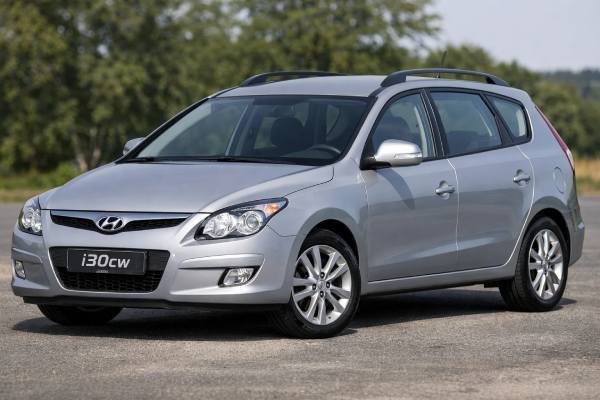
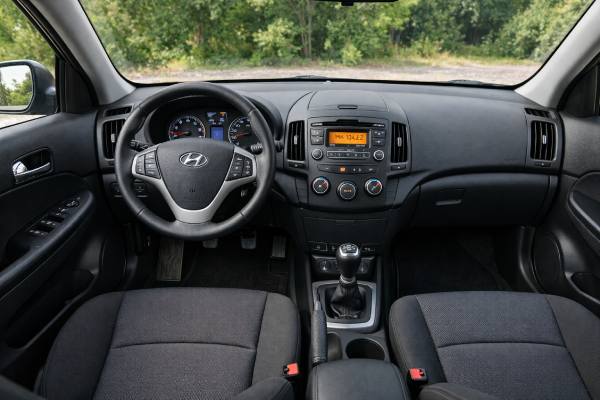
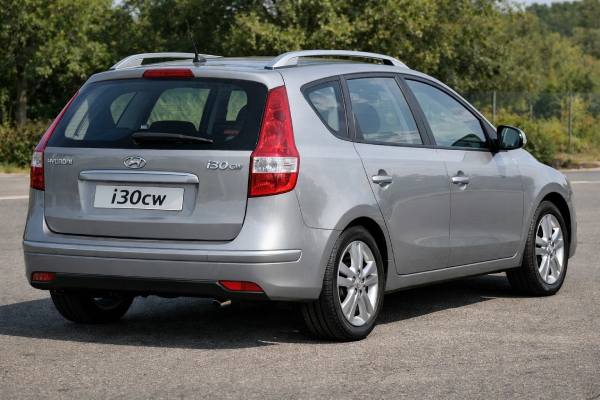
The facelifted Hyundai i30cw FD 1.6 CRDi is one of those compact diesel wagons that looks modest on paper but makes a lot of sense in the real world. It combines a useful estate body, a 1.6-litre common-rail turbo-diesel, a six-speed manual in the main configuration, and a relatively simple front-wheel-drive layout. For buyers who cover longer distances, that matters more than styling drama. The facelift version also brought Euro 5 compliance and a diesel particulate filter, while keeping the practical i30cw formula: decent luggage space, honest dimensions, and approachable running costs when the car has been maintained properly. The key strength is balance. It is efficient, roomy enough for family use, and generally easier to own than many larger diesel wagons from the same era. The main caution is equally clear: short-trip use, missed servicing, and incomplete steering-related recall history can turn a sensible diesel estate into a less convincing used-car choice.
Quick Specs and Notes
- The 1.6 CRDi diesel pairs strong mid-range torque with a six-speed manual and low official fuel use.
- The wagon body is genuinely practical, with 415 L of boot space and up to 1,395 L with the rear seats folded.
- Euro 5 emissions and a factory particulate filter make it more efficient, but also less suited to repeated short-trip use.
- Steering-system recall history matters, especially for EPS faults and steering-column fastener issues on FD cars.
- A practical service rhythm includes oil every 15,000 km or 12 months and coolant around 90,000 km or 5 years.
Contents and shortcuts
- Hyundai i30cw CRDi big picture
- Hyundai i30cw CRDi hard numbers
- Hyundai i30cw spec and safety kit
- Weak spots and campaign history
- Care schedule and buyer filter
- Diesel manners and real economy
- Rival wagons in context
Hyundai i30cw CRDi big picture
The facelifted i30cw sits in a useful sweet spot. It is larger and more cargo-friendly than the hatchback, but it still feels compact enough to work as an everyday family car rather than a bulky load-hauler. In facelifted 2010–2012 1.6 CRDi form, the wagon stretches to 4,500 mm long, rides on a 2,700 mm wheelbase, and offers 415 L of luggage space with the seats up. Fold the rear bench and capacity rises to 1,395 L. Those are meaningful gains over the hatch, and they explain why the i30cw still has a place in the used market for buyers who need more utility without moving into a bigger class.
The engine is a major part of the appeal. This version uses Hyundai’s 1.6-litre D4FB common-rail diesel, mounted transversely up front and driving the front wheels through a six-speed manual gearbox in the main spec. Output is modest by modern standards at 116 hp, but the wagon gets the more important figure right: 255 Nm of torque from 1,900 to 2,750 rpm. That gives it a more effortless everyday character than the naturally aspirated petrol version, especially when loaded with passengers or luggage. It is still not a fast car, but it is less strained in normal driving and better suited to longer distances.
The facelifted diesel also benefits from a more modern emissions setup. It is Euro 5-rated and fitted with a particulate filter, which helped the official combined fuel figure drop to 4.7 L/100 km. For the right user, that is a strong advantage. A driver doing regular motorway or mixed-distance work can get a lot out of this engine. A driver doing only short urban runs is less likely to see the car at its best. That is not a unique Hyundai issue. It is a normal consequence of an older Euro 5 diesel with DPF hardware. The engine makes the most sense when it is allowed to warm up properly and spend time at steady cruising loads. That is one reason the diesel wagon remains attractive to commuters, families, and drivers covering regular regional mileage.
Safety and specification still need care. ANCAP’s old-model i30cw rating covers build dates from March 2009 to February 2012 and applies to petrol and diesel vehicles, but the five-star result only applies where side curtain airbags are fitted. Without them, the wagon is effectively a four-star car. ESC is shown as standard on all listed Australian wagon variants, but airbags varied by trim. That means the best facelifted diesel wagon is not simply the cleanest-looking one. It is the one with the right safety kit, proper maintenance, and recall history that checks out.
Hyundai i30cw CRDi hard numbers
The figures below refer to the Hyundai i30cw FD facelift 1.6 CRDi 116 hp diesel wagon produced from 2010 to 2012 in six-speed manual form unless noted otherwise. Because this model was sold in multiple markets, exact equipment, tyre packages, towing approvals, and some service details can vary by VIN and region. The tables below are intended as a practical baseline for the facelifted diesel estate.
| Powertrain and efficiency | Value |
|---|---|
| Engine code | D4FB |
| Engine layout and cylinders | Inline-4, DOHC, 4 valves per cylinder |
| Bore × stroke | 77.2 × 84.5 mm (3.04 × 3.33 in) |
| Displacement | 1.6 L (1,582 cc) |
| Induction | Turbocharger and intercooler |
| Fuel system | Diesel common rail |
| Compression ratio | 17.3:1 |
| Max power | 116 hp (85 kW) @ 4,000 rpm |
| Max torque | 255 Nm (188.1 lb-ft) @ 1,900–2,750 rpm |
| Timing drive | Chain |
| Rated efficiency | 4.7 L/100 km (50.0 US mpg / 60.1 UK mpg) |
| Urban / extra-urban | 5.4 / 4.3 L/100 km |
| Real-world highway @ 120 km/h (75 mph) | About 5.4–6.0 L/100 km is a realistic expectation in a healthy car |
| Transmission and driveline | Value |
|---|---|
| Standard transmission | 6-speed manual |
| Optional transmission | 4-speed automatic |
| Drive type | FWD |
| Differential | Open |
| Automatic official combined economy | 5.8 L/100 km |
| Automatic 0–100 km/h | About 13.4 s |
| Automatic top speed | 180 km/h (111.8 mph) |
| Chassis and dimensions | Value |
|---|---|
| Suspension, front / rear | MacPherson strut / independent multi-link |
| Steering | Rack-and-pinion with electric power assist |
| Steering ratio | Not consistently published in open wagon-specific data |
| Brakes | Ventilated front discs / rear discs |
| Brake diameters | Public wagon-specific open data is inconsistent; verify by VIN |
| Most common tyre size | 185/65 R15 H |
| Ground clearance | 135 mm (5.31 in) |
| Length / width / height | 4,500 / 1,775 / 1,565 mm (177.2 / 69.9 / 61.6 in) |
| Wheelbase | 2,700 mm (106.3 in) |
| Turning circle | 10.4 m (34.1 ft) |
| Kerb weight | 1,334 kg (2,941 lb) |
| GVWR | 1,920 kg (4,233 lb) |
| Fuel tank | 53 L (14.0 US gal / 11.7 UK gal) |
| Cargo volume | 415–1,395 L (14.7–49.3 ft³) |
| Payload | 586 kg (1,292 lb) |
| Performance and capability | Value |
|---|---|
| 0–100 km/h | 11.6 s |
| Top speed | 188 km/h (116.8 mph) |
| Braking distance | No single open official figure is consistently published for this exact trim |
| Towing capacity, braked | 1,400 kg (3,086 lb) |
| Towing capacity, unbraked | 550 kg (1,213 lb) |
| CO₂ emissions | 124 g/km |
| Emissions standard | Euro 5 |
| Fluids and service capacities | Value |
|---|---|
| Engine oil viscosity | Verify by climate and official spec; diesel-approved low-ash oil is advisable where DPF-equipped |
| Engine oil capacity | 5.3 L (5.6 US qt) |
| Coolant capacity | 6.8 L (7.19 US qt) |
| Transmission fluid | Specification depends on gearbox version and market |
| Differential / transfer case | Not applicable |
| A/C refrigerant | Verify by VIN-specific service data |
| A/C compressor oil | Verify by VIN-specific service data |
| Key torque specs | Use official workshop data only for critical fasteners |
| Safety and driver assistance | Value |
|---|---|
| ANCAP rating context | Build dates Mar 2009 – Feb 2012; petrol and diesel i30cw variants |
| ANCAP 5-star applicability | Only where side curtain airbags are fitted |
| Without curtains | 4 stars |
| Overall score | 32.54 out of 37 |
| Frontal / side / pole | 12.97 / 15.57 / 2.0 |
| ESC | Standard on all Australian wagon variants listed by ANCAP |
| ADAS | No AEB, lane support, adaptive cruise control, or blind-spot monitoring |
The numbers explain the car’s whole character. The diesel wagon is not quick in a sporting sense, but it is usefully torquey, impressively efficient on paper, and practical in a way that still feels relevant. The six-speed manual, 53 L tank, and large wagon body are the parts that make this version stand out from the petrol hatchback.
Hyundai i30cw spec and safety kit
The facelifted i30cw diesel is a good example of why trim matters on older family cars. Mechanically, the 1.6 CRDi wagon is fairly consistent: front-wheel drive, 116 hp, six-speed manual or optional automatic, and the same basic body shell. But the actual ownership experience can vary a lot depending on which market the car came from and how it was specified. Some cars were sold as value-led workhorses with the diesel engine doing most of the heavy lifting. Others added enough equipment to feel surprisingly complete even now.
The first distinction is the one that matters most: safety specification. ANCAP’s wagon rating makes the situation very clear. The 5-star score only applies to i30cw variants with side curtain airbags. Without those curtains, the wagon’s rating drops to 4 stars. The ANCAP page also states that ABS with EBD and ESC were standard across the listed Australian variants, while side airbags and curtains were standard on SLX and optional on SX. That means used buyers should not shop this model as though all diesel wagons were equally safe. They were not. On this car, the presence of curtain airbags is a major dividing line.
The second distinction is comfort and convenience equipment. Lower-spec cars usually stick to the basics: smaller wheels, cloth trim, simpler audio systems, and fewer cabin features. Mid-grade and higher-grade cars can add alloy wheels, better steering-wheel trim, upgraded audio control layouts, parking sensors, climate-control improvements, and nicer interior materials. None of those features changes the car’s mechanical verdict, but they do influence whether the i30cw feels like a cheap old wagon or a well-judged practical estate.
Quick identifiers help when sellers do not know the full original spec. Curtain airbags should be confirmed rather than guessed. ESC should be checked by function, warning light status, and original equipment records where possible. Larger factory alloy wheels and parking sensors usually indicate a higher trim, but they are not proof of the full safety package. Cloth-only seats and smaller steel wheels often point to simpler variants, though equipment bundling varied by region.
It is also worth remembering that the ANCAP wagon rating was based on evidence Hyundai provided showing the i30cw could be expected to offer protection comparable to the hatch tested by Euro NCAP. That makes the wagon’s safety story credible for its era, but it remains a period rating, not a modern one. AEB, lane support, and blind-spot systems were not part of the picture. So the most sensible buyer today is the one who chooses the right old car, not the one who expects it to behave like a new one. Prioritize side-curtain airbags, ESC, clean airbag-system status, and a trim level that genuinely fits your needs.
Weak spots and campaign history
The facelifted i30cw 1.6 CRDi can be a durable wagon, but it is not a car to buy casually. Its biggest weakness is not a single disastrous design flaw. It is the way several medium-scale risks can pile up when servicing has been delayed or the car has been used in the wrong pattern. That makes inspection discipline important, especially on a Euro 5 diesel with DPF hardware and a decade-plus of age behind it.
The two most important official issues are steering-related recalls. One campaign covered an incorrectly tightened universal-joint bolt on the steering column. The hazard was a joint that could loosen, create knocking noise, and in extreme cases affect steering control. Another covered motor-driven power steering faults on certain FD cars, where loss of MDPS assistance could make the steering heavy and bring on the EPS warning lamp. These official actions matter because they involve both everyday drivability and basic control of the vehicle. Any i30cw buyer should ask for VIN-based recall completion, dealer records, or workshop proof before going any further.
Beyond those campaigns, the main diesel-specific caution is emissions-system use pattern. This engine is Euro 5 and fitted with a particulate filter, so it is better matched to regular longer-distance driving than to endless short cold trips. That does not mean every short-trip diesel will fail, but it is a fair inference that repeated low-load urban use is tougher on a DPF-equipped car than mixed or highway driving. If a used example has lived a mostly urban life, buyers should pay attention to warning lights, idle quality, smoke history, and any evidence of forced regenerations or repeated sensor replacements.
Timing-chain talk also needs context. There is no factory-style routine replacement interval published in the service guide source reviewed here, but it also notes that chain condition should be monitored and that real-world stretch concerns can emerge from around 120,000 km onward. The safe reading is not “replace the chain at 120,000 km no matter what.” It is “do not assume the chain is immortal.” On a diesel wagon with uncertain service history, cold-start noise, rough running, or timing-related fault codes deserve real attention.
Other likely age-related issues are less dramatic but just as important to the budget. Expect worn brakes, tired suspension links, possible wheel-bearing wear, and occasional electrical problems associated with an aging 12 V system. On the diesel side, clean fuel delivery, proper oil quality, and regular filter service matter more than they do on a basic petrol hatch. The engine itself is capable of good durability, but it depends on the basics being respected.
The pre-purchase request list is simple. Ask for a cold start, recall proof, service invoices, and a meaningful road test. Confirm the steering feels even and quiet, the clutch engages cleanly, the turbo-diesel pulls smoothly from low rpm, and the car reaches full operating temperature without warnings. A well-kept i30cw diesel can still be a smart wagon. A neglected one can become a steady drain of medium-sized repairs.
Care schedule and buyer filter
The facelifted i30cw diesel rewards regular attention more than heroic repair work. That is the right way to think about it. This is not a car that needs exotic servicing, but it is a car that wants the basics done on time: correct oil, clean filters, coolant at the right age, and sensible attention to the chain, belt, brakes, and steering. On a used Euro 5 diesel wagon, skipping the simple items usually leads to more complicated ones later.
A practical maintenance plan looks like this:
| Item | Practical interval | Notes |
|---|---|---|
| Engine oil and filter | Every 15,000 km or 12 months | Use the correct diesel-capable oil for DPF-equipped service where applicable |
| Engine air filter | Inspect regularly; replace as needed or by service schedule | Important for fuel economy and airflow |
| Cabin air filter | Inspect regularly and replace as needed | Often neglected on older estates |
| Fuel filter | Replace on schedule and especially if history is unclear | Important for common-rail diesel health |
| Timing chain | No fixed routine replacement interval | Inspect for noise, stretch symptoms, and timing faults |
| Serpentine / auxiliary belt | About 120,000 km | Replace earlier if cracked or noisy |
| Coolant | About 90,000 km or 5 years | Do not ignore age-based service |
| Brake fluid | Every 2 years is a sensible preventive interval | Helps pedal feel and corrosion control |
| Manual transmission service | Check history and condition | Preventive fluid refresh is wise on older cars |
| Brake pads and rotors | Inspect at every service | Rear brakes can suffer on lightly used wagons |
| Tyres and alignment | Inspect regularly | Uneven wear often reveals suspension or steering issues |
| 12 V battery | Test with age | A weak battery can trigger confusing electrical symptoms |
The service-capacity picture is clear enough to guide owners. The engine takes about 5.3 L of oil and about 6.8 L of coolant. Belt replacement is commonly listed around 120,000 km, while the coolant interval is commonly listed at 90,000 km or 5 years in the service guide source reviewed here. Exact fluid specifications and torque values still need VIN-level confirmation through official workshop information, especially for gearbox fluid, refrigerant charge, and any critical engine or chassis fasteners. That caution is not filler. It matters because older wagons often pass through mixed workshops and partial service histories.
As a used buy, the best version is usually the six-speed manual with confirmed curtain airbags, ESC, full steering recall history, and a service file that shows more than just oil stickers. Look for evidence of coolant changes, fuel-filter service, and normal wear-item renewal rather than a car that has only been kept running until sale. Check the underside carefully for corrosion on brake hardware, subframes, and rear suspension mounts in salted climates. Also inspect the luggage area and tailgate seals, because estate cars often live harder load-carrying lives than hatchbacks.
The cars to seek are honest, regularly driven examples that have done enough distance to suit a diesel but not so much that every consumable is overdue. The cars to avoid are bargain-price wagons with steering warnings, poor paperwork, obvious short-trip use, or a seller who cannot explain recent service work. Long-term durability is good when the fundamentals are right. That is why the i30cw diesel still earns consideration: not because it is fancy, but because it can stay useful and affordable when maintained properly.
Diesel manners and real economy
On the road, the facelifted i30cw 1.6 CRDi feels more like a practical distance tool than a city car. That is a compliment. The wagon’s extra wheelbase and estate body give it a settled, grown-up character, and the diesel engine suits that personality better than the naturally aspirated petrol in day-to-day use. Where the petrol needs revs, the diesel gives the car easier low- and mid-range pull. That matters most with luggage aboard or when joining faster roads, because the wagon feels less strained and less dependent on frequent downshifts.
The engine itself is typical of a good small diesel from this era. It is not especially refined when cold, and it is clearly a diesel rather than a polished premium unit, but the torque delivery is the point. With 255 Nm available from 1,900 rpm, the i30cw feels more relaxed in real traffic than its 116 hp figure suggests. The six-speed manual is also a real asset. It helps the car cruise more easily than older five-speed diesel rivals and makes better use of the engine’s torque band. The optional four-speed automatic is harder to recommend because it loses both pace and economy.
Official performance is honest and adequate. The manual reaches 100 km/h in 11.6 seconds and tops out at 188 km/h. That is enough for the car’s mission, and more importantly it means the wagon does not feel underpowered in routine driving. The automatic falls back to around 13.4 seconds and 180 km/h, which turns the car into more of a convenience purchase than the best all-round version. For most buyers, the manual remains the sweet spot.
Efficiency is the headline advantage. Officially, the manual wagon returns 4.7 L/100 km combined, 5.4 L/100 km urban, and 4.3 L/100 km extra-urban. In practical terms, a healthy car driven sensibly can often sit in the low- to mid-fives on longer trips, with city work or winter use pushing the number upward. At a steady 120 km/h motorway pace, something in the mid-fives to around 6.0 L/100 km is a realistic expectation. That is not miracle-economy, but it is good enough to explain why this version still appeals to drivers covering meaningful distance.
Ride and handling are competent rather than memorable. The wagon stays stable in a straight line, handles normal family-car cornering cleanly, and benefits from the i30 platform’s independent rear suspension. Steering feel is secondary to accuracy, and by now the car’s actual behavior depends heavily on tyres, damper condition, and alignment quality. In a good example, the i30cw diesel feels mature and easygoing. In a neglected one, the same chassis can feel older than it should. That is really the driving verdict in one line: the i30cw 1.6 CRDi is a sensible long-run wagon, not a sporty one, and it works best when bought for exactly that reason.
Rival wagons in context
The facelifted i30cw 1.6 CRDi lives in a very crowded class, so it is best judged as a balanced package rather than a category leader. Its biggest strengths are usable luggage space, modest operating costs, straightforward diesel performance, and a size that still feels manageable. It does not dominate one headline metric, but it avoids enough major weaknesses to stay compelling.
Its closest relative is the Kia Cee’d SW with the same 1.6 CRDi family logic. In broad terms, the Hyundai and Kia are siblings in all the ways that matter: compact exterior footprint, small-displacement common-rail diesel, manual gearbox appeal, and a value-led ownership case. That means the decision between them usually comes down to condition, safety equipment, service history, and price rather than any dramatic engineering gap. If the Hyundai has the better paper trail and a cleaner steering history, it is the better car. If the Kia does, the reverse is also true.
A Ford Focus estate of the same era usually offers the sharper steering and slightly more engaging chassis. Drivers who care about cornering feel will still notice that. But the Hyundai counters with a cleaner “appliance done properly” character. It is practical, efficient, and generally easier to justify if you want a diesel estate as transport rather than entertainment. The i30cw does not need to beat the Focus dynamically to remain relevant. It only needs to stay cheaper to buy and simpler to own in real life.
Against a Skoda Octavia Combi diesel, the Hyundai usually loses the boot-space argument and some of the larger-car polish. The Octavia feels like the bigger wagon, because it is. But it also shifts the comparison toward size, parking footprint, and sometimes higher used values. The i30cw makes more sense for buyers who want compact-estate usability rather than maximum cargo volume at all costs.
Compared with smaller hatchbacks, the i30cw also makes a strong internal case. It gives more flexibility than the i30 hatch without becoming unwieldy, and in diesel form it has enough range and economy to justify being a real road-trip or family-mileage tool. That is the version’s central advantage.
So where does the facelifted i30cw 1.6 CRDi land? It sits as a smart middle-ground diesel wagon. It is not the sharpest driver’s car, not the biggest estate, and not the most prestigious badge. What it offers instead is proportion: enough torque, enough space, enough efficiency, and enough simplicity to make sense as a used family estate. Find a manual example with curtain airbags, ESC, complete recall history, and evidence of proper diesel maintenance, and it remains one of the more rational compact wagons of its era.
References
- Hyundai i30 | Safety Rating & Report | ANCAP 2009 (Safety Rating)
- Hyundai Motor Company – HYUNDAI i30 2014 (Recall Database)
- HYUNDAI i30 (FD) , Elantra (HD) 2009 – 2010 | Vehicle Recalls 2015 (Recall Database)
- Hyundai i30 I CW (facelift 2010) 1.6 CRDi (116 Hp) | Technical specs, data, fuel consumption, Dimensions 2026 (Technical Data)
- Hyundai i30 2010 1.6 diesel service and maintenance 2026 (Service Guide)
Disclaimer
This article is for informational purposes only and is not a substitute for professional diagnosis or repair. Specifications, torque values, service intervals, and procedures vary by VIN, market, transmission, and equipment, so always verify critical details against the official service documentation for the exact vehicle.
If this guide was useful, please consider sharing it on Facebook, X, or another social platform to support our work.