
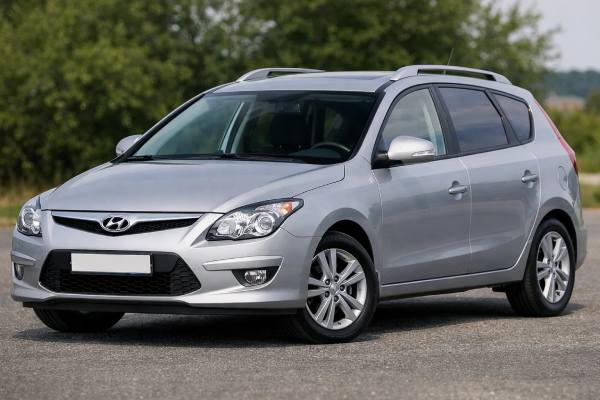
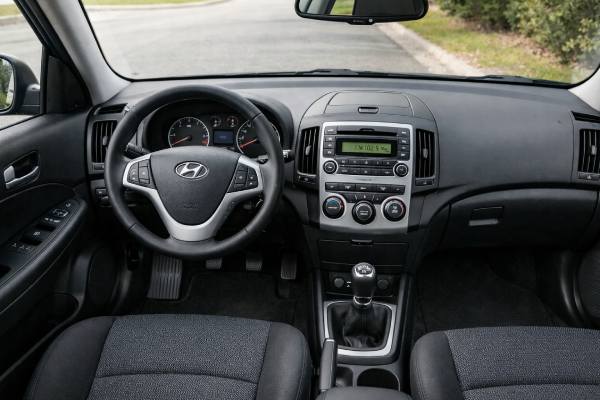
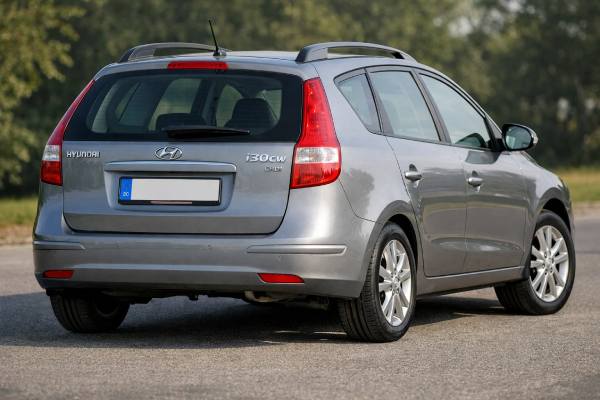
The facelifted 2010–2012 Hyundai i30cw 1.6 CRDi U2 128 sits near the sweet spot of the first-generation i30 estate range. It combines the genuinely useful FD wagon body with the stronger version of Hyundai’s 1.6-liter common-rail diesel, giving you far better mid-range shove than the 90 hp diesel while still keeping fuel use impressively low for a compact family estate. This is a car built around real-world tasks rather than image. It offers a large load area, solid motorway range, and a chassis that feels more composed than many value-focused wagons of its era. The flip side is typical late-2000s and early-2010s diesel ownership: emissions hardware, injector health, clutch wear, and service quality matter a lot. Used for regular longer trips and maintained properly, it can still be a smart, durable buy. Used mainly for short urban runs and neglected on servicing, it can turn costly far faster than its modest purchase price suggests.
Quick Specs and Notes
- The 128 hp U2 diesel gives the i30cw strong everyday torque and noticeably better flexibility than the lower-output diesel versions.
- Cargo space, rear-seat usability, and long-distance fuel economy remain major strengths.
- The facelift brought cleaner Euro 5 tuning, a 6-speed manual, and slightly better cruising refinement.
- Short-trip use can lead to EGR, intake, and DPF trouble if regeneration is repeatedly interrupted.
- A sensible maintenance baseline is engine oil and filter every 15,000 km or 12 months.
Explore the sections
- Hyundai i30cw FD U2 Profile
- Hyundai i30cw FD U2 Specifications
- Hyundai i30cw FD U2 Trims and Safety
- Failures, Fixes, and Campaigns
- Service Schedule and Buying Advice
- Driving Feel and Real Costs
- Against Other Diesel Estates
Hyundai i30cw FD U2 Profile
The facelifted Hyundai i30cw FD is one of those cars that becomes easier to appreciate once you look beyond brand image and showroom-era trim names. In 1.6 CRDi U2 128 form, it takes the first-generation i30 estate and gives it the engine most owners probably wanted from the start: enough torque to feel relaxed with passengers and luggage, yet still efficient enough to justify diesel ownership if the car is used properly.
This version uses the U2 evolution of Hyundai’s 1.6-liter common-rail diesel. It remains a four-cylinder, turbocharged, direct-injection unit, but in this tune it produces 128 hp at 4,000 rpm and around 255 to 260 Nm from low revs. That is the figure that defines the car. The earlier 90 hp diesel feels honest and economical. The 128 hp U2 feels genuinely useful. It pulls more confidently from 1,800 rpm, needs fewer downshifts on hills, and makes the wagon body feel like a practical family tool instead of a small diesel that is always working hard.
The facelift matters too. Hyundai did not reinvent the FD i30cw for 2010, but it sharpened the look, cleaned up some trim details, and paired the stronger U2 diesel with a 6-speed manual gearbox. That extra ratio helps the car at speed. It lowers cruising revs, improves motorway refinement, and supports the model’s long-distance character. For buyers who do cross-country mileage, that is a bigger improvement than the mild styling changes.
The body itself remains one of the car’s strongest selling points. At roughly 4,500 mm long with a 2,700 mm wheelbase, the i30cw is large enough to be genuinely useful without feeling like a big estate in town. The boot is rated at about 415 liters with the rear seats up and up to 1,395 liters with them folded, which is still enough for family luggage, bulky shopping, or light DIY work. The low loading lip and square shape also make the space more practical than the raw number suggests.
Underneath, the FD platform deserves more credit than it often gets. Front suspension is MacPherson strut, but the rear is an independent multi-link setup. That gives the i30cw a more settled, grown-up feel than many cheaper wagons that relied on simpler rear axles. It is not a sporty estate, but it is a stable and competent one, especially with decent tires.
The real ownership equation is simple. This is a very attractive used compact estate if you want torque, fuel range, and cargo space at sensible money. It is much less attractive if you only do short cold runs, ignore diesel maintenance needs, or buy on price alone. The 128 hp U2 version is arguably the best first-generation i30cw diesel for regular-distance drivers, but only when its service history proves it has been treated like a diesel rather than a disposable appliance.
Hyundai i30cw FD U2 Specifications
The facelifted i30cw 1.6 CRDi U2 128 is easy to understand on paper. It is a front-wheel-drive compact estate built around strong mid-range torque, efficient gearing, and practical body dimensions. The exact published figures can vary a little by country, trim, and emissions label, but the common numbers tell a clear story.
| Powertrain and efficiency | Specification |
|---|---|
| Code | D4FB U2 |
| Engine layout and cylinders | Inline-4, DOHC, 4 valves per cylinder |
| Bore × stroke | 77.2 × 84.5 mm (3.04 × 3.33 in) |
| Displacement | 1.6 L (1,582 cc) |
| Induction | Turbocharged, intercooler |
| Fuel system | Common rail direct injection |
| Compression ratio | 17.3:1 |
| Max power | 128 hp (94 kW) @ 4,000 rpm |
| Max torque | About 255–260 Nm (188–192 lb-ft) @ 1,900–2,750 rpm |
| Timing drive | Chain |
| Rated efficiency | About 5.1 / 4.2 / 4.5 L/100 km urban / extra-urban / combined |
| Rated efficiency in mpg | About 46.1 / 56.0 / 52.3 mpg US and 55.4 / 67.3 / 62.8 mpg UK |
| Real-world highway @ 120 km/h | Usually around 5.6–6.2 L/100 km in a healthy car |
| Emissions standard | Euro 5 |
| Exhaust after-treatment | DPF fitted on this facelift U2 diesel |
Those figures explain the car’s character well. It is not a high-output performance diesel, but it has enough torque to feel easy and unstrained in daily use. The six-speed manual also suits it well, because the engine does not need high revs to work effectively.
| Transmission, driveline, and chassis | Specification |
|---|---|
| Transmission | 6-speed manual |
| Drive type | FWD |
| Differential | Open front differential |
| Suspension front / rear | MacPherson strut / independent multi-link |
| Steering | Rack-and-pinion power steering |
| Brakes | 280 mm (11.02 in) vented front discs / 262 mm (10.31 in) rear discs |
| Wheels and tyres | 205/55 R16 is the most common size on 128 hp wagons |
| Ground clearance | About 135 mm (5.3 in) in commonly published data |
| Length / width / height | About 4,500 / 1,775 / 1,565 mm (177.2 / 69.9 / 61.6 in) |
| Wheelbase | 2,700 mm (106.3 in) |
| Turning circle | 10.4 m (34.1 ft) |
| Kerb weight | Roughly 1,400–1,410 kg (3,086–3,109 lb) |
| GVWR | About 1,920 kg (4,233 lb) |
| Fuel tank | 53 L (14.0 US gal / 11.7 UK gal) |
| Cargo volume | 415 L (14.7 ft³) seats up / 1,395 L (49.3 ft³) seats folded |
| Performance and service capacities | Specification |
|---|---|
| 0–100 km/h | About 11.2 s |
| Top speed | 197 km/h (122 mph) |
| Braking distance | Not consistently published for the exact wagon variant |
| Towing capacity | Commonly around 1,400 kg (3,086 lb) braked / 550 kg (1,213 lb) unbraked |
| Payload | Roughly 500–520 kg (1,102–1,146 lb), depending on trim |
| Engine oil | 0W-30 or 5W-30 low-ash diesel oil; about 5.3 L (5.6 US qt) service fill |
| Coolant | About 6.8 L (7.2 US qt) |
| Transmission oil | Manual transaxle specification varies by gearbox code; verify before filling |
| Differential / transfer case | Not applicable |
| A/C refrigerant | R-134a; exact charge varies by VIN and label |
| A/C compressor oil | PAG type; verify exact grade by compressor label |
| Key torque specs | Wheel nuts commonly 100 Nm (73.8 lb-ft) |
| Crash ratings | Euro NCAP old-protocol 5-star reassessment for the i30 hatch; ANCAP wagon 5 stars where side curtains are fitted |
| Headlight rating | IIHS not applicable for this market and era |
| ADAS suite | No AEB, ACC, lane support, BSD, or traffic-sign assist |
The broader conclusion is simple: the 128 hp U2 wagon is the fast-enough, efficient-enough version of the FD estate. It finally gives the body a drivetrain that matches its practicality.
Hyundai i30cw FD U2 Trims and Safety
Trim naming on the facelift i30cw varies by market, so buyers should think in equipment groups rather than chasing one universal badge hierarchy. In many European markets, the 1.6 CRDi U2 128 appeared in trims equivalent to Comfort, Style, Premium, or similarly named mid-level versions. That matters because the 128 hp diesel was often positioned as the more desirable long-distance option, which means many examples came with slightly better equipment than the entry-level engines.
The easy visual cues are wheel size, seat trim, steering-wheel buttons, and audio or climate controls. Cars on 205/55 R16 tires with alloy wheels, steering-wheel media controls, and upgraded cloth trim are common in the 128 hp bracket. Some markets also bundled cruise control, automatic lighting, or improved audio systems into diesel trims aimed at drivers doing higher annual mileage. Mechanically, though, there was not usually a dramatic trim-based split. The 128 hp wagon’s core appeal remains the same whether the car is modestly specified or better equipped: torque, range, and cargo space.
That makes this a condition-first used buy. A slightly plainer car with documented service history is normally a better choice than a nicer-trim example with patchy maintenance. Unlike some rivals, you are rarely missing a fundamentally different chassis or brake package by choosing the simpler trim.
Safety equipment is more complicated, because equipment could vary by region and by optional package. The strongest general point is that the FD i30 platform had a respectable crash reputation for its time. Hyundai improved the model after early crash-test concerns, and the hatchback achieved a 5-star Euro NCAP reassessment under the older rating system. For the wagon, ANCAP’s assessment is especially useful because it states clearly that the i30cw holds its 5-star rating only where side-curtain airbags are fitted. Without them, the wagon drops to 4 stars.
That means buyers should not assume all facelift wagons have identical protection. A genuine inspection should confirm:
- front, side, and curtain airbag presence,
- ABS and ESC operation,
- child-seat mounting hardware,
- warning-lamp self-check behavior at startup,
- and recall completion for airbag-related campaigns.
The late FD i30cw still offers a decent passive-safety foundation for an older family car. Dual front airbags, side airbags, curtains on better-equipped cars, ABS, EBD, ESC, and ISOFIX anchor points all help it age better than some bargain-basement wagons from the same era. But expectations need to stay realistic. This is still a pre-SmartSense, pre-AEB, pre-lane-assist car. There is no modern electronic safety net here beyond stability control and the passive systems fitted at the time.
For most buyers, the sweet spot is a mid-grade wagon with confirmed curtain airbags, working ESC, cruise control, and a clean maintenance file. That combination gives you most of what matters in daily use without paying a premium for trim pieces that do not improve the fundamental ownership experience.
Failures, Fixes, and Campaigns
The facelift i30cw 1.6 CRDi U2 128 is not a fragile car, but it is a used diesel estate from the early 2010s, and that means its reliability story depends heavily on how it was used. Cars that did regular motorway work and saw timely servicing usually age well. Cars that spent years on short urban runs with delayed oil changes can become expensive very quickly.
The most common trouble spots are diesel-emissions related. The EGR valve and intake path can carbon up over time, especially on cars that rarely get fully hot. Symptoms usually include flat response below 2,000 rpm, mild hesitation, rougher idle, extra smoke under load, and sometimes a warning light. On the U2 engine, a DPF is also part of the ownership picture. Repeated interrupted regenerations can raise soot load and eventually trigger limp-home mode or forced-regeneration visits. That does not make the car a bad design. It just means it needs the kind of use pattern a diesel expects.
Fuel-system health is the next major issue. Common-rail injectors, seals, and leak-off balance need to stay in shape. Warning signs include harder cold starts, diesel knock, a smell of combustion gases around the injectors, or a rough idle that smooths out only when warm. None of these should be brushed off. Injector repairs are manageable when caught early and far more costly when ignored.
Clutch and flywheel wear is another realistic expense. The 128 hp engine has enough torque to expose driveline wear, especially on cars used heavily in town or regularly loaded. Watch for shudder on take-off, rattle at idle, slip under load, or pedal vibration. Turbo-hose leaks, tired vacuum lines, and weak thermostats also appear often enough to matter. These faults do not always create dramatic failures, but they can hurt economy and drivability in ways sellers often try to excuse.
A few age-related chassis issues are worth checking too:
- electric power steering warning lights or inconsistent assist,
- rear suspension bush wear,
- brake drag on low-use cars,
- wheel-bearing noise,
- and corrosion around the underbody, rear arches, tailgate opening, and seam areas.
Recall and campaign history deserves extra attention on FD cars because official Hyundai campaign pages list several relevant issues. These include an airbag control unit software campaign for i30 FD vehicles, ABS module moisture-related fire risk campaigns affecting FD-era cars, a curtain-airbag positioning campaign on certain 2011 cars, a driver airbag inflator campaign, and a tandem brake-vacuum-pump campaign that can affect braking feel and warning lamps. None of that means every wagon is affected. It means every wagon should be checked by VIN, not by guesswork.
The best pre-purchase approach is to ask for more than a stamp book. Request recall proof, scan data, recent fuel-filter evidence, and details of any clutch, injector, or DPF work. A car with that paperwork is usually worth paying more for. A car with unexplained warning lights and vague “diesel service” claims is usually not.
Service Schedule and Buying Advice
The i30cw 1.6 CRDi U2 128 is one of those cars that stays affordable only when the basics are done on time. The good news is that the basics are not unusual. The bad news is that skipping them on a diesel estate quickly creates far more expensive problems. This is a car that rewards preventive maintenance more than optimistic ownership.
A practical maintenance plan looks like this:
| Item | Practical interval |
|---|---|
| Engine oil and filter | Every 15,000 km or 12 months |
| Engine air filter | Inspect every service, replace around 30,000–45,000 km |
| Cabin air filter | Usually yearly |
| Fuel filter | Around 30,000–60,000 km depending on fuel quality and history |
| Coolant | Around 90,000 km or 5 years |
| Manual transmission oil | Sensible preventive change around 90,000–120,000 km |
| Brake fluid | Every 2 years |
| Auxiliary belt | Around 120,000 km or earlier if worn or noisy |
| Timing chain | No fixed replacement interval; inspect for noise, stretch symptoms, and timing-correlation faults |
| Brake inspection | At every service |
| Tyre rotation | About every 10,000–15,000 km |
| Alignment check | When tyre wear becomes uneven or after suspension repairs |
| Battery test | Yearly after about 4 years |
| DPF and EGR behavior | Review at service time if warning lights, smoke, or frequent regeneration appear |
The key fluid decisions are straightforward. The engine wants the correct low-ash diesel oil grade, especially because this U2 wagon uses a DPF. A normal service fill is about 5.3 liters. Coolant capacity is roughly 6.8 liters. The 53-liter fuel tank gives the car its strong touring range, and manual gearbox oil quantity depends on the exact transaxle code, so it is worth checking before ordering fluid. Wheel nuts are commonly tightened to 100 Nm, but exact workshop values still need VIN-level confirmation.
For buyers, inspection needs to be focused and diesel-specific:
- insist on a fully cold start,
- scan the car before test-driving it,
- check for smoke under heavy load,
- listen for chain noise, injector knock, and flywheel rattle,
- confirm recall completion,
- and ask how the car has been used.
Then examine the details that owners often miss:
- injector tops for carbon buildup or diesel smell,
- boost hoses for oil mist and splits,
- thermostat behavior if the engine warms very slowly,
- clutch engagement and low-speed shudder,
- rear brakes for drag or corrosion,
- underbody and luggage-floor areas for rust,
- and tailgate, door-bottom, and wheel-arch edges for poor repairs.
The best examples are usually cars that have done honest distance, have boring paperwork, and feel mechanically settled. The riskier ones are city diesels with low annual mileage, half-warm engines when you arrive, and sellers who describe warning lights as “common on these.” In long-term durability terms, the U2 wagon is a good used prospect. It just needs the kind of care all older diesels need.
Driving Feel and Real Costs
The 128 hp U2 version is the first FD i30cw diesel that feels genuinely well matched to the wagon body. It is not a performance estate, but it has enough torque and enough gearing to feel easy instead of merely economical. That matters in day-to-day driving. With luggage in the back or passengers on board, the stronger diesel makes the car feel more relaxed than the 90 hp version and noticeably less busy on faster roads.
The powertrain’s best trait is its flexibility. Throttle response is not instant in the way a modern petrol turbo can be, but once the turbo is awake the engine pulls cleanly from low revs and makes normal overtakes less stressful. The 6-speed manual suits the torque curve well. Around town, you do not need to chase gears constantly. On the motorway, sixth gear lowers revs enough to make the car feel more refined than the earlier five-speed diesels.
Ride quality is a quiet strength. The FD chassis does a good job of smoothing out broken surfaces, and the independent rear suspension helps the wagon stay planted when loaded. Straight-line stability is good, cornering balance is safe and predictable, and the steering is light enough for easy daily use. It does not offer much real feedback, but that matches the car’s mission. This is a family estate built to be calm, not playful.
Noise, vibration, and harshness depend a lot on condition. A healthy example still sounds like a small diesel at idle, but the engine should settle once warm. At steady speed, wind and tire noise usually matter more than engine noise, especially on decent tires. Cheap rubber, tired engine mounts, worn wheel bearings, or a dragging rear brake can make the same car feel far rougher and more expensive than it really is.
Real-world economy remains one of the i30cw U2’s biggest advantages. A sensible ownership pattern looks like this:
- City: around 6.2–7.2 L/100 km depending on traffic and regeneration frequency
- Highway at 100–120 km/h: around 5.6–6.2 L/100 km
- Mixed driving: around 5.8–6.5 L/100 km for most healthy cars
Those numbers still make sense today for a conventional diesel estate with this much useful space. The key is that bad economy on this model is usually a warning sign. If one of these cars is drinking fuel, look for DPF issues, thermostat problems, brake drag, bad alignment, or tired injectors before blaming the design.
Performance is strong enough to feel modern enough in traffic, if not quick by current standards. A 0–100 km/h time of about 11.2 seconds and a top speed near 197 km/h tell the truth: it is brisk enough when planned, but it is not fast. The car feels best when used exactly as intended, covering distance with passengers and luggage at reasonable cost and very little drama.
Against Other Diesel Estates
The facelift i30cw 1.6 CRDi U2 128 lived in a crowded market, and its natural rivals remain the same on the used scene today: the Kia Cee’d SW 1.6 CRDi, Ford Focus Wagon diesel, Volkswagen Golf Variant diesel, Opel Astra wagon diesel, and in some regions the Renault Mégane Sport Tourer diesel. That is serious competition, so the Hyundai needs to win on balance rather than one standout headline.
Against the Kia Cee’d SW, the comparison is simple. The cars share much of their engineering, so service history and condition matter more than badge preference. Against the Ford Focus Wagon, the Hyundai usually gives away some steering precision and driver appeal, but it counters with an honest diesel powertrain, solid ride quality, and a wagon body that feels very practical in daily life. Against the Golf Variant, the Hyundai often loses on interior richness and badge prestige, but it can be the smarter financial choice if you want a durable long-distance estate without paying a premium for the logo.
The i30cw’s real advantage is balance. It offers enough performance to suit the wagon body, enough cargo space for family use, and enough chassis sophistication to feel more mature than some bargain rivals. The independent rear suspension is part of that story. It does not make the Hyundai a sports wagon, but it does help it feel settled and composed when loaded, which matters more in real ownership than a sharper turn-in number.
Its weaknesses are also clear. It is still an older diesel estate, so the usual risks apply: DPF clogging on short-trip cars, injector costs, clutch and flywheel wear, EGR fouling, and recall history that needs proper checking. The cabin is functional rather than premium, and the safety package is respectable for its era rather than modern. If you want active safety technology or a more upscale interior, newer rivals will feel like a bigger step forward.
Its strengths remain compelling:
- strong real-world fuel economy,
- useful torque,
- a wagon body with genuinely practical space,
- composed road manners,
- and straightforward value when bought carefully.
That leads to a simple verdict. The facelift Hyundai i30cw 1.6 CRDi U2 128 is one of the most convincing first-generation i30 variants for drivers who cover enough mileage to justify a diesel. It is not the most exciting compact estate of its era, and it is not the fanciest. But as an efficient, practical, competent long-distance family wagon, it still makes a strong case. Buy on condition, paperwork, and use pattern, and it is easy to recommend. Buy only on price, and it can become exactly the kind of diesel bargain that costs more than expected.
References
- Hyundai Owners manuals 2026 (Owner’s Manual)
- Hyundai i30 | Safety Rating & Report | ANCAP 2009 (Safety Rating)
- Service & Safety Campaigns | Hyundai New Zealand 2026 (Recall Database)
- Car Recalls | Owning | Hyundai Australia 2025 (Recall Checker)
Disclaimer
This article is for informational purposes only and is not a substitute for professional diagnosis, repair, or official workshop guidance. Specifications, torque values, service intervals, procedures, emissions equipment, and fitted safety features can vary by VIN, market, production date, and trim, so always verify critical details against the correct official service documentation for the exact vehicle.
If this guide helped you, please consider sharing it on Facebook, X, or another social platform to support our work.