

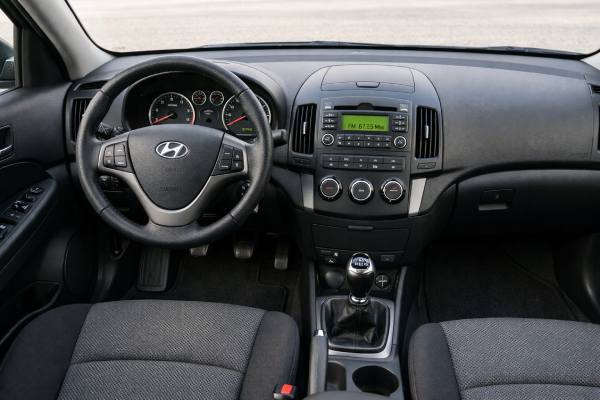

The 2008–2010 Hyundai i30cw 1.4 MPI sits in a useful sweet spot for buyers who want a compact estate without complicated hardware. It takes the first-generation FD platform, stretches it into a practical wagon body, and pairs it with Hyundai’s naturally aspirated 1.4-liter petrol engine and a simple 5-speed manual gearbox. On paper, that means modest performance rather than speed. In ownership, though, it can mean easier servicing, fewer expensive turbo-era problems, and a cargo area that makes the car far more versatile than the hatch. The trade-off is clear: this is a family-minded car with decent road manners and low running costs, not a strong motorway overtaker when loaded. Safety also depends partly on market and equipment, especially side-curtain airbags, and published specifications can vary slightly by country and test cycle, so VIN-specific verification still matters when buying or servicing one today.
Fast Facts
- Spacious for its class, with 415 L to 1,395 L of cargo room and a long 2,700 mm wheelbase.
- The 1.4 MPI setup is simple: naturally aspirated petrol power, port injection, timing chain, and 5-speed manual FWD.
- Independent rear suspension helps the i30cw feel more composed than many budget wagons of its era.
- Watch for cold-start timing-chain rattle, ignition-related running issues, and steering-related campaign history on some market versions.
- A sensible service baseline is engine oil every 15,000 km or 12 months, with shorter intervals for hard city use.
Navigate this guide
- Hyundai i30cw FD in Context
- Hyundai i30cw FD Specs and Data
- Hyundai i30cw FD Trims and Safety
- Reliability and Known Faults
- Maintenance and Buying Advice
- Road Manners and Economy
- Rivals and Overall Value
Hyundai i30cw FD in Context
The i30cw was Hyundai’s way of turning the regular FD-generation i30 into a more practical compact estate. For the 1.4 MPI version covered here, the formula is straightforward: front-wheel drive, a 1.4-liter naturally aspirated petrol four-cylinder, 109 hp, and a 5-speed manual gearbox in a five-door wagon body built from 2008 to 2010. Its core appeal is not headline performance. It is packaging, simplicity, and predictable ownership costs. The wagon body gives it a meaningful usefulness advantage over the hatch, while the 1.4-liter Gamma-family engine avoids turbocharging, direct injection, dual-clutch complications, and diesel aftertreatment issues that became more common in later rivals.
That practical theme shows up clearly in the size and space figures. Common wagon measurements are 4,475 mm long, 1,775 mm wide, and 1,565 mm tall, with a 2,700 mm wheelbase. Luggage capacity is 415 liters with the rear seats in place and up to 1,395 liters with them folded. That makes the i30cw genuinely useful for strollers, bicycles with some disassembly, airport runs, and home-improvement duties in a way many compact hatchbacks are not. The 53-liter fuel tank also gives it decent touring range for a small petrol wagon.
The engineering brief is equally conservative. The 1.4 MPI engine is an inline-four, DOHC, 16-valve, port-injected unit with a timing chain, 77 mm bore, 75 mm stroke, and 10.5:1 compression ratio. Peak output is 109 hp at 6,200 rpm and 137 Nm at 5,000 rpm. That means the engine likes revs more than torque. Around town it is smooth enough, but on faster roads it needs downshifts if the car is full of passengers or climbing hills. This is one of the main reasons the 1.6 petrol and diesel versions often feel more relaxed, even though the 1.4 remains the simpler and cheaper long-term ownership choice.
Chassis design is one of the i30cw’s quieter strengths. It uses MacPherson struts at the front and an independent multi-link rear suspension instead of the torsion-beam layout many cheaper family cars used at the time. Combined with four-wheel disc brakes and modest tire sizes on most base cars, the result is secure and predictable rather than sporty. In market terms, the i30cw sat as a value-focused rival to cars such as the Kia Cee’d SW, Ford Focus Wagon, Volkswagen Golf Variant, and Opel Astra wagon. Buyers typically chose it because it offered a lot of car for the money, a useful wagon body, and uncomplicated petrol engineering.
Hyundai i30cw FD Specs and Data
Below is the clearest way to think about the 2008–2010 Hyundai i30cw 1.4 MPI: it is a simple compact estate with honest outputs, decent cargo flexibility, and a few market-to-market specification differences. Published figures vary slightly depending on region, trim, emissions cycle, and whether a source lists minimum or ready-to-drive curb weight, so the table below focuses on the most commonly reported wagon figures and flags the areas where published data can differ.
| Category | Specification |
|---|---|
| Code | G4FA |
| Engine layout and cylinders | Inline-4, 4 cylinders, DOHC, 4 valves per cylinder |
| Bore × stroke | 77 × 75 mm (3.03 × 2.95 in) |
| Displacement | 1.4 L (1,396 cc) |
| Induction | Naturally aspirated |
| Fuel system | Multi-port fuel injection |
| Compression ratio | 10.5:1 |
| Max power | 109 hp (80 kW) @ 6,200 rpm |
| Max torque | 137 Nm (101 lb-ft) @ 5,000 rpm |
| Timing drive | Chain |
| Rated efficiency | 8.1 / 5.3 / 6.3 L/100 km urban / extra-urban / combined |
| Rated efficiency in mpg | 29.0 / 44.4 / 37.3 mpg US and 34.9 / 53.3 / 44.8 mpg UK |
| Real-world highway @ 120 km/h | Usually about 7.0–7.5 L/100 km in steady cruising |
| Transmission | 5-speed manual |
| Drive type | FWD |
| Differential | Standard open front differential layout |
These powertrain figures describe the car accurately as a straightforward small-capacity petrol wagon. Real-world motorway economy depends heavily on load, wind, tires, and driving style, but a healthy car should usually return low-to-mid 7 L/100 km figures at 120 km/h and slightly better numbers on slower country roads.
| Category | Specification |
|---|---|
| Suspension (front/rear) | MacPherson strut / independent multi-link |
| Steering | Rack-and-pinion power steering |
| Brakes | 280 mm (11.02 in) vented front discs / 262 mm (10.31 in) rear discs |
| Wheels and tyres | 185/65 R15 on 15-inch wheels on common base setups |
| Length / width / height | 4,475 / 1,775 / 1,565 mm (176.2 / 69.9 / 61.6 in) |
| Wheelbase | 2,700 mm (106.3 in) |
| Turning circle | 10.4 m (34.1 ft) |
| Kerb weight | About 1,236–1,311 kg (2,725–2,890 lb), depending on market and trim |
| GVWR | 1,820 kg (4,012 lb) |
| Fuel tank | 53 L (14.0 US gal / 11.7 UK gal) |
| Cargo volume | 415 L (14.7 ft³) seats up / 1,395 L (49.3 ft³) seats folded |
| 0–100 km/h | Roughly 11.7–12.6 s, depending on source and market spec |
| Top speed | 187 km/h (116 mph) |
| Towing capacity | 1,200 kg (2,646 lb) braked / 550 kg (1,213 lb) unbraked |
| Payload | About 509 kg (1,122 lb) in one common 2009-spec listing |
The biggest variation you will usually see in public data is curb weight, because some references list a lighter base figure while others show a better-equipped ready-to-drive trim. Towing capacity can also change slightly by market, so owners should always check the plate data and local handbook.
| Fluids and service capacities | Specification |
|---|---|
| Engine oil | 0W-30 or 5W-30; about 3.3 L (3.5 US qt) per change, about 3.7 L (3.9 US qt) total |
| Coolant | About 6.8 L (7.2 US qt) |
| Manual transmission oil | About 1.9 L (2.0 US qt); typically GL-4 75W-85 or equivalent approved manual transaxle oil |
| Differential / transfer case | Not applicable |
| A/C refrigerant | R-134a; exact charge varies by market label and compressor setup |
| Key torque specs | Wheel nuts commonly 100 Nm (73.8 lb-ft); spark plugs often around 28 Nm (20.7 lb-ft), but always verify by VIN |
| Safety and assistance | ABS and ESC were widely available or standard depending on market; modern AEB and lane-support systems were not offered |
This is a good example of a model where the broad mechanical picture stays the same across markets, but service details such as oil viscosity guidance, A/C charge, and some equipment content should always be checked against the exact VIN and local documentation.
Hyundai i30cw FD Trims and Safety
Trim naming on the first-generation i30cw varies a lot by market, so it is better to think in layers than in one universal trim ladder. In Europe, 1.4 MPI wagons commonly appeared in Classic, Comfort, or similarly named entry-to-mid grades. In Australia, the wagon safety write-up refers to SX and SLX variants. Mechanically, the 1.4 MPI remained broadly similar across these versions: the same engine, the same manual transmission, and no major performance transformation hidden in option packs. The real differences were equipment, wheel finish, trim material, and how many safety features were standard rather than optional.
Base or lower trims are easiest to identify by simpler exterior presentation. Think 15-inch wheels, plainer cabin finishes, and fewer convenience upgrades. Some lower-spec wagons still came with useful equipment such as air conditioning, radio, power steering, ABS, brake assist, traction control, electronic stability control, ISOFIX, and multiple airbags. Even so, equipment could still differ by country and importer. A buyer looking at a specific car should decode the VIN and inspect the actual airbag labels, wheels, and option content rather than assuming every similarly named trim has identical specification worldwide.
Safety is where market detail matters most. In some markets, the i30cw wagon achieved a 5-star score only when fitted with side-curtain airbags. Without curtain airbags, the same body style could drop to a lower safety rating. That matters because older cars are often bought and sold on trim name alone, even though two visually similar cars may not have identical passive safety equipment. For a family buyer, verifying the airbag count and restraint specification is just as important as checking the service book.
The generation’s crash-test performance was respectable for the era. Stronger versions performed well in frontal and side-impact testing and offered a good safety baseline for a late-2000s compact family car. Still, these are old-protocol crash scores, not modern percentage-based assessments shaped heavily by active driver-assistance systems. This generation predates autonomous emergency braking, lane-keeping support, traffic-sign recognition, and similar technologies that many newer cars use to boost safety scores.
In practical ownership terms, the core safety package is airbag coverage, ABS, ESC, and a stable chassis. Child-seat mounting points and a sensible wagon layout also help the i30cw work well as a family car. But buyers should stay realistic: a well-equipped FD i30cw can still be a sensible older choice, yet it should not be confused with a modern ADAS-equipped compact estate. The car’s safety story is mostly about solid passive protection for its time rather than electronic crash-avoidance technology.
Reliability and Known Faults
At its best, the Hyundai i30cw 1.4 MPI is the kind of used car that wins by avoiding expensive complexity. The engine is chain-driven, naturally aspirated, and port-injected, and that alone removes several common failure paths found in later downsized turbo cars. Even so, the car is now old enough that age, maintenance quality, climate, and short-trip use matter more than badge reputation. A good one can feel dependable and inexpensive. A neglected one can still turn into a long list of small faults.
Common issues tend to be manageable rather than catastrophic. One of the better-known complaints is cold-start timing-chain rattle. The usual pattern is brief rattling after start-up caused by hydraulic tensioner bleed-down or early chain wear. A very short noise on a cold start may not mean immediate disaster, but repeated or worsening rattle should not be ignored. The correct response is inspection, followed by timing-chain set replacement if wear, stretch, or tensioner problems are confirmed.
Another regular age-related theme is rough idle or uneven running. Symptoms can include hesitation, lazy throttle response, and occasional misfire. Likely causes include dirty throttle-body deposits, tired plugs, weak coils, or injector fouling. On a used example, it is smarter to scan the car, inspect ignition parts, and clean the intake side before assuming something major is wrong. Older Hyundai petrol engines also sometimes develop auxiliary-belt squeal or whistle, often tied to a weak tensioner or worn belt hardware.
There are also a few issues that deserve closer attention because they affect drivability and buyer confidence. Some owners report engine vibration or extra harshness as mounts age. Others encounter steering clicks or clunks, especially at parking speeds, often related to wear in the electric steering system or column components. These are not always expensive fixes, but they matter because they can make the car feel much more worn than it really is.
Higher-risk cases usually involve neglect. Persistent oil use, hot-engine noise, overheating history, or clear signs of poor servicing raise the chance of deeper engine wear. That does not mean the 1.4 MPI is fragile by design. It means the surviving cars are old enough that condition separates the good ones from the bad ones very quickly.
Recall and campaign history also matters. Some FD-platform market versions were subject to steering-related updates or ABS-related recall action, particularly in North America under the Elantra Touring name. That does not automatically mean every European i30cw is affected, but it does make VIN-based recall verification an essential part of pre-purchase due diligence. The best ownership approach is simple: buy a car with a quiet cold start, steady idle, solid steering feel, and documented service history. Avoid the ones with unexplained noises, warm-engine seller tricks, or vague claims about “recent work.”
Maintenance and Buying Advice
The smartest way to own an i30cw 1.4 MPI is to maintain it like an aging but fundamentally simple mechanical car, not like a disposable appliance. The official maintenance logic is conservative enough for normal use, but the car is now old enough that preventive work beats reactive work. Fresh fluids, early diagnosis of noises, and careful inspection of rubber parts, brakes, and corrosion points matter more than stretching service intervals because the car once qualified for them when new.
| Item | Practical interval |
|---|---|
| Engine oil and filter | Every 15,000 km or 12 months; shorten for short trips, dust, or repeated cold starts |
| Engine air filter | About every 45,000 km, sooner in dusty use |
| Cabin filter | Check every service; replace as needed, often yearly |
| Fuel filter | About every 60,000 km where fitted as a service item |
| Spark plugs | About every 60,000 km |
| Timing chain | No fixed replacement interval; inspect for rattle, timing-correlation faults, or stretch |
| Serpentine / auxiliary belt | About every 120,000 km, or earlier if noisy or cracked |
| Coolant | About every 120,000 km or 8 years |
| Manual transmission oil | Sensible preventive change around 90,000–120,000 km |
| Brake fluid | Every 2 years |
| Brake pads and rotors | Inspect every service |
| Tyre rotation and alignment | Rotate around every 10,000–15,000 km; check alignment if wear is uneven |
| 12 V battery | Test yearly after about 4 years |
| Top-end noise or idle quality | Investigate early rather than waiting for a fault code |
The key point is that the timing chain is condition-based, not a “never touch it” item. A quiet chain, correct oil, and frequent level checks are what keep this engine cheap to own. That matters especially on older cars used for short trips, because repeated cold starts are harder on chain tensioners and oil condition.
For fluids and workshop planning, keep a few numbers in mind: engine oil is roughly 3.3 liters per service fill, total fill is about 3.7 liters, coolant is about 6.8 liters, and manual transaxle oil is about 1.9 liters. Wheel nuts are commonly tightened to 100 Nm, and spark plugs are often listed around 28 Nm, but final torque confirmation should always come from VIN-correct service documentation.
A buyer’s inspection should focus on the basics plus FD-specific weak points:
- Start the engine fully cold and listen for more than a brief chain rattle.
- Check for steering clicks, clunks, or odd EPS behavior during parking maneuvers.
- Look for rough idle, misfire history, oil seepage, and signs of neglected plugs or coils.
- Inspect all four brakes for uneven wear, binding, and corrosion.
- Confirm recall completion by VIN and dealer history.
- Check the luggage floor, tailgate opening, lower door seams, and suspension hardware for corrosion or poor crash repair.
The best examples are usually later, well-kept cars with complete records, quiet cold starts, intact interior trim, and no steering complaints. The ones to avoid are cheap cars with a warm engine on arrival, vague “recent service” claims, or sellers who cannot explain warning lights, chain noise, or missing recall history.
Road Manners and Economy
On the road, the i30cw 1.4 MPI feels exactly like its specification suggests: honest, calm, and more mature than powerful. The long wheelbase and independent rear suspension help it settle well on broken pavement, and the wagon body does not ruin its balance. Steering is light rather than especially talkative, and the small-section tires keep replacement costs low while also smoothing out minor road imperfections. This is not a driver’s car in the hot-hatch sense, but it is usually an easy car to place in traffic and a relaxed one to use every day.
The engine’s character is linear but modest. With only 137 Nm arriving at 5,000 rpm, the 1.4 needs revs and manual downshifts to feel alert. In town, that is fine. On a motorway with passengers, luggage, or an incline, the car can feel short of reserve. Published acceleration is roughly 11.7 to 12.6 seconds to 100 km/h, which is adequate for the period but not brisk even by late-2000s family-car standards. Passing performance is acceptable only when the driver uses the gearbox properly and plans ahead.
Fuel economy is one of the car’s better ownership traits, but expectations should stay realistic. Official published figures cluster around 6.3 L/100 km combined for a common wagon version, with 8.1 urban and 5.3 extra-urban. Some region-specific references list slightly lower combined numbers for comparable 1.4 CW variants. In actual use, mixed consumption around the low-7 L/100 km range is realistic for a healthy, properly serviced car driven normally.
A sensible real-world rule of thumb looks like this:
- Around 8.0–8.5 L/100 km in heavy city use
- Around 7.0–7.5 L/100 km at 120 km/h motorway cruising
- Around low-7s in mixed driving when the car is healthy and on good tires
Because this is an older naturally aspirated petrol with no drive modes, no hybrid assistance, and no modern efficiency tricks, fuel use is very sensitive to speed and load. Keep it around 100–110 km/h and it feels pleasantly thrifty. Push it faster and the lack of torque means more throttle, more downshifts, and more fuel.
Braking and traction are reassuring rather than sporty. Four-wheel discs, ABS, and ESC give it a safe basic setup, but there is no modern driver-assistance safety net. With decent tires, it should feel stable and predictable in rain. With cheap mismatched tires, the whole car feels older very quickly. That makes tire quality one of the simplest and most effective ways to improve how a used i30cw drives.
Rivals and Overall Value
The Hyundai i30cw 1.4 MPI lived in a crowded part of the market, and its natural rivals were clear then and still are today on the used market: Kia’s closely related Cee’d SW, the Ford Focus Wagon 1.4, the Volkswagen Golf Variant 1.4, and the Opel Astra wagon 1.4 all sit on the same short list. These are the cars buyers usually compare when they want a compact estate with practical cargo space and modest running costs.
Against the Kia Cee’d SW, the Hyundai’s biggest story is familiarity. The two cars share much of their engineering, so condition and service history matter more than branding. Against the Ford Focus Wagon, the Hyundai usually gives away some steering feel but counters with straightforward naturally aspirated hardware and strong practicality. Against a Golf Variant of the same era, the i30cw often feels less polished inside, yet it can be the saner buy if you value lower purchase price and simpler mechanicals over badge appeal. Against an Astra wagon 1.4, the Hyundai often wins by feeling less burdened by drivetrain headaches and by offering an easier ownership proposition when well maintained.
That is the real verdict on this specific 2008–2010 1.4 MPI wagon. It is not the fastest compact estate, nor the most refined, nor the most modern in safety technology. What it does offer is a useful blend of cargo space, uncomplicated petrol engineering, decent suspension design, and ownership costs that stay sane if the car has been maintained properly. For buyers who need a cheap family wagon with fewer big-ticket technical risks than many later downsized rivals, that still counts for a lot.
The best reason to choose one today is not excitement. It is value. Buy a clean example, verify recalls by VIN, insist on a cold start, budget for catch-up maintenance, and the i30cw 1.4 MPI can still be a very rational small estate. Buy the cheapest tired one with chain noise and steering clunks, and it stops being rational very quickly.
References
- Hyundai Owners manuals | Hyundai Motor UK 2026 (Owner’s Manual)
- Hyundai i30 | Safety Rating & Report | ANCAP 2009 (Safety Rating)
- Car Recalls | Owning | Hyundai Australia 2025 (Recall Checker)
- Part 573 Safety Recall Report 20V-061 2020 (Recall Database)
- Recall Campaign 127: 2008 2015 (TSB)
Disclaimer
This article is for informational purposes only and is not a substitute for professional diagnosis, repair, or official workshop documentation. Specifications, torque values, service intervals, fluids, and procedures can vary by VIN, market, production date, and equipment level, so always verify critical details against the correct owner’s manual, service literature, and dealer recall records for the exact vehicle.
If this guide helped you, please consider sharing it on Facebook, X, or another social platform to support our work.