


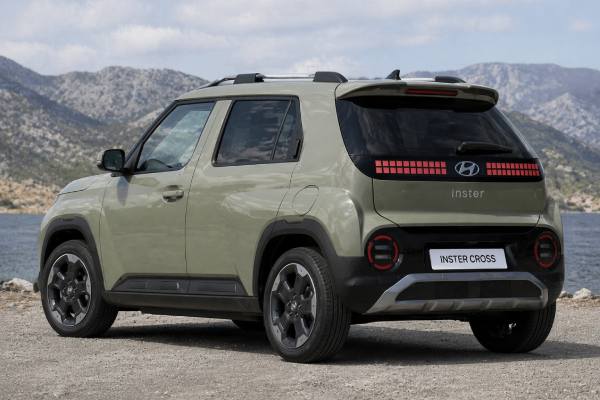
The Hyundai INSTER Cross is best understood as the tougher-looking, higher-spec version of Hyundai’s smallest long-range EV rather than a separate mechanical off-road model. It uses the 49 kWh battery and 115 hp front motor, then adds crossover styling details, 17-inch wheels, roof rails, a more distinctive cabin, and a richer equipment list. That gives it wider appeal than many city EVs, because it combines compact dimensions with clever packaging, solid charging performance, and an unusually complete safety suite for this class. Hyundai also includes several ownership-friendly features that matter in daily use, such as battery heating, heat-pump availability in key markets, and flexible rear seating. The trade-off is clear as well: the larger wheels and tougher styling trim efficiency a little, and this remains a small EV that is best suited to urban, suburban, and light regional driving rather than constant high-speed motorway work.
Owner Snapshot
- The 49 kWh battery and 115 hp motor give the Cross enough pace for daily city and suburban driving.
- Heat pump, battery heating, and 11 kW AC charging make the car easier to use in colder weather where this hardware is fitted.
- Sliding rear seats and fold-flat seating make the cabin more versatile than the small body suggests.
- Long-term reliability data is still limited because the model is new, so recall and software-history checks matter.
- Replace the cabin air filter every 30,000 km or every 2 years, and keep DC fast charging habits sensible in regular use.
Guide contents
- Hyundai INSTER Cross long-range profile
- Hyundai INSTER Cross specs and data
- Hyundai INSTER Cross trims, safety and ADAS
- Reliability, faults and service actions
- Maintenance and used-buying advice
- Real driving and charging
- How the INSTER Cross stacks up
Hyundai INSTER Cross long-range profile
The INSTER Cross sits at the top of the early INSTER range and, in Europe and the UK, it is the trim that most clearly turns Hyundai’s city EV into a small lifestyle crossover. Mechanically, it still follows the same basic recipe as the long-range INSTER: a front-mounted single electric motor, front-wheel drive, and the 49 kWh battery. What changes is the presentation and the equipment mix. Hyundai gives the Cross unique bumpers, black cladding, roof rails, exclusive 17-inch wheels, and an interior trim theme with grey cloth and lime-yellow accents, so it looks and feels more distinctive than the plainer trims below it.
That visual upgrade is backed by real ownership value. In UK specification, the Cross pairs the long-range battery with battery heating and a heat pump as standard. Those details matter more than the styling parts, because they improve winter charging behaviour, help preserve usable range in colder weather, and make the car easier to use as a year-round EV. In a class where many small electric cars are still trimmed to a price, that is one of the Cross’s strongest arguments.
The other major strength is packaging. Hyundai has made this tiny car unusually versatile. The flat EV floor, tall roofline, sliding rear bench, and fold-flat seats give the Cross a cabin that behaves more like a much larger vehicle. The rear seats can slide forward by 16 cm, which expands boot capacity from 238 to 351 litres, and maximum cargo volume reaches 1,059 litres with the seats folded. For buyers who use an EV mainly for commuting, school runs, errands, and short family trips, that flexibility is more valuable than it first appears on paper.
The compromise is efficiency. The standard long-range INSTER on smaller wheels carries the best official WLTP figure, while the Cross’s 17-inch wheel-and-tyre package drops the official number to around 359 km in UK data. That is still competitive for a very small EV, but it confirms that the Cross is the style-and-equipment version, not the most range-efficient one. Buyers who want the more rugged look and extra standard equipment will likely accept that trade. Buyers who care most about extracting the greatest possible range from each kWh may prefer a long-range non-Cross trim on smaller wheels.
In short, the Cross is not pretending to be a serious off-roader. It is a well-equipped compact EV with more personality, more visual presence, and a better ownership spec than many budget-focused rivals. That makes it appealing to buyers who want a small electric car that feels complete rather than stripped back.
Hyundai INSTER Cross specs and data
Powertrain and battery
| Spec | Value |
|---|---|
| Motor type | Permanent-magnet synchronous motor |
| Motor count and axle | Single motor, front axle |
| Drive type | Front-wheel drive |
| Transmission | Single-speed reduction gear |
| Battery chemistry | Lithium-ion polymer, NMC |
| Battery capacity | 49.0 kWh gross / 46.0 kWh usable |
| System voltage | 310 V |
| Max power | 115 hp (85.5 kW) |
| Max torque | 147 Nm (108 lb-ft) |
| Thermal hardware | Battery heating system; heat pump fitted in some markets |
| Official efficiency test | WLTP |
| Rated efficiency | 15.1 kWh/100 km (243 Wh/mi) |
| Rated range | 359 km (223 mi) |
Charging and energy
| Spec | Value |
|---|---|
| AC connector | Type 2 |
| DC connector | CCS2 |
| Charging port location | Front left |
| Onboard AC charger | 11 kW |
| AC charge time | 10–100% in 4 h 35 min to 4 h 45 min |
| DC fast-charge peak | 85 kW |
| Typical DC average power | About 70 kW over 10–80% |
| DC charging time | 10–80% in about 29–30 min |
| 50 kW DC estimate | 10–80% in about 55–58 min |
| 100 kW DC estimate | 10–80% in about 39 min |
| Battery preconditioning | Available; navigation-linked |
| Vehicle-to-Load | Up to 3.6 kW |
Performance, chassis and dimensions
| Spec | Value |
|---|---|
| 0–100 km/h | 10.6 s |
| 80–120 km/h | 7.8 s |
| Top speed | 150 km/h (93 mph) |
| 100–0 km/h braking | 36.1 m (118 ft) |
| Front suspension | MacPherson strut |
| Rear suspension | Coupled torsion beam axle |
| Steering | Rack-and-pinion, electric assist |
| Brakes | Ventilated front discs, rear discs, electronic parking brake |
| Wheels | 6.5J x 17 |
| Tyres | 205/45 R17 |
| Ground clearance | 144 mm (5.7 in) |
| Length | 3845 mm (151.4 in) |
| Width | 1610 mm (63.4 in) |
| Height | 1610 mm (63.4 in) with roof rails |
| Wheelbase | 2580 mm (101.6 in) |
| Turning circle | 10.6 m (34.8 ft) |
| Kerb weight | 1358 kg (2994 lb) |
| GVWR | 1790 kg (3946 lb) |
| Payload | 337 kg (743 lb) |
| Cargo volume | 238–351 L seats up / 1059 L seats down |
| Roof load | 100 kg (220 lb) |
Safety and protection data
| Spec | Value |
|---|---|
| Euro NCAP overall rating | 4 stars |
| Adult occupant | 70% |
| Child occupant | 81% |
| Vulnerable road users | 70% |
| Safety assist | 67% |
| Standard airbags | 7, including front-centre airbag |
Hyundai INSTER Cross trims, safety and ADAS
In most European-market material, the INSTER Cross is positioned as the flagship version of the long-range INSTER rather than a separate mechanical derivative. Hyundai uses different trim naming by market, but the basic pattern is consistent: simpler versions focus on price and efficiency, richer mainstream trims add comfort and technology, and the Cross sits at the top with its own styling package and denser equipment list. In practical terms, buyers are choosing between two ideas: maximum efficiency on smaller wheels, or the Cross’s more rugged design and stronger standard specification.
The Cross’s visual identifiers are easy to spot. Hyundai gives it unique front and rear bumpers, black wheel-arch trim, roof rails, exclusive 17-inch alloy wheels, and a special interior finish with lime-yellow accents. In UK trim, the Cross also brings a notably strong comfort package, including heated front seats, a heated steering wheel, privacy glass, climate control, a glass sunroof, and twin 10.25-inch screens for the instrument cluster and infotainment. Some markets also offer a Tech Pack with features such as Digital Key and an interior V2L outlet. Those extras are useful, but the core appeal of the Cross remains the fact that it feels properly equipped before options are added.
Safety is one of the strongest parts of the package. Hyundai equips the INSTER with seven airbags, including a front-centre airbag, which is still unusual in this class. The Cross also carries a broad driver-assistance set, with equipment lists that can include autonomous emergency braking with car, pedestrian, cyclist, and junction support, lane-keeping and lane-following assistance, adaptive cruise control with stop and go, blind-spot monitoring, rear cross-traffic support, parking assistance systems, intelligent speed limit assistance, and highway driving assistance. For a compact EV of this size and price bracket, that is an impressive list.
Euro NCAP awarded the INSTER four stars. That score is respectable, though not class-leading, and the breakdown explains why. Child protection is the strongest area, while adult occupant, vulnerable road user, and safety-assist scores are more mixed. The missing fifth star appears to come from a combination of structural and equipment details rather than a single glaring weakness. For many buyers, the important point is that the car still offers a solid safety foundation and a generous ADAS suite for daily use.
Family practicality is also better than the exterior dimensions suggest. ISOFIX child-seat provision, the sliding rear bench, and a tall roofline make the Cross easier to live with than many small hatchback-shaped EVs. On the used market, one note matters: after windscreen replacement, bumper repair, or any work involving sensors or cameras, the ADAS hardware should be recalibrated properly. On a heavily assisted modern EV, that is part of correct maintenance rather than an optional extra.
Reliability, faults and service actions
The fairest way to describe Hyundai INSTER Cross reliability today is promising but still unproven. The model is too new to have built the kind of long-term public failure history that older EVs now show, so there is not yet enough evidence for a mature verdict on battery aging trends, charging-system durability, or age-related chassis wear. That should not be mistaken for a warning sign. It simply means buyers need to judge the Cross more by design logic, early service information, and documented campaigns than by a deep body of owner history.
So far, the main official public service action is a market-specific recall covering some 2024–2025 Hyundai Inster (AX) vehicles in Australia. It concerns under-seat retaining studs that may have been assembled without a sealing cap, leaving exposed sharp edges beneath the driver’s seat. That is not a battery, inverter, or traction-motor issue, but it is exactly the kind of early-production quality matter that used buyers should verify by VIN rather than assume has already been corrected. A car can look perfect and still have an open campaign.
Software matters more on a new EV than many buyers expect. A car like the INSTER Cross relies heavily on calibration for charging behaviour, battery conditioning, warning logic, infotainment stability, and ADAS functions. That means software history forms part of the reliability picture. A car with a complete service record, campaign completion, and a dealer or owner who can show that updates were kept current is more attractive than one that is merely described as “trouble-free.” Charging performance, preconditioning behaviour, and false warning messages can all be influenced by software state.
Because long-term data is still thin, it is more useful to flag likely watch points than to claim fixed patterns of failure. The sensible checklist includes charge-port latch and seal condition, consistency on AC and DC charging, 12 V battery health, brake-disc corrosion from frequent regenerative braking, and front suspension noise on poor roads, especially with the Cross’s 17-inch wheels. In wet or salted climates, the underbody deserves close inspection as well. Fasteners, battery-area shields, plastic undertrays, and exposed hardware can tell you a lot about how the car has been used and stored.
Battery health should be monitored pragmatically rather than anxiously. There is no solid evidence yet that the Cross suffers from unusual degradation, and Hyundai backs the high-voltage battery with strong warranty coverage in several markets. Even so, buyers should ask for a battery health report where possible, especially on cars used for frequent public fast charging or heavy year-round mileage. A healthy small EV should charge consistently, show no unexplained warning messages, and deliver range that broadly matches its condition, weather, and wheel package.
In short, the INSTER Cross does not currently show a widely established serious defect pattern. The risk is mostly the normal one for a very new model: limited long-run evidence. That makes documentation, VIN recall checks, software status, and a proper inspection more important than folklore or guesswork.
Maintenance and used-buying advice
The INSTER Cross should cost less to maintain than a comparable petrol crossover, but it still benefits from a disciplined service routine. Hyundai’s published EV guidance indicates that service depends on plan and mileage, typically yearly or every 2 years, with intervals such as 15,000 or 30,000 km. For real ownership, the safest approach is to treat the Cross as a yearly-inspection car even if mileage is low. Tyres, brakes, suspension joints, coolant-system condition, software status, and 12 V battery health all deserve regular attention. Hyundai also specifies cabin air filter replacement at 30,000 km or every 2 years.
A practical maintenance rhythm for most owners looks like this:
| Item | Practical interval |
|---|---|
| General inspection and software check | Every 12 months or 15,000–30,000 km |
| Cabin air filter | Every 30,000 km or 2 years |
| Brake inspection and corrosion check | Every 12 months |
| Tyre rotation and alignment check | About every 10,000–12,000 km |
| 12 V battery test | Annually after year 3 |
| Coolant loop and thermal-system leak check | At every annual service |
| Suspension and steering inspection | Every 12 months |
| HV battery health report for used examples | Before purchase, then periodically |
That schedule blends Hyundai’s EV maintenance guidance with sensible real-world practice for a compact EV on low-profile tyres. The Cross may be small, but its wheel package and higher-spec equipment mean small neglected issues can become expensive annoyances more quickly than on a very basic city car.
For workshop decision-making, fluid specification still matters even on an EV. The owner documentation lists brake fluid to SAE J1704 DOT-4 LV / FMVSS 116 DOT-4 / ISO 4925 Class-6. That is a good reminder that even simple service items should follow the exact market and VIN-specific specification. The same applies to any future coolant or high-voltage service procedure. Wheel and tyre condition deserve special attention as well, because the 17-inch setup suits the Cross visually but gives less sidewall protection against potholes and kerb damage.
A good used-buying strategy starts with charging and battery checks. Ask for a recent battery health report if one is available, verify that AC and DC charging both work correctly, and inspect the charge-port door, latch, and sealing surfaces. During the drive, look for warning lights, odd charging messages, or any unexplained limitation in regenerative braking or power delivery. Small EVs should feel clean and predictable when healthy.
Then move to the chassis and body. Check for uneven tyre wear, signs of poor alignment, front-end knocks over bumps, corrosion on exposed underbody hardware, and damage to the battery-area undertray or lower cladding. Because the car is new, visible neglect may matter more than mileage alone. A high-mileage car with clean service history can be a better buy than a lower-mileage one with patchy records and missing campaign proof.
The best trims to seek are those that match your use rather than the headline brochure. The Cross makes sense if you want the richer equipment list, winter-friendly hardware, and more distinctive styling. A smaller-wheel long-range INSTER makes more sense if maximum efficiency matters more than appearance. The long-term battery outlook appears encouraging, but the model is still too young for a settled durability curve, so documented care remains the strongest buying signal.
Real driving and charging
On the road, the INSTER Cross should feel quicker and more substantial than its size suggests. The 115 hp front motor and 147 Nm torque output are modest by modern EV standards, but in a compact car like this they are enough to make daily driving feel easy, alert, and smooth. The official 0–100 km/h time of 10.6 seconds is not exciting on paper, yet it tells only part of the story. In normal use, the instant torque delivery and relatively low mass matter more than the stopwatch figure. The car should step away cleanly from junctions, handle traffic gaps without drama, and feel usefully responsive in city and suburban conditions.
Mid-range performance is also more relevant than the launch number. An 80–120 km/h time of 7.8 seconds suggests the Cross should cope well enough with overtakes and short motorway merges. It is not a performance EV, but it avoids feeling underpowered for its intended role. Buyers moving from basic small hatchbacks will likely find it brisk enough, while buyers used to more powerful EVs will simply see it as correctly judged for the segment.
Ride and refinement are likely to depend heavily on the 17-inch wheel package. Those wheels suit the Cross’s tougher visual theme and may sharpen steering response, but they also reduce sidewall cushioning over broken urban surfaces. Combined with the short wheelbase, that usually means a firmer low-speed ride than smaller-wheel versions of the same car. The low-mounted battery should still help body control, however, and that often makes small EVs feel more planted and settled than similarly sized combustion cars. The Cross is likely to feel nimble in town, easy to place on narrow roads, and simple to park.
Real-world range needs sensible expectations. Officially, the Cross is rated at about 359 km WLTP, but sustained high-speed driving will cut that down substantially, especially in winter or with strong heating or cooling demand. In mixed use, it should feel comfortably capable for everyday driving, commuting, and moderate weekend trips. On the motorway at 110–120 km/h, it becomes more of a planning-based EV than a carefree long-haul one. That is not unusual in this size class, but it does shape the verdict.
Charging behaviour is better matched to the car’s mission. The 11 kW onboard AC charger allows a genuinely useful overnight or workplace refill, with a full recharge taking roughly five hours from low state of charge. On DC, the 10–80% window in around 30 minutes is strong enough to make occasional longer trips realistic without making the Cross into a dedicated tourer. Battery preconditioning is especially valuable here, because it helps the car arrive at a charger ready to accept good power rather than wasting time warming the pack after plugging in.
The adjustable regenerative braking system is another everyday strength. A small EV benefits from allowing the driver to choose between easier coasting and stronger lift-off braking depending on traffic and preference. When tuned well, that makes the car feel calmer and more natural than the raw performance figures suggest. For everyday driving, that smoothness is often more important than ultimate speed.
How the INSTER Cross stacks up
The Hyundai INSTER Cross enters a small but increasingly competitive group of compact EVs, and its place in that group is fairly clear. Against budget-first rivals such as the Dacia Spring, the Hyundai is the more complete car by a wide margin. The Dacia still has appeal as a low-cost electric runabout, but the INSTER Cross offers more real-world range, stronger safety technology, better charging flexibility, a more mature cabin, and a much richer equipment list. It costs more, but it also feels like a much more developed product.
Against stylish new mainstream small EVs such as the Renault 5 E-Tech, the comparison becomes more interesting. The Renault leans harder on design flair and hatchback charm, while the Hyundai answers with a taller seating position, more flexible rear-seat packaging, and a crossover-like sense of practicality in a shorter body. Buyers who care most about interior versatility and upright visibility may prefer the Hyundai. Buyers who want a lower, more conventional small-car feel may lean toward the Renault.
The Fiat Grande Panda Electric and Citroën ë-C3 sit a little closer to the traditional small-family-car brief than the Hyundai does. Those cars make sense for buyers who want affordable EV transport with a more familiar hatchback format. The INSTER Cross instead plays to clever packaging, compact-city ease, and a flagship small-EV feel. Its cabin usefulness and standard equipment density are stronger than the exterior footprint suggests, and that gives it a distinctive identity in the market.
The Cross also competes with Hyundai’s own non-Cross long-range INSTER. That may be its most important comparison of all. If you want the best efficiency, the smaller-wheel long-range version is the rational choice. If you want the stronger standard equipment, more individual design, roof rails, and a slightly more lifestyle-oriented character, the Cross earns its higher running-cost penalty in range terms. The two cars are close enough mechanically that the decision is really about priorities rather than capability.
Overall, the INSTER Cross is one of the more interesting small EVs on sale because it is not just another stripped-down urban electric car. It gives buyers useful thermal hardware, a practical interior, competitive charging, and a strong list of comfort and safety features in a genuinely compact package. It is not the best answer for constant motorway use, and it is not the most efficient INSTER variant. But for urban and mixed-use drivers who want a small EV with character and substance, it makes a strong case.
References
- Hyundai Motor UK announces INSTER Cross pricing, specification and technical information 2025
- The new INSTER | Features 2025
- Euro NCAP | Hyundai INSTER 2025 (Safety Rating)
- REC-006394 – Hyundai Motor Company – HYUNDAI Inster (AX) 2024 – 2025 | Vehicle Recalls 2025 (Recall Database)
- AXEV Owner’s Manual – Hyundai 2025 (Owner’s Manual)
Disclaimer
This article is for informational purposes only and is not a substitute for professional diagnosis, inspection, repair, or official technical guidance. Specifications, torque values, service intervals, charging data, and repair procedures can vary by VIN, market, software version, and equipment level, so always verify critical details against the correct Hyundai service and owner documentation for the exact vehicle.
If this guide helped, please consider sharing it on Facebook, X, or another social platform to support our work.