


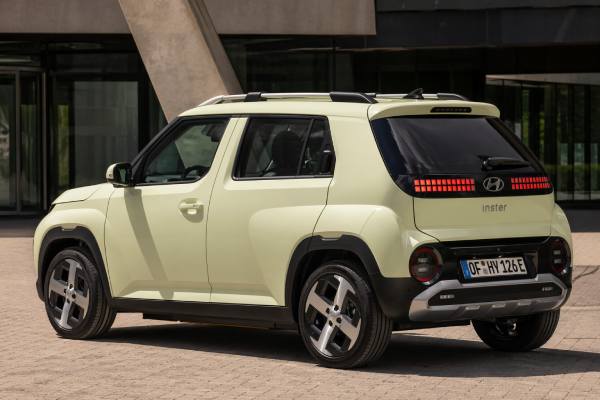
The 42 kWh Hyundai INSTER is one of the more interesting small EVs on sale because it does not feel like a stripped-out budget car. On paper, its 97 hp output looks modest, yet the combination of a light body, front-wheel-drive electric torque, a long wheelbase, and quick charging for the class gives it a broader brief than many city EVs. It is built first for urban life, but it also has enough range and charging speed to handle occasional longer trips without turning every motorway run into a chore.
For ownership, the biggest appeal is the balance. The INSTER is easy to park, efficient, unusually roomy for its footprint, and well equipped even in lower trims. The trade-offs are just as clear: it is a strict four-seater, the smaller battery makes motorway planning more important, and long-term reliability data is still limited because the model is new. That makes it a strong new-car choice, but one that still rewards informed buying.
At a Glance
- The 42 kWh version is efficient, compact, and genuinely useful in town thanks to strong low-speed response and easy manoeuvrability.
- Cabin packaging is a major strength, with a long wheelbase and a much roomier feel than the exterior size suggests.
- DC charging is strong for a small EV, so occasional longer trips are more realistic than the battery size first suggests.
- The biggest ownership caveat is motorway range: steady high-speed driving cuts the margin faster than the WLTP number implies.
- Plan tyre rotation about every 10,000–12,000 km or every 12 months, whichever comes first.
Guide contents
- Hyundai INSTER 42 kWh profile
- Hyundai INSTER technical data
- Hyundai INSTER trims and safety
- Reliability, faults and service actions
- Maintenance and used-buying guide
- Road feel, range and charging
- How INSTER compares with rivals
Hyundai INSTER 42 kWh profile
The 42 kWh INSTER is the entry point into Hyundai’s smallest European EV, but it does not come across as a penalty-box version. It uses a single front-mounted permanent-magnet motor with 97 hp and 147 Nm, which is enough to make the car feel eager in everyday use. In a small electric hatchback with a curb weight around the low-1300 kg range, that output is less about headline acceleration and more about clean step-off response, easy gaps in traffic, and stress-free city driving.
What makes the INSTER unusual is its packaging. At a little over 3.8 metres long, it sits in the small-car end of the market, yet the 2,580 mm wheelbase is long for the footprint. That gives it a cabin that feels more mature than the size suggests. There is decent head room, a commanding seating position, and better rear-seat usefulness than buyers may expect from something that looks like a city crossover. The catch is capacity: this is a four-seater, not a five-seater, so it wins on comfort and flexibility but not on total passenger count.
The 42 kWh version is also the most logical one for buyers who mainly do local and suburban work. On the official cycle it reaches 327 km with the 15-inch wheel setup, and it is the most efficient version in the range. That matters. In small EVs, wheel and tyre choice can noticeably change both ride quality and range, and the base 15-inch package suits the smaller-battery car well. It keeps the ride more forgiving and helps preserve usable distance between charges.
Charging is a core part of the INSTER’s appeal. Hyundai did not treat the small battery as an excuse to fit lazy charging hardware. The car supports 11 kW AC charging and up to 73 kW DC in this form, which is strong for the segment. That means overnight home charging is simple, and public rapid charging can turn the car around quickly enough for occasional road trips. It also gives the INSTER a more relaxed ownership pattern than many bargain EVs that are cheap to buy but slow to refill.
The wider ownership story is just as appealing. Many markets give the car features that used to sit much higher up the price ladder, including dual 10.25-inch displays, navigation, adaptive cruise with stop-and-go, lane support, and in some trim and market combinations a heat pump, battery heater, V2L capability, and more advanced parking assistance. In other words, the 42 kWh car is not merely the “cheap one.” It is the efficiency-focused one.
The main limits are clear enough to understand before buying. At motorway speeds, the small battery has less reserve than the upright shape and clever cabin might imply. It is also not a performance car; overtaking punch above urban speeds is adequate rather than strong. And because the INSTER is still new, buyers do not yet have the long-term reliability history that surrounds older EVs such as the Renault Zoe or Hyundai’s own earlier electric models. For the right owner, though, those are manageable compromises. The 42 kWh INSTER makes the strongest case when used as a smart daily EV that can occasionally stretch further without drama.
Hyundai INSTER technical data
Powertrain and charging
| Spec | Value |
|---|---|
| Motor type | Permanent Magnet Synchronous Motor (PMSM) |
| Motor layout | Single motor, front axle |
| Drive type | Front-wheel drive |
| Transmission | Single-speed reduction gear |
| Battery chemistry | Lithium-ion polymer |
| Gross battery capacity | 42.0 kWh |
| Usable battery capacity | 39.0 kWh |
| Nominal battery voltage | 266 V |
| Max power | 97 hp (71.1 kW) |
| Max torque | 147 Nm (108 lb-ft) |
| Official efficiency standard | WLTP |
| Official efficiency | 14.3 kWh/100 km (230 Wh/mi) |
| Official range | 327 km (203 mi) |
| AC connector | Type 2 |
| DC connector | CCS Combo 2 |
| Charging port location | Front side, left |
| Onboard charger | 10.5 kW |
| AC charging, 7.4 kW single-phase (10–100%) | 6 h 6 min |
| AC charging, 11 kW three-phase (10–100%) | 4 h 0 min |
| DC charging, 50 kW CCS (10–80%) | 55 min |
| DC fast-charge peak | 73 kW |
| Typical DC charging power, 10–80% | 60 kW |
| DC charging, 150 kW CCS (10–80%) | 30 min |
| 0–100 km/h | 11.7 s |
| Top speed | 140 km/h (87 mph) |
Chassis and dimensions
| Spec | Value |
|---|---|
| Front suspension | MacPherson strut |
| Rear suspension | Coupled torsion beam axle |
| Steering | C-MDPS |
| Steering lock-to-lock | 2.58 turns |
| Front brakes | Ventilated disc |
| Rear brakes | Solid disc |
| Standard tyres | 185/65 R15 |
| Standard wheels | 5.5J x 15 |
| Optional tyres | 205/45 R17 |
| Optional wheels | 6.5J x 17 |
| Ground clearance | 144 mm (5.7 in) |
| Length | 3825 mm (150.6 in) |
| Width, excluding mirrors | 1610 mm (63.4 in) |
| Width, including mirrors | 1875 mm (73.8 in) |
| Height | 1575 mm (62.0 in) |
| Wheelbase | 2580 mm (101.6 in) |
| Turning circle | 10.6 m (34.8 ft) |
| Kerb weight | 1305–1393 kg (2877–3071 lb) |
| GVWR | 1730 kg (3814 lb) |
| Payload | 337–425 kg (743–937 lb) |
| Roof load | 75 kg (165 lb) |
| Towing, braked | 0 kg (0 lb) |
| Towing, unbraked | 0 kg (0 lb) |
| Cargo volume, VDA | 280 L seats up / 1059 L seats down |
Safety and service data
| Spec | Value |
|---|---|
| Crash rating | Euro NCAP 4 stars |
| Euro NCAP adult occupant | 70% |
| Euro NCAP child occupant | 81% |
| Euro NCAP vulnerable road users | 70% |
| Euro NCAP safety assist | 67% |
| Airbags | Front, front side, and curtain |
| Standard safety systems | ABS, ESC, TPMS, eCall, HAC |
| Standard ADAS | FCA 1.5, SCC with Stop and Go, HDA 1.5, ISLA, LKA, LFA, driver monitoring camera |
| Higher-trim ADAS | BCA, BVM, PCA-R, SVM |
| Reduction gear fluid | HK ATF 65 SP4M; 0.75 ± 0.03 L (0.79 ± 0.03 US qt) |
| Wheel nut torque | 107–127 Nm (79–94 lb-ft) |
| High-voltage battery warranty | 8 years / 100,000 miles |
Hyundai INSTER trims and safety
For the 42 kWh and 97 hp version, trim structure matters because Hyundai has used slightly different grade logic by country. In the UK, the core range is built around 01, 02, and Cross. In France and some nearby markets, the naming and pack structure differ, but the equipment ladder follows the same basic pattern: a well-equipped base car, a more versatile middle trim, and a more visual, adventure-styled top version.
For the 42 kWh powertrain specifically, the key point is that the base car is not sparse. In UK form, INSTER 01 already gets the features that most daily drivers actually use: 10.25-inch driver display, 10.25-inch navigation touchscreen, climate control, smart cruise control with stop and go, and the heat pump and battery heater package. That matters because it means the small-battery version still feels like a complete car rather than a range-topping tech demo with a stripped lower trim beneath it.
The next step up, INSTER 02, is where the cabin flexibility improves. This trim adds 17-inch wheels, LED projection headlamps, privacy glass, heated front seats and steering wheel, sliding and reclining rear seats, and flat-folding front seats. For many buyers, this is the sweet spot in the wider INSTER range because it preserves the car’s practical core while adding the features that make the interior feel unusually adaptable for such a small footprint.
INSTER Cross is less about turning the car into an off-roader and more about changing its look and feature mix. It adds the Cross design package, unique 17-inch wheels, a glass sunroof, and more advanced parking and blind-spot tech such as Blind Spot Collision-Avoidance Assist, Blind Spot View Monitor, and Surround View Monitor. It still remains front-wheel drive and road-oriented, so buyers should view it as the lifestyle trim, not a capability upgrade.
Quick trim identification is fairly easy once you know what to look for. A 42 kWh 01 usually means 15-inch wheels and the simpler exterior look. Higher trims move to 17-inch wheels and extra visual detail. Cross models are easy to spot thanks to their more rugged bumpers, wheel-arch treatment, and specific interior touches. In some continental European markets, option packs also matter more, so it is worth checking whether a used car has winter or driver-assistance packages rather than assuming all same-badge cars are identical.
Safety is strong in feature count, but more mixed in crash-test outcome. Euro NCAP gave the INSTER a four-star rating. The category scores are respectable rather than class-leading, with 70% for adult occupant protection, 81% for child occupant protection, 70% for vulnerable road users, and 67% for safety assist. The detailed result matters here. The car lost ground because the driver’s door unlatched in the side barrier test, and because far-side performance did not score as strongly as some newer rivals. Child protection was also marked down in a side-barrier chest reading for the 10-year dummy.
In daily use, the standard safety suite is genuinely useful. Forward Collision-Avoidance Assist 1.5 covers car, pedestrian, cyclist, and junction-turning scenarios. Smart Cruise Control with stop and go is standard in the UK lineup, as are Lane Keep Assist, Lane Follow Assist, Intelligent Speed Limit Assist, eCall, and a driver-monitoring camera. Higher trims expand the system with blind-spot and parking layers.
One ownership point is easy to miss: ADAS calibration matters after repairs. Windscreen replacement, front camera work, radar alignment, bumper removal, and even some wheel alignment jobs can affect the proper operation of lane and collision systems. On a used example, ask whether any camera or radar recalibration was completed after body or glass work. It is a small detail, but on modern EVs it separates a neat-looking car from a properly sorted one.
Reliability, faults and service actions
The honest reliability verdict on the INSTER 42 kWh is still early. This is a fresh model, so there is not yet a mature public record of long-mileage fleet failures, repeated drive-unit replacements, or pack-level degradation stories. That is neither good news nor bad news on its own. It simply means buyers should read the car as a low-data, early-life EV rather than assuming it already has the field record of older Hyundai electrics.
So far, the most sensible way to assess reliability is by dividing the car into likely early ownership annoyances, medium-risk electronic issues, and rare but expensive high-voltage events.
The most likely low-cost irritations are the same ones that affect many modern EVs used mainly in town. The first is brake surface corrosion or light grinding noise. Strong regenerative braking means the friction brakes do less work, which is good for pad wear but not always good for keeping the discs clean. Symptoms are scraping noises after wet weather, light pulsing, or rusty-looking rotor faces. The usual remedy is simple: regular brake inspections, occasional deliberate friction-brake use to keep surfaces clean, and pad or disc replacement only when the hardware has actually deteriorated. The second likely annoyance is front-axle tyre wear. Instant torque, a short wheelbase feel, and urban stop-start use can scrub front tyres faster than buyers expect. Uneven shoulder wear usually points to alignment, under-inflation, or just repeated city use.
The next layer is charging and software behavior. On a new EV, this often matters more than hard mechanical faults. Symptoms to watch include failed public-charge handshakes, unexpectedly slow AC charging, warning messages that clear after a restart, or navigation and infotainment glitches. In many cases, the real fix is not a new part but a software update or calibration. Hyundai’s dealer service process explicitly includes recommended updates, and that matters on a car like this. If you are buying used, evidence of dealer servicing and software maintenance is more valuable than it might be on an older, simpler petrol hatchback.
A more medium-cost risk area is the low-voltage side of the car. Many EV complaints that feel “battery related” actually start with the 12 V system or the DC-DC conversion side that keeps it charged. Strange startup warnings, intermittent module faults, charging lock glitches, or systems dropping offline can all begin there. That does not mean the INSTER has an established epidemic in this area; it means the 12 V battery and charging-control hardware deserve proper testing before expensive guesses begin.
Rare but expensive issues are the ones every used-EV shopper should know, even if they are not currently common on the INSTER. These include onboard charger failure, moisture-related isolation faults, drive-unit bearing noise, and high-voltage connector or seal problems. The symptoms vary: charging refusal, isolation warning messages, limp-home behavior, or a rising whine that changes with road speed. Remedies range from a simple seal replacement or software recalibration to module replacement. On any new EV, you want dealer history that shows faults were diagnosed at system level, not guessed at part by part.
One documented service action is worth flagging. A 2025 recall affecting certain 2024–2025 INSTER (AX) vehicles in Australia addressed missing safety sealing caps on retaining studs under the driver’s seat. The hazard was not electrical or battery-related, but physical: exposed sharp-edged studs could injure someone reaching under the seat. The fix was straightforward and dealer-performed. Even though that campaign was market-specific, it is a useful reminder that early-production cars can accumulate small assembly-related actions before larger public databases in every region fully catch up.
That leads to the best ownership habit: always run a VIN recall and service-campaign check, and always ask for dealer records. On a used INSTER, the ideal file includes software update history, recall completion proof, battery-health documentation where available, evidence of correct charging behavior, and a clean underbody inspection. Right now, the model’s reliability story is less about one famous failure point and more about whether the car has been kept current.
Maintenance and used-buying guide
The INSTER is simpler to maintain than a combustion supermini, but it is not maintenance-free. The smartest approach is a practical EV schedule that combines Hyundai’s service cadence with a few checks that matter specifically on small electric cars.
A sensible routine looks like this:
- Monthly or before longer trips: check tyre pressures, washer fluid, charge-port cleanliness, visible cable condition, and whether the brake discs are developing heavy rust after repeated short runs.
- Every 10,000–12,000 km or 12 months: rotate tyres, inspect tread depth and shoulder wear, check alignment if the steering is off-centre, inspect brake pads and discs, inspect suspension joints and bushes, and look for underbody damage around trays and battery-area shields.
- Every 20,000 km or 12 months: carry out a full EV service inspection with software scan, charging-system check, 12 V battery test, cooling-system inspection, steering and chassis bolt check, and a general health check on the high-voltage system.
- Every 2 years: replace brake fluid and replace the cabin air filter sooner if the car lives in dusty, polluted, or high-pollen conditions.
- From year 3 onward: test the 12 V battery annually. In real ownership, many modern EVs need a 12 V battery somewhere around the 4–6 year window depending on climate, telematics use, and how the car is stored.
- Long-term ownership item: monitor reduction-gear condition and leaks. The official manual data gives a serviceable reduction-gear fluid quantity of 0.75 ± 0.03 L using HK ATF 65 SP4M. Even if it is not a frequent service line item, many careful long-term owners like to inspect this area closely and consider a fluid refresh later in life.
Two figures are especially useful for owners and buyers. The first is wheel nut torque: 107–127 Nm. The second is the high-voltage battery warranty. In the material reviewed for the INSTER, Hyundai quotes eight years of high-voltage battery coverage, with mileage limits varying by market. That matters more on a used EV than glossy brochure claims do.
For buyer strategy, the first checkpoint is battery behavior, not just battery percentage. Ask for a state-of-health report where the dealer can provide one. Then do a simple real-world sense check. Does the projected range at a normal state of charge look believable for the weather and wheel size? Does the car fast-charge cleanly from a low state of charge, or does it stall into unexpectedly low power? A healthy small pack should still look consistent and predictable even when the absolute range is modest.
The second checkpoint is charging hardware. Inspect the charge port for damage, loose trim, broken flap hinges, dirt in the seals, and signs of rough public-charger use. Confirm that the locking function works properly and that the car accepts both AC and DC charging without repeated handshake failures.
The third is thermal management. If the car is fitted with a heat pump or battery heater package, make sure both cabin heating and charging performance feel normal. Check for coolant service history where applicable, and inspect the front heat exchangers for blockage or impact damage. On a small EV, one neglected radiator or fan can hurt both charging consistency and cabin comfort.
The fourth is chassis and body condition. Because regenerative braking reduces friction-brake use, do not assume low pad wear means the brake system is perfect. Inspect disc condition closely. Check for knocks from the front suspension, listen for wheel-bearing hum, and look carefully at the underbody for scuffs around covers and battery-adjacent structures. Corrosion is more likely to begin in fasteners, seams, and hidden tray hardware than in the battery itself.
As for which version to seek, the 42 kWh car makes the most sense for local and regional use, especially on 15-inch wheels. It is the efficiency pick. The 02 trim is the more versatile ownership choice if budget allows, because the sliding rear seats, heated items, and LED lights add real everyday value. Cross is easiest to justify if you specifically want the extra camera and blind-spot technology or prefer the look; it is not meaningfully tougher underneath.
The long-term durability outlook is promising but still immature. There is no strong evidence yet of a model-defining battery weakness, but there is also not enough age in the fleet to make bold degradation promises. Buy the one with the cleanest software and service trail, not just the nicest colour.
Road feel, range and charging
On the road, the INSTER behaves like a small EV that has been tuned by people who understand daily life. It feels light, alert, and easy in town. The steering is light rather than especially informative, visibility is good, and the upright proportions make it easy to place in tight streets and car parks. That matters more in daily ownership than a flashy acceleration figure. The 97 hp motor is enough to make the 42 kWh car feel brisk away from lights and clean in stop-start traffic, where EV torque is most useful.
The downside appears once speeds rise. This is not an especially quick motorway car, and buyers should not pretend otherwise. It will cruise happily enough, but its best work is done below motorway pace. Passing performance from medium speed is adequate, not strong, and once the road opens up the smaller battery starts to define the experience. The car does not become unpleasant, but it feels more like a well-developed city EV stretching outward than a long-range supermini shrinking inward.
Ride comfort is one of its better traits, especially on the smaller wheel setup. The 15-inch arrangement suits the 42 kWh version because it softens sharp edges, keeps noise down, and preserves efficiency. Move up to 17-inch wheels and the INSTER looks tougher, but the usual trade-offs appear: a firmer response over rough surfaces, a little more tyre roar, and a small but noticeable range penalty. For the 42 kWh car in particular, the smaller wheel package is the one that best matches the powertrain.
Noise, vibration, and refinement are good for the class rather than miraculous. Around town it is naturally quiet apart from the pedestrian warning sound and the usual thumps from poor surfaces. At higher speeds, wind and road noise become more obvious, which is hardly surprising in a tall small car with an upright shape. That does not make it crude; it just means the INSTER feels honest about its size.
Regenerative braking is one of the car’s strongest everyday tools. Hyundai’s small EV setup gives drivers a more adaptable feel than many cheap rivals, and that helps the INSTER in traffic. It is easy to drive smoothly once you learn the system, and that helps efficiency as much as it helps comfort. The important ownership note is to occasionally use the friction brakes properly, especially after wet weather, so the hardware does not spend its life barely touched.
Range is where expectations matter most. Officially, the 42 kWh car reaches 327 km on the WLTP cycle with the 15-inch setup. In the real world, an independent combined estimate around 255 km is a much better planning number. In gentle city use and mild weather, the car can do much better than that. On faster roads, it will do less. Independent highway estimates at 110 km/h point to roughly 180–230 km depending on temperature. At a true 120 km/h cruise, expect less again. That is not a flaw so much as the natural result of a small battery and an upright body.
Charging is a stronger story than the battery size suggests. Home AC charging is straightforward: roughly four hours on 11 kW three-phase or just over six hours on 7.4 kW single-phase in official figures. On DC, the car’s 73 kW peak and roughly 30-minute 10–80% window are genuinely competitive in this size class. In practice, charging speed still depends heavily on battery temperature and starting state of charge. A warm pack and a low starting percentage produce the best results. Where battery preconditioning is fitted and active, public charging becomes more repeatable in cold weather.
Overall, the driving verdict is clear. The 42 kWh INSTER is at its best as a compact, efficient, clever daily EV with enough charge performance to avoid feeling trapped in the city. It is not the fastest or plushest small EV, but it is one of the easiest to live with.
How INSTER compares with rivals
The INSTER’s biggest strength against rivals is balance. It is not the cheapest, the fastest, or the most stylish option in every comparison, but very few rivals combine this much cabin cleverness, charging competence, and standard tech in such a small footprint.
Dacia Spring
The Spring is the obvious budget rival. Its appeal is price and simplicity, not depth. Compared with the INSTER 42 kWh, it is cheaper to get into, but it feels more basic, slower, and less substantial on faster roads. The Hyundai is the more complete car by a clear margin. It gives you stronger charging, a much richer safety and driver-assistance suite, better refinement, and a cabin that feels designed for actual adult use rather than just low purchase cost.
Citroën ë-C3
The ë-C3 is a different kind of rival because it gives you more conventional small-car room and a softer, more comfort-led character. It also benefits from being a five-seater. If your priority is carrying more people or getting a more relaxed, softer-riding small EV, the Citroën makes a strong case. The Hyundai counters with a higher-tech feel, better packaging efficiency for its external size, and stronger charging sophistication. The INSTER also feels more inventive inside, whereas the Citroën leans more toward mainstream value.
Renault 5 E-Tech
The Renault 5 is one of the toughest rivals because it brings stronger emotional appeal and a more polished on-road character. It feels more like a grown-up supermini first and an EV second, which many buyers will like. The Renault also has stronger showroom pull. The INSTER fights back with a taller seating position, easier entry, a far more upright and flexible cabin, and a very honest daily-use focus. If you want charm and driver appeal, the Renault often wins. If you want packaging intelligence and an easier urban ownership experience, the Hyundai stays very persuasive.
Fiat 500e
The Fiat still wins on image and design flair, but it is far less practical. Rear-seat usefulness, cargo flexibility, and general day-to-day usability all lean heavily toward the Hyundai. The INSTER feels like the better single-car household solution, while the Fiat makes more sense as a style-first commuter.
That is the key point. The INSTER 42 kWh is not the class showpiece in one single category. It wins by avoiding obvious weaknesses. It is roomier than it looks, quicker to charge than many buyers expect, efficient on smaller wheels, and well equipped at the lower end of the range. For people who want a small EV that behaves like a sensible long-term purchase rather than a novelty, that combination is hard to ignore.
References
- All-new INSTER 2024 (Press Kit)
- Euro NCAP | Hyundai INSTER 2025 (Safety Rating)
- Hyundai INSTER Standard Range (2024-2026) price and specifications – EV Database 2026 (Independent EV Data)
- AXEV Owner’s Manual – Hyundai 2025 (Owner’s Manual)
- Hyundai Motor Company – HYUNDAI Inster (AX) 2024 – 2025 2025 (Recall Database)
Disclaimer
This article is for informational purposes only and is not a substitute for professional diagnosis, repair, or official workshop guidance. Specifications, torque values, service intervals, charging behavior, and procedures can vary by VIN, market, trim, software level, and fitted equipment, so always verify critical details against the correct Hyundai owner literature and official service documentation for the exact vehicle.
If this guide helped, please consider sharing it on Facebook, X, or your preferred social platform to support our work.