
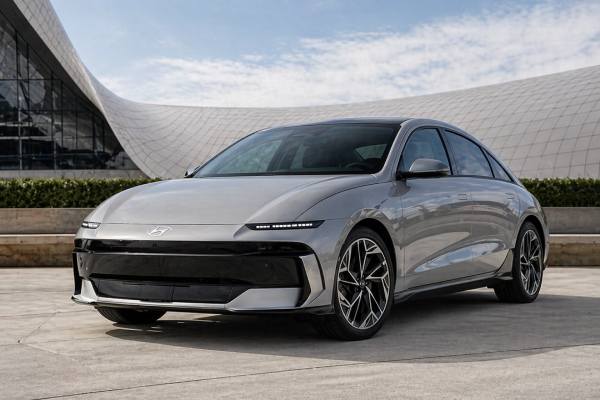

The facelift-era Hyundai IONIQ 6 CE with the 125 kW rear motor is the calmer, more efficiency-focused side of Hyundai’s streamlined electric sedan. It is not the headline-grabbing version, but for many owners it may be the sweet spot. You still get the low-drag body, long 2,950 mm wheelbase, 800-volt E-GMP architecture, and very fast DC charging potential, but with a lower entry price and lower energy use than the bigger-battery cars. In everyday driving, that makes this version more interesting than its modest 170 hp output suggests.
What stands out is how well the engineering priorities line up. The rear-drive layout keeps the steering clean, the slippery shape helps real motorway efficiency, and Hyundai’s charging system remains one of the strongest in the class. The main ownership caveat is not the motor itself, but platform-related recall history and the need to confirm software and electrical updates on early cars. For buyers who want a practical EV sedan rather than a numbers exercise, this IONIQ 6 deserves serious attention.
Fast Facts
- This 63.0 kWh rear-drive version is one of the most efficient large EV sedans on sale.
- The 800-volt system can make public rapid charging much quicker than many direct rivals.
- Ride comfort and highway stability are stronger points than outright straight-line pace.
- Check for completed ICCU, charge-port, and seat-belt campaign work on early stock or used cars.
- A sensible ownership rhythm is a 15,000 km or 12-month inspection, with cabin filter and broader checks at 30,000 km or 24 months.
Navigate this guide
- Hyundai IONIQ 6 CE essentials
- Hyundai IONIQ 6 CE specifications
- Hyundai IONIQ 6 CE trims and safety
- Reliability, faults and recalls
- Maintenance and buying advice
- On-road range and pace
- IONIQ 6 CE versus rivals
Hyundai IONIQ 6 CE essentials
The 125 kW Hyundai IONIQ 6 CE facelift is the range-minded version of Hyundai’s aerodynamic electric four-door. In facelift form, Hyundai sharpened the styling, refined the trim structure, and expanded the powertrain spread so the car now reaches more buyers without losing the technical identity that made the original IONIQ 6 stand out. That identity is still clear: a very slippery body, a low floor-mounted battery, rear-wheel drive in this configuration, and an 800-volt electrical system that is still unusual at this price point.
In this 170 hp form, the IONIQ 6 is not about shock acceleration. Hyundai quotes 0–100 km/h in 8.3 seconds, which is brisk rather than dramatic. The bigger story is efficiency. With 18-inch wheels and the 63.0 kWh battery, this version posts an official WLTP energy figure of 13.4 kWh/100 km and a WLTP range up to 521 km. That is a very strong result for a car this long. The drag coefficient remains a major part of the story, and it is one reason this car generally makes better use of each kilowatt-hour than many boxier EVs.
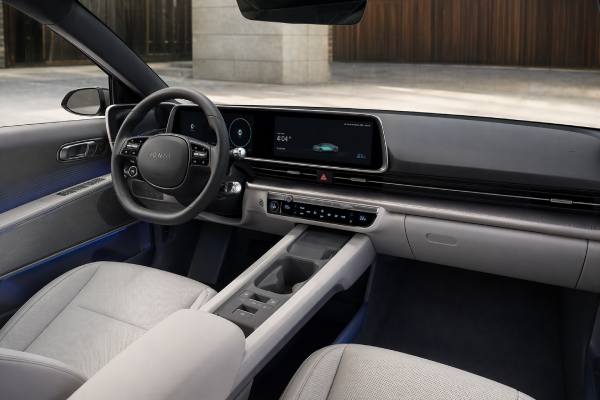
The ownership appeal is also broader than the spec sheet first suggests. The long wheelbase brings strong rear legroom, while the cabin layout feels more like a midsize executive car than a compact liftback rival. Hyundai’s latest software and charging logic help too. The facelift-era car adds improved connectivity, smarter route and charge support, and better battery preconditioning integration for fast charging in colder weather. In daily use, those details matter more than an extra half-second in an acceleration test.
This version is especially easy to recommend for drivers who do a mix of urban commuting and longer motorway runs. Around town, the rear motor is smooth and quiet, one-pedal driving is easy to learn, and the car feels balanced rather than nose-heavy. On the motorway, the low-slung shape and long chassis make it stable and calm. That balance is what gives the 125 kW IONIQ 6 its character. It is not the enthusiast’s pick in the range, but it may be the rational buyer’s pick.
The main caution is that the facelift does not erase the wider E-GMP platform history. Buyers should still check campaign completion, 12 V charging health, and software status carefully. Do that, and this version looks like one of the most convincing long-distance electric sedans for owners who care more about usable efficiency, charging speed, and comfort than about maximum output.
Hyundai IONIQ 6 CE specifications
Powertrain and battery
| Specification | Value |
|---|---|
| Motor type | Permanent-magnet synchronous motor |
| Motor layout | Single motor, rear axle |
| Drive type | Rear-wheel drive |
| Max power | 170 hp (125 kW) |
| Max torque | 350 Nm |
| System voltage | 800 V |
| Battery chemistry | Lithium-ion, NMC cathode |
| Battery gross capacity | 63.0 kWh |
| Battery usable capacity | 60.0 kWh |
| Battery layout | Floor-mounted traction battery |
| Transmission | Single-speed reduction gear |
| Vehicle-to-load | Yes, up to 3.6 kW |
Charging and efficiency
| Specification | Value |
|---|---|
| Official test cycle | WLTP |
| Rated efficiency | 13.4 kWh/100 km |
| Rated range | 521 km |
| Real-world mixed efficiency | 14.3 kWh/100 km |
| Real-world mixed range | 420 km |
| AC connector | Type 2 |
| DC connector | CCS2 |
| Charging port location | Right rear |
| AC charging phases | 3-phase |
| Onboard AC charger | 11.0 kW |
| DC fast-charge peak | 195 kW |
| Typical DC 10–80% average | 150 kW |
| DC 10–80% time | 18 min |
| AC 0–100% time | 6 h 30 min |
| Plug and Charge | Yes |
| Battery preconditioning | Yes, automatic with charger routing |
| Heat pump | Optional on lower trims, standard on higher European trims |
Performance and dimensions
| Specification | Value |
|---|---|
| 0–100 km/h | 8.3 s |
| Top speed | 185 km/h |
| Length | 4,925 mm |
| Width | 1,880 mm |
| Height | 1,495 mm |
| Wheelbase | 2,950 mm |
| Ground clearance | 141 mm |
| Turning circle | 11.8 m |
| Kerb weight | 1,892 kg |
| GVWR | 2,330 kg |
| Payload | 438 kg |
| Towing capacity, braked | 750 kg |
| Towing capacity, unbraked | 750 kg |
| Cargo volume, rear | 401 L |
| Front trunk | 45 L |
| Wheels and tyres | 225/55 R18 |
| Brakes | Disc front and rear |
Safety and service data
| Specification | Value |
|---|---|
| Euro NCAP rating | 5 stars |
| Euro NCAP adult occupant | 97% |
| Euro NCAP child occupant | 87% |
| Euro NCAP vulnerable road users | 66% |
| Euro NCAP safety assist | 90% |
| IIHS status | Top Safety Pick+ |
| IIHS headlight rating | Acceptable |
| Standard airbags | Front, side, curtain, and front-centre |
| Child-seat provision | ISOFIX outer rear seats with top tether |
| Wheel fastener torque | 108–127 Nm |
| Vehicle warranty | 5 years |
| High-voltage battery warranty | 8 years or 160,000 km |
| Battery retention threshold | 70% state of health |
Hyundai IONIQ 6 CE trims and safety
For the facelift-era European lineup, the 125 kW rear-drive car sits at the lower end of the range, but Hyundai did not strip it into irrelevance. In Germany, the basic ladder starts with the regular IONIQ 6 trim, then moves through CENTRIQ, N Line, and UNIQ. For this specific 63.0 kWh and 170 hp powertrain, the important takeaway is that the entry version still brings the core digital cabin and main active-safety backbone, while the higher trims add comfort, convenience, and stronger assistance features rather than transforming the car mechanically.
The base IONIQ 6 trim already includes dual 12.3-inch displays, navigation, Bluelink connectivity, adaptive cruise control, lane-centering support, forward collision avoidance, rear-view camera, and battery preconditioning. That matters because it means the cheapest version is still a properly modern long-distance EV. CENTRIQ is the trim many buyers will want if budget allows. It adds key ownership-friendly equipment such as a heat pump, matrix LED headlights, upgraded assistance hardware, wireless charging, powered front seats, and heated outer rear seats. In cold climates, that heat pump alone can justify the step up.
N Line is more about appearance and wheel package than efficiency. It adds the sharper body treatment and typically larger wheels, which improve stance but usually work against range and ride softness. UNIQ is the luxury-tech trim with the fuller feature count: Bose audio, surround camera, remote smart parking, blind-spot view support, head-up display, digital key functions, and more upscale seat trim and ventilation. If you want the car’s complete equipment set, UNIQ is the destination. If you want the best efficiency-to-price balance, CENTRIQ is the smarter target.
Quick identifiers are fairly easy. N Line cars have the sportier bumper treatment and larger wheels. UNIQ cars are the ones more likely to show the head-up display, 360-degree camera views, Bose branding, and more premium seat finish. CENTRIQ often lands in the middle visually but carries the practical ownership upgrades that matter most over time.
Safety remains one of the IONIQ 6’s strongest assets. Euro NCAP gave the CE platform a five-star result with very high adult occupant and safety-assist scores, while the IIHS rated the North American car as a Top Safety Pick+ and noted improved rear-seat belt performance on later model years. The car’s airbag coverage is generous, including a front-centre airbag to reduce occupant interaction in side impacts. Rear ISOFIX points are present, and the standard electronic safety stack is broad.
ADAS coverage is strong but calibration-sensitive. Depending on trim and market, the car can carry adaptive cruise control, lane-keeping and lane-following assist, blind-spot monitoring, rear cross-traffic alert, traffic-sign recognition, parking collision avoidance, and more advanced highway assist functions. After windscreen replacement, front bumper work, mirror replacement, or rear bumper repair, proper camera and radar calibration matters. A used example with poor panel alignment or undocumented body repair deserves extra caution because the IONIQ 6 relies heavily on those sensors for its polished driver-assistance behavior.
Reliability, faults and recalls
The facelift-era 125 kW IONIQ 6 is still too new for a deep, model-specific failure map, so the best way to judge it is through the wider CE and E-GMP platform record. The good news is that the battery and motor package do not currently look like chronic weak points. The bigger ownership story sits in the electrical support hardware, software, and campaign history. In other words, this is not a car that looks inherently fragile, but it is one that rewards careful VIN-level verification.
Here is the practical issue map.
- Common, medium to high cost — ICCU and 12 V charging faults.
Symptoms can include warning messages, loss of 12 V charging, repeated flat auxiliary battery episodes, or eventual reduced-power operation. The likely root issue is failure within the integrated charging control unit or the related fuse path. On affected cars, the official remedy has been software update first, plus inspection and replacement of the ICCU assembly and fuse where needed. This is the most important campaign history item to confirm. - Occasional, low to medium cost — charge-port door and outer panel issues.
Loose-feeling outer trim, poor latch engagement, or an odd gap around the charge-port door can point to the known attachment issue on some cars. The remedy is straightforward compared with the ICCU problem, but it is still worth checking because water sealing and repeat usability matter on an EV. - Occasional, medium cost — software and charging-behavior complaints.
Some owner frustrations on this platform have been solved by software rather than hardware: charging logic, phantom alerts, 12 V management, thermal control behavior, and driver-assistance niggles. On a car like this, a dealer printout showing campaign and software completion is almost as valuable as a stamped service book. - Occasional, low to medium cost — brake corrosion and friction-brake neglect.
Strong regenerative braking means the mechanical brakes may not work hard enough in normal use. That can lead to rusty discs, rough surfaces, and grabby or noisy braking if the car is driven mostly in gentle commuting. It is usually manageable with periodic brake cleaning and more deliberate friction-brake use. - Rare, high cost — moisture or isolation faults in high-voltage hardware.
These are not the dominant pattern, but any EV can suffer from water ingress at connectors, charge hardware, or junction points. Warning lights, charging refusal, or limp-home behavior need proper high-voltage diagnostics, not guesswork. - Rare, medium cost — drive-unit whine, wheel-bearing hum, or rear-axle noises.
There is not yet a strong facelift-specific pattern here, but test drives should still include a quiet-surface listen for bearing drone, reduction-gear whine, or low-speed clunks from suspension links and mounts.
Battery durability looks promising so far. Hyundai backs the high-voltage battery for 8 years or 160,000 km to 70% state of health, and there is no broad evidence at this stage that the 63.0 kWh pack is unusually degradation-prone. The main risk factors remain the expected ones: frequent high-speed driving, repeated hot-weather fast charging, and poor thermal management care. That is a much calmer picture than many buyers fear.
For recalls and service actions, the headline checks are clear: ICCU campaign status, charge-port door repair status, and front seat-belt anchor campaign status on applicable production cars. Ask for dealer records, then run an official VIN check. On a modern EV, unresolved campaigns are not a minor paperwork issue. They directly affect charging reliability, electrical stability, and safety confidence.
Maintenance and buying advice
Although the IONIQ 6 is mechanically simpler than a combustion car, it still rewards a disciplined service routine. The core idea is straightforward: inspect often, replace fluids and filters on time, and do not let regenerative braking trick you into ignoring the conventional brake hardware. A practical schedule for this platform looks like this.
| Item | Practical interval |
|---|---|
| General inspection and software check | Every 15,000 km or 12 months |
| 12 V battery test | Every 15,000 km or 12 months |
| Tyre rotation | Every 10,000–15,000 km or 6–12 months |
| Wheel alignment check | At least every 10,000–15,000 km, or sooner if wear appears |
| Brake pads, discs, lines, and parking brake inspection | Every 15,000–30,000 km or 12–24 months |
| Cabin air filter | Every 30,000 km or 24 months |
| Suspension and steering inspection | Every 30,000 km or 24 months |
| Cooling-system inspection | Every 30,000 km or 24 months |
| Air-conditioning and heat-pump inspection | Every 30,000 km or 24 months |
| Battery coolant replacement | Long-life service item, often around 195,000 km or 10 years depending on market schedule |
| Reduction-gear oil inspection | Every 30,000 km or 24 months |
For ownership decisions, a few specs matter more than they seem. Brake fluid should be DOT 4 LV. Wheel fastener torque is 108–127 Nm. If reduction-gear fluid service becomes necessary, using the correct Hyundai-spec fluid matters more than improvising with a near match. On this kind of EV, the service quality matters as much as the service interval.
Severe use also changes the picture. Frequent DC fast charging, repeated motorway running at high speed, mountain driving, towing, and very cold or very hot climates all justify shorter inspection habits, especially for tyres, brakes, alignment, 12 V health, and cooling-system condition. Even when the factory schedule looks relaxed, a hard-used EV benefits from a more active owner.
For used or nearly new buyers, this is the checklist that matters most:
- Ask for a battery state-of-health report and any record of high-voltage repair, module work, or pack replacement.
- Confirm ICCU, charge-port, and seat-belt campaign completion by VIN, not by seller promise.
- Test AC and DC charging, not just home charging. A public rapid-charge session can reveal more than a static inspection.
- Inspect the charge-port door, latch, surrounding panel fit, and seal condition carefully.
- Listen for rear drive-unit whine, wheel-bearing hum, and suspension knocks on a long test drive.
- Check brake disc surfaces for rust ridging or uneven use, especially on lightly driven cars.
- Verify heat-pump fitment if winter efficiency matters to you.
- Confirm that all keys, charging cables, app functions, and driver-assistance systems work as they should.
The best versions to seek depend on priorities. For efficiency and value, the 63 kWh car on 18-inch wheels is the one to chase, ideally with the heat pump. For equipment, CENTRIQ is the sweet spot. UNIQ is the luxury choice. N Line is the style pick, but it is rarely the smartest range pick. Long term, the outlook is good rather than perfect: battery life should be solid, routine costs should stay modest, and the main expensive risk remains electrical support hardware rather than the traction motor or battery cells themselves.
On-road range and pace
The 125 kW rear-drive IONIQ 6 is a good example of why headline power figures do not tell the whole story in an EV. It steps away cleanly, delivers its torque smoothly, and feels eager enough in city traffic. It is not fast in the way a dual-motor EV is fast, but it never feels strained in normal use. The rear-drive layout also helps the car feel tidy and natural when pulling out of junctions or feeding power in on wet roads.
Ride quality is one of its stronger everyday traits, especially on the smaller wheel package. The battery mass sits low, so the body stays controlled without feeling stiff, and the long wheelbase gives the car an easy motorway stride. Straight-line stability is excellent. Steering is accurate and calm, though not especially rich in feedback. That suits the car’s mission. Hyundai has aimed this version more at comfort and efficiency than at sportiness, and the engineering choices reflect that. On 18-inch tyres, road noise stays well contained. On larger wheels, the cabin is still refined, but the balance shifts a little toward style over softness.
Braking feel is generally good for a modern EV. Hyundai’s regenerative system offers enough adjustment to suit different drivers, and i-Pedal style operation is easy to adapt to in traffic. The handoff between regeneration and friction braking is smoother than on many older EVs, though it still pays to use the mechanical brakes deliberately from time to time to keep them clean.
Real-world energy use is where this version earns its place. A mixed-use figure around 14.3 kWh/100 km and a real range near 420 km are strong numbers for a large sedan. In mild weather at steady highway speeds around 110 km/h, around 15.0 kWh/100 km and about 400 km are realistic. In cold highway use, that can move closer to 20.0 kWh/100 km and about 300 km. Around town, especially in moderate temperatures, the car can beat its mixed-use average thanks to efficient regen and the slippery shape. A true 120 km/h motorway cruise will trim that range further, but the IONIQ 6 still tends to hold up better than bluff-bodied rivals.
Charging remains a major strength. At home, the 11 kW onboard charger makes overnight charging easy, with a full AC refill taking roughly 6 hours 30 minutes in ideal three-phase conditions. On DC power, the official 18-minute 10–80% figure is genuinely competitive, not just marketing noise, provided the battery is warm and the charger is strong enough. Preconditioning matters here. Start cold, and the advantage shrinks. Start warm with navigation-led preconditioning active, and the car behaves like one of the quicker long-distance chargers in the class.
With passengers and luggage, the IONIQ 6 stays composed rather than floaty, and it does not feel underpowered unless you expect sport-sedan pace. For drivers who care about relaxed speed, low energy use, and easy long-trip charging, that makes the 170 hp version more satisfying than its modest output figure first suggests.
IONIQ 6 CE versus rivals
The IONIQ 6 CE 63 kWh rear-drive model sits in an interesting place because it does not try to win every category. Instead, it combines several strong ones: efficiency, charging speed, comfort, and cabin space. That makes it easy to understand against its main alternatives.
The closest rival in spirit is the Tesla Model 3 RWD. Tesla still tends to lead on software integration, route planning polish, and outright efficiency, and in many markets it is also the cheaper buy. It is quicker too. But the Hyundai answers with a more distinctive cabin atmosphere, stronger seat comfort for many drivers, and a charging architecture that can be very impressive when conditions line up. If you want the most mature public-charging ecosystem and the sharpest software feel, the Tesla stays tempting. If you want a calmer motorway car with a more individual design and very strong rapid-charging potential, the Hyundai makes a real case.
Against the Polestar 2 Standard Range Single Motor, the IONIQ 6 feels more aerodynamic and more relaxed. The Polestar has a more upright hatchback shape and a more overtly premium, Scandinavian character. It also feels punchier. But the Hyundai usually travels farther on a charge from a similar-size battery and tends to recharge more aggressively. For buyers who prize hatchback practicality and a denser, heavier feel, the Polestar works. For buyers who want a lighter energy footprint and stronger motorway efficiency, the Hyundai is the smarter sedan.
The BMW i4 eDrive35 is the more premium and more expensive answer. It has the stronger badge pull, a richer interior finish, and more of the traditional sport-sedan polish that many BMW buyers expect. But it is usually pricier to buy, and the Hyundai counters with better rear-seat packaging, a more future-facing EV platform layout, and lower energy use for the performance on offer. The BMW wins on brand and driver appeal. The Hyundai wins on value and engineering efficiency.
Then there is the Volkswagen ID.7 Pro, which is roomier still and often the better choice for buyers who want a larger fastback family EV. But it is also a bigger, heavier, more expensive car. The IONIQ 6 feels more aerodynamic, more distinctive, and easier to place in daily traffic.
That is the key to the IONIQ 6 CE’s position. It is not the fastest rival, the cheapest rival, or the most overtly premium rival. It is the one that blends very low consumption, rapid charging, strong long-distance manners, and a genuinely spacious cabin into a package that feels more thought-through than many competitors. For the buyer who values that balance, especially in 63 kWh rear-drive form, it is one of the most convincing EV sedans in the class.
References
- The new Hyundai IONIQ 6 2025
- Euro NCAP | Hyundai IONIQ 6 2022 (Safety Rating)
- 2025 Hyundai Ioniq 6 2025 (Safety Rating)
- Part 573 Safety Recall Report 24V-868 2024 (Recall Database)
- IONIQ 6 2023 Owner Manual.pdf 2023 (Owner’s Manual)
Disclaimer
This article is for informational purposes only and is not a substitute for professional diagnosis, repair, or model-specific technical advice. Specifications, torque values, service intervals, charging data, and procedures can vary by VIN, market, model year, trim, software version, and equipment level, so always verify critical details against the correct official service documentation for the exact vehicle.
If this guide helped you, please consider sharing it on Facebook, X, or your preferred social platform to support our work.