
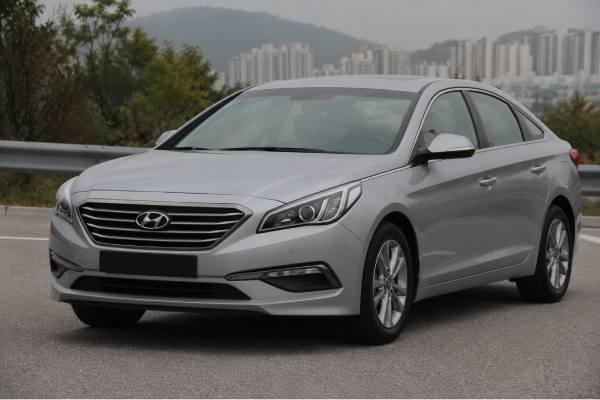
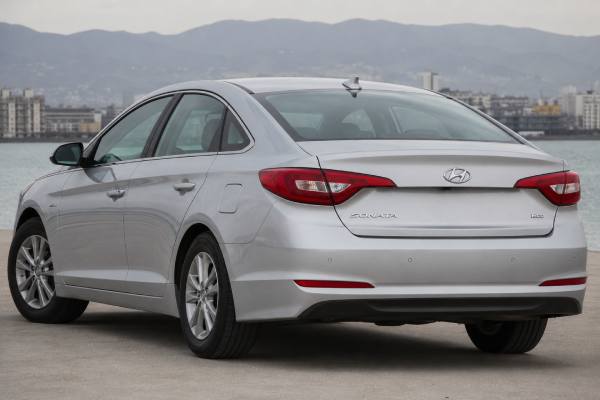
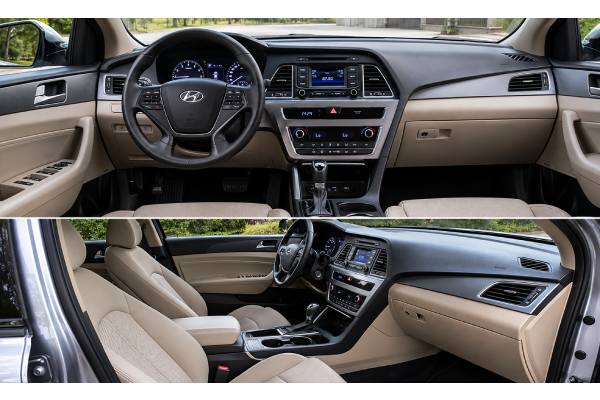
The 2015–2017 Hyundai Sonata LF 2.0T is the performance-focused version of Hyundai’s seventh-generation midsize sedan. It pairs a 245 hp turbocharged 2.0-liter Theta II GDI engine with a 6-speed automatic transmission, front-wheel drive, larger front brakes, sport-tuned suspension, and 18-inch wheels on Sport 2.0T models.
For buyers, the appeal is clear: it offers strong torque, a roomy cabin, a large trunk, good crash-test performance, and lower used prices than many equivalent Honda, Toyota, Mazda, and Ford rivals. The main caution is ownership risk around the Theta II GDI engine family, especially bearing-related campaigns, oil level discipline, and proof that recalls and software updates have been completed.
Owner Snapshot
- Strong mid-range torque makes the 2.0T easier to drive quickly than the regular 2.4 GDI Sonata.
- The LF body is spacious, quiet, and practical, with a 462 L / 16.3 ft³ trunk.
- Sport 2.0T models get larger front brakes, 235/45R18 tires, and a more direct steering rack.
- Confirm Theta GDI engine campaign completion, oil history, and any P1326-related repair records before buying.
- For the 2.0 T-GDI, Hyundai’s normal schedule lists the first oil service at 5,000 km / 6 months, then every 8,000 km / 6 months; severe use can shorten this to 5,000 km / 3 months.
Table of Contents
- Sonata LF 2.0T Character
- Sonata LF 2.0T Technical Specs
- Sonata LF 2.0T Trim And Safety
- Reliability Issues And Campaigns
- Maintenance And Buying Advice
- Road Manners And Performance
- Compared With Midsize Rivals
Sonata LF 2.0T Character
The LF Sonata marked Hyundai’s move away from the dramatic styling of the previous YF generation toward a more mature, quieter, and more structurally refined midsize sedan. In 2.0T form, the car was not a full sport sedan in the rear-drive German sense, but it was the quickest and most performance-oriented conventional gasoline Sonata sold in this generation before the 2018 refresh.
The covered version is the 2015–2017 Sonata LF with the Theta II 2.0-liter turbocharged gasoline direct-injection engine rated at 245 hp and 260 lb-ft. It uses front-wheel drive and a conventional 6-speed torque-converter automatic. The later 2018 facelift kept the same rated output but moved to an 8-speed automatic and revised styling, so it belongs outside this specific 2015–2017 scope.
In daily use, the 2.0T’s biggest advantage is torque. Peak torque arrives from low rpm, which makes the car feel relaxed in traffic, confident on highway ramps, and stronger than the naturally aspirated 2.4 GDI when loaded with passengers. It is not a high-revving engine that begs to be pushed to redline; it works best as a broad, low-to-mid-rpm turbo motor.
The LF platform also gives the 2.0T a practical foundation. The cabin is wide, the rear seat is adult-friendly, and the trunk is large for the class. Noise isolation is good, and the chassis feels more solid than older Sonatas. Sport 2.0T models add 18-inch wheels, larger front brakes, specific suspension tuning, paddle shifters, and exterior details that make them easier to identify.
The important ownership trade-off is reliability. The 2.0T uses Hyundai’s Theta II GDI family, and this engine family has been involved in engine-bearing campaigns and related inspection procedures. A good Sonata 2.0T can be a satisfying used sedan, but only if it has strong service records, clean oil-change history, no signs of neglect, and completed recalls or service campaigns.
For most used buyers, the best example is not simply the lowest-mileage car. It is the one with documented oil changes, no abnormal cold-start knock, no turbo or oil-feed leaks, no unresolved warning lights, and proof that Hyundai campaign work has been checked by VIN.
Sonata LF 2.0T Technical Specs
Figures below focus on the 2015–2017 Hyundai Sonata LF 2.0T gasoline model. Some values vary by market, trim, wheel package, equipment, and production date, so VIN-specific service data should be used for repair work.
Powertrain and Efficiency
| Item | Hyundai Sonata LF 2.0T |
|---|---|
| Engine code | Theta II 2.0 T-GDI, commonly identified as G4KH; confirm by VIN and engine stamp |
| Layout | Inline-4 gasoline, aluminum block and head, DOHC D-CVVT, 4 valves per cylinder |
| Bore × stroke | 86.0 × 86.0 mm / 3.39 × 3.39 in |
| Displacement | 2.0 L / 1,998 cc |
| Induction | Twin-scroll turbocharger with intercooling |
| Fuel system | Gasoline direct injection |
| Compression ratio | 10.0:1 |
| Maximum power | 245 hp / 183 kW @ 6,000 rpm |
| Maximum torque | 353 Nm / 260 lb-ft @ 1,350–4,000 rpm |
| Timing drive | Chain |
| Rated efficiency | 23 / 32 / 26 mpg US city/highway/combined; about 10.2 / 7.4 / 9.0 L/100 km; about 27.6 / 38.4 / 31.2 mpg UK |
| Real-world highway at 120 km/h / 75 mph | Typically about 7.8–9.4 L/100 km / 25–30 mpg US / 30–36 mpg UK depending on tires, wind, load, terrain, and temperature |
Transmission, Chassis, and Dimensions
| Item | Specification |
|---|---|
| Transmission | 6-speed electronic automatic with torque converter, lock-up, and SHIFTRONIC manual mode |
| Drive type | Front-wheel drive |
| Differential | Open front differential with traction and stability control |
| Front suspension | MacPherson strut, gas-charged dampers, 24 mm stabilizer bar on 2.0T |
| Rear suspension | Independent multi-link, coil springs, sport tuning on 2.0T, 18 mm stabilizer bar |
| Steering | Motor-driven power steering, rack-and-pinion; 2.0T uses a dual-pinion rack-mounted design; 14.3:1 ratio |
| Brakes | Front 320 mm / 12.6 in ventilated discs; rear 284 mm / 11.2 in solid discs |
| Popular tire size | 235/45R18 on 18 × 7.5 in Sport 2.0T wheels |
| Ground clearance | About 135 mm / 5.3 in |
| Length / width / height | About 4,855 mm / 1,865 mm / 1,475 mm; 191.1 in / 73.4 in / 58.1 in |
| Wheelbase | 2,805 mm / 110.4 in |
| Turning circle | 10.9 m / 35.8 ft curb-to-curb |
| Curb weight | Approximately 1,590–1,640 kg / 3,505–3,616 lb depending on trim and equipment |
| GVWR | About 2,100 kg / 4,630 lb for 2.0 T-GDI models in some markets |
| Fuel tank | 70 L / 18.5 US gal / 15.4 UK gal |
| Cargo volume | 462 L / 16.3 ft³, sedan trunk, SAE-style published volume |
Performance, Service Capacities, and Safety
| Item | Figure or specification |
|---|---|
| 0–100 km/h / 0–62 mph | Typically about 7.5–8.0 seconds depending on test conditions and launch |
| 0–60 mph | Independent tests commonly place healthy cars around the low-to-mid 7-second range |
| Top speed | Approximately 210 km/h / 130 mph where electronically limited; market data can vary |
| Braking distance | About 38 m / 125 ft from 60 mph in some independent testing; tire condition matters greatly |
| Towing capacity | Not recommended by Hyundai for this application |
| Payload | Varies by certification label; calculate from the door-jamb payload label on the individual car |
| Engine oil | ACEA A5 or above; 5W-30 or 5W-40 shown for 2.0 T-GDI temperature range; 4.8 L / 5.07 US qt drain and refill |
| Coolant | Ethylene-glycol coolant for aluminum radiator, mixed with water; about 7.5 L / 7.92 US qt |
| Automatic transmission fluid | Hyundai Genuine ATF SP-IV or equivalent listed SP-IV fluid; total listed capacity about 7.1 L / 7.50 US qt |
| Brake fluid | FMVSS116 DOT 3 or DOT 4; about 0.7–0.8 L / 0.7–0.8 US qt |
| A/C refrigerant | R-134a; 525 ± 20 g / 18.5 ± 0.7 oz for 2.0 T-GDI |
| A/C compressor oil | PAG ND-OIL8; 80 ± 10 mL / 2.82 ± 0.35 fl oz |
| Key torque value | Wheel lug nuts: 88–107 Nm / 65–79 lb-ft |
| IIHS crash ratings | 2016–2017 models earned Good ratings in major crashworthiness categories when equipped and built under the tested conditions; 2017 was a Top Safety Pick with optional front crash prevention |
| IIHS headlight rating | Poor for tested 2016–2017 headlight configurations |
| ADAS availability | Blind-spot detection and lane-departure warning optional on many trims; forward-collision technology availability depends heavily on trim and package |
Sonata LF 2.0T Trim And Safety
The 2.0T was not simply an engine option dropped into every Sonata trim. In North America, it was mainly associated with Sport 2.0T and Limited 2.0T versions, with equipment and package names varying by model year and market.
Sport 2.0T is usually the most driver-focused version. It is the easiest to recognize by its 18-inch wheels, sportier exterior trim, rear diffuser-style lower bumper treatment, quad exhaust outlets, sport seats, paddle shifters, and unique suspension tuning. It normally gives buyers the best blend of performance character and value.
Limited 2.0T is more comfort- and technology-oriented. Depending on year and package, it may add leather upholstery, ventilation for the front seats, upgraded audio, navigation, a panoramic sunroof, HID headlights, automatic high-beam-related equipment in some packages, adaptive cruise control, and forward-collision-related features. A Limited 2.0T can be the better choice for commuting comfort, but the extra equipment also means more electrical features to test before buying.
Year-to-year changes are mostly equipment-related rather than mechanical for this 2015–2017 2.0T group. The broad powertrain layout remained a 245 hp 2.0 T-GDI with a 6-speed automatic. The biggest structural safety distinction is build date: IIHS notes improvements for 2016 models built after October 2015 that affected small-overlap crash performance. When comparing a 2015, an early 2016, and a later 2016–2017 car, the later build can be preferable from a safety-rating standpoint.
Safety equipment includes front airbags, front seat-mounted side airbags, side-curtain airbags, a driver knee airbag on many U.S.-market cars, anti-lock brakes, electronic brake-force distribution, brake assist, traction control, electronic stability control, and tire-pressure monitoring. Rear child-seat provisions include two complete LATCH positions and a center tether provision, but IIHS rated LATCH ease of use as Marginal.
ADAS availability is package-sensitive. Blind-spot detection and rear cross-traffic alert are common on better-equipped trims. Lane-departure warning and forward-collision warning were available on some upper packages, while more advanced automatic braking capability became more relevant on later 2016 and 2017 cars with optional front crash prevention. After windshield replacement, bumper work, alignment changes, or front-end repair, any camera or radar-based system should be checked and calibrated according to Hyundai service procedures.
For used buyers, trim identification should include more than badges. Check the tire size, wheel style, front brake size, seat trim, steering-wheel paddles, infotainment unit, sunroof type, and driver-assistance controls. The VIN build sheet or dealer service printout is the cleanest way to confirm factory equipment.
Reliability Issues And Campaigns
The Sonata LF 2.0T can cover high mileage, but it is not a car to buy casually without records. Its most important reliability topic is the Theta II GDI engine family. The concern is not that every engine fails; it is that engine condition, oil history, recall completion, and early symptom recognition matter more here than on many less-stressed midsize sedans.
| Area | Prevalence | Severity / cost | Typical symptoms | Best response |
|---|---|---|---|---|
| Theta II bearing wear / P1326 campaign path | Known issue family-wide; VIN-specific | High | Knock, check-engine light, reduced power, DTC P1326, oil-pressure warning | Stop driving, scan codes, check campaign status, request dealer inspection records |
| Oil consumption or low oil level | Occasional to common on neglected cars | Medium to high | Low dipstick level, ticking, oil top-ups between changes, smoke under load | Monitor every 1,000 km / 600 miles, document use, inspect PCV and leaks |
| Turbo and charge-air leaks | Occasional | Medium | Low boost, hiss, sluggish acceleration, oily charge pipes | Pressure-test intake tract, inspect intercooler hoses and clamps |
| Direct-injection carbon deposits | Occasional with age and short trips | Medium | Rough idle, misfire, hesitation, loss of response | Diagnose ignition and fuel first; consider intake-valve cleaning if confirmed |
| 6-speed automatic shift quality | Occasional | Medium | Harsh shifts, flare, delayed engagement, shudder | Check fluid history, software updates, mounts, and transmission adaptation |
| Suspension and steering wear | Common with mileage | Low to medium | Clunks, wandering, tire wear, vibration | Inspect control arms, ball joints, bushings, wheel bearings, alignment |
The official P1326-related service path is especially important. Hyundai service literature describes affected 2.0L Turbo and 2.4L GDI vehicles that may illuminate the check-engine light with DTC P1326, followed by inspection and either ECU software work or engine replacement depending on test results. For a buyer, the practical question is simple: has the VIN been checked, and are there records showing the result?
Other recalls and service actions can include software updates, lighting or signal logic, parking-brake indicator concerns, airbag-related actions, seat-belt items, trunk latch campaigns on some later related vehicles, and market-specific actions. Do not rely on a seller saying “all recalls were done.” Use the VIN through official Hyundai and NHTSA tools, then ask for dealer repair-order proof.
The 2.0T’s timing chain is not a scheduled replacement item like a belt, but it is not immune to wear. Listen for cold-start rattle, check for cam/crank correlation codes, and treat persistent chain, guide, or tensioner noise seriously. A healthy chain system should not rattle continuously after oil pressure builds.
Corrosion is usually not as severe as on older body-on-frame vehicles, but salted-climate cars still deserve a lift inspection. Check the rear subframe area, brake lines, fuel-line routing, suspension mounting points, rocker seams, underbody seams, wheel arches, and exhaust fasteners. Also inspect the panoramic sunroof drains on equipped cars, because blocked drains can create water intrusion that looks like an electrical issue.
A strong pre-purchase inspection should include a cold start, hot restart, road test under boost, scan of all modules, oil-level check before the seller warms the engine, visual inspection for leaks, turbo plumbing inspection, brake and tire assessment, and a service-record review. Walk away from cars with unexplained engine noise, fresh oil hiding a low-level habit, unresolved P1326 history, heavy smoke, or missing recall documentation.
Maintenance And Buying Advice
Maintenance is the difference between a Sonata 2.0T that feels like a smart used buy and one that becomes expensive quickly. The turbocharged direct-injection engine places more heat and oil-quality demand on the powertrain than the regular 2.4 GDI, so short oil intervals and correct fluids are worth more than cosmetic condition.
| Item | Practical interval | Notes |
|---|---|---|
| Engine oil and filter | First 5,000 km / 6 months, then 8,000 km / 6 months under normal schedule; 5,000 km / 3 months for severe use | Use correct ACEA A5-grade oil and check level often; many owners should treat short trips and city use as severe |
| Engine air filter | Inspect every service; replace as needed | Replace sooner in dusty areas |
| Cabin air filter | About every 12,000 km / 6 months, or as needed | More often in dusty or humid climates |
| Spark plugs | Inspect/replace around 72,000 km / 45,000 miles in the normal schedule pattern for 1.6 / 2.0 T-GDI | Use correct iridium plugs; misfires under boost can damage the catalytic converter |
| Fuel filter | Normally maintenance-free, inspect if symptoms occur | Replace if fuel restriction, hard starting, surging, or power loss is confirmed |
| Timing chain | No routine belt-style interval | Inspect if rattle, correlation faults, poor running, or oil-pressure concerns appear |
| Drive belt | Inspect first around 96,000 km / 72 months, then every 24,000 km / 24 months | Replace if cracked, glazed, noisy, or tension is poor |
| Coolant | First replacement around 192,000 km / 120 months, then every 48,000 km / 24 months | Use correct ethylene-glycol coolant and deionized or soft water |
| Automatic transmission fluid | No normal-service check required in some manuals; severe use lists 96,000 km | Many used-car specialists prefer periodic SP-IV drain-and-fill service if history is unknown |
| Brake fluid | Test regularly; replace about every 2–3 years in humid climates | Use DOT 3 or DOT 4; brake fluid absorbs moisture over time |
| Brake pads, rotors, calipers | Inspect at least every 12,000 km / 6 months | Check rear caliper operation, rotor corrosion, and parking-brake function |
| Tire rotation and alignment | Rotate every 8,000–12,000 km / 5,000–7,500 miles; align when wear appears | The 235/45R18 package is sensitive to poor alignment and cheap tires |
| 12 V battery | Test yearly after 3 years; replacement often around 4–6 years | Weak batteries can trigger misleading electronic faults |
Before buying, ask for proof of oil services, not just a verbal claim. A thick folder, dealer service printout, or digital service history is valuable. The ideal record shows oil changes at or before time limits, spark plugs replaced with correct parts, cooling-system work done with proper coolant, and any transmission service performed with SP-IV-compatible fluid.
During inspection, focus on these areas:
- Cold-start knock, rattle, or tapping that does not fade quickly.
- Oil level, oil smell, sludge under the filler cap, and signs of recent cleanup around leaks.
- Turbocharger oil lines, intercooler hoses, clamps, and boost pipes.
- Transmission engagement from Park to Drive and Reverse when cold and hot.
- Front brake pulsation, rear brake corrosion, and uneven pad wear.
- Tire brand, tire date codes, alignment wear, and bent 18-inch wheels.
- Panoramic sunroof operation, drain performance, and water marks in the headliner.
- Infotainment, backup camera, blind-spot warning, radar/camera warnings, and all steering-wheel controls.
The most desirable examples are later-build 2016 or 2017 cars with complete records and verified campaign completion. A 2015 can still be worth buying, especially at the right price, but it deserves closer scrutiny for early build issues and safety-rating distinctions. Sport 2.0T is the better value for drivers, while Limited 2.0T is better for comfort and equipment.
Avoid heavily modified cars, cars with unknown engine replacements, cars running rough under boost, and examples with mismatched cheap tires. Also be cautious with very low-priced 2.0Ts that have fresh oil, freshly cleared codes, or a seller unwilling to allow a cold-start inspection.
Long-term durability is best described as condition-dependent. A well-maintained Sonata 2.0T can be a comfortable, strong, and affordable sedan, but it is less forgiving of neglect than the simpler naturally aspirated alternatives in this class.
Road Manners And Performance
The Sonata LF 2.0T drives like a quick, refined midsize sedan rather than a sharp sport sedan. Its main strengths are torque, comfort, cabin quietness, and highway composure. It feels happiest covering distance at speed, passing slower traffic with little effort, and carrying people without feeling strained.
The 2.0T engine has a broad torque band that starts low in the rev range. Around town, this means the car can move briskly without high rpm. On the highway, the engine pulls cleanly when the transmission drops one or two gears. Turbo lag is present but not dramatic; the smaller, responsive turbo tuning gives usable boost earlier than the older, higher-output YF Sonata 2.0T.
The 6-speed automatic is generally smooth and conventional. It does not shift as quickly as a dual-clutch transmission, and it is not as efficient as the 2018 model’s later 8-speed automatic, but it suits the engine’s torque. In Eco mode, it can upshift early and feel reluctant to downshift. Normal mode is the best everyday setting. Sport mode sharpens throttle and shift behavior enough to make passing easier, though it does not transform the car into a performance sedan.
Ride quality depends heavily on tire choice. The 18-inch Sport 2.0T wheel package gives the car a more planted look and better steering response, but it also makes impacts sharper than the 17-inch versions. Good touring or grand-touring tires improve the Sonata dramatically. Cheap tires can make it louder, less precise, and worse in rain.
The 2.0T’s steering is one of the better LF Sonata setups because it uses a dual-pinion rack-mounted electric assist design. It is not rich in road feel, but it is more natural and accurate than many older Hyundai systems. Straight-line stability is good, and the car feels secure during fast highway travel.
Braking performance is helped by the larger 12.6-inch front discs. Pedal feel is easy to modulate in normal driving, and healthy cars stop confidently. As with any used sedan, brake performance depends on pad quality, rotor condition, tire grip, and fluid age. A pulsing pedal, steering-wheel shake, or long pedal travel should be treated as a reconditioning item, not “normal Sonata behavior.”
Real-world fuel economy is reasonable but not outstanding. Expect roughly 11–13 L/100 km / 18–21 mpg US in dense city driving, 7.8–9.4 L/100 km / 25–30 mpg US on steady highway runs, and about 9–10.5 L/100 km / 22–26 mpg US mixed. Cold weather, short trips, winter tires, remote start, and boost-heavy driving can all push consumption higher.
The Sonata 2.0T is not recommended for towing in this application. With passengers and luggage, it remains stable, but payload should be respected using the vehicle’s certification label. The engine has enough torque for loaded driving; the brakes, cooling system, tires, and transmission condition become the more important factors.
Compared With Midsize Rivals
The Sonata LF 2.0T competes with a strong midsize-sedan field. Its closest rivals include the Honda Accord 2.0T’s predecessor-era V6 and later turbo cars, Toyota Camry V6, Mazda 6 2.5, Ford Fusion 2.0 EcoBoost, Nissan Altima 3.5, Kia Optima SX 2.0T, and Chevrolet Malibu 2.0T.
| Rival | Where the Sonata 2.0T is strong | Where the rival may be better |
|---|---|---|
| Honda Accord | Often cheaper used, quieter, strong low-rpm torque | Accord usually has stronger resale value and a more polished driver reputation |
| Toyota Camry V6 | More modern turbo torque feel and often lower purchase price | Camry V6 is typically smoother and has a stronger long-term reliability image |
| Mazda 6 | More power and easier highway passing than non-turbo Mazda 6 models | Mazda 6 has sharper steering and more engaging handling |
| Ford Fusion 2.0 EcoBoost | Roomy cabin, strong equipment value, larger trunk | Fusion offered AWD on some versions; Sonata is FWD only |
| Kia Optima SX 2.0T | Similar powertrain with a more conservative Hyundai cabin feel | Optima may appeal more to buyers who prefer bolder styling |
| Chevrolet Malibu 2.0T | More rear-seat room in many comparisons and strong value | Malibu 2.0T can feel quicker in some versions and has a different ride/handling balance |
The Sonata’s strongest argument is value. It gives buyers turbocharged performance, a large cabin, a big trunk, good safety structure, and generous equipment for less money than many Japanese rivals. A clean Limited 2.0T can feel surprisingly upscale for the price, while a Sport 2.0T gives enough performance to make the regular 2.4 feel mild.
Its weakest argument is risk. Honda and Toyota rivals usually inspire more confidence among buyers who want minimal mechanical uncertainty. The Sonata 2.0T asks for more homework: VIN checks, campaign records, oil history, and careful engine inspection. Buyers who skip that process may save money upfront and lose it later.
Against the Mazda 6, the Sonata is less agile but more powerful. Against the Fusion EcoBoost, it lacks AWD but often feels simpler and roomier. Against the Kia Optima SX, the choice is mostly styling, equipment, and condition, because the two cars share much of their engineering background.
The best verdict is practical: buy the Sonata LF 2.0T because you want a comfortable, quick, well-equipped sedan at a good price, not because you want the lowest-risk midsize car possible. When the service history is strong, it is one of the more appealing used turbo sedans in its price band. When the history is weak, it is better to keep shopping.
References
- Specifications & Consumer information 2016 (Owner’s Manual)
- Maintenance 2016 (Owner’s Manual)
- 2017 Hyundai Sonata 2017 (Safety Rating)
- theta gdi engine dtc p1326 2020 (TSB)
- ENGINE 2015 (Manufacturer Specifications)
Disclaimer
This article is for informational purposes only and is not a substitute for professional diagnosis, repair advice, or official service documentation. Specifications, torque values, service intervals, procedures, recalls, software updates, and parts can vary by VIN, market, production date, and installed equipment. Always verify details against the official Hyundai service information for the exact vehicle before buying parts or performing maintenance.
If this guide helped you, please consider sharing it on Facebook, X/Twitter, or your preferred automotive community to support our work.